
FreshRSS

πŸ”’
❌ Secure Planet Training Courses Updated For 2019 - Click Here
There are new available articles, click to refresh the page.
Before yesterdayYour RSS feeds

Most Parked Domains Now Serving Malicious Content

Direct navigation β€” the act of visiting a website by manually typing a domain name in a web browser β€” has never been riskier: A new study finds the vast majority of β€œparked” domains β€” mostly expired or dormant domain names, or common misspellings of popular websites β€” are now configured to redirect visitors to sites that foist scams and malware.

A lookalike domain to the FBI Internet Crime Complaint Center website, returned a non-threatening parking page (left) whereas a mobile user was instantly directed to deceptive content in October 2025 (right). Image: Infoblox.

When Internet users try to visit expired domain names or accidentally navigate to a lookalike β€œtyposquatting” domain, they are typically brought to a placeholder page at a domain parking company that tries to monetize the wayward traffic by displaying links to a number of third-party websites that have paid to have their links shown.

A decade ago, ending up at one of these parked domains came with a relatively small chance of being redirected to a malicious destination: In 2014, researchers found (PDF) that parked domains redirected users to malicious sites less than five percent of the time β€” regardless of whether the visitor clicked on any links at the parked page.

But in a series of experiments over the past few months, researchers at the security firm Infoblox say they discovered the situation is now reversed, and that malicious content is by far the norm now for parked websites.

β€œIn large scale experiments, we found that over 90% of the time, visitors to a parked domain would be directed to illegal content, scams, scareware and anti-virus software subscriptions, or malware, as the β€˜click’ was sold from the parking company to advertisers, who often resold that traffic to yet another party,” Infoblox researchers wrote in a paper published today.

Infoblox found parked websites are benign if the visitor arrives at the site using a virtual private network (VPN), or else via a non-residential Internet address. For example, Scotiabank.com customers who accidentally mistype the domain as scotaibank[.]com will see a normal parking page if they’re using a VPN, but will be redirected to a site that tries to foist scams, malware or other unwanted content if coming from a residential IP address. Again, this redirect happens just by visiting the misspelled domain with a mobile device or desktop computer that is using a residential IP address.

According to Infoblox, the person or entity that owns scotaibank[.]com has a portfolio of nearly 3,000 lookalike domains, including gmai[.]com, which demonstrably has been configured with its own mail server for accepting incoming email messages. Meaning, if you send an email to a Gmail user and accidentally omit the β€œl” from β€œgmail.com,” that missive doesn’t just disappear into the ether or produce a bounce reply: It goes straight to these scammers. The report notices this domain also has been leveraged in multiple recent business email compromise campaigns, using a lure indicating a failed payment with trojan malware attached.

Infoblox found this particular domain holder (betrayed by a common DNS server β€” torresdns[.]com) has set up typosquatting domains targeting dozens of top Internet destinations, including Craigslist, YouTube, Google, Wikipedia, Netflix, TripAdvisor, Yahoo, eBay, and Microsoft. A defanged list of these typosquatting domains is available here (the dots in the listed domains have been replaced with commas).

David Brunsdon, a threat researcher at Infoblox, said the parked pages send visitors through a chain of redirects, all while profiling the visitor’s system using IP geolocation, device fingerprinting, and cookies to determine where to redirect domain visitors.

β€œIt was often a chain of redirects β€” one or two domains outside the parking company β€” before threat arrives,” Brunsdon said. β€œEach time in the handoff the device is profiled again and again, before being passed off to a malicious domain or else a decoy page like Amazon.com or Alibaba.com if they decide it’s not worth targeting.”

Brunsdon said domain parking services claim the search results they return on parked pages are designed to be relevant to their parked domains, but that almost none of this displayed content was related to the lookalike domain names they tested.
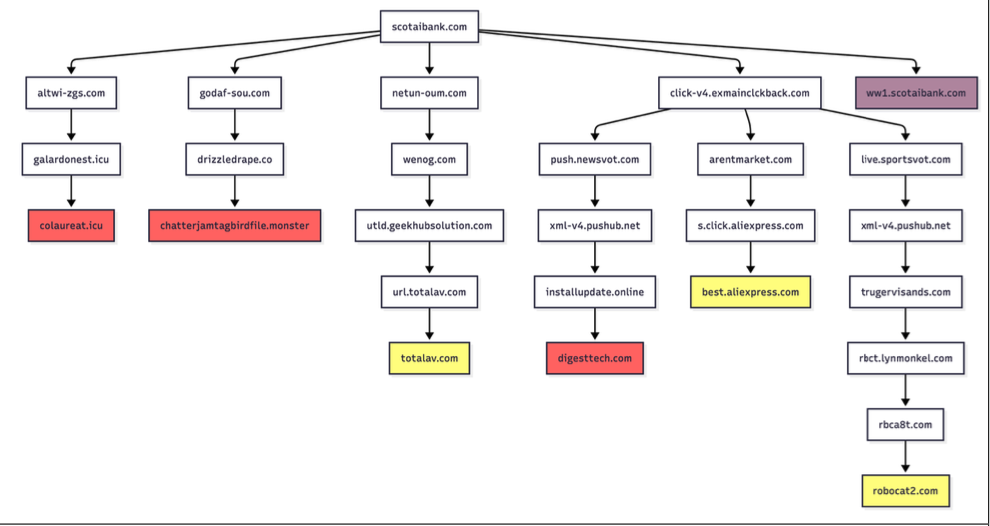
Samples of redirection paths when visiting scotaibank dot com. Each branch includes a series of domains observed, including the color-coded landing page. Image: Infoblox.

Infoblox said a different threat actor who owns domaincntrol[.]com β€” a domain that differs from GoDaddy’s name servers by a single character β€” has long taken advantage of typos in DNS configurations to drive users to malicious websites. In recent months, however, Infoblox discovered the malicious redirect only happens when the query for the misconfigured domain comes from a visitor who is using Cloudflare’s DNS resolvers (1.1.1.1), and that all other visitors will get a page that refuses to load.

The researchers found that even variations on well-known government domains are being targeted by malicious ad networks.

β€œWhen one of our researchers tried to report a crime to the FBI’s Internet Crime Complaint Center (IC3), they accidentally visited ic3[.]org instead of ic3[.]gov,” the report notes. β€œTheir phone was quickly redirected to a false β€˜Drive Subscription Expired’ page. They were lucky to receive a scam; based on what we’ve learnt, they could just as easily receive an information stealer or trojan malware.”

The Infoblox report emphasizes that the malicious activity they tracked is not attributed to any known party, noting that the domain parking or advertising platforms named in the study were not implicated in the malvertising they documented.

However, the report concludes that while the parking companies claim to only work with top advertisers, the traffic to these domains was frequently sold to affiliate networks, who often resold the traffic to the point where the final advertiser had no business relationship with the parking companies.

Infoblox also pointed out that recent policy changes by Google may have inadvertently increased the risk to users from direct search abuse. Brunsdon said Google Adsense previously defaulted to allowing their ads to be placed on parked pages, but that in early 2025 Google implemented a default setting that had their customers opt-out by default on presenting ads on parked domains β€” requiring the person running the ad to voluntarily go into their settings and turn on parking as a location.

The Stark Truth Behind the Resurgence of Russia’s Fin7

The Russia-based cybercrime group dubbed β€œFin7,” known for phishing and malware attacks that have cost victim organizations an estimated $3 billion in losses since 2013, was declared dead last year by U.S. authorities. But experts say Fin7 has roared back to life in 2024 β€” setting up thousands of websites mimicking a range of media and technology companies β€” with the help of Stark Industries Solutions, a sprawling hosting provider that is a persistent source of cyberattacks against enemies of Russia.

In May 2023, the U.S. attorney for Washington state declared β€œFin7 is an entity no more,” after prosecutors secured convictions and prison sentences against three men found to be high-level Fin7 hackers or managers. This was a bold declaration against a group that the U.S. Department of Justice described as a criminal enterprise with more than 70 people organized into distinct business units and teams.

The first signs of Fin7’s revival came in April 2024, when Blackberry wrote about an intrusion at a large automotive firm that began with malware served by a typosquatting attack targeting people searching for a popular free network scanning tool.

Now, researchers at security firm Silent Push say they have devised a way to map out Fin7’s rapidly regrowing cybercrime infrastructure, which includes more than 4,000 hosts that employ a range of exploits, from typosquatting and booby-trapped ads to malicious browser extensions and spearphishing domains.

Silent Push said it found Fin7 domains targeting or spoofing brands including American Express, Affinity Energy, Airtable, Alliant, Android Developer, Asana, Bitwarden, Bloomberg, Cisco (Webex), CNN, Costco, Dropbox, Grammarly, Google, Goto.com, Harvard, Lexis Nexis, Meta, Microsoft 365, Midjourney, Netflix, Paycor, Quickbooks, Quicken, Reuters, Regions Bank Onepass, RuPay, SAP (Ariba), Trezor, Twitter/X, Wall Street Journal, Westlaw, and Zoom, among others.

Zach Edwards, senior threat analyst at Silent Push, said many of the Fin7 domains are innocuous-looking websites for generic businesses that sometimes include text from default website templates (the content on these sites often has nothing to do with the entity’s stated business or mission).

Edwards said Fin7 does this to β€œage” the domains and to give them a positive or at least benign reputation before they’re eventually converted for use in hosting brand-specific phishing pages.

β€œIt took them six to nine months to ramp up, but ever since January of this year they have been humming, building a giant phishing infrastructure and aging domains,” Edwards said of the cybercrime group.

In typosquatting attacks, Fin7 registers domains that are similar to those for popular free software tools. Those look-alike domains are then advertised on Google so that sponsored links to them show up prominently in search results, which is usually above the legitimate source of the software in question.

A malicious site spoofing FreeCAD showed up prominently as a sponsored result in Google search results earlier this year.

According to Silent Push, the software currently being targeted by Fin7 includes 7-zip, PuTTY, ProtectedPDFViewer, AIMP, Notepad++, Advanced IP Scanner, AnyDesk, pgAdmin, AutoDesk, Bitwarden, Rest Proxy, Python, Sublime Text, and Node.js.

In May 2024, security firm eSentire warned that Fin7 was spotted using sponsored Google ads to serve pop-ups prompting people to download phony browser extensions that install malware. Malwarebytes blogged about a similar campaign in April, but did not attribute the activity to any particular group.

A pop-up at a Thomson Reuters typosquatting domain telling visitors they need to install a browser extension to view the news content.

Edwards said Silent Push discovered the new Fin7 domains after a hearing from an organization that was targeted by Fin7 in years past and suspected the group was once again active. Searching for hosts that matched Fin7’s known profile revealed just one active site. But Edwards said that one site pointed to many other Fin7 properties at Stark Industries Solutions, a large hosting provider that materialized just two weeks before Russia invaded Ukraine.

As KrebsOnSecurity wrote in May, Stark Industries Solutions is being used as a staging ground for wave after wave of cyberattacks against Ukraine that have been tied to Russian military and intelligence agencies.

β€œFIN7 rents a large amount of dedicated IP on Stark Industries,” Edwards said. β€œOur analysts have discovered numerous Stark Industries IPs that are solely dedicated to hosting FIN7 infrastructure.”

Fin7 once famously operated behind fake cybersecurity companies β€” with names like Combi Security and Bastion Secure β€” which they used for hiring security experts to aid in ransomware attacks. One of the new Fin7 domains identified by Silent Push is cybercloudsec[.]com, which promises to β€œgrow your business with our IT, cyber security and cloud solutions.”

The fake Fin7 security firm Cybercloudsec.

Like other phishing groups, Fin7 seizes on current events, and at the moment it is targeting tourists visiting France for the Summer Olympics later this month. Among the new Fin7 domains Silent Push found are several sites phishing people seeking tickets at the Louvre.

β€œWe believe this research makes it clear that Fin7 is back and scaling up quickly,” Edwards said. β€œIt’s our hope that the law enforcement community takes notice of this and puts Fin7 back on their radar for additional enforcement actions, and that quite a few of our competitors will be able to take this pool and expand into all or a good chunk of their infrastructure.”

Further reading:

Stark Industries Solutions: An Iron Hammer in the Cloud.

A 2022 deep dive on Fin7 from the Swiss threat intelligence firm Prodaft (PDF).

PyPI Halts Sign-Ups Amid Surge of Malicious Package Uploads Targeting Developers

The maintainers of the Python Package Index (PyPI) repository briefly suspended new user sign-ups following an influx of malicious projects uploaded as part of a typosquatting campaign. PyPI said "new project creation and new user registration" was temporarily halted to mitigate what it said was a "malware upload campaign." The incident was resolved 10 hours later, on March 28, 2024, at 12:56

Hackers Hijack GitHub Accounts in Supply Chain Attack Affecting Top-gg and Others

Unidentified adversaries orchestrated a sophisticated attack campaign that has impacted several individual developers as well as the GitHub organization account associated with Top.gg, a Discord bot discovery site. "The threat actors used multiple TTPs in this attack, including account takeover via stolen browser cookies, contributing malicious code with verified commits, setting up a custom

Watch Out for Spoofed Zoom, Skype, Google Meet Sites Delivering Malware

Threat actors have been leveraging fake websites advertising popular video conferencing software such as Google Meet, Skype, and Zoom to deliver a variety of malware targeting both Android and Windows users since December 2023. β€œThe threat actor is distributing Remote Access Trojans (RATs) including SpyNote RAT for Android platforms, and NjRAT and DCRat for Windows

New Malicious PyPI Packages Caught Using Covert Side-Loading Tactics

Cybersecurity researchers have discovered two malicious packages on the Python Package Index (PyPI) repository that were found leveraging a technique called DLL side-loading to circumvent detection by security software and run malicious code. The packages, named NP6HelperHttptest and NP6HelperHttper, were each downloaded 537 and 166 times, respectively,

Ubuntu 'command-not-found' Tool Could Trick Users into Installing Rogue Packages

Cybersecurity researchers have found that it's possible for threat actors to exploit a well-known utility called command-not-found to recommend their own rogue packages and compromise systems running Ubuntu operating system. "While 'command-not-found' serves as a convenient tool for suggesting installations for uninstalled commands, it can be inadvertently manipulated by attackers through the

Antisquat - Leverages AI Techniques Such As NLP, ChatGPT And More To Empower Detection Of Typosquatting And Phishing Domains

By: Zion3R


AntiSquat leverages AI techniques such as natural language processing (NLP), large language models (ChatGPT) and more to empower detection of typosquatting and phishing domains.


How to use

  • Clone the project via git clone https://github.com/redhuntlabs/antisquat.
  • Install all dependencies by typing pip install -r requirements.txt.
  • Get a ChatGPT API key at https://platform.openai.com/account/api-keys
  • Create a file named .openai-key and paste your chatgpt api key in there.
  • (Optional) Visit https://developer.godaddy.com/keys and grab a GoDaddy API key. Create a file named .godaddy-key and paste your godaddy api key in there.
  • Create a file named β€˜domains.txt’. Type in a line-separated list of domains you’d like to scan.
  • (Optional) Create a file named blacklist.txt. Type in a line-separated list of domains you’d like to ignore. Regular expressions are supported.
  • Run antisquat using python3.8 antisquat.py domains.txt

Examples:

Let’s say you’d like to run antisquat on "flipkart.com".

Create a file named "domains.txt", then type in flipkart.com. Then run python3.8 antisquat.py domains.txt.

AntiSquat generates several permutations of the domain, iterates through them one-by-one and tries extracting all contact information from the page.

Test case:

A test case for amazon.com is attached. To run it without any api keys, simply run python3.8 test.py

Here, the tool appears to have captured a test phishing site for amazon.com. Similar domains that may be available for sale can be captured in this way and any contact information from the site may be extracted.

If you'd like to know more about the tool, make sure to check out our blog.

Acknowledgements

To know more about our Attack Surface Management platform, check out NVADR.


❌