A lawsuit from the Consumer Federation of America accuses Meta of misleading consumers about its efforts to combat scams advertisements on its platforms.
Your data might be safe today. But that doesn’t mean it’s safe forever.
A growing number of sophisticated actors are collecting encrypted data now, with the goal of decrypting it later, when more powerful technology becomes available.
This strategy is known as Harvest Now, Decrypt Later (HNDL). And it’s not a future problem. It’s already happening, according to research from our McAfee VPN team.
For everyday people, that means private messages, financial records, and sensitive documents could be exposed years from now if protections don’t evolve today.
That’s why security teams, including McAfee’s VPN engineers, are already working on ways to strengthen encryption for both today and what comes next.
What “Harvest Now, Decrypt Later” Means
At its core, HNDL is simple: Attackers collect encrypted data now, store it, and wait until they have the tools to unlock it later.
Even though today’s encryption is incredibly strong, the strategy doesn’t rely on breaking it today. It relies on patience.
A Simple Way to Think About It
You put valuable belongings and documents in a safe at home that’s locked and secured. This works at preventing crimes of opportunity. But let’s say there’s a thief who steals the entire safe, knowing they have tools they can use later to access what’s inside. They wait, and once the tools are available, they break into your safe and access everything inside.
That’s one way to think of HNDL. The safe is the encryption. The quantum computing is the tool they can use later.
But in real life, you’d probably notice if your safe is gone. In the case of HNDL, if you’re not monitoring your data, you may not even notice encrypted information has been stolen to be decrypted.
Key Terms Explained
Term
What it means
Encryption
Scrambling data so others can’t read it
Quantum computing
A new type of computing that can break some encryption
HNDL
A strategy to collect encrypted data now and decrypt it later
Why This Matters Right Now
This isn’t about whether your data is valuable today. It’s about whether it might be valuable later.
Data with a long shelf life is especially at risk, including:
Financial records
Medical information
Private messages
Legal or identity documents
Even something that feels low-stakes today could become sensitive in the future.
And because the collection phase is already happening, the risk isn’t hypothetical. It’s already in motion.
How This Affects VPNs (and what doesn’t change)
VPNs remain one of the most effective ways to protect your data today. That hasn’t changed.
But HNDL introduces a new layer of complexity.
What’s still strong: The encryption that protects your data in transit remains highly resilient.
Where the risk is: The “handshake” process (how a secure connection is established) is more vulnerable to future quantum attacks.
In simple terms: Your data is well protected today, but parts of how that protection is set up may need to evolve for the future.
What Quantum Computing Changes
Traditional computers process information in a linear way.
Quantum computers work differently. They can solve certain types of problems much faster, including the kinds of mathematical challenges that protect today’s encryption.
That’s why attackers are willing to wait.
Once quantum computing reaches a certain level, it could unlock data that was previously considered secure.
What McAfee’s VPN Team is Working On
McAfee’s VPN team is already preparing for this shift.
Evaluating quantum-safe encryption approaches
Exploring hybrid models that protect both now and long-term
Building toward a more resilient VPN experience
This work builds on a broader privacy-by-design approach, where systems are designed to minimize risk from the start, not react after the fact.
Because with HNDL, waiting isn’t an option.
What You Can Do Now
You don’t need to wait for quantum computing to take steps today.
Use a trusted VPN to encrypt your connection
Be mindful of long-term sensitive data you share online
Avoid unsecured public Wi-Fi when possible
Keep your apps and devices updated
These steps help protect your data now while the industry builds toward future-ready security.
How McAfee Helps Protect You
McAfee+ Advanced gives you multiple layers working together so you are not left figuring it out after the damage is done:
Identity Monitoring alerts you if your personal info shows up where it should not, so you can act fast
Personal Data Cleanup helps remove your information from data broker sites, making you harder to target in the first place
Scam Detector flags suspicious texts, emails, links, and even deepfake videos before you engage
Safe Browsing helps block risky sites if you do click
Secure VPN keeps your data private, especially on public Wi-Fi
Frequently Asked Questions (FAQs)
FAQ
Q: Is my data safe right now?
A: In most cases, yes—today’s encryption is extremely strong and is designed to protect your data from current threats. If you’re using trusted security tools like a VPN, safe browsing protections, and device security, your data is actively protected while it’s in transit and in use. However, no system is risk-free. Data exposed through phishing, weak passwords, breaches, or unsecured networks may still be vulnerable. And with “Harvest Now, Decrypt Later,” even properly encrypted data could be collected today and targeted for decryption in the future.
Q: What is quantum-safe encryption?
A: Quantum-safe (or post-quantum) encryption refers to new types of cryptography designed to remain secure even against future quantum computers. Today’s encryption relies on math problems that are extremely difficult for classical computers to solve, but quantum computers could eventually solve some of them much faster. Quantum-safe approaches use different mathematical foundations that are believed to resist those capabilities. In practice, many companies are moving toward hybrid encryption, combining today’s proven methods with newer quantum-resistant techniques to protect data both now and long-term.
Q: Should I still use a VPN?
A: Yes. A VPN remains one of the most effective ways to protect your data today, especially on public or unsecured networks. It encrypts your internet traffic and helps prevent interception by hackers, internet providers, or other third parties. While VPN protocols are evolving to address future quantum risks, they still provide strong, essential protection against today’s threats.
Q: When will this become a real threat?
A: The risk unfolds in two phases. The collection phase is already happening today, where sophisticated actors gather encrypted data and store it. The decryption phase depends on when quantum computing advances far enough to break certain types of encryption, which could take years but is actively progressing. This means data with a long lifespan, such as financial records, personal communications, and sensitive documents, is most at risk because it only needs to remain valuable until those capabilities exist.
A 24-year-old British national and senior member of the cybercrime group “Scattered Spider” has pleaded guilty to wire fraud conspiracy and aggravated identity theft. Tyler Robert Buchanan admitted his role in a series of text-message phishing attacks in the summer of 2022 that allowed the group to hack into at least a dozen major technology companies and steal tens of millions of dollars worth of cryptocurrency from investors.
Buchanan’s hacker handle “Tylerb” once graced a leaderboard in the English-language criminal hacking scene that tracked the most accomplished cyber thieves. Now in U.S. custody and awaiting sentencing, the Dundee, Scotland native is facing the possibility of more than 20 years in prison.
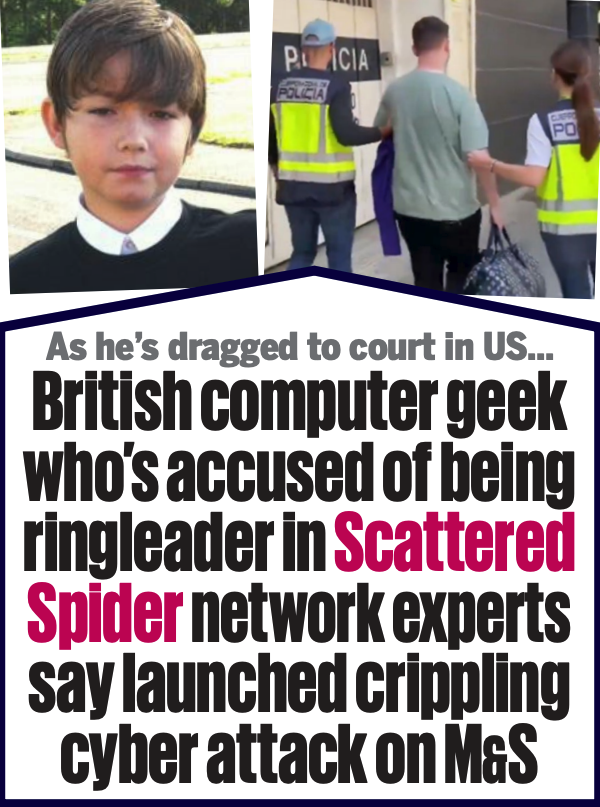
Two photos published in a Daily Mail story dated May 3, 2025 show Buchanan as a child (left) and as an adult being detained by airport authorities in Spain. “M&S” in this screenshot refers to Marks & Spencer, a major U.K. retail chain that suffered a ransomware attack last year at the hands of Scattered Spider.
Scattered Spider is the name given to a prolific English-speaking cybercrime group known for using social engineering tactics to break into companies and steal data for ransom, often impersonating employees or contractors to deceive IT help desks into granting access.
As part of his guilty plea, Buchanan admitted conspiring with other Scattered Spider members to launch tens of thousands of SMS-based phishing attacks in 2022 that led to intrusions at a number of technology companies, including Twilio, LastPass, DoorDash, and Mailchimp.
The group then used data stolen in those breaches to carry out SIM-swapping attacks that siphoned funds from individual cryptocurrency investors. In an unauthorized SIM-swap, crooks transfer the target’s phone number to a device they control and intercept any text messages or phone calls to the victim’s device — such as one-time passcodes for authentication and password reset links sent via SMS. The U.S. Justice Department said Buchanan admitted to stealing at least $8 million in virtual currency from individual victims throughout the United States.
FBI investigators tied Buchanan to the 2022 SMS phishing attacks after discovering the same username and email address was used to register numerous phishing domains seen in the campaign. The domain registrar NameCheap found that less than a month before the phishing spree, the account that registered those domains logged in from an Internet address in the U.K. FBI investigators said the Scottish police told them the address was leased to Buchanan throughout 2022.
As first reported by KrebsOnSecurity, Buchanan fled the United Kingdom in February 2023, after a rival cybercrime gang hired thugs to invade his home, assault his mother, and threaten to burn him with a blowtorch unless he gave up the keys to his cryptocurrency wallet. That same year, U.K. investigators found a device at Buchanan’s Scotland residence that included data stolen from SMS phishing victims and seed phrases from cryptocurrency theft victims.
Buchanan was arrested by Spanish authorities in June 2024 while trying to board a flight to Italy. He was extradited to the United States and has remained in U.S. federal custody since April 2025.
Buchanan is the second known Scattered Spider member to plead guilty. Noah Michael Urban, 21, of Palm Coast, Fla., was sentenced to 10 years in federal prison last year and ordered to pay $13 million in restitution. Three other alleged co-conspirators — Ahmed Hossam Eldin Elbadawy, 24, a.k.a. “AD,” of College Station, Texas; Evans Onyeaka Osiebo, 21, of Dallas, Texas; and Joel Martin Evans, 26, a.k.a. “joeleoli,” of Jacksonville, North Carolina – still face criminal charges.
Two other alleged Scattered Spider members will soon be tried in the United Kingdom. Owen Flowers, 18, and Thalha Jubair, 20, are facing charges related to the hacking and extortion of several large U.K. retailers, the London transit system, and healthcare providers in the United States. Both have pleaded not guilty, and their trial is slated to begin in June.
Investigators say the Scattered Spider suspects are part of a sprawling cybercriminal community online known as “The Com,” wherein hackers from different cliques boast publicly on Telegram and Discord about high-profile cyber thefts that almost invariably begin with social engineering — tricking people over the phone, email or SMS into giving away credentials that allow remote access to corporate internal networks.
One of the more popular SIM-swapping channels on Telegram has long maintained a leaderboard of the most rapacious SIM-swappers, indexed by their supposed conquests in stealing cryptocurrency. That leaderboard previously listed Buchanan’s hacker alias Tylerb at #65 (out of 100 hackers), with Urban’s moniker “Sosa” coming in at #24.
Buchanan’s sentencing hearing is scheduled for August 21, 2026. According to the Justice Department, he faces a statutory maximum sentence of 22 years in federal prison. However, any sentence the judge hands down in this case may be significantly tempered by a number of mitigating factors in the U.S. Sentencing Guidelines, including the defendant’s age, criminal history, time already served in U.S. custody, and the degree to which they cooperated with federal authorities.
 Login
Login