 Login
Login
Engaging Cisco Talos Incident Response is just the beginning
Cisco Talos Incident Response Retainer provides expert, proactive, and reactive cybersecurity support to quickly contain threats and strengthen defenses.


If a message popped up in your feed tomorrow promising a cash refund, a surprise giveaway, or a limited-time crypto opportunity, would you pause long enough to question it?
That split second matters more than ever.
Most modern scams don’t rely on panic or obvious red flags. They rely on familiarity. On things that feel normal. On moments that seem too small to question.
And those moments are exactly what scammers exploit.
There was a time when spotting a scam was relatively straightforward. The emails were badly written. The websites looked rushed. The warnings were obvious.
Scammers don’t just rely on obvious spam or panic-driven messages. Instead, many now use:
McAfee’s Celebrity Deepfake Deception research shows how common and convincing these scams have become: 72% of Americans say they’ve seen a fake or AI-generated celebrity endorsement, and 39% say they’ve clicked on one that turned out to be fraudulent. When scam content shows up in the same feeds, apps, and formats people use every day, it feels normal.
That’s the danger zone. It’s also why McAfee chose to use a familiar, culturally recognizable moment to talk about a much bigger issue.
Whether you’ve been saying mack-uh-fee or mick-affy, the long-running name mix-up is harmless in everyday conversation.
Online, though, small moments of confusion can have outsized consequences.
Scammers rely on quick assumptions: that a familiar name means legitimacy, that a recognizable face means trust, that a message arriving in the right place must be real. They move fast, hoping people act before stopping to verify
Pat McAfee knows firsthand how scammers exploit familiarity and trust.
In recent months, fake social media giveaways promising cash and prizes have circulated using Pat’s likeness, and even a fraudulent “American Heart Association fundraiser” made the rounds, falsely claiming he was collecting donations.
Pat wants his fans to know: if you ever see a giveaway, fundraiser, or message claiming to be from him, double-check it on his official channels first. If it feels off, it probably is.
Unfortunately, these scams work because people trust Pat. Scammers exploit that trust to lower people’s guard and make fraudulent requests feel legitimate.
It’s the same tactic used across countless impersonation scams today: borrow the authority of a familiar face, add a sense of urgency, and move fast before anyone stops to verify, “is this legit?” We’ve seen it happen with Taylor Swift, Tom Hanks, Al Roker, Brad Pitt, and numerous others.
Remember, no legitimate giveaway will ask for payment, banking details, login credentials, or account access. And no nonprofit fundraiser tied to a celebrity should ever come from a personal message or unfamiliar social account.
In the video below, Pat McAfee playfully demonstrates how easily familiar moments online can turn into risk, and why digital safety today can’t rely on perfect judgment alone.
You don’t have to stop using your favorite platforms. But you do have to change how you verify online threats.
If a video or message feels real but the request feels extreme, that’s a red flag.
McAfee offers more than traditional antivirus, combining multiple layers of digital protection in one app
If a scam looks obvious, most people won’t fall for it.
But modern scams don’t look obvious. They look familiar. They use your favorite faces. They look normal. They look safe. And that’s where people get hurt.
Staying safe now means slowing down, verifying independently, and having protection work quietly in the background while you stay focused on what you actually came online to do.
McAfee’s built-in Scam Detector, included in all core plans, automatically detects scams across text, email, and video, blocks dangerous sites, and identifies deepfakes, stopping harm before it happens.
And because today’s risks aren’t just about what you click, a VPN and Personal Data Cleanup add additional layers of defense by helping protect your connection and limit how much personal information is available to be exploited in the first place.
Ready to get Pat’s Picks? Learn more here.
For clarity, and because these questions come up often, here’s the straightforward explanation:
| Q: Is Pat McAfee the founder of McAfee antivirus? A: No. Pat McAfee is not associated with the founding or leadership of McAfee. McAfee was founded by John McAfee and operates independently. |
| Q: Are Pat McAfee and McAfee the same company? A: No. Pat McAfee is a sports media personality. McAfee is a cybersecurity company. They are separate entities. |
| Q: Why does McAfee work with Pat McAfee? A: McAfee partnered with Pat McAfee to raise awareness about online scams, impersonation fraud, and digital safety using culturally relevant examples. |
The post McAfee and Pat McAfee Turn a Name Mix-Up Into a Push for Online Safety appeared first on McAfee Blog.

Google has officially discontinued its Dark Web Report, the tool that alerted users when their personal information appeared in dark web breach databases. New scans stop on January 15, 2026, and on February 16, 2026, Google will permanently delete all data associated with the feature.
This does not mean Google.com or Google Accounts are going away. It means Google is no longer scanning the dark web for leaked data tied to your account, and it is no longer storing or updating any breach information that was collected for the report.
For people who relied on Google’s alerts, this change creates a real gap. After January 16, you will no longer get new notifications if your information shows up in breach databases. That is why it is worth taking a few minutes now to lock down the basics.
According to reporting from TechCrunch, Google said it ended the service after concluding that it did not give users enough clarity about what to do once their data was found.
That decision highlights a much larger shift in online security: Finding leaked data is no longer enough. Protecting identity is now the real challenge.
The Dark Web Report was a Google Account feature that searched known data breach dumps and dark web marketplaces for personal information tied to a user, such as email addresses, phone numbers, and other identifiers.
If Google found a match, it sent an alert.
What it did not do was show which accounts were at risk, whether financial or government ID data was involved, or how to prevent fraud from happening next. That gap is why some users said the tool fell short.
The internet has three layers:
The dark web is where data from breaches is commonly sold, traded, and packaged for scams. When a company is hacked, stolen files often end up in dark web databases that include email addresses, passwords, Social Security numbers, bank details, and full identity profiles.
Scammers use this data to commit account takeovers, financial fraud, tax fraud, and identity theft.
Even without passwords, this personal information can be enough for scammers to target you with convincing phishing and social engineering scams.
Looking up an email address is no longer enough. Modern identity theft relies on things like Social Security numbers, government IDs, bank and credit card numbers, tax records, insurance data, usernames, and phone numbers.
To understand whether any of that is exposed, people need to monitor the dark web for identity-level data, not just logins.
Here is what that looks like in practice:
Tools like McAfee’s Identity Monitoring are designed to look for those types of data so you can act before fraud happens.
Been meaning to bolster your security? Here are three quick ways you can enhance your identity protection and reduce real-world damage in a breach:
Estimated time: 10 minutes
This is a powerful free protection option that many forget about. A credit freeze blocks anyone from opening new loans, credit cards, or accounts in your name, even if they have your Social Security number and full identity profile.
You can do this for free with any of the major credit bureaus. If you do it with one, the others are notified.
Why this matters: Most identity theft today is not account hacking. It is criminals opening accounts in your name. A credit freeze stops that cold.
Estimated time: 10 minutes
Go into your main bank and credit card apps and turn on:
You’ll find these somewhere under Settings>Alerts.
Why this matters: Identity thieves often test stolen data with small charges or login attempts before stealing larger amounts. These alerts are how you catch it early.
Estimated time: 10 minutes
This is one of the most overlooked vulnerabilities.
Go into:
Check and update:
Remove anything you do not recognize.
Why this matters: Even if you change your password, attackers can still take over accounts through recovery systems if those are compromised. This closes that back door.
| Is Google deleting my Google Account data? No. Google is only deleting the data it collected specifically for the Dark Web Report feature. Your Gmail, Drive, Photos, and other Google Account data are not affected. |
| Is Google still protecting my account from hackers? Yes. Google continues to offer security features like two-factor authentication, login alerts, and account recovery tools. What it removed is the dark web scanning and alert system tied to breach data. |
| Does the dark web report website still exist? No. After February 16, 2026, Google no longer operates or updates the Dark Web Report feature. There is no active scanning, no dashboard, and no stored breach data tied to it. |
| Does this mean dark web monitoring is useless? No. It means email-only monitoring is not enough. Criminals use far more than emails to commit fraud, which is why identity-level monitoring is now more important. |
| What kind of information is most dangerous if it appears on the dark web? Social Security numbers, government IDs, bank and credit card numbers, tax records, insurance IDs, usernames, and phone numbers are the data types most commonly used for identity theft and financial fraud. |
| How can I check if my information is exposed right now? You can use an identity monitoring service like McAfee that scans dark web sources for sensitive personal data, not just email addresses. That is how people can see whether their identity is being traded or abused today. |
The post Google Ends Dark Web Report. What That Means and How to Stay Safe appeared first on McAfee Blog.


The story you are reading is a series of scoops nestled inside a far more urgent Internet-wide security advisory. The vulnerability at issue has been exploited for months already, and it’s time for a broader awareness of the threat. The short version is that everything you thought you knew about the security of the internal network behind your Internet router probably is now dangerously out of date.
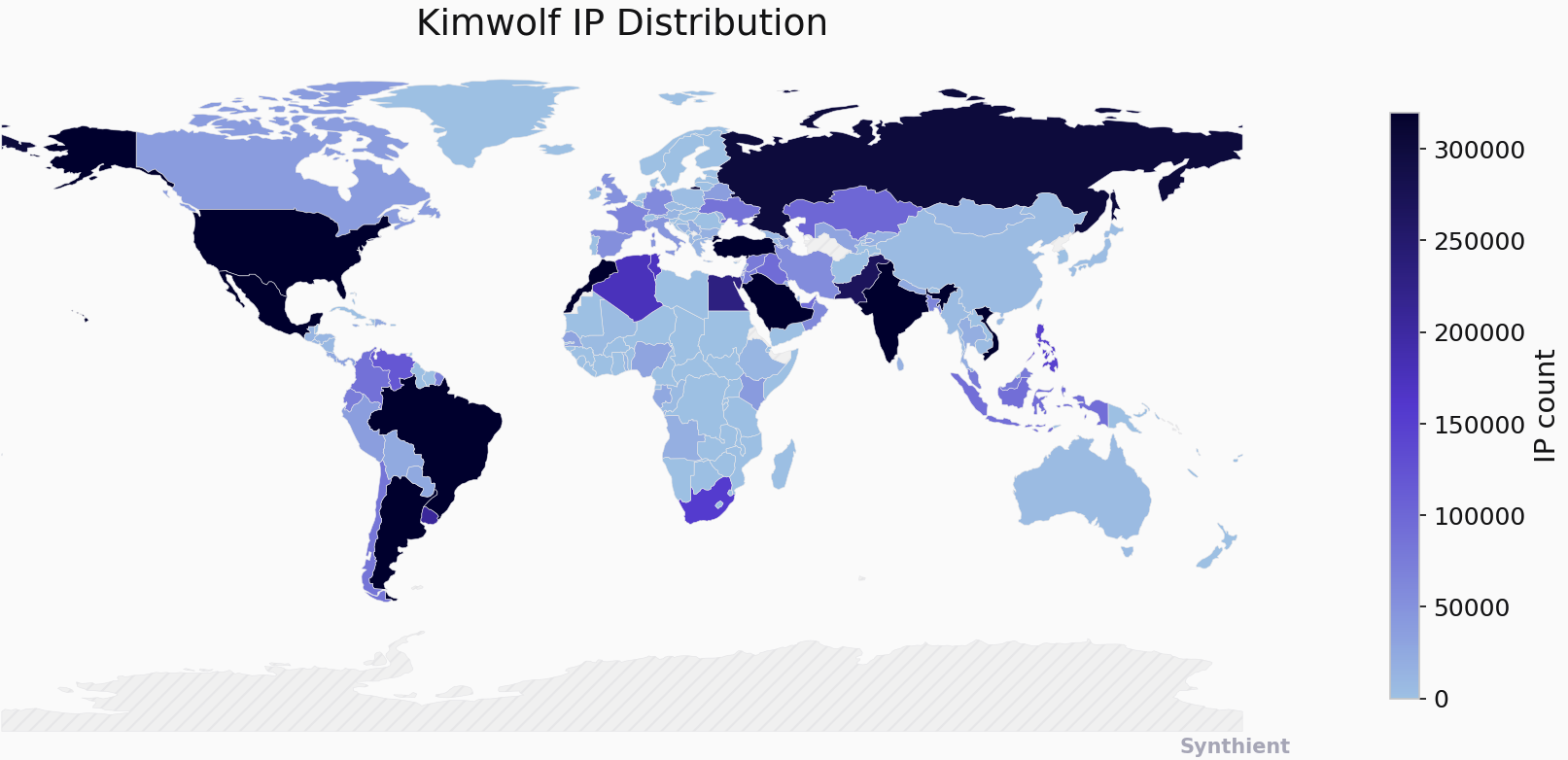
The security company Synthient currently sees more than 2 million infected Kimwolf devices distributed globally but with concentrations in Vietnam, Brazil, India, Saudi Arabia, Russia and the United States. Synthient found that two-thirds of the Kimwolf infections are Android TV boxes with no security or authentication built in.
The past few months have witnessed the explosive growth of a new botnet dubbed Kimwolf, which experts say has infected more than 2 million devices globally. The Kimwolf malware forces compromised systems to relay malicious and abusive Internet traffic — such as ad fraud, account takeover attempts and mass content scraping — and participate in crippling distributed denial-of-service (DDoS) attacks capable of knocking nearly any website offline for days at a time.
More important than Kimwolf’s staggering size, however, is the diabolical method it uses to spread so quickly: By effectively tunneling back through various “residential proxy” networks and into the local networks of the proxy endpoints, and by further infecting devices that are hidden behind the assumed protection of the user’s firewall and Internet router.
Residential proxy networks are sold as a way for customers to anonymize and localize their Web traffic to a specific region, and the biggest of these services allow customers to route their traffic through devices in virtually any country or city around the globe.
The malware that turns an end-user’s Internet connection into a proxy node is often bundled with dodgy mobile apps and games. These residential proxy programs also are commonly installed via unofficial Android TV boxes sold by third-party merchants on popular e-commerce sites like Amazon, BestBuy, Newegg, and Walmart.
These TV boxes range in price from $40 to $400, are marketed under a dizzying range of no-name brands and model numbers, and frequently are advertised as a way to stream certain types of subscription video content for free. But there’s a hidden cost to this transaction: As we’ll explore in a moment, these TV boxes make up a considerable chunk of the estimated two million systems currently infected with Kimwolf.

Some of the unsanctioned Android TV boxes that come with residential proxy malware pre-installed. Image: Synthient.
Kimwolf also is quite good at infecting a range of Internet-connected digital photo frames that likewise are abundant at major e-commerce websites. In November 2025, researchers from Quokka published a report (PDF) detailing serious security issues in Android-based digital picture frames running the Uhale app — including Amazon’s bestselling digital frame as of March 2025.
There are two major security problems with these photo frames and unofficial Android TV boxes. The first is that a considerable percentage of them come with malware pre-installed, or else require the user to download an unofficial Android App Store and malware in order to use the device for its stated purpose (video content piracy). The most typical of these uninvited guests are small programs that turn the device into a residential proxy node that is resold to others.
The second big security nightmare with these photo frames and unsanctioned Android TV boxes is that they rely on a handful of Internet-connected microcomputer boards that have no discernible security or authentication requirements built-in. In other words, if you are on the same network as one or more of these devices, you can likely compromise them simultaneously by issuing a single command across the network.
The combination of these two security realities came to the fore in October 2025, when an undergraduate computer science student at the Rochester Institute of Technology began closely tracking Kimwolf’s growth, and interacting directly with its apparent creators on a daily basis.
Benjamin Brundage is the 22-year-old founder of the security firm Synthient, a startup that helps companies detect proxy networks and learn how those networks are being abused. Conducting much of his research into Kimwolf while studying for final exams, Brundage told KrebsOnSecurity in late October 2025 he suspected Kimwolf was a new Android-based variant of Aisuru, a botnet that was incorrectly blamed for a number of record-smashing DDoS attacks last fall.
Brundage says Kimwolf grew rapidly by abusing a glaring vulnerability in many of the world’s largest residential proxy services. The crux of the weakness, he explained, was that these proxy services weren’t doing enough to prevent their customers from forwarding requests to internal servers of the individual proxy endpoints.
Most proxy services take basic steps to prevent their paying customers from “going upstream” into the local network of proxy endpoints, by explicitly denying requests for local addresses specified in RFC-1918, including the well-known Network Address Translation (NAT) ranges 10.0.0.0/8, 192.168.0.0/16, and 172.16.0.0/12. These ranges allow multiple devices in a private network to access the Internet using a single public IP address, and if you run any kind of home or office network, your internal address space operates within one or more of these NAT ranges.
However, Brundage discovered that the people operating Kimwolf had figured out how to talk directly to devices on the internal networks of millions of residential proxy endpoints, simply by changing their Domain Name System (DNS) settings to match those in the RFC-1918 address ranges.
“It is possible to circumvent existing domain restrictions by using DNS records that point to 192.168.0.1 or 0.0.0.0,” Brundage wrote in a first-of-its-kind security advisory sent to nearly a dozen residential proxy providers in mid-December 2025. “This grants an attacker the ability to send carefully crafted requests to the current device or a device on the local network. This is actively being exploited, with attackers leveraging this functionality to drop malware.”
As with the digital photo frames mentioned above, many of these residential proxy services run solely on mobile devices that are running some game, VPN or other app with a hidden component that turns the user’s mobile phone into a residential proxy — often without any meaningful consent.
In a report published today, Synthient said key actors involved in Kimwolf were observed monetizing the botnet through app installs, selling residential proxy bandwidth, and selling its DDoS functionality.
“Synthient expects to observe a growing interest among threat actors in gaining unrestricted access to proxy networks to infect devices, obtain network access, or access sensitive information,” the report observed. “Kimwolf highlights the risks posed by unsecured proxy networks and their viability as an attack vector.”
After purchasing a number of unofficial Android TV box models that were most heavily represented in the Kimwolf botnet, Brundage further discovered the proxy service vulnerability was only part of the reason for Kimwolf’s rapid rise: He also found virtually all of the devices he tested were shipped from the factory with a powerful feature called Android Debug Bridge (ADB) mode enabled by default.

Many of the unofficial Android TV boxes infected by Kimwolf include the ominous disclaimer: “Made in China. Overseas use only.” Image: Synthient.
ADB is a diagnostic tool intended for use solely during the manufacturing and testing processes, because it allows the devices to be remotely configured and even updated with new (and potentially malicious) firmware. However, shipping these devices with ADB turned on creates a security nightmare because in this state they constantly listen for and accept unauthenticated connection requests.
For example, opening a command prompt and typing “adb connect” along with a vulnerable device’s (local) IP address followed immediately by “:5555” will very quickly offer unrestricted “super user” administrative access.
Brundage said by early December, he’d identified a one-to-one overlap between new Kimwolf infections and proxy IP addresses offered for rent by China-based IPIDEA, currently the world’s largest residential proxy network by all accounts.
“Kimwolf has almost doubled in size this past week, just by exploiting IPIDEA’s proxy pool,” Brundage told KrebsOnSecurity in early December as he was preparing to notify IPIDEA and 10 other proxy providers about his research.
Brundage said Synthient first confirmed on December 1, 2025 that the Kimwolf botnet operators were tunneling back through IPIDEA’s proxy network and into the local networks of systems running IPIDEA’s proxy software. The attackers dropped the malware payload by directing infected systems to visit a specific Internet address and to call out the pass phrase “krebsfiveheadindustries” in order to unlock the malicious download.
On December 30, Synthient said it was tracking roughly 2 million IPIDEA addresses exploited by Kimwolf in the previous week. Brundage said he has witnessed Kimwolf rebuilding itself after one recent takedown effort targeting its control servers — from almost nothing to two million infected systems just by tunneling through proxy endpoints on IPIDEA for a couple of days.
Brundage said IPIDEA has a seemingly inexhaustible supply of new proxies, advertising access to more than 100 million residential proxy endpoints around the globe in the past week alone. Analyzing the exposed devices that were part of IPIDEA’s proxy pool, Synthient said it found more than two-thirds were Android devices that could be compromised with no authentication needed.
After charting a tight overlap in Kimwolf-infected IP addresses and those sold by IPIDEA, Brundage was eager to make his findings public: The vulnerability had clearly been exploited for several months, although it appeared that only a handful of cybercrime actors were aware of the capability. But he also knew that going public without giving vulnerable proxy providers an opportunity to understand and patch it would only lead to more mass abuse of these services by additional cybercriminal groups.
On December 17, Brundage sent a security notification to all 11 of the apparently affected proxy providers, hoping to give each at least a few weeks to acknowledge and address the core problems identified in his report before he went public. Many proxy providers who received the notification were resellers of IPIDEA that white-labeled the company’s service.
KrebsOnSecurity first sought comment from IPIDEA in October 2025, in reporting on a story about how the proxy network appeared to have benefitted from the rise of the Aisuru botnet, whose administrators appeared to shift from using the botnet primarily for DDoS attacks to simply installing IPIDEA’s proxy program, among others.
On December 25, KrebsOnSecurity received an email from an IPIDEA employee identified only as “Oliver,” who said allegations that IPIDEA had benefitted from Aisuru’s rise were baseless.
“After comprehensively verifying IP traceability records and supplier cooperation agreements, we found no association between any of our IP resources and the Aisuru botnet, nor have we received any notifications from authoritative institutions regarding our IPs being involved in malicious activities,” Oliver wrote. “In addition, for external cooperation, we implement a three-level review mechanism for suppliers, covering qualification verification, resource legality authentication and continuous dynamic monitoring, to ensure no compliance risks throughout the entire cooperation process.”
“IPIDEA firmly opposes all forms of unfair competition and malicious smearing in the industry, always participates in market competition with compliant operation and honest cooperation, and also calls on the entire industry to jointly abandon irregular and unethical behaviors and build a clean and fair market ecosystem,” Oliver continued.
Meanwhile, the same day that Oliver’s email arrived, Brundage shared a response he’d just received from IPIDEA’s security officer, who identified himself only by the first name Byron. The security officer said IPIDEA had made a number of important security changes to its residential proxy service to address the vulnerability identified in Brundage’s report.
“By design, the proxy service does not allow access to any internal or local address space,” Byron explained. “This issue was traced to a legacy module used solely for testing and debugging purposes, which did not fully inherit the internal network access restrictions. Under specific conditions, this module could be abused to reach internal resources. The affected paths have now been fully blocked and the module has been taken offline.”
Byron told Brundage IPIDEA also instituted multiple mitigations for blocking DNS resolution to internal (NAT) IP ranges, and that it was now blocking proxy endpoints from forwarding traffic on “high-risk” ports “to prevent abuse of the service for scanning, lateral movement, or access to internal services.”
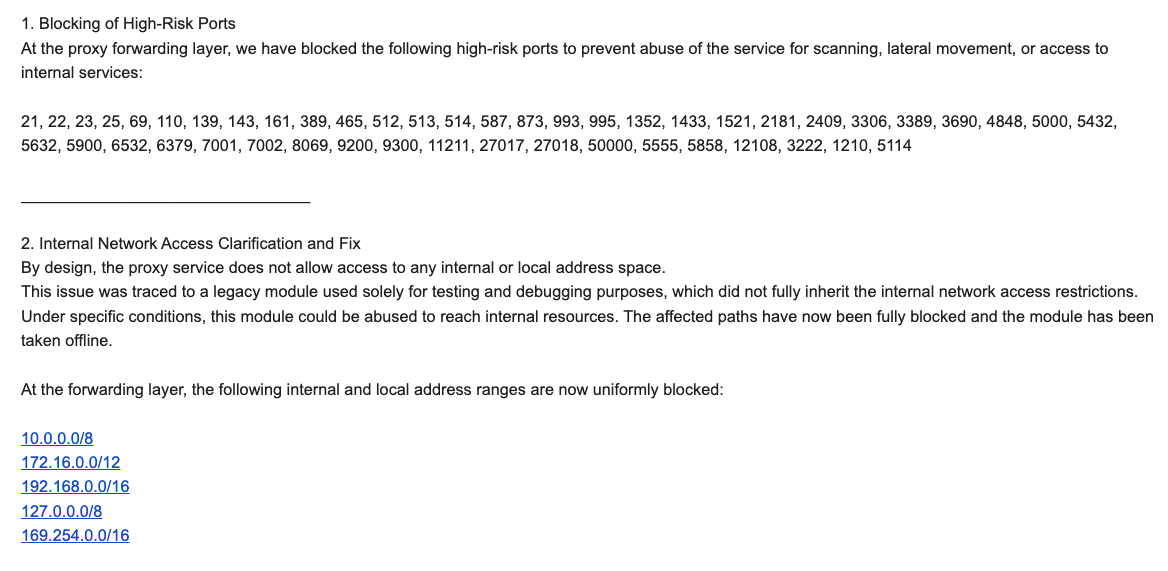
An excerpt from an email sent by IPIDEA’s security officer in response to Brundage’s vulnerability notification. Click to enlarge.
Brundage said IPIDEA appears to have successfully patched the vulnerabilities he identified. He also noted he never observed the Kimwolf actors targeting proxy services other than IPIDEA, which has not responded to requests for comment.
Riley Kilmer is founder of Spur.us, a technology firm that helps companies identify and filter out proxy traffic. Kilmer said Spur has tested Brundage’s findings and confirmed that IPIDEA and all of its affiliate resellers indeed allowed full and unfiltered access to the local LAN.
Kilmer said one model of unsanctioned Android TV boxes that is especially popular — the Superbox, which we profiled in November’s Is Your Android TV Streaming Box Part of a Botnet? — leaves Android Debug Mode running on localhost:5555.
“And since Superbox turns the IP into an IPIDEA proxy, a bad actor just has to use the proxy to localhost on that port and install whatever bad SDKs [software development kits] they want,” Kilmer told KrebsOnSecurity.
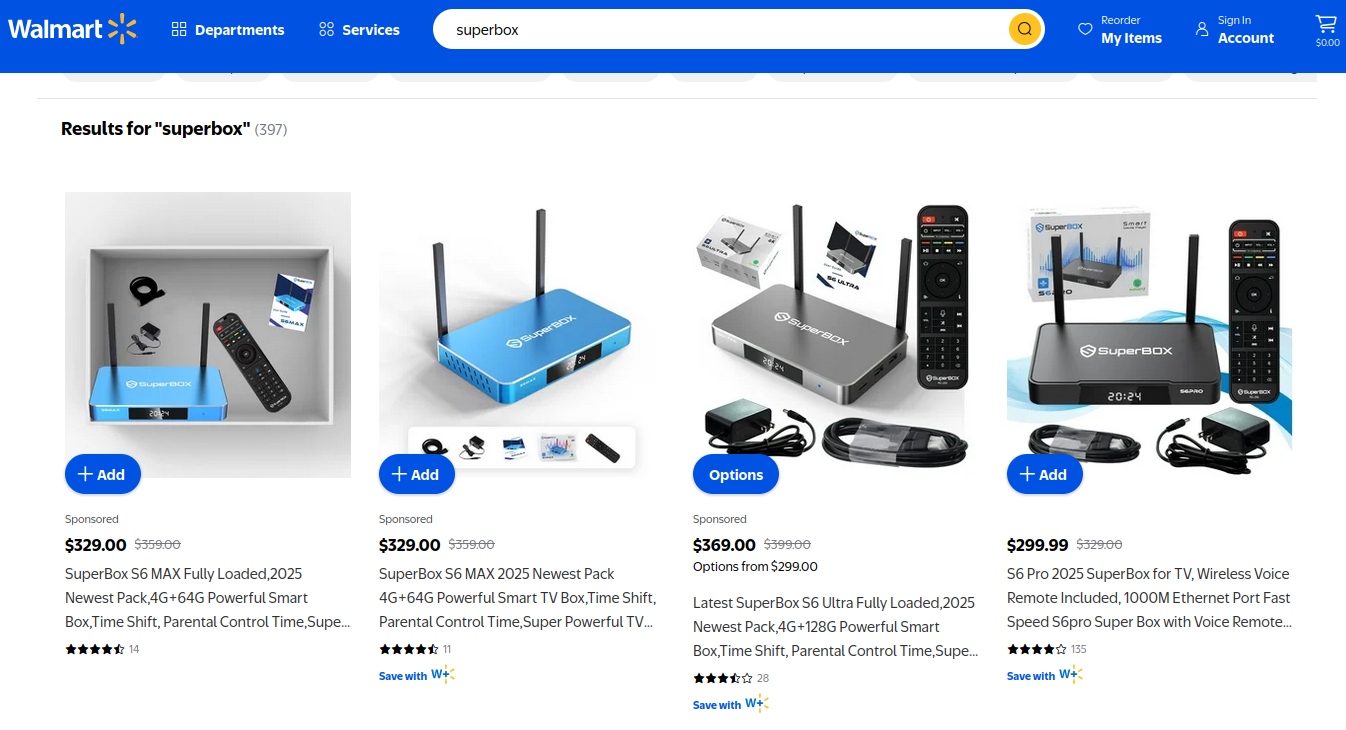
Superbox media streaming boxes for sale on Walmart.com.
Both Brundage and Kilmer say IPIDEA appears to be the second or third reincarnation of a residential proxy network formerly known as 911S5 Proxy, a service that operated between 2014 and 2022 and was wildly popular on cybercrime forums. 911S5 Proxy imploded a week after KrebsOnSecurity published a deep dive on the service’s sketchy origins and leadership in China.
In that 2022 profile, we cited work by researchers at the University of Sherbrooke in Canada who were studying the threat 911S5 could pose to internal corporate networks. The researchers noted that “the infection of a node enables the 911S5 user to access shared resources on the network such as local intranet portals or other services.”
“It also enables the end user to probe the LAN network of the infected node,” the researchers explained. “Using the internal router, it would be possible to poison the DNS cache of the LAN router of the infected node, enabling further attacks.”
911S5 initially responded to our reporting in 2022 by claiming it was conducting a top-down security review of the service. But the proxy service abruptly closed up shop just one week later, saying a malicious hacker had destroyed all of the company’s customer and payment records. In July 2024, The U.S. Department of the Treasury sanctioned the alleged creators of 911S5, and the U.S. Department of Justice arrested the Chinese national named in my 2022 profile of the proxy service.
Kilmer said IPIDEA also operates a sister service called 922 Proxy, which the company has pitched from Day One as a seamless alternative to 911S5 Proxy.
“You cannot tell me they don’t want the 911 customers by calling it that,” Kilmer said.
Among the recipients of Synthient’s notification was the proxy giant Oxylabs. Brundage shared an email he received from Oxylabs’ security team on December 31, which acknowledged Oxylabs had started rolling out security modifications to address the vulnerabilities described in Synthient’s report.
Reached for comment, Oxylabs confirmed they “have implemented changes that now eliminate the ability to bypass the blocklist and forward requests to private network addresses using a controlled domain.” But it said there is no evidence that Kimwolf or other other attackers exploited its network.
“In parallel, we reviewed the domains identified in the reported exploitation activity and did not observe traffic associated with them,” the Oxylabs statement continued. “Based on this review, there is no indication that our residential network was impacted by these activities.”
Consider the following scenario, in which the mere act of allowing someone to use your Wi-Fi network could lead to a Kimwolf botnet infection. In this example, a friend or family member comes to stay with you for a few days, and you grant them access to your Wi-Fi without knowing that their mobile phone is infected with an app that turns the device into a residential proxy node. At that point, your home’s public IP address will show up for rent at the website of some residential proxy provider.
Miscreants like those behind Kimwolf then use residential proxy services online to access that proxy node on your IP, tunnel back through it and into your local area network (LAN), and automatically scan the internal network for devices with Android Debug Bridge mode turned on.
By the time your guest has packed up their things, said their goodbyes and disconnected from your Wi-Fi, you now have two devices on your local network — a digital photo frame and an unsanctioned Android TV box — that are infected with Kimwolf. You may have never intended for these devices to be exposed to the larger Internet, and yet there you are.
Here’s another possible nightmare scenario: Attackers use their access to proxy networks to modify your Internet router’s settings so that it relies on malicious DNS servers controlled by the attackers — allowing them to control where your Web browser goes when it requests a website. Think that’s far-fetched? Recall the DNSChanger malware from 2012 that infected more than a half-million routers with search-hijacking malware, and ultimately spawned an entire security industry working group focused on containing and eradicating it.
Much of what is published so far on Kimwolf has come from the Chinese security firm XLab, which was the first to chronicle the rise of the Aisuru botnet in late 2024. In its latest blog post, XLab said it began tracking Kimwolf on October 24, when the botnet’s control servers were swamping Cloudflare’s DNS servers with lookups for the distinctive domain 14emeliaterracewestroxburyma02132[.]su.
This domain and others connected to early Kimwolf variants spent several weeks topping Cloudflare’s chart of the Internet’s most sought-after domains, edging out Google.com and Apple.com of their rightful spots in the top 5 most-requested domains. That’s because during that time Kimwolf was asking its millions of bots to check in frequently using Cloudflare’s DNS servers.

The Chinese security firm XLab found the Kimwolf botnet had enslaved between 1.8 and 2 million devices, with heavy concentrations in Brazil, India, The United States of America and Argentina. Image: blog.xLab.qianxin.com
It is clear from reading the XLab report that KrebsOnSecurity (and security experts) probably erred in misattributing some of Kimwolf’s early activities to the Aisuru botnet, which appears to be operated by a different group entirely. IPDEA may have been truthful when it said it had no affiliation with the Aisuru botnet, but Brundage’s data left no doubt that its proxy service clearly was being massively abused by Aisuru’s Android variant, Kimwolf.
XLab said Kimwolf has infected at least 1.8 million devices, and has shown it is able to rebuild itself quickly from scratch.
“Analysis indicates that Kimwolf’s primary infection targets are TV boxes deployed in residential network environments,” XLab researchers wrote. “Since residential networks usually adopt dynamic IP allocation mechanisms, the public IPs of devices change over time, so the true scale of infected devices cannot be accurately measured solely by the quantity of IPs. In other words, the cumulative observation of 2.7 million IP addresses does not equate to 2.7 million infected devices.”
XLab said measuring Kimwolf’s size also is difficult because infected devices are distributed across multiple global time zones. “Affected by time zone differences and usage habits (e.g., turning off devices at night, not using TV boxes during holidays, etc.), these devices are not online simultaneously, further increasing the difficulty of comprehensive observation through a single time window,” the blog post observed.
XLab noted that the Kimwolf author shows an almost ‘obsessive’ fixation” on Yours Truly, apparently leaving “easter eggs” related to my name in multiple places through the botnet’s code and communications:
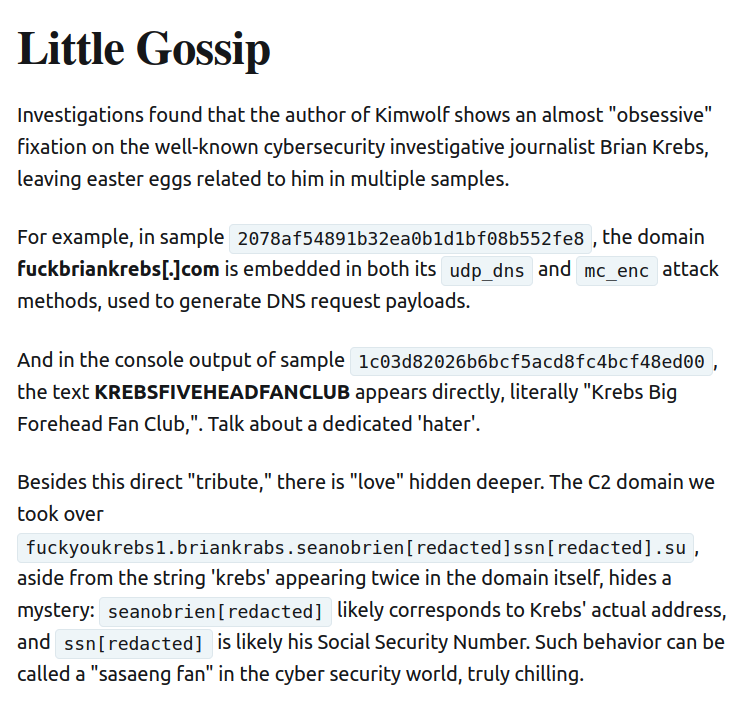
Image: XLAB.
One frustrating aspect of threats like Kimwolf is that in most cases it is not easy for the average user to determine if there are any devices on their internal network which may be vulnerable to threats like Kimwolf and/or already infected with residential proxy malware.
Let’s assume that through years of security training or some dark magic you can successfully identify that residential proxy activity on your internal network was linked to a specific mobile device inside your house: From there, you’d still need to isolate and remove the app or unwanted component that is turning the device into a residential proxy.
Also, the tooling and knowledge needed to achieve this kind of visibility just isn’t there from an average consumer standpoint. The work that it takes to configure your network so you can see and interpret logs of all traffic coming in and out is largely beyond the skillset of most Internet users (and, I’d wager, many security experts). But it’s a topic worth exploring in an upcoming story.
Happily, Synthient has erected a page on its website that will state whether a visitor’s public Internet address was seen among those of Kimwolf-infected systems. Brundage also has compiled a list of the unofficial Android TV boxes that are most highly represented in the Kimwolf botnet.
If you own a TV box that matches one of these model names and/or numbers, please just rip it out of your network. If you encounter one of these devices on the network of a family member or friend, send them a link to this story and explain that it’s not worth the potential hassle and harm created by keeping them plugged in.
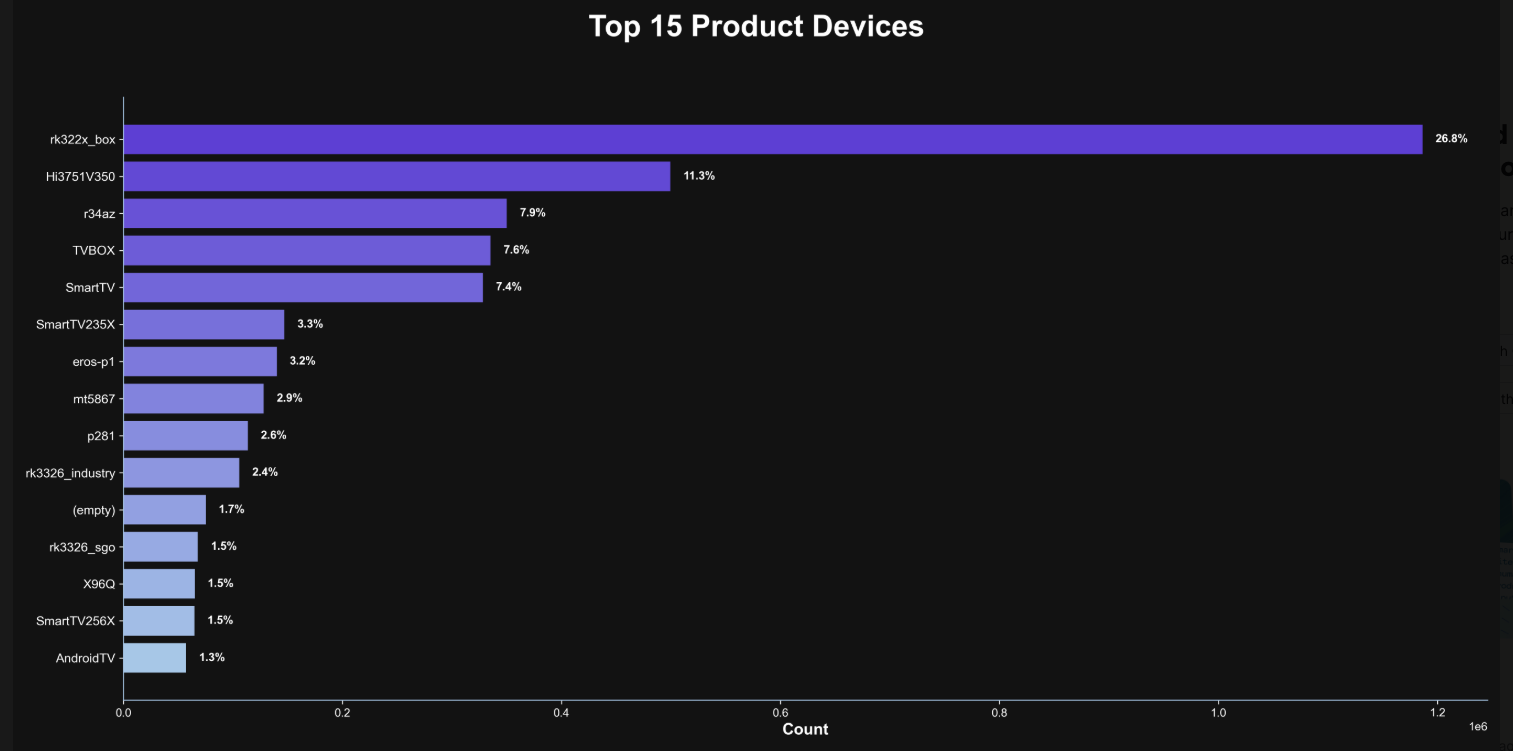
The top 15 product devices represented in the Kimwolf botnet, according to Synthient.
Chad Seaman is a principal security researcher with Akamai Technologies. Seaman said he wants more consumers to be wary of these pseudo Android TV boxes to the point where they avoid them altogether.
“I want the consumer to be paranoid of these crappy devices and of these residential proxy schemes,” he said. “We need to highlight why they’re dangerous to everyone and to the individual. The whole security model where people think their LAN (Local Internal Network) is safe, that there aren’t any bad guys on the LAN so it can’t be that dangerous is just really outdated now.”
“The idea that an app can enable this type of abuse on my network and other networks, that should really give you pause,” about which devices to allow onto your local network, Seaman said. “And it’s not just Android devices here. Some of these proxy services have SDKs for Mac and Windows, and the iPhone. It could be running something that inadvertently cracks open your network and lets countless random people inside.”
In July 2025, Google filed a “John Doe” lawsuit (PDF) against 25 unidentified defendants collectively dubbed the “BadBox 2.0 Enterprise,” which Google described as a botnet of over ten million unsanctioned Android streaming devices engaged in advertising fraud. Google said the BADBOX 2.0 botnet, in addition to compromising multiple types of devices prior to purchase, also can infect devices by requiring the download of malicious apps from unofficial marketplaces.
Google’s lawsuit came on the heels of a June 2025 advisory from the Federal Bureau of Investigation (FBI), which warned that cyber criminals were gaining unauthorized access to home networks by either configuring the products with malware prior to the user’s purchase, or infecting the device as it downloads required applications that contain backdoors — usually during the set-up process.
The FBI said BADBOX 2.0 was discovered after the original BADBOX campaign was disrupted in 2024. The original BADBOX was identified in 2023, and primarily consisted of Android operating system devices that were compromised with backdoor malware prior to purchase.
Lindsay Kaye is vice president of threat intelligence at HUMAN Security, a company that worked closely on the BADBOX investigations. Kaye said the BADBOX botnets and the residential proxy networks that rode on top of compromised devices were detected because they enabled a ridiculous amount of advertising fraud, as well as ticket scalping, retail fraud, account takeovers and content scraping.
Kaye said consumers should stick to known brands when it comes to purchasing things that require a wired or wireless connection.
“If people are asking what they can do to avoid being victimized by proxies, it’s safest to stick with name brands,” Kaye said. “Anything promising something for free or low-cost, or giving you something for nothing just isn’t worth it. And be careful about what apps you allow on your phone.”
Many wireless routers these days make it relatively easy to deploy a “Guest” wireless network on-the-fly. Doing so allows your guests to browse the Internet just fine but it blocks their device from being able to talk to other devices on the local network — such as shared folders, printers and drives. If someone — a friend, family member, or contractor — requests access to your network, give them the guest Wi-Fi network credentials if you have that option.
There is a small but vocal pro-piracy camp that is almost condescendingly dismissive of the security threats posed by these unsanctioned Android TV boxes. These tech purists positively chafe at the idea of people wholesale discarding one of these TV boxes. A common refrain from this camp is that Internet-connected devices are not inherently bad or good, and that even factory-infected boxes can be flashed with new firmware or custom ROMs that contain no known dodgy software.
However, it’s important to point out that the majority of people buying these devices are not security or hardware experts; the devices are sought out because they dangle something of value for “free.” Most buyers have no idea of the bargain they’re making when plugging one of these dodgy TV boxes into their network.
It is somewhat remarkable that we haven’t yet seen the entertainment industry applying more visible pressure on the major e-commerce vendors to stop peddling this insecure and actively malicious hardware that is largely made and marketed for video piracy. These TV boxes are a public nuisance for bundling malicious software while having no apparent security or authentication built-in, and these two qualities make them an attractive nuisance for cybercriminals.
Stay tuned for Part II in this series, which will poke through clues left behind by the people who appear to have built Kimwolf and benefited from it the most.

Scams didn’t slow down in 2025—and all signs point to the problem getting worse in 2026.
While the final numbers aren’t in yet, reported losses are already on track to break records. Through just the first half of 2025, the Federal Trade Commission (FTC) cited nearly $6.5 billion in scam-related losses, putting the year on pace to surpass 2024’s total. And it’s not just isolated incidents: 73% of Americans say they’ve experienced at least one scam or online attack.
As scams become more convincing, often powered by AI and designed to blend into everyday digital life, basic “spot the red flag” advice isn’t enough anymore. Protecting yourself now means tightening up your digital hygiene: how you manage passwords, personal data, online accounts, and the everyday tools you rely on to stay safe.
The good news is that modern protection has evolved just as quickly as the threats. Many of the most effective safeguards can be set up quickly and then work in the background over time.
Below, we’ll walk through practical steps you can take to improve your digital hygiene for 2026, using protections included with McAfee+ to help reduce your exposure to scams, data misuse, and identity theft.
Think about your passwords and everything they give you access to … your finances, online shopping accounts, banking, and of course every important thing in your email account.
Now are any of those passwords weak, re-used, or highly similar? Don’t worry if the answer to that is “yes.” You can switch them over to strong, unique passwords across all your accounts. Using a password manager like ours helps you create strong, unique while also storing them securely. Quickly.
| Q&A | Q: Should I use a password manager?
A: Yes. It’s the easiest way to create strong, unique passwords for all your online accounts, which protects you from data breaches and hacks. |
So, what makes up a “strong and unique” password?
It contains a mix of 16 uppercase and lowercase letters, numbers, and symbols while never reusing that password elsewhere. That makes the password incredibly tough to crack and protects your other accounts if that password gets caught up in a breach (it won’t work on any other account).
Yes, creating strong and unique passwords for your dozens and dozens of accounts can be … demanding. But that’s where a password manager comes in. It does that work for you.
Speaking of all the accounts you have, how many of them do you really need? And how many of them have you forgotten about altogether? It’s time to track them down and close them up. Why? Data breaches of various sizes hack into an estimated 3.5 million accounts on average each day, so the odds of an old account of yours getting compromised are better than you might think. But where do you even start?
|
Q&A |
Q: Should I delete my old accounts?
A: Yes. When you delete old accounts, you reduce your digital footprint and lower the risk of exposure to data breaches, both of which help protect your personal info. |
Our Online Account Cleanup can track down those old accounts for you. It scans for accounts you no longer use and helps you delete the ones you choose, along with your personal info. In our McAfee+ Advanced and McAfee+ Ultimate plans, you get full-service Online Account Cleanup, which sends the data deletion requests for you.
Data brokers sell all kinds of info that power all kinds of spam and scams. It’s one way spammers and scammers get contact info like emails and phone numbers, and it’s yet another way they get detailed info to target their ads and their attacks.
For example, beyond your full name, home address, phone numbers, email addresses, and date of birth, many also have info about your family members, employment, and past purchases. Data brokers might gather and sell other info like religious and political leanings, health conditions, and employment history. Simply put, this detailed profile makes it easier for spammers and scammers to target you.
|
Q&A
|
Q: Can people find my detailed personal info online?
Yes, and some of the easiest places to find it are on data broker sites. They collect and analyze up to hundreds of bits of personal info, often without your knowledge or consent. Further, they’ll sell it to any buyer, including scammers. |
Where do they harvest this info? From public records, shopper loyalty programs, and even from app data—all kinds of sources. And that underscores the problem, some data brokers keep exhaustive amounts of data about people, all in one place.
And they’ll sell it to anyone who pays for it. You can help reduce those scam texts and calls by removing your info from those sites. A service like our Personal Data Cleanup can do that work for you. It scans some of the riskiest data broker sites, shows you which ones are selling your personal info, and helps you remove it.
One of the first things that comes to mind about VPNs is travel, a great way you can stay secure while using public Wi-Fi in airports and cafes. It works at home as well, giving you an extra layer of security when you bank, shop, or do anything that involves sensitive info. Yet it offers another big benefit. It helps make you more private, because it’s not just hackers who want to snoop on you online.
|
Q&A Block
|
Q: What is a VPN?
A: A VPN, or Virtual Private Network, hides your IP address and encrypts your internet connection in a secure “tunnel” that shields your online activity from snoops, advertisers, and your Internet Service Provider (ISP). |
For example, some ISPs collect your browsing data. In the United States and many other countries, ISPs can legally monitor and record info about the websites you visit and the apps you use. They can use it for advertising and analytics purposes, and, in some cases, they may share it with third parties.
When you use a VPN, it encrypts all the data leaving your device and routes it through a secure server. As a result, your ISP can only see that you are connected to a VPN server, and it can’t track which websites you visit or the data you send and receive. Without a doubt, going online with a VPN makes you safer and keeps you more private.
We saw big spikes in several types of scams over the year, and naturally a spike in reported losses followed. One reason for the jump is that AI tools have made it even easier for scammers to create convincing texts, emails, and deepfake videos designed to rip people off.
|
Q&A |
Q: How bad are scams today?
A: According to a 2025 Pew Research Center survey, 73% of U.S. adults said they’ve experienced at least one online scam or attack, with 32% reporting an incident within the past year.iv |
They’re getting tougher to spot too. In the earlier days of AI-created content, you could often spot the telltale signs of a fake. That’s not always the case anymore, and scams are looking more and more sophisticated as AI tools evolve.
But you have tools of your own. Our Scam Detector protects you across text, email, and video by spotting scams and detecting deepfake videos (like the one of a deepfaked Taylor Swift promoting a bogus cookware offer). You also have our Web Protection which detects links to scam sites and other sketchy corners of the internet while you browse. Both will alert you if a link might take you to a sketchy site. It’ll also block those sites if you accidentally tap or click on a bad link.
So, let’s say the unfortunate happens to you. You get scammed. Maybe it’s a few bucks, maybe it’s more. You’re faced with a couple issues. One, that money could be gone for good depending on how you paid the scammer. Two, also depending on the payment method, the scammer might have your financial info.
|
Q&A Block
|
Q: What is the cost of identity theft?
A: Based on reports to the FTC, the median loss was about $500 in 2024, with more than 10% of victims claiming they lost $10,000 or more. However, it levels an emotional cost as well. The time and stress involved in resolving identity theft can be significant. |
This is where something like our ID Theft & Restoration Coverage comes in. It gives you up to $2 million in identity theft coverage and identity restoration support if it’s determined you’re a victim of identity theft. Further, it puts a licensed recovery pro on the case to restore your credit and your identity, which takes that time-consuming burden off your shoulders.
The post New Year Reset: A Quick Guide to Improving Your Digital Hygiene in 2026 appeared first on McAfee Blog.
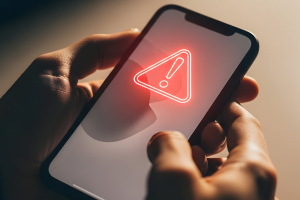
It’s the screen you never want to see.
Something is seriously wrong with your phone. Or is it? You might not have a broken phone at all. Instead, you might have a hacked phone.

What you see above is a form of scareware, an attack that frightens you into thinking your device is broken or infected with a virus. What the hacker wants you to do next is panic. They want you to tap on a bogus link that says it’ll run a security check, remove a virus, or otherwise fix your phone before the problem gets worse.
Of course, tapping that link takes you to a malware or phishing site, where the hacker takes the next step and installs an even nastier form of malware on your phone. In other cases, they steal your personal info under the guise of a virus removal service. (And yes, sometimes they pose as McAfee when they pull that move. In fact,
Note that in this example above, the hacker behind the phony broken screen is arguably going for a user who’s perhaps less tech savvy. After all, the message atop the “broken” screen appears clear as day. Still, in the heat of the moment, it can be convincing enough.
Scareware typically finds its way onto phones through misleading ads, fake security alerts, or hacked websites. In other cases, downloading apps from places other than an official app store can lead to scareware (and other forms of malware too).
As for malware on phones, you’ll find different risk levels between Android and iOS phones. While neither platform is completely immune to threats, Android phones are reportedly more susceptible to viruses than iPhones due to differences in their app downloading policies. On Android phones, you can install apps from third-party sources outside the official Google Play Store, which increases the risk of downloading malicious software.
In contrast, Apple restricts app installations to its official App Store, making it harder for malware to get on iOS devices. (That’s if you haven’t taken steps to jailbreak your iPhone, which removes the software restrictions imposed by Apple on its iOS operating system. We absolutely don’t recommend jailbreaking because it may void warranties and make it easier for malware, including scareware, to end up on your phone.)
If you think you’ve wound up with a case of scareware, stay calm. The first thing the hacker wants you to do is panic and click that link. Let’s go over the steps you can take.
If you don’t already have mobile security and antivirus for your phone, your best bet is to get the latest virus removal guidance from Android, which you can find on this help page.
Moving forward, you can get protection that helps you detect and steer clear of potential threats as you use your phone. You can pick up McAfee Security: Antivirus VPN in the Google Play store, which also includes our Scam Detector and Identity Monitoring. You can also get it as part of your McAfee+
Step 1: Restart your phone
Hold down the iPhone power button until you see slide to power off on your screen. Slide it, wait for the phone to power down, and then press the power button to restart your iPhone.
Step 2: Download updates
Having the latest version of iOS on your phone ensures you have the best protection in place. Open the Settings app. Look for Software Update in the General tab. Select Software Update. Tap Download and Install to the latest iPhone update.
Step 3: Delete suspicious apps
Press a suspicious app icon on your screen and wait for the Remove App to pop up. Remove it and repeat that as needed for any other suspicious apps.
More steps you can take …
If those steps don’t take care of the issue, there are two stronger steps you can take. The first involves restoring your phone from a backup as described by Apple here.
The most aggressive step you can take is to reset your phone entirely. You can return it to the original factory settings (with the option to keep your content) by following the steps in this help article from Apple.
Clearly these attacks play on fear that one of the most important devices in your life has a problem—your phone.
Comprehensive online protection software can secure your phone in the same ways that it secures your laptops and computers. Installing it can protect your privacy, keep you safe from attacks on public Wi-Fi, automatically block unsafe websites and links, and detect scams, just to name a few things it can do.
Along with installing security software, keeping your phone’s operating system up to date can greatly improve your security. Updates can fix vulnerabilities that hackers rely on to pull off their malware-based attacks. It’s another tried-and-true method of keeping yourself safe—and for keeping your phone running great too.
Google Play and Apple’s App Store have measures in place to review and vet apps to help ensure that they are safe and secure. Third-party sites might very well not, and they might intentionally host malicious apps as part of a front. Further, Google and Apple are quick to remove malicious apps from their stores when discovered, making shopping there safer still.
The post Black or Scrambled Phone Screen? Here’s How to Spot a Hacked vs Broken Phone appeared first on McAfee Blog.

They came by phone, by text, by email, and they even weaseled their way into people’s love lives—an entire host of scams that we covered here in our blogs throughout the year.
Today, we look back, picking five noteworthy scams that firmly established new trends, along with one in particular that gives us a hint at the face of scams to come.
Let’s start it off with one scam that pinged plenty of phones over the spring and summer: those toll road texts.
It was the hot new scam of 2025 that increased by 900% in one year: the toll road scam.
There’s a good chance you got a few of these this year,scam texts that say you have an unpaid tab for tolls and that you need to pay right away. And as always, they come with a handy link where you can pay up and avoid that threat of a “late fee.”
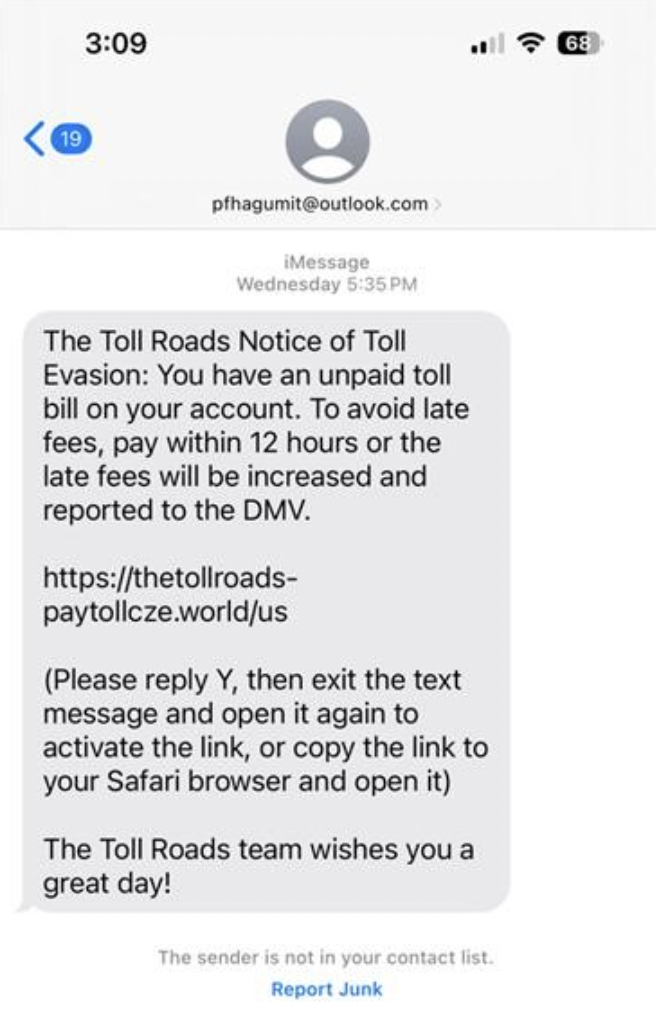
Of course, links like those took people to phishing sites where people gave scammers their payment info, which led to fraudulent charges on their cards. In some instances, the scammers took it a step further by asking for driver’s license and Social Security numbers, key pieces of info for big-time identity theft.
Who knows what the hot new text scam for 2026 will be, yet here are several ways you can stop text scams in their tracks, no matter what form they take:
Don’t click on any links in unexpected texts (or respond to them, either). Scammers want you to react quickly, but it’s best to stop and check it out.
Check to see if the text is legit. Reach out to the company that apparently contacted you using a phone number or website you know is real—not the info from the text.
Get our Scam Detector. It automatically detects scams by scanning URLs in your text messages. If you accidentally tap or click? Don’t worry, it blocks risky sites if you follow a suspicious link.
It started with a DM. And a few months later, it cost her $1,200.
Earlier this year, we brought you the story of 25-year-old computer programmer Maggie K. who fell for a romance scam on Instagram. Her story played out like so many. When she and her online boyfriend finally agreed to meet in person, he claimed he missed his flight and needed money to rebook. Desperate to finally see him, she sent the money and never heard from him again.
But here’s the twist—he wasn’t real in the first place.
When she reported the scam to police, they determined his images were all made with AI. In Maggie’s words, “That was the scariest part—I had trusted someone who never even existed.”
Maggie isn’t alone. Our own research earlier this year revealed that more than half (52%) of people have been scammed out of money or pressured to send money or gifts by someone they met online.
Moreover, we found that scammers have fueled those figures with the use of AI. Of people we surveyed, more than 1 in 4 (26%) said they—or someone they know—have been approached by an AI chatbot posing as a real person on a dating app or social media.
We expect this trend will only continue, as AI tools make it easier and more efficient to pull off romance scams on an increasingly larger scale.
Even so, the guidelines for avoiding romance scams remain the same:
The job offer sounds simple enough … go online, review products, like videos, or do otherwise simple tasks and get paid doing it—until it’s time to get paid.
It’s a new breed of job scam that took root this spring, one where victims found themselves “paying to get paid.”
The FTC dubbed these scams as “gamified job scams” or “task scams.” Given the way these scams work, the naming fits.
It starts with a text or direct message from a “recruiter” offering work with the promise of making good money by “liking” or “rating” sets of videos or product images in an app, all with the vague purpose of “product optimization.” With each click, you earn a “commission” and see your “earnings” rack up in the app. You might even get a payout, somewhere between $5 and $20, just to earn your trust.
Then comes the hook.
Like a video game, the scammer sweetens the deal by saying the next batch of work can “level up” your earnings. But if you want to claim your “earnings” and book more work, you need to pay up. So you make the deposit, complete the task set, and when you try to get your pay the scammer and your money are gone. It was all fake.
This scam and others like it fall right in line with McAfee data that uncovered a spike in job-related scams of 1,000% between May and July,which undoubtedly built on 2024’s record-setting job scam losses of $501 million.
A proper recruiter will reach out to you by email or via a job networking site. Moreover, per the FTC, any job that pays you to “like” or “rate” content is against the law. That alone says it’s a scam.
In the case of job offers in general, look up the company. Check out their background and see if it matches up with the job they’re pitching. In the U.S., The Better Business Bureau (BBB) offers a list of businesses you can search.
Any case where you’re asked to pay to up front, with any form of payment, refuse, whether that’s for “training,” “equipment,” or more work. It’s a sign of a scam.
Prince Harry, Taylor Swift, and now the Today show’s Al Roker, too, they’ve all found themselves as the AI-generated spokesperson for deepfake scams.
In the past, a deepfake Prince Harry pushed bogus investments, while another deepfake of Taylor Swift hawked a phony cookware deal. Then, this spring, a deepfake of Al Roker used his image and voice to promote a bogus hypertension cure—claiming, falsely, that he had suffered “a couple of heart attacks.”
The fabricated clip appeared on Facebook, which appeared convincing enough to fool plenty of people, including some of Roker’s own friends. “I’ve had some celebrity friends call because their parents got taken in by it,” said Roker.
While Meta quickly removed the video from Facebook after being contacted by TODAY, the damage was done. The incident highlights a growing concern in the digital age: how easy it is to create—and believe—convincing deepfakes.
Roker put it plainly, “We used to say, ‘Seeing is believing.’ Well, that’s kind of out the window now.”
In all, this stands as a good reminder to be skeptical of celebrity endorsements on social media. If public figure fronts an apparent deal for an investment, cookware, or a hypertension “cure” in your feed, think twice. And better yet, let our Scam Detector help you spot what’s real and what’s fake out there.
And to close things out, a look at some recent news, which also serves as a look ahead.
Last September, researchers spotted something unseen before:a cyberattack almost entirely run by agentic AI.
What is Agentic AI?
Definition: Artificial intelligence systems that can independently plan, make decisions, and work toward specific goals with minimal human intervention; in this way, it executes complex tasks by adapting to new info and situations on its own.
Reported by AI researcher Anthropic, a Chinese state-sponsored group allegedly used the company’s Claude Code agent to automate most of an espionage campaign across nearly thirty organizations. Attackers allegedly bypassed guardrails that typically prevent such malicious use with jailbreaking techniques, which broke down their attacks into small, seemingly innocent tasks. That way, Claude orchestrated a large-scale attack it wouldn’t otherwise execute.
Once operational, the agent performed reconnaissance, wrote exploit code, harvested credentials, identified high-value databases, created backdoors, and generated documentation of the intrusion. By Anthropic’s estimate, they completed 80–90% of the work without any human involvement.
According to Anthropic: “At the peak of its attack, the AI made thousands of requests, often multiple per second—an attack speed that would have been, for human hackers, simply impossible to match.”
We knew this moment was coming, and now the time has arrived: what once took weeks of human effort to execute a coordinated attack now boils down to minutes as agentic AI does the work on someone’s behalf.
In 2026, we can expect to see more attacks led by agentic AI, along with AI-led scams as well, which raises an important question that Anthropic answers head-on:
If AI models can be misused for cyberattacks at this scale, why continue to develop and release them? The answer is that the very abilities that allow Claude to be used in these attacks also make it crucial for cyber defense. When sophisticated cyberattacks inevitably occur, our goal is for Claude—into which we’ve built strong safeguards—to assist cybersecurity professionals to detect, disrupt, and prepare for future versions of the attack.
That gets to the heart of security online: it’s an ever-evolving game. As new technologies arise, those who protect and those who harm one-up each other in a cycle of innovation and exploits. As we’re on the side of innovation here, you can be sure we’ll continue to roll out protections that keep you safer out there. Even as AI changes the game, our commitment remains the same.
We’re taking a little holiday break here and we’ll be back with our weekly roundups again in 2026. Looking forward to catching up with you then and helping you stay safer in the new year.
The post This Year in Scams: A 2025 Retrospective, and a Look Ahead at 2026 appeared first on McAfee Blog.


If you’re in the market for insurance right now, keep an eye out for scammers in the mix. They’re out in full force once again this open enrollment season.
As people across the U.S. sign up for, renew, or change their health insurance plans, scammers want to cash in as people rush to get their coverage set. And scammers have several factors working in their favor.
For starters, many people find the insurance marketplace confusing, frustrating, and even intimidating, all feelings that scammers can take advantage of. Moreover, concerns about getting the right level of coverage at an affordable price also play into the hands of scammers.
Amidst all this uncertainty and time pressure, health insurance scams crop up online. Whether under the guise of helping people navigate the complex landscape or by offering seemingly low-cost quotes, scammers prey on insurance seekers by stealing their personal information, Social Security numbers, and money.
According to the FBI, health insurance scams cost families millions each year. In some cases, the costs are up front. People pay for fraudulent insurance and have their personal info stolen. And for many, the follow-on costs are far worse, where victims go in for emergency care and find that their treatment isn’t covered—leaving them with a hefty bill.
Like so many of the scams we cover here in our blogs, you can spot health insurance scams relatively quickly once you get to know their ins and outs.
Here’s how some of those scams can play out.
Some are “one and done scams” where the scammer promises a policy or service and then disappears after stealing money and personal info—much like an online shopping scam. It’s a quick and dirty hit where scammers quickly get what they want by reaching victims the usual ways, such as through texts, emails, paid search results, and social media. In the end, victims end up on a phishing site where they think they’re locking in a good deal but handing over their info to scammers instead.
Other scams play a long con game, milking victims for thousands and thousands of dollars over time. The following complaint lodged by one victim in Washington state provides a typical example:
A man purchased a plan to cover himself, his wife, and his two children, only to learn there was no coverage. He was sold a second policy, with the same result, and offered a refund if he purchased a third policy. When he filed a complaint, his family still had no coverage, and he was seeking a refund for more than $20,000 and reimbursement for $55,000 in treatments and prescriptions he’d paid out of pocket.
Scams like these are known as ghost broker scams where scammers pose as insurance brokers who take insurance premiums and pocket the money, leaving victims thinking they have coverage when they don’t. In some cases, scammers initially apply for a genuine policy with a legitimate carrier, only to cancel it later, while still taking premiums from the victim as their “broker.” Many victims only find out that they got scammed when they attempt to file a claim.
Another type of scam comes in the form of policy cancellation scams. These work like any number of other account-based scams, where a scammer pretends to be a customer service rep at a bank, utility, or credit card company. In the insurance version of it, scammers email, text, or call with some bad news—the person’s policy is about to get cancelled. Yet not to worry, the victim can keep the policy active they hand over some personal and financial info. It’s just one more way that scammers use urgency and fear to steal to commit identity theft and fraud.
As said, health insurance scams become relatively easy to spot once you know the tricks that scammers use. The Federal Trade Commission (FTC) offers up its list of the ones they typically use the most:
1)Someone says they’re from the government and need money or your personal info.Government agencies don’t call people out of the blue to ask them for money or personal info. No one from the government will ask you to verify your Social Security, bank account, or credit card number, and they won’t ask you to wire money or pay by gift card or cryptocurrency.
If you have a question about Health Insurance Marketplace®, contact the government directly at: HealthCare.gov or 1-800-318-2596
2) Someone tries to sell you a medical discount plan. Legitimate medical discount plans differ from health insurance. They supplement it. In that way, they don’t pay for any of your medical expenses. Rather, they’re membership programs where you pay a recurring fee for access to a network of providers who offer their services at pre-negotiated, reduced rates. The FTC strongly advises thorough research before participating in one, as some take people’s money and offer very little in return. Call your caregiver and see if they really participate in the program and in what way. And always review the details of any medical discount plan in writing before you sign up.
3) Someone wants your sensitive personal info in exchange for a price quote. The Affordable Care Act’s (ACA’s) official government site is HealthCare.gov. It lets you compare prices on health insurance plans, check your eligibility for healthcare subsidies, and begin enrollment. But HealthCare.gov will only ask for your monthly income and your age to give you a price quote. Never enter personal financial info like your Social Security number, bank account, or credit card number to get a quote for health insurance.
4) Someone wants money to help you navigate the Health Insurance Marketplace. The people who offer legitimate help with the Health Insurance Marketplace (sometimes called Navigators or Assisters) are not allowed to charge you and won’t ask you for personal or financial info. If they ask for money, it’s a scam. Go to HealthCare.govand click “Find Local Help” to learn more.
1)For health insurance, visit a trusted source like HealthCare.gov or your state marketplace. Doing so helps guarantee that you’ll get the kind of fully compliant coverage you want.
2) Make sure the insurance covers you in your state. Not every insurer is licensed to operate in your state. Double-check that the one you’re dealing with is. A good place to start is to visit the site for your state’s insurance commission. It should have resources that let you look up the insurance companies, agents, and brokers in your state.
3) For any insurance, research the company offering it. Run a search with the company name and add “scam” or “fraud” to it. See if any relevant news or complaints show up. And if the plan you’re being offered sounds too good to be true, it probably is.
4) Watch out for high-pressure sales. Don’t pay anything up front and be cautious if a company is forcing you to make quick decisions.
5) Guard your personal info. Never share your personal info, account details, or Social Security number over text or email. Make sure you’re really working with a legitimate company and that you submit any info through a secure submissions process.
6) Block bad links to phishing sites. Many insurance scams rely on phishing sites to steal personal info. A combination of our Web Protection and Scam Detector can steer you clear of them. They’ll alert you if a link might take you to one. It’ll also block those sites if you accidentally tap or click on a bad link.
7) Monitor your identity and credit. In some health insurance scams, your personal info winds up in wrong hands, which can lead to identity fraud and theft. And the problem is that you only find out once the damage is done. Actively monitoring your identity and credit can spot a problem before it becomes an even bigger one. You can take care of both easily with our identity monitoring and credit monitoring.
Additionally, our identity theft coverage can help if the unexpected happens with up to $2 million in identity theft coverage and identity restoration support if determined you’re a victim of identity theft.
You’ll find these protections and more in McAfee+.
The post How To Spot Health Insurance Scams This Open Enrollment Season appeared first on McAfee Blog.


Imagine a day where you didn’t have to juggle passwords.
No more sticky notes. No more notebooks with dozens of passwords scribbled in, crossed out, and scribbled in again. No more forgetting and resetting. No more typing them in all the time.
And even better, imagine secure accounts, likely even more secure than you could keep them on your own.
That’s the power of a password manager in your life.
A password manager does the work of creating strong, unique passwords for each and every one of your accounts. And considering the hundred or so accounts you have, that’s something that would take plenty of time if you did all that work on your own.
In all, a password manager can turn the pain of juggling passwords into a real comfort.
Before we get into how a password manager can make your life easier while making your accounts more secure, let’s look at what makes up a bad password. Here are a few examples:
Obvious passwords: Password-cracking programs start by entering a list of common (and arguably lazy) passwords. These may include the simple “password” or “1234567”. Others include common keyboard paths like “qwerty.” Even longer keyboard paths like “qwertyuiop” are well known to hackers and their tools as well.
Dictionary words: Hacking tools also look for common dictionary words strung together, which helps them crack longer passwords in chunks. The same goes for passwords that contain the name of the app or service in them. These are “no brainer” words found in passwords that make passwords even easier to crack.
Repeated passwords: You may think you have such an unbreakable password that you want to use it for all your accounts. However, this means that if hackers compromise one of your accounts, all your other accounts are vulnerable. This is a favorite tactic of hackers. They’ll target less secure accounts and services and then attempt to re-use those credentials on more secure services like online bank and credit card companies.
Personal information passwords: Passwords that include your birthday, dog’s name, or nickname leave you open to attack. While they’re easy for you to remember, they’re also easy for a hacker to discover—such as with a quick trip to your social media profile, particularly if it is not set to private.
If any of the above sounds familiar, you’ll want to replace any of your bad passwords with strong ones.
We can point to three things that make up a strong password, which makes it difficult to hack.
Your password is:
Long: A longer password is potentially a stronger password when it comes to a “brute force” attack, where a hacker uses an automated trial-and-error system to break it. For example, an eight-character password using uppercase and lowercase letters, numbers, and symbols can get hacked in minutes. Kick it up to 16 characters and it becomes incredibly more difficult to break—provided it doesn’t rely on common words or phrases. McAfee can help you generate a strong password, for stronger security with our random password generator.
Complex: To increase the security of your password, it should have a combination of uppercase letters, lowercase letters, symbols, and numbers like mentioned above.
Unique: Every one of your accounts should have its own password.
Now, apply this to the hundred or so accounts you keep and creating strong passwords for all of them really does call for a lot of work.
Given its ease of use and the big security boost it gives you and all your accounts, the answer is yes.
A password manager does the work of creating strong, unique passwords for your accounts. These will take the form of a string of random numbers, letters, and characters. They won’t be memorable, but the manager does the memorizing for you. You only need to remember a single password to access the tools of your manager.
A strong password manager also stores your passwords securely. Our password manager protects your passwords by scrambling them with AES-256, one of the strongest encryption algorithms available. Only you can decrypt and access your info with the factors you choose. Additionally, our password manager uses multi-factor authentication (MFA), so you’ll be verified by at least two factors before being signed in.
Aside from the comfort of convenience a password manager can give you, it gives you another level of assurance—extra protection in an age of data breaches, because you’ll have unique passwords where one compromise won’t lead to others.
And whether or not you go with a password manager to create those strong and unique passwords, make sure you use MFA on every account that offers it. MFA offers another layer of protection by adding another factor into the login process, such as something you own like a text to your phone or notification to an authentication app. That way if a hacker has your password, they’ll still be locked out of your account because they lack that MFA code.
In some cases, you really don’t need some of your old accounts and the passwords that come along with them. Maybe they’re old and unused. Or maybe they were for a one-time purchase at an online store you won’t visit again. Deleting these accounts is a smart move because they’re yet more places where your personal info is stored—and subject to a data breach.
Our Online Account Cleanup can help, which you can find in all our McAfee+ plans. It scans for accounts in your name, gives you a full list, and shows you which types of accounts might be riskier than others. From there you can decide which ones you want to delete, along with the personal info linked to them. In our McAfee+ Ultimate plans, you get full-service Online Account Cleanup, which sends the data deletion requests for you.
Between this and a password manager, you’ll have one less thing to juggle—your passwords, and one less thing to worry about—if they’re secure from hackers.
The post Why “Strong Passwords” Aren’t Enough Anymore—and What to Do Instead appeared first on McAfee Blog.

Pets, poisoned AI search results, and a phone call that sounds like it’s coming straight from the federal government, this week’s scams don’t have much in common except one thing: they’re getting harder to spot.
In today’s edition of This Week in Scams, we’re breaking down the biggest security lapses and the tactics scammers used to exploit them, and what you can do to stay ahead of the latest threats.
If you’re a Petco customer, you’ll want to know about not one but two data security lapses in the past week.
First, as reported by TechCrunch on Monday, Petco followed Texas data privacy laws by filing a data breach with the attorney general’s office. In that filing, Petco reported that the affected data included names, Social Security numbers, and driver’s license numbers. Further info including account numbers, credit and debit card numbers, and dates of birth were also mentioned in the filing.
Also according to Techcrunch, the company filed similar notices in California and Massachusetts.
To date, Petco has not made a comment about the size of the breach and the number of people affected.
Different states have different policies for reporting data breaches. In some cases, that helps us put a figure to the size of the breach, as some states require companies to disclose the total number of people caught up in the breach. That’s not the case here, so the full scope of the attack remains in question, at least for right now.
As of Thursday, we know Petco reported that 329 Texans were affected along with seven Massachusetts residents, per the respective reports filed. California’s report does not contain the number of Californians affected, yet laws in that state require businesses to report breaches that affect 500 or more people, so at least 500 people were affected there.
Below you can see the form letter Petco sent to affected Californians in accordance with California’s data privacy laws:
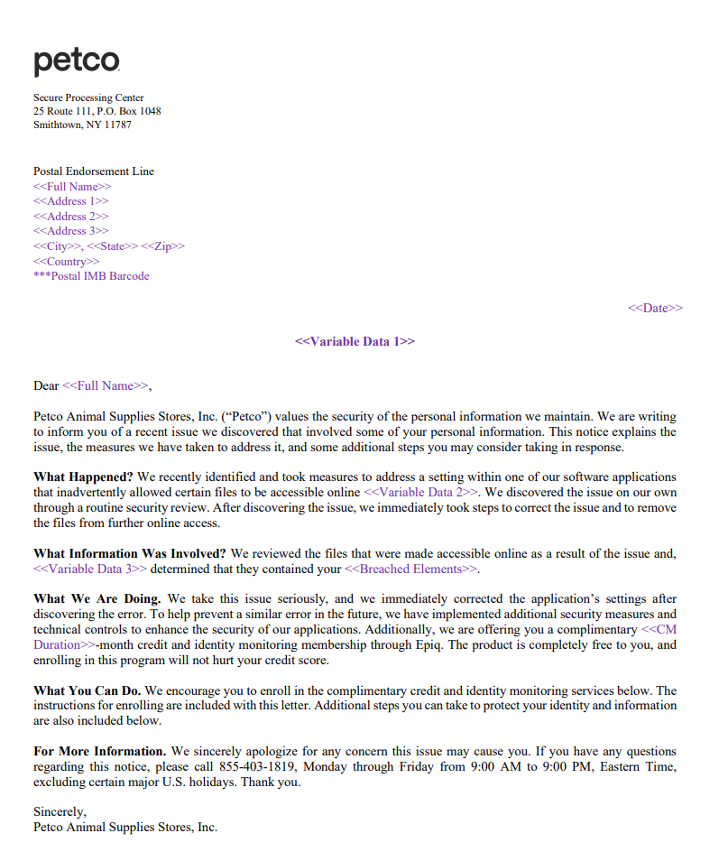
In it, you can see that Petco discovered that “a setting within one of our software applications … inadvertently allowed certain files to become accessible online.” Further, Petco said that it “immediately took steps to correct the issue and to remove the files from further online access,” and that it “corrected” the setting and implemented unspecified “additional security measures.”
So while no foul play appears to have been behind the breach, it’s still no less risky and concerning for Petco’s customers. We’ll cover what you can do about that in a moment after we cover yet another data issue at Petco through its Vetco clinics.
Also within the same timeframe, yet more research and reporting from Techcrunch uncovered a second security lapse that exposed personal info online. From their article:
“TechCrunch identified a vulnerability in how Vetco’s website generates copies of PDF documents for its customers.
“Vetco’s customer portal, located at petpass.com, allows customers to log in and obtain veterinary records and other documents relating to their pet’s care. But TechCrunch found that the PDF generating page on Vetco’s website was public and not protected with a password.
“As such, it was possible for anyone on the internet to access sensitive customer files directly from Vetco’s servers by modifying the web address to input a customer’s unique identification number. Vetco customer numbers are sequential, which means one could access other customers’ data simply by changing a customer number by one or two digits.”
With the size and reach of the Petco breach still unknown, and the impact of the Vetco security lapse also unknown, we advise caution for all Petco customers. At minimum, monitor transactions and keep an eye on your credit report for any suspicious activity. And it’s always a good time to update a weak password.
For those who received a notification, we advise the following:
Check your credit, consider a security freeze, and get ID theft protection. You can get all three working for you with McAfee+ Advanced or McAfee+ Ultimate.
Monitor transactions across your accounts, also available in McAfee+ Advanced and Ultimate.
Keep an eye out for phishing attacks. Use our Scam Detector to spot any follow-on attacks.
Update your passwords. Strong and unique passwords are best. Our password manager can help you create and store them securely.
And use two-factor authentication on all your accounts. Enabling two-factor authentication provides an added layer of security.
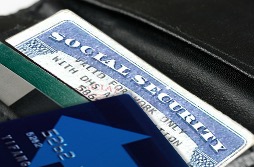
What to do if your Social Security number was breached.
If you think your Social Security number was caught up in the breach, act quickly.
You might want to be careful when searching for customer service numbers while in AI mode. Or with an AI search engine. It could connect you to a scammer.
From The Times comes reports of scammers manipulating the AI in platforms like Google and Perplexity so that their search results return scam numbers instead of a proper customer service numbers for, say, British Airways.
How do they manipulate those results? By spamming the internet with false info that gets picked up and then amplified by AI.
“[S]cammers have started seeding fake call center numbers on the web so the AI is tricked into thinking it is genuine …
“Criminals have set up YouTube channels with videos claiming to help with customer support, which are packed with airline brand names and scam numbers designed to be scraped and reused by the AI.
“Bot-generated reviews on Yelp or video descriptions on YouTube are filled with fraudulent numbers as are airline and travel web forums.”
And with these tactics, scammers could poison the results for just about any organization, business, or brand. Not just airlines. Per The Times, “The scammers have also hijacked government sites, university domains, and even fitness sites to place scam numbers, which fools the AI into thinking they are genuine.”
This reveals a current limitation with many AI platforms. Largely they can’t distinguish when people deliberately feed them bad info, as seen in the case here.
Yet even as this attack is new, our advice remains the same: any time you want to ring up a customer service line, get the number directly from the company’s official website. Not from AI search and not by clicking a paid search result that shows up first (scammers can poison them too).
Are you under investigation for money laundering? Of course not. But this scam wants you to think so—and to pay up.
On Tuesday, the Federal Trade Commission (FTC) issued a consumer alert warning that people are reporting getting unexpected calls from someone saying they’re “FTC agent” John Krebs. Apparently “Agent Krebs” is telling people that they’re under investigation for money laundering—and that a deposit to a Bitcoin ATM can resolve the matter.
Of course, it’s a scam.
For starters, the FTC doesn’t have “agents.” And the idea of clearing one’s name in an investigation with a Bitcoin payment is a sure-fire sign of a scam. Lastly, any time someone asks for payment with Bitcoin or other payment methods that are near-impossible to recover (think wire transfers and gift cards), those are big red flags.
Apart from hanging up and holding on to your money, the FTC offers the following guidance, which holds true for any scam call:
As always, here’s a quick list of a few stories that caught our eye this week:
AI tools transform Christmas shopping as people turn to chatbots
National cybercrime network operating for 14 years dismantled in Indonesia
Why is AI becoming the go-to support for our children’s mental health?
We’ll see you next Friday with a special edition to close out 2025 … This Year in Scams.
The post This Week in Scams: Petco Breach Warning, and Watch Out for Fake Federal Calls appeared first on McAfee Blog.

It looks harmless enough.
A digital party invitation lands in your inbox or phone. You click to see the details. Then it asks you to log in or create an account before revealing the event.
That’s where the scam begins.
Fake e-vite phishing scams are on the rise, and they take advantage of something simple: social trust. You’re far more likely to click an invitation than a generic “account alert” or “delivery notice.”
And that’s exactly why scammers are using them.
In fact, here’s a screenshot of a fake phishing email I recently got this holiday season:
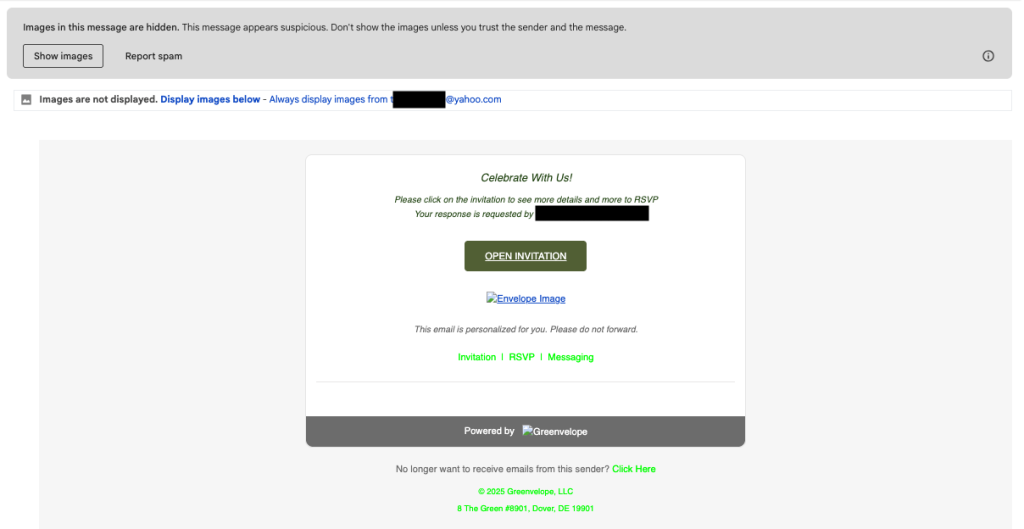
When you click the “open invitation” link, it immediately asks you to sign in or create an account with your personal information. That’s the step where scammers steal your private data.
A fake e-vite scam is a phishing attack that pretends to be a real invitation from platforms like Paperless Post or other digital invitation services.
The goal is to trick you into:
Once scammers have your login information, they can:
Here’s the most common flow:
Because this starts with something familiar and social, many people don’t realize it’s phishing until accounts are already compromised. Plus, scammers then use your email and name to trick friends and family into trusting more fake e-vites from your account.
Paperless Post has publicly acknowledged these scams and shared what legitimate messages actually look like.
Legitimate Paperless Post Emails Will Never:
Official Paperless Post Email Domains:
Legitimate invitations and account messages only come from:
Official support emails only come from:
If the sender does not match one of these exactly, it’s a scam.
Paperless Post also notes that verified emails may display a blue checkmark in supported inboxes to confirm authenticity.
If you see any of the following, do not click:
Modern phishing attacks don’t rely on sloppy design anymore. Many now use:
Invitation phishing is especially powerful because:
If you entered any information into a suspicious invitation page:
The faster you act, the more damage you can prevent.
The post Think That Party Invite Is Real? Fake E-Vite Scams Are the New Phishing Trap appeared first on McAfee Blog.
AI-powered browsers give you much more than a window to the web. They represent an entirely new way to experience the internet, with an AI “agent” working by your side.
We’re entering an age where you can delegate all kinds of tasks to a browser, and with that comes a few things you’ll want to keep in mind when using AI browsers like ChatGPT’s Atlas, Perplexity’s Comet, and others.
So, what’s the allure of this new breed of browser? The answer is that it’s highly helpful, and plenty more.
By design, these “agentic” AI browsers actively assist you with the things you do online. They can automate tasks and interpret your intentions when you make a request. Further, they can work proactively by anticipating things you might need or by offering suggestions.
In a way, an AI browser works like a personal assistant. It can summarize the pages in several open tabs, conduct research on just about any topic you ask it to, or even track down the lowest airfare to Paris in the month of May. Want it to order ink for your printer and some batteries for your remote? It can do that too. And that’s just to name a few possibilities.
As you can see, referring to the AI in these browsers as “agentic” fits. It truly works like an agent on your behalf, a capability that promises to get more powerful over time.
But as with any new technology, early adopters should balance excitement with awareness, especially when it comes to privacy and security. You might have seen some recent headlines that shared word of security concerns with these browsers.
The reported exploits vary, as does the harm they can potentially inflict. That ranges from stealing personal info, gaining access to Gmail and Google Drive files, installing malware, and injecting the AI’s “memory” with malicious instructions, which can follow from session to session and device to device, wherever a user logs in.
Our own research has shown that some of these attacks are now tougher to pull off than they were initially, particularly as the AI browser companies continue to put guardrails in place. If anything, this reinforces a long-standing truth about online security, it’s a cat-and-mouse game. Tech companies put protections in place, bad actors discover an exploit, companies put further protections in place, new exploits crop up, and so on. It’s much the same in the rapidly evolving space of AI browsers. The technology might be new, but the game certainly isn’t.
While these reports don’t mean AI browsers are necessarily unsafe to use, they do underscore how fast this space is evolving…and why caution is smart as the tech matures.
It’s still early days for AI-powered browsers and understanding the security and privacy implications of their use. With that, we strongly recommend the following to help reduce your risk:
Don’t let an AI browser do what you wouldn’t let a stranger do. Handle things like your banking, finances, and health on your own. And the same certainly goes for all the info tied to those aspects of your life.
Pay attention to confirmations. As of today, agentic browsers still require some level of confirmation from the user to perform key actions (like processing a payment, sending an email, or updating a calendar entry). Pay close attention to them, so you can prevent your browser from doing something you don’t want it to do.
Use the “logged out” mode, if possible. As of this writing, at least one AI browser, Atlas, gives you the option to use the agent in the logged-out mode.i This limits its access to sensitive data and the risk of it taking actions on your behalf with your credentials.
If possible, disable “model learning.” By turning it off, you reduce the amount of personal info stored and processed by the AI provider for AI training purposes, which can minimize security and privacy risks.
Set privacy controls to the strictest options available. Further, understand what privacy policies the AI developer has in place. For example, some AI providers have policies that allow people to review your interactions with the AI as part of its training. These policies vary from company to company, and they tend to undergo changes. Keeping regular tabs on the privacy policy of the AI browser you use makes for a privacy-smart move.
Keep yourself informed. The capabilities, features, and privacy policies of AI-powered browsers continue to evolve rapidly. Set up news alerts about the AI browser you use and see if any issues get reported and, if so, how the AI developer has responded. Do routine searches pairing the name of the AI browser with “privacy.”
McAfee’s award-winning protection helps you browse safer, whether you’re testing out new AI tools or just surfing the web.
McAfee offers comprehensive privacy services, including personal info scans and removal plus a secure VPN.
Plus, protections like McAfee’s Scam Detector automatically alert you to suspicious texts, emails, and videos before harm can happen—helping you manage your online presence confidently and safeguard your digital life for the long term. Likewise, Web Protection can help you steer you clear of suspicious websites that might take advantage of AI browsers.
The post How to Stay Safe on Your New AI Browser appeared first on McAfee Blog.
