Using a 1930s trade law, Homeland Security targeted the man—who hasn’t entered the US in more than a decade—following posts on X condemning the killings of Renee Good and Alex Pretti.
The exploit, dubbed CopyFail and tracked as CVE-2026-31431, allows hackers to take over PCs and data center servers. The Linux vulnerabilities have been patched—but many machines remain at risk.
You’re scrolling through Facebook or TikTok and see it.
A flash sale from a brand you recognize. A limited-time investment opportunity. A job posting that promises quick money.
The ad has comments. The account looks polished. Maybe someone you follow even liked it.
So you click.
From there, things move fast. You’re pushed to act quickly, enter your information, or send payment before the “deal” disappears. And just like that, the money is gone or your account is compromised.
This isn’t an edge case anymore. According to new FTC data, nearly 30% of people who reported losing money to a scam in 2025 said it started on social media, with total losses hitting $2.1 billion.
That’s why McAfee+ Advanced includes comprehensive protection designed to help you spot and stop scams at every step, including McAfee’s Scam Detector, which flags suspicious links and messages and explains why they may be risky, along with identity and privacy tools that help protect your information if a scam slips through.
How Social Media Ad Scams Work
A social media ad scam is when scammers use paid ads, fake profiles, or hijacked accounts on platforms like Facebook, Instagram, or TikTok to promote fake products, services, or investment opportunities in order to steal money or personal information.
Step
What happens
What to do
How McAfee helps
1
You see an ad, post, or DM promoting a deal, job, or investment
Don’t engage immediately, even if it looks legitimate
Scam Detector flags suspicious links and messages before you interact
2
The ad links to a website or moves you into DMs
Avoid clicking unfamiliar links or continuing off-platform
Safe Browsing helps block risky or newly created websites
3
You’re pressured to act quickly or “secure your spot”
Slow down and verify the company independently
Scam Detector explains urgency tactics and why they’re risky
4
You’re asked to pay, share login info, or download something
Never send money or credentials based on a social media interaction
Identity Monitoring helps protect your personal data if exposed
5
The product never arrives, the investment disappears, or your account is compromised
Report the scam and secure your accounts immediately
Personal Data Cleanup and monitoring help reduce ongoing exposure
Red Flags To Watch For
Deals that feel unusually cheap or urgent
Ads linking to unfamiliar or slightly misspelled websites
Requests to move conversations off-platform quickly
Payment requests via apps, crypto, or wire transfer
Accounts with limited history or inconsistent engagement
And that is the first part of This Week in Scams! This Friday we’re taking a different format to talk about this new FTC data and all that it reveals.
Let’s keep digging in:
FTC Report: Social Media Scams Are Now The Most Costly Fraud Channel
New data from the FTC shows just how dominant social media has become in the scam landscape.
Social media scams drove $2.1 billion in reported losses in 2025
Losses have increased eightfold since 2020
Investment scams alone accounted for $1.1 billion of those losses
Where Scams Are Happening And What’s Changing
Category
What to know
Most common scams
Shopping scams lead, with over 40% of victims reporting purchases from social media ads that never arrived
Most costly scams
Investment scams drive the biggest losses, often starting with ads or group chats showing fake success
What’s changing
Scammers are using platform tools like ads, targeting, and profile data to reach people more precisely than ever
OpenAI is rolling out Advanced Account Security for people concerned that their ChatGPT or Codex accounts could be potential targets of phishing attacks.
Secure Access adds Security Insights to speed up SOC Ops. Now, an analyst uses a three-click workflow, reducing investigation time from minutes to seconds.
Dive into the architecture behind Cisco’s holistic, mutilayered PQC strategy to understand how Cisco is operationalizing the secure communications and secure products across the communication planes, inside the chipset, and down to the firmware that loads before your operating system even boots.
Spyware appears to have captured everything from intimate photos to private messages from the smartphone of European celebrity. They were publicly accessible until a researcher flagged the exposure.
The war in Iran has drawn attention to arrests in the United Arab Emirates over online content, but the legal framework behind that enforcement has existed for years.
AI agents may soon be buying your stuff for you. The FIDO Alliance has teamed up with Google and Mastercard to try to ensure that shopping in the near future isn't a complete disaster.
The suspected shooter at Saturday night’s White House Correspondents’ Dinner faces three felony charges. He remains in custody following Monday’s hearing.
A 31-year-old engineer and self-described indie game developer is suspected of firing shots at the annual event attended by President Donald Trump, high-profile media figures, and US government officials.
Plus: Spy firms tap into a global telecom weakness to track targets, 500,000 UK health records go up for sale on Alibaba, Apple patches a revealing notification bug, and more.
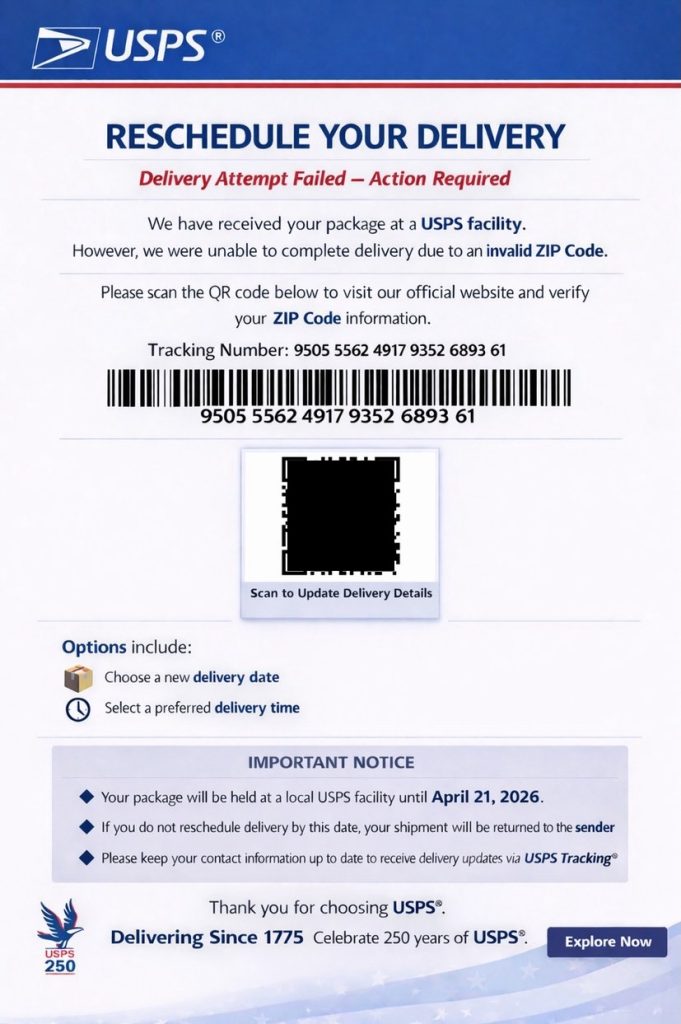
A new scam making the rounds takes a familiar delivery trick and upgrades it with hyper‑realistic messaging and a QR code that looks safe to scan.
But don’t be fooled.
It’s the same delivery scam playbook scammers have relied on for years, just repackaged with better design and more convincing details.
You get a message with a notice that looks something like this, a real message received by our team and tested against McAfee’s Scam Detector.
This is an example of the scam message we received, impersonating the USPS.
That added layer of realism is what makes this version more dangerous. But it doesn’t hold up under scrutiny. McAfee’s Scam Detector flagged both the suspicious language and the QR code in this message before any interaction.
If you receive something like this, pause. Do not scan the code.
You can also protect yourself with McAfee’s Scam Detector, which flags suspicious links and messages, including delivery scams and QR‑based attacks, and explains why they may be risky.
What is the USPS QR Code Scam and How Does it Work?
The USPS QR code scam is a phishing attempt where scammers impersonate postal services and use QR codes instead of clickable links to direct victims to malicious websites.
Once scanned, the QR code can lead to a fake USPS page that asks for payment, login credentials, or personal information.
How the scam works
Step
What happens
The red flags
What to do
How McAfee helps
1
You receive a text about a delivery issue or missed package
Requests for small “redelivery” or “processing” fees are not normal
Exit immediately and do not submit anything
Scam Detector explains why the page is risky, and Identity Monitoring supports you when if your info gets out.
What To Do If You Get This Message
Do not scan the QR code
Go directly to the official USPS website to check tracking
Delete the message
Report it as spam
Monitor your accounts if you interacted with it
And that, my friends, is scam number one in this week’s This Week in Scams.
Let’s get into what else is on our radar.
A Major Health Data Breach Exposes 500,000 Records
A massive health data incident is raising new concerns about how sensitive information is handled and shared.
According to reporting from the Associated Press, data tied to 500,000 participants in a major U.K. health research project was found listed for sale online. The dataset included biological and health-related information, though it did not contain direct identifiers like names or contact details.
Access to the data had been granted to research institutions, but that access has since been revoked. Authorities say no purchases were made, and the listing has been removed.
Still, the situation highlights a growing reality: once data is accessed or shared, control over it becomes harder to guarantee.
What This Breach Says About Data Privacy
Scams are no longer isolated events. They are layered.
A data breach does not just stay a breach. It becomes fuel for future scams. Exposed information can be used to make phishing messages more convincing, personalize attacks, and build trust with targets.
That is why detection alone is not enough anymore. Protection has to account for both incoming threats and what happens when data is already out there.
How McAfee Protects You In A World of Scams and Data Breaches
McAfee+ Advanced gives you multiple layers working together so you are not left figuring it out after the damage is done:
Identity Monitoring alerts you if your personal info shows up where it should not, so you can act fast
Personal Data Cleanup helps remove your information from data broker sites, making you harder to target in the first place
Scam Detector flags suspicious texts, emails, links, and even deepfake videos before you engage
Safe Browsing helps block risky sites if you do click
A US surveillance program that lets the FBI view Americans’ communications without a warrant is up for renewal. A new bill aims to address mounting lawmaker concerns—with smoke and mirrors.
Researchers have finally cracked Fast16, mysterious code capable of silently tampering with calculation and simulation software. It was created in 2005—and likely deployed by the US or an ally.
One group of hackers used AI for everything from vibe coding their malware to creating fake company websites—and stole as much as $12 million in three months.
The Firefox team doesn’t think emerging AI capabilities will upend cybersecurity long term, but they warn that software developers are likely in for a rocky transition.
A lawsuit from the Consumer Federation of America accuses Meta of misleading consumers about its efforts to combat scams advertisements on its platforms.

 Login
Login