New analysis shows that attacks on satellite navigation systems have impacted some 1,100 ships in the Middle East since the US and Israel attacked Iran on February 28.
The Odido breach leaks were towards the beginning during this week's update. I recorded it the day after the second dump of data had hit, with a third dump coming a few hours later, and a final dump of everything the day after that. From what I hear, it dominated the news in the Netherlands, and we sure saw that through the traffic stats. Clearly, the leak cadence was designed for maximum news impact, and it seems to have achieved that. It may not have put any cash in the extortionist's pockets, but it's set a very visible precedent and, I suspect, put a massive law enforcement target on them. It's hard to image leaks of this impact continuing for much longer...
As Israeli airstrikes hit Tehran this morning, Iranians received mysterious push notifications saying that “help is on the way,” promising amnesty if they surrender.
Well, the ESP32 Bluetooth bridge experiment was a complete failure. Not the radios themselves, they're actually pretty cool, but there's just no way I could get the Yale locks to be reliably operated by them. At a guess, BLE is a bit too passive to detect state changes, and unless it was awake and communicating, it just had no idea what was happening with the locks. So, I've now silenced all lock-related alerts and am focusing on making the wifi network as reliable as possible in the hope the locks actually become responsive. If that doesn't work, those Aqara U400s look really sweet...
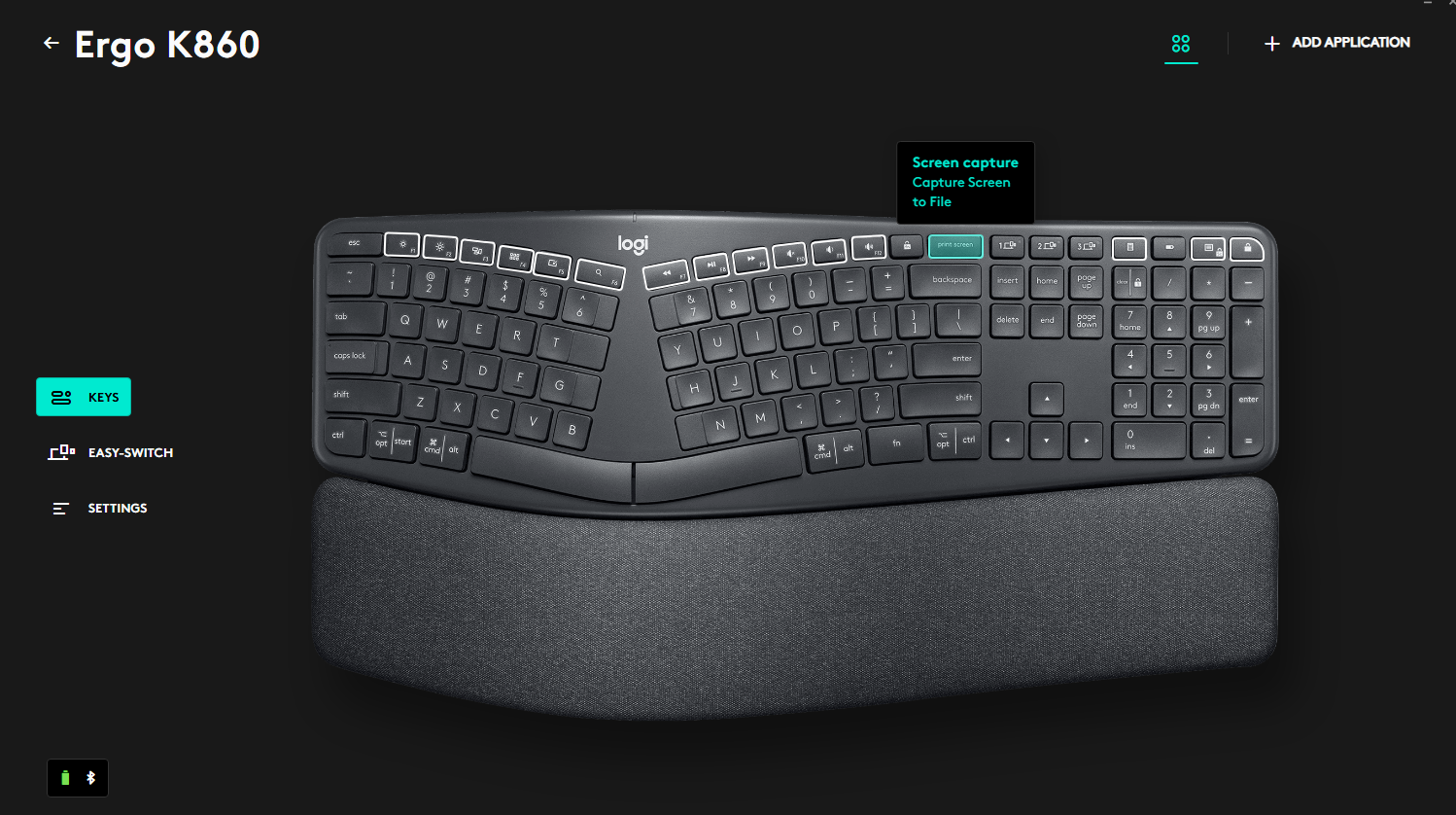
A big "thank you" to everyone who helped me troubleshoot the problem with my "Print Screen" button on the new PC. Try as we all might, none of us could figure out why it refused to bind to SnagIt and instead insisted on dumping the entire collection of screens to a file on the desktop. But an especailly big thanks to the follower who later emailed me with an idea that didn't work, and followed up with an idea that finally did!
So, yeah, thanks Logitech for making this a real pain in the arse 🤦♂️
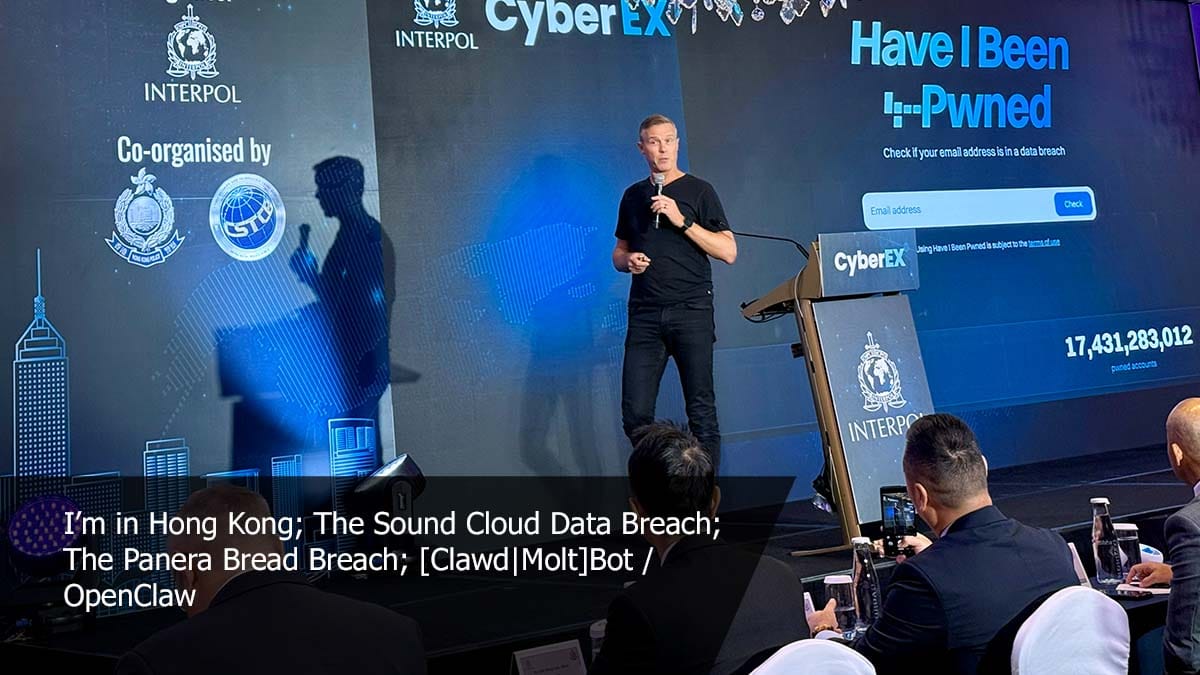
This week I'm in Hong Kong, and the day after recording, I gave the talk shown in the image above at INTERPOL's Cybercrime Expert Group. I posted a little about this on Facebook and LinkedIn, but thought I'd expand on what really stuck with me after watching other speakers: the effort agencies are putting into cybercrime prevention. It's very easy for folks to judge law enforcement solely on what they see from the outside, and that's mostly going after offenders and taking down criminal infrastructure. But the bit I'm increasingly seeing behind the scenes is a push to help kids (the sorts of hackers I usually interact with are teenagers or young adults at most) make better choices when they're faced with a pathway into cybercrime. The transition from minor offences (game cheats and DDoS'ing) to full-on cybercriminals (hacking and extortion) is very well-known, and intervening at the right time can not only make a difference to the impact of data breaches on all of us, but it can also make a massive difference to these kids' lives. These agencies are underfunded and understaffed compared to the scale of the problem, so making the time to come visit and find some ways to help in our little corner of the data breach world is a no-brainer 😊
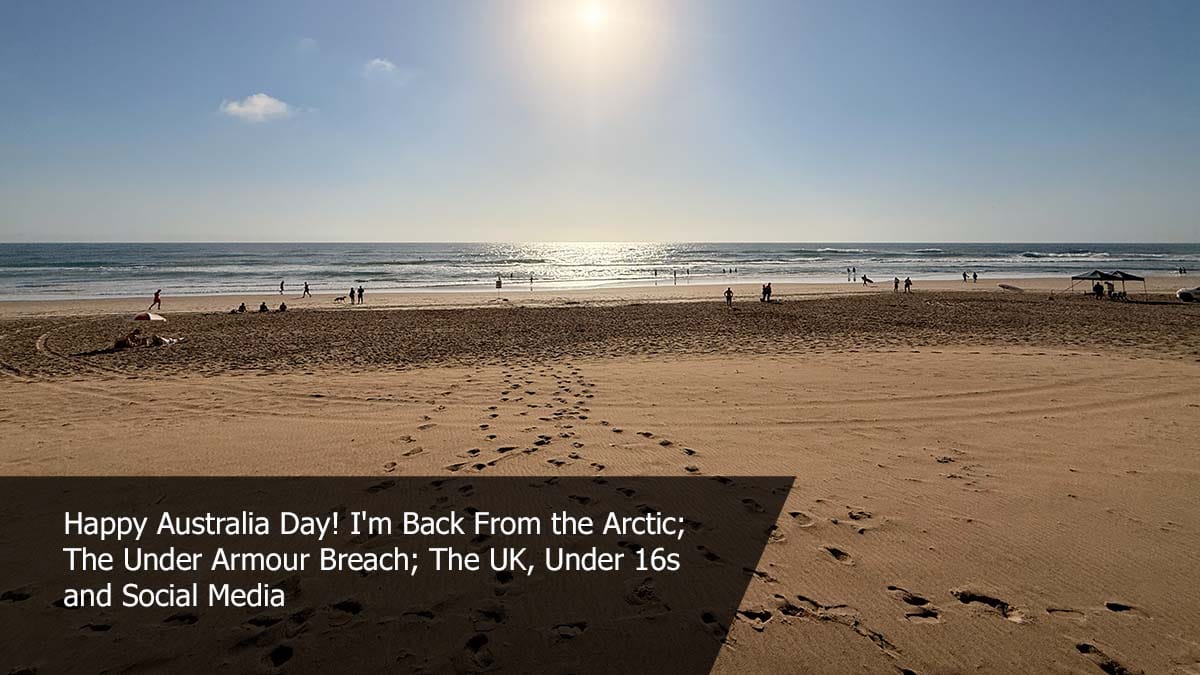
It's the discussion about the reaction of some people in the UK regarding their impending social media ban for under 16s that bugged me most. Most noteably was the hand-waving around "the gov is just trying to siphon up all our IDs" and "this means everyone will have to show ID, not just under 16s". If only there was another precedent somewhere in the world where precisely this model was rolled... oh - wait! 🐨 The way the ban (sorry - "delay") has been done in Australia isn't perfect, but it also doesn't have to be. There are still plenty of under 16s with access so socials, but I do not know of a single adult who had had to show any form of ID or do any age verification whatsoever. So, relax, wait until we know more about how thye're planning to do it (and the UK gov will be closely looking at the Aussie precedent), and then lose your minds if it's done totally differently at the expense of everyone's privacy.
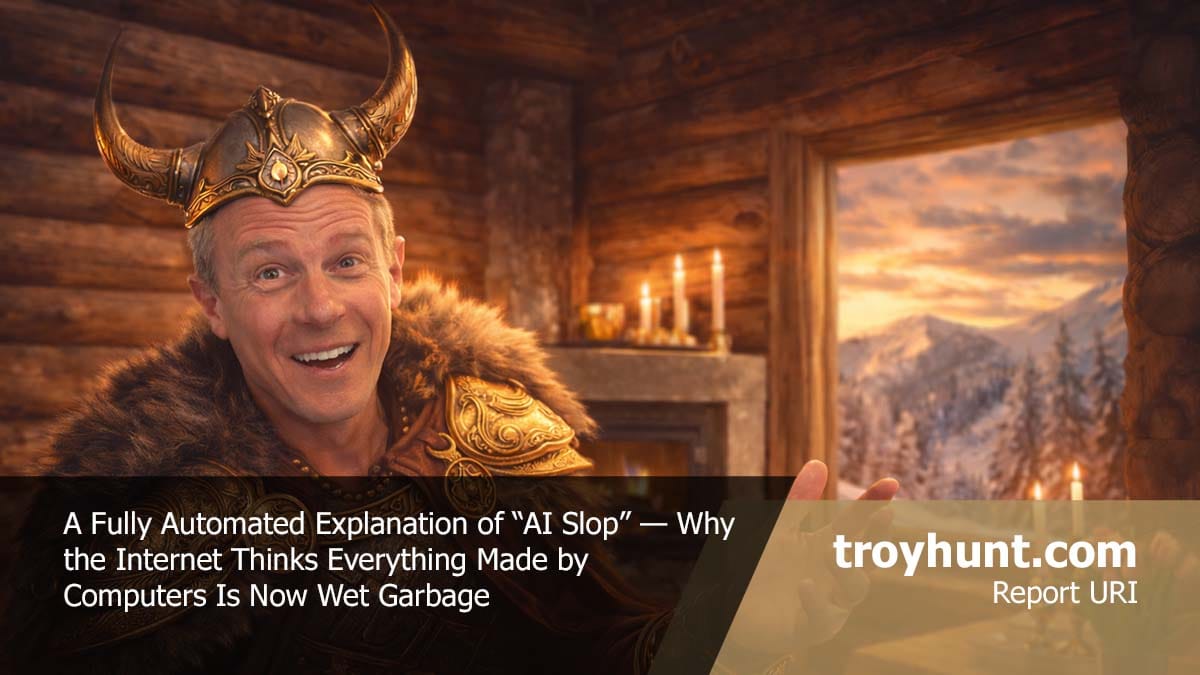
I thought Scott would cop it first when he posted about what his solar system really cost him last year. "You're so gonna get that stupid AI-slop response from some people", I joked. But no, he got other stupid responses instead! And I got the AI-slop responses! Draw your own conclusions on those comments, but I find it fascinating that the one thing people would take away from a thoughtful blog post I spent many hours writing to explain how much work I put into privacy is that the illustration was computer-generated. That such feedback aligns with the political leanings of folks on Mastodon is also fascinating, and probably something I should have seen coming. But hey, there's nothing new about folks popping their heads up to make inane comments where none were needed, and I have a special blog post for just such occasions: If You Don't Want Guitar Lessons, Stop Following Me.
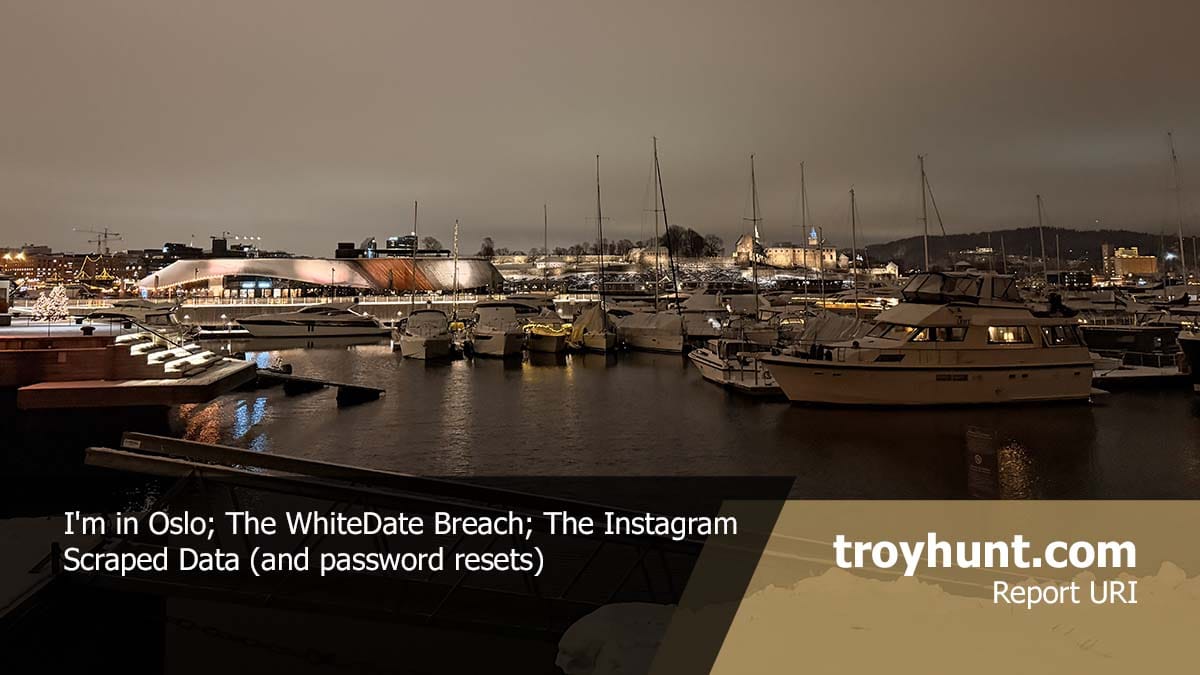
I’m in Oslo! Flighty is telling me I’ve flown in or out of here 43 times since a visit in 2014 set me on a new path professionally and, many years later, personally. It’s special here, like a second home that just feels… right. This week, the business end of things is about the WhiteDate data breach. Seeking a partner along common racial lines isn’t unusual, but… well… WhiteDate is anything but usual. And, just for fun, see if you can pick the thing that garnered the most negative feedback about that blog post this week, I’ll feature the discussion in the next vid.
Remember the Ashley Madison data breach? That was now more than a decade ago, yet it arguably remains the single most noteworthy data breach of all time. There are many reasons for this accolade, but chief among them is that by virtue of the site being expressly designed to facilitate extramarital affairs, there was massive social stigma attached to it. As a result, we saw some pretty crazy stuff:
Arguably, we now live in a more privacy-conscious era, one full of acronyms such as GDPR and CCPA, among others, in different parts of the world. The right to be forgotten, the right to erasure, and, indeed, privacy as a fundamental human right feature very differently in 2026 than they did in 2015. But arguably, even back then, the impact of outing someone as a member of the site should have been obvious. It was certainly obvious to me, which is why I introduced the concept of a sensitive data breach before the data even went public. HIBP wouldn’t show results for this breach publicly because I was concerned about the impact on people being outed. My worst fear was a spouse coming home to find someone having taken their own life, an HIBP search result on the screen in front of their lifeless body.
People died as a result of the breach. Marriages ended and lives were turned upside down. People lost their jobs. The human toll of the breach was profound. The decision I made after witnessing this was that if a breach was likely to have serious personal or social consequences for people in there, it would be flagged as sensitive and not publicly searchable.
The public doxing of members of the service was often justified on a moral basis: “adultery is bad, they deserve to be outed”. But there are two massive problems with this attitude, and I’ll begin with the purpose for which accounts were sometimes made:
An email address appearing in that breach implied that the person was there to have an extramarital affair because that was literally the catch-phrase of the service: “Life is short, have an affair”. But the reality was that people were members of the service for many, many different reasons. Have a read of my post titled Here’s What Ashley Madison Members Have Told Me and you’ll begin to understand how much more nuanced the situation was:
Single people had joined the service, and later married before the breach occurred
People who were worried about a cheating spouse joined the service in order to try to catch them
Accounts were made with some people’s names and email addresses without their consent (there are many “Barrack Obamas” in the data)
So, should everyone with an email address on Ashley Madison be considered an adulterer? Clearly, no, that completely misses the nuances of what an email address in a data breach really means. But what about the people who were there to have an affair? Well, that brings us to the second problem:
Our own personal belief systems are not a valid basis for outing people publicly because their belief systems differ. I used more generic terms than “extramarital affair” or “cheating” because there are many other data breaches that are flagged as sensitive in HIBP for the very same reason. Fur Affinity, for example: there is a social stigma around furries and outing someone as a member of that community could have negative consequences for them. Rosebutt Board is another example: anal fisting is evidently something a bunch of people are into, and equally, I’m sure there are many who take a moral objection to it. And finally, to get to the catalyst for this post, WhiteDate: the website that is ostensibly designed for white people to date other white people. Flagging that as sensitive resulted in some unsavoury commentary being directed at me:
Now, I emphasised “ostensibly” because the more you dig into this breach, the more you find tones of white supremacy and other behaviours that definitely don’t align with my personal value system. That societal view doesn’t sit well with me, and I think I’m safe in saying it wouldn’t sit well with most people. Would someone being outed as a member of that service be likely to result in “serious personal or social consequences”? Yes, and you can see that in the messaging from the same account:
Context matters. U are literally shielding Nazi hate mongering scoundrels. We can't doxx white supremacists?
If ISIS had a dating site & it got breached, would you protect it out of fear of doxxing? No.
This behaviour is precisely what I don’t want HIBP being used for: as a weapon to attack people solely on the basis of their email address being affiliated with a website that has had a data breach.
personal data revealing racial or ethnic origin, political opinions, religious or philosophical beliefs;
trade-union membership;
genetic data, biometric data processed solely to identify a human being;
health-related data;
data concerning a person’s sex life or sexual orientation.
An ISIS dating website breach would tick many of the boxes above and would therefore constitute a sensitive data breach. That's not an endorsement of what they stand for; it's simply a data-processing decision. But there may be a nuance in there which I didn't see present in the WhiteDate data - what if it contained illegal activity? (Sidenote: for the most part, HIBP is used by people in Western Europe, North America and Australasia, so when I say "illegal", I'm looking at it through that lens. Clearly, there are parts of the world where our "illegal" is their "normal", which further complicates how I run a service accessible from every corner of the world.) I had another example recently that went well beyond moral contention and deep into the realm of illegality:
New sensitive breach: "AI girlfriend" site Muah[.]ai had 1.9M email addresses breached last month. Data included AI prompts describing desired images, many sexual in nature and many describing child exploitation. 24% were already in @haveibeenpwned. More: https://t.co/NTXeQZFr2x
Of all the different things people can disagree on when it comes to our moral compasses, paedophilia is where we unanimously draw the line. But I still flagged it as sensitive because of the reasons outlined above. Many people using the service were just lonely guys trying to create an AI girlfriend with no prompts around age. There would be email addresses in there that weren’t entered by the rightful owner. And then, there are cases like this:
That's a firstname.lastname Gmail address. Drop it into Outlook and it automatically matches the owner. It has his name, his job title, the company he works for and his professional photo, all matched to that AI prompt. pic.twitter.com/wpXQMBLf3B
I sat there with my wife, looking at the LinkedIn profile that used the same email address as the person who posted that comment. We looked at his photo and at the veneer of professionalism that surrounded him on that site, knowing what he had written in that prompt above. It was repulsive. Further, beyond being solely an affront to our morals, it was clearly illegal. So, I had many conversations with law enforcement agencies around the world and ensured they had access to the data. Involving law enforcement where data sets contain illegal activity is absolutely the right approach here, but equally, not being the vehicle for implying someone’s affiliation or beliefs and doxing them publicly without due process is also absolutely the right approach.
I understand the gut reaction that flagging a breach like WhiteDate as sensitive protects people whom most of us do not like. But a dozen years of running this service have caused me to consider individual privacy and rights literally hundreds of times, and these conclusions aren’t arrived at hastily. Imagine for a moment, the possible ramifications for HIBP if the service were used to publicly shame someone as a "Nazi" and that, in turn, had serious real-world consequences for them. Whether that implication was right or not, there are potentially serious ramifications for us that could well leave us unable to operate at all. And, as the Ashley Madison examples show, there are also potentially life-threatening outcomes for individuals.
I don't particularly care about one random, anonymous X account making poorly thought-out statements, but the same sentiment has been expressed after loading previous similar breaches, and it deserves a blog post. Equally, I've written before about why all the other data breaches are publicly searchable and again, that conclusion is not arrived at lightly.
No one shall be subjected to arbitrary interference with his privacy, family, home or correspondence, nor to attacks upon his honour and reputation. Everyone has the right to the protection of the law against such interference or attacks.
Breaches with legally defined sensitive data will continue to be flagged as sensitive, and breaches with illegal data will continue to be forwarded to law enforcement agencies.
15 mins and 40 seconds. That's how long it took to troubleshoot the first tech problem of 2026, and that's how far you'll need to skip through this video to hear the audio at normal volume. The problem Scott and I had is analogous to the troubleshooting so many of us do in our roles day in and day out:
This should work fine
It doesn't work, and I don't know why
I did something that seems unrelate,d and now it works
I still don't know why
Anyway, I've cleaned up the audio-only version for the podcast, but I can't change the YouTube version once it's streamed, so apologies, just pump your volume up for the first quarter hour. And Happy New Year!
Every day, new ransomware and data breaches dominate the headlines, reminding us that it’s a matter of when, not if, your organization may be next. Having a well-prepared response plan and a team of forensic professionals ready to act at a moment’s notice can mean a world of difference between swift incident recovery or a […]
Building out an IoT environment is a little like the old Maslow's Hierarchy of Needs. All the stuff on the top is only any good if all the stuff on the bottom is good, starting with power. This week, I couldn't even get that right, but thankfully, sparky to rescue and ensuite underfloor heating disconnected, and we now have reliable power again. On top of that is the layer that has increasingly been my nemesis - the network. Two days after recording, I've just spent the better part of the entire day making a much more concerted effort to adjust channel and power settings on APs, lock clients that don't move to the APs that make the most sense, and generally just screw around with it until stuff worked. And then I turned off a circuit, turned it back on again, and all hell broke loose 😭
Perhaps it's just the time of year where we all start to wind down a bit, or maybe I'm just tired after another massive 12 months, but this week's vid is way late. Ok, going away to the place that had just been breached (ironic!) didn't help, but I think in general the pace we've maintained this year just needs to come back a bit. That said, I'll try to get this week's and next week's out on time, then it's off on travels for the next four weeks after that. Stay tuned for more IoT problems in a few days from now 🤦♂️
The sheer scope of cybercrime can be hard to fathom, even when you live and breathe it every day. It's not just the volume of data, but also the extent to which it replicates across criminal actors seeking to abuse it for their own gain, and to our detriment.
We were reminded of this recently when the FBI reached out and asked if they could send us 630 million more passwords. For the last four years, they've been sending over passwords found during the course of their investigations in the hope that we can help organisations block them from future use. Back then, we were supporting 1.26 billion searches of the service each month. Now, it's... more:
Just as it's hard to wrap your head around the scale of cybercrime, I find it hard to grasp that number fully. On average, that service is hit nearly 7 thousand times per second, and at peak, it's many times more than that. Every one of those requests is a chance to stop an account takeover. But the real scale goes well beyond the API itself. Because the data model is open source and freely available, many organisations use the Pwned Passwords Downloader to take the entire corpus offline and query it directly within their own applications. That tool alone calls the API around a million times during download, but the resulting data is then queried… well, who knows how many times after that. Pretty cool, right?
This latest corpus of data came to us as a result of the FBI seizing multiple devices belonging to a suspect. The data appeared to have originated from both the open web and Tor-based marketplaces, Telegram channels and infostealer malware families. We hadn't seen about 7.4% of them in HIBP before, which might sound small, but that's 46 million vulnerable passwords we weren't giving people using the service the opportunity to block. So, we've added those and bumped the prevalence count on the other 584 million we already had.
We're thrilled to be able to provide this service to the community for free and want to also quickly thank Cloudflare for their support in providing us with the infrastructure to make this possible. Thanks to their edge caching tech, all those passwords are queryable from a location just a handful of milliseconds away from wherever you are on the globe.
If you're hitting the API, then all the data is already searchable for you. If you're downloading it all offline, go and grab the latest data now. Either way, go forth and put it to good use and help make a cybercriminal's day just that much harder 😊
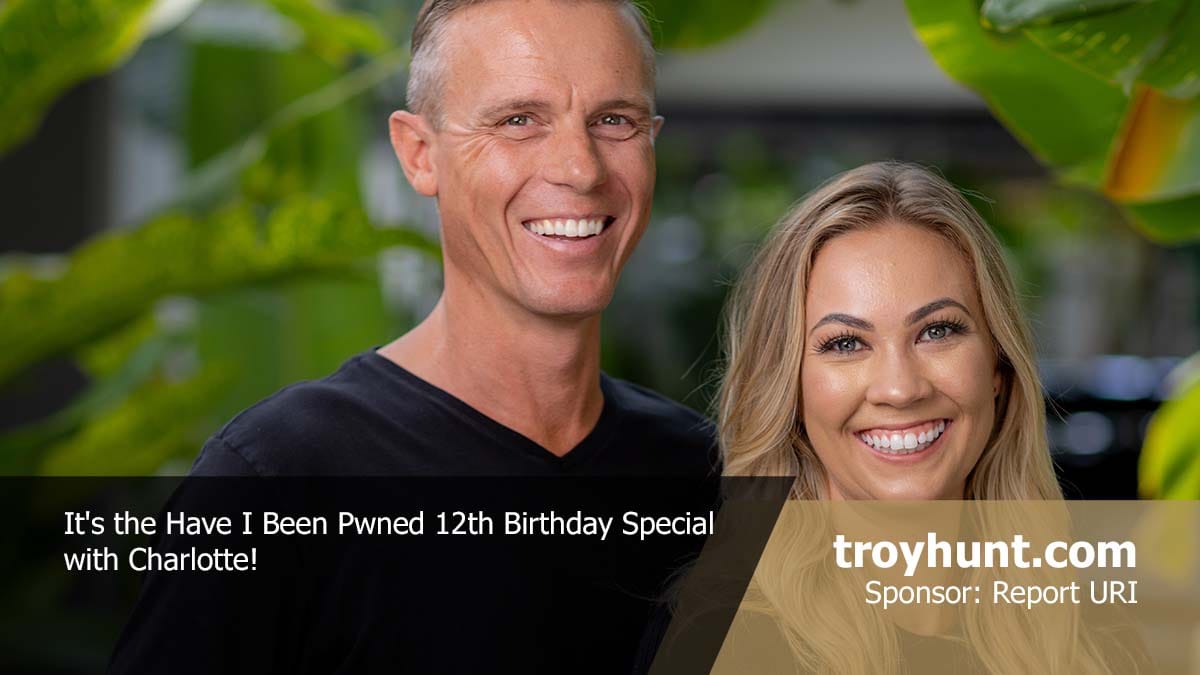
Twelve years (and one day) since launching Have I Been Pwned, it's now a service that Charlotte and I live and breathe every day. From the first thing every morning to the last thing each day, from holidays to birthdays, in sickness and in heal... wait a minute - did we marry each other or a data breach service?! We decided to do a 12th-birthday special together today to give everyone a bit more insight into what she does and what life is like running this service. It's a different weekly vid, and we really hope you enjoy watching it 😊
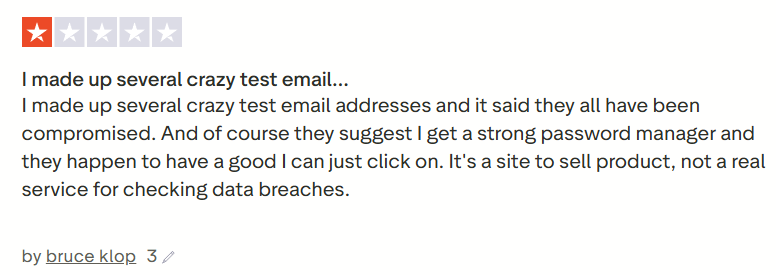
Normally, when someone sends feedback like this, I ignore it, but it happens often enough that it deserves an explainer, because the answer is really, really simple. So simple, in fact, that it should be evident to the likes of Bruce, who decided his misunderstanding deserved a 1-star Trustpilot review yesterday:
You think you know - and Bruce thinks he knows - but you might both be wrong. To explain the answer to the question, we need to start with how HIBP ingests data, and that really is pretty simple: someone sends us a breach (which is typically just text files of data), and we run the open source Email Address Extractor tool over it, which then dumps all the unique addresses into a file. That file is then uploaded into the system, where the addresses are then searchable.
The logic for how we extract addresses is all in that Github repository, but in simple terms, it boils down to this:
There must be an @ symbol
There can be up to 64 characters before it (the alias)
There can be up to 255 characters after it (the domain)
A few other little criteria that are all documented in the public repo
That is all! We can't then tell if there's an actual mailbox behind the address, as that would require massive per-address processing, for example, sending an email to each one and seeing if it bounces. Can you imagine doing that 7 billion times?! That's the number of unique addresses in HIBP, and clearly, it's impossible. So, that means all the following were parsed as being valid and loaded into HIBP (deep links to the search result):
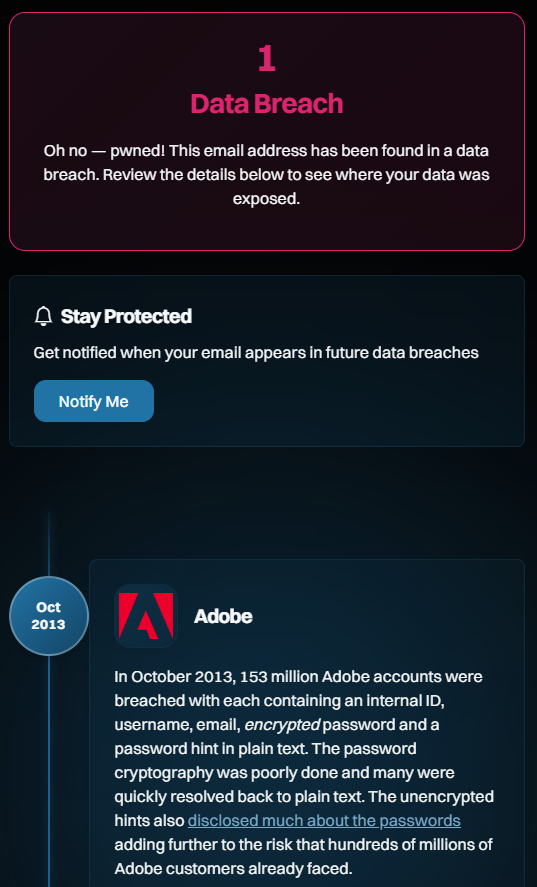
I particularly like that last one, as it feels like a sentiment Bruce would express. It's also a great example as it's clearly not "real"; the alias is a bit of a giveaway, as is the domain ("foo" is commonly used as a placeholder, similar to how we might also use "bar", or combine them as "foo bar"). But if you follow the link and see the breach it was exposed in, you'll see a very familiar name:
Which brings us to the next question:
How Do "Fake" Email Addresses End up in Real Websites?
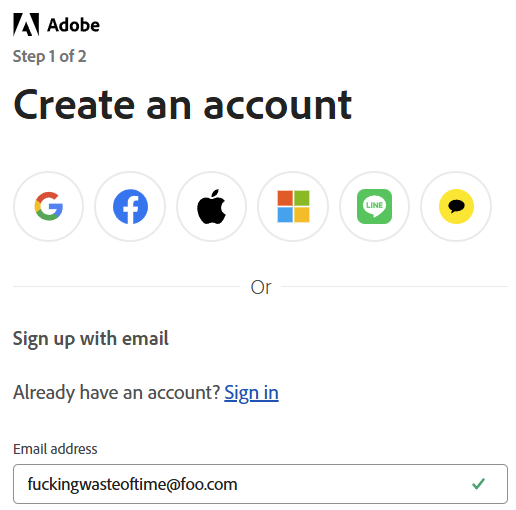
This is also going to seem profoundly simple when you see it. Here goes:
Any questions, Bruce? This is just as easily explainable as why we considered it a valid address and ingested it into HIBP: the email address has a valid structure. That is all. That's how it got into Adobe, and that's how it then flowed through into HIBP.
Ah, but shouldn't Adobe verify the address? I mean, shouldn't they send an email to the address along the lines of "Hey, are you sure you want to sign up for this service?" Yes, they should, but here's the kicker: that doesn't stop the email address from being added to their database in the first place! The way this normally works (and this is what we do with HIBP when you sign up for the free notification service) is you enter the email address, the system generates a random token, and then the two are saved together in the database. A link with the token is then emailed to the address and used to verify the user if they then follow that link. And if they don't follow that link? We delete the email address if it hasn't been verified within a few days, but evidently, Adobe doesn't. Most services don't, so here we are.
How Can I Be Really Sure Actual Fake Addresses Aren't in HIBP?
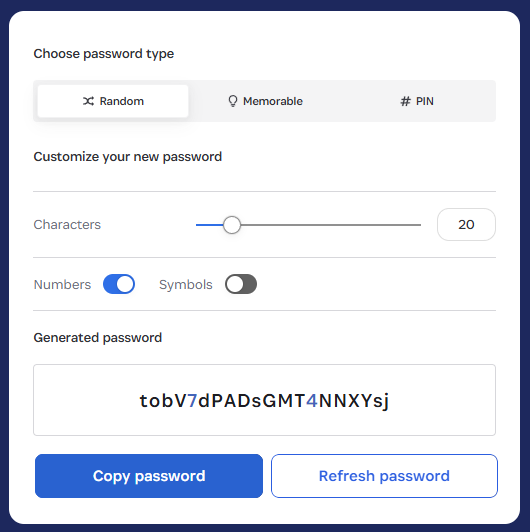
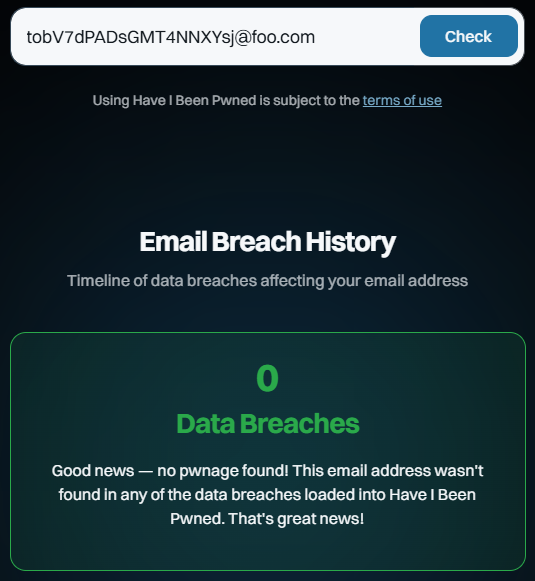
This is also going to seem profoundly obvious, but genuinely random email addresses(not "thisisfuckinguseless@") won't show up in HIBP. Want to test the theory? Try 1Password's generator (yes, Bruce, they also sponsor HIBP):
Huh, would you look at that? And you can keep doing that over and over again. You’ll get the same result because they are fabricated addresses that no one else has created or entered into a website that was subsequently breached, ipso facto proving they cannot appear in the dataset.
Conclusion
Today is HIBP's 12th birthday, and I've taken particular issue with Bruce's review because it calls into question the integrity with which I run this service. This is now the 218th blog post I've written about HIBP, and over the last dozen years, I've detailed everything from the architecture to the ethical considerations to how I verify breaches. It's hard to imagine being any more transparent about how this service runs, and per the above, it's very simple to disprove the Bruces of the world. If you've read this far and have an accurate, fact-based review you'd like to leave, that'd be awesome 😊
Well, I now have the answer to how Snapchat does age verification for under-16s: they give an underage kid the ability to change their date of birth, then do a facial scan to verify. The facial scan (a third party tells me...) allows someone well under 16 to pass it easily. So, is that control "reasonable"? I guess that will depend on whether this case is an outlier or a much more common scenario, and a sample set of one isn't particularly scientific. Either way, I expect that what we're seeing is representative of a pretty obvious problem: privacy-preserving age verification is very unlikely to be reliable. It will inevitably result in letting too many young kids through, whilst blocking too many people of legitimate age. Or we end up with people needing to start uploading formal age-verification documents, which creates a whole new problem. Absolutely none of this should come as any surprise whatsoever!
You’re scrolling TikTok or Instagram, half-paying attention, when a Black Friday ad pops up. It looks like the brand you love—same logo, same photos, same “limited-time deal” language you’ve seen in real promos. The link takes you to a site that looks identical to the real one. The checkout page works. The confirmation email looks legit.
Then the payment clears, and the merchant name on your bank statement doesn’t match the store at all.
That moment, wait, what did I just buy from?, is becoming the defining holiday-shopping scam of 2025.
This year, fake ads and cloned storefronts aren’t sketchy one-offs or typo-filled red flags. They’re polished. They’re identical. And increasingly, they’re powered by AI.
McAfee’s 2025 holiday research found that nearly half of Americans (46%) have already encountered AI-altered or AI-generated scams while shopping. And with 96% of people planning to shop online, many doing so daily, scammers know this is peak opportunity.
Here’s how fraudsters are blending into the busiest shopping season of the year, what the data shows, and how to stay one step ahead.
Why Scammers Are So Effective Right Now
A perfect storm is happening:
People are shopping more often. Nearly half of U.S. adults expect to shop online daily or multiple times per day during the holidays.
People are rushed. From early Black Friday “price drop” alerts to Cyber Monday countdowns, shoppers don’t slow down to verify what they’re seeing.
Holiday deals are already rolling out—and so are the scams.
McAfee’s 2025 holiday research shows major spikes in email scams (~50% increase), technology scams (~85% increase), and fake storefronts that mimic trusted retailers. AI tools are making these scams faster, more realistic, and harder to spot.
It’s not that shoppers suddenly got careless.
It’s that scammers suddenly got good.
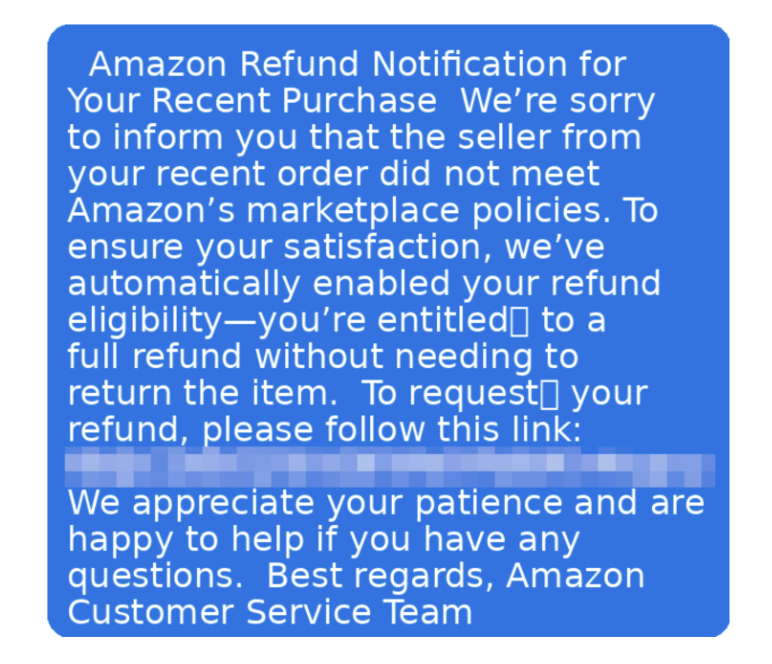
This shows a SMishing text from a fake Amazon. Companies won’t text you like this.
The 2025 Scams Hitting Shoppers the Hardest
1. Fake Retail Sites & “Deal” Pages That Look Real
This is the big one, and it’s getting cleaner every year.
Scammers lift entire storefronts:
Logos
Product photos
Sale graphics
Checkout flows
Even fake customer service pages
The only giveaway? A URL that’s juuust slightly off—“target-sale.com” instead of “target.com,” or a link ending in “.shop” or “.store” rather than a brand’s normal domain.
Once you enter your payment info, it goes directly into a database that criminals resell or use to make purchases.
How to spot and avoid this scam: Skip the ad. Type the retailer’s name into your browser yourself. If it’s a real deal, you’ll find it on their actual site.
2. TikTok, Instagram & Social Video Scams
Short-form videos are now a prime scam vehicle.
Scammers steal influencer footage, use AI voice clones, or generate deepfake “promo” videos with celebrities offering huge holiday discounts. When someone clicks the link, it leads straight to a counterfeit store.
46% have encountered fake influencer/celebrity endorsements
Younger shoppers (18–34) see them most
Many appear during holiday-sale cycles on TikTok Shop and Instagram Shopping
US – Holiday Shopping 2025 fact…
How to spot and avoid this scam: Check the creator’s account history. Real brands don’t drop one-off promo videos from accounts you’ve never seen before. Same as our initial advice, skip the ad entirely and go directly to the official brand website rather than clicking any links.
3. Delivery & Shipping Text Scams
The classic delivery scam is back, with McAfee researchers finding dozens of examples of fake messages attempting to scam holiday shoppers.
You’ll receive a text saying a package can’t be delivered or that a small fee is needed to confirm your address.
McAfee found that 43% of people have encountered fake delivery notifications, and many victims say they entered credit card information thinking they were resolving a legitimate issue.
How to spot and avoid this scam: UPS, USPS, and FedEx will never send a clickable payment link in a text. If you’re wondering about a specific delivery, go directly to the site you ordered it from, or your original receipt in your email to find your tracking information.
4. Account Verification & Gift Card Scams
These hit during the weeks leading up to the holidays.
Messages claim:
Your Amazon account is locked
Your Apple ID has “suspicious activity”
Your loyalty points are expiring
You must verify your payment information
You must pay a fee or gift card to resolve an issue
How to spot and avoid this scam: No legitimate company will ever resolve account issues through gift cards or text-confirmation codes.
How AI Is Supercharging These Scams
Not long ago, scam emails had broken English and pixelated logos.
Now scammers use generative AI to:
Clone real brand websites
Rewrite perfect phishing emails
Fake customer service chatbots
Produce Hyper-real video ads
Replicate influencer voices
Generate thousands of unique scam texts instantly
And people are noticing.
57% of shoppers say they’re more concerned about AI scams this year than last.
Yet 38% believe they can spot scams—even though 22% have fallen for one.
Confidence ≠ protection.
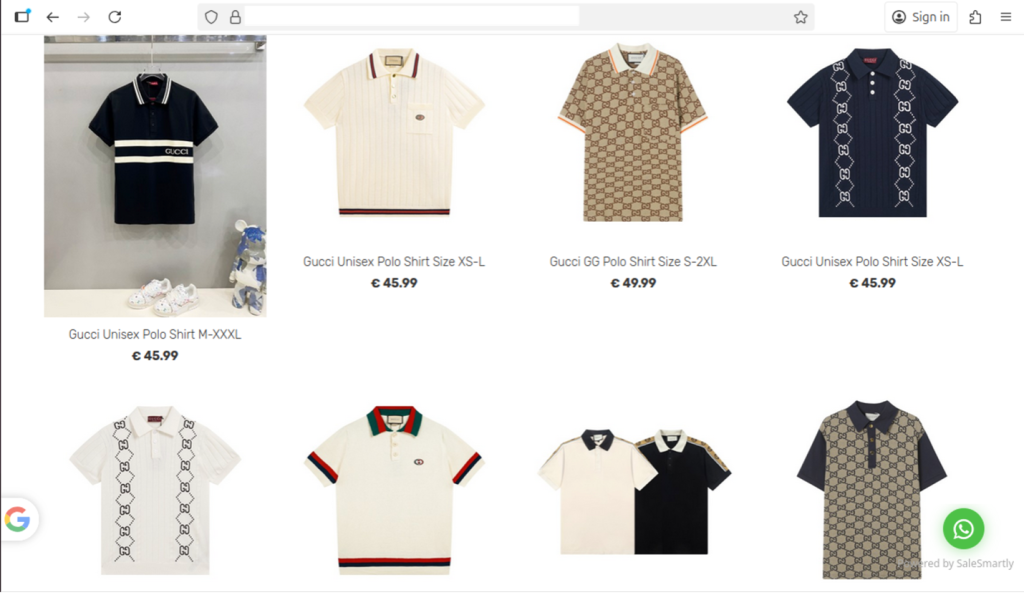
Fake designer websites like this page for Gucci shirts are deceptive and look close to the real thing.
What to Do if You Think You’ve Encountered a Scam
If something feels off—a message, a link, a charge on your bank statement—don’t panic. Most holiday scams rely on speed and confusion. Slowing down and taking a few simple steps can keep a bad situation from turning into real damage.
1. Stop engaging immediately
Close the tab, delete the message, and don’t click anything else. Scammers often stack multiple pop-ups or redirects to pressure you into acting fast.
2. Don’t enter any additional information
If you started typing in a password or card number but didn’t hit “submit,” back out. If you did enter details, move to the next steps right away.
3. Change your passwords (starting with the affected account)
Use a strong, unique password—especially for accounts tied to:
email
shopping apps
banking
cloud storage
A reused password is how one compromised login unlocks everything else. McAfee offers a password manager to help you make and store strong, unique passwords.
4. Check your bank or credit card for unexpected charges
Fraud usually starts small: $1–$5 “test” charges, odd merchant names, or tiny withdrawals. If you see anything suspicious, contact your bank and request:
a card replacement
a fraud alert
a temporary account freeze, if necessary
5. Run a security scan on your device
Some fake sites drop malware or spyware quietly in the background. A quick scan can detect:
Reporting helps stop other shoppers from being targeted. You can report scams to:
the retailer being impersonated
the platform where you saw the ad (TikTok, Instagram, Facebook)
your national fraud reporting center
7. Let technology help you clean up
McAfee can automatically detect whether the link, message, or site you interacted with is malicious—and alert you if your information may have been exposed. Tools like:
can help contain an issue before it turns into identity theft.
We offer a free antivirus trial to help protect your devices.
Need a Gift for the Practical Person in Your Life? Consider Giving Them Scam Protection
There’s always someone on your holiday list who doesn’t want more stuff, they want something useful. The friend who loves a clean inbox. The sibling who’s constantly traveling. The parent who keeps forwarding you suspicious texts asking, “Is this real?”
For them, security might actually be the most thoughtful gift you can give this year.
Online safety tools aren’t flashy, but they are the thing people reach for the moment they click the wrong link, lose a password, or get a sketchy delivery text. And with scams more believable than ever, digital protection has quietly become a new “practical essential,” like a good VPN or a reliable password manager.
Scam protection that works quietly in the background Scam Detector flags dangerous messages, deepfake-style content, and fake shopping sites before they ever interact with them.
Identity & financial monitoring A huge help for anyone who’s been burned by fraud in the past — or is tired of checking bank statements manually.
Password security that doesn’t require them to remember anything Perfect for the person who uses the same password everywhere (and you know exactly who I mean).
Device protection for laptops, phones, and tablets Which is especially relevant for people shopping, traveling, or working remotely through the holiday season.
It’s practical. It’s protective. And unlike most presents, it’s something they’ll use all year.
I gave up on the IoT water meter reader. Being technical and thinking you can solve everything with technology is both a blessing and a curse; dogged persistence has given me the life I have today, but it has also burned serious amounts of time because I never want to let a problem go unsolved. But sometimes, common sense and the ROI of my time have to prevail, so I packed up all the gear and went back to processing data breaches. If you happen to solve this problem in a way that doesn't require any more time investment on my end, I'd love to hear it 😊
 Login
Login