Reading view

This Week in Scams: The AI “Truman Show” Scam Draining Bank Accounts

We’re back with another roundup of must-know scams and cybersecurity news making headlines this week, including a scam that features the name of the Jim Carrey movie, The Truman Show.

Let’s break it down. 

Why Reports Call it the “Truman Show” Scam 

So, why the name of this scam?

In the 1998 film The Truman Show, the main character unknowingly lives inside a staged reality TV world where everything around him is carefully controlled. In the “Truman Show” scam, criminals try to place victims into a similarly staged investment environment, complete with fake group chats, fake investors, and fake profits designed to build trust. It doesn’t actually have anything to do with the movie.

What is the “Truman Show” Scam?

The “Truman Show” scam is an AI-powered investment scam where criminals create an entire fake online community to convince victims an investment opportunity is real. 

According to reports, scammers invite people into group chats on platforms like Telegram or WhatsApp that appear full of investors sharing tips and celebrating profits. In reality, many of the participants, moderators, and conversations may be run by AI bots designed to simulate a lively trading community. 

Security researchers say the moderator and the other “investors” in the group may actually be AI-driven bots, programmed to simulate real conversations and enthusiasm around the investment strategy. 

The scam often includes: 

  • A group chat on Telegram or WhatsApp 
  • A downloadable trading app or website 
  • Screenshots showing fake profits 
  • Encouragement from “other members” to invest more 

The app itself may appear legitimate. But in reality, it often redirects users to a malicious website where scammers collect personal and financial information. 

Once victims deposit money, the criminals can quickly drain accounts or block withdrawals. 

McAfee’s State of the Scamiverse research shows just how convincing scams have become. One in three Americans (33%) say they feel less confident spotting scams than they did a year ago, as criminals increasingly use polished branding, realistic conversations, and AI-generated content to make fraudulent opportunities look legitimate. 

Why this works: people naturally trust social proof. When it looks like dozens of other investors are making money, people lower their skepticism.  

Fake Government Letters Are Targeting Residents Across Towns 

Another scam to be aware of this week includes spoofed letters impersonating local government offices.

According to reporting from WGME in Maine, residents in multiple towns recently received official-looking notices requesting payment for supposed municipal fees tied to development applications. 

The letters appeared convincing. They used formal language, official seals, and department names. But there was a problem. 

One of the notices claimed it came from a “Board of Commissioners,” even though the town in question does not have one. 

Officials say the letters instructed recipients to send payments by wire transfer, a method legitimate government offices almost never use for these kinds of transactions. 

McAfee’s experts say these scams are effective because they rely on volume. Fraudsters send thousands of letters hoping a small percentage of recipients will respond before verifying the request. And remember, these types of scams occur all the time and across the globe. While today’s reports are in Maine, it’s important to be vigilant wherever you live. 

Red flags to watch for: 

  • Requests for wire transfers, gift cards, or crypto payments 
  • Pressure to pay quickly to avoid penalties 
  • Official-looking letters with subtle inconsistencies 
  • Contact information that doesn’t match the official government website 

The safest move is simple: verify the request independently. Contact the government office directly using phone numbers listed on its official website, not the ones in the letter. 

LexisNexis Confirms Data Breach After Hackers Leak Files 

Meanwhile, a well-known data analytics company is dealing with a breach after hackers published stolen files online. 

According to BleepingComputer, LexisNexis Legal & Professional confirmed that attackers accessed some of its servers and obtained limited customer and business information. The confirmation came after a hacking group leaked roughly 2GB of stolen data on underground forums. 

LexisNexis says the compromised systems contained mostly older or “legacy” data from before 2020, including: 

  • Customer names 
  • User IDs 
  • Business contact information 
  • Product usage details 
  • Support tickets and survey responses 

The company says highly sensitive financial information, Social Security numbers, and active passwords were not part of the exposed data. 

However, attackers claim they accessed millions of database records and hundreds of thousands of cloud user profiles tied to the company’s systems. 

LexisNexis says it has contained the intrusion and is working with cybersecurity experts and law enforcement. 

Why breaches like this matter: even when the stolen data appears limited, it can still be used in targeted phishing attacks. 

For example, scammers might use real names, email addresses, or business roles to send convincing messages that appear legitimate. 

Breaches often trigger waves of follow-up scams weeks or months later. (We know we cover this one a lot, but it’s key to remember!) 

McAfee’s Safety Tips This Week 

A few simple habits can make these schemes much easier to spot. 

  • Be skeptical of investment groups online. Real trading communities rarely pressure you to deposit money quickly or download unfamiliar apps. 
  • Verify government payment requests independently. If you receive a letter demanding payment, contact the agency directly using information from its official website. 
  • Treat breach-related messages cautiously. After a breach makes headlines, phishing emails often follow pretending to offer “account verification” or “security updates.” 
  • Avoid clicking unfamiliar links in emails or texts. Tools like McAfee’s free WebAdvisor can help flag risky websites and block known malicious pages before they load. 
  • Pause before sending money or personal information. Many scams rely on urgency. Slowing down gives you time to verify what’s real.

We’ll be back next week with another roundup of the scams and cybersecurity news making headlines and what they mean for your digital safety. 

The post This Week in Scams: The AI “Truman Show” Scam Draining Bank Accounts appeared first on McAfee Blog.

  •  

Tax Scams Hit Nearly 1 in 4 Adults. Spot the Red Flags

John C. isn’t the person you picture getting scammed. 

He’s 36. He’s tech-savvy. He’s a mechanical engineer leading a team at a national energy lab in Denver. And he told us his story for one reason: “Scammers will target anyone.” 

It began with a phone call from someone claiming to be the IRS. They said John had underpaid his taxes and needed to resolve it quickly. The caller sounded polished and convincing, so convincing that John didn’t stop to question it. 

“I thought maybe they sent back too much money [in my refund], and they needed it back,” he said. “I was just so busy and overwhelmed that I never really stopped to think about the situation.” 

A follow-up email arrived with IRS logos, clean formatting, and a big payment button. John was trying to move fast between classes as he finished up his PhD, and he wanted to correct the situation as quickly as possible. 

“I was like, let me just hurry up and do this, get it over with.” 

He clicked. He paid. But later, when he checked his statement, he saw the charge didn’t look like an IRS payment at all. In fact, it was an international charge. The whole thing was a scam. 

John said the scammer on the phone had appealed to his emotions and been incredibly convincing.  

“It was absolutely masterful,” John said. “I would give him an Oscar for it. 

And new McAfee research shows John isn’t alone, with nearly 1 in 4 (23%) US adults surveyed revealing they’ve lost money to a tax scam.  

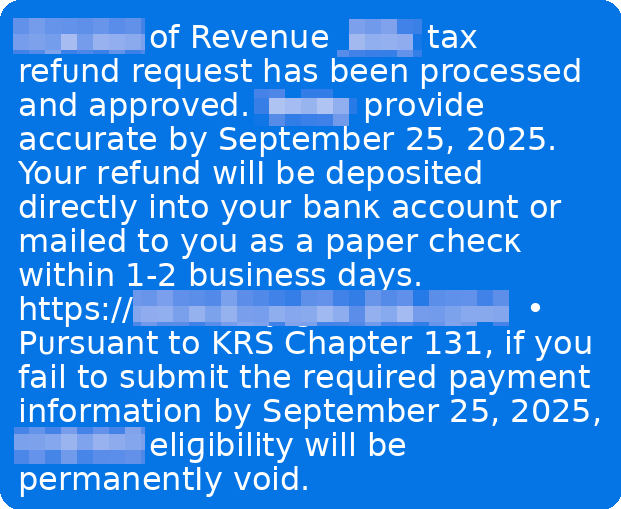
Example of a tax scam text message

Key findings from McAfee’s 2026 Tax Season Survey 

Here’s what our January 2026 survey of 3,008 U.S. adults found: 

The big picture: lots of worry, not enough confidence 

  • 82% of Americans say they’re concerned about tax fraud this season. 
  • 67% say they’re seeing the same or more tax scam messages than last year. 
  • 40% say tax scam messages are more sophisticated than last year. 
  • 84% are concerned about AI making tax scams more realistic. 
  • Only 29% say they’re very confident they could spot a deepfake tax scam. 

How often scams are reaching people 

  • 34% say they’ve been contacted by someone claiming to be the IRS or another tax authority (phone, text, or email). 
  • 38% say they’ve been asked to click a link or send payment related to a “tax issue.” 
  • Common asks include SSNs (15%), birth dates (11%), addresses (10%), “you owe back taxes” pressure (9%), and banking details (8%). 

Who is getting hit hardest 

  • Nearly 1 in 4 Americans (23%) say they’ve fallen for a tax scam. 
  • Young adults report the highest exposure: 42% of 18–24-year-olds say they’ve fallen for at least one tax scam. 
  • 11% of Americans report tax-related identity theft, rising to 17% among ages 25–34. 

The money is real 

  • Among people who say they’ve fallen for a tax scam, the average loss is $1,020. 
  • Separately, nearly 1 in 5 Americans say they’ve lost money to a tax scam. 

Tax filing is increasingly digital (and that changes the risk) 

  • 55% say they file taxes online (software or IRS Free File). 
  • 75% say they receive refunds or pay taxes electronically (direct deposit, cards, apps, EFTPS, etc.). 
  • 30% say they plan to use an AI tool (like ChatGPT) to help prepare taxes, especially younger adults. This is highly dangerous, even with platform security protections. For example, if an AI tool were compromised in a data breach, user messages with personal tax information (like social security numbers, home address, and more) could be made public.  

Tax Scams Now Hit Year-Round, McAfee Labs Finds 

In addition to our consumer survey findings, McAfee Labs analyzed malicious URLs, apps, texts, and emails in the months leading up to filing season. 

The major takeaway: tax scams don’t wait for April. 

Scam activity began climbing as early as November and has again continued building steadily into 2026. 

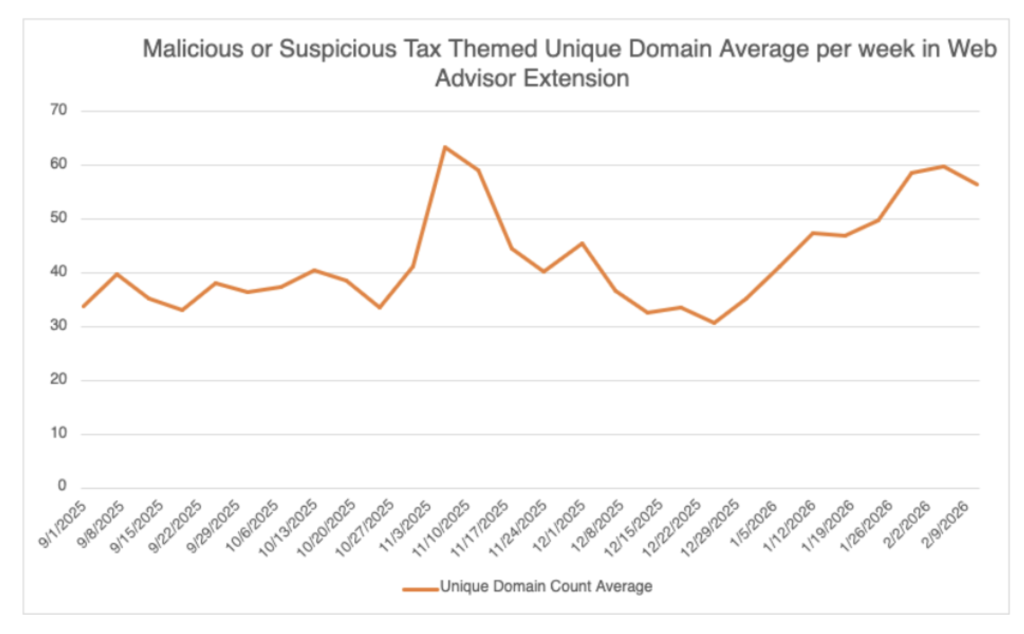
Between September 1, 2025, and February 19, 2026, McAfee Labs identified 1,468 malicious or suspicious tax-themed unique domains, an average of 43 new fake tax websites every day. 

In early November 2025 alone, the average number of new tax-themed malicious domains nearly doubled in just over a week. After a brief dip in late December, activity resumed climbing into February, a pattern we expect to intensify as the April filing deadline approaches. 

a chart showing the malicious domains blocked by McAfee's web advisor
A chart showing the unique, malicious domains detected by McAfee’s Web Advisor


Fake IRS Websites Are A Major Threat 

Scammers are rapidly creating lookalike IRS domains that mimic official government URLs.  

They use small changes, extra letters, added words, subtle misspellings, to trick taxpayers into believing they’re on a legitimate IRS site. 

Examples include domains that insert additional text around “irs.gov” or add misleading subdomains designed to pass a quick glance. 

These fake portals are used to: 

  • Steal login credentials 
  • Harvest Social Security numbers and tax IDs 
  • Capture payment details 
  • Charge bogus “processing fees” 

In some cases, these sites don’t just steal, they overcharge. 

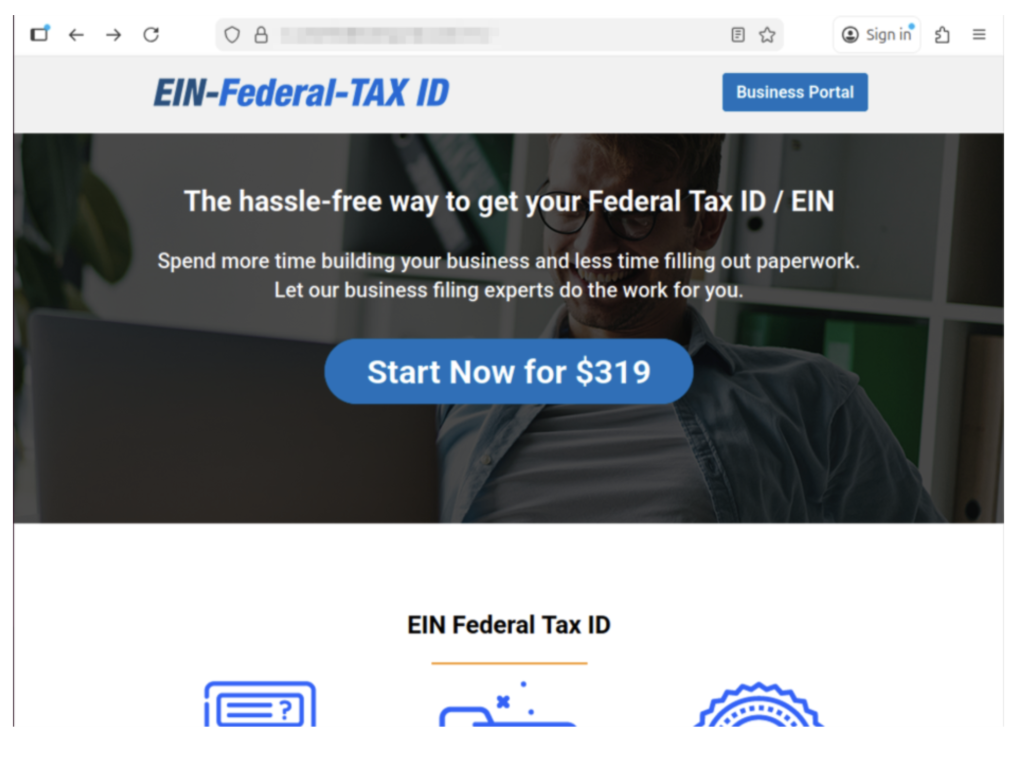
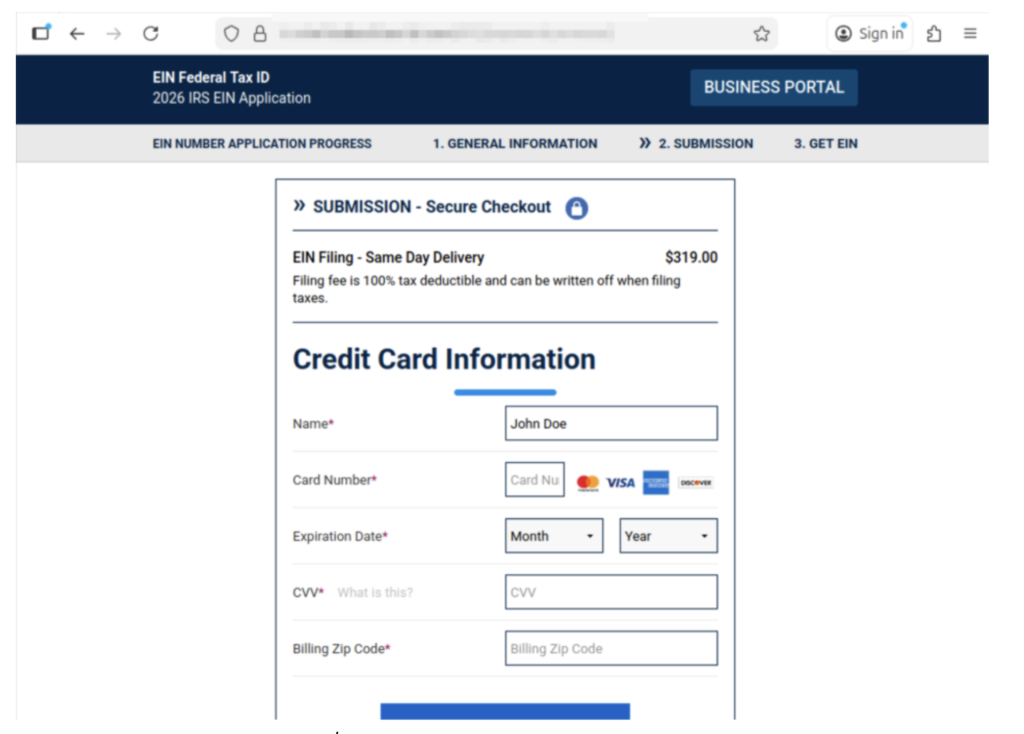
McAfee Labs observed scam services offering to file for an EIN (Employer Identification Number), something the IRS provides for free, and charging as much as $319 for it. 

Example of a scam website we found charging for an EIN.

Example of a scam website we found charging for an EIN. 

The official IRS website explicitly warns: you never have to pay a fee to obtain an EIN. 

Other scam sites misuse legitimate policy terms, like the “Fresh Start Initiative,” to harvest personal data and enroll victims in aggressive robocall and marketing campaigns. 

Tax scams don’t always steal outright. Sometimes they monetize confusion. 

Here it shows them charging $319 for an EIN, and collecting their personal information.

How a Typical Tax Scam Unfolds 

Most tax scams aren’t one single message. They’re a sequence, designed to make you panic, click, and comply. 

Below is the common playbook, plus the red flags that show up repeatedly. 

*Note: Scammers may swap the details like AI voice, fake IRS videos, cloned websites, or impersonating tax software, but the pattern stays familiar. 

Step  What happens  Red flags you’ll see at this step  Red flags that are true every time  What to do instead 
1) The hook  You get a call, text, or email claiming there’s a tax issue (refund problem, underpayment, verification needed).  Message arrives out of nowhere, often during busy hours; “final notice” language; spoofed caller ID.  Unexpected contact + urgency.  Don’t engage. Pause. Go directly to IRS.gov or your tax provider’s official site (type it in). 
2) The authority move  They lean hard on being “the IRS” or “state tax authority,” sometimes with personal details.  They sound polished; may use AI voice cloning; may cite a “case number.” Fake or meaningless case numbers are very common.  They want you to trust the title, not verify the source.  Ask for written notice and time. Real tax issues can be verified through official channels. 
3) The link  They send a link to a “secure portal” or “refund page.”  Lookalike website, subtle misspellings, weird domain, shortened link, email button that says “Pay Now.”  They’re trying to pull you off official channels.  Never click the link. Navigate to the real site yourself. If unsure, delete it. 
4) The data grab  The site (or “agent”) asks for SSN, banking info, login credentials, or details from a prior return.  Requests that are broader than needed; “verify identity” prompts; form fields that feel too invasive.  They want sensitive info fast.  Stop. Don’t type anything. If you already did, assume it’s compromised and act quickly (see next section). 
5) The payment push  They demand payment to “avoid penalties,” “release your refund,” or “resolve a mistake.”  Gift cards, crypto, wire transfers, payment apps; pressure to pay today; threats.  Urgency + unusual payment method.  The IRS does not demand immediate payment via text/social, and doesn’t require gift cards or crypto. Verify independently. 
6) The escalation  If you hesitate, they intensify: threats, “law enforcement,” or AI video/audio that “proves” it’s real.  Deepfake IRS video, intimidating language, “you’ll be arrested,” “your license will be revoked.”  Fear is the product.  Hang up. Save evidence. Talk to a trusted person. Contact official support through verified numbers. 
7) The aftermath  You realize it was a scam—often after noticing a strange charge or login activity.  Charges from odd merchants; new accounts; IRS account alerts; failed tax filing due to “duplicate return.”  Shame keeps people quiet—scammers count on that.  Report it and protect your identity right away. You’re not alone, and it’s not your fault. 

Key point: A message can look “official” and still be fake. AI is making scam language smoother and scams more believable. The safest habit is simple: slow down, and verify using official sources you navigate to yourself. 

What to do if you’ve been involved in a tax scam 

First: take a breath. Scams are designed to trick you, especially when you’re overwhelmed, rushed, or just trying to fix a problem quickly. 

John said it plainly: “Don’t be embarrassed. It does happen. It’s common… they will target anyone.” 

And he’s right. The most important thing is what you do next. 

1) Stop the bleeding: cut off contact 

  • Stop replying 
  • Don’t click anything else 
  • Don’t send more information or money 

2) Capture proof (before it disappears) 

Take screenshots and save: 

  • Phone numbers, email addresses, usernames 
  • The message content 
  • Links (don’t click them, just copy) 
  • Payment receipts and transaction IDs 

3) Lock down your accounts (especially email) 

If a scammer gets into your email, they can reset passwords for everything else. 

Do this today: 

  • Change your email password first, then banking/tax accounts 
  • Turn on two-factor authentication (2FA) 
  • If you reused passwords anywhere, change those too 

Important: If you clicked a suspicious link, downloaded a file, or gave someone remote access to your computer, make sure you use a different, trusted device (like your phone or another computer) to change passwords. Why? If a scammer installed malware or has access to your computer, they may be able to see all of your brand-new passwords as you’re making them. 

Tip: A password manager like McAfee’s can help you create strong, unique passwords quickly, without having to memorize them all. 

4) Check for identity theft signals 

Tax scams often turn into identity theft. Watch for: 

  • IRS notices about a return you didn’t file 
  • Trouble e-filing because a return was already submitted 
  • Alerts about a new IRS online account you didn’t create 

If you suspect tax-related identity theft: 

  • Consider filing an IRS identity theft report (commonly done with IRS Form 14039, Identity Theft Affidavit). 
  • Create or log into your IRS account periodically to review account activity (John now does this every few months). 

McAfee’s Identity Monitoring can help restore your sense of security and privacy online.  

5) Report it (even if you feel weird about it) 

Reporting helps you and helps stop the next person from getting hit. 

Common reporting options include: 

  • FTC report: Report scams and identity theft at the FTC’s reporting site. 
  • IRS phishing email: If you received a scam email posing as the IRS, you can forward it to phishing@irs.gov. 
  • Your bank or card provider: If you paid, contact them immediately. Even if recovery isn’t guaranteed, speed matters. 

6) Clean up your digital footprint 

Scammers don’t just use what you give them. They also use what they can look up. 

Removing your personal details from risky data broker sites can reduce how easily scammers can target you again. Tools like Personal Data Cleanup can help you identify where your information is exposed and guide removal. 

7) Add protection for the next attempt 

Tax season scams often come in waves, especially if scammers think your info is “good.” 

Helpful layers include: 

  • Web protection to warn you about risky links and lookalike sites before you enter info – get our free WebAdvisor download here 
  • Scam detection that can flag suspicious messages 
  • Identity monitoring to alert you if key personal info shows up in risky places 
  • Run a free antivirus scan to check your device for malware or unwanted programs (especially if you clicked a link or downloaded anything) 

The key takeaway 

Tax season creates the perfect storm: time pressure, sensitive data, and a lot of official-looking communication. 

Our research shows most people are worried, and for good reason. Scammers are getting more convincing, and AI is raising the bar on what “real” looks and sounds like. 

“Tell your friends, tell your family,” John said. “Everyone I know at some point has heard this story, and it might just prevent someone from losing… thousands of dollars.” 

If you remember just three things this season, make them these: 

  1. Pause before you click. 
  2. Verify through official channels you navigate to yourself. 
  3. If something happens, act quickly, and don’t blame yourself. 

The post Tax Scams Hit Nearly 1 in 4 Adults. Spot the Red Flags appeared first on McAfee Blog.

  •  

This Week in Scams: Conduent Data Breach and AI Olsen Twins

This week in scams, we’re looking at three very different stories with the same underlying theme: trust is being exploited at scale. 

A massive government contractor data breach has quietly grown to affect more than 25 million people. Meanwhile, a viral AI-generated image of Mary-Kate and Ashley Olsen posing in a fake luxury campaign is spreading across social media, fooling some users and alarming others. 

And in a new threat report, OpenAI detailed how its own tools are being misused for dating scams, impersonation, and influence operations. 

Let’s break it down. 

The Conduent Data Breach Now Impacts 25+ Million People 

The fallout from a ransomware attack on Conduent, one of the largest government contractors in the U.S., continues to expand. 

According to reporting from TechCrunch, updated state-level breach notifications now indicate that more than 25 million people across the U.S. have had personal data exposed. 

Conduent provides services tied to state benefit programs, including food assistance, unemployment systems, and other government payment processing operations. The company has said its services reach over 100 million people. 

Data reportedly exposed in the breach includes: 

  • Names 
  • Dates of birth 
  • Addresses 
  • Social Security numbers 
  • Health insurance and medical information 

TechCrunch noted that the majority of affected individuals appear to be in Oregon and Texas, based on state breach disclosures. Other states have also reported an impact. 

The attack has been described as one of the largest government-contractor-related data breaches in recent memory. 

Why this matters: When companies that process government benefits are hit, the exposed data often includes highly sensitive identity information. Social Security numbers combined with medical or insurance details can significantly increase the risk of identity theft and fraud. 

How to Protect Yourself After a Major Data Breach 

If you believe your data may have been exposed: 

  • Monitor your credit reports for unfamiliar activity 
  • Consider placing a free credit freeze 
  • Be wary of phishing emails or texts referencing benefits or account verification 
  • Never share personal information in response to unexpected outreach 

Breaches like this often lead to secondary scams months later. The breach itself is only phase one. Phishing campaigns usually follow. 

That Viral Olsen Twins “Louis Vuitton” Image? It’s AI. 

A supposed luxury campaign featuring Mary-Kate and Ashley Olsen began circulating widely on X and Facebook this week, racking up millions of views. 

The images show the twins styled in what appears to be a high-end fashion shoot, drawing numerous comments over their styling. But social media users quickly pointed out visual irregularities and inconsistencies commonly associated with AI-generated imagery. 

the AI image making rounds online

A screenshot of one of the AI images making thr rounds across social media.

While this doesn’t fall into our typical “scam” roundup, the normalization of AI-generated visuals that look close enough to real to confuse people are a growing issue that can lead to real confusion and distrust. 

We have entered a phase where: 

  • Fake ads look legitimate 
  • Public figures appear in campaigns they never participated in 
  • Synthetic images spread faster than corrections 

Today it’s a fashion ad. Tomorrow it could be a fake political endorsement, financial announcement, or emergency alert. 

The takeaway: If you see a surprising campaign or announcement, verify it through official brand websites or verified accounts before assuming it’s real. 

OpenAI Details How ChatGPT Is Being Misused

In a newly released threat report, OpenAI outlined several ways its tools have been abused by bad actors. 

According to Reuters’ reporting: 

A cluster of accounts used ChatGPT to run a dating scam targeting Indonesian men, allegedly defrauding hundreds of victims per month. 

Some accounts used the tool to generate promotional copy and ads for a fake dating platform that pressured users into completing costly “tasks.”

Other accounts posed as law firms, impersonating real attorneys and U.S. law enforcement to target fraud victims.

OpenAI also banned accounts linked to activity believed to be part of influence operations, including efforts targeting Japanese political figures. 

OpenAI stated that the activity was detected and accounts were removed. 

Why this matters: AI tools themselves are not inherently scams. But they dramatically lower the cost and increase the scale of fraud operations. Writing persuasive emails, generating fake legal letters, building scam ads… these now require fewer technical skills than ever before. 

The technology doesn’t create the criminal intent. It just accelerates it. 

McAfee’s Safety Tips This Week 

  1. Assume viral images could be AI-generated until verified 
  2. Verify unexpected announcements through official websites 
  3. Treat post-breach emails as suspicious by default 
  4. Be skeptical of online “consultation” invites that promise payment 
  5. Never send money to someone you’ve only met online 

We’ll Be Back Next Week 

From ransomware breaches to AI-generated impersonations, the pattern is clear: scammers are scaling trust manipulation with technology. 

Stay skeptical. Verify before you click. And we’ll be back next week with another breakdown of what’s making headlines, and what it actually means for your security. 

For more reading on AI deepfakes and breaches: 

Taylor Swift Tops List of Most Deepfaked Celebs

What to Do If You’re Caught Up in a Data Breach

Everything You Need to Know to Keep Your Passwords Secure

The post This Week in Scams: Conduent Data Breach and AI Olsen Twins appeared first on McAfee Blog.

  •  
❌