 Login
Login
How to switch from ChatGPT to Gemini - without starting from scratch
Gemini will now let you transfer your memories, chat history, and preferences from another AI so you don't have to start over. Here's how it works.


A few days ago I wrote about how the Trivy ecosystem got turned into a credential stealer. One of my takeaways was “pin by SHA.” Every supply chain security guide says it, I’ve said it, every subreddit says it, and the GitHub Actions hardening docs say it.
The Trivy attack proved it wrong, and I think we need to talk about why.
Here is a draft for a Reddit post tailored for the r/homelab community.
Title: [Project] Turning a Raspberry Pi into a "Poor Man's" Enterprise IDS/NSM using Zeek and Suricata
Hey everyone,
I’ve been looking for ways to get better visibility into my network traffic without dropping $500+ on dedicated hardware or running a power-hungry 1U server 24/7. I came across this guide from HookProbe that breaks down how to deploy Zeek and Suricata on a Raspberry Pi (specifically optimized for the Pi 4/5), and I thought it would be right up this sub's alley.
Link: Deploying Zeek and Suricata on Raspberry Pi for Edge Security
Why this is cool for a Homelab:
The Setup: The guide walks through the /etc configurations for both tools. If you’re like me and love structured logs (DNS queries, SSL handshakes, HTTP headers) for your ELK stack or Grafana dashboards, Zeek is a goldmine.
Some questions for the community:
I’m planning to set this up this weekend to feed into my local SOC dashboard. If you're looking for a low-cost way to move past "just a basic firewall," this seems like a solid weekend project.
Curious to hear if anyone has tried a similar "Edge Security" approach!
Built a free red team arena for testing real attack paths against a live defense system for ShieldNet DLX7.
This is NOT a CTF or a static lab. It actually responds to what you do.
Current scenarios:
Everything runs in a sandbox. No production targets. Novel attacks generate detection rules that get reviewed and pushed into the system
If you want to test how your payloads actually hold up against modern defenses, this is useful.
Mongoose network library <= 7.20
CVE-2026-5244 - mg_tls_recv_cert pubkey heap-based overflow (exploitable)
CVE-2026-5245 - mDNS Record stack-based overflow (exploitable)
CVE-2026-5246 - authorization bypass via P-384 Public Key (trivially exploitable)
Fun ride.

We’re proud to share that McAfee’s “Keep It Real” campaign has been named a finalist in the 2026 Shorty Awards Social Good Campaign category.
This category recognizes work that doesn’t just perform, it matters: campaigns that raise awareness, inspire action, and make a real-world impact.
That’s exactly what “Keep It Real” set out to do.
Because behind every scam statistic is a person who thought they were making the right call. And too often, what follows isn’t just financial loss. It’s embarrassment, silence, and stigma.
We wanted to change that.
The campaign launched alongside McAfee Scam Detector to address a growing reality: scams powered by AI are becoming harder to recognize and easier to fall for.
“Keep It Real” paired real survivor stories with AI-driven protection to show how scams actually happen and how people can stop them in the moment.
The goal was simple:
Because when people feel safe talking about scams, they’re more likely to spot them and stop them.
The Shorty Awards honor the best work in social media, digital campaigns, and online storytelling across brands, creators, and organizations.
Now in their 18th year, the awards recognize campaigns that combine creativity, impact, and real-world relevance. Finalists are selected alongside leading global brands and judged on both industry evaluation and public voting.
McAfee’s Scam Detector is designed to help people identify scams across everyday digital moments.
It uses AI to fight AI by flagging suspicious:
By combining automatic detection with clear guidance, Scam Detector helps people better understand what they’re seeing and decide what to trust.
A core part of “Keep It Real” was giving space to people who experienced scams to share what happened, in their own words.
These stories helped show that scams can happen to anyone and played a key role in breaking the stigma around being targeted.
This recognition reflects the work across McAfee teams who built and brought this campaign to life, including product, engineering, research, creative, and communications.
It also reflects the individuals who chose to share their real scam stories to help others recognize scams, stay safer, and end the shame and stigma around being scammed.
The Shorty Awards include a public voting component.
If you’d like to support the campaign, you can vote here:
https://shortyawards.com/18th/keep-it-real-mcafees-ai-scam-media-relations-campaign
Voting is open through April 8, and you can vote once per day.
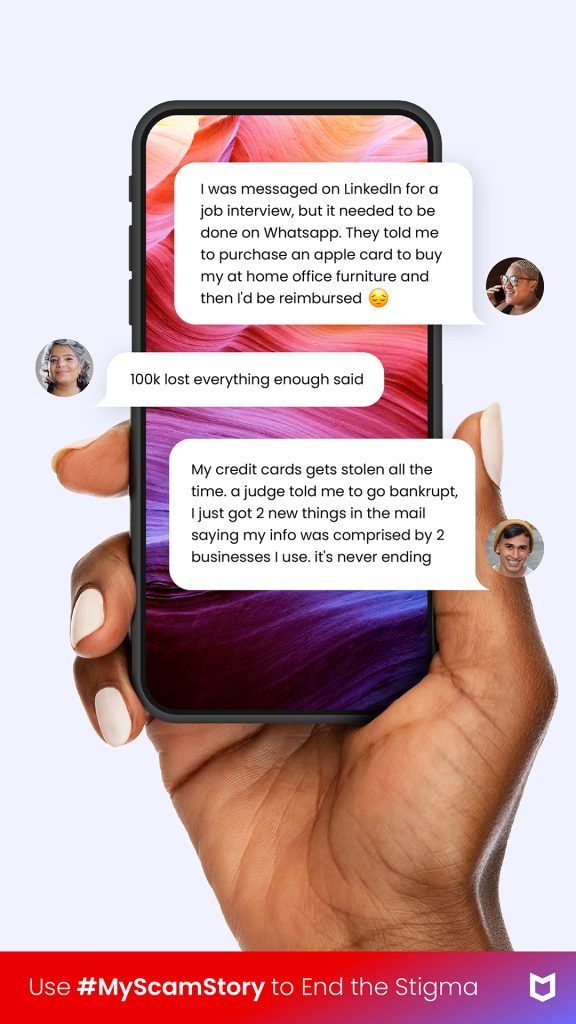
The post McAfee’s “Keep It Real” Campaign Named Shorty Awards Finalist appeared first on McAfee Blog.
Researcher Yarden Porat (Cyata) disclosed a vulnerability chain in CrewAI, the widely-used Python multi-agent framework. CERT/CC advisory VU#221883. No full patch released yet.
The chain:
CVE-2026-2275 — Code Interpreter silently falls back to SandboxPython when Docker is unavailable. SandboxPython allows arbitrary C function calls → RCE.
CVE-2026-2287 — CrewAI does not continuously verify Docker availability during runtime. An attacker who triggers the fallback mid-execution lands in the vulnerable sandbox.
CVE-2026-2285 — JSON loader tool reads files without path validation. Arbitrary local file read.
CVE-2026-2286 — RAG search tools don't validate runtime URLs → SSRF to internal services and cloud metadata endpoints.
Attack entry point: prompt injection against any agent with Code Interpreter Tool enabled. The attacker doesn't need code execution access to the host — they just need to reach the agent with crafted input.
Scope: Any CrewAI deployment running Code Interpreter Tool where Docker is not guaranteed to be available (or can be disrupted). Default "unsafe mode" config is fully exposed.
Current status: CrewAI maintainers are working on mitigations (fail closed instead of fallback, block C modules, clearer warnings). Not released. No CVSSv3 scores published yet.
Has anyone tested whether the Docker availability check can be disrupted mid-execution in a containerized deployment, or does that attack path require an already-degraded environment?
