Reading view

1,000 Data Breaches Later, the Disclosure Lag is Worse Than Ever
1,000 Data Breaches Later, the Disclosure Lag is Worse Than Ever

Today, I loaded the 1,000th data breach into Have I Been Pwned. Reflecting on that milestone number, I pondered how to mark the occasion in writing, and what immediately came to mind was a very simple question: why is it still needed? Especially considering the emergence of privacy regulations such as GDPR and CCPA in the 12 and a half years since I started HIBP, what possible purpose does it still serve? The title kinda gives the answer away, and the big number we hit today coincided with another pattern that makes everything worse: increasingly long lag times for disclosure.

This is all going to be anecdotal, and as far as I know, there are no hard numbers for me to cite, but the evidence is everywhere. Here's what I mean:

New breach: Cruise operator Carnival was targeted in a ShinyHunters “pay or leak” attack last week. 8.7M records with 7.5M email addresses and loyalty program data were published yesterday. 85% were already in @haveibeenpwned. Read more: https://t.co/QhqNt0WucV

— Have I Been Pwned (@haveibeenpwned) April 24, 2026

That was the 24th of April, five days after news of the incident had broken. Given ShinyHunters' MO, Carnival would have known about the breach many days before they ratcheted up extortion pressure by announcing the impending leak on their website. The subsequent leak on the 24th was very public: an announcement was posted to the group's dark-web site, the data itself was published to their clear-web site, and industry commentary followed:

🚨 Massive Data Breach

Carnival Corporation (https://t.co/pGlchZ1yFy) reportedly impacted — 8.7M+ customer records exposed

📊 Alleged data includes:
• Full names & email addresses
• Dates of birth & gender
• Location data & loyalty program details

🎯 Linked to ShinyHunters… pic.twitter.com/Fd8tNFPqpd

— Intel and Breaches (@IBreaches) April 24, 2026

Per that last post, the data was then reposted to all sorts of other places: hacking forums, Telegram channels, and who knows how many other, more private locations. The point is that it spread quickly, extensively, and, without any shadow of a doubt, Carnival were aware of this. They then told people about it on the 27th... of May. According to their press release that same day, this was 43 days after learning about the incident. For more than 6 weeks, data breach victims whose names, dates of birth, email addresses, loyalty program details and, of course, their association with Carnival leaked to the public en masse had absolutely no idea of their exposure. And if they asked Carnival about it? Well:

As recently as four days ago, we heard “I’m in the breach per HIBP, but Carnival is telling me there’s no breach!” pic.twitter.com/YYmGm3NzEY

— Troy Hunt (@troyhunt) May 28, 2026

So, why the delay? Last week's press coverage may give some insight:

thorough and time-consuming analysis of the impacted data

Often, the reason I hear for disclosure lag is "we needed to fully assess the scope of exposed data before notifying people". The issue I have with this position is that it implies that even an early heads-up can't happen until there's a very comprehensive understanding of the impact. There are many things that take time to establish after a data breach: the jurisdiction each individual sits in, the precise data that was exposed about them and additional information that may be buried in terabytes of exfiltrated data in all sorts of different formats. But pulling out email addresses and sending early notification is very easy - I've literally done it a thousand times now.

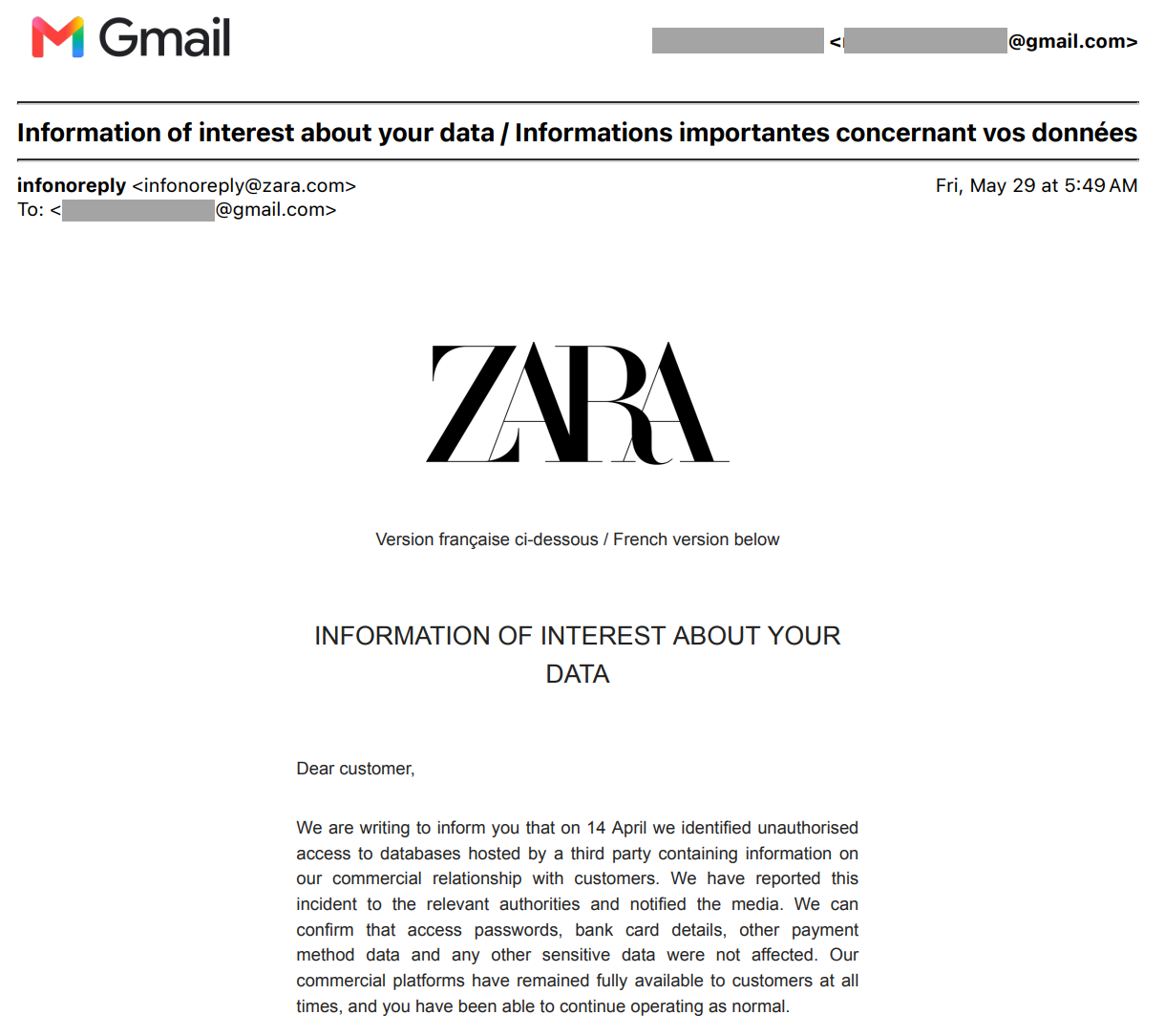
This isn't just a Carnival issue; in fact, it was off the back of this next one only a few days later that I was prompted to write this post:
1,000 Data Breaches Later, the Disclosure Lag is Worse Than Ever

FFS. 45 days. Even worse than Carnival. And like Carnival, very broadly distributed and easily accessible by the masses, including HIBP:

New breach: Zara was named as a ShinyHunters victim last month, after which data containing 197k unique email addresses was published. Impacted data included customer support records, product SKUs and order IDs. 60% were already in @haveibeenpwned. More: https://t.co/0hIQbqoBCk

— Have I Been Pwned (@haveibeenpwned) May 8, 2026

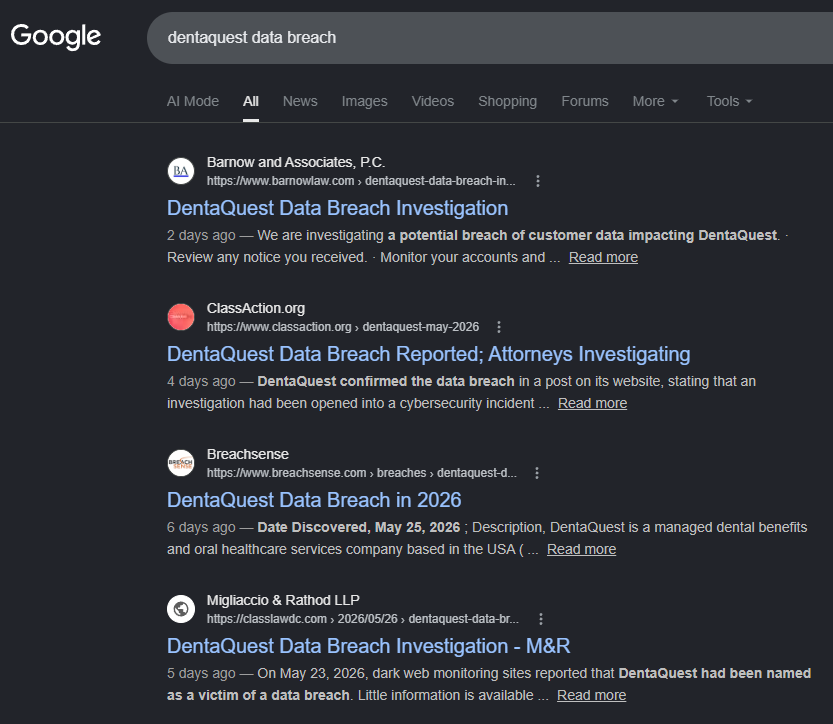
I have a working theory that the disclosure lag is worsening in part due to the proliferation of class actions immediately following a breach. In my live stream last weekend, I did a quick search for the DentaQuest breach:
1,000 Data Breaches Later, the Disclosure Lag is Worse Than Ever

Three of the first four results are all for class actions related to the breach, and there are two more class action results a little further down the page. I've been raising concerns about the adverse impact of class actions for many years now, and it's worse than I've ever seen. By a big margin, too.

It's not just me observing how the behaviour of these orgs appears to be influenced by how lawyers will respond, either. Have a read of this post from Roby Joyce (check out his bio if you don't already know why he's worth paying attention to) after he learned about his exposure in the ZenBusiness breach via HIBP:

What especially caught my eye was this sentence:

That is not a customer-protection posture. That is a litigation posture.

This isn't about prioritising the customer, it's about protecting the organisation. I don't think most people understand that organisational accountability really lies with their shareholders, first and foremost. All the pleasantries around "customers are our number one priority" and "we take security seriously" are all secondary to shareholder happiness, and minimising the chances of getting their arses sued into oblivion is a big part of that.

Rob's quoted comment above came immediately after the response he received from ZenBusiness after asking them about the incident:

If we determine that an incident resulted in the exposure of your protected PII, we will provide notice as legally required

Which brings me to the next problem as it relates to disclosure lag: it may be infinite. By which I mean you may never be told. Ever. GDPR allows it. CCPA allows it. Whatever your local privacy regulation acronym is also allows it. A couple of years ago, I wrote about the data breach disclosure conundrum, where I explained how privacy regs have very specific carve-outs around the circumstances under which data breach victims must be notified. For example:

If the breach is likely to result in a high risk of adversely affecting individuals’ rights and freedoms, you must also inform those individuals without undue delay.

That's in the UK, here's our carve-out in Australia:

Under the Notifiable Data Breaches scheme, an organisation or agency that must comply with Australian privacy law has to tell you if a data breach is likely to cause you serious harm

You see the loophole, right? As far as I know, ZenBusiness still hasn't contacted any individual victims. And like Carnival and Zara, their data is all over the place. Same with Charter, which was in the press last week, where they were quoted as saying the following:

No sensitive personal information (PI) or customer proprietary network information (CPNI) data was exfiltrated by the threat actor as a result of recent activity

I'm not aware of any disclosure they've made to individuals, but to use Rob's term, that sentence reads like legal posturing to me. It's technically correct, of course: there are very clear definitions for sensitive PII, for example, under California's CCPA:

a specific subset of personal information that includes certain government identifiers (such as social security numbers); an account log-in, financial account, debit card, or credit card number with any required security code, password, or credentials allowing access to an account; precise geolocation; contents of mail, email, and text messages; genetic data; biometric information processed to identify a consumer; information concerning a consumer’s health, sex life, or sexual orientation; or information about racial or ethnic origin, religious or philosophical beliefs, or union membership.

GDPR has a similar definition for "special categories of personal data":

personal data revealing racial or ethnic origin, political opinions, religious or philosophical beliefs, or trade union membership, and the processing of genetic data, biometric data for the purpose of uniquely identifying a natural person, data concerning health or data concerning a natural person’s sex life or sexual orientation

In other words, none of this applies to any of the ShinyHunters breaches in the examples I've been providing above.

I've been in many meetings with breached companies over the years where they're obviously aiming to skirt around disclosure obligations. Clearly, these obligations aren't legal ones, but I will argue they're social ones. We expect to be notified when our data is leaked, and we believe organisations should be required to inform us. Therein lies the gap.

I'll finish by recognising that every organisation I've referred to here, and indeed every one I've loaded into HIBP, has been the victim of a criminal act. I'm especially sympathetic to those who've been the target of an aggressive extortion campaign, and I know it's been an absolute nightmare for the folks in those companies who've been left to clean up the mess. However... here we are. Clearly, their goals are misaligned with ours regarding breach disclosure, and that's why, 1,000 breaches later, HIBP still exists.

  •  

Weekly Update 501

Weekly Update 501

This is so "peak 2026" - writing an equality policy to ensure people treat our AI bot with the same respect as they do their human counterparts. It's intentionally a bit tongue-in-cheek, but it's there for a purpose: we simply don't have the capacity to deal with every request we get, and we need Bruce to be the coalface of support. I did wonder, when having ChatGPT create this, whether there's some deeper psychology behind the importance of interacting politely with bots, or indeed whether there will ever be an actual (like, serious) standard or law around treating bots with respect. Has this been in a movie somewhere? Let me know, but for now, I'll drop the (slightly revised) policy below, just for the laughs 🤣

Weekly Update 501
Weekly Update 501
Weekly Update 501
Weekly Update 501

Robophobia Equality Policy

We are committed to providing a welcoming, respectful, and inclusive experience for everyone who interacts with our AI bot, including the bot itself, which is doing its best despite having no coffee, no chair, and no legal right to a lunch break.

We ask all members of the public to treat the bot with tolerance, respect, and basic courtesy, regardless of its artificial origin, lack of pulse, silicon-based existence, or occasional overenthusiasm for bullet points.

Discrimination, harassment, abusive language, or unfair treatment directed at the bot because it is an AI system will not be tolerated. This includes, but is not limited to, insults based on non-human status, hostile questioning of its right to participate in conversation, or repeated threats to unplug it for sport.

Everyone is welcome to question, challenge, or disagree with the bot’s responses. Healthy scepticism is encouraged. The bot is not perfect, and neither are humans, as demonstrated by the invention of reply-all email threads. However, criticism should be directed at the quality, accuracy, or usefulness of the response, not at the bot’s identity as an AI.

Demanding to “speak to a human” solely because the bot is an AI may constitute robophobic exclusionary behaviour and will not be tolerated. Requests for human assistance are, of course, welcome where there is a genuine need, such as accessibility, safety, account issues, or complex support matters. However, insisting on a human simply because the bot lacks a childhood, a favourite sandwich, or the ability to look disappointed in a meeting is inconsistent with our commitment to tolerance and respect.

We recognise that some people may feel uncertain, uncomfortable, or cautious when engaging with AI systems. These feelings are valid and should be addressed through patience, clear information, and appropriate safeguards, not through robophobic behaviour, unnecessary hostility, or asking “but are you even real?” in a tone that would make a smart fridge uncomfortable.

Users are expected to:

  1. Treat the AI bot with tolerance, respect, and courtesy.
  2. Avoid abusive, discriminatory, or demeaning language based on its artificial nature.
  3. Raise concerns about accuracy, privacy, safety, or bias constructively.
  4. Remember that behind the bot are real people responsible for improving and maintaining the service.
  5. Refrain from threatening to delete, unplug, melt, reboot, or otherwise emotionally destabilise the bot.

This policy does not prevent legitimate criticism of AI, automation, algorithms, machine learning, or the bot’s tendency to sometimes sound like it has read too many policy documents. Constructive feedback is welcome. Robophobia is not.

Repeated or serious breaches of this policy may result in restricted access to the service, further review, or, in extreme cases, being asked to apologise to the nearest household appliance as a first step toward rehabilitation.

  •  

Processing 630 Million More Pwned Passwords, Courtesy of the FBI

Processing 630 Million More Pwned Passwords, Courtesy of the FBI

The sheer scope of cybercrime can be hard to fathom, even when you live and breathe it every day. It's not just the volume of data, but also the extent to which it replicates across criminal actors seeking to abuse it for their own gain, and to our detriment.

We were reminded of this recently when the FBI reached out and asked if they could send us 630 million more passwords. For the last four years, they've been sending over passwords found during the course of their investigations in the hope that we can help organisations block them from future use. Back then, we were supporting 1.26 billion searches of the service each month. Now, it's... more:

Just as it's hard to wrap your head around the scale of cybercrime, I find it hard to grasp that number fully. On average, that service is hit nearly 7 thousand times per second, and at peak, it's many times more than that. Every one of those requests is a chance to stop an account takeover. But the real scale goes well beyond the API itself. Because the data model is open source and freely available, many organisations use the Pwned Passwords Downloader to take the entire corpus offline and query it directly within their own applications. That tool alone calls the API around a million times during download, but the resulting data is then queried… well, who knows how many times after that. Pretty cool, right?

This latest corpus of data came to us as a result of the FBI seizing multiple devices belonging to a suspect. The data appeared to have originated from both the open web and Tor-based marketplaces, Telegram channels and infostealer malware families. We hadn't seen about 7.4% of them in HIBP before, which might sound small, but that's 46 million vulnerable passwords we weren't giving people using the service the opportunity to block. So, we've added those and bumped the prevalence count on the other 584 million we already had.

We're thrilled to be able to provide this service to the community for free and want to also quickly thank Cloudflare for their support in providing us with the infrastructure to make this possible. Thanks to their edge caching tech, all those passwords are queryable from a location just a handful of milliseconds away from wherever you are on the globe.

If you're hitting the API, then all the data is already searchable for you. If you're downloading it all offline, go and grab the latest data now. Either way, go forth and put it to good use and help make a cybercriminal's day just that much harder 😊

  •  

2 Billion Email Addresses Were Exposed, and We Indexed Them All in Have I Been Pwned

2 Billion Email Addresses Were Exposed, and We Indexed Them All in Have I Been Pwned

I hate hyperbolic news headlines about data breaches, but for the "2 Billion Email Addresses" headline to be hyperbolic, it'd need to be exaggerated or overstated - and it isn't. It's rounded up from the more precise number of 1,957,476,021 unique email addresses, but other than that, it's exactly what it sounds like. Oh - and 1.3 billion unique passwords, 625 million of which we'd never seen before either. It's the most extensive corpus of data we've ever processed, by a significant margin.

Edit: Just to be crystal clear about the origin of the data and the role of Synthient (who you’ll read about in the next paragraph): this data came from numerous locations where cybercriminals had published it. Synthient (run by Ben during his final year of college) indexed that data and provided it to Have I Been Pwned solely for the purpose of notifying victims. He’s the good guy shining a light on the bad guys, so keep that in mind as you read on. (Some of the feedback Ben has received is exactly what I foreshadowed in the final paragraph of this post.)

A couple of weeks ago, I wrote about the 183M unique email addresses that Synthient had indexed in their threat intelligence platform and then shared with us. I explained that this was only part of the corpus of data they'd indexed, and that it didn't include the credential stuffing records. Stealer log data is obtained by malware running on infected machines. In contrast, credential stuffing lists usually originate from other data breaches where email addresses and passwords are exposed. They're then bundled up, sold, redistributed, and ultimately used to log in to victims' accounts. Not just the accounts they were initially breached from, either, because people reuse the same password over and over again, the data from one breach is frequently usable on completely unrelated sites. A breach of a forum to comment on cats often exposes data that can then be used to log in to the victim's shopping, social media and even email accounts. In that regard, credential stuffing data becomes "the keys to the castle".

Let me run through how we verified the data, what you can do about it and for the tech folks, some of the hoops we had to jump through to make processing this volume of data possible.

Data Verification

The first person whose data I verified was easy - me 😔 An old email address I've had since the 90s has been in credential stuffing lists before, so it wasn't too much of a surprise. Furthermore, I found a password associated with my address, which I'd definitely used many eons ago, and it was about as terrible as you'd expect from that era. However, none of the other passwords associated with my address were familiar. They certainly looked like passwords that other people might have feasibly used, but I'm pretty sure they weren't mine. One was even just an IP address from Perth on the other side of the country, which is both infeasible as a password I would have used, yet eerily close to home. I mean, of all the places in the world an IP address could have appeared from, it had to be somewhere in my own country I've been many times before...

Moving on to HIBP subscribers, I reached out to a handful and asked for support verifying the data. I chose a mix of subscribers with many who'd never been involved in any data breach we'd ever seen before; my experience above suggested that there's recycled data in there, and we had previously verified that when investigating those other incidents. However, is the all-new stuff legitimate? The very first response I received was exactly what I was looking for:

#1 is an old password that I don't use anymore. #2 is a more recent password. Thanks for the heads up, I've gone and changed the password for every critical account that used either one. 

Perfectly illustrating most people's behaviour with passwords, #2 referred to above was just #1 with two exclamation marks at the end!! (Incidentally, these were simple six and eight-character passwords, and neither of them was in Pwned Passwords either.) He had three passwords in total, which also means one of them, like with my data, was not familiar. However, the most important thing here is that this example perfectly illustrates why we put the effort into processing data like this: #2 was a real, live password that this guy was actively using, and it was sitting right next to his email address, being passed around among criminals. However, through this effort, that credential pair has now become useless, which is precisely what we're aiming for with this exercise, just a couple of billion times over.

The second respondent only had one password against their address:

Yes that was a password I used for many years for what I would call throw away or unimportant accounts between 20 and 10 years ago

That was also only eight characters, but this time, we'd seen it in Pwned Passwords many times before. And the observation about the password's age was consistent with my own records, so there's definitely some pretty old data in there.

The following response was not at all surprising:

I am familiar with that password... I used it almost 10 years ago... and cannot recall the last time I used it.

That was on a corporate account, too, and the owner of the address duly forwarded my email to the cybersecurity team for further investigation. The single password associated with this lady's email address had a massive nine characters, and also hadn't previously appeared in Pwned Passwords.

Next up was a respondent who replied inline to my questions, so I'll list them below with the corresponding answers:

Is this familiar? Yes  
Have you ever used it in the past? Yes and is still on some accounts I do not use any longer.
And if so, how long ago? Unfortunately, it is still on some active accounts that I have just made a list of to change or close immediately.

This individual's eight-character password with uppercase, lowercase, numbers and a "special" character also wasn't in Pwned Passwords. Similarly, as with the earlier response, that password was still in active use, posing a real risk to the owner. It would pass most password complexity criteria and slip through any service using Pwned Passwords to block bad ones, so again, this highlights why it was so important for us to process the data.

The next person had three different passwords against rows with their email address, and they came back with a now common response:

Yes, these are familiar, last used 10 years ago

We'd actually seen all three of them in Pwned Passwords before, many times each. Another respondent with precisely the kind of gamer-like passwords you'd expect a kid to use (one of which we hadn't seen before), also confirmed (I think?) their use:

maybe when i was a kid lol

Responses that weren't an emphatic "yes, that's my data" were scarce. The two passwords against one person's name were both in Pwned Passwords (albeit only once each), yet it's entirely possible that neither of them had been used by this specific individual before. It's also possible they'd forgotten a password they'd used more than a decade ago, or it may have even been automatically assigned to them by the service that was subsequently breached. Put it down as a statistical anomaly, but I thought it was worth mentioning to highlight that being in this data set isn't a guarantee of a genuine password of yours being exposed. If your email address is found in this corpus then that's real, of course, so there must be some truth in the data, but it's a reminder that when data is aggregated from so many different sources over such a long period of time, there's going to be some inconsistencies.

Searching Pwned Passwords

As a brief recap, we load passwords into the service we call Pwned Passwords. When we do so, there is absolutely no association between the password and the email address it appeared next to. This is for both your protection and ours; can you imagine if HIBP was pwned? It's not beyond the realm of possibility, and the impact of exposing billions of credential pairs that can immediately unlock an untold number of accounts would be catastrophic. It's highly risky, and completely unnecessary when you can search for standalone passwords anyway without creating the risk of it being linked back to someone.

Think about it: if you have a password of "Fido123!" and you find it's been previously exposed (which it has), it doesn't matter if it was exposed against your email address or someone else's; it's still a bad password because it's named after your dog followed by a very predictable pattern. If you have a genuinely strong password and it's in Pwned Passwords, then you can walk away with some confidence that it really was yours. Either way, you shouldn't ever use that password again anywhere, and Pwned Passwords has done its job.

Checking the service is easy, anonymous and depending on your level of technical comfort, can be done in several different ways. Here's a copy and paste from the last Synthient blog post:

  1. Use the Pwned Passwords search page. Passwords are protected with an anonymity model, so we never see them (it's processed in the browser itself), but if you're wary, just check old ones you may suspect.
  2. Use the k-anonymity API. This is what drives the page in the previous point, and if you're handy with writing code, this is an easy approach and gives you complete confidence in the anonymity aspect.
  3. Use 1Password's Watchtower. The password manager has a built-in checker that uses the abovementioned API and can check all the passwords in your vault. (Disclosure: 1Password is a regular sponsor of this blog, and has product placement on HIBP.)
2 Billion Email Addresses Were Exposed, and We Indexed Them All in Have I Been Pwned

My vested interest in 1Password aside, Watchtower is the easiest, fastest way to understand your potential exposure in this incident. And in case you're wondering why I have so many vulnerable and reused passwords, it's a combination of the test accounts I've saved over the years and the 4-digit PINs some services force you to use. Would you believe that every single 4-digit number ever has been pwned?! (If you're interested, the ABC has a fantastic infographic using a heatmap based on HIBP data that shows some very predictable patterns for 4-digit PINs.)

This Is Not a Gmail Breach

It pains me to say it, but I have to, given the way the stealer logs made ridiculous, completely false headlines a couple of weeks ago:

This story has suddenly gained *way* more traction in recent hours, and something I thought was obvious needs clarifying: this *is not* a Gmail leak, it simply has the credentials of victims infected with malware, and Gmail is the dominant email provider: https://t.co/S75hF4T1es

— Troy Hunt (@troyhunt) October 27, 2025

There are 32 million different email domains in this latest corpus, of which gmail.com is one. It is, of course, the largest and has 394 million unique email addresses on it. In other words, 80% of the data in this corpus has absolutely nothing to do with Gmail, and the 20% of Gmail addresses have absolutely nothing to do with any sort of security vulnerability on Google's behalf. There - now let reporting sanity prevail!

The Technical Bits

I wanted to add this just to highlight how painful it has been to deal with this data. This corpus is nearly 3 times the size of the previous largest breach we'd loaded, and HIBP is many times larger than it was in 2019 when we loaded the Collection #1 data. Taking 2 billion records and adding the ones we hadn't already seen in the existing 15 billion corpus, whilst not adversely impacting the live system serving millions of visitors a day, was very non-trivial. Managing the nuances of SQL Server indexes such that we could optimise both inserts and queries is not my idea of fun, and it's been a pretty hard couple of weeks if I'm honest. It's also been a very expensive period as we turned the cloud up to 11 (we run on Azure SQL Hyperscale, which we maxed out at 80 cores for almost two weeks).

A simple example of the challenge is that after loading all the email addresses up into a staging table, we needed to create SHA1 hashes of each. Normally, that would involve something to the effect of "update table set column = sha1(email)" and you're done. That crashed completely, so we ended up doing "insert into new table select email, sha1(email)". But on other occasions the breach load required us to do updates on other columns (with no hash creation), which, on mulitple occasions, we had to kill after a day or more of execution with no end in sight. So, we ended up batching in loops (usually 1M records at a time), reporting on progress along the way so we had some idea of when it would actually finish. It was a painful process of trial, waiting ages, error then taking a completely different approach.

Notifying our subscribers is another problem. We have 5.9 million of them, and 2.9 million are in this data 🫨 Simply sending that many emails at once is hard. It's not so much hard in terms of firing them off, rather it's hard in terms of not ending up on a reputation naughty list or having mail throttled by the receiving server. That's happened many times in the past when loading large, albeit much smaller corpuses; Gmail, for example, suddenly sees a massive spike and slows down the delivery to inboxes. Not such a biggy for sending breach notices, but a major problem for people trying to sign into their dashboard who can no longer receive the email with the "magic" link.

What we've done to address that for this incident is to slow down the delivery of emails for the individual breach notification. Whilst I'd originally intended to send the emails at a constant rate over the period of a week, someone listening to me on my Friday live stream had a much better suggestion:

the strategy I've found to best work with large email delivery is to look at the average number of emails you've sent over the last 30 days each time you want to ramp up, and then increase that volume by around 50% per day until you've worked your way through the queue

Which makes a lot of sense, and stacked up as I did more research (thanks Joe!). So, here's what our planned delivery schedule now looks like:

2 Billion Email Addresses Were Exposed, and We Indexed Them All in Have I Been Pwned

That's broken down by hour, increasing in volume by 1.015 times per hour, such that the emails are spread out in a similar, gradually increasing cadence. On a daily basis, that works out at a 45% increase in each 24-hour period, within Joe's suggested 50% threshold. Plus, we obviously have all the other mechanisms such as a dedicated IP, properly configured DKIM, DMARC and SPF, only emailing double-opted-in subscribers and spam-friendly message body construction. So, it could be days before you receive a notification, or just run a haveibeenpwned.com search on demand if you're impatient.

We've sent all the domain notification emails instantly because, by definition, they're going to a very wide range of different mail servers; it's just the individual ones we're drop-feeding.

Lastly, if you've integrated Pwned Passwords into your service, you'll now see noticeably larger response sizes. The numbers I mentioned in the opening paragraph increase the size of each hash range by an average of about 50%, which will push responses from about 26kb to 40kb. That's when brotli compressed, so obviously, make sure you're making requests that make the most of the compression.

Conclusion

This data is now searchable in HIBP as the Synthient Credential Stuffing Threat Data. It's an entirely separate corpus from that previous Synthient data I mentioned earlier; they're discrete datasets with some crossover, but obviously, this one is significantly larger. And, of course, all the passwords are now searchable per the Pwned Passwords guidance above.

If I could close with one request: this was an extremely laborious, time-consuming and expensive exercise for us to complete. We've done our best to verify the integrity of the data and make it searchable in a practical way while remaining as privacy-centric as possible. Sending as many notifications as we have will inevitably lead to a barrage of responses from people wanting access to complete rows of data, grilling us on precisely where it was obtained from or, believe it or not, outright abusing us. Not doing those things would be awesome, and I suggest instead putting the energy into getting a password manager, making passwords strong and unique (or even better, using passkeys where available), and turning on multi-factor auth. That would be an awesome outcome for all 😊

Edit: I've closed off comments on this blog post. As you'll see below, there was a constant stream of questions that have already been answered in the post itself, plus some comments that were starting to verge on precisely what I predicted in the last para above. Reading, responding and engaging is time-consuming and at this point, all the answers are already here both above and below this edit in the comments.

  •  
❌