An attack on software provider Wellington IT exposed saved payee details held by around 40 Irish credit unions, prompting a minister to criticize the company's delay in notifying them. Robert Troy, Ireland's minister of state with responsibility for credit unions, said the breach happened in October but many affected institutions only learned of it in recent days. Troy told Irish broadcaster RTÉ that the breach occurred "sometime in October," and Wellington IT's delay in providing details to its credit union customers was "not acceptable." News of the issues affecting Irish credit unions broke on Tuesday, although the government said at the time it was only investigating a "possible cybersecurity incident" in the first instance, and did not name Wellington IT until Wednesday. Affected credit unions said attackers exploited a vulnerability in their provider's online banking platform between October 2 and 4. The flaw was closed on October 6. Troy said the affected credit unions were only informed for the first time in recent days. The exposed records concern payees saved in members' online banking accounts. Those records can also be linked to the members who created them. The information exposed varies between institutions and individual records, but disclosures list the following data types: Names on payee bank accounts and saved nicknames Business Identifier Codes (BICs) International Bank Account Numbers (IBANs) Sort codes Payment references Internal reference numbers that do not identify customers Payee addresses Credit unions including St. Canice's said online banking passwords, PINs, and login credentials were unaffected, and that the exposed payee details did not provide access to members' accounts or funds. St. Canice's warned members not to transfer money in response to anyone claiming it needed to be moved to safety because of the breach. The CEO of Belfast-based Wellington IT, Colin Mitchell, said in a statement that the company notified the affected organizations "as soon as we confirmed the potential risk to customer data." He said Wellington IT has engaged outside cybersecurity experts to help investigate the breach, and reported the matter to the relevant authorities. Mitchell added: "We are directly supporting our customers in their assessment of the potential impact on affected individuals and to help them meet any applicable regulatory obligations. "We recognize the importance of this matter to our customers and their members and are treating it with the utmost seriousness. We remain focused on completing a thorough investigation and communicating directly with our customers as the investigation progresses." Owned by Canadian company Vencora, Wellington IT has offices in Belfast and Dublin, and provides credit unions with software, mobile apps, private cloud infrastructure, and fully managed services. Around 40 credit unions in Ireland were affected, roughly a quarter of the national total, Troy said. Credit unions operate similarly to traditional banks, offering savings accounts and loans, but are owned by their members and are not-for-profit organizations. Troy told RTÉ that cybersecurity is a constant challenge for financial institutions, as technology and threats evolve over time. "What's most important is that financial institutions take all the right measures to mitigate against these threats and that is what is happening," he said. Separately, the UK's Financial Conduct Authority, Prudential Regulation Authority, and Bank of England opened a joint consultation on cyber resilience guidance on Thursday. The FCA said October brought its second-highest monthly tally of reported cyber incidents in five years, and the highest in 18 months. The proposed guidance clarifies how firms should meet existing requirements rather than introducing new rules. ®
Transport for London (TfL) has copped to another cybersecurity breach, this time involving the account details of around 265,000 Oyster photocard customers. The capital's transport operator told The Register it first became aware something was amiss on November 16, when Oyster photocard customers started receiving emails asking them to create accounts they already had. The emails came from TfL's own systems, the transport body confirmed, but were generated as a result of the compromise. "We immediately took the TfL photocard website down while this was being investigated," said Shashi Verma, TfL's director of technology strategy and revenue. "The protection of personal information is a priority for us, and I apologize to our customers affected by this incident." TfL reckons its speedy response spared a considerable number of customers from having their details compromised. The transport operator says it has since contained the incident and contacted those potentially affected, though it is rather more forthcoming about what the hackers didn't get their hands on than what they did. TfL says no passwords, bank or payment card details, or customer journey information were compromised. It also believes the names and dates of birth of children with Zip Oyster cards were unaffected. Among those whose accounts may have been compromised are holders of Zip Oyster cards – issued to children as young as five – as well as students, apprentices, care leavers, veterans, and Londoners aged 60 and over. Despite the assurances about passwords, TfL says it will ask all photocard customers to change theirs, along with their security questions and answers. Those in the habit of recycling passwords across multiple websites are being advised to change them elsewhere, too. TfL says it has yet to find any evidence that the compromised data has been used and has notified the Information Commissioner's Office (ICO). The transport operator hasn't disclosed how the perpetrators got into its systems. Existing photocards will still let holders through the ticket barriers, though anyone needing to renew one or check their journey history will have to contact TfL's customer services team while the website is out of action. There's no word yet on when it'll be back. "We hope to restore the affected website services as quickly as possible," Verma said. TfL should be well versed in dealing with data breaches by now. In March, the transport operator told The Register it had notified more than 7 million customers following its September 2024 cyberattack. The hackers had accessed systems holding customers' names, email addresses, and home addresses, while around 5,000 customers were contacted as a priority because their bank account details may also have been compromised. Two teenagers were subsequently charged in connection with the attack, which authorities linked to the notorious Scattered Spider cybercrime crew. The ICO looked into that incident but opted not to take enforcement action against TfL, having deemed its response proportionate. There's nothing at present to suggest the two incidents are related. Londoners can at least rest assured that their Oyster photocards still work. Whether the information they handed over to obtain them is in someone else's hands is another matter. ®
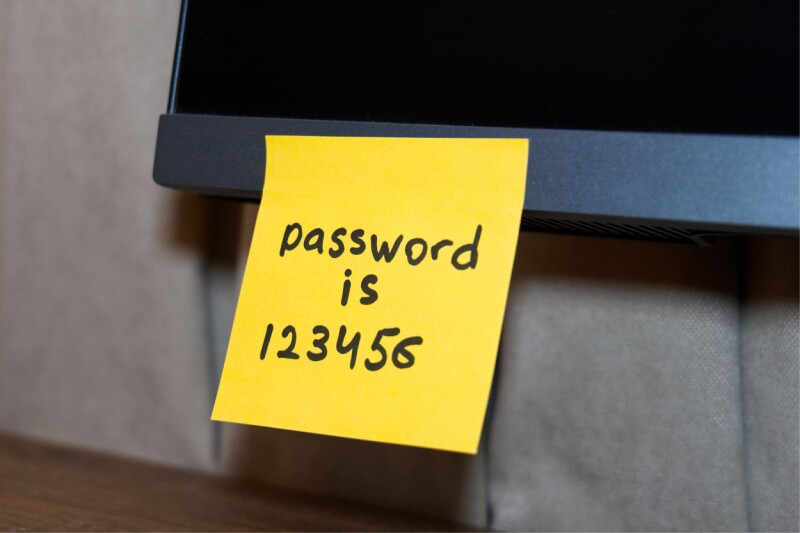
Welcome, once again, to PWNED, where we talk smack about organizations that have smacked themselves down by practicing poor security hygiene. This week's story involves everyone's favorite low-tech password manager: the sticky note. Our terrifying tale comes courtesy of Christian Espinosa, a certified penetration tester with over 30 years of experience and the CEO of Blue Goat Cyber, a security company. Espinosa shared an experience where critical credentials were right out in the open for any person in the office to see. During a walkthrough of a client's office, he noticed a password written on a sticky note that was taped to an employee's monitor. While writing down your password and placing it in a physically secure paper notebook might be ok, taping it to the computer is definitely not. "Before I get my fingers on any system, I first walk the physical area that the system is located in — attackers do that when they're looking at a target too," Espinosa explained. “Physical security vulnerabilities are neglected much more often than technical security vulnerabilities and firms invest in firewalls where a sticky note is placed 3 feet from the front door." Espinosa took a photo of the sticky note and immediately tried logging into that employee's account. Success. Then, he tried the very same password on the VPN, which apparently had been maintained by that employee. Once he connected to the VPN, Espinosa had full access to the company network and all of its shared drives. He opened a shared drive that this employee had access to and there was an HR folder with all kinds of personally identifiable information (PII) about employees, including home addresses, driver's licenses, and scanned W-4 forms. There were even spreadsheets that listed everyone's salaries. The employee account also had access to a document that contained a list of internal server names and the names of the people in charge of each server (great for phishing). Another document had instructions for how to log into the accounting server specifically. The accounting server was a particular treasure trove of client information. On that server, Espinosa found a folder with vendor banking information, invoices, and payment records. "At that point, a password I had read from a sticky note during a walk-through had taken me from one desk to information that could have been used for payroll fraud, identity theft, or vendor-payment fraud," Espinosa said. After getting access to all this information, the pen tester presented his findings to the client. They quickly disabled the rogue account and started reviewing VPN access logs to see who else might have gotten into the network. They then searched the office to see if anyone else was exposing a password on a sticky note. Finally, they tightened permissions on the HR and accounting shares so that only people who really needed access to that data could get in. The lessons here are pretty obvious. Don't expose your passwords and, perhaps even more importantly, limit who has access to file shares that contain mission-critical data such as employee or client information. "The part that really got the client's attention was how easily the attack could have continued after I left the building," Espinosa posited. "Someone could have photographed that sticky note, walked out, connected to the VPN later that night, and started going through employee and financial records from somewhere else." ®
Apologies in advance to all patch managers and security teams that thought they might get a break this week. The PHP Foundation will release a “critical” security update on Thursday between 14:00 and 14:30 UTC. While we don’t have many details about the latest vulnerabilities – these haven’t been leaked like last month’s critical PHP2Shell flaws – a Wednesday advisory said the highest-severity bugs in the upcoming release are rated critical. “The issues rated critical require either non-default configuration or uncommon setups,” the foundation said, urging PHP users to “prepare to upgrade promptly once the releases become available.” We do know that one of the vulnerabilities is another remote code execution (RCE) flaw, tracked as CVE-2026-115560. In October, the PHP Foundation told The Register that it had reserved this CVE identifier for another RCE bug, but added it would not get an emergency fix like the earlier two PHP2Shell vulnerabilities because the third one doesn't pose the same risk. CVE-2026-115560 “requires a very unlikely combination of configuration and specific PHP application code, which we do not expect to occur in practical use of PHP,” Elizabeth Barron, executive director of the PHP Foundation, told The Register at the time. “The issue can be mitigated with a configuration setting. So for the moment the PHP Security Team has only published an informational advisory on the PHP website, explaining exactly this situation.” The earlier informational advisory urged users to “set session.upload_progress.enabled=0 until the next regular bugfix release, to fully protect from an unlikely RCE vector.” These unlikely RCE attacks require an application to set “session.serialize_handler to php_binary or php_serialize in its configuration and then switch it to php at runtime with ini_set() before calling session_start().” Additionally, the session upload progress feature must be enabled, which the PHP Foundation said is very unlikely in real-world applications. The November security release follows a hectic October emergency PHP patch-a-thon, with security teams racing to apply fixes for CVE-2026-109618 and CVE-2026-109619, collectively called PHP2Shell, before attackers could abuse the memory-safety flaws in the open source programming language running on about 70 percent of websites. While it took miscreants longer to reverse engineer the PHP2Shell fixes than some researchers had anticipated – and the entire internet didn’t burn down in the meantime – the US Cybersecurity and Infrastructure Security Agency (CISA) did add the two PHP vulns to its Known Exploited Vulnerabilities catalog on October 26. Suspected Chinese attackers chained PHP2Shell with a Linux kernel privilege-escalation exploit to root 25 servers, including Palo Alto Networks firewalls linked to US government-affiliated organizations, as early as October 23, according to Dream researchers. The Israeli AI cybersecurity startup said the attackers targeted organizations across the US, Japan, Taiwan, and South Korea, and “likely still” have persistent, remote access to compromised organizations’ networks. ®
Hot on the heels of serious vulnerabilities in seemingly every other widely used software powering the entire internet, F5 today released emergency patches for 10 bugs in open source NGINX. These include critical remote code execution flaws that let attackers hijack NGINX servers with HTTP/2 enabled, as well as the millions of websites running NGINX, to steal sensitive data and disrupt services. “At this time, we have found no evidence of active exploitation of any of these vulnerabilities in the wild,” and F5 spokesperson told The Register. “We continue to monitor closely and will share updates via myF5 as we learn more.” As with all of the other recently disclosed vulnerabilities in foundational technologies like PHP, Apache, and Java, these critical NGINX bugs were uncovered by researchers using AI. One of them has been hiding in the code for at least 10 years. Tomer Schwartz, Wiz’s chief technology officer of exposure management and AppSec, helped find the bug, along with researchers from Ikotas Labs, Metnir, Rapid7, and Xint working independently. Schwartz told The Register that this wave of AI-discovered flaws “point to a new reality.” “We need to treat every internet-connected system as potentially vulnerable,” Schwartz said. “AI has changed not only which vulnerabilities can be found, but how quickly longstanding risks can become real threats.” NGINX is the world’s most widely used open source web server, handling HTTPS requests and routing incoming traffic to the right application or API. It powers about a third of all websites (around 225 million), and F5 maintains the open source version. On Wednesday, F5 published an out-of-band security notification that addressed 10 CVEs in open source NGINIX. If you run NGINX, update to 1.31.9 as soon as possible. CVE-2026-123633 and CVE-2026-123007 Two of the vulns are especially serious as they allow a remote attacker to execute code on the NGINX server without authentication. These two, tracked as CVE-2026-123633 and CVE-2026-123007, both received a critical, 9.2 CVSS rating, and CVE-2026-123007 affects versions dating back to NGINX 1.9.5 in 2015. Both vulnerabilities require HTTP/2 to be enabled on the affected NGINX server. All of the security shops listed earlier independently found at least one of these two CVEs - most, if not all, with an AI assist - and reported them to F5. “Both vulnerabilities are memory-safety issues in how NGINX handles HTTP/2 traffic,” Schwartz and fellow Wiz kid Nir Ohfeld said in a Wednesday blog about the two bugs. “In CVE-2026-123633, a connection's memory is freed while a request still needs it, creating a use-after-free. In CVE-2026-123007, incorrect flow-control accounting leads to an invalid memory copy.” Rapid7’s team also published a proof-of-concept to demonstrate leveraging CVE-2026-123007 for unauthenticated remote code execution against a vulnerable linux/amd64 Docker image running nginx version 1.31.8. Xint found three other NGINX flaws, plus a separate vulnerability in the Linux kernel that can be chained with any of the five NGINX vulnerabilities to gain root privileges on the host. The research team dubbed the six bugs “nginx2root.” The AI-powered offensive security firm also published videos demonstrating attacks using CVE-2026-123007 to execute commands as the NGINX worker inside a container, and then using the kernel vulnerability to escalate to root on the host. These attacks work on AWS, Microsoft Azure, Google Cloud Platform, and bare-metal servers. AI-powered bug hunting for the win? "While preparing for ZeroDay Cloud 2026, a Xint researcher found CVE-2026-123007," the company said in a Wednesday blog. "A few days later, a fully automated Xint scan found the other four without human guidance." All of these newly-disclosed CVEs point to a larger security issue - especially in light of Tuesday’s Java4Shell, found by AI-bug-hunting-outfit Calif, PHP2Shell (Calif was one of the firms that also used AI to find and weaponize these critical vulns in PHP), and a critical Apache flaw under active exploitation . “AI is also accelerating vulnerability discovery faster than existing infrastructure was designed to absorb,” Schwartz told us. “Even after a vendor ships a fix, security teams still face heavy manual work in terms of locating vulnerable versions and configurations, testing patches, deploying interim mitigations (such as disabling HTTP/2), and coordinating all of these rollouts.” There is light at the end of the tunnel, he believes. “In the long run, AI-powered vulnerability research will harden foundational software.” But in the meantime, it’s a nightmare for security teams, vulnerability managers, and system administrators, who are drowning in the near-daily deluge of CVEs to patch before attackers find and exploit these vulnerabilities. “Continued collaboration between security researchers, maintainers, and defenders is crucial to absorb the speed and scale of these disclosures,” Schwartz said.®

 Login