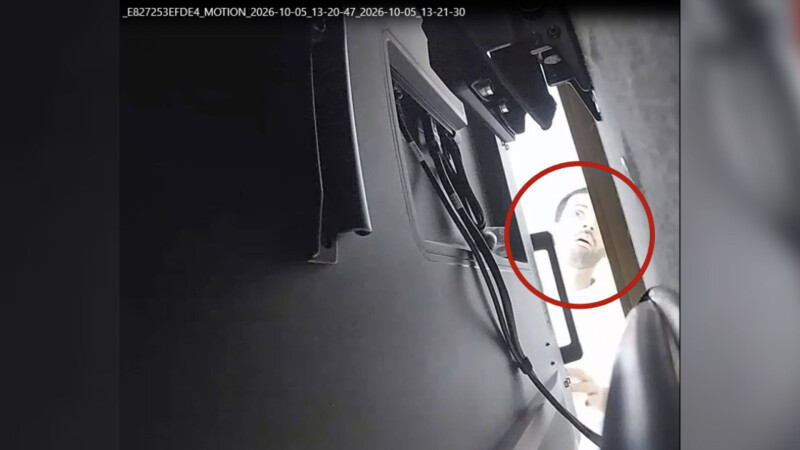
The Department of Justice has charged an OpenAI engineer with attempting to intercept oral communications after allegedly planting a recording device in an exec conference room. Investigators claim company security staff found a second device in his bag. Saudi national Abdulrahman Alfozan, 35, is described in court documents as an engineer at OpenAI who had worked there since July 2025, and has held permanent residency in the US since September 2020. He was arrested on October 9 and made his initial federal court appearance on October 13. He is accused of installing, on or around September 28, 2026, a Seeed XIAO ESP32-S3 Sense recording device via a USB port in a TV located in OpenAI's executive conference room. According to the complaint, staff discovered the device concealed in toilet paper on September 30. OpenAI said it used its models to analyze the device. According to the complaint, it may have been modified to prevent data transfer between the recorder and the TV. The contents of the bug's microSD card may also have been encrypted, as the company could not retrieve any of the data stored on the card after making a forensic image of it. CCTV footage placed him near the room on several dates, although prosecutors say Alfozan had no authority to access or participate in meetings held in the executive conference room, which is often reserved for the highest-level discussions. Officials did not state whether the device was able to capture anything of importance, but said the room typically plays host to non-public and secret technical meetings, as well as those with government representatives. OpenAI did not have CCTV covering the executive conference room at the time when the secret device was planted, but the company subsequently installed a camera. Court documents [PDF] include an image taken on October 5 from a camera situated behind the TV into which the DoJ claims the recording device was installed, allegedly showing Alfozan checking on it. Investigators examined Alfozan's devices, according to the complaint, which alleges that between around August 17 and September 16, 2026, Alfozan used a productivity agent to inquire about company building addresses, meeting rooms, room capacities and calendars, and external-partner meeting venues. The complaint also describes an AI chatbot account associated with his spouse that shared installation identifiers, logged IP usage, and user-path references with Alfozan's account. Between September 24 and 30, it submitted prompts about building and modifying an audio-recording device. The prompts allegedly included questions related to recording reliability, how to add browser access and controls, how to develop a second unit with speech-triggered recording, and more. On October 5, the day Alfozan was allegedly recorded looking behind the executive conference room TV, company representatives say he left a bag unattended in the office's printer room. Security staff inspected the bag, finding a wallet, an ID card, and a second Seeed-manufactured recording device, before Alfozan reported the bag missing, according to the DoJ. He collected the bag the following day from the company's Lost and Found, and later claimed in a written report that several items were missing, including a credit card, around $500 in cash, two AirPods, one set of headphones, sunglasses, and a power bank. Alfozan was charged with an attempt to intercept oral communications, an offense that carries a maximum sentence of five years in prison and a $250,000 fine. "According to the complaint unsealed today, Abdulrahman Alfozan allegedly concealed a covert recording device inside his employer's executive conference room to secretly capture sensitive communications about the company's super intelligence technology," said FBI director Kash Patel. "Protecting American SI innovation is essential to safeguarding our nation's economic strength and national security, and the FBI views that mission as one of our highest counterintelligence priorities." "At this time, we have no indications of this individual inappropriately accessing or exfiltrating model weights, source code, or customer data," OpenAI said in a statement. "The employee was terminated." "We take protecting our technology, data, and people seriously, and as a matter of national importance. Our security program is designed to protect against a wide range of threat actors, from insider risks to cybercriminals to nation states, and this case is an example of how AI can help address these sophisticated security threats." ®
Tim Beasley, a senior incident response consultant at Semperis, was investigating a cyberattack involving Russia’s Midnight Blizzard when a package containing nesting dolls and other regional gifts showed up on his doorstep. At the time, Beasley served as the lead investigator for Microsoft’s Detection and Response Team (DART). He assumed it was from the group, which has been linked to the Kremlin’s Foreign Intelligence Service (SVR), although the sender didn’t leave a note. “Just little souvenirs and gift basket stuff from that area of the world,” he told The Register. “We-know-where-you-are kind of stuff. It’s a real eye-opener when you get that type of thing.” While digital intrusions having physical consequences is nothing new, cybercriminals in recent years have turned to real-life harm and mental and physical trauma to force victims into paying extortion demands. Some groups even use cybercrime as a gateway drug to real-life violence. Over the summer, Europol and its partners' investigators flagged 4,340 “horrific” URLs for removal as part of an ongoing crackdown on The Com (short for community), a loosely knit network of online groups whose young members participate in a range of illicit activities including hacking, swatting, digital extortion, real-life shootings, and other physical violence. “We’ve seen violence as a service get used,” Beasley said. He’s also investigated ransomware attacks where C-suite executives receive pictures of their kids’ schools directly from the cybercriminals in an attempt to apply psychological pressure to pay the extortion fee. “I've seen threats involving people's families, from social media reconnaissance, and in our world you more and more come to expect it, which is unfortunate,” Beasley said. This type of psychological intimidation and harm against victim companies’ employees has seen an uptick in the last several years to the point where it's almost common. Thirty-seven percent of ransomware attacks involved psychological or physical threats against staff, according to Semperis’ annual ransomware risk report. The global study of 1,200 post-ransomware organizations conducted over the first half of the year found attackers threatening psychological intimidation (23 percent) and physical threats (17 percent), to force payment. They are not only targeting executives and staff, but also families of their victims. A quarter of these victims experienced doxxing – posting individuals' personal details, such as names, home and work addresses, and phone numbers online – while another 25 percent had to seek psychological and/or medical treatment in response to ransomware infections. Nearly the same number (24 percent) hired personal security teams, while 23 percent experienced swatting calls – that's when attackers phone emergency services and report a bogus incident like a bomb or active-shooter threat to trigger an armed response. Additionally, more than half (53 percent) of respondents reported that ransomware attackers carried through on threats in the past year. Some of these threats reported by ransomed organizations’ employees include: threatening texts, letters, or packages: 57 percent threats against family or friends: 37 percent physical intrusion: 19 percent abduction: 17 percent bodily harm: 13 percent stalking: 6 percent. “It's the more well-known groups,” using psychological and physical threats to force payments, Beasley said. “I've seen Scattered Spider, I've seen ShinyHunters, I've seen Lapsus$.” For what it's worth, ShinyHunters claimed in an exclusive interview with The Register that they “don't attack human beings.” They did, however, admit that “there are times in the work we do sometimes we have to push the corporate to the absolute limit to get them on the table.” The takeaway for defenders and executives from this report is to “stand your ground,” Beasley said. “Don’t buckle under the pressure, and just know that you know it's going to be okay. If you feel like you're under duress, then by all means get law enforcement involved. Don't be afraid to call the cops. Don't be afraid to get the FBI involved, sooner rather than later. And don’t pay them.” This last piece of advice is important, as once you pay, they're going to come back for more. Semperis’ report found that 69 percent of surveyed ransomware victims were targeted multiple times within the past 12 months, and 31 percent made multiple payments to attackers. “Don’t pay anything,” Beasley said. “Never pay them.”®

 Login
Login