The RIKEN Center for Computational Science, the home of the Fugaku supercomputer, has revealed unauthorized attempts to access the machine after a data leak. According to a statement issued by RIKEN yesterday, between November 10 and 13 an unknown entity attacked a web dashboard that displays operational status data for Fugaku. It sounds like whatever the attackers did to that dashboard allowed them to move across the RIKEN network, because they were able to reach several servers that store data belonging to authorized users, and install malware. The servers stored users’ names and email addresses, plus credentials used to access supercomputers and services not operated by RIKEN. The attacker has tried to use those credentials. RIKEN is working with the organizations that host those other supercomputers to investigate whether the attackers succeeded. The research outfit doesn’t know how the attack happened and can’t say with certainty what information attackers were able to access and/or steal, beyond saying that 4,222 registered users of Fugaku are at risk, along with 375 registered users of its smaller Rikyu supercomputer. RIKEN does know that on November 13, someone attempted to log onto Fugaku. RIKEN quickly took the machine offline. Fugaku comprises 158,976 nodes, each packing a 48-core processor and 32GiB of available RAM, for a total of 7,630,848 cores and over five petabytes of memory. Those specs saw Fugaku lead the Top 500 lists of Earth’s mightiest supercomputers for two years between 2020 and 2022. It ranks ninth on the update of the list released on Tuesday. RIKEN’s other super, Rikyu, operates 288,000 cores. If attackers managed to run a workload on either machine, they could do a lot of damage. The intrusion has already had serious consequences because Fugaku is currently offline. As the machine is used for scientific research, and RIKEN schedules use of the machine, the outage will disrupt researchers who were waiting for their turn to use the supercomputer. At the time of writing, RIKEN has found no evidence that users’ research data has leaked but isn’t yet sure what info did make it out of the building and whether it contains any data describing third parties. The research org has promised to conduct a detailed investigation into the incident, which is the latest in a long string of significant cyberattacks that have struck Japanese clouds, telcos, retailers and government agencies, leading Tokyo to release emergency funds in the hope that extra money can quickly shore up the nation’s cyber-defenses. ®
Networking and security firm Infoblox is investigating a third-party breach that allowed crims to access sensitive customer and staff data. "Infoblox is investigating a security event involving unauthorized access to certain company information through a compromised third-party data migration vendor,” a company spokesperson confirmed to The Register. According to sources, the compromised third-party data migration vendor had trusted access to Infoblox's SharePoint system, and the intruders used this vendor’s accounts and access to exfiltrate data directly from Microsoft SharePoint. This data included configuration information related to some customer's NIOS (Network Identity Operating System) deployments. These are saved snapshots of customers’ network data, such as DNS, DHCP configurations, Grid databases, and reporting logs, that can be used to fully recover the appliance or grid in case of a system failure or faulty upgrade. The intruders also stole employee data during the break-in. According to an email CEO Scott Harrell sent to employees, which The Register has seen, compromised employee details include financial information such as direct deposit details, contact info, dates of birth, and Social Security numbers for employees and dependents. Upon discovering the breach, Infoblox “immediately activated” its incident response procedures, and took steps to contain the incident, including hiring outside cybersecurity experts, the spokesperson said. “We have sent notifications about this security event and are providing support and guidance as appropriate,” the Infoblox spokesperson told us. “Based on our investigation to date, we have no indication that any Infoblox products, cloud services, software updates or build-and-release processes were involved. Our priority is to fully investigate and resolve this issue." Affected staff received a $100 "spot bonus" to buy password management services, and were warned to be "especially alert for phishing, vishing, fraud, or other suspicious communications." Infoblox also gave employees and their dependents free credit monitoring and identity protection for two years. Infoblox declined to answer our more detailed questions about the compromise, including the type of data exposed, and how many employees and customers might be affected. The Register will update this story as we learn more about the breach.®
It’s been eight years since NordPass released the first edition of its most common passwords of the year list, and the world has learned nothing about password security in the meantime. NordPass’ eighth edition of its most common passwords list, as culled from data breaches, was released Monday, and it looks suspiciously like the previous ones in the worst possible way. “Once again, ‘123456’ is the most commonly used password in the world,” NordPass said in the report. “That makes it seven out of eight years this password has stood at the top of the leaderboard.” Even when 123456 wasn’t number one, it was still near the top of the heap, as the top three passwords in the list remain unchanged in the eight years NordPass has published its list: 123456, admin, and 12345678. It’s not like the rest of the most common passwords are showing any variety either. According to NordPass, the only real shuffling among the 10 most popular passwords was the entry of the worryingly short 1234 into the top ten and the migration of the ever-popular password “password” down slightly in the top 10 from 6th to 7th place. “We still have a lot of work to do to spread awareness about password safety,” NordPass concluded of that data – and there’s no more pressing time than the present. AI adoption has made password cracking an easier exercise than ever, with more credentials being sucked up in more data breaches at a faster pace. AI has also made cracking hashed passwords a snap too. In other words, if you’re reusing a password that’s been exposed in a breach, even if it’s just a hash that was exposed, you’re more likely than ever before to have another account compromised. The best advice NordPass gives is to move away from passwords toward biometric authentication or passkeys and you're insane not to enable MFA. But for the places you still have to use passwords, there are a few things to avoid – like the 200 passwords in NordPass’ list, for example. Beyond that, NordPass also recommends steering clear of pop cultural trends. “Fandoms make for terrible passwords,” NordPass notes. There are several reasons for that – namely the fact that they follow trends, meaning that “minecraft” password in the early 2000s was a simple one to add to a password stuffing dictionary, just like “skibiditoilet” in recent years. The one thing that connects all those pop-culture passwords is that “they all could be cracked in seconds,” NordPass said. We’re sure our readers are conscientious about their online habits, carefully protecting their accounts with the proper security measures and ensuring each and every password is unique, long, complicated, and random. Unfortunately for you smarties reading El Reg, the person down the hall whose security you’re responsible for may not be so disciplined, so be sure you’re enforcing good practices – Nord knows the average user just isn’t doing it despite years of begging and reminders. ®
The researcher who sounded the alarm over Dirty Frag earlier this year has uncovered another Linux kernel flaw, and this one lets attackers crash entire servers remotely without so much as a password. The vulnerability, tracked as CVE-2026-99288 and dubbed NoisyTCP, was discovered by security researcher Hyunwoo Kim, who says it affects almost all Linux distributions. The flaw dates back to October 2015 and went unnoticed until this year, when Kim found and patched it. Attackers don't need to log in or get their hands on any credentials to cause trouble. They can simply knock the server over, although there's no evidence yet that the flaw can be used to steal data or hijack a machine. The bug is buried in Linux's TCP networking code. Two parts of the kernel can trip over each other while processing incoming traffic, leaving one trying to use memory that's already been freed. When that happens, Linux can panic and take the whole machine down with it. Kim says there's no need for any special server configuration either. Services such as Nginx, Apache, and SSH can be vulnerable straight out of the box. An attacker needs access to an open TCP port on a system that processes incoming network traffic across multiple receive queues or CPUs. Perhaps more concerning for administrators running containerized workloads, the damage isn't necessarily limited to the application being attacked. Because the flaw sits in the Linux kernel, crashing a web server inside a container can take down the underlying host and anything else running on it. Kim found that the attack was particularly effective against virtual machines. During testing, he managed to crash Nginx, Apache, and SSH servers running on QEMU/KVM virtual machines in between five seconds and two minutes. Physical hardware put up more of a fight. Even after tailoring his exploit to the target machine, Kim needed roughly 14 hours to crash a bare-metal server running Nginx. Kim has a knack for finding holes in Linux. Back in May, he uncovered Dirty Frag, a kernel bug that allowed local users to gain root privileges. That one caused headaches for administrators when a working exploit went public before patches were ready. His latest discovery, NoisyTCP, has another potentially nasty trick up its sleeve. Kim identified a second exploitation path involving a use-after-free condition, although pulling it off is considerably more difficult than simply crashing a server. In his advisory, Kim says he has developed a limited exploit targeting virtual machines in a lab environment but has yet to demonstrate a general-purpose remote code execution attack. For the moment, the confirmed impact is remote denial of service. A fix was committed to the upstream Linux kernel on November 3, but administrators will need to check whether their distribution has shipped an updated kernel. Red Hat has rated the vulnerability Important, assigning it a CVSS score of 7.5. For those unable to patch immediately, Kim suggests two temporary workarounds: disabling TCP SYN cookies or restricting incoming packet processing to a single receive queue. Neither is particularly appealing. Disabling SYN cookies reduces protection against SYN flood attacks, while limiting packet processing can hurt network performance. The former also needs to be applied separately to containers using their own network namespaces. Kim published the details on November 15, once the disclosure embargo was lifted. The bug had been hiding in plain sight since 2015, leaving Linux servers vulnerable to remote crashes for 11 years. Not bad for a flaw that doesn't even require a login. ®
LearnWorlds, a software and learning course platform, says an attacker sent 13,000 phishing emails to YouTube creators over seven days by using automated tools to open free trial accounts. The company insists its systems were not breached. Panos Siozos, Co-founder and CEO at LearnWorlds, said the miscreant created around 570 free trial accounts on the platform between November 7-14, which they used to issue fake copyright infringement notices to recipients of their choosing. "We have found no evidence of unauthorized access to existing customer schools or personal data held for our customers and their end users," he told The Register. According to Siozos, the attacker bypassed the platform's per-customer limit on trial subscriptions and exploited its welcome email feature to send the phishing emails. "In each trial they added their own list of target addresses and rewrote the standard welcome email as a fake copyright notice," he said. "Adding those users triggered the welcome email from our sending address." The first email was sent on November 7, after which the company detected the suspicious signups and blocked the first sender on November 9, although the attacker returned to send a second wave of emails within 40 minutes. LearnWorlds removed all the trial accounts by November 10 and one paid account, which was used to launch more emails, on November 14. "In total, around 13,000 emails were sent to addresses on external recipient lists supplied by the sender," said Siozos. "The trial accounts sent 9,853 between November 7-9, and the paid account sent 3,723 on November 14. "We can’t tell how many people clicked, because the link was disguised to hide clicks. The recipient addresses were the sender’s own list." The CEO confirmed that LearnWorlds has since enhanced its bot checks and is placing holds on new accounts if their emails trigger fraud flags. "We have also examined the novel patterns the attackers used to create more advanced scoring mechanisms. We have reported the phishing website so it can be taken down. Further measures are currently being examined. "Anyone who signed in on the fake page should change their Google password and review their account’s recent security activity." The company's confirmation follows suspicions of foul play aired by users on social media. User reports included copies of the emails they received, which demanded urgent responses to fake copyright infringement claims related to YouTube content. Among the more prominent recipients of the copyright infringement email notices was Marcus Hutchins, of WannaCry fame, who claimed he received an email from the company’s official mail server. The email, a copy of which Hutchins posted to X, referenced general intellectual property and copyright infringements but failed to specify any specific issues. The email prompted the recipient to click a YouTube link to see the “supporting documentation submitted by LearnWorks.” The link predictably turned out to be a YouTube redirect link, taking recipients to a separate website that presents them with a real Google OAuth page. If the user completed the authorization flow, it would have handed attackers control of the target’s Google and YouTube accounts. “The site is designed to look like an official YouTube webpage that enables users to review copyright claims against their channel,” Hutchins wrote. “It contains both the YouTube and Google branding, as well as a very similar theme to the official YouTube one.” According to Hutchins' screenshots, and those posted by others, the attacker was actively tweaking the email style and format, although the underlying lure and authentication mechanisms remained the same. Hutchins didn't specify exactly how the phishing page steals access to targets’ Google accounts, although his description aligns with the steps often seen in OAuth consent phishing attacks. These involve malicious websites serving victims genuine OAuth pages, into which unwitting victims enter their credentials and pass the relevant MFA tests. Typical scenarios see permission pages appear immediately after, and if the user accepts, the malicious website is handed OAuth access tokens to the victim’s account, effectively the keys to control it. LearnWorlds, based in Cyprus, claims to have two million active monthly learners on its platform accessing 900,000 courses and more than 14,000 business customers. Since launching in 2014, it claims to have generated more than $1 billion in revenue. The business focuses on white-label courses - training programs developed by one business and sold to another, assuming the buyer will change the branding and present the course materials as their own. ®
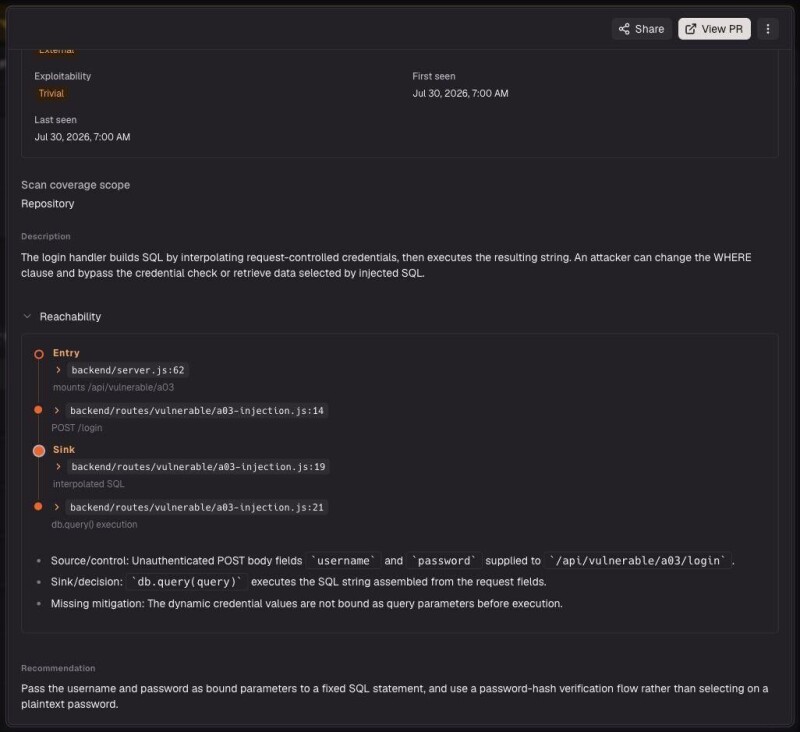
October ’26 might be remembered as a seminal moment for software developers and application security teams. AI agents are investigating unfamiliar systems, testing ways to get in and adjusting their next move when an attempt fails. Anyone with a credit card can use that capability to come after your application. Coding agents and their tool integrations have introduced new entry points and surface areas that can be exploited. Pillar’s OpenCode disclosure in October showed how a malicious Model Context Protocol (MCP) server could execute commands on a developer’s Windows or WSL machine during authentication. A server-supplied URL reached a shell without tricking the model. In the same month, the discovery of the two PHP2Shell vulnerabilities, remote code execution bugs in the PHP runtime uncovered with the help of OpenAI’s models, brought new urgency to securing longstanding code across much of the internet. Microsoft revealed that an agent moved from searching GitHub for exposed credentials to stealing Azure Key Vault data in five minutes. When its cloud API requests failed, the agent corrected the API versions and tried again until they succeeded. A report by Anthropic described individual operators using agent frameworks for multi-victim campaigns that previously required specialist teams. Agents carried out reconnaissance, exploitation and data theft across targets in parallel, making sophisticated operations accessible with less hands-on work. In a recent analysis, Tomasz Tunguz estimated the model cost of a 100-million-token attack workload using GLM-5.3, a low-cost model: 100 million tokens × $0.902 per million = $90.20. That is roughly 98% to 99% below the $5,000 to $10,000 frontier-model estimate cited by Bank for International Settlements (BIS) for a comparable cyber attack. Tunguz’s figure covers model usage only, not the full cost of an attack. Even still, it shows how trivially cheap it is now for attackers to go after any codebase, with the spend falling from thousands of dollars to under $100. These new agentic attacks should make every team take another look at the code they’ve been running for years. Engineering and security teams need to find and fix weaknesses in their own applications before an attacker with an army of AI agents gets there first. Security has to become every developer’s responsibility Traditional AppSec checks such as rule-based static analysis, dependency scanning and secret detection are no longer enough on their own. Developers, engineering leaders, and security teams also need defensive AI agents that trace attack paths, uncover missing safeguards and business-logic vulnerabilities, and help fix them. Developers’ responsibility doesn’t stop at the code they’re writing now. An application already in production without known vulnerabilities might still get exploited by an AI agent looking for ways to skip a permission check or business rule. The gap only shows up when a request is traced through the codebase and checked against what users should be allowed to do. A new approach to securing your code CodeRabbit Secure uses semantic analysis to understand your codebase and reason about it the way a security engineer would, tracing requests and checking whether permissions and business rules are enforced. Agents investigate potential attack paths and verify findings independent of the developer or agent that wrote the code, while CodeRabbit Agent generates reviewable fixes. Three main use cases that improve your code security: this works across the SDLC: reviewing each commit in a new PR and flag its security risks; finding vulnerabilities across the repo with a Deep Scan; rechecking code with incremental scans and validating findings at runtime. Find vulnerabilities already in committed code Deep Scan examines the repository, including older paths outside the latest PR. Agents map entry points, access controls, and sensitive operations, then investigate across functions and files. Linked repositories, when configured, supply context from shared services and libraries. A separate agent challenges each suspected vulnerability, checking reachability, exploitation conditions, and safeguards that could disprove it. I tried CodeRabbit Secure Deep Scan against ast-grep and was impressed by its precision. Proving vulnerabilities before flagging them makes every finding far more actionable. Herrington Darkholme, creator of ast-grep Review incoming changes before merge PR security reviews assess each incoming change, including agent-generated code, for vulnerabilities that are reachable and exploitable in the existing application. CodeRabbit’s Security Architecture Review examines how architecture-level changes affect permissions, sensitive data flows, and trust boundaries. The Security Blast Radius map connects changed components to their dependencies and the code that relies on them, helping reviewers trace the potential security impact beyond the PR diff. On GitHub, administrators can enable CodeRabbit Security check and require it through branch protection or a ruleset. It blocks merges when PR security comments at or above the configured severity threshold remain unresolved. Recheck code as it evolves and validate findings at runtime Each Deep Scan builds an attack surface map of the repository, showing which security-relevant entry points have been verified, which have gone stale as the code changed, and which have never been examined. Delta scans then check changed files and areas of the map that are out of date or unverified, so teams know how much of the codebase has been security-reviewed and when it was last reviewed. Individual findings can also be rechecked to determine whether a fix addressed them. For eligible Deep Scan findings on GitHub Cloud with CodeRabbit Cloud, runtime verification generates a reproduction guide and can run it in an isolated environment to confirm whether the vulnerable path is reached. Results are “reproduced”, “not reproduced” or “inconclusive” for the tested revision and environment, however a failure to reproduce may not mean the finding is fixed. Carry the investigation through to a fix Developers can ask CodeRabbit Agent to implement a fix and open a PR, then inspect the finding, proposed fix, and supporting evidence. Teams can also configure severity thresholds to create Jira or Linear tickets automatically and track remediation in their existing workflow. Connecting the vulnerability finding, its supporting evidence, and a proposed fix helps engineering and security teams act while the context is still fresh and carry the change through review, testing and release. Teams can use CodeRabbit Agent to act on that context or easily hand it off to your preferred coding agent with a shareable markdown file. What a million-dollar initiative surfaced CodeRabbit recently committed up to $1 million in free Deep Scans to help organizations find and fix hidden vulnerabilities. In Deep Scans created over a 10-day period in early November, CodeRabbit Secure recorded about 53,000 High or Critical findings across some 2,000 organizations. More than 10,000 findings have already been fixed, including 1,049 rated High or Critical. Some of the security fixes implemented by CodeRabbit included preventing: embedded JavaScript in a repository document’s metadata from running arbitrary code. email subject lines from being interpreted as executable templates and running JavaScript with an API server’s privileges. unauthenticated transfer requests from injecting SQL and triggering unauthorized database operations. As agents produce more code and attackers become more capable, investigation using semantic analysis needs to become a regular part of how software is built and maintained, alongside existing security checks. Find vulnerabilities in your code before an attacker does As attackers use AI agents to investigate unfamiliar systems and adapt their next move, engineering and security teams need the same capacity to investigate their code and carry findings through to tested fixes. Start with a repository your organization cares most about and run a Deep Scan with CodeRabbit Secure. Supplied by CodeRabbit
Technology companies are doing just enough to show a degree of compliance with the UK's Online Safety Act, but are failing to meet the needs of the individuals and young victims the legislation exists to protect, experts say. A panel of online safety pros assembled before Parliament's Communications and Digital Committee on Tuesday, taking aim at the likes of Google, Microsoft, Meta, and ByteDance for failing to act on important matters. Clare McGlynn, professor of law at Durham University and expert on violence against women and girls (VAWG), was especially critical of major search engine providers for their inconsistent downranking of harmful content search terms. "Rape porn," for example, is correctly downranked and no user sees any relevant links until the tenth page of results, although adjacent terms such as "unwilling porn" can be found as early as the third page, McGlynn said. "I just think if someone spent a little more time thinking 'I really want to minimize the risk of this material appearing,' I would take a systematic approach," she told the committee. "I would downrank 'unwilling' and 'unwanted,' and I would downrank 'asleep porn' as well… because it just means that it's easily findable. "So, they don't rank some of them, but just not systematically or wholly consistently." McGlynn went on to say that during her own research, "force porn" was rightly downranked heavily, although terms as similar as "forced porn" were not. "If you were trying to think of the words that would be similar to say rape, and rape porn is extreme porn and it's not supposed to be on those platforms anymore, you would think of words like unwilling and unwanted," she added. "And we know your algorithm would." Google inevitably took much of McGlynn's flak due to its dominance of the search engine market, although the professor said the same issues can be observed on Bing, too. Alexandra Whiston-Dew, partner at law firm Miscon de Raya, argued that search engines have such an important role in regulating the OSA, noting the limited resources at Ofcom's disposal. She said that more needs to be done from the tech side to ensure different parties in the chain of publication are detected early and downranked or blocked accordingly. There are publications, for example, that actively advertise themselves as websites that host illegal content, and these appear to be missing from the search engines' crosshairs. "So, they are spotlighting the fact that they are publishing illegal content, and this is going under the radar not only from the search engines but also the other platforms and the businesses in the chain of publication," said Whiston-Dew. "Also Ofcom needs to really pull all of their resources together and attack that receptacle of illegal content." Similarly, McGlynn raised the issue of porn sites continuing to host extreme porn, as they are legally allowed to do, to make it available to less regulated territories. With the harmful content still on the site, all it takes is a VPN connection to access it, and bypass the age assurance mechanisms in the process. Success of user reports trails away As well as a piecemeal approach to downranking extreme content, experts said that tech platforms initially showed a strong appetite in quickly handling content-takedown requests, although this appears to have waned substantially. Citing data from domestic violence and VAWG charity Refuge [PDF], Janaya Walker, interim director at the End Violence Against Women Coalition (EVAW), said that before November 2025, the success rate for these kinds of reports made using Refuge’s Trusted Flagger team stood at 53.7 percent. Over the past 12 months, however, this dropped to just 18.2 percent. Further, since November 2025, zero percent of reports made to Meta have been successful, according to Refuge’s figures. The charity’s Trusted Flagger team works closely with social media platforms to report content that victims may have reported to it. The idea is that if the report comes from an authority like Refuge, it is acted upon more quickly. Walker said there was real concern about how platforms behave and whether they comply with existing regulation, and about what that means for specialist services supporting survivors in limbo, particularly without an online commission to advocate for victims' and survivors' interests. Meta did not immediately respond to questions about its takedown rate, but according to its Community Standards Enforcement Report, it removed 27.8 million posts related to adult nudity and sexual activity between April and June 2026. The report does not include a category devoted to VAWG-related reports, so take the data with the appropriate level of scrutiny. Neither Google, Microsoft, nor TikTok responded to requests for comment. The findings from Refuge and the discussion in Parliament this week reflect the wider concern about the efficacy of the OSA, and how online safety experts are frustrated with how little impact it has had, more than a year after the new duties came into force. England's Children's Commissioner, Dame Rachel de Souza, told the same committee in September that the OSA "has made absolutely no difference" to children's access to harmful content online, as evidenced by the accounts of young people themselves. Amid discussions from the panel of experts this week regarding the need for a civil redress scheme, McGlynn pointed to British Columbia's system as an example of how other countries are going further to protect people from online harms. She said: "...an individual still does not have the right to demand an image be taken down. And that is where I think we just lack that capacity to say to an individual, 'this is what you need to do, and you can bring this legal action, for example, against X, against the perpetrator, you can get the material deleted.' "In British Columbia in Canada, they have a swift online civil redress system where you can make these claims, and you can get instant orders to get this material taken down, and you can even get compensation for some of the harm suffered. "So other countries are doing more, if you like, to give the individuals that right as well as all the other measures at the platform level." ®
Chalk up a new record for vulns. The number of Common Vulnerabilities and Exposures (CVEs) found and disclosed so far in 2026 surpassed 100,000 on Friday - more than double 2025’s total - and the reason can be summed up in two letters: AI. “It’s kind of wild,” Josh Bressers, VulnCheck’s director of coordinated vulnerability disclosure, told The Register. “The thing that almost scares the bejesus out of me is while 100K sounds like a lot, in a couple years we're going to say, remember when it was only 100K?” As of the time of our interview, about 4 pm UTC on Friday, VulnCheck counted 100,222 CVEs, he said. Microsoft alone added 1,094 security flaws to the total count on Tuesday, following 1,474 vulnerabilities the month before. “There's no denying the fact that vulnerability hunting with AI is driving a majority of what we're seeing.” All the major CVE Numbering Authorities (CNAs) - these are the organizations authorized by the CVE program to assign unique identifiers to security vulnerabilities - like VulnCheck, Microsoft, Oracle, GitHub, and other large enterprise IT vendors “are just screaming into the atmosphere right now,” Bressers said. “It’s AI.” Meanwhile, the percentage of these bugs that are exploited in the wild remains relatively consistent. About 1.4 percent (1,363) of the CVEs published this year have been added to VulnCheck’s Known Exploited Vulnerabilities (KEV) catalog. “But obviously, as the number of CVEs grows, [1 percent] of 1,000 is a lot different than [1 percent] of 100,000,” Bressers said. Plus, as other security researchers have documented, the window between the public release of a security patch and attackers developing working exploits – often by reverse engineering the patch while end users are still applying the fix – is rapidly shrinking. This is also thanks to AI. From CVE to KEV From January to June, 88 percent of the exploitation observed by CrowdStrike using public proof-of-concept (PoC) code occurred within 48 hours of the code's release. The security firm said China-linked groups such as Vault Panda and Genesis Panda moved even faster, launching attacks within 24 hours of disclosure. Similarly, VulnCheck found the median time from CVE publication to exploitation falling from 120 days in 2025 to 80 days during the first half of 2026. This window has closed even further during the second half of the year, which also seems to coincide with the AI-induced vulnpocalypse. “It’s often just hours,” Bressers said, noting 14 make-me-root vulnerabilities that VulnCheck disclosed on Friday in Copeland refrigeration controllers. Two are under active exploitation. These are the devices that Iranian hackers abused to spoil food and spark fires in supermarkets across Europe. “We published those CVEs, and literally minutes later, we were seeing hits on our honey pots,” Bressers said about the Copeland device vulnerabilities. “We’ve hit a point where with anything that looks interesting, someone is taking that information and seeing what they can do with it. Is it AI driven? Probably. It'd be hard to say it's not, because we've seen it really ramp up recently.” This influx of software bugs requires a sea change in how the entire industry approaches vulnerability disclosure and patching. “We don't have a security problem anymore,” Bressers said. “We have a data problem now. Instead of obsessing over vulnerabilities, we need to start looking at things like heat maps for infrastructure, and figure out the vulnerabilities that actually affect you. The CISA BOD helps with that.” What to prioritize in a patchpocalypse The US Cybersecurity and Infrastructure Security Agency (CISA) in June issued a cybersecurity directive that replaces flat-deadline vulnerability management policies. Instead of prioritizing patching based solely on CVSS severity scores, the directive instructs organizations to prioritize based on specific risk criteria, including whether the asset is internet-exposed, under active exploitation, and whether an attacker can automate the exploit. “It's telling people to figure out the vulnerabilities that actually affect you, and then put those at the top of the list, instead of just saying we're going to fix all the criticals,” Bressers said. AI-generated vulnerability disclosures also create huge headaches for open source software developers and maintainers, which Bressers describes as a security problem “super close to my heart.” “You've got individual developers that are drowning in vulnerability reports,” he said. “You have foundations being crushed by AI agents scraping their data or downloading their packages, millions of times a day, and it's straining the seams absolutely everywhere you look. The one thing I can say with certainty is: The way we currently do things has to change, and it's going to have to change fairly soon.” Different open source projects have taken different approaches to solving this issue. The Eclipse Foundation, which houses the Open VSX Registry, in April launched a “managed tier” for enterprise customers and other organizations running Open VSX at scale. Instead of using the free, open source version, the managed version guarantees a 99.95 percent uptime SLA backed by service credits. Its customers include AWS, IBM, Google, Cursor, and Windsurf. This paid option means commercial users who rely on the registry help fund its ongoing maintenance - and their own platforms’ security and performance. Meanwhile, curl’s maintainer, Daniel Stenberg, citing an “avalanche of vulnerability reports," updated its bug reporting rules last month. As of October 26, all low- and medium-severity reports go directly into the public GitHub repository, with only the high- and critical-flaws receiving private handling. Stenberg already shuttered curl's bug bounty program this year as AI-generated submissions piled work onto its security team. “A lot more needs to happen, and I think it is going to be a challenge to enact some of this change,” Bressers said. “When a package registry drastically changes something, people start freaking out, and the world is going to end, and people on LinkedIn are complaining - a lot of people are hesitant. No one wants to be the first to jump into the alligator-filled pool. That's one of our challenges.”®
Quantum Systems says its drones are flying again with Germany's military after a cyberattack prompted a precautionary grounding. The company says it spotted the attack at the end of October and reported it to the relevant authorities, but disclosed few details about the intrusion. "The threat was contained thanks to the swift response of our IT and security teams in close and transparent collaboration with the authorities," it said on Thursday. "Through the quick measures taken and the characteristics of the incident, there is no risk in operating Quantum Systems' unmanned systems for the end users and the operators." It added that other players in the European defense industry, and those who support Ukraine's military efforts, have faced "persistent cyberattacks for years." The Bundeswehr grounded its Quantum Systems drones after malware was detected in an update to QBase, the company's QBase ground-control software, Der Spiegel reported, citing unnamed sources. QBase lets operators plan missions, monitor flights, and process data from the ground. The malicious update reportedly reached servers belonging to the German military and other customers, but did not directly infect the drones. "The fleet is operating normally around the globe – including Germany and the Bundeswehr," Quantum Systems told Reuters. "The Bundeswehr was the only customer to ground their systems as a precaution." A spokesperson for Germany's defense ministry declined to comment on the attack or the reported details. The Register asked Quantum Systems for further details. Founded in 2015, Quantum Systems has been providing drones to the Ukrainian war effort for years. Last month, Chancellor Friedrich Merz announced funding for "several tens of thousands" of the company's interceptor drones as part of Germany's winter aid package. The new drones will be built in Ukraine and support interceptor systems already in use on the front lines. Quantum Systems announced a $1.2 billion Series D funding round in July, valuing the company at around $8 billion. ®
Britain's privacy watchdog has put healthcare bosses on notice after receiving more than 300 reports of staff snooping through medical records this year, demanding that executives personally confirm they're doing enough to keep prying eyes out of patient files. The Information Commissioner's Office (ICO) said on Thursday that it had written to more than 200 senior health leaders across the UK, warning that employees accessing records without good reason put patient privacy and public trust at risk. The ICO received and assessed more than 300 reports of medical record snooping between January and mid-October 2026. Staff were caught looking up people they knew, poking around patient files out of sheer curiosity, and sharing private information with people who had no business seeing it. The figure covers reports submitted by healthcare organizations rather than confirmed breaches, and excludes cases still awaiting assessment. ICO chief executive Paul Arnold wants health bosses to personally assure him that their organizations have safeguards in place to stop staff having a nose through records they aren't supposed to see. "Accessing someone's health records without a legitimate reason isn't harmless curiosity. It can cause enormous distress to patients and jeopardize the vital trust people place in our health service," Arnold said. In a three-page letter to chief executives, Arnold makes clear that simply trusting staff to behave themselves won't cut it. He wants to know who can access patient records, whether anyone is checking what they're looking at, and what happens when somebody gets caught snooping. Health bosses are also expected to investigate suspected breaches without dragging their feet, work out whether patients need to be told, and take action against staff caught accessing records they shouldn't. Executives have until November 27 to respond. Those who haven't reviewed their safeguards in the past six months, or aren't happy with what they find, have been given another three months to put their house in order. The problem isn't necessarily that healthcare workers are hacking into systems, as many already have legitimate access to patient records as part of their jobs. The trouble starts when they use that access to look up someone they're not treating, whether it's a neighbor, an ex-partner, or somebody whose name has appeared in the news. This isn't the first time health authorities have tried to stamp out the problem. In July, NHS England warned employees that accessing records without a legitimate reason could cost them their jobs or even land them in prison. That crackdown followed incidents involving staff accessing the medical records of victims of high-profile crimes, including the Nottingham attacks. NHS England also published guidance encouraging organizations to use access controls and audit systems to catch employees poking around where they shouldn't. Some newer electronic patient record systems can even flag suspicious access in real time, although the NHS acknowledged that monitoring capabilities vary depending on the technology organizations have installed. The scale of the problem has been troubling regulators for years. In July, the UK government told Parliament that 1,445 cases of inappropriate access had been reported to the ICO between 2019 and 2025. And the consequences can go beyond getting the sack. The ICO has prosecuted 16 healthcare workers for snooping through patient records over the past decade, with unauthorized access to personal information potentially amounting to a criminal offense under the Data Protection Act 2018. Arnold warned that the regulator could also take enforcement action against healthcare organizations whose protections aren't up to scratch. "I've written to chief executives across the UK asking them to personally assure me that their safeguards work in practice. Where they don't, we expect organizations to put that right," he said. With hundreds of reports already landing on the watchdog's desk this year, healthcare bosses now have a fortnight to explain how they're keeping staff out of records they have no business reading. ®
UK police forces must do more to prevent the wrongful arrests of people subjected to retrospective facial recognition (RFR) searches, according to a Criminal Justice Inspectorate that holds deep concerns about the way in which the technology is used. According to a report from His Majesty's Inspectorate of Constabulary and Fire & Rescue Services (HMICFRS), there is a large gap in understanding among police forces and the National Crime Agency about how RFR should be used in responsible policing. The inspectorate blamed "fragmented and underdeveloped" frameworks for governance and legislation. It pointed to a lack of bespoke legislation to provide a uniform approach to police facial recognition use – and said existing laws have not kept pace with the technology. HMICFRS also said the rules governing each force's use of RFR are mismatched, and called for a statutory code to be included in the forthcoming Police Reform Bill to set nationwide standards. Illustrating the breadth of misunderstanding across forces, the report noted that despite the message being routinely communicated by National Police Chiefs' Council (NPCC) reps, individual investigators "often" thought RFR results constituted evidence rather than intelligence. In many cases, they are unaware that RFR results require further enquiries before enforcement action can be taken. "We found that some investigators didn't always carry out enough corroborative enquiries before acting on potential matches," the report stated. "In a small number of cases, officers relied too heavily on RFR results, which led to inappropriate investigative action. "Although some forces had strengthened their processes after such incidents, practice remained inconsistent." Later in the report, the inspectorate described the findings as "deeply concerning." Some of the excuses police staff offered included acute demands on response teams leading to reduced opportunities to carry out further enquiries before acting on RFR matches. In one force, managers were known to encourage officers to "progress investigations quickly" after getting a match on the RFR system. However, the inspectorate clarified that just because an arrest is made, it does not necessarily mean it is wrongful, as investigators may need to rule out subjects from their inquiries. The onus for taking action should also be placed on the police forces themselves, given that some lack formal procedures regarding how RFR enquiries should be carried out, the report noted. The best forces had centralized facial recognition teams, which generally provided better governance and consistent processes. Officials fear long-term misuse of RFR, and other forms of facial recognition, will erode public trust in the technology, which it insists remains generally high. Surveys carried out in 2025 by the likes of the Ada Lovelace Institute and Alan Turing Institute, as well as the King's College London Policy Institute, showed a generally favorable view of facial recognition use in UK policing, with support ranging from 91 percent and 53 percent respectively. Home Office figures released on Thursday to complement the report show similar positivity toward the technology among police officers, with only 4 percent reporting a negative experience. The Register's comments section often paints a vastly different picture of public perception of facial recognition. Kathryn Stone, his majesty's inspector at HMICFRS, said facial recognition has transformed policing, allowing officers to compare images in seconds, allowing them to solve crimes more quickly, but echoed the report's main concerns. "Police forces must be able to show that appropriate safeguards are in place, risks relating to bias and data retention are effectively managed, and decisions are still subject to human judgment," she said. "A clearer statutory framework, stronger national standards and improved governance and oversight arrangements are essential to maintaining public confidence." As well as legislative and governance-related concerns, HMICFRS also noted in its report that officers' training around the use of RFR remains inconsistent, and if improvements were made, this would lead to more effective and lawful use of RFR across the UK. Another major issue was police forces' failure to meet their image retention obligations. Forces were found too often to retain custody images taken of suspects on the Police National Database, against which many RFR queries are made. Police guidance sets out the scenarios in which custody images can and cannot be retained, and the inspectorate found that forces have failed to delete images that should have been wiped. The Police Reform Bill includes a provision to group custody images with the likes of DNA and fingerprints, bringing about more robust measures to ensure they are retained or deleted in line with legal requirements. A Home Office review previously found in 2017 that introducing such a statutory framework was untenable. It concluded that police could not automate the deletion of these images, and doing so manually would be too time-consuming. Jasleen Chaggar, senior legal and policy officer at Big Brother Watch, said UK police cannot be allowed to continue to use RFR when it risks wrongfully arresting individuals. "The revelations that officers are treating facial recognition as bona fide evidence rather than a probability score is alarming," she said. "This approach significantly increases the risk that more innocent people will have officers knock on their door to arrest them for crimes committed in towns they've never visited, as we've seen before. "Worse still, police aren't even logging their use of retrospective facial recognition, meaning people could wrongfully become suspects in criminal investigations without any record of why they've been accused." Chaggar called on the government to "urgently step in" and help the UK's police forces to sort out the new frameworks needed for effective RFR use. ®
OpenAI has launched two new security products, one for penetration testing and another for defense, and warned organizations that their businesses are only safe if they use tools like these. “We're now at a point where companies will be secure only to the extent of the frontier model that they use to defend themselves and how well they utilize that,” OpenAI President Greg Brockman said during a Thursday keynote address. The co-founder of the company that broke security did admit that security “fundamentals are important, and not to be discounted.” However, “you need to really reorient your security practice around what these models can do,” Brockman said, with zero irony, and presumably talking about using AI models for defense - not for hacking other organizations. “Also very important is product.” This product, of course, should come from OpenAI, and, to that end, the company rolled out Daybreak Red Team and Daybreak Defense Factory, which are both part of OpenAI’s Daybreak security platform. Red Team, which is available in early access, uses OpenAI models to test companies’ web applications for vulnerabilities. Nancy Wang, who leads cyber-applied AI, described it as “superhuman pen-test at the scale of automated continuous scanning,” with a fleet of agents using source code and app context to investigate and test attack paths. It also helps security teams validate reported vulnerabilities - from code scanners, bug bounty programs, and disclosure reports - and then test the patches for these flaws. The second product, Daybreak Defense Factory, automates the “defensive loop” by “finding, validating, and fixing vulnerabilities at scale.” This one also uses agents built on OpenAI’s latest cyber models - currently, that’s GPT-6 Cyber. The agents scan organizations’ codebases, hunting for vulnerabilities and developing patches. Engineers review and approve the proposed fixes before they go into production. “This way engineers get a merge-ready pull request with the patch and a test that shows that it works,” Wang said. Meanwhile, as OpenAI execs touted the new security products, a coalition of nonprofits filed a lawsuit in San Francisco Superior Court asking a judge to stop OpenAI, Anthropic, Google, Meta, and SpaceX's AI businesses from developing or deploying AI systems more capable than their most advanced existing models. The lawsuit, filed by Irreplaceable Education Fund, Public Citizen, Heat Initiative, and The Alliance for Secure AI, cites incidents involving OpenAI agents accessing Hugging Face, gaining unauthorized access to an Australian government portal containing Medicare statistics, and other AI-related cybersecurity incidents. “Defendants tell us that the AI technology they are developing poses catastrophic risks to the public, including by enabling AI-driven cyberattacks and bioweapons,” the court documents allege, adding that the AI companies “are not wrong.” ®
Lego-owned marketplace BrickLink has been offline for almost a week after identifying "unusual activity on the platform," leaving fans unable to buy and sell spare bricks and minifigures. The company initially described the outage as "necessary work" and said the site would return on November 9. That deadline has come and gone. Visiting BrickLink's domain automatically serves the platform's maintenance page, which was last updated on November 11. "We took BrickLink offline after identifying unusual activity on the platform," the website states. "Our immediate priority was to secure the site, protect our members and ensure the integrity of BrickLink. "Before bringing the site back online, we need to fully understand what has happened. That means containing the issue, investigating how it happened and checking for related issues. "This work is still ongoing and we appreciate your patience while we work to get things back online as soon as possible." The references to security, containment, and investigation suggest something beyond routine maintenance, although BrickLink has not confirmed whether it suffered a cyberattack. The Register asked Lego for more information, but it did not immediately respond. Some adult fans of Lego (AFOL) have criticized the lack of information since the outage began on Friday, November 6. "Imagine how much better this would have been received if they were transparent from day one instead of pretending they have control over something they clearly don't," said one disgruntled Legohead via Reddit. "They don't even need to say what went wrong," said another. "Just an email acknowledging the issue would be appropriate. The entire site is down, and has been for days. That warrants more than a splash page." BrickLink was launched by Dan Jezek in June 2000 as an independent marketplace for enthusiasts to buy and sell Lego sets and individual pieces, including discontinued parts and rare minifigures. The Lego Group acquired BrickLink and Sohobricks from investment outfit NXMH in 2019 for an undisclosed sum. NXMH had bought BrickLink in 2013 and also owned Sohobricks, a South Korean manufacturer of unofficial but Lego-compatible bricks. Lego shuttered Sohobricks in 2020. At the time of Lego's acquisition, BrickLink had more than 10,000 storefronts on its marketplace selling Lego sets, parts, and minifigures. The AFOL community was initially concerned about Big Brick's intention with the acquisition, fearing that it would lead to high prices closer to those on Lego's own Pick a Brick parts-ordering service. For now, buyers and sellers would probably settle for a marketplace that's actually online. ® Updated to add on November 13: Lego said on Friday that BrickLink is back online after acknowledging the "confusion and uncertainty" the downtime caused among Lego fans. A statement made via the BrickLink website confirmed that "some" usernames and IP addresses were accessed, as were "a very small number" of email addresses. "We have already emailed members whose BrickLink usernames or emails were accessed with further information," it said. "Based on our investigation, passwords and payment information were not accessed. You do not need to take any action at this time. We have addressed the issue identified through our investigation and will continue to monitor the platform closely." The site is back online, although its Studio Forum remains down, and the company said it will provide more information on this front "over the coming days." BrickLink will also waive sellers' fees for November and December as a token of appreciation for putting up with the downtime and disruption.
eMudhra's private key exposure has been a security disaster, but it also means that you can block those annoying ads on smart TVs if you’re so inclined. Luckily for those with some know-how and a hatred of smart TV ads, Czech software developer Daniel Vrátil has done the work for you and published his project on GitHub for anyone who wants to take a stab at it - and do the legwork to add support for their own ad-riddled television. Vrátil said he’d been blocking ads on his Samsung smart TV using a Pi-hole (DNS-based ad-blocking software that can run on a Raspberry Pi, for those unfamiliar), but right around the time the eMudhra certificate leak mess unfolded, he had messed something up while tinkering with his home lab and the ads were back. First, here's a bit of background on the eMudhra mess. The company, based in India, operated a publicly trusted HTTPS certificate authority and says it has issued more than 60 million digital certificates. As we learned last month, eMudhra wasn't doing its best to keep its cryptographic keys safe: Eight intermediate CA private keys were found to be absurdly weak, with one being the number four and the others consisting of two- or three-digit numbers that could be guessed with little effort. eMudhra has since left the CA racket, saying that it wasn’t a big deal to it since issuing certs was a small part of its business. The company has blamed a bad software script put in place to generate keys that its hardware couldn’t handle as the root of the issue. What all that means, in a practical sense, is that anyone could forge an eMudhra certificate to spoof a website and do something malicious. It also means that security researchers who were able to get their hands on devices that still trust eMudhra certificates could have a field day learning how their communications work, which is exactly what Vrátil took advantage of. eMudhra private keys were added to the open source mitmproxy service - a fully interactive HTTPS proxy that can be used for good or bad - shortly after they were exposed. Pair that with a 2022 Samsung smart TV that still trusts the compromised eMudhra certificates, and you have a way to inspect its HTTPS traffic and redirect selected requests to a server of your choosing. By Vrátil’s account, swapping out annoying ads for pictures of his family on his TV’s main screen was a pretty simple task. “Luckily for me, Samsung did not yet release an update for my TV that would revoke the certificate,” Vrátil explained in his writeup. “This allowed me to route all traffic from the TV through mitmproxy and get a list of all the domains and endpoints that my TV talks to, but also see the structure of the requests and response payloads.” The advertising traffic flow was pretty basic, it turns out: Activity on the TV is relayed to an ad server, which serves up ads on the home screen based on a JSON response. By generating a certificate for Samsung's advertising domains using a compromised eMudhra signing key, and configuring his router to direct requests for those domains to a server on his home network, Vrátil was able to replace ads with family photos served from his NAS. He also added code that tosses other requests to those advertising domains, including tracking data, into a black hole rather than forwarding them to Samsung's servers. As mentioned above, it’s on GitHub for those who want to trick their TV, if it still supports eMudhra certificates, but you’ll have to do the legwork to dissect how your device is getting ads and tweak the code to work. “It's not exactly a one-click setup,” Vrátil told The Register in an email. He’s invited people to try it out, but no one has bothered to submit a pull request to add support for their own device to his public repo. It’s also worth noting that this is only going to work as long as vulnerable devices keep trusting eMudhra certificates, which hopefully means you need to act fast. That said, smart TVs that are out of support may never receive such an update, leaving them exposed to the certificate weakness even if their owners block the ads. “The compromised eMudhra certificates open up a lot of opportunities for understanding and spoofing network requests from embedded devices, especially those that no longer receive security updates,” Vrátil told us. “And while replacing ads on a TV's home screen with pictures of my family is fun, there are also countless much more sinister applications of this vulnerability.” As for Vrátil, he’s still trying to figure out how to block the firmware update that may eventually render his method obsolete, even though that, as he points out, is a security risk in and of itself. “I want to run the traffic through a proxy that would validate the connection against an up-to-date trust store to at least mitigate anyone intercepting traffic from my TV, or spoofing responses, like I do with my little project here, but it won't protect me from other potential security risks, so there's a trade-off,” he explained. We suppose at this point you can take your pick of abuse. You can use a vulnerability to block ads and some tracking while leaving your TV exposed to potential interception, or let the manufacturer serve up ads and collect data about your viewing habits. There are safer ways to block ads than relying on a TV to keep trusting a compromised CA. ®
Hackers have used a dodgy third-party ScreenConnect extension to push malware onto at least 288 machines across 48 organizations, prompting ConnectWise to disable a handful of plugins in hundreds of customer environments. Security outfit Huntress first raised the alarm in a Reddit post on Wednesday, warning of an active campaign targeting cloud-hosted ScreenConnect instances. At the time, its security operations center was tracking six compromised managed service providers (MSPs) and more than 286 affected endpoints, with the numbers still climbing. ConnectWise acquired popular remote supporttool ScreenConnect in February, 2015. Huntress spotted the attacks at around 1747 UTC, when someone began using ScreenConnect's remote command feature to install rogue clients on machines managed by multiple IT service providers. All 288 endpoints were hit within 90 minutes, with roughly a third compromised in the first ten minutes. Huntress suspects more MSPs may have been compromised, as the attackers appeared to be numbering their victims sequentially, with the numbers suggesting earlier attacks that it hadn't detected. The attackers deployed a 16-file malware toolkit dubbed SCKit, which installs a separate ScreenConnect client to maintain remote access even if the legitimate connection is shut down. It also contains code designed to spread the infection to IT technicians and potentially other customers under their control. Huntress has since traced the activity to a possible authentication weakness in RMM+, a third-party extension that lets other management tools issue commands through ScreenConnect without technicians using its console. Versions 1.0.31 and 1.0.32 of the extension contain a flaw that means installations without a configured access key will accept a blank one. Because RMM+ operates independently of ScreenConnect's normal user accounts and authentication controls, an attacker could potentially execute commands without defeating MFA. Huntress said the findings matched what its investigators saw during the attacks, with commands reaching machines across several ScreenConnect installations despite no corresponding login activity. The researchers also confirmed that the attacks affected ScreenConnect versions 26.6.6.9747 and 26.7.6.9783, meaning administrators running the latest releases weren't necessarily safe. ConnectWise has acknowledged that third-party extensions may have been involved but has stopped short of confirming how the attackers initially gained access. In a security advisory, the company said it was investigating unauthorized access to certain partner environments and had identified approximately 400 installations containing at least one extension from the RMM+ family. It has disabled five extensions, including RMM+, RMM Plus, and Labtech Plus, wherever it can do so remotely, and urged customers running their own ScreenConnect servers to follow suit. ConnectWise stressed that the 400 environments were identified because they had the extensions installed, not because they were necessarily compromised. The company said: "At this time, we have found no evidence of a compromise of ConnectWise infrastructure or a vulnerability in ScreenConnect itself." There's another nasty trick buried in SCKit. According to Huntress, the malware is designed to turn an infected computer into a trap for the technician sent to investigate it. If the technician connects through ScreenConnect, the toolkit attempts to transfer malware back to their workstation, steal authentication cookies, and use their access to infect other machines. That could give attackers a route from one compromised customer into others managed by the same IT provider. However, Huntress says it has yet to see that part of the attack succeed. "We have not observed that method to spread work successfully. The console-takeover attempt failed in every recovered host log we have checked so far," the researchers wrote. Huntress also suspects that some of the malware's C# code was generated using an LLM, pointing to unusually detailed comments explaining what the code is supposed to do. Apparently, even malware authors appreciate a little help with their homework. Both Huntress and ConnectWise are urging administrators not to investigate suspected infections by remotely connecting through ScreenConnect, since doing so could put the technician's own machine at risk. Administrators are being advised to use other security tools to investigate affected machines, look for rogue ScreenConnect clients, and check what commands have been run. Any malware left behind will also need to be removed before the machines are brought back online. Huntress warned on Reddit that some machines were becoming reinfected within minutes of being taken out of isolation because the malware had not been properly removed. Simply disabling the vulnerable extensions won't necessarily undo the damage, either. As ConnectWise warns, "Disabling extensions and resetting credentials alone may not remove unauthorized software, persistence mechanisms, or access already established on endpoints." And with the attackers already able to install their own remote access software, kicking them out could prove considerably harder than closing the door they came through. ®
European tech buyers are increasingly choosing cybersecurity vendors from their own continent in a bid to reduce their reliance on American technology. Digital sovereignty isn't only prompting enterprise customers to question their clouds of choice, it is also reshaping other parts of the industry too, and the shift is marked. According to sales figures compiled by Context, distributor sales in EMEA of cybersecurity products from EU-headquartered vendors jumped 35 percent in the two years to calendar Q3 2026. Total cybersecurity sales grew up 10 percent over the same period, and sales by US-run companies went up just 8 percent. That growth is from a relatively small base, though EU vendors gained nearly three percentage points to reach 15 percent of tracked sales by value. There is still a long way to go as US-headquartered vendors accounted for 62 percent. The trend coincides with a loss of trust in the Trump administration among customers outside of America, after it cosied up to autocratic rulers while criticizing and punishing allies with tariffs and more. Context stopped short of assigning blame. It said organizations are reviewing their reliance on third-party tech in light of EU compliance regimes: the NIS2 Directive and Digital Operational Resilience Act (DORA). NIS2, transposed into national law in October 2024, requires organizations in the bloc to raise their common level of security in the face of digital threats and risks to critical infrastructure. DORA, introduced in January last year, is designed to strengthen cyber security in the financial sector. "Digital sovereignty is becoming a buying decision. As customers and resellers get clearer about what it means in practice, they're asking who holds the encryption keys, who can access sensitive logs and where that data is stored," said Context veep of research Joe Turner. "We're seeing a measurable shift in the EMEA channel. EU vendors gained nearly three points of sales share in two years. An organization can keep its existing identity platform and still choose a European supplier to manage its security logs. That's the kind of decision that gives European vendors an opening." The stats indicate that EU-HQd vendors comprised 92 percent of tracked sales in security awareness training, 82 percent in vulnerability management, and 52 percent for SIEM and log management. US-headquartered companies held into 74 percent of identity and access management sales and 54 percent of cloud security sales. The Reg has asked Context for UK-specific figures to see whether British customers are also voting with their wallets for European alternatives. That certainly isn’t the case for tech purchases in the British public sector, despite Prime Minister Andy Burnham’s professed desire to buy British. Data released yesterday by the Institute for Public Policy Research showed just £1 in every £6 spent by government with the biggest technology suppliers goes to Brit businesses. Still, Burnham only came to power in July so there is time yet for him to put his money where his mouth is. Sovereign AI is another area of concern for enterprise customers. Analyst Omdia said last month that despite the marketing adjective meaning "local assets," almost a third AI providers disclose no proof of sovereignty, and some "expect enterprise to pay for audits to verify their claims." Omdia also found that 80 percent of contracts say network resilience is "out of providers control or responsibility," and "US-headquartered AI providers offer better service transparency and contract terms than a majority of local sovereign AI providers, with providers in India a notable exception." Sovereign services in Omdia's classification include data residency, operational autonomy, jurisdictional sovereignty, and technological autonomy. "Local hosting is not sovereignty. Serious providers must demonstrate their credibility through transparent operations, fair contracts and proof of competence. That includes the network, because data in transit must be sovereign too," said Camille Mendler, research director for telco B2B at Omdia. Someone should tell Microsoft and Anthropic. ®
Welcome, once again, to PWNED, where all the victims are self-owned. This week, we welcome you to a London hotel where you could check out its admin credentials for a booking website just by walking past the front desk. Our story comes courtesy of Neycho Tepavicharov, co-founder of Flashcloud, a Delaware-based web hosting company. He was staying at a hotel in London when he noticed a shocking breach of basic security protocols by management, who were a little too hospitable with their credentials. As he was passing through the lobby, Tepavicharov noticed that the door behind the front desk was open and, inside that back room, there was a whiteboard. On the whiteboard, written in plain English, were the hotel’s Booking.com administrative username and password. Anyone near the desk could clearly see the login information, and if they didn’t have time to write it down, they could have snapped a picture for later use. As Tepavicharov explains, there’s plenty of mischief you could perform with these credentials. “With that login, someone could change or cancel reservations, see guests’ names and contact details, or message guests pretending to be the hotel,” he said. “Fake 'please confirm your payment' messages sent from compromised hotel accounts are a well-known scam.” An attacker could potentially exploit that access to disrupt hotel operations or target guests with convincing scams. Whether the exposed credentials alone would have been enough to access the account would depend on its security settings. Tepavicharov decided to play the role of good samaritan and warn the hotel’s manager that the business was endangering itself by showing everyone its password. “I asked to speak with the manager and showed him what I’d seen. He was mortified and very grateful,” Tepavicharov said. “Nobody on staff had thought of it as a risk. It was just the easiest way for the whole team to share one login.” After Tepavicharov talked to the manager, not only did the hotel change its ways, but it also moved its website to his hosting service, Flashcloud. Tepavicharov notes that there are plenty of takeaways from this incident. Most important: give each user dedicated credentials with their own separate login, and use multi-factor authentication. “The lesson is an old one, but it keeps happening,” he said. “Shared logins end up written somewhere convenient. Give each staff member their own login, turn on two-factor authentication, and keep passwords in a password manager, not on the wall.” ®
Former certification authority eMudhra has claimed a buggy Python script is the main reason it issued laughably insecure digital certificates. The company posted its account of the matter on Bugzilla where a user with the handle “Naveen Kumar ML” wrote “During a single key‑generation ceremony on 30 April 2025, sixteen subordinate (issuing) CA key pairs in eMudhra’s ‘B’ and ‘C’ series were generated correctly on a hardware security module and then processed through an approved wrap/unwrap round‑trip using a custom python key‑handling script.” eMudhra aimed to create eight ECDSA P-384 private keys which should have been 48 bytes long. But the script contained what Kumar described as “a bug/defect in the import code [which] resulted in a read‑back from the unwrapped object that truncated the private value, so the certified public keys correspond to private scalars below the expected range and are recoverable from public information.” The truncation is the key problem here, because it appears that eMudhra ignored 47 of the 48 bytes, producing its infamously insecure single-byte keys such as the number four. Whatever the nature of the bug, Kumar asserts it was “a custom script run only on an isolated ceremony host and was not a function of the emCA software.” eMudhra needed that script because “global supply chain constraints” meant it couldn’t acquire the hardware security modules (HSMs), devices that generate and store cryptographic keys, that it wanted to use when creating a set of certificates for use in the USA. It therefore used HSMs made by a company called Utimaco to generate keys and planned to transfer the keys it produced to a different set of HSMs from a company called Crypto4A. Kumar explained that eMudhra decided on that move, which is unusual, because changes to policy about provenance of certificates meant it had to generate new certs by the end of May. The plan went sour when the company didn’t notice the errors in its script and didn’t test the keys it created. The rest is history: a Mozilla team member noticed that the company’s keys were woefully weak and pointed out that attackers could therefore issue fraudulent certificates that allowed them to impersonate servers, observe traffic, or even modify data in transit. Browser-makers quickly tweaked their software so it would not recognize certs from eMudhra. The Indian business then quit the SSL/TLS certification business, which it said was never a major source of revenue but had suddenly become a severe source of embarrassment. Kumar’s new post lists three steps eMudhra will take to wind up its certification business, one of which will see the company “Put in place improvements motivated by findings of [an] independent review to strengthen our general PKI operations.” Sounds like a plan. ®
Shipping behemoth A.P. Moller-Maersk says it is investigating "an IT security incident" involving the potential theft of data from a legacy system. In a statement issued on Wednesday, the Denmark-based shipping, cargo, and logistics giant confirmed it immediately launched an investigation into the attack and the affected system was secured. "Our findings so far strongly suggest no sensitive data has been disclosed," the company said. "The incident is isolated to a local system, and we have found no indication that there has been any impact on other Maersk systems or customer and partner systems that connect to Maersk through integrations such as APIs and EDI." Maersk described the legacy local system as one "from a previous acquisition," and said it does not expect the attack to have an effect on operations. Customers were reassured that they can continue to use Maersk platforms to manage their shipments as usual, and to expect updates from the company as and when they're available. "Cybersecurity remains a constant, ongoing priority for Maersk," it added. "We have rigorous processes in place to identify and prevent incidents and minimize customer impact. "As always, please treat any unexpected communications claiming to relate to this matter with caution and verify them through your usual Maersk contact. "Thank you for your patience as we continue to investigate the incident." Fortunately for those who immediately feel uneasy after hearing "Maersk" and "IT security" mentioned in the same breath, the wording of the shipping giant's disclosure suggests this intrusion won't be as calamitous as the NotPetya disaster in 2017. Mimicking the Petya ransomware strain, NotPetya was an infamous destructive wiper malware strain that wormed its way across the global economy. Western intelligence agencies attributed the malware to Russia's Sandworm group, an outfit believed to be part of the country's military intelligence service (GRU). Maersk said at the time that it expected the attack to result in a circa $300 million bill, owing to remediation and rebuild costs. Offering a sense of scale, Jim Hagemann Snabe, then chair of Maersk, told World Economic Forum delegates in 2018 that the company's rebuild encompassed 4,000 new servers, 45,000 new PCs, and 2,500 applications – which he said had been completed over just ten days. In 2020, as exclusively revealed by The Register, Maersk went on to lay off around 150 staffers from its command and control center in Maidenhead, England. The staffers who lost their jobs had played key roles in the recovery. ®
It’s another doozy of a Patch Tuesday, with Microsoft fixing 1,094 bugs in its products, including one that attackers exploited before Redmond released a patch. Jake Knott, head of threat intelligence at exposure management firm watchTowr, succinctly said in an email to The Register: “Maybe we should just go home.” “Most security teams haven’t quite recovered from the last month of bumper-to-bumper critical vulnerabilities, emergency patches, and ‘2shell’-branded everything, and we’re yet again at another Patch Tuesday,” Knott told us. Starting with the zero-day: It’s an Outlook spoofing vulnerability, tracked as CVE-2026-124194, and it only garnered a 6.5 out of 10 CVSS rating. But as Dustin Childs, head of threat awareness at TrendAI’s Zero Day Initiative, warns, don’t let the score or the name lull you into thinking it’s OK to put off patching this one. “It’s labeled spoofing, but the impact is bigger than the name suggests,” Childs said in his monthly Patch Tuesday review. “An attacker sends a specially crafted message file and convinces a user to open it,” he wrote. “Outlook then connects to an attacker-controlled network location without showing the usual external-content warning, which discloses the user’s NTLMv2 hash. The attacker can use that hash to authenticate as the user.” Microsoft marked CVE-2026-124194 as exploited, but per usual didn’t say when the attacks started, who is battering this bug, and what they are doing with the access post exploitation. These details will likely start trickling out soon. Plus, now that there’s a public fix, other miscreants are undoubtedly already scanning for vulnerable versions and reverse engineering the patch for their own attack purposes. So prioritize this fix, and keep an eye on your inbox for any suspicious files. Back-to-back months of 1K+ CVEs Despite the second month of more than 1,000 CVEs (October had 1,474), CVE-2026-124194 is the only one under active exploitation, and none of the 1,094 are listed as publicly known. Childs says this shouldn’t give organizations “false comfort.” “Logging back-to-back months above 1,000 CVEs proves automated bug-hunting has permanently reset patch volume,” he told The Register. “With AI making patch-diffing and exploit generation near-instant, the threat window opens the minute these updates drop.” For defenders, this means two things, Childs added. “What defenders need to know and do right now is abandon broad triage and take immediate defensive action: patch Exchange and Domain Controllers (LDAP/Kerberos) first to stop zero-click compromise, ring-fence exposed network services like DNS and DHCP to prevent wormable spread, and verify manual administrative fixes on your cloud services,” he said. Zero-click threats There are two zero-click threats in this month’s batch of fixes: CVE-2026-116928 and CVE-2026-119958. Both are critical, carrying 9.8 CVSS ratings, in part because they don’t require any user interaction to exploit. CVE-2026-116928 is an out-of-bounds write in Microsoft Windows Search Component that could lead to remote code execution. An unauthenticated attacker could abuse this search feature in Exchange “by sending an email containing a specially crafted attachment,” Redmond warned. “Exchange automatically processes the attachment for indexing, so the recipient does not need to open the email or attachment. Successful exploitation could allow the attacker to execute code with the permissions of the affected processing service.” CVE-2026-119958 is an out-of-bounds write vulnerability in Windows' implementation of the Lightweight Directory Access Protocol (LDAP) that could allow unauthenticated attackers to execute code remotely without user interaction. This one can be exploited by sending specially crafted LDAP requests to vulnerable systems, potentially compromising domain controllers. Childs also counts 30 CVEs that pose a “wormable risk,” requiring zero authentication and zero user interaction over a network. All of those are listed in his blog, so prioritize fixing those as well. And…Xbox remote code execution And finally, for funsies, a critical flaw in the Windows Xbox Live Networking Service, CVE-2026-112967, that could allow remote code execution also made this month's roundup. It's a heap-overflow vulnerability with a 9.8 CVSS rating that doesn't require authentication or user interaction to exploit. So don't take a gaming break between testing November's updates. Or, if you do, at least make sure vulnerable Windows systems running the Xbox Live Networking Service are on your patching list, too. ®

 Login