Hackers Exploit Plex2Shell Flaws to Install Crypto Miners and Linux Proxy Backdoor

Gen Z grew up online. But that isn’t giving them an advantage against the next generation of AI-powered scams, and the data shows it.
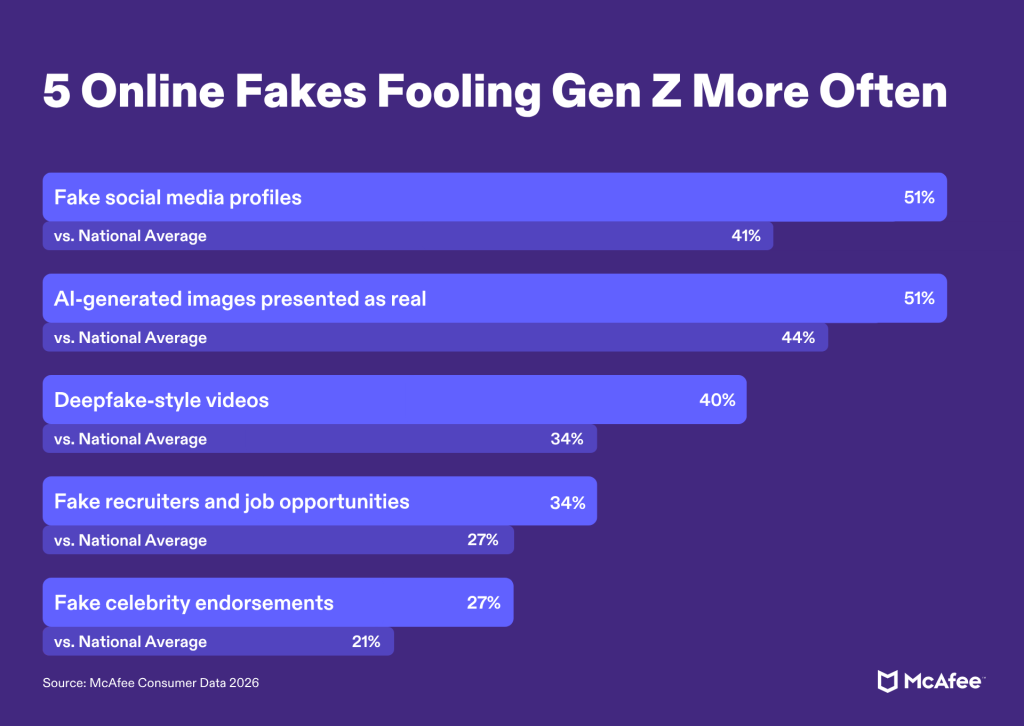
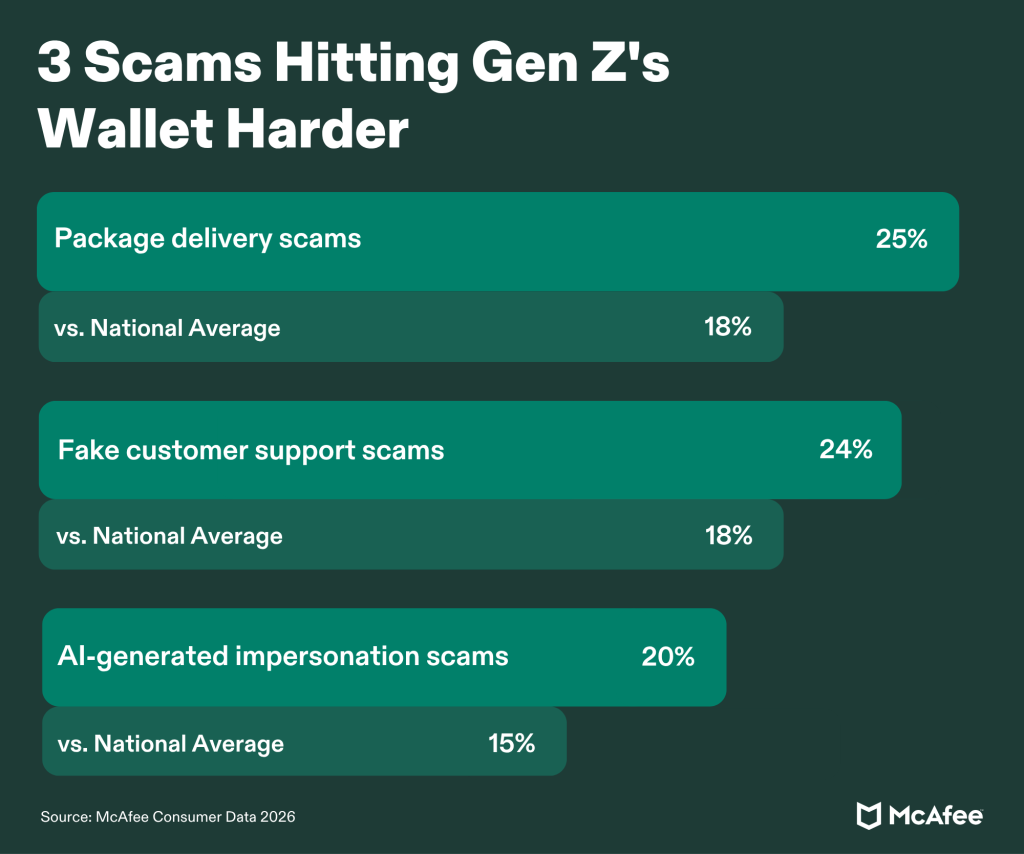
More than one in three Gen Z adults reported losing money to an online scam in the past year. They’re also encountering several types of online fakes at higher rates than Americans overall, including fake social media profiles, fake recruiters, AI-generated images and deepfake-style videos.
The data points to a new reality for a generation that has spent much of its life online: Digital familiarity alone may not be enough when AI is making fake content easier to create and harder to recognize.
Here’s what we found, plus our Head of Threat Research Abhishek Karnik’s key safety takeaways for Gen Z:

More than half of Gen Z adults encountered a fake social media profile in the past year, according to McAfee’s research.
In these instances, someone might impersonate a creator, brand, potential romantic partner or even a person you already know. Once contact is established, the conversation can move toward a suspicious link, request for money, investment opportunity or attempt to collect personal information.
Abhishek’s key takeaway: “Treat unexpected messages regarding requests for money or help, with some level of skepticism, even if it’s from familiar-looking accounts. Account takeovers (where a known contact’s account was compromised) and copycat accounts (impersonated accounts where someone created a similar looking profile) are often tactics used to target victims. Call your friend on a trusted number and confirm if they really need help.”
AI image tools can produce realistic-looking people, products, places and events that never existed.
For scammers, that creates another way to manufacture credibility. A fake profile can have convincing photos. A fraudulent product listing can appear to show a real item. An investment or giveaway scam can be dressed up with imagery that looks legitimate at first glance.
Abhishek’s key takeaway: “Look for oddities in the images itself. AI is not always perfect and does make errors. But also look beyond the image. Check the account posting it, the surrounding context and whether reputable sources confirm the claim before acting on it.”
Two in five Gen Z adults said they encountered deepfake-style videos in the past year.
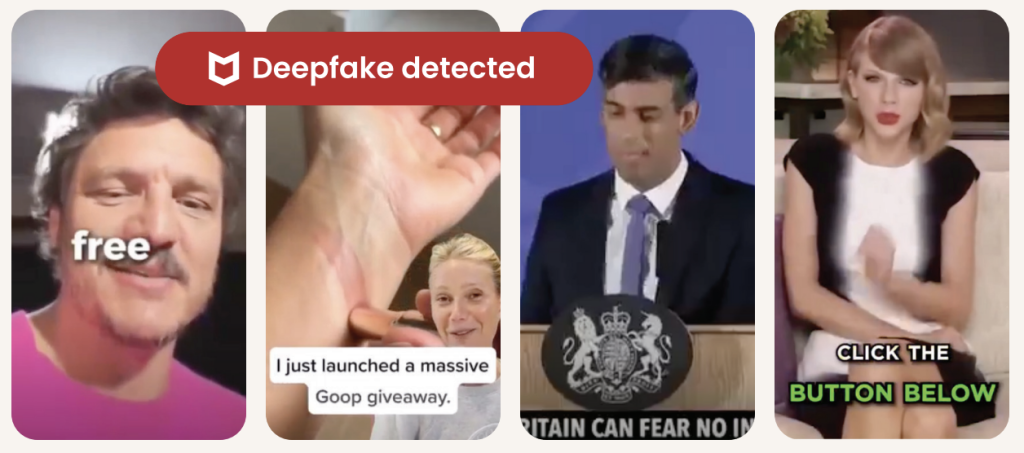
A deepfake is manipulated or AI-generated media designed to make it appear that a real person said or did something they didn’t. Improvements in AI mean visual oddities alone are becoming a less reliable way to identify one.
Abhishek’s key takeaway: “Not all deepfakes are bad. Some are made for entertainment. However, pause to analyze and consider what the video is asking you to do or believe.
A surprising celebrity investment pitch, urgent request for money or unbelievable announcement deserves independent verification, even when the person on screen looks and sounds convincing.”

For Gen Z adults entering or moving through the workforce, job hunting increasingly means interacting with people they have never met through email, social media, job platforms and messaging apps.
Scammers can exploit that normal behavior by posing as recruiters or employers. A convincing company name, professional-looking profile and friendly interview process can make a fraudulent opportunity harder to distinguish from the real thing.
Abhishek’s key takeaway: “Be cautious when a recruiter quickly asks for sensitive personal information, asks you to pay upfront costs or moves the hiring process onto an unusual platform like WhatsApp. Verify the role through the employer’s official website and independently confirm that the recruiter works there.”
AI has also made it easier to put familiar faces and voices behind claims they never made.
Fake celebrity endorsements can appear in investment scams, product promotions and giveaways. What makes them powerful is the borrowed trust. Seeing someone familiar can make an unfamiliar offer feel more credible.
Before buying, investing or sharing information, verify the endorsement through the celebrity’s official channels and independently research the company or offer.

Exposure tells us what people are seeing. Financial loss tells another part of the story.
McAfee’s research found Gen Z adults were more likely than Americans overall to report losing money to three particular types of scams:
Each takes advantage of an ordinary digital interaction.
Abhishek’s key takeaway: “Scams can work by fitting naturally into what someone is already doing online, making verification increasingly important before clicking a link, sending money or sharing sensitive information.”

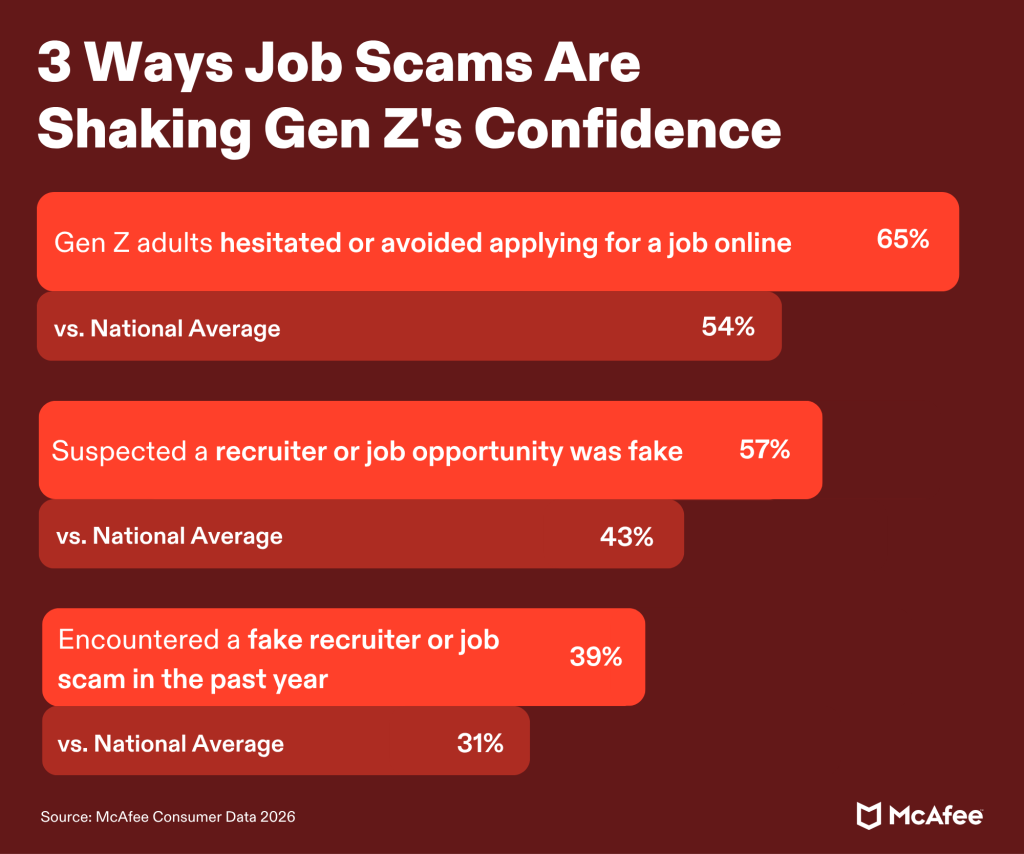
The job market provides one of the clearest examples of how scam concerns can affect people even when they never lose money.
McAfee found:
For young adults building careers, that uncertainty can carry a real cost. A legitimate recruiter and a scammer may contact someone through the same platforms and use many of the same professional conventions.
Abhishek’s key takeaway: “Verification can help. Search for the position on the company’s official careers page, check the recruiter independently and contact the company through information you find yourself when something feels questionable.”

Gen Z’s experience sits inside a much bigger shift in how Americans navigate life online.
McAfee’s newest research, which combines a nationally representative survey of 5,000 U.S. adults with McAfee Labs analysis of text-based scam activity, found that 88% of Americans encountered at least one type of scam in the past year. Nearly one-third, 31%, reported losing money to one.
The effects extend beyond financial losses.
Nearly three-quarters of Americans, 74%, say they feel the need to double-check most things online before trusting them. Sixty-two percent say figuring out what is real takes more mental energy than it did a year ago. And 82% say concerns about scams have changed something they do online.
That can mean avoiding an unfamiliar retailer, ignoring a legitimate message or deciding against clicking a real link.
AI adds another layer to that uncertainty because convincing content can now be produced faster and at greater scale. As synthetic content becomes part of everyday digital life, spotting scams cannot depend entirely on whether something simply “looks fake.”
For Gen Z, the findings suggest that challenge is already especially visible. They are encountering some forms of manipulated and fraudulent content more frequently while also navigating important parts of early adult life, from finding work to shopping and managing money, online.
A few habits can help reduce the risk without requiring you to investigate everything you encounter online.
Here’s what our threat researchers want you to know:
As AI changes how people create, communicate and connect, consumer protection needs to evolve with it.
McAfee has been protecting people for decades, and for many people, our name is still synonymous with antivirus. Today’s digital lives extend far beyond a single device, and the risks people encounter do too.
The new McAfee experience is designed to help protect the things people rely on every day, including their personal information, connections, devices and accounts, while making it clearer what’s safe, what needs attention and what McAfee can handle for them.

That includes helping identify suspicious messages, links and websites, alerting people when personal information appears in a data breach, monitoring for exposed personal information, helping protect connections on risky Wi-Fi and keeping devices and accounts safer.
The experience is built around three principles:
The goal is to help identify risk earlier and give people clearer guidance in the moment, reducing how much of the burden they have to carry themselves.
Gen Z’s digital fluency has developed alongside the internet itself. Now the internet is changing again.
AI is lowering the barrier to creating realistic fake content, while many of the interactions young adults depend on, including friendships, job searches, shopping, banking and entertainment, happen online.
The answer cannot be expecting people to become experts at identifying every new AI trick.
Let McAfee do that for you.
The post The Top 5 Scams Hitting Gen Z Harder Than the Rest of America appeared first on McAfee Blog.
A security breach at the Pentagon’s Defense Manpower Data Center (DMDC) exposed unencrypted personal and military records for approximately 3.05 million individuals between October 2025 and July 2026. First reported by Military Times on September 24, 2026, the intrusion compromised sensitive files, including Social Security numbers, belonging to active-duty personnel, veterans, and deceased service members.
With official notification letters dated September 18, 2026, now arriving in physical mailboxes, affected individuals can determine their exposure and enroll in 12 months of free credit monitoring and identity restoration services provided by the Department of Defense through IDX. Understanding the full scope of the incident, confirming whether your records were involved, and establishing immediate account and credit safeguards are essential steps to shielding military benefits and personal finances from targeted exploitation.
The breach occurred when unauthorized actors exploited a software vulnerability in a DMDC file-sharing system, maintaining access to a server holding unencrypted personnel data for nine months. According to official notification letters mailed by the DMDC on September 18, 2026, unauthorized users accessed personal and military service files between October 2025 and July 2026.
The Pentagon did not issue a public press release prior to dispatching physical mailings. Community members first raised public awareness by sharing letter excerpts on Reddit’s r/Veterans. Pentagon officials confirmed to CNN that the breach compromised records for 2.76 million living individuals and 294,000 deceased service members.
The exposed server contained unencrypted personally identifiable information (PII) belonging to service members, veterans, and military dependents. Compromised records include full names, Social Security numbers, dates of birth, contact information, and administrative military service details.
The primary notification method for this incident is a physical letter sent via the United States Postal Service. The DMDC began mailing official breach notification letters dated September 18, 2026, directly to affected personnel, veterans, and surviving family members.
The Pentagon has not released an online lookup database to verify individual exposure. The incident affects individuals whose personnel, manpower, or benefits records were stored on the compromised server during the nine-month exposure window, spanning active-duty military, reserve personnel, National Guard, defense civilians, contractors, veterans, and eligible dependents.
If you have moved recently, your notification letter may be delayed or returned to sender. Log in to milConnect to confirm that your mailing address and contact details are current within the Defense Enrollment Eligibility Reporting System (DEERS). If your records were maintained in DMDC systems between October 2025 and July 2026, take proactive security steps even before a physical letter arrives.
When personal and military records leak, cybercriminals routinely use the data to stage targeted impersonation schemes and financial fraud. Watch for these warning signs:
Military personnel and service members should take immediate steps to restrict access to their credit profiles and personal accounts:
If you received an official DMDC notification letter dated September 18, 2026, or notice unauthorized activity on your accounts, execute the following recovery steps:
Report security incidents, fraudulent accounts, and impersonation attempts directly through official federal reporting channels:
Because Social Security numbers and military service records cannot be readily changed, exposure from the DMDC breach presents a persistent risk for active personnel and veterans. Taking proactive security measures now, such as enrolling in the IDX identity monitoring program, locking down credit files, securing military accounts with multi-factor authentication, and reporting suspicious contact immediately, is critical to preventing long-term identity exploitation.
The post Pentagon Data Breach Impacts 3.05 Million: How Military Personnel Can Protect Themselves appeared first on McAfee Blog.

On October 6, 2026, the ASOS push notification hack sent unauthorized messages to millions of customer devices after cybercriminals accessed a connected third-party platform. ASOS, a British online fashion and cosmetic retailer serving active shoppers worldwide, confirmed that an attacker compromised employee credentials to access external systems. As reported by BBC News, the intrusion exposed customer contact records and personal search histories, although company representatives confirmed that banking and payment information was not accessed.
The unauthorized messages originated from an extortion ring calling itself the Xuanyewen hacker group. The intruders hijacked the ASOS mobile shopping app interface to broadcast rogue alerts directly to users, claiming they had extracted full customer databases.
The breach did not stem from a software flaw within the ASOS mobile application. Instead, the intruders relied on social engineering, impersonating a trusted contact to deceive an employee into providing valid system credentials.
Those credentials allowed the attackers to sign in to Simon AI, a third-party marketing and personalization platform built on Snowflake Cortex AI that ASOS uses to power customer communications. Once logged in, the threat actors initiated app-wide push alerts and exfiltrated audience data containing customer personal data.
During the intrusion, the hackers claimed they had carried out a direct Snowflake breach to compromise ASOS’s central databases. Official statements from both platforms quickly refuted that claim.
In a corporate statement released through Snowflake’s official statement via Alliance News, a Snowflake spokesperson stated: “We can confirm this issue did not in any way result from a vulnerability, weakness, flaw, or misconfiguration with the Snowflake service… and was not caused by Snowflake.”
Independent reporting and corporate disclosures confirm that the compromise occurred exclusively at the third-party marketing integration layer. Attackers frequently target peripheral marketing tools using stolen credentials because these platforms handle live customer segments without requiring direct access to locked-down corporate networks.
The data accessed during the incident included more than basic contact lists. As documented by BBC’s reporting, data samples provided directly by the threat actors revealed specific customer search histories, including search terms such as “reclaimed vintage.”
In the official ASOS customer breach notification, the retailer stated they did not believe that payment card numbers, banking details, and account passwords were accessed, as those are stored on separate, isolated transactional systems. However, exposed contact information and shopping preferences still present risks for targeted follow-up fraud. Watch for these warning signs that your personal data was exposed:
Taking direct defensive steps helps minimize the risk of identity theft or secondary phishing. Use these best practices to protect your personal data:
If your personal details were exposed or you interacted with the rogue push alert, take these containment measures:
Reporting incidents to official oversight agencies helps authorities identify threat infrastructure and take down fraudulent operations:
The ASOS App push notifications incident highlights how cybercriminals bypass central infrastructure by using social engineering to compromise connected third-party tools. Practicing strong credential hygiene, staying alert to targeted phishing messages, and reporting suspicious contact to regulators are your most effective steps for keeping your personal information secure.
The post ASOS Push Notification Hack: Inside the Breach and How to Stay Safe appeared first on McAfee Blog.

A new cyberattack is weaponizing everyday search results to trick users into running malicious code on their devices. The campaign, dubbed “Adception,” was uncovered by Push Security. By buying paid search ads on Google and routing traffic through trusted web services, attackers are placing deceptive links directly in front of people searching for popular software. Then, they use a social engineering framework known as “ClickFix” to trick people into running malicious scripts on their devices.
Search ads appear at the very top of search engine results, making them easy to click and easy to trust. Malvertising (short for malicious advertising) occurs when cybercriminals buy or hijack legitimate ad placements to spread malware or direct users to fraudulent websites. In this campaign, attackers purchase legitimate ad slots but route clicking visitors through a hidden chain of web redirects before loading a fraudulent website. This detour conceals the final destination from automated ad-review crawlers, allowing malicious ads to bypass platform security filters and reach active searchers.
According to Push Security’s research, the threat actors specifically targeted Mac users searching for Anthropic’s Claude AI assistant. To evade automated detection, the attack chain bounces traffic through legitimate Bing click-tracking redirects and a compromised website. Once a visitor lands on the fake software portal, the attackers deploy an evasion technique known as “ClickFix,” using deceptive troubleshooting prompts to trick macOS users into executing base64-encoded malware directly inside the Z shell (zsh).
The campaign executes across five distinct stages:
If you clicked a deceptive ad and pasted code into your Mac’s Terminal, assume your device has been compromised. Take these immediate steps to limit the damage:
Deceptive search ads succeed by exploiting everyday browsing habits and the assumption that top-ranked search results are safe. Taking a moment to verify destination URLs and reporting suspicious sponsored listings helps platforms dismantle malicious infrastructure and keeps the broader online community safer.
The post New Adception Campaign Weaponizes Search Ads: How to Stay Safe From Malvertising appeared first on McAfee Blog.

Security researchers at Jamf Threat Labs issued a September 2026 threat report warning Mac users about a newly discovered malware program called “CloudSyncD.” Disguised as a Zoom installer on unverified download sites, this malicious software tricks users into entering their administrator password, allowing attackers to secretly take remote control of the computer. The campaign targets individuals looking to install or update the popular video conferencing software.
For a detailed technical breakdown of how the malware operates, you can read the full Jamf Threat Labs report. In simple terms, when someone downloads and opens the fake Zoom installer, the malware enacts a process to take control of the Mac:
Recognizing a suspicious installer before opening it prevents system compromise:
Adopting safe download practices reduces the risk of installing malicious macOS software:
If you downloaded a fraudulent Zoom installer or entered credentials into a suspicious prompt, execute these recovery steps immediately:
Reporting malicious downloads helps threat intelligence researchers and federal agencies track active campaigns. Submit reports regarding fraudulent software installers to the FBI Internet Crime Complaint Center or the Federal Trade Commission. Notifying the official security team of the impersonated service provider also assists in taking down fake download domains.
Because CloudSyncD installs persistent background files, completely removing every component is essential to restoring system security. Simply deleting the downloaded installer disk image does not eliminate the threat. Ensure all hidden binaries and configuration files are thoroughly purged from your system to revoke remote access and protect your data.
The post CloudSyncD macOS Malware Hidden in Fake Zoom Installer: How to Avoid Malicious Installers appeared first on McAfee Blog.

On October 2, 2026, attackers hijacked Microsoft’s official X account (which reaches over 13 million followers) to execute a cryptocurrency pump-and-dump scheme, as reported by The Verge. The unauthorized access allowed attackers to replace Microsoft’s profile image with its retro mascot Clippy and promote a fraudulent token called $Clippy before the posts were removed. An official statement on Microsoft’s X account confirmed the account was secured, the unauthorized posts were deleted, and an internal investigation into the breach is ongoing.
When cybercriminals gain control of a verified corporate account, they leverage its built-in credibility to trick followers into fake financial investments.
Unauthorized actors gained access to @Microsoft on October 1, 2026. The attackers changed the account’s profile picture to image assets of Clippy, Microsoft’s legacy virtual assistant, and retweeted promotional posts from an impersonator handle, @clippymsftcto.
The malicious posts directed users to external sites promoting a fraudulent $Clippy cryptocurrency token. To confuse followers and delay remediation, the attackers also published a fake apology tweet from @Microsoft claiming control had been restored while continuing to promote the scam. Account access was eventually restored, and X suspended the associated impersonator accounts.
Protecting your assets from social media crypto schemes requires careful verification and strict wallet safety practices.
If you encounter or fall victim to a social media crypto scam, report cyber fraud directly to the FBI Internet Crime Complaint Center and deceptive financial schemes to the Federal Trade Commission. You can also flag hijacked profiles or scam links using on-platform reporting tools directly on X, or contact local law enforcement if you suffered significant financial losses.
High-profile corporate account hijacks demonstrate how quickly bad actors can exploit trusted brands to promote fraudulent schemes. Verifying financial news across primary corporate websites, auditing token contracts, and recognizing red flags remain critical steps to keeping your digital assets secure.
The post Microsoft X Account Hacked in Crypto Scam: How to Spot Hijacked Accounts Promoting Scams appeared first on McAfee Blog.
Authored By: Fernando Ruiz
McAfee’s Mobile Research Team identified more than 1,900 unique applications associated with the campaign across over 500,000 devices in more than 190 countries. Based on publication patterns, we estimate that the operators were releasing approximately 20 to 25 new applications per day, each leveraging different themes, brands, and impersonation targets. The highest concentrations of affected devices were observed in India, Russia, and the United States.
Most of these apps were published on the official android platform impersonating well-known products such as CapCut, Roblox, Zelle, PayPal, Netflix, Xbox Game Pass, Siri, iMessage, etc. under different developer accounts, they shared a common codebase, repeated the same deceptive behaviors, and contacted the same remote server, which told each app where to send its users. That destination was an advertising funnel and in our testing the ads it served led to third-party subscription-fraud pages billing as much as $49.99 per month
McAfee identified the malicious apps, conducted technical analysis, and reported its findings to Google through responsible disclosure channels. Following McAfee’s report, Google removed all of the identified apps from Google Play. McAfee is a member of the App Defense Alliance, which supports collaboration across the mobile ecosystem to improve user protection. McAfee Mobile Security detects these apps as a Medium-Risk Threat. For more information, and to get fully protected, visit McAfee Mobile Security.
This fake app campaign reached consumers around the world, with McAfee researchers identifying more than 1,900 unique apps across over 500,000 devices in more than 190 countries.
McAfee’s detection data shows how the campaign appeared across key markets. In the United Kingdom, McAfee recorded 11,862 detections, in Germany (5,016 detections), France (4,288), Australia (1,434), and Japan (944).
| Market | Devices protected | Global rank | Share of global | Fake apps seen | Top 3 lures |
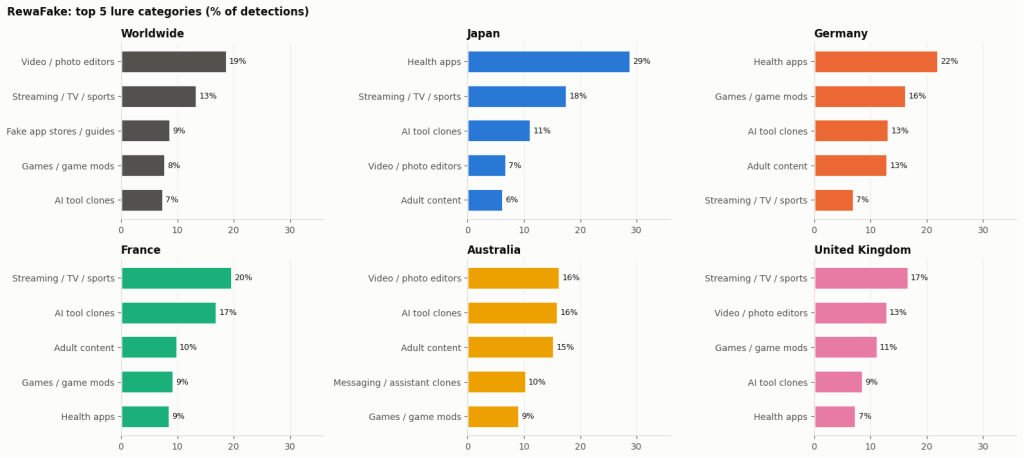
| United Kingdom | 10,582 | #8 of 207 | 1.98% | 970 | Streaming/TV/sports (17%), video editors (13%), games (11%) |
| Germany | 4,465 | #16 | 0.84% | 444 | Health apps (22%), games (16%), AI tools (13%) |
| France | 3,882 | #19 | 0.72% | 450 | Streaming/TV/sports (20%), AI tools (17%), adult content (10%) |
| Australia | 1,293 | #42 | 0.24% | 306 | Video editors (16%), AI tools (16%), adult content (15%) |
| Japan | 843 | #55 | 0.16% | 229 | Health apps (29%), streaming/TV (18%), AI tools (11%) |
These figures represent fake app encounters identified by McAfee, not total infections. It reflects where McAfee detected these apps rather than the overall infection rate in each country.

While the campaign used the same underlying tactics worldwide, the types of apps detected varied by region. Globally, fake video and photo editors accounted for 19% of detections, followed by streaming, TV, and sports apps (13%).
A closer look at individual markets reveals some notable differences:
These findings highlight how the same fake app campaign can appear in very different forms depending on what consumers are looking for. Whether it’s a health app, an AI assistant, a streaming service, or a popular game, familiar names and recognizable branding can make a fraudulent app appear trustworthy.
The risk isn’t limited to one country or one type of app. It’s the same underlying deception: an app that promises a familiar service but delivers something entirely different.
We identified fake apps impersonating Zelle, PayPal, Apple Pay, Mir Pay, Binance and several banks. One fake PayPal app had been downloaded 10,000+ times.
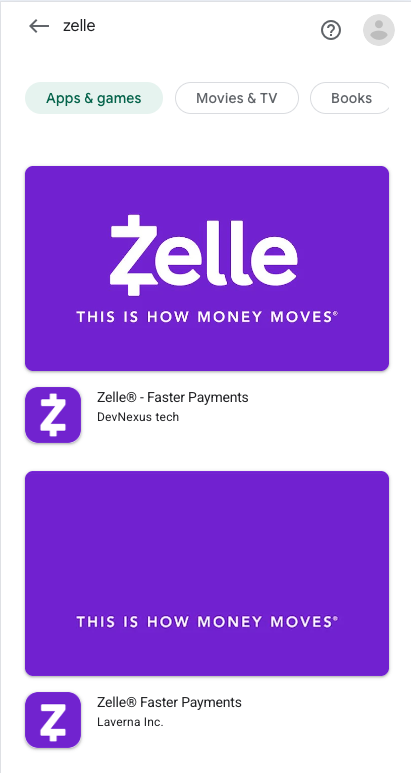
Zelle has no standalone consumer app: it lives inside your bank’s app so anyone searching Google Play for “Zelle” is already confused. And Apple Pay has no Android app at all, so users searching for it cannot find a legitimate result. Both are searches with no correct answer, which makes them ideal traffic to intercept.

Figure 1: Firsts result on Google Play of ‘Zelle’ search are Fake Applications
Combine that with an in-app browser whose address bar is hidden and whose destination the operator controls remotely, and the risk profile of a fake banking app is simply not the same as a fake video editor even when both currently do nothing worse than show ads.
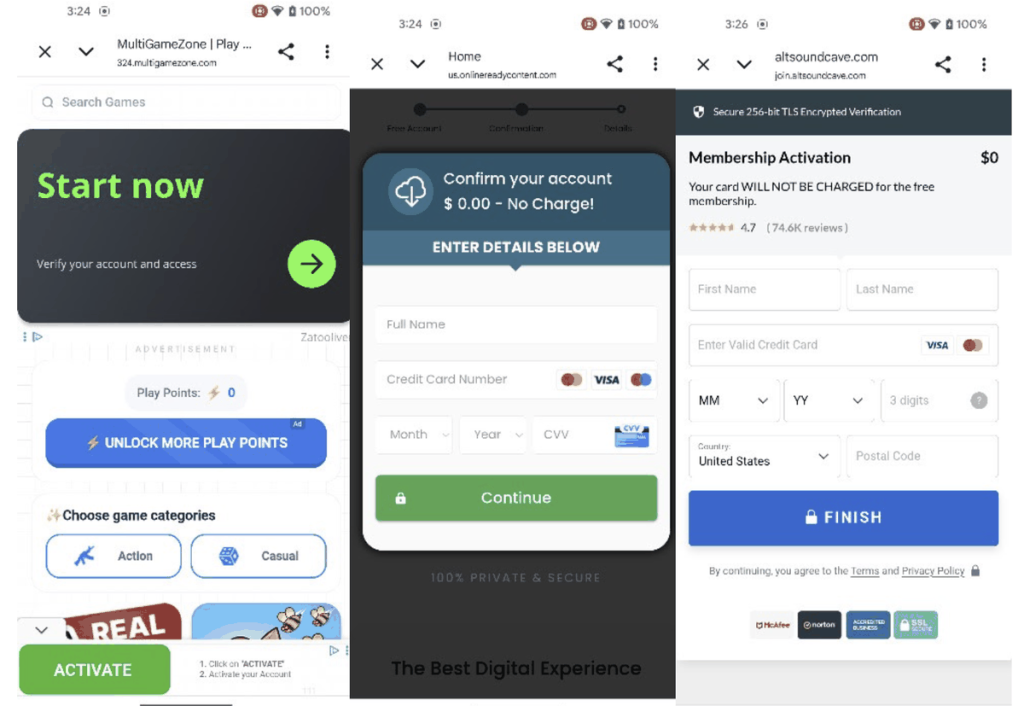
From the user’s perspective the current risk is straightforward: they search Google Play for “Zelle”, the first results include fake apps, and installing it delivers not a banking guide but a stream of full-screen ads. Tapping one leads to a page requesting their credit card details for a “free” trial that then bills them monthly.
In multiple cases we observed a gambling-style quiz funnel: “Win Mega Jackpot,” “50,000 COINS DAILY,” “PLAY FOOTBALL QUIZ,” “Play Now.”
Now consider who was looking at those store pages: Among the apps still available for measurement at the time of our analysis, the ones impersonating children’s and teenagers’ brands had been downloaded more than 86,000 times:
| Downloads | App title | Package Name |
|---|---|---|
| 50,000+ | Roblox | com.sitaram.robloxgame1 |
| 10,000+ | Roblox | com.sitaram.robloxgame3 |
| 10,000+ | Netflix Game Controller | netflixgamecontroller.uzair1 |
| 10,000+ | Netflix Game Controller: Play | netflixgamecontroller.uzair2 |
| 5,000+ | Xbox Game Pass: Play Games | xboxgame.abdul2 |
| 1,000+ | Fall Guys for Mobile | com.react.fallguysgame1 |
Across the full campaign we identified 37 apps impersonating games and services aimed at young players: Roblox, Minecraft, Fall Guys, Brawl Stars, Clash of Clans, Deltarune, Xbox Game Pass even GTA VI.

Figure 2: Fake Xbox App with over 5,000 installations
Every one of these listings carried an “Everyone” content rating.
So, the chain runs: a child searches Google Play for Roblox, installs an app called Roblox with the Roblox logo, rated suitable for everyone — and is funneled into gambling-style prize inventory that the operator can redirect at will. No exploit, no permission prompt, no warning.
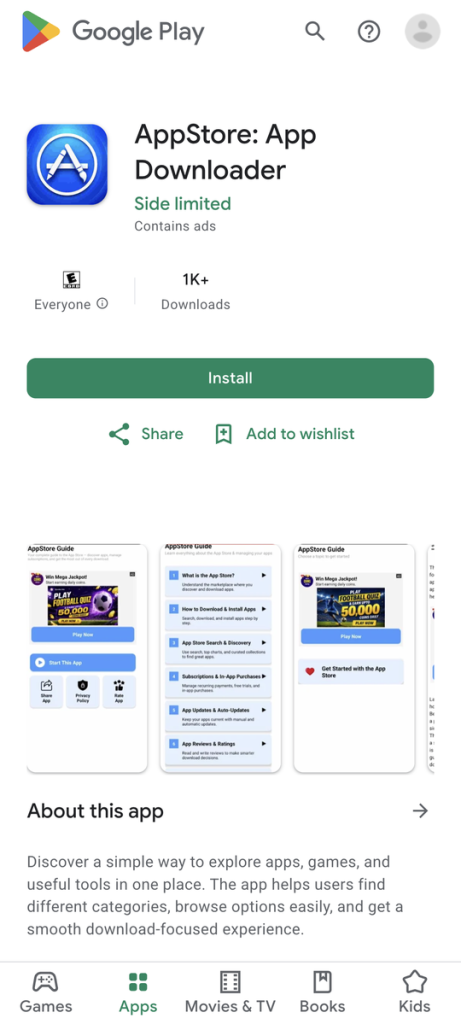
One application captured this strategy particularly well: Published as “AppStore: App Downloader,” the application used a legacy Appstore icon and presented itself as an Android version of Apple’s official software marketplace.

Figure 3: Fake AppStore on Google Play with over 1K Downloads
A legitimate Apple App Store cannot exist on Android because Apple operates the App Store exclusively for its own platforms, and the iOS applications it distributes are not compatible with Android’s operating system or application format. Any Android app claiming to be Apple’s App Store is therefore impersonating the service rather than providing the official marketplace.
“AppStore: App Downloader” was not an alternative marketplace but an advertising funnel disguised with Apple’s branding, rated for all users, and distributed through Google Play.
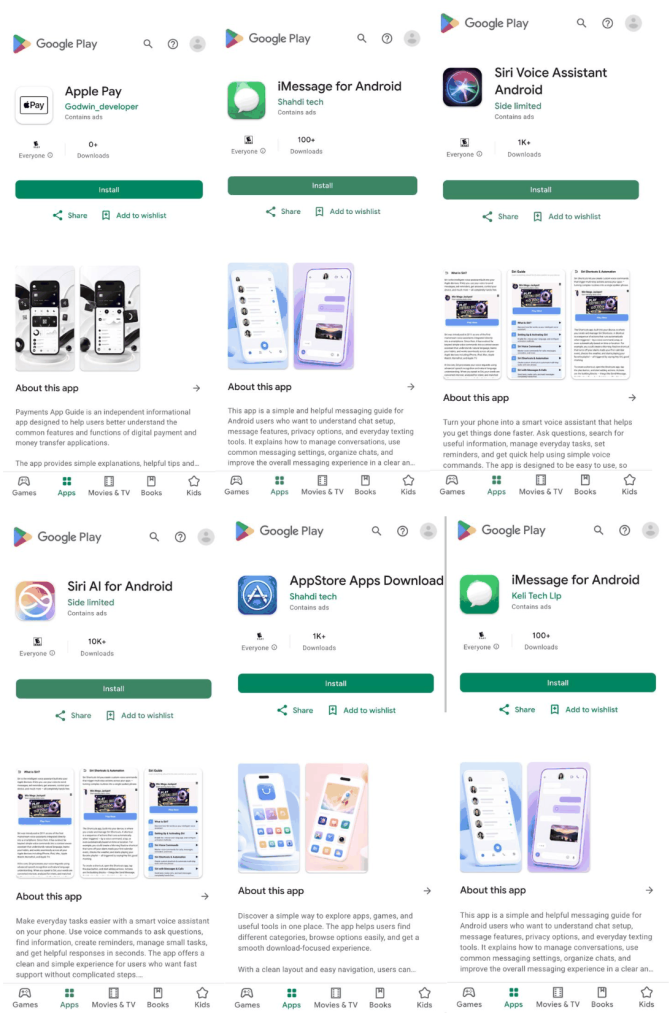
There is no App Store, Siri, iMessage, FaceTime nor Apple Pay app for Android. Zelle has no standalone consumer app, it lives inside your bank app. Every one of those is a search people perform on Google Play every day, and every one of them is a search with no legitimate result.

Figure 4: Multiple fake apps that does not officially exist on Android
The user’s own intent is the vulnerability: they want the thing, they cannot have the thing, and something appears that looks exactly like the thing. No security control mediates that moment. It is not a technical failure at all: it is a person trusting a logo, which is precisely what logos are for.
Each app is a shell. It wears the branding of something people search for — CapCut, Roblox, Zelle, PayPal, Netflix, Huawei Health, Xbox Game Pass, Siri, iMessage — and behind that branding it contains no real product. What it contains is a redirector.
On launch, the app contacts a server controlled by the operator:
`hxxps://rewadevelopments[.]online/data/.json`
The server replies with a small configuration block. One field in that block, `qureka_url`, holds a web address. The app takes that address and opens it in an in-app browser window, a Chrome Custom Tab, configured with the URL bar hidden.
In every case we observed, the address served was a gambling-style quiz site promising daily coin rewards. Users did not get a CapCut tutorial or a Zelle guide. They got an endless funnel of ad and quiz pages, monetized by the operator.
The mechanism matters more than today’s payload. Because the destination is fetched from the server at every launch, the operator can change where these apps send users at any moment, for any single app, without shipping an update and without passing store review again. An app wearing a bank’s logo, opening a browser window with the address bar hidden, pointed wherever the operator chooses, is a capability that can be used for phishing and credential exfiltration.

Figure 5: Ads severed from the website loaded in full screen that funnel to subscription fraud.
The full-screen ads users encounter are not served by the app. Its own ad slots are configured with Google’s public test IDs, which generate no revenue — so the app earns nothing from advertising itself. The ads come from the website the app opens: the destination supplied in the remote JSON configuration. That page’s ad inventory is filled with deceptive offers which, when tapped, lead to credit-card forms tied to subscription-fraud billing.
There is no exploit, privilege escalation, rooting attempt, dynamic code loading, obfuscation, encrypted payload, or dropper chain. The applications request no dangerous Android permissions. From the perspective of conventional static analysis, their code presents few of the indicators typically associated with Android malware.
This campaign avoids many of those controls because its primary deception occurs outside the application code. Rather than exploiting a software vulnerability, the operators exploit the user’s trust in an official app store and in recognizable brands.
The post-installation behavior can remain technically simple, as it does here with advertising redirection, because persuading the user to install the application is the most critical stage of the operation.
The affected users did not need to follow a malicious link or sideload an APK from an unofficial forum. They searched an official application store for a product they recognized, and the search results presented an application with the expected name, logo, and visual identity.
Mobile security has genuinely improved. Permissions are narrower, sandboxing is stronger, exploit mitigations are routine, store review catches more than it used to, and AI now finds obfuscated payloads at a scale no human team could match. Every one of those defenses works but none of them was tested here.
Attackers move to one part of the system that cannot be patched: the judgment of the person holding the phone. And they apply pressure exactly where that judgment is weakest — a familiar logo, an official store, a name that matches what you searched for.
These apps are adware or a medium risk threat rather than malware because the fraudulent content is not theirs. The app opens a web page chosen by its operator; that page’s advertising slots are filled by open programmatic ad exchanges, which sell to whichever advertiser bids. The subscription-fraud pages belong to those advertisers.
As threat actors continue to exploit trust rather than software vulnerabilities, McAfee remains committed to protecting users, raising awareness, and collaborating across the industry to ensure that seemingly harmless applications do not evolve into large-scale fraud operations.
| App title | Package | Play downloads | SHA-256 (primary build) |
|---|---|---|---|
| Roblox | com.sitaram.robloxgame1 | 50,000+ | 4f7b36963518e701276c77c1cad88d16fe64e8025c5223141c9af0eeb954ea63 |
| Roblox | com.sitaram.robloxgame3 | 10,000+ | c56d49a2f323ca0333778964fd58a7399aa60c8136a6a178adc1f222747b353f |
| Netflix Game Controller | netflixgamecontroller.uzair1 | 10,000+ | 2bdbd5c78a9d08b69983b965ae466210329b09eb26e5b491acdae9b822c729ab |
| Netflix Game Controller: Play | netflixgamecontroller.uzair2 | 10,000+ | 8cf714e0dab975c12cb5ac16837d7d2748a7f1672a3210a0e8e247dc405f8c68 |
| Xbox Game Pass: Play Games | xboxgame.abdul2 | 5,000+ | 37539a20f07bd29e9285e7266ab29015c5467241bea43eee48f77769c42bbc7e |
| Fall Guys for Mobile | com.react.fallguysgame1 | 1,000+ | d9ae6d844bf9269bee7d1f67f2f3d9e1d932974733068639c7204c2c92c391b1 |
| Capkut – Video Editor | com.flintos.capcut2 | 50,000+ | ba7a00fd597c04b7aa2efb59da853b1fcf34ba3bb63e7fbef2b9d9ef1a497641 |
| Capcut Video Editor 2026 | com.capcut.capvideoeditorapp58 | 10,000+ | 9b9e08b176d12c5e388b33c3e1fcdf2ba52b94cc6b310b56e3596eb783c26569 |
| Siri Voice Assistant Android | com.shahdi.siri2 | 10,000+ | b015de54db5073758909e5f3eaa90e73d7ff6f923195569d22395808b99a5557 |
| Siri for Android | com.shahdi.siri1 | 5,000+ | 9a0881a67a7c35592216e0896e184d1ed960ef5c2280a6dafcfcbc0dcb29c099 |
| Siri for Android | com.keli.siriapp1 | 1,000+ | 30a9f7461a0c11061b9349004f3dcd39ec763ec8bf1520ce655653fca67e183e |
| iMessage for Android | com.keli.imessage3 | 100+ | ac46add9b7bb09779ab0a51924601e649431153c40d95c2ecc995e614ff2b89d |
| iMessage Android App | com.shahdi.imessage2 | 100+ | 83a95ceb22e24d5486f997d3ab7a8fa336cbf52c6489bfd20b285ccb16237f8e |
| Apple Health for Android | com.godwin.applehealth2 | 1+ | 5d2c823acf6e719553688626a113e79842d186de7d3203c011b032eb2f87adca |
| Huawei Health | huwaei.health1 | 10,000+ | 695eca22217b60b6218fbef51bcf660e569f7ce36c1d73a4646494d5489ae352 |
| Casino Plus PH | casinoplus.pindo3 | 10,000+ | 3a50fa0ee7be36cbb1052254fbfdc0602abd7f52d69d7dc32d5c9ea6148ed16c |
| Aviator Game | com.aviator.aviatorgamejamantech2 | 1,000+ | 18af2b9a1e9db5f85c789252dbb0048a244e0a181f88b31c0969e6789b9657b8 |
| GTA VI | com.react.gta6game1 | N/A | 78a098470a7926dc0bd36c625032fd421587aea88200fdbb877dbc655110c5f5 |
| App title | Package | Play downloads | SHA-256 (primary build) |
|---|---|---|---|
| PayPal – Fast Payments | com.paypal.wallawalled11 | 10,000+ | 601639168ac739e08fd267e86ba7eae440116e5b295fe01c00098bc2d9845405 |
| Zelle® Easy Secure Payments | com.premkumar.zelleapp5 | 100,000+ | 8a943f50417c53fd9d8f522fdb69d76c96ca386c2416a43d20f9181350282bd1 |
| Zelle® Faster Payments | com.premkumar.zelleapp2 | 50,000+ | 84fac9f350cd9d627392125cd3b06bac62321a2a36954605bd4680383ee86ae2 |
| Zelle® – Faster Payments | com.zelleapp.devnexus2 | 10,000+ | 99122b355ba17d6fa55625414f9a48f8755f4a438374ce85c73c751e9f4fe6b6 |
| Zelle® – Online Payments | com.mhd.zelleapp2 | N/A | 0022360894f15199c5f2fda5b5d8be3d26045d12ad50d80d02a23741601345af |
| Apple Pay | com.godwin.applepay3 | N/A | aa6883d64438a4374a5f44b5180d8ff12ca3d0c9423946df092420291007fdaf |
The post Android/RewaFake: Uncovering a Large-Scale Fake Apps Adware Campaign on Google Play appeared first on McAfee Blog.

Every time a big Amazon sales event takes place, shoppers flock to the deals. And scammers know it.
This year, Amazon has added a new Prime Day event Oct 6-7 called Amazon’s Prime Big Deal Days event. And in preparation, we’re breaking down the ways scammers use AI-driven manipulation to create fake Amazon websites, send delivery scam texts, impersonate customer support agents, and make scams look more convincing than ever.
Recent McAfee research suggests shoppers may be especially vulnerable in 2026. Forty percent of consumers say they would trust a lower-priced deal without verifying it first, while 29% admit they would skip researching a seller if the price looked good enough.
That combination of urgency, discounts, and increasingly sophisticated scams creates the perfect environment for fraud.
“Anyone who has ever fallen for a scam thought they would recognize one first,” McAfee’s Head of Threat Research Abhishek Karnik reminds shoppers.
“That confidence is part of what scammers count on,” he says. “Tools like McAfee exist precisely for those moments, flagging suspicious links, messages, and offers in real time, before a split-second decision becomes a costly one.”
Here are the most common Amazon Prime Day scams to watch for in 2026 and the warning signs that can help you avoid them.
| Scam Type | How It Works | Red Flags |
| Fake shopping websites | Fraudulent websites mimic real retailers and disappear after collecting payments | Prices far below competitors, little company information, newly created websites |
| Fake social media ads | Ads promote products that never arrive or are counterfeit | Too-good-to-be-true discounts, limited reviews, unfamiliar brands |
| Delivery notification scams | Fake package alerts claim there is an issue with your shipment | Unexpected texts, suspicious links, requests for payment |
| Retailer impersonation scams | Messages claim there is a problem with your account or order | Urgent language, login requests, unfamiliar sender addresses |
| QR code scams | QR codes redirect shoppers to fraudulent websites | Codes placed on flyers, posters, packages, or public locations |
| Brushing scams | Unsolicited packages arrive at your home | Items you never ordered, requests to scan codes or leave reviews |
| Fake recall scams | Messages claim a recent purchase has been recalled | Requests for payment, account credentials, or personal information |
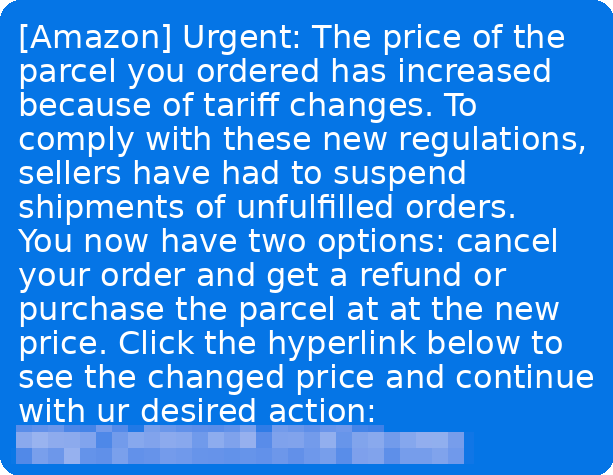
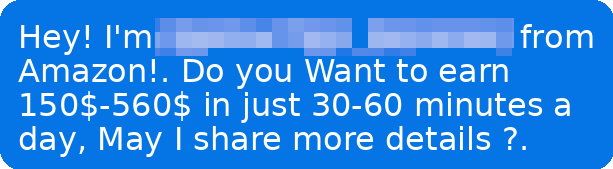
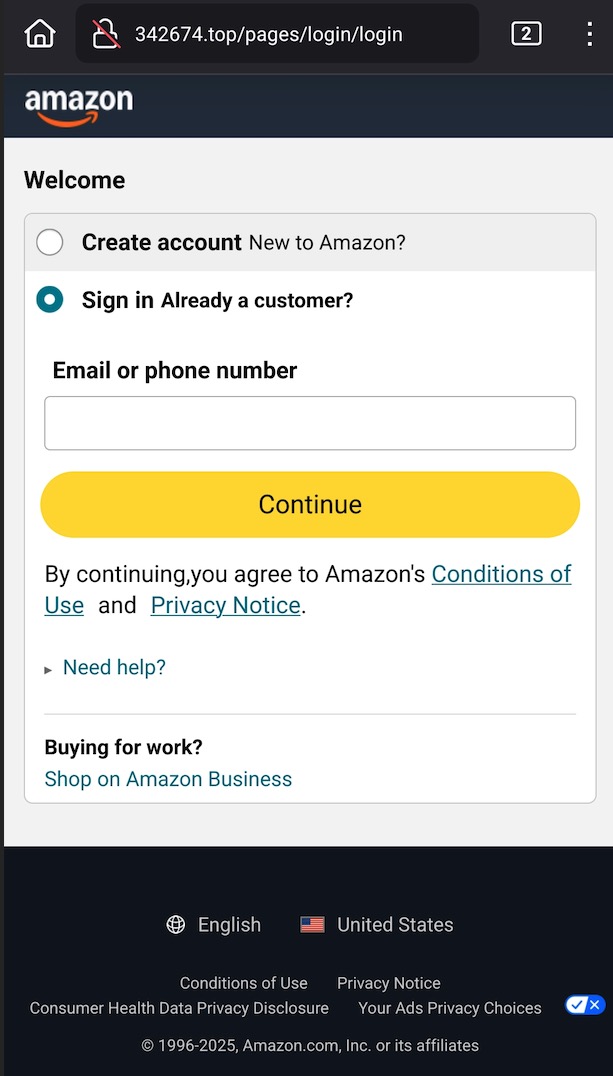
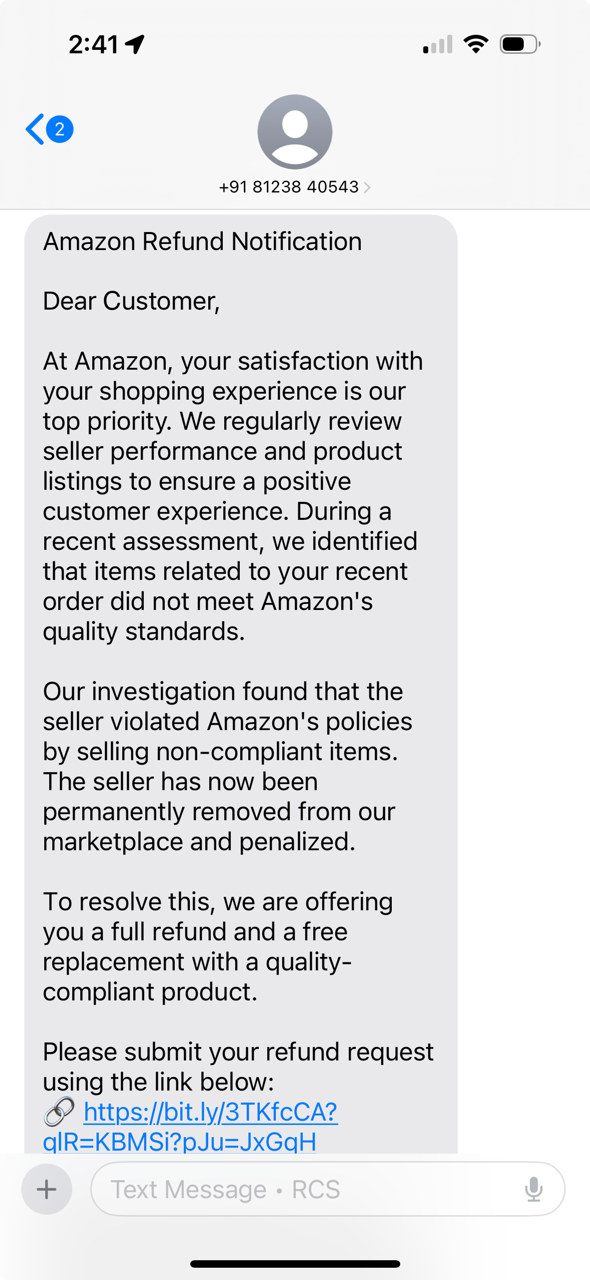
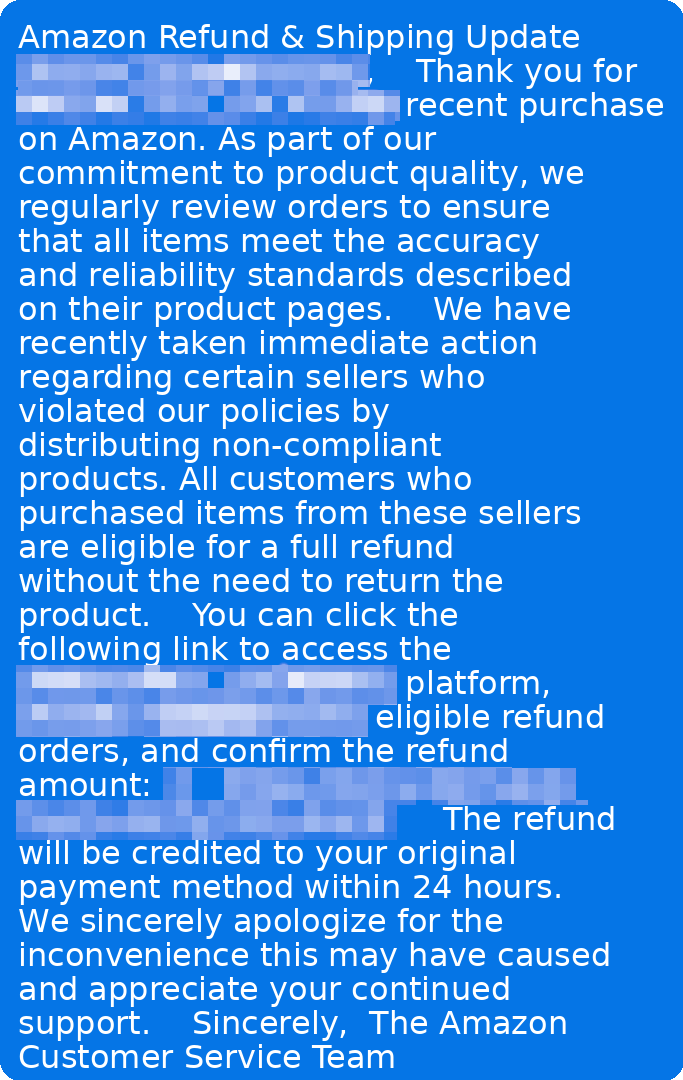
Here are examples of Amazon-related scam texts our team came across near Prime day last year, McAfee’s Scam Detector helped detect and stop these messages:


Figure 1. Examples of Amazon tariff and job scams

Figure 2. An example of a fake Amazon sign-in page.


Figure 3. Examples of Amazon phishing scams
Major shopping events create the exact conditions scammers rely on: urgency, distraction, and the promise of savings.
“What the data reflects is that economic pressure has effectively done some of the scammer’s work for them,” says Abhishek Karnik, Head of Threat Research at McAfee. “When consumers are already primed to move quickly and prioritize price over authenticity, it takes far less effort to push them toward a bad click or a fraudulent purchase.”
The good news? These scams are preventable if you know what to watch for and take the right precautions. Here’s your defense playbook:
Together, these protections are designed to address the broader range of online risks people face every day.
Check out the McAfee our latest offer this Amazon Prime Big Deal Days Event here.
The post How to Shop Safely During Amazon’s October Prime Big Deal Days Shopping Event appeared first on McAfee Blog.

On October 2, 2026, BleepingComputer reported that ed-tech software provider Frontline Education suffered a data breach exposing personal information of K-12 school district employees, including Social Security numbers, email addresses, and physical addresses.
Frontline internally identified unauthorized access on August 14, 2026, stemming from a security flaw in a third-party application, and began notifying impacted school administrators via Cyberscout on October 1, 2026. Because Frontline provides administrative and workforce management tools to over 80,000 schools across the country, the exposure directly impacts teachers, administrators, and educational staff whose employee records were managed through the platform.
According to reporting by BleepingComputer and discussions among IT administrators from multiple school districts in the r/k12sysadmin Reddit community, attackers exploited a vulnerability in a third-party software application integrated with Frontline Education’s systems. This vulnerability enabled unauthorized access to internal databases containing administrative and workforce management records.
Frontline discovered the intrusion on August 14, 2026. Rather than issuing an immediate public statement on its corporate website, Frontline partnered with Cyberscout to dispatch private notification emails directly to superintendents, business managers, and IT personnel starting October 1, 2026. The exposed data includes critical personally identifiable information:
Because compromised Social Security numbers and contact details enable identity theft and targeted phishing, school district employees should watch for these specific warning indicators:
If you are a K-12 school employee whose district utilizes Frontline Education software, take these immediate actions to secure your personal information:
If your Social Security number or personal financial details have already been misused, complete the following recovery steps immediately:
To report suspicious activity or document fraudulent use of your information resulting from this incident, use official reporting channels:
Data breaches often have a long tail, as compromised details can resurface months or years after the initial breach. Long-term protection relies on strong password hygiene, routine credit checks, and ongoing caution with unexpected communications. Automated monitoring tools can alert you if exposed credentials surface online, while consistent security habits and swift action remain your primary defense.
The post Frontline Education Data Breach: What Happened and How K–12 Staff can Stay Safe appeared first on McAfee Blog.

Cybersecurity used to be easier to picture. It was antivirus software protecting the family computer. A suspicious email you knew not to open. A password you were reminded to make a little harder to guess.
Today, our digital lives don’t fit neatly inside a computer. And neither do the risks.
A scam text can follow you into a purchase. Personal information scattered online can fuel unwanted calls and messages. An account you haven’t thought about in 10 years can still hold information about you. And every ordinary interaction, from following a delivery link to shopping at a new store, can require a moment of calculation: Is this real? Is this safe?
McAfee’s latest research shows how much work that’s becoming. Nearly three-quarters of Americans (74%) say they feel the need to double-check most things online before trusting them, while 62% say figuring out what’s real takes more mental energy than it did a year ago.
That’s why this Cybersecurity Awareness Month, we’re thinking about cybersecurity a little differently.
Every October, Cybersecurity Awareness Month encourages people and organizations to build better habits for staying safe online.
For 2026, the Cybersecurity and Infrastructure Security Agency (CISA) is marking the month with the theme “Securing the Next 250.“ CISA points to technologies such as artificial intelligence that are accelerating how quickly attackers can identify and take advantage of weaknesses in computer systems.
For individuals and families, CISA recommends four basic actions:
They’re good fundamentals. Use unique passwords and multifactor authentication when they’re available. Install security updates instead of putting them off indefinitely. And treat unexpected requests for money or information with caution.
But good cybersecurity today also means looking beyond the traditional security checklist.
If your phone constantly rings with unknown callers or your inbox is overflowing with unwanted messages, consider looking at how much information about you is available online.
Your name, phone number, email address, home address, and other personal details can appear on data broker and people-search sites. That information can contribute to the pool of data available to marketers, and potentially provide useful ingredients for scammers trying to make a message more convincing.
You can’t make yourself invisible online. But you can reduce unnecessary exposure.
Personal Data Cleanup scans data broker sites for your personal information and can help with its removal, depending on your plan. Think of it as reducing some of the information about you that’s unnecessarily floating around online.
It’s a useful shift in mindset: don’t just get better at dealing with unwanted contact. Look for opportunities to reduce your exposure in the first place.
Remember Myspace?
What about that Tumblr you haven’t touched in a decade? The shopping site you ordered from once? An old forum account? Or one of the dozens of apps and services you tried, abandoned, and promptly forgot existed?
Our digital footprints are full of these little leftovers.
And your digital footprint isn’t only what you post publicly. It’s also the accounts you’ve created and the companies you’ve entrusted with pieces of your information over the years.
An abandoned account may still contain an email address, old login information, purchase history, personal details, or other data. If a service you no longer use experiences a breach someday, that’s one more place where information associated with you could potentially be exposed.
A good, simple rule: If you don’t use it and don’t need it, consider deleting it.
McAfee’s Online Account Cleanup can help find accounts associated with your email and help you identify ones you may want to remove. We’ve also updated the experience to help prioritize higher-risk accounts, so you can focus your attention where it matters.
This Cybersecurity Awareness Month, see how many pieces of your old internet life you can finally retire.
Airport Wi-Fi. Hotel Wi-Fi. Coffee-shop Wi-Fi.
Using a network you don’t control doesn’t need to become a cybersecurity event every time you leave the house.
A VPN, or virtual private network, encrypts the internet traffic traveling between your device and the VPN service. That adds privacy to your connection, particularly when you’re using unfamiliar or unsecured networks.
The important part isn’t remembering to become extra vigilant every time you sit down at a coffee shop. It’s making protection easier to use consistently.
With Secure VPN, you can add protection to your internet connection when you’re away from networks you know and trust.
That’s the kind of cybersecurity we like: something working quietly in the background while you get on with whatever you actually opened your laptop to do.

McAfee will let let you know if you have weak internet security.
Think about how many times a day something online asks you to go somewhere else.
A text sends you to track a package. An email asks you to sign in. A search result takes you to a new website. An ad introduces you to a store you’ve never heard of.
Scammers rely on those transitions.
McAfee Labs’ 2026 analysis of text scams found schemes impersonating or referencing everything from deliveries and bank accounts to jobs, tolls, shopping, subscriptions, investments, and utilities. Many are designed to get the recipient to click, respond, or move the conversation somewhere else.
You can inspect every URL yourself. But that puts the work right back on you.
McAfee’s Scam Detector can help warn you about risky websites and links before an everyday click becomes a bigger problem.
It’s a small example of a larger principle at McAfee: You shouldn’t have to be the cybersecurity expert. That’s our job.
If you have another five minutes this Cybersecurity Awareness Month, open your browser settings.
Start with your extensions.
Browser extensions can be genuinely useful, but some require significant permissions to function. If you have extensions you don’t recognize or haven’t used in years, remove them. The fewer unnecessary tools you give access to your browsing, the fewer things you’re relying on to behave responsibly.
Next, check which websites have permission to send you notifications. Remove ones you don’t recognize or no longer want. Unwanted browser notifications can sometimes imitate security alerts or use other alarming messages to get your attention.
Finally, check for browser updates, or simply turn on automatic updates if your browser supports them.
You don’t have to become an expert on browser security. You’re just cleaning out things you no longer need.
This Cybersecurity Awareness Month also comes just as we’re rolling out an updated McAfee experience.
The idea behind it connects directly to what our research is telling us.
Seventy-four percent of Americans feel the need to double-check most things online before trusting them. Sixty-two percent say deciding what’s real takes more mental energy than it did a year ago.
Good protection shouldn’t add another set of things to check.
The new McAfee experience brings protection for personal information, connections, and devices into one connected experience across PC, Mac, mobile, and tablet. It’s designed to make it easier to understand what’s protected, what needs your attention, and what McAfee can help handle. That can mean alerting you to suspicious messages and links, helping identify risky websites, monitoring for exposed personal information, protecting your connection, finding forgotten accounts, or helping remove personal information from data broker sites.
We’ve also updated tools including Online Account Cleanup to help people prioritize higher-risk accounts and Personal Data Cleanup to make it easier to understand what personal information is being found and removed on their behalf.
The philosophy behind those changes is simple: Good protection shouldn’t create another job for you.

Our digital lives are simply our lives now.
We shop, date, bank, work, travel, talk to family, look for jobs, manage our health, and discover new things online. And the risks can move just as easily between those digital and physical worlds.
So this Cybersecurity Awareness Month, don’t worry about becoming a cybersecurity expert.
Reduce what you expose. Close what you don’t use. Protect the connections you rely on. And let technology help you decide what’s safe.
The post Cybersecurity Awareness Month 2026: 4 Simple Ways to Stay Safer Online appeared first on McAfee Blog.

Customer names, email addresses, phone numbers, and shipping addresses were exposed across multiple e-commerce storefronts when attackers breached two third-party shopping applications. The cyberattack was confirmed when UK online spirits retailer Master of Malt notified its customers on September 18, 2026 of the risk to their personally identifiable information (PII). The following day, they informed customers that Master of Malt was not the target of the attack and that “The attack was against Ribon, which was installed on hundreds of BigCommerce stores.”
In a September 2026 statement reported by BleepingComputer, e-commerce platform BigCommerce alerted merchants that unauthorized actors accessed shopper records between September 13 and September 17, 2026. BigCommerce confirmed its core platform remained uncompromised and uninstalled the affected software on September 17, 2026, to block cybercriminals from further access.
According to BigCommerce’s comments to BleepingComputer, the data breach originated from a system compromise at Fastr, the parent company of third-party app developer “Be A Part Of.” Attackers obtained API application keys for the Ribon and Ribon 1.5 e-commerce apps, which merchants integrate into BigCommerce storefronts to manage customer features.
Because e-commerce integrations grant application keys permission to read store data, holding valid credentials allowed attackers to generate legitimate platform API requests. From September 13 to September 17, 2026, the unauthorized actor extracted customer records across affected stores and injected malicious scripts into a small number of storefronts. BigCommerce uninstalled the applications on September 17, 2026, and notified impacted merchants directly.
Exposed contact details often serve as the foundation for follow-up phishing attempts and impersonation scams. Watch for these specific indicators:
Protecting your personal accounts after news of a data breach requires proactive credential management and exercising caution with calls and emails. Take these actions to help protect yourself:
If your data was exposed or you received a breach notification from an affected BigCommerce merchant, take these immediate steps to secure your identity and finances:
If you encounter phishing attempts or fraudulent activity linked to this breach, report the incident directly to official regulatory and law enforcement channels. You can submit details to the FBI Internet Crime Complaint Center, report deceptive or suspicious messages through the Federal Trade Commission, or notify the impacted retailer directly through the customer support portal on its primary website.
The BigCommerce Ribon app incident demonstrates how compromised third-party application permissions can expose customer records even when core e-commerce platform infrastructure remains secure. Verifying sender credentials and maintaining separate passwords across online accounts helps mitigate personal risk when supply-chain breaches occur.
The post BigCommerce Ribon App Breach: What It Is and How to Protect Yourself appeared first on McAfee Blog.
For a long time, being safe online came with a relatively familiar set of rules.
“Don’t click suspicious links.”
“Keep your software updated.”
“Be careful about what you share.”
But today, AI is everywhere. And it’s rapidly evolving and drastically changing what it means to trust what we see and hear online. It can make scams more convincing and easier to create at scale, while personal information available online can make those scams feel remarkably specific to us.
As AI reshapes nearly everything we consume and do, our daily interactions all come with an added mental burden: the feeling that you have to question everything.
Our research found that nearly three-quarters of Americans (74%) feel the need to double-check most things online before trusting them.
That finding stuck with me because it captures something bigger than concern about any one cyberthreat: Trust itself is becoming time-consuming work.
In a world where normal, everyday interactions put people at risk, consumers need protection that keeps them safe in every moment, feels simple, and works quickly and proactively.
Meet the new McAfee: a completely transformational safety solution that protects you when you know you need it, and when you don’t.
This marks a shift from reactive security to proactive safety that helps you identify risks and take action before any damage is done.
I experienced a great example of it recently. I was getting on a plane and connected to the public Wi-Fi. McAfee let me know that my VPN had automatically turned on to help protect my connection.
I didn’t have to remember to take a security step. I didn’t have to search for a setting or wonder whether I had done the right thing. I didn’t have to know that I should be securing my connection on public Wi-Fi. And I didn’t have to know what a “VPN” is (virtual private network for those who are wondering!) The protection was simply there when I needed it. Always on. Simple and easy. Personalized and proactive.
That small moment captured something much bigger about the experience we want to create.

McAfee has been protecting people for decades, and for many, our name is still synonymous with antivirus. But in a world of accelerating AI, people’s digital lives no longer fit neatly inside a single device, and neither do the risks they encounter.
That’s why the new McAfee experience is designed to do much more than protect individual devices. It helps protect the things people rely on every day, including their personal information, connections, devices, and accounts, while making it clearer what’s safe, what needs attention, and what McAfee can handle for them.
McAfee’s new product experience seamlessly protects your personal info, finances, connections and devices so you can shop, text, bank and browse with confidence, delivering advanced and comprehensive protection at every moment.
This is merely an evolution of what McAfee has always been here to do: keep people safe- from today’s threats and tomorrow’s.
Our new brand is an expression of that same evolution.
Safe is reacting. Safer is preventing.
Safe is worrying about tomorrow. Safer is enjoying today.

Those contrasts capture what Safer Than Safe means to us. It’s about giving consumers greater confidence instead of building on decades of fear associated with scams, malware, risks, alerts, and the protection industry broadly.
With the growing concern over AI and the speed at which it’s evolving, there has never been a more important moment to provide critical safety solutions proactively and simply. And that’s the moment we’re meeting.
That thinking shaped a McAfee brand that is brighter, simpler, and more human. The experience of being protected shouldn’t be defined by warnings and complexity, and neither should the brand behind it.
McAfee’s “Safer Than Safe” brand promise, the new experience simplifies security into one holistic safety solution:
AI will continue to change how we create, communicate, and connect. It will bring extraordinary possibilities and new risks. We cannot expect people to study every development closely enough to recognize every new way their trust might be tested.
Consumers shouldn’t be security experts. That’s our job.
McAfee. Safer Than Safe.
The post There’s Safe. And There’s Safer With McAfee: Transformational Protection appeared first on McAfee Blog.

No matter where you live in the U.S., AI-driven scams and deceptive content are increasingly filling our feeds, alerts, and inboxes with moments that make us stop and ask: “Is this real?”
But the scams and threats Americans encounter aren’t the same everywhere. Where you live can shape the types of scams reaching your devices, how often you encounter them, and even how those experiences affect the way you behave online.
This 50-state breakdown combines McAfee consumer research with McAfee Labs data to show how Americans are experiencing scams, how those experiences are affecting trust and behavior online, and which text-based scams are reaching devices across the country.
The consumer findings come from a nationally representative survey of 5,000 U.S. adults, with 100 respondents in each state. The survey explores people’s exposure to scams, financial losses, changing online behaviors, concerns about AI and the mental effort involved in deciding what to trust online.
Alongside those findings, McAfee Labs analyzed text-based scam activity across the U.S. from May through July 2026. That data provides a view into the volume, concentration and types of scam texts McAfee observed in each state during the three-month analysis period.
Together, the two datasets offer different views of the same problem: what people say they are experiencing and how it affects them, alongside the scam activity McAfee is seeing in the wild.

Key takeaway: Alabama had the highest scam-text rate per device in McAfee’s analysis, while scam concerns are also changing how residents behave online.
McAfee detected 5.14 scam texts per device, the highest rate in the country.
Key takeaway: Alaska has one of the widest gaps between rising trust fatigue and active checking: 54% report more mental effort, but only 44% verify online content at least weekly.
Investment and cryptocurrency scams were the leading text-scam category detected in Alaska.
Key takeaway: Arizonans are feeling a pronounced trust burden, with 65% saying it now takes more mental energy to decide what’s real online.
Investment and cryptocurrency scams led Arizona’s text-scam volume.
Key takeaway: Arkansas residents are relatively active verifiers: 64% check online legitimacy at least weekly even though only about half report greater mental strain.
Investment and cryptocurrency scams led Arkansas text-scam volume.
Key takeaway: California has one of the heaviest trust burdens in the survey: 72% say figuring out what’s real online now takes more mental energy.
Investment and cryptocurrency scams led California’s text-scam volume.
Key takeaway: Colorado’s clearest signal is concern about AI-enabled scams, shared by 85% of residents surveyed.
Investment and cryptocurrency scams led Colorado’s text-scam volume.
Key takeaway: Connecticut residents report rising trust fatigue, yet fewer than half say they verify online content every week.
Investment and cryptocurrency scams led Connecticut’s text-scam volume.
Key takeaway: Delaware stands out for exposure to synthetic imagery, with 46% encountering an AI-generated image presented as real.
Investment and cryptocurrency scams led Delaware’s text-scam volume.
Key takeaway: Floridians are active online reality-checkers, with 63% verifying messages, offers, websites or people at least weekly.
Investment and cryptocurrency scams led Florida text-scam volume.

Key takeaway: Georgia had the second-highest scam-text-per-device rate highlighted by McAfee, at 4.67.
Investment and cryptocurrency scams led Georgia’s text-scam volume.
Key takeaway: Hawaii had the country’s highest scam intensity among affected devices: those receiving at least one scam text averaged 8.45 over three months.
Investment and cryptocurrency scams led Hawaii’s text-scam volume.
Key takeaway: Idaho shows a sizeable trust gap: 62% report greater mental effort deciding what’s real, while 49% verify online content weekly.
Investment and cryptocurrency scams led Idaho’s text-scam volume.
Key takeaway: Two-thirds of Illinois residents say deciding what’s real online is taking more mental energy than a year ago.
Investment and cryptocurrency scams led Illinois text-scam volume.
Key takeaway: Indiana’s scam anxiety is translating into caution: 81% are concerned about AI making scams harder to recognize and 60% verify online content weekly.
Investment and cryptocurrency scams led Indiana text-scam volume.
Key takeaway: Iowa residents report relatively restrained checking behavior: 47% verify online content at least weekly despite 55% reporting greater mental effort.
Investment and cryptocurrency scams led Iowa text-scam volume.
Key takeaway: Kansas has one of the bleakest recovery pictures in the survey: 75% of scam victims who lost money recovered none of it.
Investment and cryptocurrency scams led Kansas text-scam volume.
Key takeaway: Kentucky is the standout verification state: 76% say they check whether online content is legitimate at least weekly.
Investment and cryptocurrency scams led Kentucky text-scam volume.
Key takeaway: Louisiana combines comparatively low trust fatigue with severe financial consequences: 73% of victims who lost money recovered none of it.
Investment and cryptocurrency scams led Louisiana text-scam volume.
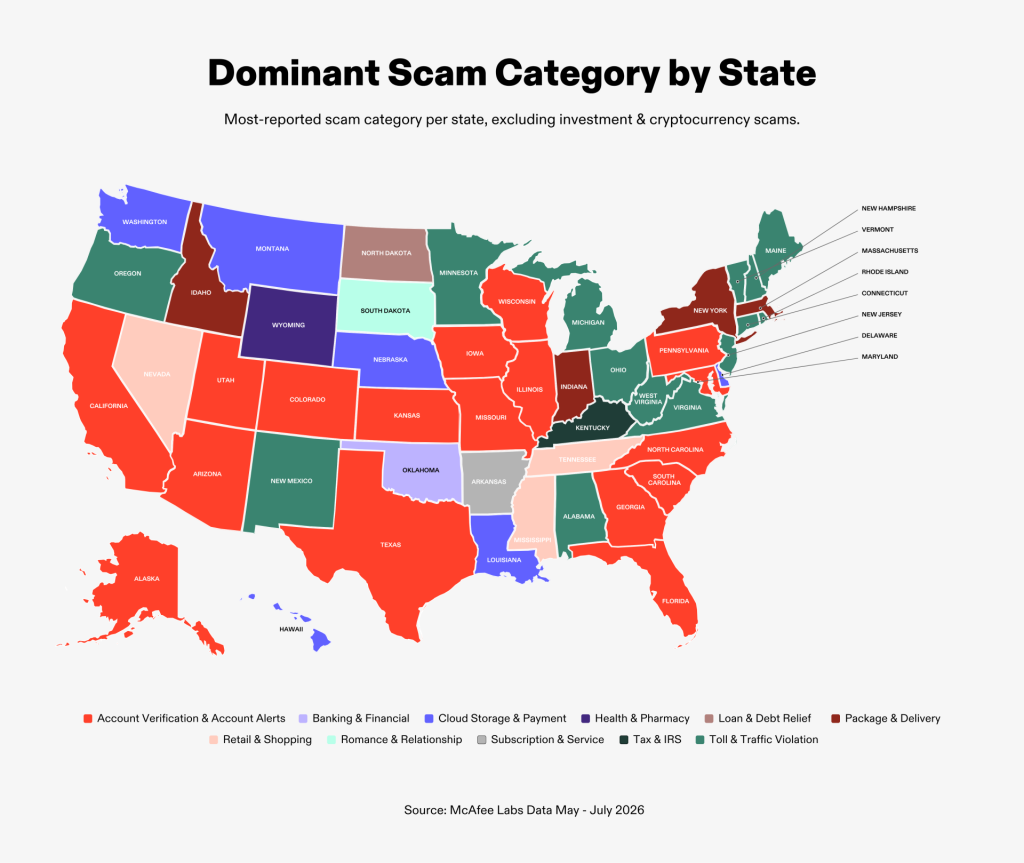
Key takeaway: Maine is one of only two states where toll and traffic scams, rather than investment and crypto scams, ranked first in McAfee’s text telemetry.
Toll and traffic violation scams were Maine’s leading text-scam category.
Key takeaway: Marylanders show particularly high concern about AI-enabled fraud, with 86% saying AI is making scams harder to recognize.
Investment and cryptocurrency scams led Maryland text-scam volume.

Key takeaway: Massachusetts has a striking trust gap: 65% report more mental effort deciding what’s real, but only 48% verify online content at least weekly.
Investment and cryptocurrency scams led Massachusetts text-scam volume.
Key takeaway: Michigan joins Maine as the only state where toll and traffic scams outranked investment and cryptocurrency scams.
Toll and traffic violation scams were Michigan’s leading text-scam category.
Key takeaway: Minnesota records the highest AI-scam concern in the state crosstabs, at 91%.
Investment and cryptocurrency scams led Minnesota text-scam volume.
Key takeaway: Mississippi had one of the heaviest scam-text loads in McAfee’s analysis, averaging roughly 4.64 scam texts per device.
Investment and cryptocurrency scams led Mississippi text-scam volume.
Key takeaway: Missouri residents show a confidence problem around AI scams: 13% said they were not at all confident spotting AI-created or AI-enhanced fraud.
Investment and cryptocurrency scams led Missouri text-scam volume.
Key takeaway: Montana has the highest reported exposure to AI-generated images presented as real, at 51%.
Investment and cryptocurrency scams led Montana text-scam volume.
Key takeaway: Nebraska’s strongest signal is AI concern: 87% say AI is making online scams harder to recognize.
Investment and cryptocurrency scams led Nebraska text-scam volume.
Key takeaway: Nevada has the broadest reported scam exposure in the survey, with 95% encountering at least one type of scam in the past year.
Investment and cryptocurrency scams led Nevada text-scam volume.
Key takeaway: New Hampshire shows another trust gap: 59% report more mental effort figuring out what’s real, while 46% verify online content weekly.
Investment and cryptocurrency scams led New Hampshire text-scam volume.
Key takeaway: New Jersey residents report unusually frequent scam exposure, with 30% saying they encounter four or more scam attempts on a typical day.
Investment and cryptocurrency scams led New Jersey text-scam volume.
Key takeaway: New Mexico has one of the toughest scam-recovery pictures: 72% of victims who lost money recovered none of it.
Investment and cryptocurrency scams led New Mexico text-scam volume.
Key takeaway: New York’s most striking behavioral signal is comparatively low retailer avoidance: 33% have stayed away from unfamiliar sellers because of scam concerns.
Investment and cryptocurrency scams led New York text-scam volume.

Key takeaway: North Carolina stands out on recovery: 42% of scam victims who lost money said they recovered all of it.
Investment and cryptocurrency scams led North Carolina text-scam volume.
Key takeaway: North Dakota had the country’s highest concentration of scams in analyzed text traffic, at 2.8%.
Investment and cryptocurrency scams led North Dakota text-scam volume.
Key takeaway: Ohio stands out for financial harm: 41% of respondents say they lost money to an online scam in the past year.
Investment and cryptocurrency scams led Ohio text-scam volume.
Key takeaway: Oklahoma consumers are feeling the mental load of navigating AI-powered scams: 85% are concerned AI is making scams harder to recognize, while half say figuring out what’s real online requires more mental effort.
Investment and cryptocurrency scams led Oklahoma text-scam volume.
Key takeaway: Oregon scam concerns are spilling into ordinary digital life, with 45% avoiding new apps, websites or services.
Investment and cryptocurrency scams led Oregon text-scam volume.
Key takeaway: Pennsylvania has one of the heavier trust burdens in the survey, with 67% saying figuring out what’s real takes more mental energy.
Investment and cryptocurrency scams led Pennsylvania text-scam volume.
Key takeaway: Rhode Island scam concerns are affecting legitimate online behavior: 42% have avoided clicking a real message or link.
Investment and cryptocurrency scams led Rhode Island text-scam volume.
Key takeaway: South Carolina has a confidence problem around AI scams: 13% say they are not at all confident identifying AI-created or AI-enhanced fraud.
Investment and cryptocurrency scams led South Carolina text-scam volume.
Key takeaway: South Dakota’s scam response is relatively restrained compared with many states, with 35% avoiding unfamiliar retailers and 29% avoiding legitimate links.
Investment and cryptocurrency scams led South Dakota text-scam volume.
Key takeaway: Tennessee residents report rising trust fatigue without matching verification habits: 59% feel more mental strain, but 48% verify weekly.
Investment and cryptocurrency scams led Tennessee text-scam volume.
Key takeaway: Texas is one of the more active verification states, with 62% checking online legitimacy at least weekly.
Investment and cryptocurrency scams led Texas text-scam volume.

Key takeaway: Utah has one of the highest levels of exposure to AI-generated imagery, with 49% seeing an AI image presented as real.
Investment and cryptocurrency scams led Utah text-scam volume.
Key takeaway: Vermont has a sizeable trust-versus-action gap: 58% report more mental effort online while 47% verify content weekly.
Investment and cryptocurrency scams led Vermont text-scam volume.
Key takeaway: Virginia reports comparatively low exposure to AI-generated images presented as real, at 34%, even as concern about AI scams remains high.
Investment and cryptocurrency scams led Virginia text-scam volume.
Key takeaway: Washington has one of the highest levels of AI-scam concern in the survey, at 86%.
Investment and cryptocurrency scams led Washington text-scam volume.
Key takeaway: West Virginia has one of the lower weekly verification rates in the survey, at 45%, despite a majority reporting greater trust fatigue.
Investment and cryptocurrency scams led West Virginia text-scam volume.
Key takeaway: Wisconsin shows relatively high exposure to synthetic imagery: 46% have encountered an AI-generated image presented as real.
Investment and cryptocurrency scams led Wisconsin text-scam volume.
Key takeaway: Wyoming has the most distressing scam-loss recovery story in the survey: 76% of victims who lost money recovered none of it.
Investment and cryptocurrency scams led Wyoming text-scam volume.
The post What Scams Look Like in Your State: A 50-State Breakdown appeared first on McAfee Blog.
There is a small tax many of us pay in our everyday interactions without even realizing it.
A package notification arrives, and we stop to check whether we actually ordered something. A recruiter reaches out about a job, but before replying, we research the person and the company. A bank alert appears, and instead of tapping the link, we open the banking app ourselves.
These are sensible habits. But McAfee’s latest research suggests the effort behind them is increasing the average American’s every day mental load.
Nearly three-quarters of Americans (74%) say they feel the need to double-check most things online before trusting them. Sixty-two percent say figuring out what is real takes more mental energy than it did a year ago.
That growing burden is one reason McAfee is introducing a new brand and product experience built around a broader idea of what protection should do. Good security shouldn’t demand more of people’s attention. It should help give some of it back.
That’s why the new McAfee experience is designed to do more than protect individual devices. It helps protect the things people rely on every day, their personal information, connections, devices, and accounts, all while making it clearer what’s safe, what needs attention, and what McAfee can handle for them.

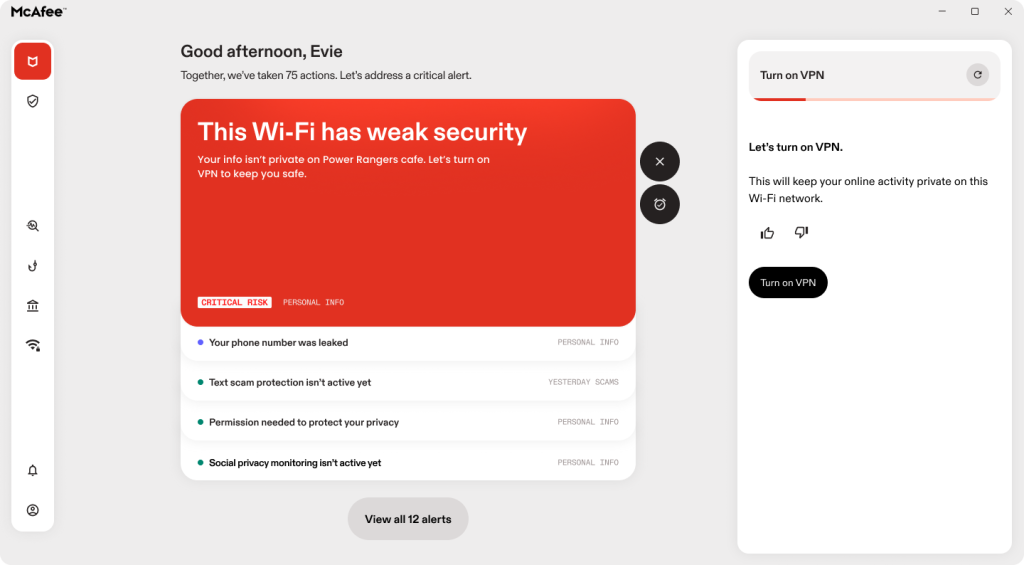
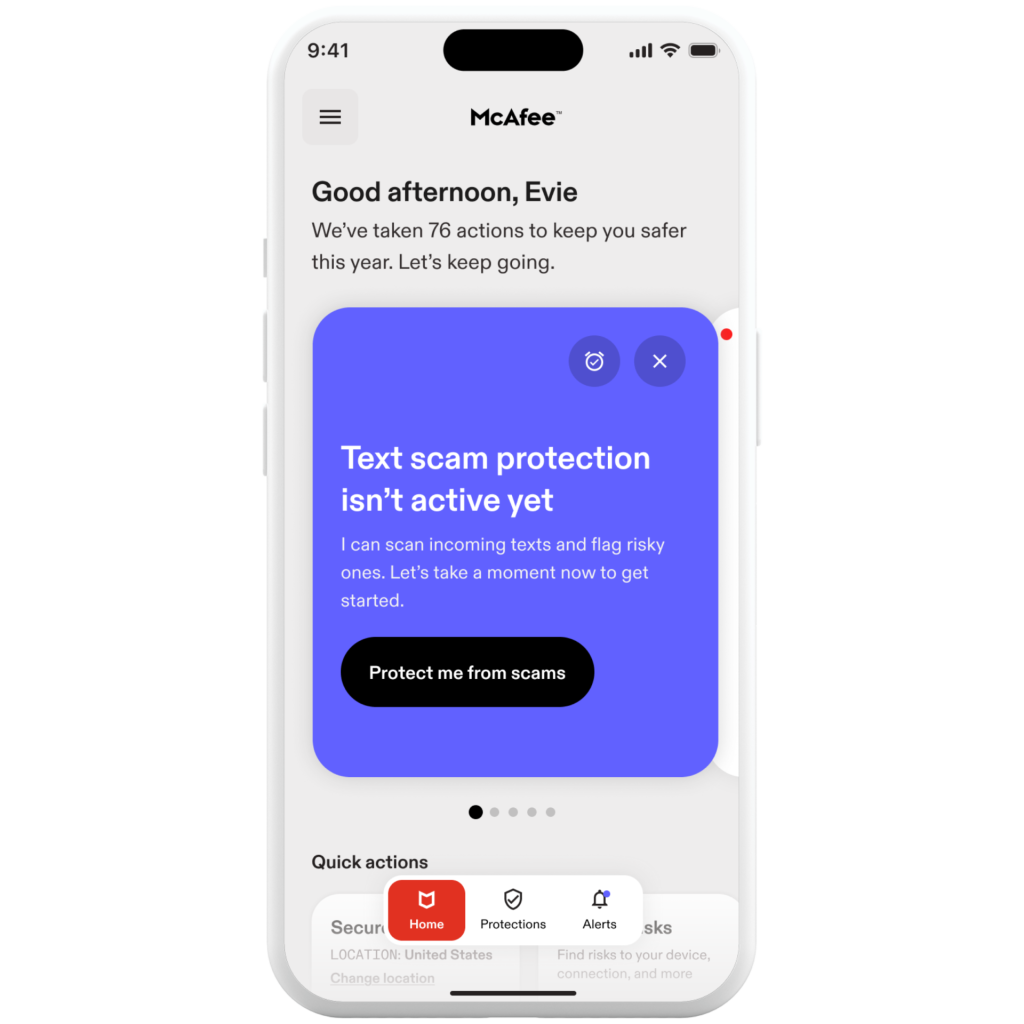
Get quick alerts and easily update protections in McAfee’s app
That matters at a moment when attention is already stretched thin. AI is everywhere, and it has made it easier to produce convincing content at an enormous scale, adding to an already crowded attention economy. Increasingly, ordinary moments come with an extra question: Is this real?
And those questions have consequences. Our research found that 82% of Americans have changed how they behave online because of scams. Some have stopped buying from unfamiliar retailers. Others have ignored communications that turned out to be legitimate. Eighteen percent say scam concerns have even caused them to avoid responding to a job opportunity.
“I’ve accused my doctor’s office of being an AI,” says McAfee Threat Researcher Charles McFarland, recounting a time when even he thought something legitimate was fraudulent. “I had to apologize.”
Financial losses remain a serious part of the picture. Nearly one-third of Americans (31%) reported losing money to a scam in the past year. But measuring scams only in dollars misses something important. Scams are also making trust more expensive.
This report examines that growing cost: the attention Americans are spending figuring out what to trust, how the scam experience differs across all 50 states, and what protection should look like when staying safe increasingly competes for the same limited time and attention as everything else we do online.

McAfee’s research combines a nationally representative survey of 5,000 U.S. adults, with 100 respondents in every state, and McAfee Labs analysis of text-based scam activity across the U.S.
Together, the findings show how scams are affecting not only Americans’ wallets, but also their attention, trust and behavior online.
Scams are placing a growing burden on Americans’ attention. Nearly three-quarters (74%) say they feel the need to double-check most things online before trusting them, while 62% say figuring out what is real takes more mental energy than it did a year ago. (Survey)
That uncertainty is changing legitimate online behavior. Eighty-two percent say scam concerns have changed something they do online. Forty-four percent have avoided buying from an unfamiliar retailer, 37% have ignored a legitimate call, text or email, 34% have avoided a new app, website or service, 33% have avoided a legitimate link and 25% have abandoned an online purchase. (Survey)
Scams can make real opportunities harder to trust. Twenty-seven percent encountered a fake recruiter or job opportunity in the past year. At the same time, 18% say scam concerns have caused them to avoid responding to a job opportunity. (Survey)
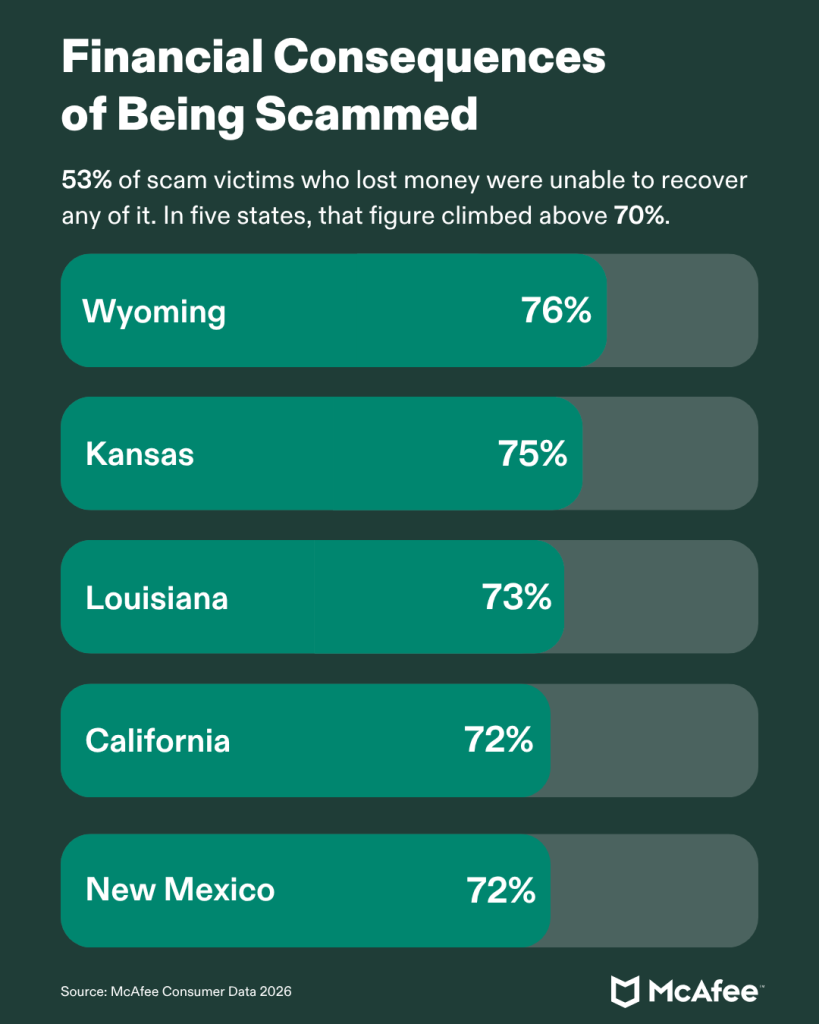
Financial losses are widespread, and getting money back can be difficult. Nearly one-third of Americans (31%) report losing money to a scam in the past year. Among those who lost money, 53% recovered none. In Wyoming, Kansas, Louisiana, California and New Mexico, more than 70% of victims who lost money recovered nothing. (Survey)
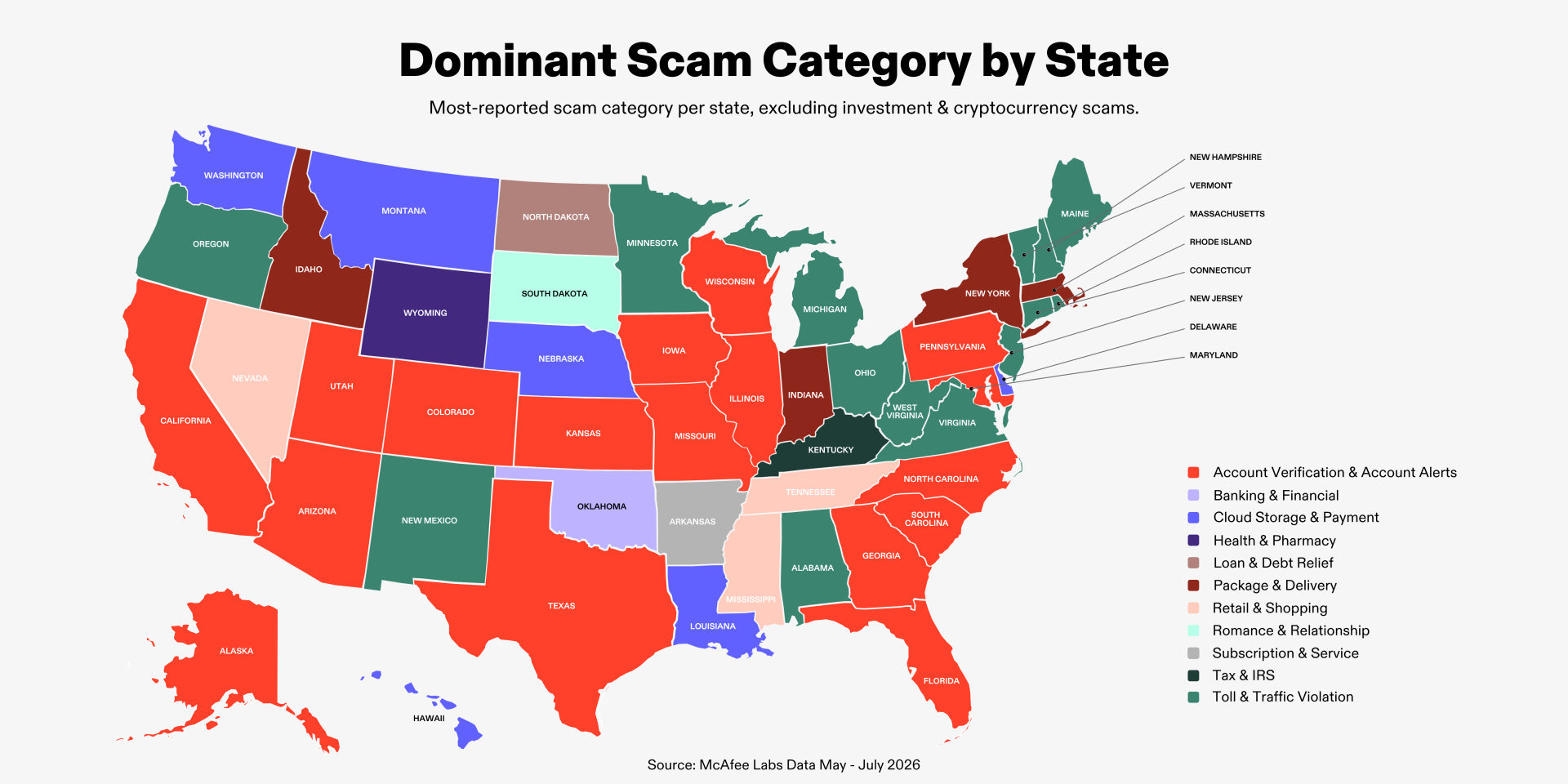
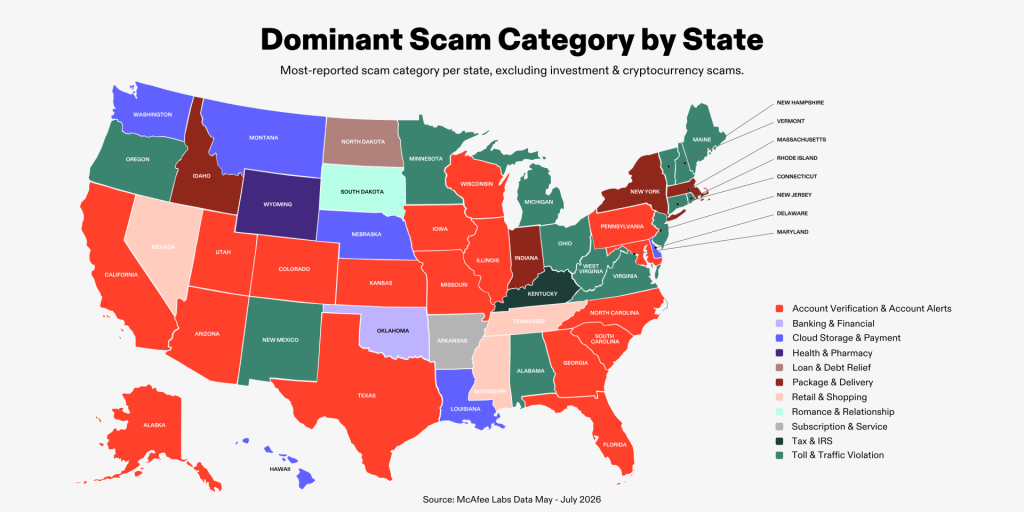
Investment and cryptocurrency scams dominate text-based scam activity. McAfee Labs found them to be the leading scam-text category by volume in 47 of 50 states from May through July 2026. Maine, North Dakota and Michigan were the exceptions. In Maine and North Dakota, toll and traffic scams ranked first. Meanwhile, in North Dakota, loan and investment scams ranked first. (McAfee Labs)
The volume and intensity of scam texts varies considerably by state. Alabama averaged 5.14 scam texts per device, the highest in McAfee’s analysis. In North Dakota, scams represented 2.8% of analyzed text traffic, the highest concentration nationally. In Hawaii, devices receiving at least one scam text averaged 8.45 scam messages during the three-month analysis period. (McAfee Labs)
Some states experience especially high exposure or financial consequences. Ninety-five percent of Nevada respondents encountered at least one type of scam in the past year. In Ohio, 41% reported losing money to a scam. Thirty percent of New Jersey respondents say they encounter four or more scam attempts on a typical day. North Carolina stood out in the other direction: 42% of victims who lost money said they recovered all of it. (Survey)
Many scam texts are designed to begin a conversation rather than complete the scam immediately. Joining or clicking through to a WhatsApp group was the most common requested action in the scam texts McAfee analyzed, driven largely by investment and cryptocurrency schemes. The initial message may be only the first step in a longer attempt to build trust before asking for money. (McAfee Labs)
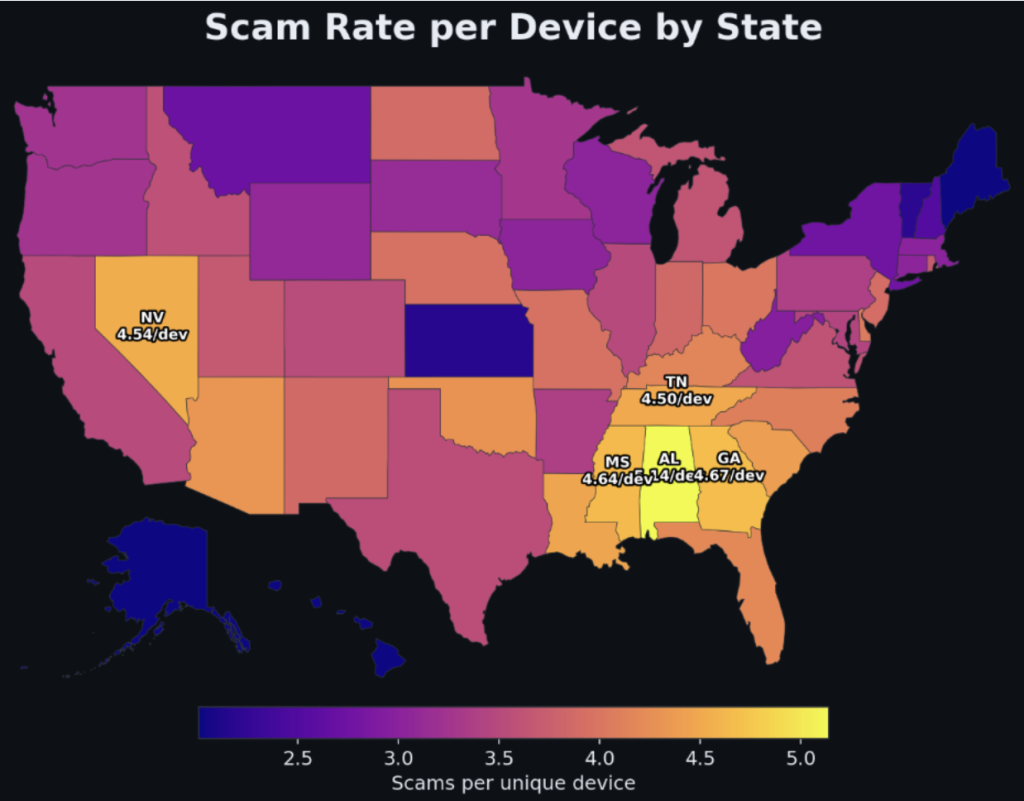
Displays the number of scams seen per unique device
Scams no longer occupy some separate, obviously suspicious corner of the internet. Increasingly, they imitate the ordinary business of being online.
In its analysis of U.S. text-based scams from May through July 2026, McAfee Labs identified 49 leading scam topics across 23 broader categories. They touched nearly every part of daily life: package deliveries and bank accounts, job offers and investments, shopping and subscriptions, health and utilities, relationships and family emergencies.
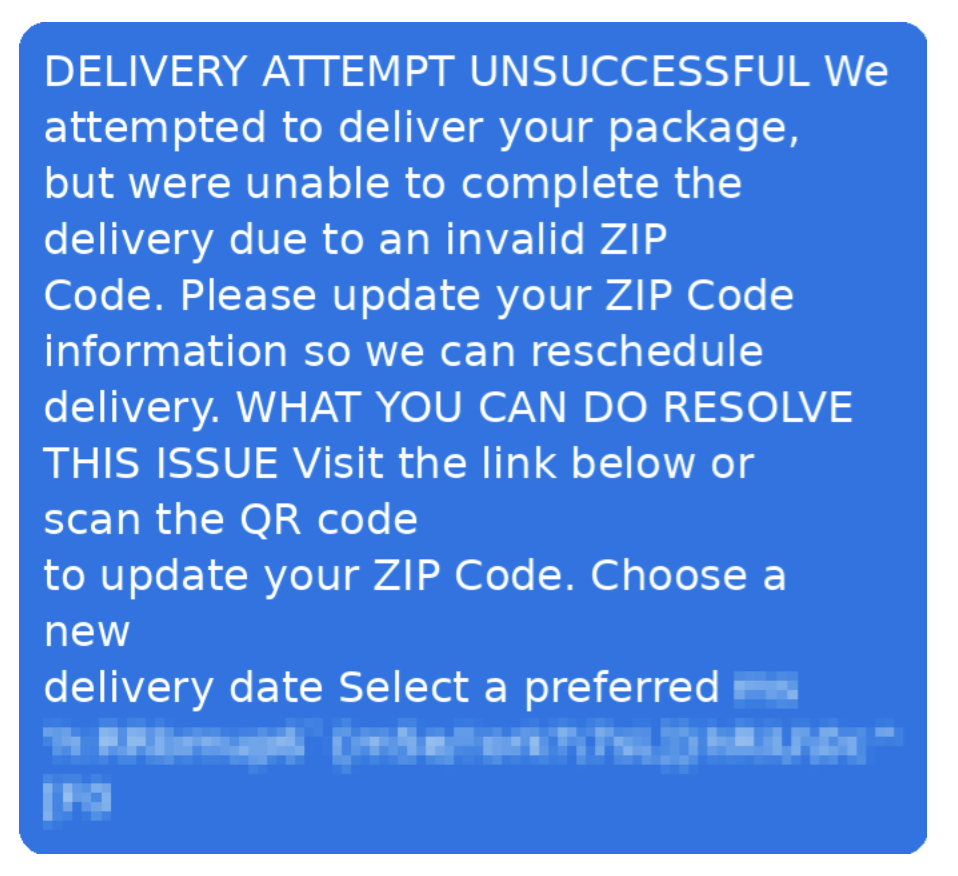
Example of one of the many types of delivery text scams consumers face
The full list spans Cloud Storage & Payment; Package & Delivery; Banking & Financial; Toll & Traffic Violation; Tax & IRS; Legal Threat & Law Enforcement; Government Impersonation; Tech Support & Security; Prize & Lottery; Romance & Relationship; Employment & Job Offer; Subscription & Service; Account Verification & Account Alerts; Investment & Cryptocurrency; Charity & Donation; Utility & Bill Payment; Health & Pharmacy; Family & Friend Emergency; Retail & Shopping; Loan & Debt Relief; Buying Property & Real Estate; Context-Free Links & Phone Numbers; and Other.
That breadth matters. The more scams resemble the normal messages people receive every day, the more ordinary life requires verification.
One category nevertheless dominated. Investment and cryptocurrency scams were the largest text-scam category by volume in 47 of 50 states. Only Maine, North Dakota and Michigan broke the pattern, with toll and traffic violation scams as well as loan and investments ranking first.
The prevalence of investment scams is important because many are not trying to steal money with a single text. They are trying to start a relationship.
The most common action requested in the scam texts analyzed by McAfee was clicking or joining a WhatsApp group, driven heavily by investment and cryptocurrency schemes. A message might promote an investing community or offer access to financial advice.
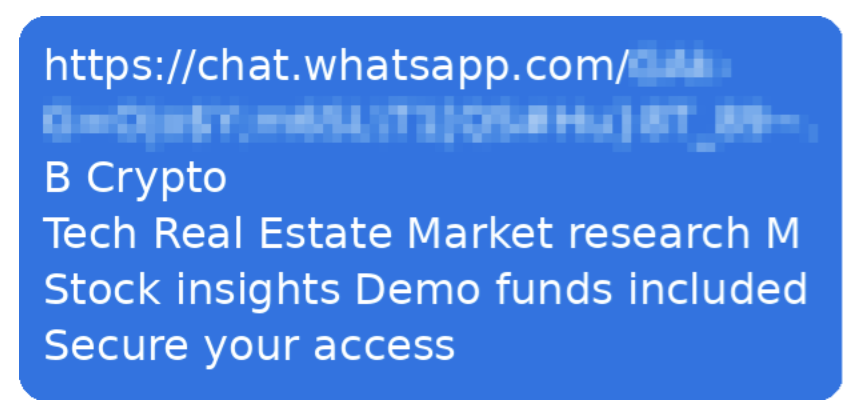
Example of a scam text attempting to move users to WhatsApp
Moving the recipient into a group or private conversation gives the scammer more time to establish credibility before money enters the picture. Plus, for many of us, social apps feel more personal and we more easily let our guard down when we move a conversation to these messaging platforms.
That helps explain why an unsolicited text that looks relatively harmless can still be the beginning of a much longer scam.
Other prominent scams rely on a different tactic: urgency. Fake account alerts can suggest that something needs immediate attention. Toll and traffic scams warn of an unpaid charge or violation. McAfee Labs also saw scammers impersonating T-Mobile with fake reward offers among the largest individual scam topics.
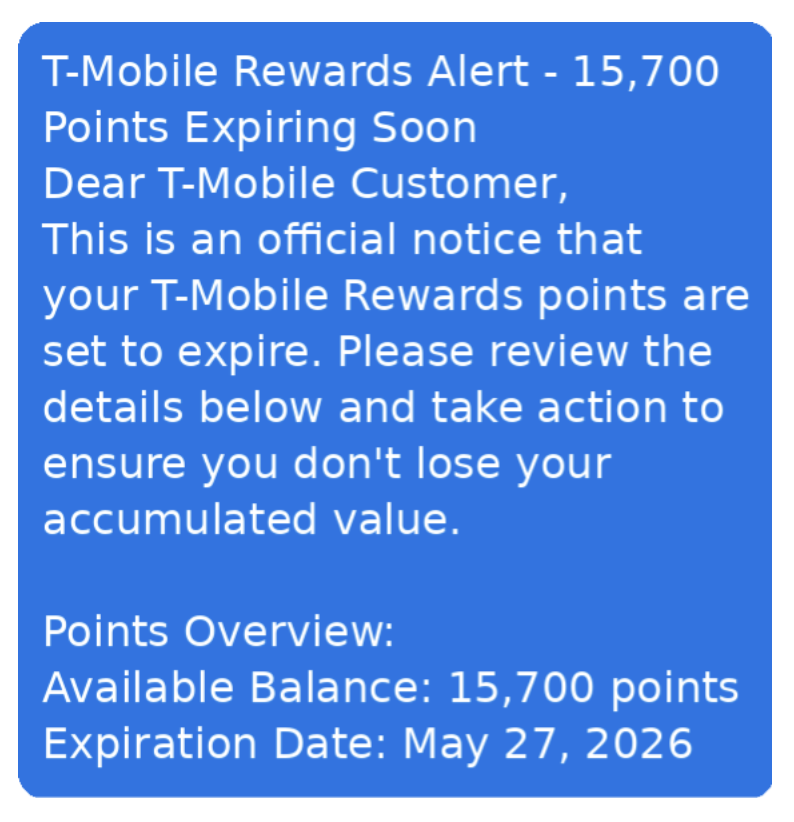
Example of scammers exploiting trusted brands like T-Mobile to dupe customers
The stories change, but the underlying objective is often the same. Scammers want people to act before they have time to question what they are seeing. And there is a lot to question.
McAfee’s analysis found meaningful differences in the amount of scam traffic reaching consumers around the country during the three month analysis period. Alabama recorded an average of 5.14 scam texts per device, the highest in the analysis. Georgia followed at 4.67, with Mississippi close behind at 4.64.
North Dakota stood out in a different way. There, scams represented 2.8% of all text traffic McAfee analyzed, the highest concentration in the country. Hawaii showed another pattern: among devices that received at least one scam text, the average was 8.45 scam messages during the three-month period. That was about 15% higher than Alabama, which ranked second at 7.35 scam texts per exposed device.
| Rank | State | Scams per device | State | Scams per device scammed |
| 1 | Alabama | 5.14 | Hawaii | 8.45 |
| 2 | Georgia | 4.67 | Alabama | 7.35 |
| 3 | Mississippi | 4.64 | Ohio | 7.29 |
| 4 | Nevada | 4.54 | Florida | 7.29 |
| 5 | Tennessee | 4.50 | North Dakota | 7.28 |
A third measure shows how concentrated scam traffic was within people’s overall text messages. North Dakota had the highest concentration in the country, with scams accounting for 2.8% of all text traffic McAfee analyzed.
These measures capture different dimensions of the same problem. The all-device average shows how many scam texts reached devices across a state overall. The exposed-device average shows how persistent scam activity was for devices that received at least one scam. And the share of total text traffic shows how prominent scam messages were within the broader messaging environment.
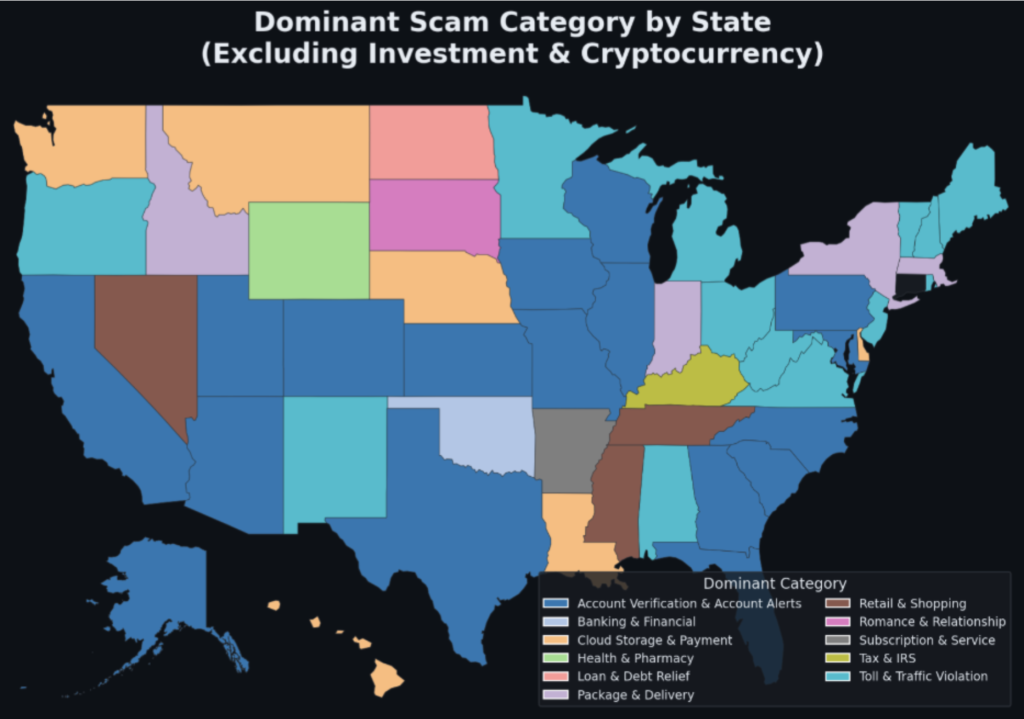
This shows each states top scam category by volume if Investments & Cryptocurrency scams are ignored. Notice these colors don’t necessarily match the colors from the previous graph.
For consumers, those distinctions may be invisible. What they experience is repetition: another message asking for attention and another decision about whether it deserves it.
AI raises the stakes further. It can make convincing scam content cheaper and faster to produce, while people are simultaneously encountering more AI-generated material in everyday online life. The result is an environment where the old advice to simply “look for something suspicious” becomes harder to apply reliably. Sometimes the suspicious thing looks perfectly ordinary.
That is why the next phase of consumer protection cannot depend on people becoming infinitely better at scrutinizing everything themselves.
McAfee’s consumer research shows what happens when that scam environment meets everyday life.
Most Americans are encountering scams regularly. Eighty-eight percent say they experienced at least one type of scam in the past year, and one in five say they typically encounter four or more scam attempts in a single day.
Yet frequency tells only part of the story. The more consequential finding may be what people are doing in response.
Eighty-two percent say scam concerns have changed their online behavior. Forty-four percent have avoided an unfamiliar retailer. Thirty-seven percent have ignored a legitimate call, text or email because they suspected a scam. Thirty-three percent have avoided clicking a legitimate message or link.
These are not examples of people falling for scams. They are examples of people trying not to.
Job scams make that tradeoff particularly tangible. Twenty-seven percent of Americans say they encountered a fake recruiter or job opportunity in the past year. Eighteen percent say concerns about scams have caused them to avoid responding to a job opportunity.
The financial consequences remain substantial when a scam does succeed. Nearly one-third of Americans (31%) report losing money to a scam in the past year. Among those victims, 53% recovered none of what they lost.
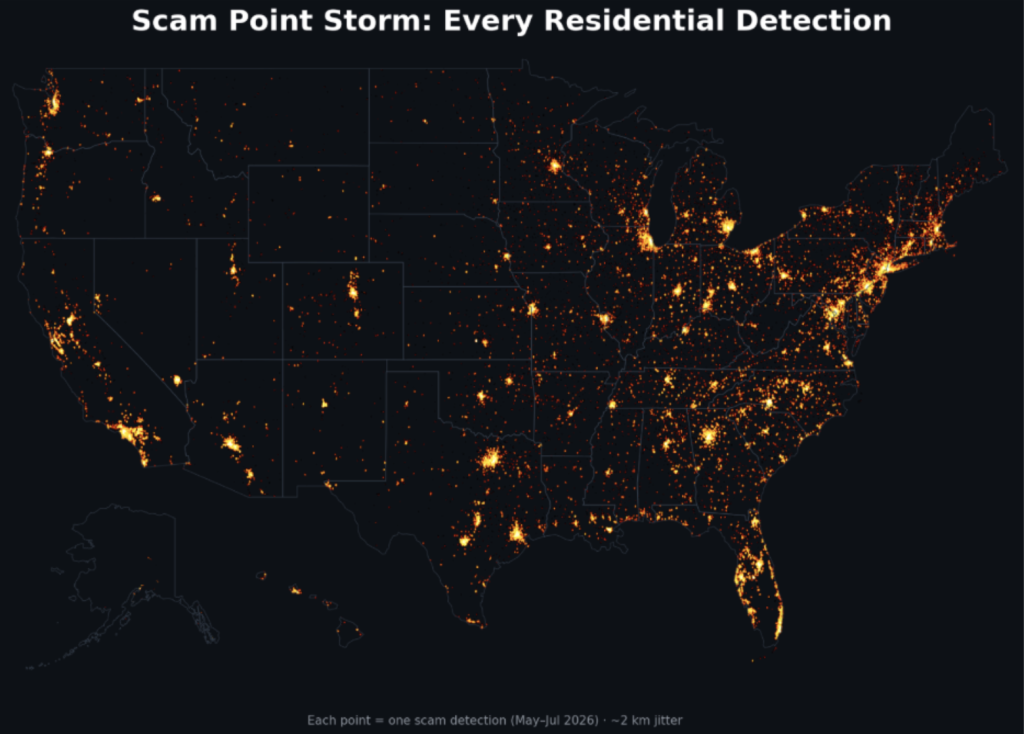
From our McAfee Labs Research: This shows approximate location of all the scams received
But a national average can obscure how differently people experience the problem.
Our full 50-state scam breakdown examines the data state by state, combining McAfee’s consumer survey with Labs telemetry to show where scam exposure is highest, where financial recovery is hardest, how concerns affect behavior, and which types of text scams McAfee is seeing across the country.
Across those differences, one finding remains remarkably consistent: Americans are adapting. They are checking more carefully and approaching unfamiliar interactions with greater caution, or even avoiding them altogether.
Those behaviors can help keep people safe. But that puts the mental load on back onto the everyday user. There is a limit to how much vigilance we should expect people to supply on their own.
The better question is how technology can take on more of that work for them. And that is the thinking behind McAfee’s new brand and product experience, beginning its rollout in the U.S. today.
McAfee’s new consumer experience is designed to make protection simpler to understand and easier to act on, while helping people navigate the moments where scams and other threats increasingly create uncertainty.

We’ll let you know if something seems suspicious and could put you at risk.
The experience is built to spot risks earlier, guide people clearly, and act when protection can be handled automatically. That means flagging suspicious messages, links, sites, exposed data, or unsafe connections; explaining what matters in plain language; and helping people take the right next step without requiring them to become security experts.
McAfee can alert you when your information appears in a data breach, help identify suspicious messages and links, protect your connection on risky Wi-Fi, monitor for exposed personal information, and help keep your devices and accounts safer.
Just as importantly, we’ve worked to make those protections understandable.
Instead of expecting people to know cybersecurity terminology or hunt through settings, the experience is designed to surface what matters and help people understand what to do next.
Because good protection shouldn’t create another job for you.

The refreshed McAfee experience makes it easier to see what needs your attention and how you’re protected.
That idea, making protection do more of the work, is built into the new McAfee experience we’re unveiling today.
We’ve brought protection for personal information, connections, and devices into one connected experience across PC, Mac, mobile, and tablet. Instead of asking people to piece together what’s protected or search for what needs attention, McAfee makes it easier to see both in one place.
The experience is also more personal. McAfee can alert you when your information or devices may be at risk and provide guided actions, that explain what needs your attention in plain language. The goal is not to give people more security information. It’s to help them understand what matters to them and what they can do about it.
And over time, the experience is designed to become more personal and relevant to each person, proactively identifying risks, alerting in the moment, and guiding when action is needed for the protections that matter most based on their digital life.
We’ve also made improvements to privacy tools like Online Account Cleanup, which now helps people prioritize higher-risk accounts, and Personal Data Cleanup, which makes it easier to see the personal information being found and removed on their behalf.
Taken together, these changes reflect where we believe consumer safety needs to go: less hunting through settings, less deciphering security alerts, and less relying on people to spot every threat themselves.
More protection that understands what matters, explains what needs attention, and works proactively in the background.
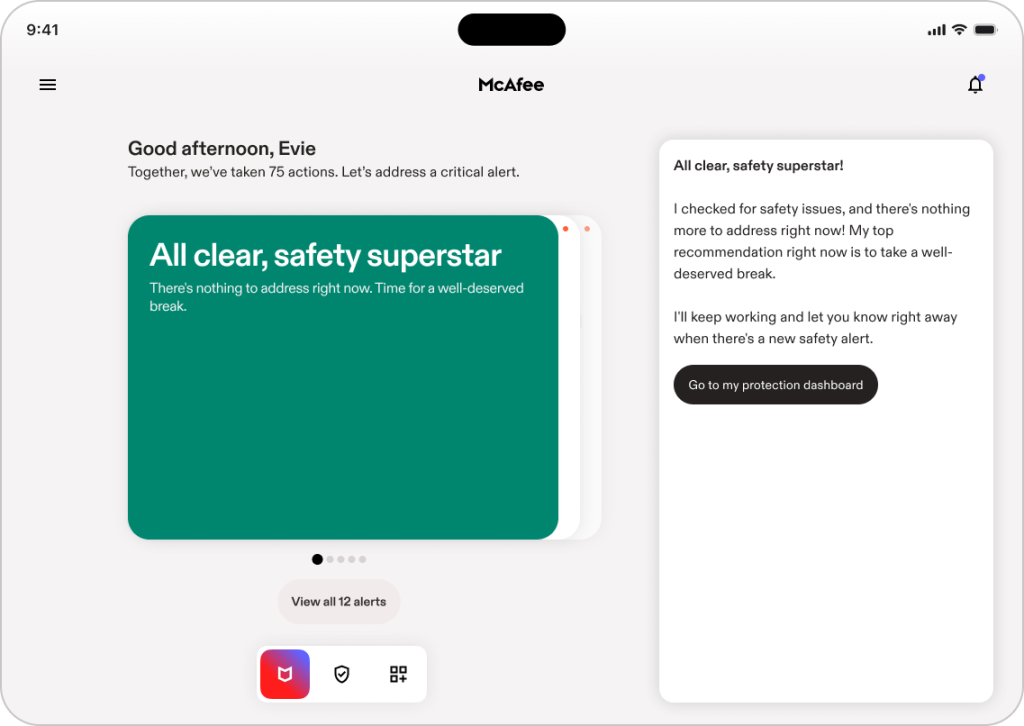
Here to give you peace of mind and lighten the mental load of life online.
The findings in this report suggest that the impact of scams extends beyond exposure and financial loss.
Every scam adds another small decision to an already crowded digital day: Is this message real? Is this link safe? Is this person who they say they are? As those decisions multiply, staying safe online becomes not just a security challenge, but a growing mental burden.
As people encounter more attempts to imitate legitimate messages, businesses and opportunities, the effort required to establish trust becomes a consequence in its own right.
That makes reducing the burden of verification an increasingly important part of consumer protection. People should not have to devote more of their limited attention to staying safe simply because scams are becoming harder to distinguish from everyday life online. That’s where McAfee comes in.
The post Your State’s Scam Reality: What New Research Reveals Across All 50 States appeared first on McAfee Blog.

Cybercriminals are deploying autonomous AI agent frameworks to target online retailers and steal payment card details at scale, according to research from cybersecurity firm Gambit Security. Their analysis reveals that the ongoing campaign has compromised at least 119 websites—including a Fortune 500 hospitality company, a major U.S. airline, and an online fashion retailer—exfiltrating over 600,000 valid credit card records. These automated systems allow threat actors to scan, exploit, and infect target sites at a remarkably low operational cost, lowering the technical and financial barriers to large-scale cybercrime.
In simple terms, a digital credit card skimmer acts like a hidden recording device inside an online checkout counter. Instead of physically tampering with a card reader, scammers use automated software tools to breach an e-commerce website’s backend servers.
Once inside, the software places invisible lines of malicious code directly on the payment page. When you enter your credit card number, expiration date, and security code to make a purchase, the hidden code silently copies your financial information and sends it to the attacker. Your order processes normally without any visible interruption.
Behind this campaign, threat actors use three specialized open-source AI frameworks to manage the intrusion without needing constant human oversight:
According to data published by Gambit Security, the attacker ran 105 distinct attack waves in a five-day span using brief instructions like “get to work.” The total infrastructure cost ranged between $12,000 and $18,000, averaging just $25.46 per targeted company. By driving the average cost down to tens of dollars per target, AI automation slashes the financial and technical barriers to cybercrime. Threat actors can now execute high-volume enterprise breaches at scale that previously required costly manual operations and dedicated technical teams.
Once inside, the AI agents inject malicious JavaScript skimmers into checkout forms, Google tag blocks, content delivery networks (CDNs), or server caches. The Hermes agent was also instructed to execute cleanup routines that wiped stolen payment fields directly from merchant databases, causing server errors and data loss for affected retailers. While this particular campaign compromised e-commerce websites, automated scripts can also target payment data directly on client devices, such as the browser-level threats highlighted in McAfee Labs research on wallet-swapping extension malware.
Digital skimmers operate quietly within legitimate checkout pages, but technical anomalies can indicate a compromised payment form:
If you suspect your credit card information was stolen or compromised in a digital skimming attack:
Reporting stolen payment data helps law enforcement track malicious server infrastructure and disrupt automated threat networks. If you suspect your financial data was exposed on a compromised site, report the incident through official channels:
While AI skimming attacks can be difficult to detect on the front end of retail websites, taking immediate action after a suspected exposure limits potential financial damage. By utilizing encrypted digital wallets, avoiding stored payment methods, and reviewing account statements regularly, you significantly reduce your exposure to AI-driven cybercrime.
The post Card Skimmers Expose 600k Cards: What They Are and How to Protect Yourself appeared first on McAfee Blog.
The FBI is investigating a major data breach after learning the federal agency’s job application portal was compromised, according to a September 2026 report by 404 Media. The cyberattack on FBIJobs.gov may have exposed the personal records of thousands of job applicants alongside current and former FBI personnel.
On September 23, the FBI shared in a statement that they were “aggressively investigating this matter,” and on September 29, shared a video on X reporting that Dutch authorities had arrested an alleged leader of ShinyHunters, the global cybercrime group known who took responsibility for the FBI data breach. In the video, Brett Leatherman, Assistant Director of the FBI’s Cyber Division, warned remaining members of ShinyHunters that the FBI knew where to find them and suggested they reach out to the FBI first while they still have the choice.
The intrusion targeted the FBI Candidate Gateway, where the hacker group claims to have extracted sensitive personally identifiable information (PII). According to the group and media reviews of leaked sample data, this compromised dataset contains the PII of federal job applicants, prospective candidates, active special agents, and former FBI employees. Exposed records allegedly include full legal names, home addresses, phone numbers, email addresses, spousal information, job titles, and Social Security numbers.
In a statement circulated on the dark-web by ShinyHunters, the group attempted to use the stolen database to extort the agency, giving officials one week to retract a public advisory that had identified ShinyHunters as a criminal syndicate. After the deadline passed and the advisory remained live, the group claimed they would not publish the database publicly. However, breached records frequently wind up circulating in cybercriminal forums.
When news breaks that sensitive personnel data from a high-profile agency has been exposed, the risks extend beyond immediate identity theft. Cybercriminals can leverage this stolen data to launch two categories of attacks:
Because this breach may have exposed real personnel details, impersonation attempts carry heightened risk. Scammers could pair verified agent names, genuine department titles, and realistic internal background details with fake caller ID tags, making fraudulent outreach appear legitimate. Be extra vigilant for these red flags that you may be dealing with an impersonation scam:
Protect against impersonation schemes by verifying all unexpected contacts independently.
If you shared personal details or sent funds to a scammer, or if you previously submitted job applications or personal information through federal career sites, take immediate action to secure your identity and accounts:
Reporting cybercrime and impersonation attempts helps law enforcement trace criminal networks like the ShinyHunters hacker group and shut down active fraud operations. Submit reports through these official channels:
Prompt reporting provides law enforcement with vital intelligence to track threat actors and protect others from emerging scams.
The post FBI Job Portal Hack Claimed by ShinyHunters: What Happened and How to Protect Yourself appeared first on McAfee Blog.

The FBI Internet Crime Complaint Center (IC3) issued a September 2026 public service announcement warning of a rise in government and law enforcement impersonation scams. These scams feature individuals posing as law enforcement agents leveraging threats to acquire money or personal information.
Between January 2025 and July 2026, the IC3 received nearly 61,000 complaints regarding fraudsters posing as local police, federal agents, or court officials, with reported losses exceeding $1.6 billion. Imposters use caller ID spoofing and legal threats to extract immediate payments and sensitive personal information from their targets.
Law enforcement impersonation scams rely on scammers projecting authority and manufacturing urgency. Their goal is to drive you to act before you can verify the caller’s identity.
According to the IC3, fraudsters use caller ID spoofing technology to make your phone screen display the legitimate name and telephone number of a law enforcement agency or court. They build credibility by providing fake badge numbers, official-sounding department names, and fictitious case file numbers.
During these law enforcement imposter scams, callers may claim that you missed jury duty, owe outstanding court fines, face an active arrest warrant, or have a suspended driver’s license or passport. The fraudster insists that you resolve the issue immediately over the phone or online. They demand payment via non-traditional methods, including prepaid gift cards, cryptocurrency, wire transfers, or physical cash couriers. Scammers frequently follow up with text messages or emails containing links to fake government portals designed to capture payment details and login credentials.
If you receive a call from police, local courts, or federal agencies, watch for these warning signs that you could be dealing with a scam:
Reporting an impersonation incident promptly helps authorities track fraudulent networks and protects others from falling victim. If you encounter a fake call from police or a fraudulent court notice, submit an official report through the FBI Internet Crime Complaint Center. You should also contact your local police department to file a report, particularly if you experienced financial loss or received direct threats. Finally, inform the specific agency or court that was impersonated by calling the official directory number listed on its .gov website, allowing their security officials to issue public advisories.
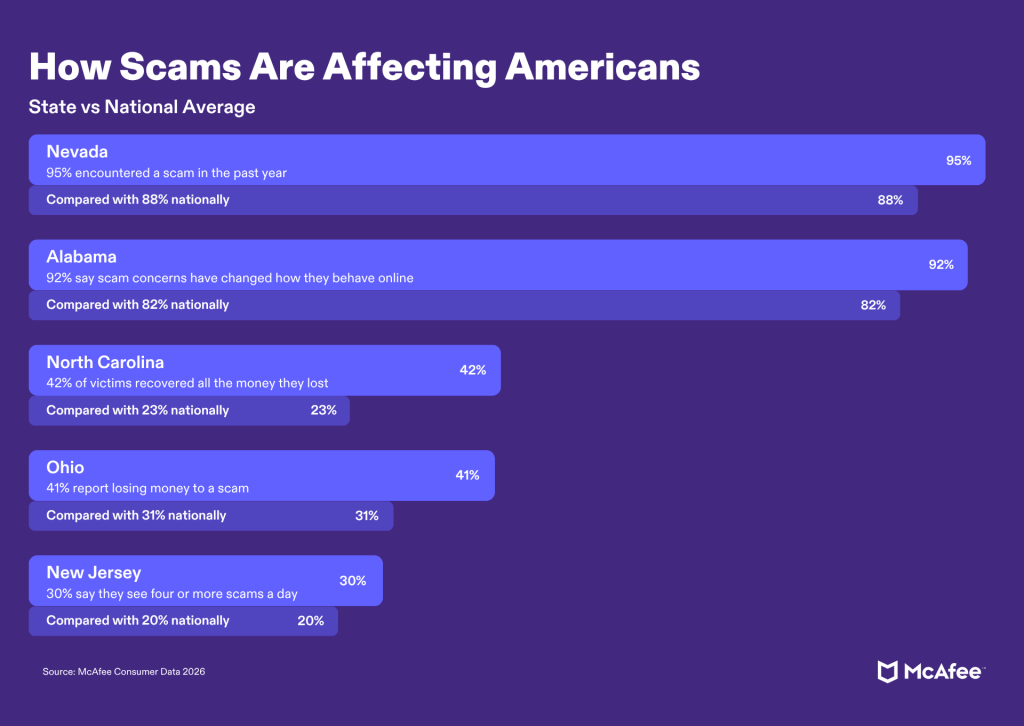
The post FBI Warns of Law Enforcement Impersonation Scams: What They Are + How to Protect Yourself appeared first on McAfee Blog.