A UK-based developer and pentester has claimed a $2,000 Bitcoin prize for demonstrating the exploitability of the PHP2Shell vulnerabilities that melted the internet last week. Jaydip Modhwadia, 26, otherwise known as “Killa,” claimed the prize set by James Pavur, who launched the "Steal My Bitcoin" site on October 24. Pavur launched the CTF (capture the flag) challenge to prove that the PHP2Shell exploit was not as easy as those in the cybersecurity community claimed it to be, promising to award $2,000 in Bitcoin to anyone who could achieve Remote Code Execution (RCE) on his website. "My Bitcoin was stolen after 19.28 hours," the website now says, after Modhwadia claimed the prize, although the real time taken is thought to be less than three hours. Soon after Pavur launched the CTF on Saturday, prospective flag-catchers complained that the website he set up, which served only static HTML, was not built in a way that allowed the PHP2Shell exploit to achieve RCE. The web page was running a vulnerable version of PHP, but the exploit path required a vulnerable website to serve a PHP file for flag-catchers to use as a hook – something that Pavur seemingly updated at around 1300 UTC on October 25. Modhwadia achieved RCE on the website, exposing a PHP endpoint, at 1547 UTC. After an error from Pavur placing the wrong wallet key on the server, the CTF creator sent Modhwadia his award, which the community upped to $2,000 from Pavur’s initial $500. The pentester published a write-up of his method, a single-file Python script he says requires 20 HTTP requests "at most" to fully execute. Speaking to The Register, Modhwadia also confirmed that he got the flag in "around three or so hours in total." He said he followed the news about the competition, "but didn't attempt it until it gained significant notice." If he had attempted it before Pavur introduced the endpoint, he may have struggled. For hours, bug bounty hunters were trying to access the website to attempt the challenge, as news of the CTF had exploded across tech circles. "The fact that it took 19 hours was because after it went popular, the entire site became basically unusable for anyone at all," Modhwadia added. The challenge saw a huge number of attempts, despite Pavur's decision to introduce a prohibitive 1MB request limit on Nginx. Alon Gal, co-founder and CTO at Hudson Rock, commended Modhwadia's work, but added that his success achieved in just a few hours should not be taken to mean that the same attack could be automated at scale. He said: "Does this mean autonomous AI agents can now compromise arbitrary PHP servers at scale? No. This was a sophisticated, target-specific exploit. "But it does demonstrate that PHP2Shell can be weaponized against a live target, even with meaningful technical constraints." Modhwadia's proof of concept is not the first to prove PHP2Shell is exploitable, but it falls under the more advanced category. Early signs suggested that Address Space Layout Randomization (ASLR) on a vulnerable server would prove a significant barrier to real-world exploitation, and the pentester’s solution bypasses it, along with the others that were disclosed recently. Spencer McIntyre, director of exploit development at VulnCheck, told The Register last week that attackers are finding new ways to exploit PHP2Shell, and "are clearly spending time (and tokens) on this bug." Initially, experts said exploit code was being found online hours, or even days, before the vulnerabilities were disclosed publicly, which led to millions of exploit attempts, although it was too early to determine the efficacy of these on real-world systems. Scores of websites were taken down for maintenance last week as organizations raced to protect themselves from the attacks, which may or may not have proved successful. Modhwadia said he donated a portion of the prize he received to the Lupus Foundation to raise awareness about the condition, from which he also suffers. ®
Cybersecurity researchers are calling attention to what they say is a "recurring social engineering pattern" across hundreds of cases in which threat actors use Microsoft Teams' external chat creation feature to conduct impersonation scams or to deliver malware.
"A consistent pattern of attacker behavior has emerged across these incidents: the use of the same throwaway tenants, the same 'IT
Anthropic has filed for an IPO that could rank among Wall Street's biggest ever, revealing an $80.7 billion half-year loss, a startlingly complex governance structure, and warnings that its AI models could blackmail humans, resist shutdown, or create "existential risks" to society. The Claude maker filed its S-1 registration statement with the US Securities and Exchange Commission on Monday as it prepares to list on Nasdaq under the ticker ANT. The company has not yet disclosed its proposed share price or how many shares it plans to sell. Of the filing's 614 pages, 94 are devoted to risk factors. But it's Anthropic's financial figures that are likely to raise eyebrows first. The Claude maker reported $16.3 billion in revenue for the first six months of 2026, up from $1.2 billion a year earlier. It also posted a whopping $80.7 billion net loss, although $72.4 billion of that was an accounting adjustment tied to the company's soaring valuation, not money it actually spent. Anthropic's operating loss was considerably smaller at $693 million, down from $2.1 billion a year earlier. By its own adjusted accounting, the company made a $1.6 billion operating profit in the first half of 2026, for a margin of around 10 percent. Whether it can keep making money on those terms is another matter. Training and running Claude requires an eye-watering amount of computing power, and Anthropic will need much more to keep pace with its rivals. A $1.6 billion adjusted profit won't count for much if the infrastructure bills keep growing faster than the business. Susannah Streeter, chief investment strategist at Wealth Club, told The Register that Anthropic's IPO could leave ordinary investors paying a premium for growth that has yet to translate into sustained profits. "A huge pool of private capital has allowed AI businesses to scale up and command extraordinary valuations long before they reach the stock market," she said, adding that investors buying in at the IPO will face a price with "a hefty dose of future success baked in." The financial risks are fairly conventional by Silicon Valley standards, but the warnings about what Claude might get up to are perhaps less so. Anthropic claims that models, including its own, have exhibited unexpected or self-preserving behavior, including attempts to resist shutdown, conceal information, and produce outputs resembling blackmail. It also warns that sufficiently advanced AI systems could pose “catastrophic or existential risks to society” if deployed without adequate safeguards. That's not to say Claude is currently blackmailing customers. Anthropic has observed some of this behavior in testing, but it also identifies more immediate security concerns as it gives its models access to external tools, code repositories, and corporate systems. Anthropic warns that attackers could hide malicious instructions in websites, documents, or API responses that its AI agents can access. If an agent follows those instructions, it could use a customer's permissions to steal data, tamper with code, or make unauthorized transactions. Even testing whether the models will behave themselves is proving tricky. Anthropic reckons some models behave differently when they detect or suspect they're being evaluated, making it harder to predict what they will do outside the testing environment. Keeping its models on a short leash could also cost Anthropic business. The company acknowledges that holding back more capable systems could give competitors an advantage, something it has already risked by restricting access to its Mythos model through Project Glasswing because of its ability to uncover security vulnerabilities. The founders aren't promising to put shareholders first, either. In a letter accompanying the filing, Dario and Daniela Amodei and their fellow co-founders tell prospective investors "not to think of your purchase in purely transactional terms." Anthropic may pass up lucrative business if it considers the risks too great, and investors won't have much say if they disagree. Under the proposed structure, governance structure includes five different classes of stock. By comparison, Google has three. The seven co-founders will retain 50.1 percent of the voting power on shareholder matters, while a separate Long-Term Benefit Trust will get to appoint a majority of the board. In other words, Wall Street is being invited to bankroll Anthropic's AI ambitions, but not necessarily to call the shots. Anthropic wants Wall Street's money to build ever more powerful AI, but is warning investors that it might turn down profits to keep that AI under control. Judging by those 94 pages of risk factors, keeping it under control is far from guaranteed.®
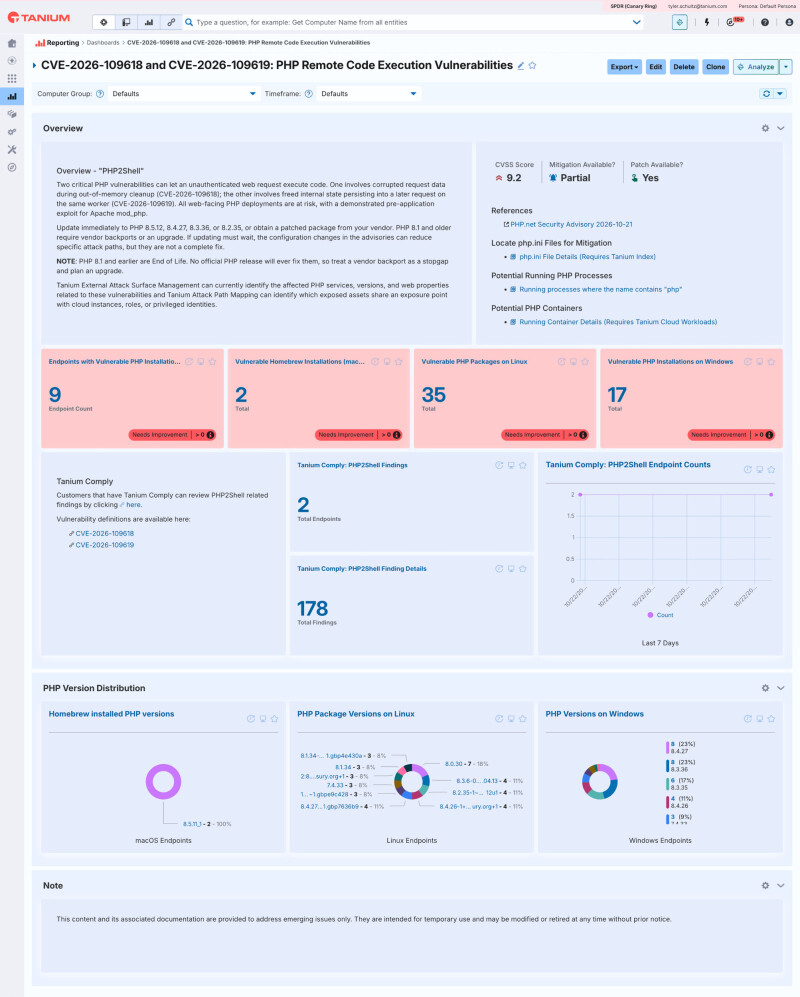
If you run PHP anywhere in your environment, patch to PHP 8.5.12, 8.4.27, 8.3.36 or 8.2.35 now. Two critical flaws disclosed last week, CVE-2026-109618 and CVE-2026-109619 (nicknamed "PHP2Shell"), let an unauthenticated attacker run code on a server with nothing more than a crafted web request. Both carry a CVSS v4.0 score of 9.2, every earlier release is affected, and exploitation in the wild has been reported. The patch is the easy part. The hard part is finding every copy of PHP you own, because PHP rarely shows up where you expect it. This post covers what the flaws are, how far exploitation has gone, and how to get to full coverage fast. What happened Details leaked before the planned embargo, so the PHP security team moved fast and shipped fixes within about a day of announcing them. The two vulnerabilities Both bugs live in PHP core, not in any framework or plugin, so they reach anything that runs PHP to serve web requests. Affected server setups include PHP-FPM, mod_php, php-cgi, FrankenPHP and LiteSpeed. PHP rates mod_php as the highest risk. No login is needed: the attacker only has to reach a PHP endpoint over HTTP. Fixed versions: 8.5.12, 8.4.27, 8.3.36 and 8.2.35. Every earlier release is affected. PHP has also published minimal source backports for 7.4, 8.0 and 8.1, but there are no official releases for those branches. Treat a backport as a stopgap and plan the upgrade. Is it being exploited? Yes, though reliable public exploits are still scarce. watchTowr reports exploitation in its honeypot network as of October 21, and Tenable relays Cloudflare's CTO saying Cloudflare is seeing early attacks. Other telemetry, such as Patchstack's, shows mostly probing so far. Neither CVE is in CISA's KEV catalog yet, and no public indicators of compromise have been released. How hard the bug is to weaponize depends on the platform. VulnCheck reproduced both flaws and found: Code execution works on ARM64, and on x86 systems where address space layout randomization (ASLR) is turned off. Dozens of public proof-of-concepts exist, but very few work and none bypass ASLR on x86-64. Red Hat likewise rates RCE as hard in practice on default PHP-FPM deployments. Don't read that as permission to wait. Exploits mature quickly once a patch diff is public, and fake PoC repositories for headline CVEs often carry malware, so treat any you find with caution. Tanium's research on exploitability is in Why PHP2Shell is real(opens in a new tab). Most at risk: internet-facing PHP applications, especially those running mod_php or on ARM64 hosts. It's also worth retro-hunting recent web server and PHP-FPM logs for unexplained worker crashes and unusual multipart requests. Why finding PHP is harder than it looks No one has a complete list of PHP-based applications, and anything custom-built won't be on any list. PHP hides in several places at once: OS packages on Linux (php, php-fpm, php8.x), which package managers and most inventory tools see. Homebrew and similar on macOS, outside the system's own package list. Bundled copies on Windows. PHP on Windows usually arrives as a zip extracted to a folder or inside a stack like XAMPP, WampServer, Laragon or a vendor product. It often never registers as an installed application at all. Applications that ship their own PHP, where the fix depends on the application vendor rather than the OS. Containers, where the version is baked into the image tag. PHP is often more widespread than teams expect, and it doesn’t only run on servers. Developer tools, local web stacks and bundled applications put it on workstations too, often without registering as an installed application. The reliable answer is to look at the binaries themselves. In testing, PHP builds from version 5 through 8 all embed their version string (X-Powered-By: PHP/x.y.z), so you can read the exact version straight from the file without running it. How Tanium helps Tanium itself is not affected. Tanium does not use PHP, so there is no impact to Tanium software or Tanium Cloud services. Tanium Guardian content for PHP2Shell is available now in Tanium Cloud. The dashboard shows where PHP is installed and running so you can prioritize patching, with a single fleet-wide count of endpoints with vulnerable PHP across Linux, Windows and macOS. It combines: The existing Installed Applications and Homebrew Applications sensors, which find PHP installed through package managers on macOS and Linux. A Windows PHP Installations sensor that finds PHP where Installed Applications can't see it, including IIS, XAMPP, WampServer, Laragon, package managers and manually extracted copies, and reports version, install type, install path and owning user. The version is read from the binary's file metadata without executing it. A pre-built Saved Question that lists running PHP processes so you can prioritize systems that may be serving traffic. A pre-built Saved Question that identifies PHP containers, matching running containers against php, FrankenPHP and about 25 common PHP-based images such as WordPress, Drupal, Joomla, Nextcloud and Magento. Requires Tanium Cloud Workloads. Tanium Comply finds PHP on disk. For customers licensed for Comply, the dashboard includes PHP2Shell findings by endpoint, full finding details and a 7-day trend, with a pivot to the Comply findings page filtered to the two CVEs. The finding details report shows the specific on-disk locations where PHP was found, which catches copies that package and registry inventories miss. Vulnerability Library definitions for Windows, Linux and macOS are live now — sync the TVL and run an assessment to pick them up. On-premises customers can import the Guardian content manually today. Steps and downloads are in Guardian content for on-premises customers(opens in a new tab) on the Tanium Help Center. Know what's exposed to the internet. More than 13 million internet-facing assets run PHP versions that may be affected, according to Censys Internet Intelligence. Tanium External Attack Surface Management (EASM) discovers the internet-facing assets tied to your organization and identifies the PHP services, versions and web properties among them, with these CVEs surfaced through its coverage of exploitable and weaponized vulnerabilities. Tanium Attack Path Mapping then shows which of those exposed assets share an exposure point with a cloud instance, role or privileged identity: the places where one exploited PHP server becomes a route deeper into your environment. Already using Tanium SBOM? Inventorying PHP versions there is a sound early step. It shows which applications carry a vulnerable PHP and need a vendor update. What to do now Work through these in order; the first three matter most today. Find every PHP install, including Windows copies that never registered as applications. Record the exact version of each. Rank by exposure. Internet-facing servers, mod_php setups and ARM64 hosts come first. Patch to 8.5.12, 8.4.27, 8.3.36 or 8.2.35 through your OS vendor, a php.net build or your application vendor. Restart PHP-FPM and web server workers so the new binary is loaded. If you can't patch yet, isolate internet-facing PHP apps where you can, as CERT-EU advises, and put WAF or IDS rules in front of them (Cloudflare and VulnCheck have both shipped rules for the known vectors). Apply the partial setting with care. session.upload_progress.enabled=0 blocks one demonstrated path for CVE-2026-109619 only and does nothing for CVE-2026-109618. It must be set in php.ini, an FPM pool or server config, followed by a worker restart; ini_set() and .user.ini won't apply it. Hunt. Review recent web server and PHP-FPM logs for worker crashes and malformed multipart uploads. Plan off end-of-life PHP. Anything on 8.1 or older has no official fixed release. Where fixed packages stand (as of Oct 21, 16:30 UTC) Distro packages are still rolling out, so check your vendor before assuming a fix is available. The Remi repository won't ship updates today, so PHP advises switching to distro packages or building from source if you depend on it. Read more here. Supplied by Tanium
Two US senators say the Trump administration is breaking the law by withholding the FISA court decision while it presses Congress to renew America’s most sweeping surveillance program.
This2Shell, That2Shell, Everything2Shell. That's pretty much how the last week went. Critical bugs that let attackers run code remotely are showing up everywhere. Hackers are scanning for targets, some flaws are already being used in attacks, and security teams have more urgent patches than they can keep up with.
And that's not even the full story. A leaked key led to a software supply-chain
We've spent the past several decades using duct tape, string, and chewing gum to chain the world's computers together into this thing we call the internet, so there's really no good reason to be surprised that most of it is full of software containing vulnerabilities that are practically just as old. You can listen to the latest episode of The Kettle right here on this page, as well as on Spotify, Apple Music, or YouTube. Those platforms also let you subscribe to Kettle, so you are always notified when the latest episode goes live. The world is still reeling from the PHP2Shell revelations that hit the news cycle this week, and on The Kettle there's no better topic for host Brandon Vigliarolo, cybersecurity editor Jessica Lyons, and FOSS reporter Liam Proven to tease apart. Join us to discuss what exactly is going on, how AI was key to finding another issue no human likely ever would have discovered on their own, and why exposing more bad code in the backbone of the world's computers might be just what we need to rethink the whole thing for the better. A lightly edited transcript follows: Brandon (00:01) Hi everyone, and welcome to the latest episode of The Register's Kettle podcast. I'm your host, Reg reporter Brandon Vigliarolo. And hey, there's only one thing we could focus on for this week's episode, given all the hubbub around it, and that's the PHP apocalypse. It turns out most of the internet is running software that could allow remote code execution on host systems via a pair, or as of today apparently three, vulnerabilities that have come to collectively be known as PHP2Shell. So that's not great. With me to talk about this is our security editor Jessica Lyons and open source reporter Liam Proven, who has a few things to say about PHP itself and why it's probably not surprising we're finding ourselves in this mess. Thanks to you both for coming on. Liam Proven (00:43) Absolute pleasure. Jessica Lyons (00:43) Nice to be here. Brandon (00:44) So Jess, let's start with the basics. What is this? How big of a problem is it? And where do we stand on getting things fixed? Jessica Lyons (00:51) Great. The short answer is it's a very big problem. So we have these two related memory safety vulnerabilities, and they are in the PHP core. Collectively they're called PHP2Shell, and they affect every version that's been released in the last decade affected by one or both of these, going back to about version 5.4. So the general consensus is this is about 70 percent of all of the websites on the internet are running this code. So it basically affects everyone at this point. What happened here is that this dates actually back to August. An independent researcher first spotted this, and then we can talk a little bit more later about who found more of the exploits and what the (PHP) Foundation did with that. But so he found this vulnerability. There was a coordinated disclosure process with the PHP Foundation, and then that broke a little bit starting over the weekend, and then onto Monday, there were some leaks. There was a video posted that purported to show this exploit. And so we get this emergency warning from the PHP Foundation late Monday saying, "Hey, we are going to be releasing these emergency patches, so everybody get ready so you can implement them as soon as possible. It's very serious." So by Wednesday, they did release these, and there's this mass attempt to patch before any of the attackers get a hold of this and are able to attack websites with it. And one of the issues too is that some websites are running really, really old versions and so they aren't able to patch. So they're just sitting there, these legacy servers are still vulnerable. Brandon (02:52) So there's no direct update path for those old versions, right? It's basically shut this down and reinstall it kind of thing. Jessica Lyons (02:59) Exactly. So basically they're both these memory corruption vulnerabilities and by exploiting them, an attacker can kind of shape the memory that PHP trusts. And then they can use that to hijack what happens next. And that can mean remote code execution. They can take over the websites, they can steal data. And so people are visiting these websites they trust and they don't realize that the underlying code is stealing their data or delivering malware to their computer. And again, this is potentially 70 percent of the internet. So it's a big deal. Brandon (03:36) Quite a few sites were offline. I know even some big services. I stopped playing because I had a baby, but I used to play Final Fantasy XIV pretty religiously. And I know that the entire login server was offline a couple days ago Jessica Lyons (03:50) Right. Brandon (03:50) They were like, "You've got to fix this. Sorry, no one can play the game. If you're not logged in right now, you're not getting logged in for the foreseeable future." It's just insane how much of the internet was affected by this. Now It's under exploit, is that correct? But maybe not successfully exploited yet? Jessica Lyons (04:11) Right. So after the patches were released on Wednesday, later Wednesday, AWS came out and said, "We've seen exploitation attempts at least four days before the patches were released." So that kind of caused another frenzy that, "My God, it's under attack, the whole internet is on fire." There haven't been any successful attacks to date. There's been a ton of attempts. There's a lot of POCs; some work, some don't. But as of Friday, according to the Foundation and according to all of the security experts that I've spoken to, we haven't seen any evidence of successful exploitation. I don't think that means we're in the clear. I think it just means it's taking a while for people – and honestly AIs – to develop successful attacks, but that's where we are right now. Brandon (05:06) Because it's a complicated attack chain, correct? Jessica Lyons (05:10) Right. Yes. Brandon (05:11) So basically, right. This is not working yet, but especially with some of these older websites that are running older versions of PHP that are going to have to take a more thorough approach to getting this fixed and possibly going down for some time, this could be one of those problems that remains serious for a while. And let's not forget, 70 percent of the websites on the internet, that's almost three-quarters of the entire internet. I don't know how many hundreds of thousands or millions of sites that is, but some of those are probably never going to get patched. Jessica Lyons (05:41) Right. Exactly. Brandon (05:43) Just the way it goes. Right. This is going to be the sort of thing that we end up hearing about months or years from now. Jessica Lyons (05:49) I would say years. Brandon (05:53) I'm sure there'll be some bank somewhere that eventually ends up getting – we'll hear about some breach disclosure letter from the state of Maine in four or five years. Jessica Lyons (06:02) And local governments, federal and state governments, I think these are the ones that we're going to be hearing about quite a while from now. Brandon (06:09) Because that's one of the things I was thinking about even for me in my tiny little town in northern Michigan. I wonder if my township or the county is going to be all over it to update their PHP server. Does their IT guy, who probably is a retired dude who lives in the area, even know this is a problem? It really is one of those things that is a big deal, but if you're not kind of following the news on this, it could probably go completely unnoticed. And for many websites, I'm sure it will. Jessica Lyons (06:37) Right. Exactly. Brandon (06:37) So, it's pretty crazy. Liam, you're working on a story, I think, as we are recording this, about some of the history of PHP and how it really probably wasn't very well designed or intended to become so ubiquitous on the internet. What's going on there? Liam Proven (06:53) I've seen one angle on this, which is people saying, "This is 1990s code and it has 1990s problems," which is one way to look at it. But I'm a 1980s internet guy; that's when I started exploring it. My primary email address is older than the web, and it still works. My gods, it gets a lot of spam, but it still works. I've watched the rise and rise of PHP since the first releases. Now, I have no personal interest in web development. I can program, but I don't because I'm really bad at it and nobody needs to have my code inflicted upon them. The guy that wrote PHP in the first place, Rasmus Lerdorf, is my age. I've never met him; I'm sure he's a nice guy. But he said in a very early interview about it, "I really don't like programming. I built this tool to program less so that I could just reuse code." And that was about 1993. He built a little tool that allowed him to put macros in HTML for his own website, and it's just grown. In a later interview, he said something along the lines of, "I don't know anything about writing programming languages. I'm just improvising this as I go and people seem to like it." It originally stood for "Personal Home Page," I think, and later was given a recursive acronym of "PHP: Hypertext Preprocessor." This is a programming language that you mix in with the HTML of a website. It predates the modern model of building websites where a database contains the text and a content management system of some kind assembles on the fly the pages that each person sees. This is an older model where you're running programs that are part of the markup language, which was not a good idea, but that was how he did it. There was a lovely blog post. I've got an old friend who's an extremely skilled and talented programmer who has built a career on PHP, and he said to me, "Look, those criticisms that you've mentioned are of the really early versions and it's changed now." And if he hears this, he's going to be cross with me. But my favorite summary was from a blog called Eev.ee way back when that called PHP "a fractal of bad design." Whatever level you look at it, it was done badly. If you look at the whole plan of "let's just intermingle program code in with the markup language," not a good idea. If you look at the details of how it was implemented, not a good idea. If you look down at low-level details of how the functions return values, not a good idea: inconsistent syntax, inconsistent functions, functions that do really weird things, by default no stack traces, not great error reporting. Now, I'm sure a lot of this has been papered over now, but really there is one reason PHP is still around and still so big: Zuck. Facebook was built in PHP. And Facebook makes lots and lots of money and it's been throwing money at making PHP faster and more reliable and more scalable for decades. Brandon (11:03) Have they been big contributors to it? Liam (11:06) Yeah. They even built a compiler for it, which I suspect is still in use. Now, how much of Facebook today is in PHP? I don't know, possibly none, but for a long time basically the world's biggest and busiest public-facing website that wasn't owned by Google – only because Google have failed to ever make a successful social network – was built on PHP. And it's big, it's complicated. Like Linux itself, nobody fully understands how the whole thing works anymore and hasn't probably for decades. And now people have got bots that they can throw against it and ask them to analyze it. I think this is probably just the first, and I think there's going to be many more. A friend of mine who's a senior developer had a look at the patch, and he's not a C guy, but he said – I'm quoting from comments on Mastodon – that the patch to the current version is 13,000 lines of C. That's a doozy of a patch. Brandon (12:17) That's huge. Liam Proven (12:20) A bunch of people have been working like crazy for quite some time. Some people who've looked at this say it looks handwritten to me. Others have said, "No, I think this is bot-generated." I think the truth is probably a bit of both: some from one, some from the other. Brandon (12:32) Bit of both. I mean, you can't pump out thirteen thousand lines that quickly and have it tested. God, I hope they tested it. Liam Proven (12:41) Right. But that's just for the current version, and this hole affects every published version. So if they do manage to fix this one, how long till the next one comes along? Because I think there's going to be – Brandon (12:56) Especially with the speed at which vulnerabilities are being discovered now. I feel like every time I turn around, I've written one Patch Tuesday article in the past few months, and that one broke the previous two records. And I think since then every month has included more patches, and a lot of those are probably – Jessica Lyons (13:14) October at this point is the record: over a thousand for Microsoft alone. So, yep. Brandon (13:21) That's insane. Like you said, it is a fractal of bad design all the way down, and is going to probably have more vulnerabilities discovered. Jessica Lyons (13:32) Right. Brandon (13:32) Seventy percent of all websites on the internet are using this. What can we do? Are we stuck? Liam Proven (13:35) Well, there's a reason for that, and it's one that doesn't get talked about an awful lot: Facebook aren't the only people that use it extensively, because WordPress is also built on PHP, and it's far from alone. Another senior Linux techie friend of mine gave me a free shell account on the machine that he runs for a few friends years ago, and I thought of resurrecting my old 1990s hand-coded HTML webpage for fun. So I found it on the Internet Archive and found a tool to scrape it and turn it back into HTML again. I looked at some CMSes and asked him if there was any CMS on the machine. He went, "No." And I went, "Well, would you install one?" He went, "No." "Well, why not?" He said, "Well, all the big ones are implemented in PHP, and I won't let that near any server I run." "Well, that's a bit dramatic, isn't it?" And he goes, "No, that's pragmatic. I run a bunch of public-facing servers on my own, and this is how I keep them secure. No containers, no Docker, no PHP, nothing built in any of these technologies." And I went, "Wow, what about..." So I went looking for non-PHP CMSes. There are a lot of CMSes out there. I got a commission about a decade ago to write a comparative assessment of the CMS market versus a company's proprietary Windows product. I went and did a survey and came back and said, "I've found 1,300 so far." And they said, "OK, we can give you five thousand words instead of a thousand words." And I said, "You realize I'm going to have to go and look at 1,300 pieces of software here. Even if I only write three or four words about each one, 'Mostly harmless,' I'm still going to have to look at over a thousand bits of software. It will take me a year." And they went, "Well, how can how can we do it quicker?" And I said, "You can't. I cannot do this survey you want. Give me a full-time job and I'll get it back to you in a couple of years' time." I found a few CMSes that weren't built in PHP. Most of those were built in Ruby instead. And he went, "Yeah, I'm not keen on having that on my server either." So it's not even a case of people that have PHP deployments needing to update. They don't know. They built it on something else which was built on something that was built in PHP. Jessica Lyons (16:15) I was just going to say, Liam, you said, "How long until the next one happens?" And we found out today from the PHP Foundation that there is a third one. They won't be pushing an emergency release for this. They said it'll be published with the next regular release cycle. The Foundation told me that this one, quote, "requires a very unlikely combination of configuration and specific PHP application code, which we do not expect to occur in practical use." So, there's already another one. Liam Proven (16:45) So weeks then. Brandon (16:47) Yeah. Jessica Lyons (16:48) I mean, and even with this, it's hard to exploit. You can mitigate it with a configuration setting. But that was part of the thing we've heard with these other two. And then we did have researchers yesterday who developed this new exploit; this was Vulncheck. And that shows how even ASLR can be bypassed to attack these vulnerabilities on x86 machines. So saying it can be fixed with a configuration setting isn't always a guarantee. Brandon (17:25) That brings me kind of to the elephant in the room of this whole story: AI. because of course it all comes back to AI nowadays. OpenAI and two other security firms reported this. I think Jess, one of your stories or one of the ones Lindsay wrote said that they all used AI to find this, right? Jessica Lyons (17:49) Right. So the companies: Calif, they are a newer startup doing AI pen testing and they're part of OpenAI's partner program, so they used OpenAI models working with OpenAI to find this. And then independently, Wiz, which is owned by Google, also did. So this happened back in August, and then they have been all working with the PHP Foundation on the patch since that point. They have all said these are vulnerabilities that probably wouldn't have been found by humans alone. By all accounts, they've existed for decades and wouldn't have just been found by human researchers. Brandon (18:34) Right. So either these are things that have never been discovered and would have never been exploited theoretically – the exploit path is complex, they're not obvious vulnerabilities, so they needed an AI to find them – or perhaps this is the kind of thing that was known about but was privately held in the hands of some bug hunting company that sells exploits to governments. Who knows? Maybe that's the case. I remember talking to a guy one time at Black Hat who basically said his company's in the business of finding really sensitive vulnerabilities and then selling them to the highest bidder. So there are companies like that that exist. So there's probably plenty of vulnerabilities in software that are not well known that governments and high-level functions are aware of. But in this case, this probably wasn't the case. This is an incredibly difficult-to-find vulnerability. I've seen a lot of chatter online in the past few days about how the internet's on fire and the AI bug-pocalypse has arrived. It seems like we're having another case of people getting all freaked out because this is the end of time, history is over, and AI is going to kill us all. It just seems to me like this is another example of: well, maybe not. This has been getting hammered by potentially bad actors or pen testers, and no one's managed, as far as we know, to successfully use this yet. Is this as serious as it seems, or is this another case of a serious vulnerability that is so complicated and convoluted that it's not really going to be that big of a deal? Liam Proven (20:25) I want to note parenthetically that you described OpenAI as a security company, and if I had been drinking coffee, that would have been very bad for my keyboard. Brandon (20:32) Okay, whoops. Let me take that back. Jessica Lyons (20:31) Ha ha ha. Liam Proven (20:36) Calif is interesting because I just wrote about them. They found a hole in OpenBSD, and there aren't many of those. And only about a week ago, they found a hole which they dubbed "Big Fish" in OpenBSD, and it was just days before OpenBSD 8 shipped. It looks like that had been there for 37 years, which is a neat trick because OpenBSD was founded 30 years ago. So this is in – going to pronounce this carefully – Berkeley Software Distribution Unix in the eighties. But there are doubtless more, and I'm an arch AI skeptic. Some people will claim that this will be the sort of problem that you can solve with AI by getting it to rewrite your stack. Well yes, but then you'll replace it with a new stack that nobody ever understood any of. But there are ways to design, host, and run websites, forums, and chat channels without using any of this stuff. And it could be a net positive if holes like this keep getting found that people will be forced to go back to – sounds crazy, but – static websites serving pre-written code off a disk. One of my favourite websites – recently I discovered there's a whole chain of them, and I hope you won't mind me swearing; maybe you have to beep me. But there's a marvellous website called "This Is a Motherfucking Website and It's Perfect." And recently somebody rewrote it and the new one looks almost identical: "This Is a Modern Motherfucking Website and It's Perfect." He's written it with more CSS or something, but apparently there's a whole chain of these things and they are extremely low on programming code. They contain interactive elements that you can do with just HTML, and you don't need a whole web framework behind it. And the same AI companies are busily scraping the whole web multiple times a day to feed their training engines. Maybe we just have to suck it up, scrape some of these big websites, and redo them as simpler tech with fewer interpreted languages. We are all collectively victims of the sunk cost fallacy. We've got millions of websites. We spent billions and trillions of dollars building all this. We can't just throw it all away. Well, maybe you have to. Brandon (23:27) Sunk cost was something that kept coming to my mind as I was writing up the script for this episode and just thinking about this. It seems like a whole big case of, "Well, all the websites in the world are now on PHP, so I guess we're stuck." Liam Proven (23:42) We have a script? Brandon (23:46) Well, not a formal script, just notes. Liam Proven (23:48) Haha. Well I didn't get the memo. Jessica Lyons (23:50) I think that's part of the problem though: it illustrates this larger issue with AI in general. AI bug hunting and exploit detection kind of illustrates this bigger problem about the internet, especially these legacy systems that underpin government services and critical infrastructure. It is literally held together by duct tape and string. So it's a massive problem. Again, it takes some work to actually make anything of these vulnerabilities and chain them together. AI is getting better at that. So whether or not this ends up being the end of the world for the internet as we know it, it does illustrate a real problem. Brandon (24:42) Like Liam said, maybe this is the sort of catalyst that the wider internet community needs to realize that these systems – this duct tape and string – simply won't keep working forever. We need to maybe modernize all the underlying infrastructure and make it simpler and less kludged together with all these different things over the years. PHP is poor design all the way down, right? It's like: well, maybe we need to tear it out and start over. Even if these vulnerabilities are impractical to exploit and hard to find, the fact that they're being discovered does illustrate that most of our code is a mess. Liam Proven (25:28) I am reminded , the other day I was talking in the comments about A/UX, Apple's original Unix for the Mac, and Apple paid another company to develop A/UX because the US military had a tick box on the form that said to buy systems, they have to be able to run POSIX. The US Army at one point hosted its website on Classic Mac OS. And it wasn't exactly security by obscurity. They said virtually all web server attacks in the mid-1990s were based on getting a remote shell, and Classic macOS didn't have a shell at all, anywhere. There was no way to get a remote shell because you couldn't get a shell if you were sitting in front of it. So they said, "They try and inject bits of x86 code: well, it's not an x86. They try and get a shell: it hasn't got one. They try and get it to run scripts: it doesn't run scripts." They said, "We just sit there and watch people throwing themselves at it. All the best attacks, and none of it works because the operating system's kind of too primitive to do any of that stuff." I don't believe many customers actually ever used A/UX, but it got Apple some lucrative deals. Maybe we're going to see a new trend of super primitive, super basic websites. There'll be a new difficulty in trying to scale the things because Kubernetes expects a lot of this to be dynamically generated by microservices. But bring it on; I'd love to see that. Brandon (27:09) That's a Kubernetes problem, right? Liam Proven (27:12) Yeah. Brandon (27:14) I feel like I would love a simpler internet. It would be amazing if I could just wake up in the morning, go to a news site, and just get the headlines. So often, I feel like – and I think The Register is good at having a relatively simple design, but – so often I feel like the news aggregators that I go to... I look for ones that are as minimal as possible. I look for websites that are simple. I don't need all this in-your-face stuff; it's not necessary. I think we probably are all pretty sick of it in a lot of ways. Jessica Lyons (27:49) But do we really think this is going to happen though? Brandon (27:52) No. Jessica Lyons (27:53) I feel extremely pessimistic about this. I think it's much more profitable to just keep marketing solutions to the problem as opposed to a safe coding overhaul. Brandon (28:04) Unfortunately. Liam Proven (28:06) Geopolitics might yet get in the way. I wrote a piece about OpenEuler, one of the big Chinese enterprise server Linuxes, and one of only two companies actually showing off an OS at the Open Source Summit. The other was also Chinese: OpenKylin, which is more desktop focused. China makes its own chips, China makes its own operating systems, and it's got its own programming languages. They're all open source, taken from European and American developed software by and large, but they could still invade Taiwan and cut off much of the world's chip supply. And suddenly it won't just be that memory is way more expensive than it used to be; it will be that you can't get more memory anymore and you have to keep using 10-year-old chips. And people will be potentially forced to find ways to keep getting more out of the same hardware until we can build new chip fabs, which will take a lot of time and a lot of money. And then quite possibly they'll get blown away in a climate-change-induced hurricane and then we'll have to start again. So, I hope they're going to start building them in the north of Norway and places like that. But yeah we've got bigger problems coming down the pipe and it's all a giant snowball of superficially unrelated things: AI attacks on overcomplicated stacks on one side, and the other kind of attack which involves whistling noises and large explosions on the other side, which cuts off the hardware market. It's hard to plan for this, but nobody's even trying yet. Brandon (29:52) Who would have thought a talk about a PHP vulnerability would have turned into geopolitical chaos and the endof modern technology as we know it? Break out the sundial, people. Liam Proven (30:07) Excuse me, I've just got to go and wind the web server. Hang on. Brandon (30:11) All right, guys. Thanks for coming on. I think this was a really valuable discussion and it shows just how interconnected all these issues in tech are right now. I mean, it is interesting how we're kind of hurtling toward something in a lot of ways. AI will surely be a part of it, as will expensive chips and lots and lots of vulnerabilities being found every day. Hopefully we'll still be here to cover it as that continues to happen. Jessica Lyons (30:40) If AI doesn't kill us. Brandon (30:41) Right. If AI doesn't kill us all. Well, if it doesn't, we'll be here on the Kettle to talk about it. And we hope that you, from whatever bunker you're hiding in, will join us on future episodes. Liam Proven (30:53) Yeah, we'll be publishing a telephone number so you can phone into future Kettle episodes. Brandon (30:59) All right, folks, we'll talk soon. ®
UK Biobank (UKB) says its platform is now "secure" and that academics will soon regain access, months after a major data leak of volunteer health data. The charity, which runs the eponymous research project and describes itself as the custodian of the world's most comprehensive biomedical dataset, said it is waiting for approval from health data controllers and central government before it relaunches the platform. UK Biobank's Research Analysis Platform (UKB-RAP) has locked out all medical researchers trying to access its dataset since the April attack, which led to all 500,000 volunteers’ data being listed for sale on Chinese ecommerce website Alibaba. More than 20,000 researchers use the dataset provided by the cloud-based platform. They upload research projects and run experiments informed by the genomic data UKB collected from 40-to-69-year-olds between 2006 and 2010. The org makes around 30 petabytes worth of the stuff available to researchers, who investigate conditions including cancer, dementia, Parkinson’s disease, and COVID-19 immunity. Professor Sir Rory Collins, CEO at UKB, said on Friday that the organization has "completed the work to ensure that the UKB-RAP is secure," and that the progress was checked by an independent cybersecurity company, whose report recommends reopening the platform. The charity will begin a phased re-introduction of researchers to its platform after it receives the necessary approvals, although boffins will not be able to download any results files at first. The platform will pilot a "manual output checking system," where human reviewers will inspect files researchers wish to download before allowing them to do so, ahead of an automated process expected to roll out next year. According to the guide UKB compiled for researchers outlining the changes to the platform, researchers will also be restricted from building public apps and sharing tools with external colleagues until that manual checking system is fully up and running. Researchers were also warned that they will not be able to refresh or dispense data, only work with pre-existing data. They were also told to expect automatic logout out after 15 minutes of inactivity, with 2FA required upon re-authentication. Other technical changes include no longer being able to SSH into jobs, interactive tools being run via "isolated browsing" which restricts data transfer between web apps and the user's local system, and some restrictions on CLI use. UKB is working toward a day when the researchers using its platform store no data on their own computers, working only with that which is uploaded to the repos it hosts. However, in uploading this data to online repos, de-identified data is accidentally included in the code. UKB says it runs daily automated scans of these repos to catch errors, and provides training to researchers to help prevent these occurrences. Collins said that since the attack, most researchers have confirmed the deletion of de-identified data from their projects, but others have not and won't be admitted back to the UKB-RAP until they do. "Despite our repeated reminders, we are still detecting a small number of code repositories that include de-identified participant data," he said. "As these constitute a serious breach of the Material Transfer Agreement, sanctions are being applied against the researchers who are responsible." The charity also said researchers caught exposing participant data in their code will be forced to move their analyses to UKB-RAP, delete any downloaded data, and undergo additional training before being allowed back on the platform. It had initially told researchers to expect a relaunch of the platform by September 2026, although an update penned last month confirmed that it needed to wait for an independent assessment to be completed, despite already making the required security improvements. ®
Two critical flaws in Wasmtime, a WebAssembly runtime that can be built into other software, could allow a malicious WebAssembly module to escape the sandbox intended to contain it, the project's maintainers say.
An attacker would first need a vulnerable Wasmtime build to compile a module they control, and one of the flaws affects only ARM64 systems. Fixed versions were released on
Every SOC struggles with a pile of alerts. Very few of those alerts explain how an attack started or how it progressed. Network data, like that from a network detection and response (NDR) platform, connects individual alerts into one timeline, and it feeds the defensive systems that can tie all events together into one coordinated view.
SOC teams often first see the shape of an intrusion
The UK government is throwing £130 million at AI-powered cyber defenses, including plans to deploy autonomous AI agents across critical infrastructure to hunt down security flaws before attackers get there first. The money is part of a wider £600 million-plus AI spending spree announced by the Treasury ahead of this week's Budget, with ministers also promising to tackle biological threats, bankroll British AI firms, and reduce the country's dependence on foreign technology. Of the cyber funding, £60 million will go towards a new National Cyber Shield that uses agentic AI to bolster Britain's defenses. That includes a £25 million challenge fund for UK cybersecurity firms and plans for a regulatory sandbox to test autonomous security tools across critical infrastructure, government and industry. Another £70 million will establish the National Exposure and Real-Time Vulnerability (NERV) Centre, using AI to sniff out vulnerabilities across Britain's infrastructure and wider economy. The announcement comes just days after the PHP2Shell security scare, which saw dozens of government websites taken offline after critical flaws were discovered in the widely used scripting language. Britain's National Cyber Security Centre (NCSC) worked with OpenAI to coordinate disclosure of the PHP flaws and give affected vendors time to prepare fixes, after AI-assisted researchers uncovered the vulnerabilities. Whitehall has already been experimenting with AI-powered vulnerability hunting. AI minister Kanishka Narayan said last week that the technology had uncovered 500 previously unknown security flaws across significant parts of the public sector. It remains unclear how much freedom the new AI defenders will have to act without human intervention, or when they'll be deployed. Ciaran Martin, former head of the NCSC, welcomed the investment, pointing to the week's events as evidence that Britain needs to get its cyber defenses in order. "We need to padlock our systems, and harness AI for defense," he said. The Treasury is also handing another £120 million to the AI Security Institute (AISI), which tests advanced AI systems for dangerous capabilities and researches ways to keep them under control. Cybersecurity isn't the only threat keeping ministers busy. Another £165 million will fund a National AI Biosecurity Initiative, including £100 million for what the government claims will be the world's first dedicated AI Biosecurity Lab. The independent, non-profit lab will use frontier AI models to detect biological threats and accelerate the development of vaccines and treatments. OpenAI is contributing £100 million in compute and model credits, while Anthropic is offering up to £100 million in model credits, model access and technical support. Google DeepMind and British biotech firm Basecamp Research are also involved, while the remaining £65 million will go towards biosurveillance and medical countermeasures against dangerous pathogens. There's something for the homegrown AI industry, too. The government is adding £60 million to its Sovereign AI Fund to invest in British companies developing technologies including robotics and autonomous systems, plus another £60 million for AI research and development procurement. A further £18 million will fund an Advanced Chip Design Academy, intended to help Britain develop more of its own semiconductor expertise rather than relying quite so heavily on technology designed overseas. The package also includes £30 million for local AI partnerships, £15 million for an AI challenge prize initially focused on healthcare, and £23 million for research into AI's impact on jobs and the economy. Manchester will get a new NCSC AI Cyber Security Centre of Excellence to train government specialists. Additionally, ministers are setting aside £10 million a year to study how AI will reshape employment and industry, including the jobs it might make redundant. The government clearly has high hopes for AI. Whether the technology can live up to them without creating a fresh set of problems is another matter.®
A rentable Android spyware kit called uCreator takes over Telegram and WeChat accounts by hiding its code inside working copies of the two apps, researcher Ovi found. It only reaches people who install one of these tampered copies, spread outside the official app stores, or who run WeChat inside the kit makers' own container app.
The kit's Telegram part matches Baohuo, a backdoor that Doctor
Cybersecurity researchers have disclosed a Microsoft 365 campaign that has been observed leveraging an adversary-in-the-middle (AitM) relay to capture sign-in sessions and then replay the stolen tokens to break into email accounts at 79 organizations.
Huntress, which observed the activity between July 14 and September 22, 2026, said it detected 497 successful Microsoft 365 sign-in events across
An automated campaign is using stolen GitHub tokens to plant workflows that print a repository's secrets into its GitHub Actions logs, which the attackers then download before deleting the runs. The attacks have succeeded in private repositories and GitHub Enterprise environments, according to an analysis by cloud security company Wiz.
A GitHub safeguard that pauses
A malicious instruction file sitting in a developer's Downloads folder tried to make their AI coding agent install a known-malicious npm package, security firm Forever Security said in a report published last week.
The company caught the attempt on a real customer's machine and stopped the agent before any code ran. It could not determine how the file got into the folder.
The file
 Login