 Login

We third-party tested our firewall built for AI-scale. The test tools hit their limit first.
We tested Cisco Secure Firewall 6160 with NetSecOPEN for AI-scale. It delivered 5X more throughput than previously tested and 100% threat block rate. 


"Build a smart home", they said. "It'll make life so much better", they said. Well, life wasn't very bloody good at 23:00 the other night after travelling 33 hours from Paris only to find the IoT doorlock batteries dead and the 9V "jump start" procedure completely failing! Eventually, the locksmith arrived and opened an old-school physical lock on another door in an alarmingly short time. So, lessons:
As I say in the video, we do have other doors that have keys, and if it weren't for the complacency we developed, we would have had one of these accessible. But alas, we didn't. The path forward is to take a deep dive into Ubiquiti's Access ecosystem, which I've flagged in the past, and by pure coincidence, I already had a meeting lined up with them to discuss just this. So, the hardware is on the way, and I'll have something entirely new to play with in the coming weeks. Stay tuned!


Microsoft Corp. today released software updates to plug at least 570 security holes in its Windows operating systems and other software, almost triple the number of vulnerabilities the software giant fixed in its record-smashing Patch Tuesday release last month. Microsoft attributed the burgeoning patch counts to vulnerability discoveries aided by artificial intelligence.

Nearly 60 of the bugs quashed in July’s Patch Tuesday earned a “critical” severity rating, meaning miscreants or malware could use them to seize remote control over a Windows device with little or no help from the user. Microsoft also addressed three zero-day flaws, including two that are already being exploited in the wild.
Two of the zero-day weaknesses allow an attacker to elevate their user rights on a Windows system, as do approximately 250 other elevation of privilege flaws fixed this month; they include CVE-2026-56155 — an Active Directory Federation Services bug — and CVE-2026-56164, a Microsoft Sharepoint vulnerability.
CVE-2026-50661 is a security feature bypass in Windows BitLocker that could allow attackers to gain access to encrypted data if they have physical access to the device. Microsoft said this bug has been detailed publicly, but that it is not aware of any active exploitation.
In a blog post on July 9, Microsoft Executive Vice President Pavan Davuluri wrote that Windows users will notice “a higher volume of security updates included in each security release” as a result of AI aiding in the discovery of vulnerabilities.
“The pace of vulnerability discovery is changing with advances in AI making it possible to find more issues, faster, across more code, with new mechanisms that can accelerate both discovery and analysis,” Davuluri wrote.
Jack Bicer, director of vulnerability research at Action1, called attention to CVE-2026-48561, a remote code execution flaw in Microsoft Copilot (with a 9.6 CVSS threat score) that allows an unauthorized attacker to execute code over the network. Microsoft says an attacker could exploit this bug by hosting a malicious website that causes Microsoft Edge for Android to automatically send crafted prompts to Copilot when a user visits the site.
As AI advances the state of vulnerability discovery and remediation, it is also making it easier for attackers to quickly devise working exploits for known software flaws. Microsoft has long labeled security bugs using its “exploitability index,” which is Redmond’s best guess as to how likely it is that attackers will be able to figure out a reliable way to exploit a given vulnerability.
But Satnam Narang, senior staff research engineer at Tenable, argues that Microsoft’s exploitability index needs to do a better job of shifting with the machine speed of discovery. For example, Microsoft originally gave this month’s SharePoint zero-day an exploitability rating of “less likely,” although the flaw was added to CISA’s Known Exploited Vulnerabilities list on July 1.
“Anthropic’s Red Team’s own findings for known vulnerabilities (n-days) revealed how fragile this system has become, with its Mythos Preview model being able to produce proof-of-concept exploits for 13 of 14 vulnerabilities that were rated ‘Exploitation Less Likely’ or ‘Exploitation Unlikely,'” Narang said. “What this means is that our way of looking at Patch Tuesday has changed, because the exploitability index is centered around humans, not AI tools, and as these tools continue to improve, defense needs to improve alongside it.”
Chris Goettl at Ivanti observed that the record patch numbers from Microsoft come as a number of other major software makers are increasing their patch cadence, including Adobe which announced today it is moving to twice-monthly security bulletins published on the 2nd and 4th Tuesday of each month (Adobe also cited AI for accelerating their patch cycles). Cisco, Mozilla and Oracle also are shipping updates more frequently, while Google’s patch batches in June 2026 totaled more than 900 security fixes, Goettl noted.
Backing up your Windows system and/or data is always a good idea before applying operating system updates. Given the volume of patches addressed this month it may be wise for end users to wait a few days before applying these fixes. It’s not uncommon for security patches to introduce system stability issues, and those chances probably increase quite a bit with the gigantic patch count released today.
Further reading:
The Cybersecurity and Infrastructure Security Agency (CISA) has issued a postmortem on a recent data leak in which a contractor published dozens of internal CISA credentials — including AWS Govcloud keys — in a public GitHub repository for almost six months before being notified by KrebsOnSecurity. Experts say the gaps identified in the agency’s initial response provide important lessons that all security teams should absorb.
On May 15, 2026, the security firm GitGuardian asked for help in notifying CISA about the existence of a public GitHub repository called “Private CISA” that included 844 MB of sensitive CISA-related data. One of the exposed files, titled “importantAWStokens,” included the administrative credentials to three Amazon AWS GovCloud servers. Another file — “AWS-Workspace-Firefox-Passwords.csv” — listed plaintext usernames and passwords for dozens of internal CISA systems.
CISA quickly acknowledged our initial alert, but took more than 48 hours to invalidate the AWS keys and many other important secrets leaked in the GitHub repo. In its report on the data leak, CISA said the complexities of the agency’s systems and interconnections with federal and industry partners caused its key rotation to take longer than anticipated.
“Drawing on this experience, CISA encourages others to maintain mature and well-tested key management capabilities,” the report notes.
CISA also admitted it can do better when it comes to responding to security incident notifications from external parties. The postmortem stresses that clear and distinct reporting channels are essential to ensure that incidents affecting the organization itself are handled differently from those involving its products or customers.
“In CISA’s case, these channels were not well defined, leading the security researcher to try multiple avenues – including emailing the contractor, submitting through CISA’s vulnerability disclosure platform (which is intended for vulnerabilities impacting the broader cybersecurity community), and ultimately involving a reporter,” reads the analysis written by Preston Werntz and Brad Libbey, the acting chief information officer and acting chief information security officer at CISA, respectively.
CISA said it is refining its reporting channels to make them easier and faster for researchers. “Additionally, while many researchers rely on the security.txt file, organizations can ensure clarity by publishing reporting instructions in multiple prominent locations,” the CISA authors wrote.
Guillaume Valadon, the GitGuardian researcher who first contacted KrebsOnSecurity about the exposed CISA credentials, said CISA ignored nine automated alerts about the exposed credentials prior to our notification on May 15. Valadon’s company constantly scans public code repositories at GitHub and elsewhere for exposed secrets, automatically alerting the offending accounts of any apparent sensitive data exposures.
“Letting nine notification emails go unanswered is how a one-day incident becomes a six-month exposure,” Valadon wrote in an analysis of CISA’s report. “Make it trivial to report a leak about you, not just about your products. The person reporting a leak to you is not the threat. Publish a security.txt, but do not stop there. Put reporting instructions in several prominent places, and make sure a report about your own infrastructure does not land in a product-bug queue.”
The report’s authors also emphasized the importance of continuously scanning public code repositories like GitHub for exposed secrets, and said CISA has since rotated all secrets and created an action plan to improve management of developer secrets and to better monitor for them going forward.
The report notes that while CISA had developed a playbook for responding to cybersecurity incidents, that playbook somehow didn’t include what to do in situations involving GitHub or other cloud services. Valadon said the report validates the need to scan continuously — not just quarterly — for exposed secrets.
“The Private-CISA repository sat public for six months,” Valadon wrote. “Continuous monitoring of public GitHub surfaced it. Comprehensive internal scanning could have caught the plaintext passwords and committed backups long before they left the building.”
CISA gave itself passing grades on several areas of security preparedness that it said helped the agency gauge the scope and impact of the exposed secrets, including enhanced logging capabilities, and the adoption of zero-trust principles in both its production and development systems. CISA said those detailed logs allowed it to show that no customer or mission data was exposed, and that the leaked credentials were not used outside of CISA’s environments. The agency said the contractor who exposed the secrets had their system access revoked.
Valadon reckons the biggest takeaway is the CISA postmortem itself, and praised the agency for being transparent about what worked and what didn’t.
“To my knowledge, it is also the first time a national cybersecurity agency has publicly advocated for secrets scanning and for simplifying relations with security researchers,” Valadon wrote. “That is exactly the incident communication we should expect from every organization.”

Millions of Americans hand over personal information every day. They share their data with insurance companies, banks, investment apps, and other services they trust.
And that’s exactly why cybercriminals target and impersonate those services.
This week, an insurance provider disclosed a breach reportedly affecting nearly 7 million people’s driver’s license numbers, while a California journalist shared how a convincing fake Robinhood text ultimately cost her more than $70,000.
Here’s what happened, why these scams work, and what you can do to protect yourself This Week in Scams.
One of the largest U.S. data breaches of the year has exposed sensitive information belonging to 6.9 million people.
According to reporting from TechCrunch, insurance provider AssuranceAmerica confirmed that hackers accessed customer information after compromising an employee account. The company says the stolen data includes names, contact information, driver’s license numbers, insurance policy details, vehicle information, and claims data.
While the company has not said exactly how the employee’s credentials were compromised, it noted that the attackers targeted an employee account before accessing company systems.
Unlike a password, you can’t simply change your driver’s license number.
Combined with your name, address, phone number, or other information from previous breaches, driver’s license numbers can be used by criminals to:
This is also part of a larger trend. In recent months, multiple breaches have exposed government-issued identity documents as more organizations collect IDs for identity verification and age-check requirements.
If you receive a notice that your information was involved in a breach, monitor your financial accounts closely, consider placing a fraud alert or credit freeze, and remain cautious of unexpected emails, texts, or phone calls referencing your insurance or driver’s license information.
Unfortunately, scammers will reach out saying they’re trying to “help” secure your stolen information, only to try and steal more personal data from you.
Before a breach
Personal Data Cleanup helps reduce your digital footprint by removing your personal information from many data broker sites, limiting what scammers can easily find about you.
During a breach
Identity Monitoring alerts you if your personal information appears on the dark web or in known data leaks, helping you respond faster if your information is exposed.
After a breach
Scam Detector helps identify suspicious texts, emails, and links that often follow major breaches, while Web Protection helps block malicious websites designed to steal additional information or credentials.
Even people who report on scams can become victims.
A former California television news anchor recently shared how she lost more than $70,000 after receiving what appeared to be a legitimate text message claiming there was suspicious activity on her Robinhood investment account.
The message instructed her to call a phone number for assistance. Once connected, the caller posed as Robinhood support before transferring her to a fake “fraud department.”
Believing she was protecting her investments from hackers, she was convinced to move her money into what she thought was a secure account. Instead, it went directly to scammers.
She later contacted Robinhood through the official app, but by then the money had already been transferred.
Investment scams rely on urgency, authority, and impersonation rather than obvious phishing emails.
Rather than asking targets to “invest” immediately, many scams begin by convincing people that their existing account is under attack and immediate action is needed.
At McAfee, we’ve also seen scammers impersonate Robinhood, Charles Schwab, cryptocurrency platforms, and other investment services through fraudulent text messages and malicious links promising AI-powered investing, exclusive bonuses, or unusually high returns.
Whether the message claims your account has been compromised or promises incredible profits, the goal is often the same: get you to click, call, or transfer money before you have time to verify what’s happening.
Before responding to any message about your investments:
 Never call the phone number provided in a text message or email. Instead, contact your financial institution using the number listed in its official app or website.
Slow down when someone creates urgency. Claims that your account is being hacked or frozen are designed to make you act before you think.
Be skeptical of guaranteed returns or AI-powered investment opportunities. Promises of extraordinary profits are a common hallmark of investment fraud.
Verify alerts through your account directly. If you receive a suspicious notification, log in through the official app, not a link in the message.
With McAfee+, multiple layers work together before any damage is done:
Scam Detector flags suspicious texts, emails, links, QR codes, and even deepfake videos before you engage
Secure VPN keeps your data private, especially on public Wi-Fi
Web Protection helps block risky sites, even if you do accidentally click
Password Manager doesn’t just help you make unique, strong passwords, it keeps them stored and organized for you
Device Security helps detect malicious apps or downloads
Identity Monitoring alerts you if your personal info appears online in places it shouldn’t, so you can act fast
Personal Data Cleanup helps remove your information from sites selling it.
Online Account Cleanup assists in taking down your old, forgotten accounts across the web
Social Privacy Manager helps you monitor and change privacy settings across your social platforms in just a few clicks
Together, these protections are designed to address the broader range of online risks people face every day.
The post Nearly 7 Million Driver’s Licenses Exposed in Assurance Breach: This Week in Scams appeared first on McAfee Blog.

How's this for a location?! I mean, last week was nice with Scott in Mallorca, but Marrakech is, well, wow 😮 Anyway, about those data breaches... This week I'm talking about the futility of attempting to remove piss from a pool, yet here we are, with various companies wanting to place that message alongside the very data breaches they can do nothing about! As I say in the post, I don't question the good intentions behind setting up a service to try to scrub data from legally operating data brokers, but the marketing machines behind those organisations that regularly reach out to me for product placement don't really seem to grasp that reality. At least now they have a nice explainer courtesy of that post 😊
A cybersecurity startup dangling millions of dollars to acquire zero-day security vulnerabilities in popular software is run by a pair of far-right conspiracy theorists and convicted felons whose most recent ventures included fake intelligence companies and a now-defunct AI-based lobbying platform they operated under assumed names.
The X/Twitter account IRIS C2 (@C2IRIS) has gained more than 4,000 followers since its creation in January 2025, posting frequently about security vulnerabilities, AI and software exploits. IRIS C2 says it is a company in McLean, Va. that sells offensive cybersecurity capabilities.

The IRIS C2 website dangles the possibility of million-dollar payouts for exploits to attract talent.
“Our business model is this,” reads a pinned post on top of the IRIS C2 account on X. “Attract the very best vulnerability researchers and exploit developers in the world to join our company. This mostly revolves around junior engineers with raw talent/extremely high IQ. We don’t care if they have a college degree/industry experience.”
The website linked in that profile — irisc2[.]com — says the company is hiring for a number of open positions, and a recent post on its LinkedIn page enthuses about an overwhelming number of applications from potential employees. The website claims IRIS C2 is in the business of acquiring “zero-day exploits, individual primitives, partial chains, and full capabilities across all major platforms. Payouts range from $10,000 to $7 million depending on target, reliability, and operational value.”
The government contracting portal g2exchange.com reports that irisc2[.]com is operated by a business based in Virginia called Calvexa Group LLC. The “contact” link on the website for Calvexa Group — calvexagroup[.]com — forwards visitors to irisc2[.]com. G2Exchange shows that while Calvexa Group LLC is registered as a federal contractor, it does not appear to be working on any direct government contracts.
A search on the Arlington, Va. address listed in the incorporation records for Calvexa Group LLC finds the property is occupied by Jack Burkman, the 60-year-old founder and managing partner of the lobbying firm Burkman & Associates. When approached with questions about IRIS C2, Burkman referred further inquiries to his longtime associate, 28-year-old Jacob Wohl.

Jack Burkman (left) and Jacob Wohl, at a press conference in August 2020. Image: Wikipedia.
Burkman and Wohl have a storied history of creating fake intelligence companies and using them to spread false claims about and frame public figures, including fabricated sexual assault claims against then FBI director Robert Mueller, and Pete Buttigieg, then mayor of South Bend, Indiana and a Democratic candidate for the presidency. In 2019, Burkman and Wohl held press conferences falsely alleging extramarital affairs by Sen. Elizabeth Warren (D-Mass.) and then-2020 presidential candidate Kamala Harris.
In the wake of the 2020 presidential election, Wohl and Burkman were prosecuted by multiple U.S. states for making thousands of robocalls to residents of battleground states and disseminating false claims about mail-in ballots. They were indicted in Cleveland on 15 felony counts of orchestrating a robocall scheme aimed at suppressing the black vote in Detroit, and were sentenced in late 2025 to probation after their appeals to dismiss the charges were rejected.
In 2022, Wohl and Burkman both pleaded guilty to a single felony charge of telecommunications fraud in Ohio, and sentenced to a fine, probation, and community service. In March 2023, a judge in a New York civil case ruled that Wohl and Burkman had violated federal and state civil rights laws, and the two agreed to pay a $1 million settlement.
In June 2023, the Federal Communications Commission (FCC) imposed a $5.1 million fine against Wohl and Burkman for their robocall campaigns, at the time the largest fine ever sought by the FCC under the Telephone Consumer Protection Act.

Jacob “Jay” Wohl’s GitHub account.
By the age of 17, Wohl had started multiple investment firms, and cultivated the nickname “Wohl of Wall Street” after appearing on Fox News in 2015 to discuss his new hedge funds. In 2017, the Arizona Corporation Commission charged Wohl and his investment funds with 14 counts of securities fraud, and ordered him to pay $35,000 in restitution. In 2019, Wohl pleaded guilty in California to four felony counts of selling unregistered securities and was sentenced to two years of probation.
The market for previously unknown security vulnerabilities has always been populated by a colorful mix of researchers, academics, charlatans, clout-chasers and people actively involved in cybercrime communities. But the market for selling offensive security services to the U.S. government tends to be far more circumspect. Plenty of government contractors recruit vulnerability researchers and pay for the exclusive rights to novel software exploits, yet none of them do so quite as brazenly and openly as IRIS C2.

Recent posts from the Twitter/X account IRISC2 (@c2iris).
Indeed, KrebsOnSecurity was unaware of IRIS C2 until last month, when an attendee at a regional cybersecurity conference shared that Wohl and Calvexa Group were pestering people at the conference about selling their vulnerability research.
In an interview with KrebsOnSecurity, Wohl said Mr. Burkman was not involved in the day-to-day operations of IRIS C2. Wohl shared that IRIS C2 originally began as a penetration testing company, but shifted its focus recently to selling phone-hacking services to the government. Several times throughout the interview, Mr. Wohl mentioned working on federal government contracts, but when pressed for specifics said he was not at liberty to speak publicly about them.
Mr. Wohl said he does not have any formal education or training in computer science or information security, and that most of his knowledge on the matter is self-taught.
“I know more about tech than anyone,” Wohl bragged. “My background has always been extremely technical, and I’ve always been deeply into tech. People know me as someone who is able to create spectacularly exquisite capabilities that would make your head spin.”
Wohl said security researchers bring the company unique vulnerability findings “on a regular basis,” but that in many cases those findings are preliminary and not fully fleshed-out.
“Let’s say someone finds a flaw in a media decoder on a phone,” Wohl said. “A lot of times what we receive is an exploit primitive, where the idea is there but the [execution] needs work. You need that exploit to be stable and reliable, and that’s what we do.”
Wohl claims IRIS C2 has approximately 40 employees, although he said none of them are allowed to list their employment on LinkedIn for operational security reasons. In May, the author of the IRIS C2 account on X said that his girlfriend had no idea what he did for a living. But if IRIS C2 has any other employees, they may be similarly unaware of Mr. Wohl’s history of outright fabrications — or even his real name.
In September 2024, Politico reported that Burkman and Wohl were bragging about big companies supposedly buying services from their now-defunct company LobbyMatic, which claimed to use artificial intelligence to assist in political lobbying efforts. However, Politico found the pair were running the company using pseudonyms, with Wohl reportedly adopting the name “Jay Klein” and Burkman using the moniker “Bill Sanders.” Politico reported that two of the former LobbyMatic employees resigned after learning of their true identities, while other employees only learned after they had left the company.
Update, July 9, 9:44 a.m. ET: Several readers pointed our attention to a March 31 publication from journalist Molly White, which reported that Burkman and Wohl were paid a $300,000 retainer by a Canadian cryptocurrency fraudster wanted by the United States and several other countries for allegedly stealing $65 million from the crypto platforms KyberSwap and Indexed Finance. According to that report, the two were hired to pursue a “presidential pardon to avert a miscarriage of justice” on behalf of the accused hacker, who has not yet been convicted.



I can't recall if someone else originally came up with this saying or if I said it in some off-the-cuff comment and it just propagated, but since it's often attributed back to me, I'll relay it here regardless:
Trying to delete yourself from the internet is like trying to take piss out of a swimming pool
Depending on the publication, I'll tailor the saying to be either more broadly palatable or more, uh, "Australian", but the sentiment doesn't change: once data spreads on the internet, you can never put a lid on it. This is important in the context of data breaches because it speaks to the immutability of our exposed personal information. It also speaks to the limited practicality of services that promise to erase your data from the internet, and it's the constant outreach from these organisations looking for marketing opportunities on Have I Been Pwned (HIBP) that's prompted me to write this.
Let's begin with those services, and because there are so many and I don't want to throw any of them under the bus, I won't name names. I also won't name them because whilst they're rather assertive in their marketing outreach, I do believe they're well-intentioned and I don't want to imply otherwise. And they have a role to play; it's just much more limited than is represented. The positioning is often around "data broker removal services", or "protect my data", or "remove my information from the internet". You'll find various companies providing these services by searching for those terms, or you can search for specific organisations... and find others hijacking the search term as they pay to market their brand in front of others. Usual internet marketing shadiness, of course, but IMHO it speaks volumes about the commercialisation of the data removal business.
These services all follow roughly the same marketing handbook:
So let's go through these points one by one, starting with the data broker claim, which is absolutely correct. Your data has value - "data is the new oil" - and there's business in obtaining and selling it. I've dealt with many of them personally over the years, primarily because they've had data breaches. Master Deeds in South Africa was massive. National Public data a couple of years ago was many times larger. Exactis, Adapt, and many others have also been added to HIBP over the years. To the best of my knowledge, they're legally operating services, even if they may exist on the fringe of what most of us would consider "a bit dodgy" as far as respecting our personal information goes.
Which brings us to the second point about nefarious uses. There is a very broad spectrum of legitimacy across data brokers. Let's pick two extremes as far as the legality of the service goes. On the "very legally operating" end of things, we have Experian, and even if you don't like what they do, there's no arguing the fact that they're on the cleaner end of legitimacy and do provide valid services. At the other end, you have the likes of LeakedSource (and pretty much every other service with the word "Leak" in its name) that... well... just Google them. And there are many, many more at each end and everywhere in between. And a lot of it's very grey: different legal jurisdictions, different means of obtaining data, and different tolerances for adhering to opt-out requests.
But it's the data removal piece that's the real problem. If you pay one of the services in question to scrub you from the internet, I have no doubt they'll have some degree of success with the legally operating services. Those services will comply with legal requests and are adequately equipped to receive and process them. But the LeakedSources of the world? Not so much. And that's where the rub begins:
Requests to remove personal information are only effective for services that are willing to honour them.
That should sound profoundly obvious to anyone reading this now, but it doesn't really feature when you read the marketing material on data removal services. But I'm only just warming up...
Imagine trying to remove your data from here:
🚨🇺🇸 ShinyHunters has leaked the data of multiple companies...
— Dark Web Informer (@DarkWebInformer) June 16, 2026
🇺🇸 American Tower Corporation
🇺🇸 JCPenney & subsidiaries under Catalyst Brands & Authentic Brands Group
🇺🇸 Madison Square Garden Sports Corp.
🇺🇸 Ralph Lauren
🇺🇸 https://t.co/08IaUnp1sx pic.twitter.com/TvqanSTO1Y
That's a small snippet of the ShinyHunters website from a couple of weeks ago. At the time of writing, a bunch more data has been dumped, including only about 15 minutes before putting these words down in the draft blog post. These breaches have impacted tens of millions of people, including my wife courtesy of her having previously shopped at Canada Goose. Now, let's see how you go about scrubbing her data from that incident. For all the data broker removal services I'll direct to this post later, how do you do that? Clearly, you can't. The pee is now in the pool, and you're not taking it back out. And it's not just "on the dark web" either, their Tor site links through to a clear web site hosting all the data:
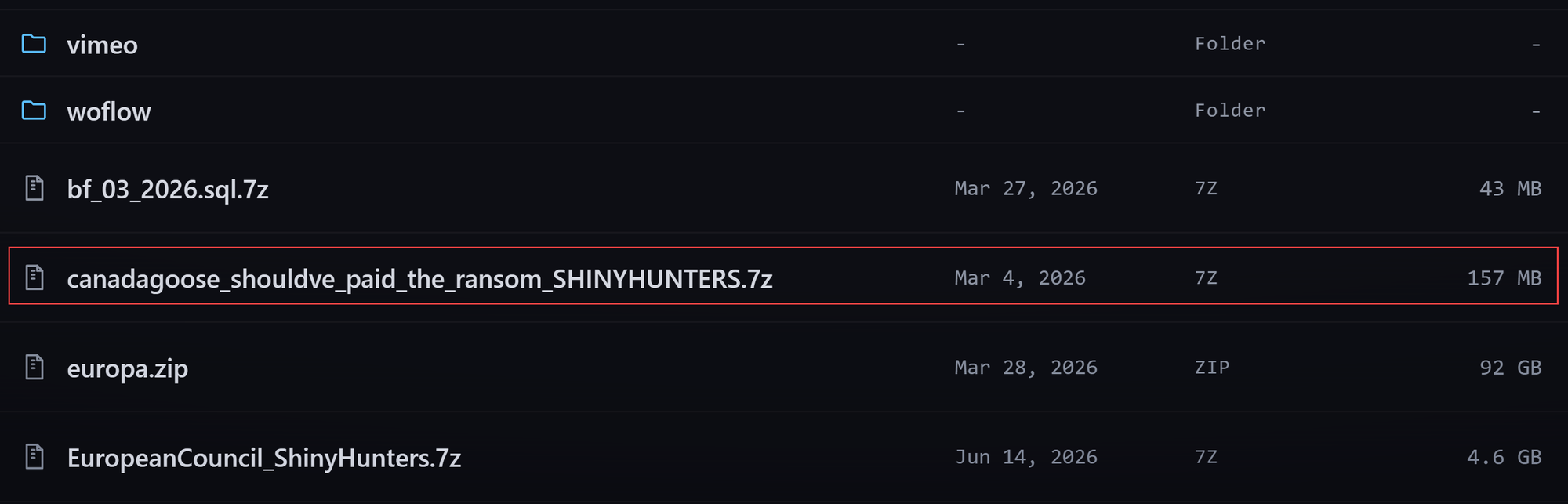
And that's just the beginning. Because we're talking about digitised data posted publicly, it replicates like crazy. There will be tens of thousands of copies of my wife's personal info floating around between personal stashes, Telegram channels and public hacking forums. That genie is never going back in the bottle, not unless we're talking about the narrow scope of a legally operating data broker, which raises another issue:
What legally operating broker is enriching their corpus from data breaches?! That's just not where the legitimate ones source info from. The data comes from surveys, exchanges with other services where you ticked the box to agree to the terms and conditions for exchanging data with "partners", public business directories, and even arrest records. Legal services, legal sources, legal processes. In one of the emails from a company looking for product placement, they described their plan as follows (bold is mine):
a plan which allows you to remove your personal information from any URL (where it's legal) you find your personal information on
So what we're left with is data removal services being effective for legally operating brokers who honour legitimate requests, whilst being completely useless against the worst kinds of sites that replicate and abuse your data. In other words, you may be able to opt out of some marketing material or content that's way too specifically targeted to you, but you can't stop the bad guys trying to steal your identity or extort you because "we caught you watching porn on your PC via the malware we installed". It's a little like the court injunctions being the thoughts and prayers of data breach response I wrote about in October: I can't touch the Qantas data breach because I'm a law-abiding Australian who knows about the injunction, but there's absolutely nothing stopping the genuinely bad actors from abusing that data.
And therein lies the core of why I don't want to entertain partnerships with these organisations: not because I disagree with the service or because it will cause any harm, rather because when someone uses HIBP to search for their email address and finds it in the Canada Gooses of the world, these services can't do anything about it. They're merely skimming the leaves off the top of the pool, and no amount of skimming is going to remove what we all know still lies beneath.
The Federal Bureau of Investigation (FBI) said today it worked with industry partners to seize hundreds of domains associated with NetNut, a sprawling residential proxy service operated by the publicly-traded Israeli company Alarum Technologies [NASDAQ: ALAR]. The action comes roughly two weeks after KrebsOnSecurity published findings from multiple security firms connecting NetNut to the Popa botnet, a collection of at least two million devices that have been compromised by malicious software with little or no consent from victims.
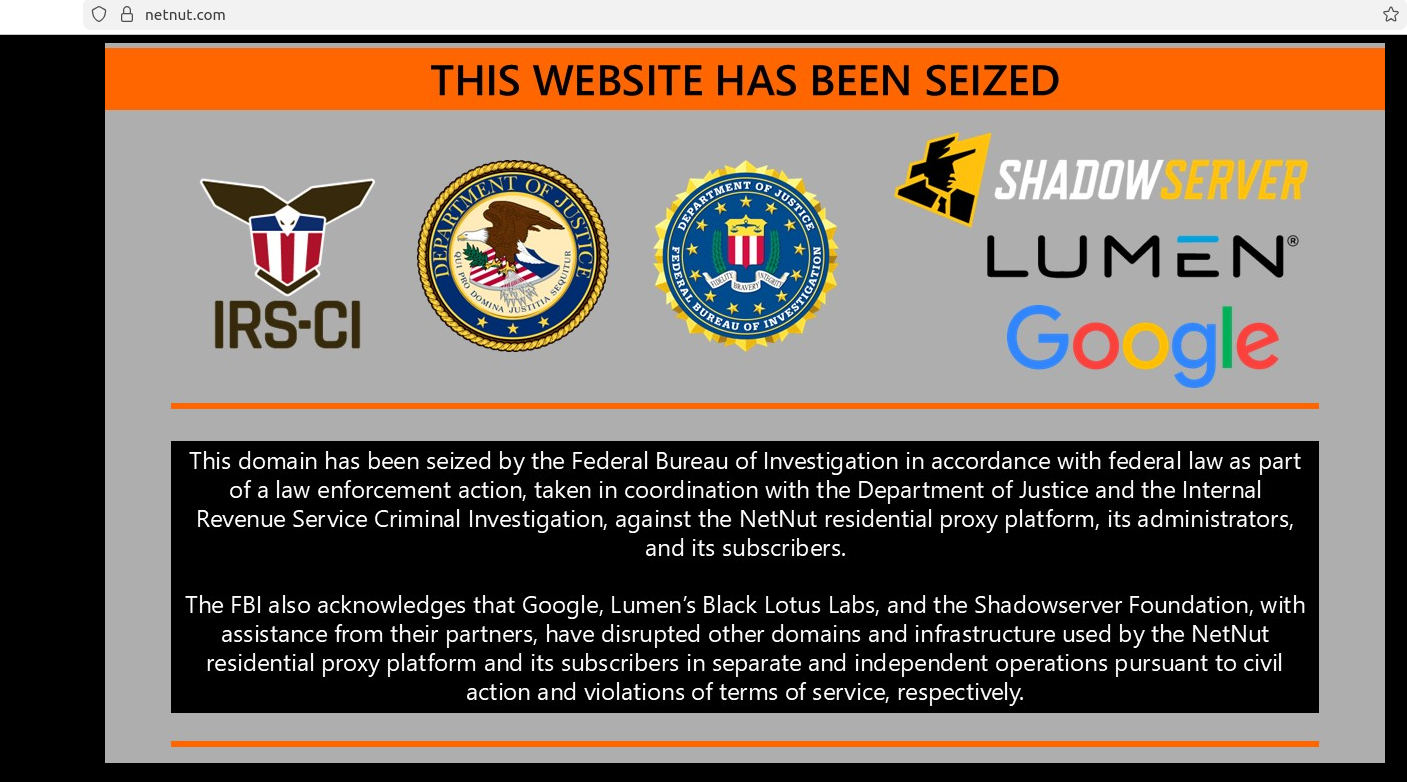
The NetNut homepage today was replaced by this seizure banner from the FBI.
On June 19, three different security firms issued similar findings: That NetNut is a residential proxy network which populates a botnet called Popa, and distributes software for devices commonly found in homes, such as smart TVs and streaming boxes. NetNut’s software turns those systems into always-on residential proxy nodes that are rented to others, who predominantly use them to relay abusive and intrusive Internet traffic, such as mass content scraping, advertising fraud, and account takeover activity.
Earlier today, NetNut’s homepage was replaced with a seizure notice from the FBI and the Internal Revenue Service Criminal Investigation division. The seizure notice thanked Google, Lumen, Shadowserver and other industry partners for their help in dismantling hundreds of domains tied to the Popa botnet, which experts say has long been synonymous with NetNut’s residential proxy infrastructure.
In a blog post published today, the Google Threat Intelligence Group (GTIG) said NetNut’s proxy network is widely resold and white-labeled by a number of third-party proxy providers, and that its services are heavily sought out by cybercriminals seeking to obfuscate the source of their malicious traffic. The GTIG said that in a single week during June 2026, they observed 316 distinct clusters of threat actors using suspected NetNut exit nodes, including cybercriminal and espionage groups.
“These bad actors can use NetNut to mask their origin IP address when accessing victim environments, accessing their own infrastructure, and conducting password spray attacks,” Google’s GTIG wrote. “Furthermore, when a consumer device becomes an exit node, unauthorized network traffic passes through it. This means bad actors can access other private devices on the same home network, effectively exposing them to Internet threats.”
Google said it disabled Google accounts and services used by NetNut for malware command and control, and that it shared technical intelligence on NetNut’s software development kits (SDKs) and backend infrastructure with platform providers, law enforcement and research firms. The company also disabled apps known to bundle NetNut’s various SDKs.
Omer Weiss, legal counsel for NetNut parent Alarum Technologies, said the company was aware of the FBI seizure and cooperating with investigators.
“Alarum takes this matter seriously and will fully cooperate with law enforcement to ensure any misuse of its infrastructure is thoroughly investigated and those responsible are held to account,” Weiss said in a written statement.
Benjamin Brundage is founder of the proxy tracking service Synthient, one of the companies that published evidence last month linking the Popa botnet to NetNut and Alarum Technologies. Brundage said the domain seizures appear to have disrupted both the Popa botnet and the NetNut proxy network that rides on top of it.
Brundage said NetNut’s apparent demise is likely to be a great disadvantage for the cybercrime community, which was already reeling from legal actions by Google earlier this year that seized infrastructure for NetNut’s biggest competitor — IPIDEA.
“I think this takedown is going to have a big impact, because NetNut gained significant popularity after the IPIDEA takedown,” he said. “Also NetNut has been incredibly common among resellers, and they were on par with IPIDEA in terms of their daily traffic, quality, size, price per gigabyte, all of it.”
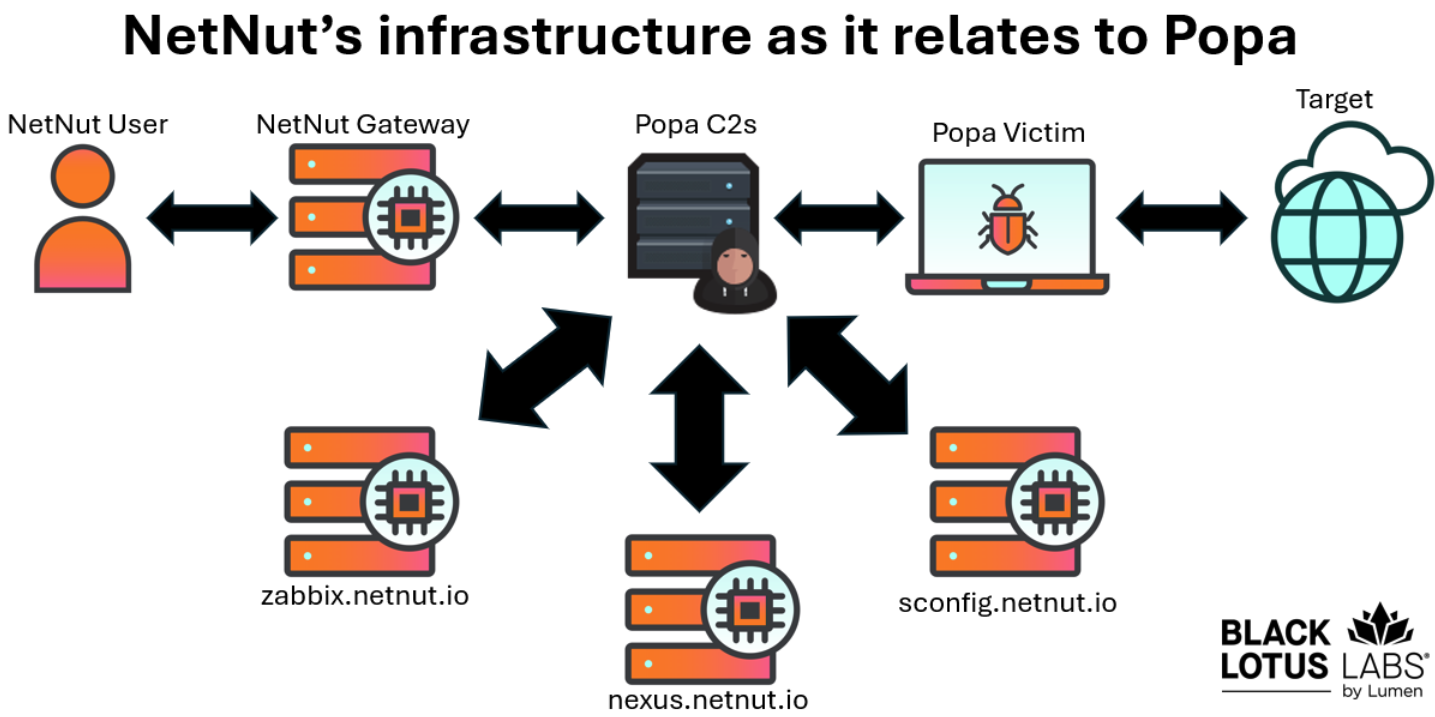
NetNut’s infrastructure, in a nutshell. Image: Black Lotus Labs, Lumen.
The NetNut and Popa botnet takedown may have another added benefit, Brundage said: Lessening the impact of large distributed denial-of-service botnets that have been built on the backs of poorly configured residential proxy services. In January, Synthient revealed how cybercriminals had built the world’s largest DDoS botnet (Kimwolf) by tunneling through IPIDEA proxy connections into the local networks of TV box owners, and infecting other Android-based devices behind the victim’s firewall.
While many of the bigger proxy providers took steps to block this activity, resellers of the major proxy networks have been far slower to respond to the threat, Brundage said.
“In terms of all these TV box devices getting compromised from the proxy network, it will have an impact on the DDoS botnets out there,” he said.
For its part, Google reckons today’s actions have caused “significant degradation to NetNut’s proxy network and its business operations, reducing the available pool of devices for the proxy operator by millions.” But the company warns that proxy networks can rebuild themselves by effectively reselling other proxy services, as IPIDEA has done over the past few months.
“Google has high confidence that many popular residential proxy brands are in fact whitelabeling the NetNut botnet,” the GTIG report concludes. “While we expect this disruption to have a larger ripple effect across the residential proxy ecosystem, observations after the disruption of IPIDEA proved that individual networks can appear resilient. What we have observed is that when faced with the degradation of their own botnet, proxy operators begin buying capacity from their competitors, effectively becoming a reseller. We recognize that creating a lasting disruption in this fluid ecosystem means we must scale our efforts to target the infrastructure of several interconnected providers.”
As KrebsOnSecurity has warned repeatedly, most of the no-name TV streaming boxes for sale on the major e-commerce websites either come pre-installed with residential proxy software, or require the installation of proxy SDKs in order to use the device for its stated purpose (streaming pirated movies, sporting events and TV shows). Google’s advice here is sound: When it comes to TV boxes, stick to name brands from reputable manufacturers, and then be sparing and judicious with any apps you choose to install.
The sketchy TV boxes that are being commandeered by the Popa botnet and other threats all come with or require the user to install unofficial Android operating systems that do not operate within the confines of Google’s Official Play Protect store. Google says consumers can confirm whether or not a device is built with the official Android TV OS and Play Protect certification by following these instructions.
Even people without TV streaming boxes can find their smart TVs enrolled in residential proxy networks, just by installing one of thousands of apps available for download on Samsung and LG smart TVs. In a report released last month, the proxy tracking company Spur found 42 percent of apps available for download via the webOS operating system on LG smart TVs include SDKs that turn one’s television into an always-on residential proxy node. More than a quarter of the apps made for Samsung’s Tizen operating system had similar residential proxy components, Spur found.

Image: Spur.us.
Update, 4:24 p.m. ET: Included a statement shared post-publication from an attorney representing NetNut parent Alarum Technologies.
Update, July 8, 2:34 p.m. ET: The website for Alarum Technologies — alarum[.]io — now also features a seizure notice from the FBI. The company’s stock has taken a beating since the FBI action, and is currently trading at $2.62 a share, a roughly 67 percent decline over the past week.

Imposter scams remain the most reported type of fraud in America for the fifth year in a row, according to new data from the Federal Trade Commission (FTC).
Americans submitted more than 1 million reports of imposter scams in 2025, making them the agency’s top fraud category once again. Victims reported more than $3.5 billion in losses, though the real number is likely much higher since many scams go unreported.
But “imposter scam” is a broad category. It doesn’t tell you what these scams actually look like when they land in your inbox, texts, social media DMs, or phone calls.
To better understand what consumers are encountering every day, McAfee surveyed more than 7,500 people for its State of the Scamiverse report. The results show scammers aren’t just pretending to be one type of person or company. They’re impersonating the brands, services, and people we trust most.
This week’s edition of This Week in Scams is here ahead of the holiday weekend with the 10 most common identities scammers pretend to be.
Common scam: An innocent conversation that turns into something more.
These scams often begin with a harmless message intended for “someone else.” Once you reply, the scammer slowly builds trust over days or even weeks before introducing investment opportunities, romance, or requests for money.
Unlike traditional phishing, these scams don’t always include suspicious links.
Why it works: They feel like genuine human conversations rather than obvious scams.
Learn more about wrong number and pig-butchering scams.
Common scam: “Your device has been compromised.”
These messages impersonate technology companies or cybersecurity brands, claiming your computer or phone has been infected or involved in a security breach.
Some direct victims to fake technical support, while others encourage downloads of malicious software.
Why it works: Security alerts are designed to grab attention, and convincing impersonation can make fake warnings look legitimate.
Learn more about tech support scams.
Common scam: “We’ve detected suspicious activity on your account.”
Bank impersonation scams create immediate urgency, asking customers to confirm transactions, secure their accounts, or verify their identity.
Many direct victims to fake websites or connect them with fraudulent customer support representatives.
Why it works: Financial security messages naturally demand attention, making people more likely to react before verifying the sender.
Learn more about banking scams and financial fraud.
Common scam: “Your payment couldn’t be processed.”
Scammers impersonate streaming services, software subscriptions, and other recurring services, warning that your account will be canceled unless you update your payment information.
Why it works: Consumers are used to recurring billing notifications, making these messages blend into everyday digital life.
Learn more about mobile payment and subscription scams.
Common scam: “Your vehicle warranty is about to expire.”
One of the oldest impersonation scams is still one of the most common. Fraudsters claim your warranty is ending and pressure you to purchase coverage immediately or provide personal information.
Why it works: Many people aren’t sure when their warranty expires, making the claim difficult to verify on the spot.
Learn more about these types of robocallers.
Common scam: “You’ve won a prize.”
These scams promise gift cards, rewards, or exclusive offers but require you to “verify” your identity or enter payment information to claim them.
Why it works: The promise of something free lowers skepticism, especially when the message appears to come from a familiar brand.
Learn more about survey and prize scams.
Common scam: Fake invoices for purchases you never made.
Receiving an invoice for an expensive purchase can trigger panic. Scammers count on victims clicking quickly to dispute the charge, often leading them to malicious websites or fake customer support numbers.
Why it works: Consumers naturally want to stop fraudulent purchases as quickly as possible.
Learn more about shopping scams.
Common scam: “Verify your PayPal account.”
Messages claiming there’s a problem with your payment account often direct you to fake login pages designed to steal your username, password, or financial information.
While PayPal is one common example, scammers impersonate many digital payment platforms.
Why it works: Payment notifications are common, and many consumers don’t think twice before signing in to resolve what appears to be a routine issue.
Learn more about mobile payment scams.
Common scam: “Verify your account or it will be suspended.”
Scammers frequently impersonate platforms like Facebook, Instagram, TikTok, or X, claiming there’s unusual activity or that your account violates community guidelines.
The goal is usually to steal your login credentials or two-factor authentication codes.
Why it works: Many people rely on social media for work, business, or staying connected, making the threat of losing access feel urgent.
Learn more about social media scams.
Common scam: “Your package couldn’t be delivered.”
Whether you’re waiting for a birthday gift, an online order, or an important package, fake delivery notifications prey on the fact that most people are expecting something to arrive.
These messages often claim there’s a shipping issue, unpaid delivery fee, or missed package and urge you to click a link immediately.
Why it works: Package updates have become part of daily life, making fake notifications feel routine rather than suspicious.
Learn more about delivery scams.
While these scams may look different, they all rely on the same tactic: impersonation.
“AI has lowered the barrier for creating convincing impersonation scams,” said Abhishek Karnik, Head of Threat Research at McAfee.
“Scammers can now produce professional-looking emails, realistic websites, and even convincing voices or videos at scale. The result isn’t necessarily more scam types, it’s far more believable versions of the scams people already encounter every day.”
That mirrors a broader trend McAfee identified in its State of the Scamiverse research: scams are becoming more realistic, more personalized, and harder to distinguish from legitimate communications.
Americans now receive an average of 14 scam messages every day, spend 114 hours each year deciding what’s real and what’s fake, and one in three say they feel less confident spotting scams than they did a year ago.
| If you notice this… | Do this instead |
| A message creates a sense of urgency (“Your account will be suspended,” “Package delivery failed,” “Fraud detected”) | Pause before acting. Scammers want you to make a quick decision before verifying the message. |
| You’re asked to click a link or scan a QR code | Open the company’s official website or app yourself instead of using the link in the message. |
| The message asks you to verify your account, payment information, or identity | Never enter credentials through an unsolicited message. If you’re concerned, contact the company directly using a trusted phone number or website. |
| Someone asks for passwords, one-time verification codes, or payment over text, email, or phone | Legitimate companies won’t ask for this. Don’t share the information, even if the request seems convincing. |
| A “wrong number” text quickly becomes unusually friendly or shifts toward investing, crypto, or money | Stop responding and block the sender. Modern scams often begin as seemingly harmless conversations. |
With McAfee+, multiple layers work together before any damage is done:
Together, these protections are designed to address the broader range of online risks people face every day.
The post Imposter Scams Are Evolving. Here Are the 10 Identities Scammers Pretend to Be Most. appeared first on McAfee Blog.
Overview
If you have open positions at your company for information security professionals and would like to hire from the /r/netsec user base, please leave a comment detailing any open job listings at your company.
We would also like to encourage you to post internship positions as well. Many of our readers are currently in school or are just finishing their education.
Please reserve top level comments for those posting open positions.
Rules & Guidelines
Include the company name in the post. If you want to be topsykret, go recruit elsewhere. Include the geographic location of the position along with the availability of relocation assistance or remote work.
You can see an example of acceptable posts by perusing past hiring threads.
Feedback
Feedback and suggestions are welcome, but please don't hijack this thread (use moderator mail instead.)

McAfee Mobile Security has once again earned a perfect score from AV-TEST, one of the cybersecurity industry’s most respected independent testing organizations.
In AV-TEST’s latest Android security evaluation, McAfee achieved a flawless 18 out of 18 points, receiving perfect 6/6 scores in Protection, Performance, and Usability.
The result also earned McAfee AV-TEST’s highest certification for mobile security.
More importantly, this isn’t a one-time achievement. McAfee has earned top certification in every AV-TEST Mobile Security evaluation since testing began in 2013, demonstrating more than a decade of consistently delivering industry-leading protection for Android users.
AV-TEST is one of the world’s leading independent cybersecurity testing laboratories. Rather than relying on vendor claims, AV-TEST evaluates security products under controlled, real-world conditions using the same types of threats consumers face every day.
Its certifications are widely referenced by:
Because every product is tested using the same methodology, AV-TEST provides an objective benchmark for comparing mobile security solutions.
For this evaluation, AV-TEST examined 12 Android mobile security products across three equally weighted categories:
| Category | What It Measures |
| Protection | Ability to detect and block real-world Android malware and emerging threats |
| Performance | Whether the security app slows down your device or drains system resources |
| Usability | Accuracy of detections and avoidance of false alarms or unnecessary interruptions |
McAfee earned the maximum possible score in all three categories:
Overall Score: 18/18
That means McAfee not only blocked threats effectively, but did so without slowing devices down or generating unnecessary false positives.
Mobile devices have become one of our primary ways to bank, shop, communicate, and manage our digital lives. As cybercriminals increasingly target smartphones with malware, phishing attacks, malicious apps, and credential theft, effective mobile protection matters more than ever.
Independent testing helps separate marketing claims from measurable performance.
McAfee’s latest AV-TEST results demonstrate that users don’t have to choose between strong security and a smooth mobile experience. The protection works quietly in the background, helping keep devices secure without getting in the way.
Even more importantly, this latest certification continues a streak that spans more than a decade. Consistently earning perfect scores across changing threat landscapes reflects McAfee’s ongoing investment in protecting customers against today’s evolving mobile threats.
The award-winning protection recognized by AV-TEST is included in:
Whether you’re protecting your own phone or your entire family’s devices, you’re getting the same independently tested mobile security that continues to earn top marks from one of the industry’s most trusted testing organizations.
Ready to get protection that doesn’t slow you down? Explore McAfee+ Plans →
The post McAfee Mobile Security Earns a Perfect AV-TEST Score Yet Again appeared first on McAfee Blog.
