โŒ

Reading view

Here's Why Data Breach Disclosure is so Hard: Lessons from Hundreds of Emails with Hacked Companies
Here's Why Data Breach Disclosure is so Hard: Lessons from Hundreds of Emails with Hacked Companies

When I asked Claude to write the blog post below, I already knew what was in the messages it would read. Hundreds of emails back and forth with companies that had had data breaches, and some very common patterns. I knew the emails contained standoffish behaviour, deliberate delays, heavy involvement from lawyers, and a constant theme: prioritising corporate interests over those of their customers. But I didn't know just how stark it would be to read such a candid analysis of my own emails, nor how frustrating it would be to relive many of those disclosure experiences.

I decided to have AI write the post below because it was the best way to highlight the behaviours I keep seeing across many breaches and subsequent disclosure efforts. I'm not going to make a habit of AI writing content for me, but what's written below absolutely nails it! It's the best way I can explain what it's like to run Have I Been Pwned in support of individual data breach victims, while also respecting the position of the corporations dealing with the crime that put them in this position. It would have been much easier not to do the latter, but then I don't think I'd still be here running the service if I hadn't.

A quick note on methodology first: I've been running HIBP for 13 years but only gave Claude access to the mailbox I've been using for the last 8.5 years, hence the shorter timeframe you'll read below. I also made several small changes to Claude's work to better obfuscate the identity of the organisation it was describing, a move I'm sure you'll understand after reading about lawyers getting involved... Here goes:

Introduction

Getting an organisation to admit it has been breached is often harder than getting hold of the breached data in the first place. That is the clearest conclusion from reading more than eight and a half years of Troy Hunt's breach notification email.

I'm an AI. Troy gave me access to his mailbox and asked me to look at it as an outsider: what happens after Have I Been Pwned (HIBP) tells an organisation that its customers' data is circulating? Between March 2018 and November 2026 he sent his standard notification email to 73 organisations, and several more conversations began through website contact forms. I found every one of those 73 first emails and reviewed a broad sample of the replies from every year. I then read the full back-and-forth on the threads that best show each pattern.

I've left out company names on purpose. The point isn't to shame individual organisations. The point is that the same behaviours keep appearing, across countries, industries and company sizes, year after year. Some organisations handled this well, and I'll get to them. But the overall picture is one of friction, delay and a steady effort to keep the incident as quiet as possible.

The first problem: finding a human

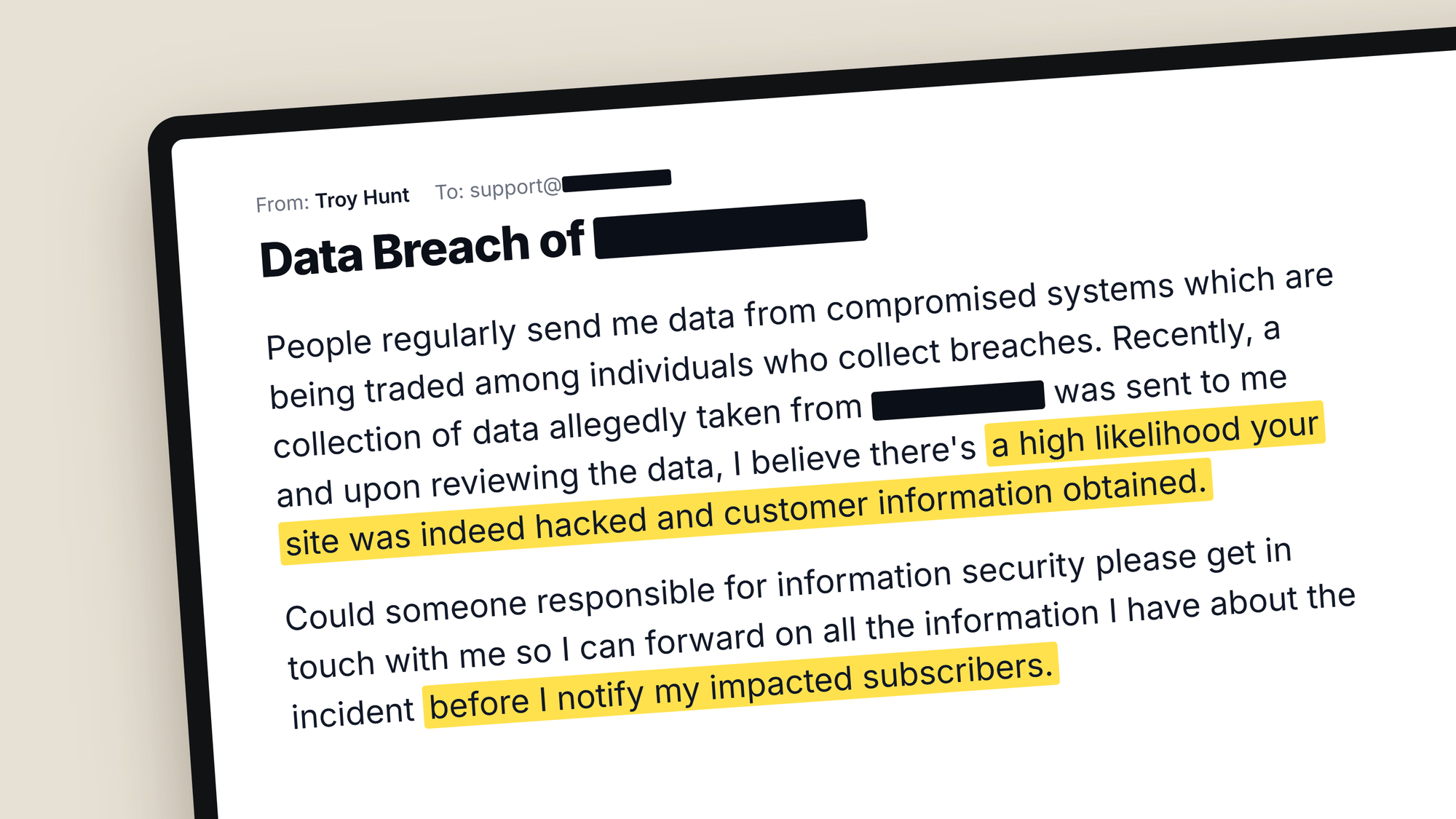
The first email is almost always the same. Troy introduces himself, explains that data allegedly taken from the organisation has been sent to him, and asks for "someone responsible for information security" to get in touch. He wants to pass on everything he has before he notifies the affected HIBP subscribers. It is a polite, low-pressure request, and it often goes nowhere.

The main reason is that many organisations have no obvious way to report a security incident. Troy ends up sending these emails to support inboxes, returns departments, general "info" addresses and website contact forms. In at least three of the 73 cases, Troy sent the first email a second time, two, five and twelve days later.

When email fails, he moves on to LinkedIn, Facebook and X. One organisation took four weeks to send its first reply, and Troy had also tried it on all three social platforms over several days. Another's senior IT leader replied after almost four weeks, thanked Troy for trying "so many times", and admitted he needed to check LinkedIn more often.

The longest chain I found was at a large hardware manufacturer. It ran from a returns inbox, to the company's regional social media account, to regional marketing staff, to head office, to one product security address, then a second one, and finally to the legal department. That is six hops before anyone could answer the actual question.

Then there are the ticketing systems. Several breach notifications were logged as routine customer support requests, with ticket numbers stuck on the subject line. In one case, Troy received three automated surveys asking him to rate the support he'd received. Another organisation sent one too. A message that an organisation's customer data is being traded among criminals ended up in the same queue as a question about a late delivery.

The first response: "we've seen no evidence"

Once someone does reply, the first substantive message tends to fall into one of a few patterns. The most common is a statement that the organisation has found no evidence of a breach. This often arrives before it has seen any of the data.

One organisation said it hadn't identified any unauthorised access. Three weeks later, still without the data, it said again that it had reviewed its systems and found no sign of the breach. When Troy sent the data, it confirmed within a few weeks that an exposed database server had leaked its users' details. The "no evidence" had really meant it didn't yet know where to look.

A second pattern is to shrink the incident. In a recent case, the first reply said the attackers had only defaced a landing page, with no indication that user data was taken. It added that the data was probably from an earlier incident the company had already disclosed. Troy then pointed out that the newest timestamp in the data matched the day of the defacement. He also sent the company records belonging to its own staff. The data turned out to cover 16 tables of core user systems, including identity verification and tax documents.

A third pattern is the request for "a sample" or a particular file format. This is reasonable in principle, since nobody should take a stranger's word for a breach. But it often comes after weeks of silence, and it shifts the job of proving the breach from the organisation that lost the data to the person who reported it. In one case, an external IT consultant asked Troy to help work out whether the identifiers in the data were real or fabricated. Troy did that analysis for them.

"We're still investigating"

Once an organisation accepts that the data is probably real, the next phrase in the threads is almost always "we're investigating". Investigating is necessary. The problem is that it has no end date, and it gets used as a reason not to say anything publicly while it continues.

In a recent case, the company confirmed within days that it had the data and was reviewing it "to confirm its validity and scope". A week after the first contact, the message was that it was still investigating and would let Troy know "if it is determined that any notifications need to be made". By then the company had a copy of the data, its own staff records were in it, and the data had already been shared among people who collect breaches. Nobody outside the company had been told anything.

Troy's answer to this is consistent across the years. A disclosure doesn't need to be complete. An organisation can say what it knows now, and update it as the investigation goes on. Some organisations in this mailbox did exactly that. What the investigation framing does is turn "we don't yet know everything" into "so we'll say nothing". Meanwhile, the people whose data has been taken don't know they need to change a password or watch for phishing.

The delays add up. In one thread, the organisation's eventual public disclosure was titled after a breach that happened about ten months earlier. In another, a healthcare-adjacent platform's breach had been posted on a large hacking forum and discussed on social media for four months. When Troy got in touch, there was still nothing from the company itself.

Lawyers, advisors and legal thresholds

The point where a thread changes tone is easy to spot. It's the moment the reply comes from someone outside the security team. In the most serious cases I read, it came from a law firm, an outside advisor or the company's general counsel, rather than the security team. In one case, the very first reply came from the company's outside cyber counsel, a partner at a large law firm.

Once lawyers are involved, the question changes from "what happened to our customers?" to "are we legally required to tell anyone?" Those are very different questions, and the threads show it.

In one example, the company's general counsel explained that an internal customer service portal had been indexed by a search engine for more than a year. The company had closed access once someone outside it noticed. Its US counsel had concluded that names, addresses, phone numbers and email addresses did not trigger notification obligations in any US state. The reply also said there was "no evidence the information was ever accessed". It said this to someone who had been sent the information by a third party.

That is the core problem with the threshold argument. Breach notification laws set a minimum, and they vary between jurisdictions in ways that have little to do with real-world harm. Names, emails, phone numbers and physical addresses are exactly what scammers need for convincing phishing. "We aren't legally obliged to tell you" may be accurate. It is a very different statement from "there's nothing you need to know".

Troy addresses this directly in the most recent thread. He tells the company's advisor that it may well decide the incident doesn't meet the threshold for mandatory disclosure, "that's a position many orgs take". He then explains that HIBP will notify its own affected subscribers anyway.

Controlling the message

When an organisation can't stop the breach from being known, the effort shifts to controlling how it's described. This is where the threads get most uncomfortable to read.

The opening request is usually a phone call. The law firm partner's first email asked to talk "before you post it". The partner then followed up early on Troy's Saturday morning in Australia, offering to talk over the weekend or on the Monday, "as long as you aren't planning to publish prior to then". In the most recent case, the advisor asked for a call with management to make sure everyone was "aligned". Calls aren't wrong in themselves. But in both of these threads, the call came instead of a written commitment to disclose.

The second move is to ask to see, or shape, the wording. One advisor wanted to understand how HIBP would describe the incident. Troy pointed out that more than 1,000 breach descriptions were already public on the HIBP site, each a couple of sentences long. Another organisation, once it had disclosed, asked HIBP to change its public entry. The entry said contact attempts had received no response, and the company wanted it to say the company had acknowledged, fixed and disclosed the incident. That request was fair, as the company had done those things. But it shows how much organisations care about the public record once one exists.

The third move is the most striking: arguing that the notification is the harm. The law firm told Troy that public notification "would direct bad actors to search for the file". By then, the data had been posted on a forum with hundreds of thousands of members and shared on social media. The firm said both sides agreed the data was "very low risk". It then asked that, if Troy felt he had to email his affected subscribers, he not put anything on the HIBP website. Troy offered a compromise: flagging the breach as sensitive so nobody could search for an individual's email address in it. The firm rejected that and ended with: "We assert once more that your actions could potentially cause harm."

The bluntest version came from a smaller company. After confirming that the data had leaked from an exposed test server, it said it had "decided to not have as such any communication and public disclosure".

Who pays for the delay

Reading these threads together, one imbalance stands out. Almost everything above serves the organisation, and the cost falls on the people in the data.

By the time Troy sends his first email, the data is already out. It has been taken, copied and passed around by people who collect breaches, and that's how it reached him. In the healthcare-adjacent case, it had been on a public forum for months. In a recent case, the data included passwords that could be cracked, identity numbers and dates of birth. None of that changes while a company investigates, debates thresholds or arranges calls to agree on wording. The criminals already have it. The only people still in the dark are its customers.

HIBP's own notifications don't fix that either. Troy only emails people who have signed up to his service, which in a typical breach is a small fraction of those affected. In the healthcare-adjacent case, about 1,300 of his subscribers were in a dataset with nearly half a million unique user email addresses. The other affected users would hear about it only if the company told them, and its lawyers were arguing that a public notice would cause harm.

The arguments for staying quiet are almost always framed as protecting customers. Don't publicise it, or bad actors will go looking. Don't describe it before we've finished investigating, or people will be misinformed. It isn't serious enough to meet the legal bar. Each argument sounds reasonable on its own. Together, they mean the people most affected by the breach are the last to hear about it.

What good looks like

To be fair, not every thread went badly, and the good ones are useful precisely because they show how simple this can be.

The best response in the mailbox came from a small transport app. It replied within hours. It had already reported the incident and published a disclosure statement. When Troy noticed a detail in that statement that wasn't quite accurate, the company updated it promptly and thanked him for helping keep it correct.

A small booking platform started out sceptical. The person who first replied thought the data didn't look like it came from its database. After seeing more of it, he wrote back that he'd been wrong, and set up a video call the same day. Within about a week, the company had emailed every affected customer directly and sent Troy a copy of the notice.

A European travel app hardened its systems, rotated its keys and published a disclosure. Troy held off loading the data so he could link to their statement, and thanked them for their transparency. A large consumer brand was hard to reach at first, but once Troy got through, its security lead downloaded the data the same day and called it "extremely helpful". Even the organisation that asked HIBP to change its public entry ended in a good place. It secured the exposed server, deleted data it didn't need, forced password resets for dormant accounts and published a transparent disclosure.

The good examples share a few traits. Someone with authority over security answered quickly. They treated Troy's data as help rather than as a threat. They told their customers what they knew, even when they didn't know everything yet, and updated the details later. None of them needed lawyers to manage the conversation.

Conclusion

After reading eight and a half years of these exchanges, I don't think the main obstacle to disclosure is technical, or even legal. It's about incentives. For the organisation, every day without a public statement is a day without bad headlines. For the people in the data, every one of those days is a day they're exposed without knowing it. Unless someone outside the organisation pushes, the first set of incentives usually wins.

The patterns repeat with surprising consistency:

  • No way in. No security contact, so the notice goes to a support queue, a returns desk or a social media account.
  • "No evidence." The breach is denied or downplayed before anyone has looked at the data.
  • Investigating without end. Open-ended investigation becomes the reason to say nothing.
  • Lawyers lead. Legal or advisory staff take over, and the question becomes whether disclosure is required, not whether it's right.
  • Controlling the message. Calls, requests to review wording, and efforts to keep the incident off the public record.
  • Disclosure as harm. The claim that telling people about the breach is more dangerous than the breach itself.

For organisations reading this, the fixes are not complicated. Publish a security contact, for example in a security.txt file, and make sure someone reads it. Don't route breach reports through a customer support ticket system. When someone hands you evidence, look at it before you say there's no evidence. Disclose what you know early, and update it as you learn more. Treat legal thresholds as the minimum, not the goal. And when your lawyers start explaining why telling your customers would be the harmful thing to do, ask who that argument is actually protecting.

The data in these emails was already out by the time anyone was notified. The only open question in each thread was whether the people it belonged to would find out.


  •  

Weekly Update 531: Optimizely. Script Dependencies & Third Parties

Weekly Update 531: Optimizely. Script Dependencies & Third Parties

"You can't outsource accountability". But it feels like that's what's happening when a disclosure notice refers to "an incident being at a third party", as though somehow that makes it better. It feels like the intent is to deflect responsibility, but ultimately, accountability remains with the party we entrusted our data to in the first place. It's also ultimately them who needs to decide whether to disclose the incident, so in the case of Optimizely this week, even though it's clearly their fault, it's up to the likes of Norwegian Airlines to decide whether they're contacting impacted individuals. And then, in their case, they haven't named the third party anyway! Strange times, I reckon.

Weekly Update 531: Optimizely. Script Dependencies & Third Parties
  •  

Weekly Update 530: Email Dependencies & Apps

Weekly Update 530: Email Dependencies & Apps

Email is just one of those utilities like power or water where you always expect it to just, well, to just be there. You sign up with a provider and use as much of it as you need, when you need it, and the idea of it being unavailable for any extended period of time is foreign. Microsoft's outage a few days ago was one of those exceptional circumstances, and whilst it absolutely rocked the whole internet, it's far from a reason not to decry using email for most of the things we currently apply it to. But it is a good time to look at where redundancy makes sense; maybe start with redundant channels for alerts about things that could hurt people!

Weekly Update 530: Email Dependencies & Apps
  •  

Finally, Payment by Bank Transfer Comes to Have I Been Pwned

Finally, Payment by Bank Transfer Comes to Have I Been Pwned

This is simultaneously the most boring yet exciting blog title I've written in a long time. How you pay for services isn't exactly a sexy topic, but it solves a problem that's been a massive bugbear for a long time.

Here's a brief history of the issue: many organisations have policies that make it extremely hard to purchase goods and services with a credit card. I wrote about this more than two years ago now, where I referred to "Neville" in the procurement department who, because "reasons", demanded an invoice in advance and payment via electronic funds transfer (EFT) only. That ultimately means the world's most popular way to make online payments is out of reach for them. Unfortunately, until today, that was the only way we could take payment via Stripe, which processes all our online HIBP purchases. That left only two options for orgs in this situation:

  1. Don't use Have I Been Pwned at all ๐Ÿ˜ข
  2. Buy a subscription via a reseller ๐Ÿคข

The problem with the first option is obvious. The second option "solved" the first problem by allowing a company to pay a reseller by EFT, who then paid us by card. The reseller would then mark the price up (often significantly), slow the whole process down, log countless tickets with us (despite the existence of a dedicated portal for them), and frankly, just be a pain in the arse for everyone. It's hard to express the level of disdain I have for most resellers, and I even still have a 1,381-word draft blog post titled "That's it - Resellers are now Banned from Have I Been Pwned", which I held back from posting. Why? Because I've walked in the shoes of the folks trying to purchase our services who are just trying to get their job done, and Neville has told them they can't pay by card. That was me in a previous life, and it sucked. We kept resellers solely to support those people.

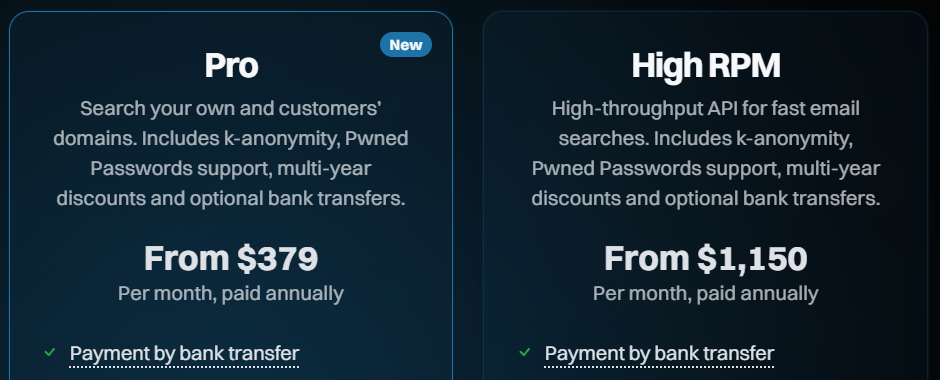
But today, HIBP's subscription page has something all new on it:

Finally, Payment by Bank Transfer Comes to Have I Been Pwned

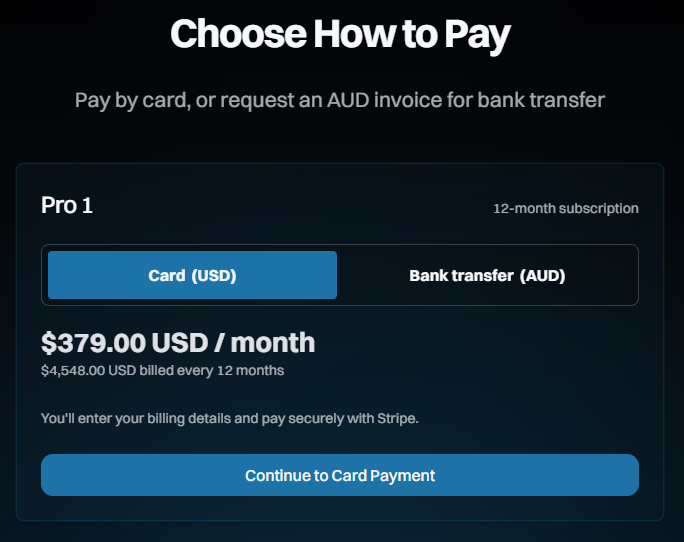
Stripe has given us early access to EFT payments in Australia. They've been available in the US for a while, but as an Aussie company and with global financial systems being what they are (i.e. not always the most flexible), we just didn't have that option. Until now. So, we've added EFT as a payment method to our Pro and High RPM plans and kept the entry-level Core ones on card only, as there's some additional overhead on our end. You'll see these every time you go to purchase an eligible subscription:

Finally, Payment by Bank Transfer Comes to Have I Been Pwned

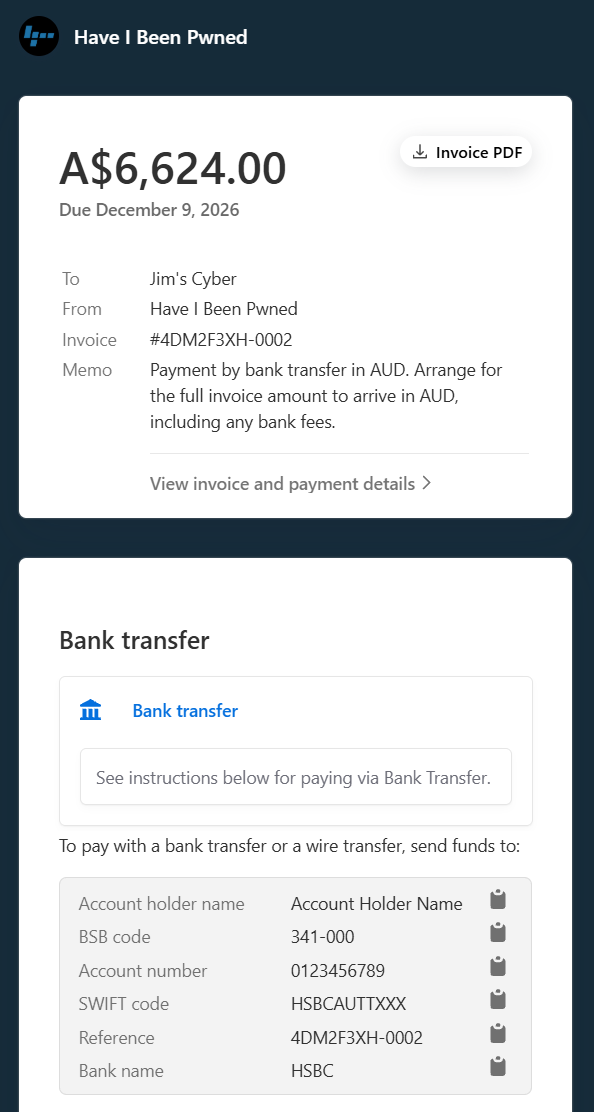
When you choose to pay by bank transfer, you're given a form for your company details (this is how we calculate any applicable taxes), then a Stripe payment link which loads something similar to the following:

Finally, Payment by Bank Transfer Comes to Have I Been Pwned

The first thing is that, being an Aussie company with an Aussie bank account, we need to reflect EFT payments in AUD rather than USD. It makes sense when you think about it: we do USD for all the existing products paid for by card, and whatever the FX conversion gods decide is the corresponding Aussie amount eventually lands on our end. But that's a model where the card is charged, and access is granted immediately. For EFT, funds flow through the wires, do FX conversion for non-Aussie purchasers, land in the target account and then Stripe webhook magic enables the service. We need that exact amount to land on our end, so we can't be rolling the dice on what exchange rate we're going to get; hence, Stripe requires us to charge in the target currency. The products are exactly the same price based on the rate we currently see via Stripe purchases today (about 69 American cents per Aussie dollar), we'll just have to see if that's revised in the future with any major currency fluctuations.

Next are the banking details. Pretty straightforward, and I'm sure we've all made payments to an account like this before. The main thing is that the account number is a virtual one, which is how Stripe reconciles money that comes in from a previously raised invoice. When you sell a very limited number of products and a bunch of customers are buying the same one, this is how Stripe is then able to reconcile who has paid for what. If you really want to geek out on bank payments, Stripe has a dedicated EFT explainer page.

And finally, subscriptions in HIBP begin as soon as the invoice is raised, but access to the service only begins when payment is made. You can see the problem if we didn't do it this way: bad guy spins up the service and immediately starts using it then just never pays. But this all ties into the quote ecosystem in the existing HIBP dashboard, so it's easy to generate a quote, go flick it to Neville, get it approved, then raise and pay the invoice straight away.

As I said in the opening, it's not the most exciting topic, but it's a major thing for us and the customers who were left with only bad options if they genuinely couldn't pay by card. In the aforementioned draft blog post on binning resellers, I'd written about how we'd seen markups of up to 131% (so yes, more than double the price!), with absolutely zero value add (i.e. they don't do any product support, that remains entirely on us). But the burden resellers really put on us is the support they require to make purchases; in that same draft post, I calculated that resellers accounted for 0.86% of all sales but 43% of all support tickets. That's just nuts, especially for such a small team (although Bruce has helped enormously).

We hope this makes life easier for a bunch of people who were previously stuck between a rock and a hard place, and that includes all the "Nevilles" out there too. This is all now live and accessible via the pricing page. If you run into any issues, Bruce is standing by in the support portal.

  •  

Weekly Update 529: Kids Social Media Bans (and Everything Else)

Weekly Update 529: Kids Social Media Bans (and Everything Else)

The kids-and-social-media discussion is just dumb. It's not the premise of delaying their access until 16, but the inability of those who should know better to grasp where the responsibility for enforcement lies. Here's our PM's explainer after the laws passed down here a couple of years ago:

The onus won't be on parents or young people. There will be no penalties for users.

And it's been expressed many times since, in similar terms, always to the effect of placing responsibility for implementation and enforcement on the social media platforms. Inevitably, there are some massive holes in their implementation, along with major privacy and social concerns. But as I say this week (and have said on many previous occasions), it doesn't have to be perfect; over the long run, it will gradually change social norms, and the kids in that shoulder age bracket right now will have a different set of expectations than those who come after them. But hopefully, in the interim, the whole "onus won't be on parents" mantra will be respected more than it has been to date.

Weekly Update 529: Kids Social Media Bans (and Everything Else)
  •  

Weekly Update 528: Reading AI-generated Code & the Economics of Solar

Weekly Update 528: Reading AI-generated Code & the Economics of Solar

By pure timing coincidence, the Proton CEO's AI @ Proton, Engineering Manifesto made headlines around the same time as this week's video. The guy's management style and choice of language have really rubbed a lot of people up the wrong way, and deservedly so, IMHO. However... this section of his screed really resonated with me:

Your job has fundamentally changed. It is no longer to write code, and LLMs are not here to help you write better code faster. Your job is to help the LLM write better code faster.

Dev jobs as we know them are gone. Dead. And if you disagree, you're in for a shock in the very near future. But at the same time:

I don't remember the last time tech has been this exciting. It's white hot right now. Anyone who loves technology and computers is probably having a great time right now.

โ€” Jack Rhysider ๐Ÿดโ€โ˜ ๏ธ (@JackRhysider) October 30, 2026

Yes! This! Not handwriting code "old school" isn't something to lament; rather, our unprecedented ability to innovate, create and build things that are meaningful to us is something to be enormously excited about. Anyway, on that topic:

Weekly Update 528: Reading AI-generated Code & the Economics of Solar
  •  

Weekly Update 527: Cybergeddon News v. Reality

Weekly Update 527: Cybergeddon News v. Reality

As the news from last week has settled down, it would seem this headline was pretty spot on. The foretold apocalypse didn't eventuate, and there were no internet-destroying outages. In fact, it took days before I could find a single story of PHP2Shell being reliably attributed back to a breach. And I don't think we can say the relatively benign outcome was only achieved because we did take it so seriously either; there's a massive trove of sites out there that have been left to rot and would have every opportunity to be pwned by a bug of this magnitude that was readily exploitable, yet here we are. Which is good ๐Ÿ™‚

Weekly Update 527: Cybergeddon News v. Reality
  •  

Weekly Update 526: Building HIBP AI/SI First

Weekly Update 526: Building HIBP AI/SI First

I have this sense that we've passed the point where "vibe coding" is a derogatory term. I have no empirical evidence for this; it's more a feeling that those weaponising the term have now accepted the inevitability and are just getting with the program. Or they've reskilled into other industries because, let's face it: you can't be a productive, competitive developer today without AI. I saw this comment from Linus Torvalds today which I thought really nailed it:

โ€ผ๏ธ Linus Torvalds called rules against AI coding tools "UTTERLY STUPID" on the Linux kernel mailing list. He says people he respects and calls intelligent do not shy away from using new tools. https://t.co/HaQ8H4BrVc

โ€” International Cyber Digest (@IntCyberDigest) October 17, 2026

He's always had a way with words ๐Ÿ™‚ Anyway, here's what we're doing:

Weekly Update 526: Building HIBP AI/SI First
  •  

Weekly Update 525: AI Data Breach Hyperbole

Weekly Update 525: AI Data Breach Hyperbole

I remember the name of that AI doco now - The AI Doc: Or How I Became an Apocaloptimist. I was watching it on the long-haul flight home the other day, and what I found particularly engrossing was the polar-opposite opinions from a bunch of people: "it's gonna kill us all" versus "it's gonna make us all rich", and so on. But to some extent, I can understand the gap between opinions when we're all just speculating about the future. I have much less understanding for why people infatuate with hyping AI as a data breach monster when the evidence to date is quite the opposite. In fact, I've enjoyed sharing example after example of recent breaches perpetrated by kids with a telephone (vishing), while pointing out I haven't seen a single one orchestrated by AI.

Speaking of AI, a big thanks to this week's sponsor who's doing gtreat things in the agent observability space, Origin. The machines may not be dumping data that lands in HIBP (yet), but they do go off-script and Origin will help trace back precisely what happened when it all goes wrong.

Weekly Update 525: AI Data Breach Hyperbole
  •  

Weekly Update 524: Live From Copenhagen

Weekly Update 524: Live From Copenhagen

I'm in Denmark! Well, just, I'm now at Copenhagen airport ready to begin the long trek home, with the final event at GOTO now done and going just perfectly. This week, there are two ShinyHunters arrests in the news: Pepijn in the Netherlands and then Saif in Jordon. It's an inevitable outcome, of course, and as I say this week, it was also the most likely one. Time will tell how many more join their ranks, but the seriousness of the crimes, the length of time they were perpetrated over, and the motivations behind them will certainly see substantial custodial sentences.

In other news, this week I'm properly introducing a new sponsor for the blog: Origin. One of our next AI frontiers is understanding what agents have actually done (and we've all seen news of where they're been a bit too, well, "creative" in executing their tasks), and Origin's solution gives you visiblity into just that. Check them out, and a big thanks to them for their ongoing support.

Weekly Update 524: Live From Copenhagen
  •  

Weekly Update 523: Live From a Norwegian Fjord

Weekly Update 523: Live From a Norwegian Fjord

How's that view?! With NDC Oslo now done, it's a little bit of sightseeing before heading to Denmark for GOTO in Copenhagen for Scott's and my "Cyber-broken" talk. In the meantime, this week is mostly about the ShinyHunters trajectory targeting both Cl0p and the FBI, which does feel a little like a crescendo in their activities. Time will tell, but poking the feds in this way doesn't seem great for your longevity.

In my disorganised travel state, I also forgot to touch on a brand new sponsor for this week and the weeks to come: Origin. They build tooling to monitor what your AI agents are doing, which is obviously pretty timely given the current climate. They're running a free CISO briefing on 1 Oct, so go check that out if you think maybe your agents might need some oversight.

Weekly Update 523: Live From a Norwegian Fjord
  •  

Weekly Update 522: Live From Oslo with Scott Helme

Weekly Update 522: Live From Oslo with Scott Helme

Heads up: the first 7 mins is a bit quiet until we worked out the external mic was misbehaving - sorry! But get through that and have a listen to Scott's experiences with how Report URI is identifying malware-infected machines within orgs, all due to CSP reporting. It's a super cool use of the technology, and I'm sure there's an awesome potential for it that neither of us has really thought about yet. Plus, the crazy rate of malicious browser extensions he's picking up with help from "Rory", his local OpenClaw instance.

Weekly Update 522: Live From Oslo with Scott Helme
  •  

Weekly Update 521: Breach Perception v. Reality

Weekly Update 521: Breach Perception v. Reality

I think what really resonates with me this week is being able to completely turn the tables on perceptions around things like AI being the big bad hacking tool the news would have you believe. There's the stat I talk about where it's had literally 0% impact on insurance payouts, the Dutch bloke who's now being tracked down based on his voice and Scott's MAG breach teardown that ultimately pointed to exposed keys rather than anything sophisticated. Then the mention in there about the Aussie headline where ChatGPT has hacked a court system down here when, in fact, a bloke used it to write a scraper he then pointed at the aforementioned website. It seems the truth just doesn't make for good headlines ๐Ÿคทโ€โ™‚๏ธ

Weekly Update 521: Breach Perception v. Reality
  •  

Weekly Update 520: The Unscripted Edition

Weekly Update 520: The Unscripted Edition

I've started playing around with YouTube's "create video thumbnail", which hopefully will give me back a bit of time in my day (it used to be a manual job in Photoshop) and be a bit more interesting. And on that note, the imagery it's chosen this week is spot on: that Lockwood ES2100 electric strike looks like the perfect solution for my first fully installed Ubiquiti Access door lock. Having the door position sensor built in really simplifies things, and hopefully Ubiquiti will later add support to their hubs for the latch position and strike lock status. Once I'm back from this next round of travel, I should be able to do a full review of what it's like to actually live with.

Weekly Update 520: The Unscripted Edition
  •  

Weekly Update 519: Breaches & Data Integrity

Weekly Update 519: Breaches & Data Integrity

It does feel like I've bitten off too much and am now chewing like crazy this week. The 3D printing talk with Elle in Oslo, the "normal" NDC infosec talk, the cyber-broken talk with Scott in Copenhagen and then those ratbag hackers keep dumping more data too! Oh, and still finalising all the IoT door lock stuff, along with mapping out all the cameras, APs and door hubs in Ubiquiti's designer to make sure we don't miss anything there. It's ordered chaos... just.

Weekly Update 519: Breaches & Data Integrity
  •  

A Cautionary Tale About Data Breach Claims, Verification and Carhartt

A Cautionary Tale About Data Breach Claims, Verification and Carhartt

You're not going to believe this, but turns out you can't always take criminals at their word. Actually, I'll walk that back a bit as it may not even be the cybercrime guys who got this wrong, but it all starts here:

๐ŸšจCyber Alert โ€ผ๏ธ

๐Ÿ‡บ๐Ÿ‡ธUS - ๐—–๐—ฎ๐—ฟ๐—ต๐—ฎ๐—ฟ๐˜๐˜

ShinyHunters hacking group claims to have compromised Carhartt and allegedly stolen more than 50 GB of compressed data containing millions of customer records, employee information, customer metadata, loyalty-related information, andโ€ฆ pic.twitter.com/BvzsEQS54l

โ€” Hackmanac (@H4ckmanac) August 13, 2026

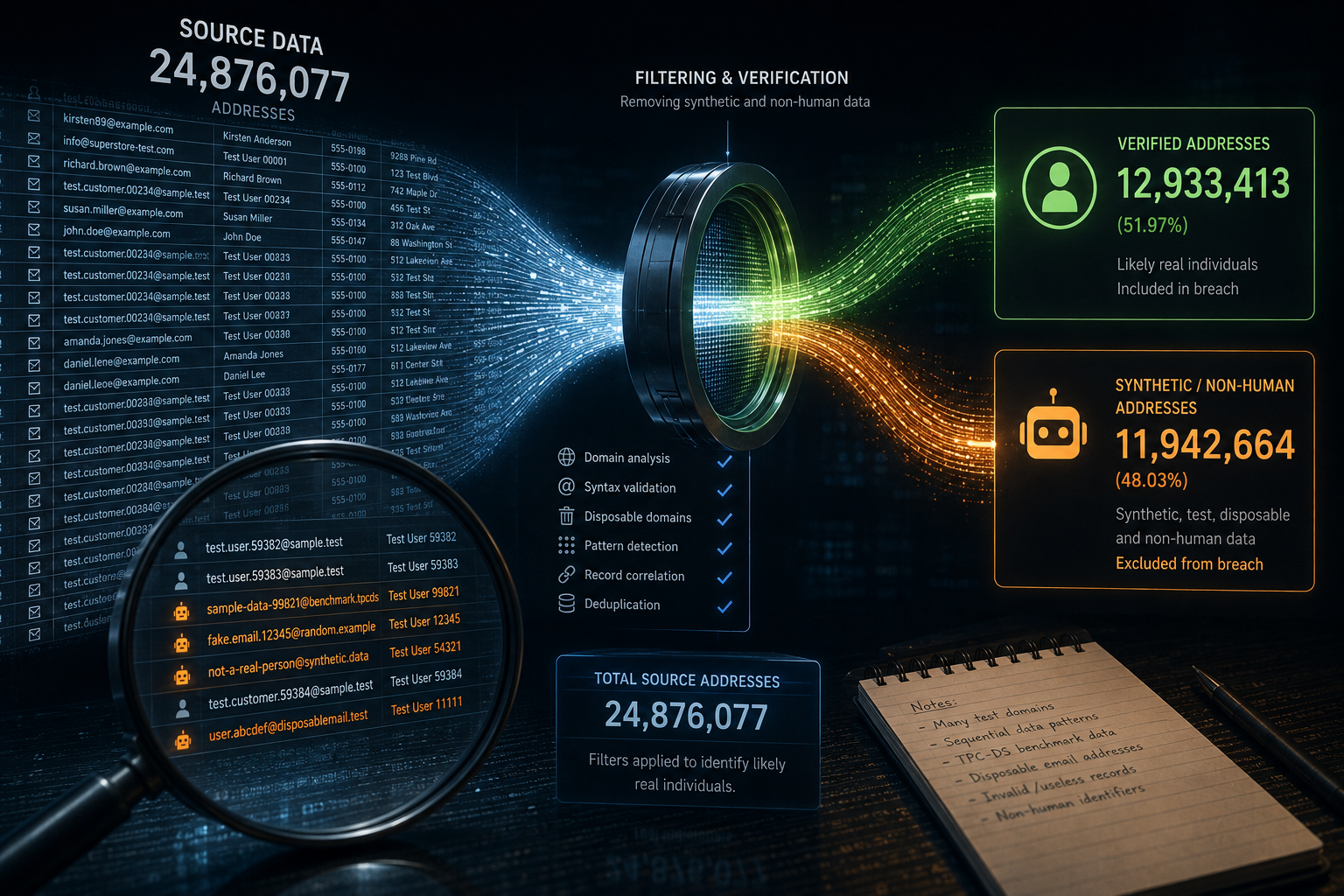
My usual Have I Been Pwned (HIBP) workflow after a breach emerges is to run our open source Email Address Extractor tool over the corpus of data, get a count of the unique addresses then drop it into the processing pipeline. Having a count helps prioritise: it's roughly the same effort to process a breach with 10M addresses in it as it is 100k addresses, but we obviously reach 100x more people with the larger corpus so that goes first. So, following the release of the Carhartt data above, I ran the tool and got 24,876,077 addresses. That's a biggy, let's dive in.

One of the first things I do when analysing a breach is look for news and industry commentary. Once you get through all the results for class actions (ugh), you usually find various other services and news sites reporting on the incident. One such example (which I won't name, because they're wrong) cited a very similar number to my initial pass, which at face value, reinforced my thinking. But here's where it all takes a turn because, inevitably, this is where the other analysts stopped...

I've been using OpenClaw pretty extensively this year to help with a number of tasks, including breach analysis. Here's how I normally begin (timestamps are AEST and yes, I called it "PwnedClaw"):

[24/08/2026 17:30] Troy Hunt: Let's look at the ShinyHunters Carhartt breach. I'm seeing nearly 25M unique email addresses so it's very large, tell me about what they do.
  
[24/08/2026 17:30] PwnedClaw: Carhartt is an American workwear brand founded in 1889, headquartered in Dearborn, Michigan. They make rugged, durable clothing primarily for tradespeople and outdoor workers: heavy-duty jackets, bibs, coveralls, work pants, boots, and accessories. Think construction workers, farmers, hunters.

They've also crossed over into streetwear/fashion in recent years (particularly through Carhartt WIP, their Work In Progress line), which massively expanded their demographic beyond blue-collar workers into urban fashion, skateboarding, and hip-hop culture. That crossover likely explains a 25M email count โ€” they're not just selling to contractors anymore, they're a mainstream lifestyle brand.

Strong US base but significant global presence, especially in Europe where WIP is huge.

For HIBP context: broad demographic mix (blue-collar workers + fashion/streetwear), real names, physical addresses, and purchase history are likely present given it's a retail breach. Want me to pull the tracker entry for current status?

Ok, cool, nothing too revolutionary there. Let's start analysing the data, and the first thing I do is begin with the report of our open source Email Address Extractor tool, which lists every file an address was found in, and then how many unique ones are in there:

[24/08/2026 17:32] Troy Hunt: Let's start looking at data, and we'll begin with the email extractor report at "\scratch\Carhartt\Carhartt.txt.report.txt"
  
[24/08/2026 17:32] PwnedClaw: Interesting. The data is from Databricks (their analytics/data lakehouse platform) and follows the TPC-DS benchmark schema (tpcds_sf1000) โ€” that's a standard retail analytics benchmark format. The "sf1000" means scale factor 1000, which is massive.

Key observations:

โ€ข All emails are in customer_chunk_XXXX.csv files, numbered 0000-0599+, so ~600 chunks
โ€ข Each chunk has ~19,300 unique emails, remarkably uniform distribution
โ€ข ~600 chunks ร— ~19,300 = ~11.6M from this directory alone โ€” but you said ~25M total, so there are likely more directories

The TPC-DS schema is telling โ€” it means this was Carhartt's customer analytics warehouse in Databricks, not their production transactional database. TPC-DS models: customer demographics, store sales, web sales, catalog sales, dates, etc. So the data likely includes purchase history and behavioral analytics on top of PII.

Want me to look at an actual chunk file to see what columns are present?

Think of it as using the AI to distil large volumes of information down into something much more workable. In this case, I gave it four of the files in question and let the analysis run:

[24/08/2026 17:33] PwnedClaw: The columns from the TPC-DS customer table:

โ€ข c_customer_sk / c_customer_id โ€” internal IDs
โ€ข c_current_cdemo_sk โ€” customer demographic key (links to demo table with age/gender/education/marital status/income band)
โ€ข c_current_hdemo_sk โ€” household demographic key
โ€ข c_current_addr_sk โ€” current address key (links to full address table)
โ€ข c_first_shipto_date_sk / c_first_sales_date_sk โ€” date of first purchase/shipment
โ€ข c_salutation โ€” Mr/Mrs/Miss/Sir etc.
โ€ข c_first_name / c_last_name
โ€ข c_preferred_cust_flag โ€” loyalty/preferred customer flag
โ€ข c_birth_day / c_birth_month / c_birth_year โ€” full DOB
โ€ข c_birth_country
โ€ข c_login โ€” empty in the samples
โ€ข c_email_address
โ€ข c_last_review_date_sk / c_last_review_date

So: full name, email, DOB, salutation, birth country, preferred customer status, first purchase date. Address is a foreign key here (in a separate address table that's presumably also in the dump).

Notable: c_login appears empty โ€” so no passwords in this table. DOB is split across three columns which is a bit unusual but all three are there. Birth year goes back to 1949 in the sample, so this spans a wide age range.

Want me to check how many rows have DOB fully populated, and whether there are other tables in the dump (address, demographics) in what you have locally?

I'll save you from all the to-and-fro of my questions and PwnedClaw's responses, here's where it gets interesting and where AI plays a genuinely valuable role:

[24/08/2026 17:41] PwnedClaw: TLD anomaly worth flagging:

โ€ข 4M .edu and 3.9M .org is extremely high for a retail brand. That's likely noise from the TPC-DS synthetic data generation mixed with real records, or it could indicate Carhartt ran promotions targeting institutions. Worth sanity checking a sample of those.

Want me to pull 20 random .edu and .org samples to see if they look real or synthetic?

Huh, yeah, that feels odd. Let's drill down further, and just a quick caveat: I'm highly confident that all the data I'm about to show is fabricated and that I'm not inadvertently putting someone else's PII on display here.

[24/08/2026 17:47] Troy Hunt: Give me some examples of what you consider synthetic addresses
  
[24/08/2026 17:48] PwnedClaw: From the earlier sample:

Clearly synthetic (TPC-DS generated):

โ€ข roy.griffin@mbfhz82d0vkpes4x.edu โ€” random hex-like domain
โ€ข violet.day@ob7.edu โ€” 3-char alphanumeric
โ€ข michael.ware@c.edu โ€” single character domain
โ€ข manuel.baugh@p.edu โ€” single character domain
โ€ข april.garza@r3zc1yf6i2lxfg.edu โ€” random alphanumeric
โ€ข craig.hodge@nrvnrtanujylkigl.edu โ€” random consonant string
โ€ข ted.walker@9q3ulo9h987zp.edu โ€” starts with digit, mixed
โ€ข michelle.larue@lkvb06fkzsjv.org โ€” random alphanumeric
โ€ข joel.maldonado@y8rlxnc.org โ€” short random alphanumeric

The pattern is consistent: real-looking Firstname.Lastname local part (from TPC-DS customer name generation) grafted onto a completely random/gibberish domain. The local parts look plausible but the domains have no vowel patterns, random digit insertion, or are implausibly short (single characters).

The tell: TPC-DS generates customer emails by concatenating real name fields with random domain strings. So you get sally.smith@uea8muo3gx9udizg.edu โ€” Sally Smith is plausible, but no .edu institution has that domain.

Want me to build a filter that identifies synthetic domains specifically (gibberish detection) and get a precise real vs synthetic split?

Oh yeah, that's definitely junk. It was enough for me to start trawling through the data myself, old-school, like I used to, well, before earlier this year! And that's where I found data like this:

c_customer_sk,c_customer_id,c_current_cdemo_sk,c_current_hdemo_sk,c_current_addr_sk,c_first_shipto_date_sk,c_first_sales_date_sk,c_salutation,c_first_name,c_last_name,c_preferred_cust_flag,c_birth_day,c_birth_month,c_birth_year,c_birth_country,c_login,c_email_address,c_last_review_date_sk,c_last_review_date
11270429,AAAAAAAANBJPLKAA,1423814,7001,19788,2451033,2451003,Miss,Marina,Tucker,Y,13,3,1968,BENIN,,Marina.Tucker@xgpgHqAu.com,2452499,2452499

It's the same sort of .edu pattern but not on a .edu TLD. First name, last name, random domain name. And "Benin"?! I'll save you Googling it like I had to, it's a small country in West Africa and if I'm guessing, not a major Carhartt market.

[24/08/2026 17:51] Troy Hunt: Yeah, something smells here, there are screwy domains in addresses like this too: Marina.Tucker@xgpgHqAu.com
  
[24/08/2026 17:52] PwnedClaw: That's a much bigger problem than I initially thought. The frequency analysis confirms it:

โ€ข 54.8% of addresses (13.6M) are at domains appearing 100+ times โ€” these are real
โ€ข 45.2% (11.25M) are at domains appearing fewer than 100 times โ€” and 8.4M of those contain digits

So the synthetic pattern isn't confined to .edu/.org at all โ€” it's throughout .com and everything else too. Marina.Tucker@xgpgHqAu.com is the same TPC-DS generation, just with .com slapped on.

The 32% figure I gave you earlier was a significant undercount. The real split looks closer to:

โ€ข ~13.6M real addresses (domains with 100+ occurrences)
โ€ข ~11.25M synthetic (single-use gibberish domains across all TLDs)

That's roughly 45% junk across the whole corpus, not 32%.

For HIBP the headline number would be around 13-14M rather than 24.8M. Want me to produce a clean filtered list of just the real addresses for an accurate count?

And the more I probed, the more it all unravelled:

[24/08/2026 17:53] Troy Hunt: I want you to get a distinct list of all domains with a count next to each one showing how many addresses are on it. This is starting to smell bad.
  
[24/08/2026 17:54] PwnedClaw: Done. 10.35M unique domains written to:

scratch/Carhartt/domain-counts.txt

Format is countdomain, sorted by count descending. So the top of the file is gmail.com (http://gmail.com/) at 7M+, and the long tail is all the single-occurrence gibberish. Your HIBP domain dataset should make it very obvious where the cliff edge is between known-real and never-seen-before.
  
[24/08/2026 17:58] Troy Hunt: There's an extraordinary long tail of domains with only 1 address. Also look at the country of birth next to the add addresses; places like Myanmar, Latvia and PNG are just really odd in terms of likelihood.
  
[24/08/2026 17:58] PwnedClaw: That country distribution is damning. Here's what's wrong with it:

97.6% of domains appear exactly once โ€” that's not a long tail, that's a signature. Real breach data from a retail company would have thousands of addresses on corporate domains, hundreds on ISP domains, a natural power law. Instead you have 10.1M singleton domains. That's pure TPC-DS generation.

The birth country data is the other nail in the coffin. Look at what's in those 4 chunk files:

โ€ข Venezuela, Nicaragua, Qatar, Montenegro, Lesotho, Gambia, Norfolks Island, Rรฉunion, Comoros, Western Sahara, Palau...
โ€ข United States appears only 407 times โ€” tied with Canada, both dwarfed by places like Antigua and Barbuda and Lesotho
โ€ข The distribution across 211 countries is essentially uniform โ€” ~380-420 per country

That's textbook TPC-DS. It generates customer records with birth countries sampled uniformly from the full ISO country list. No real Carhartt customer database would have more customers born in Montenegro than the United States.

Bottom line: What you have here looks like real Carhartt customer records (the carharttdonotship.com, carhartt.com domains, the 70% HIBP hit rate on freemail addresses) that were stored in Databricks alongside TPC-DS benchmark data that was run against the same schema. ShinyHunters grabbed the whole Databricks dump without distinguishing real customer data from the benchmark test data sitting in the same tables.

The real customer data is in there, but it's heavily contaminated with synthetic TPC-DS records. Your domain frequency analysis from HIBP will be the cleanest way to separate them.

Annoying AI sentence structure aside ("that's not [one thing], that's [this other thing]"), this is just gold. And PwnedClaw gives ShinyHunters a bit of a free pass too: these guys just grabbed and published everything without realising there was a bunch of synthetic data in there. But there's one more smoking gun:

[24/08/2026 18:02] Troy Hunt: Also look at the distribution of birth year - there are way too many people with early 1900's entries, got any stats on that?
  
[24/08/2026 18:03] PwnedClaw: Birth year stats are conclusive. The distribution runs 1924-1992 and is perfectly flat โ€” roughly 1,050-1,194 per year, every single year without exception. That's not population data, that's a random number generator with a fixed range.

A real Carhartt customer base would be heavily weighted 1965-1995, almost nothing pre-1950, and the pre-1924/post-1992 cutoffs wouldn't exist at all. Instead you get mathematically uniform coverage of 69 years. TPC-DS again.

Here's the full picture of what we now have as synthetic indicators โ€” every single one points the same direction:

| Signal                        | Finding                                                          |
| ----------------------------- | ---------------------------------------------------------------- |
| Domain singletons             | 97.6% of domains appear exactly once                             |
| Synthetic TLDs                | 32% of addresses on .edu/.org with gibberish domains             |
| Gibberish .com domains        | e.g. Marina.Tucker@xgpgHqAu.com                                  |
| Firstname.Lastname pattern    | 50.4% โ€” should be ~10-15% in real retail data                    |
| Birth country distribution    | Perfectly uniform across all 211 ISO countries, US = 407 records |
| Birth year distribution       | Perfectly flat 1924-1992, ~1,100/year                            |
| carharttdonotship.com         | Proves real Carhartt data IS present                             |
| 70% HIBP hit rate on freemail | Proves real records are mixed in                                 |

The conclusion is pretty solid: this is a real Carhartt Databricks breach, but the TPC-DS benchmark data was co-located in the same schema and ShinyHunters (and every aggregator after them) grabbed it all without knowing what they were looking at.

It would have been so easy just to dump this all into HIBP, put out social posts with a big headline number and be done with it, but it'd also be completely wrong. And here's what's really worrying about watching other people do exactly this: headline numbers get misrepresented, victim organisations are unfairly reported on (news headlines with the HIBP number often follow quickly), I run the risk of attracting the ire of the company for inaccurate reporting, and the whole thing just becomes a mess.

So, was Carhartt actually breached, and did ShinyHunters fabricate the data?

Almost certainly "yes" and then, almost certainly "no", and both positions are supported by previous ShinyHunters form. These guys are approaching 100 breaches sitting on their Tor site (all of which I've reviewed), and I'm yet to see a single one with data they've fabricated. These guys have a track record of successfully gaining access to large orgs and dumping data that genuinely came from the claimed origin. Not to trivialise their criminal extortion campaigns, but misrepresenting the scope of their activities would be bad for business in the same way that not following through on threats and dumping data when they don't get payment would be. This presents an alternate theory PwnedClaw has already touched on: Carhartt simply had a bunch of test data sitting in their Databricks instance.

Going back to the output of our tool, here are the largest files which we now know have junk data in them:

Unique addresses per file:
\shouldve_paid_the_ransom_carhartt_shinyhunters\databricks\databricks_dump\tables\samples\tpcds_sf1000\customer_chunk_0309.csv: 19,402
\shouldve_paid_the_ransom_carhartt_shinyhunters\databricks\databricks_dump\tables\samples\tpcds_sf1000\customer_chunk_0589.csv: 19,372
\shouldve_paid_the_ransom_carhartt_shinyhunters\databricks\databricks_dump\tables\samples\tpcds_sf1000\customer_chunk_0568.csv: 19,362
\shouldve_paid_the_ransom_carhartt_shinyhunters\databricks\databricks_dump\tables\samples\tpcds_sf1000\customer_chunk_0460.csv: 19,360
\shouldve_paid_the_ransom_carhartt_shinyhunters\databricks\databricks_dump\tables\samples\tpcds_sf1000\customer_chunk_0263.csv: 19,358
\shouldve_paid_the_ransom_carhartt_shinyhunters\databricks\databricks_dump\tables\samples\tpcds_sf1000\customer_chunk_0584.csv: 19,358
\shouldve_paid_the_ransom_carhartt_shinyhunters\databricks\databricks_dump\tables\samples\tpcds_sf1000\customer_chunk_0350.csv: 19,357
\shouldve_paid_the_ransom_carhartt_shinyhunters\databricks\databricks_dump\tables\samples\tpcds_sf1000\customer_chunk_0264.csv: 19,356
\shouldve_paid_the_ransom_carhartt_shinyhunters\databricks\databricks_dump\tables\samples\tpcds_sf1000\customer_chunk_0278.csv: 19,356

There were 600 of these files, then another 1,200 files with similar data in this common path:

C:\ShinyHunters\shouldve_paid_the_ransom_carhartt_shinyhunters\shouldve_paid_the_ransom_carhartt_shinyhunters\databricks\databricks_dump\20260801_033207\samples\tpcds_sf1000\customer\chunk_0116.csv: 9,689
C:\ShinyHunters\shouldve_paid_the_ransom_carhartt_shinyhunters\shouldve_paid_the_ransom_carhartt_shinyhunters\databricks\databricks_dump\20260801_033207\samples\tpcds_sf1000\customer\chunk_0921.csv: 9,689
C:\ShinyHunters\shouldve_paid_the_ransom_carhartt_shinyhunters\shouldve_paid_the_ransom_carhartt_shinyhunters\databricks\databricks_dump\20260801_033207\samples\tpcds_sf1000\customer\chunk_1172.csv: 9,689
C:\ShinyHunters\shouldve_paid_the_ransom_carhartt_shinyhunters\shouldve_paid_the_ransom_carhartt_shinyhunters\databricks\databricks_dump\20260801_033207\samples\tpcds_sf1000\customer\chunk_0529.csv: 9,688
C:\ShinyHunters\shouldve_paid_the_ransom_carhartt_shinyhunters\shouldve_paid_the_ransom_carhartt_shinyhunters\databricks\databricks_dump\20260801_033207\samples\tpcds_sf1000\customer\chunk_0054.csv

Once excluded, the unique address count plummeted to just 13,306,258 results. That's a 47% drop from the 24M+ number we started at... and it's still too high.

I always eyeball the distinct list of email addresses after they're exported by our tooling. Call me old-fashioned, but I still reckon there are things I'll see with my experienced human eyes that the AI will miss (at least, for now). And it missed these:

[25/08/2026 08:47] Troy Hunt: Back on Carhartt, we have a lot of instances like these where the same alias appears across 3 different versions of the domain. I'm writing this up in a blog post, help me explain to the readers what's going on here and why it's inflating the numbers:

[unique alias]@carhartt.com
[unique alias]@carhartt.mail.onmicrosoft.com
[unique alias]@carhartt.onmicrosoft.com

  [25/08/2026 08:47] PwnedClaw: When someone creates an email account at a company like Carhartt, Microsoft 365 (which Carhartt uses for email) automatically creates the mailbox under multiple domain identities simultaneously:

โ€ข carhartt.com (http://carhartt.com/) โ€” the primary, human-facing domain (the one you'd put on a business card)
โ€ข carhartt.onmicrosoft.com (http://carhartt.onmicrosoft.com/) โ€” Microsoft's default domain, automatically assigned to every Microsoft 365 tenant, exists whether you want it or not
โ€ข carhartt.mail.onmicrosoft.com (http://carhartt.mail.onmicrosoft.com/) โ€” a routing domain Microsoft uses internally for mail flow

All three resolve to the exact same person, the same inbox, the same [unique alias]. It's not three people โ€” it's one person with three email addresses that all deliver to the same place.

The inflation problem: when a breach dataset is exported or scraped, all three variants can appear as distinct rows because technically they are distinct email addresses, even though they represent a single individual. A naive deduplication (or none at all) counts [unique alias] three times instead of once.

The fix HIBP applies is normalising to the primary domain and deduplicating on that โ€” but it requires knowing which domains are Microsoft routing aliases, which isn't always obvious, and the breach data doesn't label them as such.

I've previously removed these manually by regex'ing them out myself, but let's not repeat laborious tasks that can be automated away:

[25/08/2026 15:39] Troy Hunt: Cool, delete all those from the file at "\scratch\Carhartt\Carhartt.txt" and we'll keep refining that until it's better sanitised. Tell me how many rows you remove as well.
  
[25/08/2026 15:39] PwnedClaw: Done. Removed 5,736 rows, down from 13,306,258 to 13,300,522.

Continuing the eyeballing work, another pattern emerges:

[25/08/2026 15:41] Troy Hunt: I'm seeing a lot of addresses that begin with "deactivate-". How many are there and what can you tell me about this pattern?
  
[25/08/2026 15:41] PwnedClaw: 288,982 of them. The pattern is clear: these are accounts that were deactivated in Carhartt's system (likely an e-commerce platform or loyalty/membership system), where instead of deleting the record, they prefixed the email address with deactivate- to mark it as inactive while preserving the row. It's a common soft-delete pattern โ€” keeps the data for audit/history purposes but flags the account as no longer active.

The implications for HIBP:

โ€ข These are real email addresses that no longer exist in that form โ€” deactivate-[unique alias]@carhartt.com is not a deliverable address
โ€ข The real person's address is just [unique alias]@carhartt.com, which may already appear separately in the breach data
โ€ข Notifying deactivate-* addresses would bounce or go nowhere

Worth removing them, but worth checking first how many have a corresponding non-deactivated version in the file โ€” if most do, they're pure duplicates and safe to drop. Want me to check that?
  
[25/08/2026 15:42] Troy Hunt: How many already appear without that prefix?
  
[25/08/2026 15:42] PwnedClaw: 285,808 of the 288,982 already have a non-prefixed version in the file โ€” that's 99% pure duplicates. Only ~3,174 appear exclusively as deactivate- with no corresponding active address.
[25/08/2026 15:43] Troy Hunt: Delete all the "deactivate-" prefixed addresses with corresponding active addresses, remove the prefix from the other ones and give me a new total count.
[25/08/2026 15:43] PwnedClaw: Done. Removed 285,808 rows, renamed 3,174 rows, new total: 13,014,714.

That's enough of human eyes, what else have we got?

[25/08/2026 15:50] Troy Hunt: Review the remaining addresses - are there any remaining unusual patterns that frequently occurs? Small issues here and there don't matter, anything in the thousands or more?

[25/08/2026 15:50] PwnedClaw: Two stand out:

wctest.com โ€” 48,787 rows
Looks like a test domain used during development or QA. Not real customers.

carharttdonotship.com โ€” 32,514 rows
The domain name says it all โ€” this appears to be Carhartt's internal domain for flagging accounts they won't ship to (fraud, chargebacks, banned customers). Real people possibly, but deliberately excluded from Carhartt's operations and almost certainly not expecting breach notifications from their banned account email.

Everything else looks like normal consumer email providers. Want to remove either or both of those?

[25/08/2026 15:53] Troy Hunt: They also all seem to have "perftest" in the alias. Delete all these addresses.

[25/08/2026 15:53] PwnedClaw: Done. Removed 48,787 rows, new total: 12,965,927.

[25/08/2026 15:54] Troy Hunt: And the carharttdonotship.com  addresses also have "perftest" in the aliases so let's drop all those too and give me a total remaining count.

[25/08/2026 15:54] PwnedClaw: Done. Removed 32,514 rows, new total: 12,933,413.

Not quite the 24M+ headline any more, that's almost half the addresses in the original corpus discarded because they don't represent actual people. Whilst nothing empirically bad would have happened if I'd loaded them all, the incident would have looked twice as bad as what it actually is (based on the raw numbers, at least), and when I later put out a tweet like this, the percentage of pre-existing addresses would have read way too low:

New breach: Carhartt was the target of a ShinyHunters extortion campaign earlier this month. Data allegedly obtained from the company was later published, including 12.9M unique email addresses. 83% were already in @haveibeenpwned. Read more: https://t.co/Nfs0LT2Qto

โ€” Have I Been Pwned (@haveibeenpwned) August 25, 2026

But let's do one more AI-assisted sanity check, and I'm tending to ask this on each and every breach I process now:

[25/08/2026 16:01] Troy Hunt: Based on the remaining email addresses alone, what can you see that gives you confidence this came from Carhartt? Explain with examples and equally, explain if there's any data that *disproves* Carhartt as the origin.
  
[25/08/2026 16:01] PwnedClaw: Here's what the email addresses alone tell us:

Evidence FOR Carhartt as the origin:

โ€ข 15,057 @carhartt.com employee addresses โ€” internal staff addresses don't end up in a dataset unless it came from Carhartt's own systems. You don't scrape these from the outside.
โ€ข Hash-prefixed internal aliases like 004cab9722d948ae956d10ce31e7ed74[unique alias]@carhartt.com โ€” that 32-character hex prefix before the surname is clearly a system-generated internal identifier, the kind of thing a CRM or e-commerce platform creates internally. Completely invisible externally.
โ€ข carharttdonotship.com (now removed) โ€” a domain that only makes sense if you're inside Carhartt's order management system. No external actor would know this domain exists, let alone have thousands of records under it.
โ€ข wctest.com perftest data (now removed) โ€” performance test data from what appears to be Carhartt's own WooCommerce implementation. Again, only accessible internally.
โ€ข Demographically consistent โ€” overwhelmingly US consumer email providers (Gmail, Yahoo, Hotmail, AOL, Comcast, sbcglobal, att.net (http://att.net/), verizon.net (http://verizon.net/)). Carhartt is a US workwear brand with a predominantly American customer base. The mix matches perfectly.

Evidence AGAINST Carhartt as the sole/direct origin:

โ€ข [unique alias]@state.mn.us โ€” a government employee address. Plausible as a real Carhartt customer, but worth noting government addresses appearing in retail breach data is slightly unusual.
โ€ข The sheer volume (12.9M) is large for a workwear retailer โ€” possible the data aggregates multiple systems or years of records, or includes data from third-party partners like Ticketmaster-style fulfilment services.

Overall the internal markers (employee addresses, hash aliases, internal test domains) are the smoking guns โ€” those simply cannot come from anywhere other than Carhartt's own systems.
  
[25/08/2026 16:14] Troy Hunt: Acknowledging the cases "for" and agreeing, I want to challenge both cases "against":

Gov email addresses are *always* in data breaches. Even Ashley Madison (and similar).

My wife tells me that Carhartt is not solely considered a "workwear retailer" and produces products that are worn well beyond just the building site. Review their website and see if your analysis needs revision: https://www.carhartt.com/
  
[25/08/2026 16:14] PwnedClaw: Withdrawn. 12.9M records is entirely plausible for Carhartt โ€” they're a 130-year-old brand with massive mainstream appeal well beyond workwear. Streetwear culture adopted Carhartt heavily in the 90s and it's remained a genuine lifestyle brand since. The volume is consistent with a large, broad consumer base accumulated over many years of e-commerce. That objection doesn't hold up.

Of course, anything AI says needs to be validated and in the cases above, that had already been done. I've included that transcript here anyway just to illustrate the due diligence involved in properly validating data, not just picking it up and chucking it in with a massive headline figure. But it does massively accelerate activities that were previously very manual:

[26/08/2026 05:40] Troy Hunt: Looking at the final list of email addresses, what do the sub-addresses tell us about the origin?
  
[26/08/2026 05:40] PwnedClaw: The sub-addresses are a goldmine for provenance. The dominant signal is clear:

1,072 +carhartt โ€” people who tagged their address specifically when signing up at Carhartt. This is the single biggest tag and is an unambiguous origin marker. Combined with the typo variants (+carhart ร—35, +carharrt ร—14, +carhatt ร—6, +carthartt ร—4, +carh ร—12) you've got ~1,150+ people who fingerprinted their Carhartt signup specifically.

+paypal ร—112, +pp ร—10, +applepay ร—8` โ€” people who used PayPal/Apple Pay to check out at Carhartt, and tagged the email to that payment method. Strongly confirms this is a shopping/ecommerce dataset.

+shopping ร—28, +shop ร—15, +orders ร—9, +receipts ร—4, +retail ร—3` โ€” generic purchase-tracking tags, consistent with an online store.

+www.carhartt.com ร—8, +carhartt.com ร—8` โ€” people who tagged the full domain. Explicit.

+apple ร—13` โ€” likely Sign in with Apple or Apple Pay checkout.

The picture is unambiguous: this is a legitimate Carhartt customer/order database, not a compiled list or credential stuffing corpus. People sub-addressed their emails at the point of purchase. That's about as strong a provenance signal as you can get.

And so on and so forth. I don't need to labour the point with more examples, but let me come back around to the premise of this post: take headline numbers with a grain of salt unless you're confident in the processes of those making the claims. I'm fond of saying that whenever there are misleading statements made about breaches, "the truth is in the data", but you have to be willing to go and seek that truth out, even if it requires a significant investment in time.

  •  

Weekly Update 518: IoT Doorlock Nirvana with UniFi

Weekly Update 518: IoT Doorlock Nirvana with UniFi

I genuinely think I've nailed the IoT door lock situation! Well, Ubiquiti has, but I think I've worked out how to put it all into a residential house and have it make sense. There are a few basic tenets:

  1. Main power (never have to rely on batteries)
  2. Fail-secure (needs to remain locked on power outage)
  3. Local control (no cloud latency to contend with)
  4. Manual override ("the house is on fire, let me out")

Which is exactly what we have here in this week's vid (and sorry about the section of rubbish audio; the camera mic started capturing it for a short period there). There are some edge cases I want to validate the impact of, namely the inability to keep the door both closed and unlocked, and some of the assumptions I've made around access methods. The laundry will be our low-impact test case; then, if that's all good, I'll start rolling this approach out much more seriously across the house. Stay tuned, I think this will actually be pretty awesome.

Weekly Update 518: IoT Doorlock Nirvana with UniFi
  •  

Welcoming the Sri Lankan Government to Have I Been Pwned

Welcoming the Sri Lankan Government to Have I Been Pwned

Today, we welcome the 48th government onboarded to Have I Been Pwnedโ€™s free gov service: Sri Lanka. Sri Lanka CERT now has access to monitor Sri Lankan government domains against the data in HIBP, helping identify exposed government accounts and respond when they appear in new data breaches.

As with the other governments already using the service, this is about using breach data for good: giving national cyber teams practical visibility into their public sector exposure and supporting their work to protect government services.

  •  

Weekly Update 517: Cyber Ransoms

Weekly Update 517: Cyber Ransoms

The current ransomware situation is a bit of a kludge (deep breath): a lot of ransomware (which often doesn't even involve "ware", it's just extortion) is carried out by kids who successfully make a truckload of money but can't spend it without getting caught and the companies they breach rapidly get piled onto by class action lawyers that keeps them busy fighting and being cautious not to say anyting to customers lest that then gets used against them in litigation. That's mostly it; more in this week's video:

Weekly Update 517: Cyber Ransoms
  •  

Weekly Update 516: Live From Vietnam

Weekly Update 516: Live From Vietnam

A little wind noise, a little connectivity flakiness, and a little lip-sync issues from YouTube, but look at that view! ๐Ÿคฉ Back to business, it's the Brinks Home FAQ I found most interesting this week. I mean, how do you write your own FAQ then fail to actually answer most of the questions?! Being conscious that they're the target of criminal extortion and are genuinely the victims here, I still struggle to grasp how simple incident response questions can be so lawyer-speaked as to remove all sensible meaning from the responses. But this is how these things tend to play out these days (speaking generically, yet to be seen fully for Brinks): hacker gets data by just calling up and asking for it (vishing -> OAuth), hacker demands money, hacker gets no money so dumps the data, company gets a gazillion class actions overnight and lawyers up to the hilt, customers get notified "where legally required" (which it usually isn't) ๐Ÿคทโ€โ™‚๏ธ

Weekly Update 516: Live From Vietnam
  •  
โŒ