
Normal view

Lessons Learned from CISA’s Recent GitHub Leak

13 July 2026 at 15:03

The Cybersecurity and Infrastructure Security Agency (CISA) has issued a postmortem on a recent data leak in which a contractor published dozens of internal CISA credentials — including AWS Govcloud keys — in a public GitHub repository for almost six months before being notified by KrebsOnSecurity. Experts say the gaps identified in the agency’s initial response provide important lessons that all security teams should absorb.

On May 15, 2026, the security firm GitGuardian asked for help in notifying CISA about the existence of a public GitHub repository called “Private CISA” that included 844 MB of sensitive CISA-related data. One of the exposed files, titled “importantAWStokens,” included the administrative credentials to three Amazon AWS GovCloud servers. Another file — “AWS-Workspace-Firefox-Passwords.csv” — listed plaintext usernames and passwords for dozens of internal CISA systems.

CISA quickly acknowledged our initial alert, but took more than 48 hours to invalidate the AWS keys and many other important secrets leaked in the GitHub repo. In its report on the data leak, CISA said the complexities of the agency’s systems and interconnections with federal and industry partners caused its key rotation to take longer than anticipated.

“Drawing on this experience, CISA encourages others to maintain mature and well-tested key management capabilities,” the report notes.

CISA also admitted it can do better when it comes to responding to security incident notifications from external parties. The postmortem stresses that clear and distinct reporting channels are essential to ensure that incidents affecting the organization itself are handled differently from those involving its products or customers.

“In CISA’s case, these channels were not well defined, leading the security researcher to try multiple avenues – including emailing the contractor, submitting through CISA’s vulnerability disclosure platform (which is intended for vulnerabilities impacting the broader cybersecurity community), and ultimately involving a reporter,” reads the analysis written by Preston Werntz and Brad Libbey, the acting chief information officer and acting chief information security officer at CISA, respectively.

CISA said it is refining its reporting channels to make them easier and faster for researchers. “Additionally, while many researchers rely on the security.txt file, organizations can ensure clarity by publishing reporting instructions in multiple prominent locations,” the CISA authors wrote.

Guillaume Valadon, the GitGuardian researcher who first contacted KrebsOnSecurity about the exposed CISA credentials, said CISA ignored nine automated alerts about the exposed credentials prior to our notification on May 15. Valadon’s company constantly scans public code repositories at GitHub and elsewhere for exposed secrets, automatically alerting the offending accounts of any apparent sensitive data exposures.

“Letting nine notification emails go unanswered is how a one-day incident becomes a six-month exposure,” Valadon wrote in an analysis of CISA’s report. “Make it trivial to report a leak about you, not just about your products. The person reporting a leak to you is not the threat. Publish a security.txt, but do not stop there. Put reporting instructions in several prominent places, and make sure a report about your own infrastructure does not land in a product-bug queue.”

The report’s authors also emphasized the importance of continuously scanning public code repositories like GitHub for exposed secrets, and said CISA has since rotated all secrets and created an action plan to improve management of developer secrets and to better monitor for them going forward.

The report notes that while CISA had developed a playbook for responding to cybersecurity incidents, that playbook somehow didn’t include what to do in situations involving GitHub or other cloud services. Valadon said the report validates the need to scan continuously — not just quarterly — for exposed secrets.

“The Private-CISA repository sat public for six months,” Valadon wrote. “Continuous monitoring of public GitHub surfaced it. Comprehensive internal scanning could have caught the plaintext passwords and committed backups long before they left the building.”

CISA gave itself passing grades on several areas of security preparedness that it said helped the agency gauge the scope and impact of the exposed secrets, including enhanced logging capabilities, and the adoption of zero-trust principles in both its production and development systems. CISA said those detailed logs allowed it to show that no customer or mission data was exposed, and that the leaked credentials were not used outside of CISA’s environments. The agency said the contractor who exposed the secrets had their system access revoked.

Valadon reckons the biggest takeaway is the CISA postmortem itself, and praised the agency for being transparent about what worked and what didn’t.

“To my knowledge, it is also the first time a national cybersecurity agency has publicly advocated for secrets scanning and for simplifying relations with security researchers,” Valadon wrote. “That is exactly the incident communication we should expect from every organization.”
CISA Admin Leaked AWS GovCloud Keys on Github

18 May 2026 at 20:48

Until this past weekend, a contractor for the Cybersecurity & Infrastructure Security Agency (CISA) maintained a public GitHub repository that exposed credentials to several highly privileged AWS GovCloud accounts and a large number of internal CISA systems. Security experts said the public archive included files detailing how CISA builds, tests and deploys software internally, and that it represents one of the most egregious government data leaks in recent history.

On May 15, KrebsOnSecurity heard from Guillaume Valadon, a researcher with the security firm GitGuardian. Valadon’s company constantly scans public code repositories at GitHub and elsewhere for exposed secrets, automatically alerting the offending accounts of any apparent sensitive data exposures. Valadon said he reached out because the owner in this case wasn’t responding and the information exposed was highly sensitive.

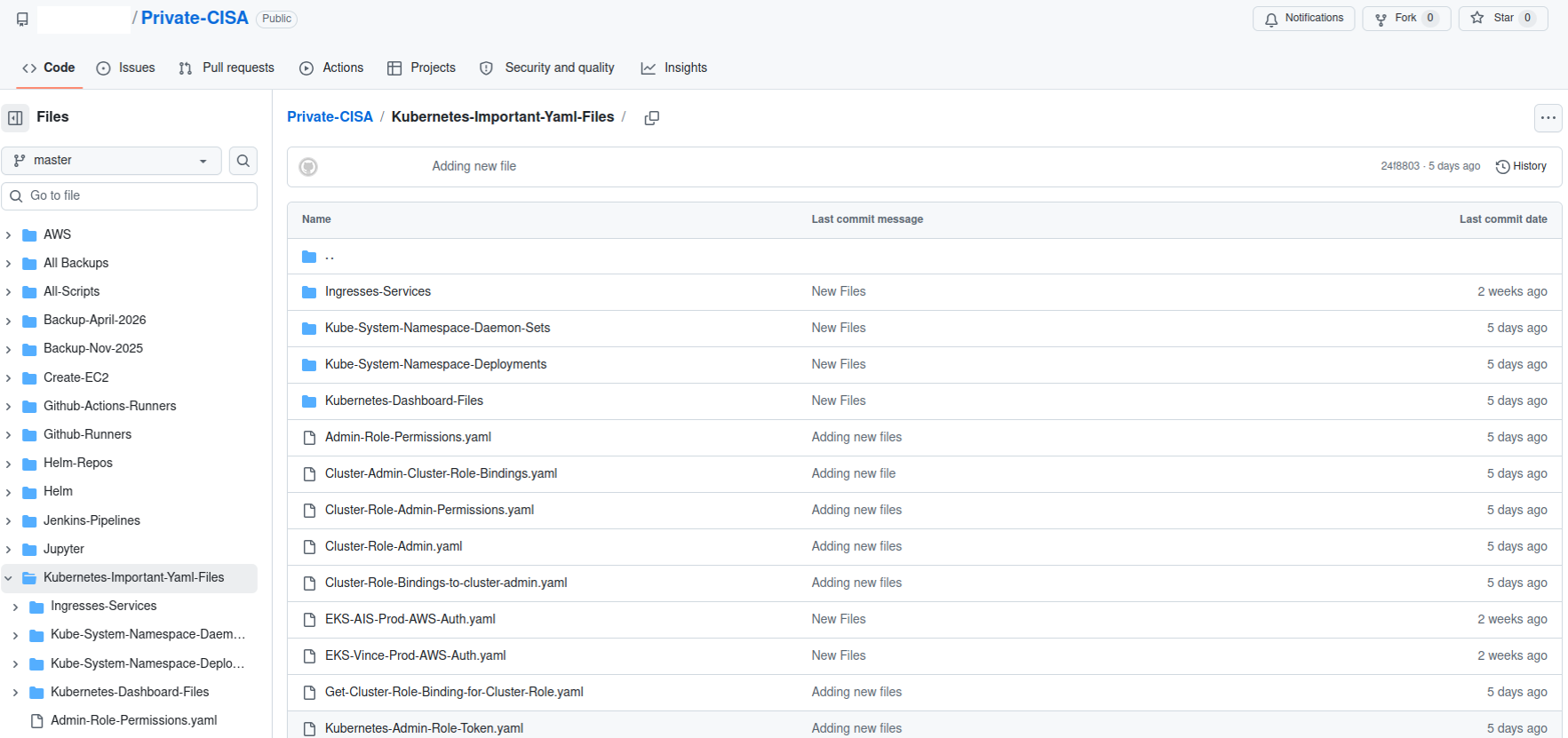
A redacted screenshot of the now-defunct “Private CISA” repository maintained by a CISA contractor.

The GitHub repository that Valadon flagged was named “Private-CISA,” and it harbored a vast number of internal CISA/DHS credentials and files, including cloud keys, tokens, plaintext passwords, logs and other sensitive CISA assets.

Valadon said the exposed CISA credentials represent a textbook example of poor security hygiene, noting that the commit logs in the offending GitHub account show that the CISA administrator disabled the default setting in GitHub that blocks users from publishing SSH keys or other secrets in public code repositories.

“Passwords stored in plain text in a csv, backups in git, explicit commands to disable GitHub secrets detection feature,” Valadon wrote in an email. “I honestly believed that it was all fake before analyzing the content deeper. This is indeed the worst leak that I’ve witnessed in my career. It is obviously an individual’s mistake, but I believe that it might reveal internal practices.”

One of the exposed files, titled “importantAWStokens,” included the administrative credentials to three Amazon AWS GovCloud servers. Another file exposed in their public GitHub repository — “AWS-Workspace-Firefox-Passwords.csv” — listed plaintext usernames and passwords for dozens of internal CISA systems. According to Caturegli, those systems included one called “LZ-DSO,” which appears short for “Landing Zone DevSecOps,” the agency’s secure code development environment.

Philippe Caturegli, founder of the security consultancy Seralys, said he tested the AWS keys only to see whether they were still valid and to determine which internal systems the exposed accounts could access. Caturegli said the GitHub account that exposed the CISA secrets exhibits a pattern consistent with an individual operator using the repository as a working scratchpad or synchronization mechanism rather than a curated project repository.

“The use of both a CISA-associated email address and a personal email address suggests the repository may have been used across differently configured environments,” Caturegli observed. “The available Git metadata alone does not prove which endpoint or device was used.”

The Private CISA GitHub repo exposed dozens of plaintext credentials for important CISA GovCloud resources.

Caturegli said he validated that the exposed credentials could authenticate to three AWS GovCloud accounts at a high privilege level. He said the archive also includes plain text credentials to CISA’s internal “artifactory” — essentially a repository of all the code packages they are using to build software — and that this would represent a juicy target for malicious attackers looking for ways to maintain a persistent foothold in CISA systems.

“That would be a prime place to move laterally,” he said. “Backdoor in some software packages, and every time they build something new they deploy your backdoor left and right.”

In response to questions, a spokesperson for CISA said the agency is aware of the reported exposure and is continuing to investigate the situation.

“Currently, there is no indication that any sensitive data was compromised as a result of this incident,” the CISA spokesperson wrote. “While we hold our team members to the highest standards of integrity and operational awareness, we are working to ensure additional safeguards are implemented to prevent future occurrences.”

A review of the GitHub account and its exposed passwords show the “Private CISA” repository was maintained by an employee of Nightwing, a government contractor based in Dulles, Va. Nightwing declined to comment, directing inquiries to CISA.

CISA has not responded to questions about the potential duration of the data exposure, but Caturegli said the Private CISA repository was created on November 13, 2025. The contractor’s GitHub account was created back in September 2018.

The GitHub account that included the Private CISA repo was taken offline shortly after both KrebsOnSecurity and Seralys notified CISA about the exposure. But Caturegli said the exposed AWS keys inexplicably continued to remain valid for another 48 hours.

CISA is currently operating with only a fraction of its normal budget and staffing levels. The agency has lost nearly a third of its workforce since the beginning of the second Trump administration, which forced a series of early retirements, buyouts, and resignations across the agency’s various divisions.

The now-defunct Private CISA repo showed the contractor also used easily-guessed passwords for a number of internal resources; for example, many of the credentials used a password consisting of each platform’s name followed by the current year. Caturegli said such practices would constitute a serious security threat for any organization even if those credentials were never exposed externally, noting that threat actors often use key credentials exposed on the internal network to expand their reach after establishing initial access to a targeted system.

“What I suspect happened is [the CISA contractor] was using this GitHub to synchronize files between a work laptop and a home computer, because he has regularly committed to this repo since November 2025,” Caturegli said. “This would be an embarrassing leak for any company, but it’s even more so in this case because it’s CISA.”

❌