 Login
Login


Microsoft today pushed updates to fix at least 56 security flaws in its Windows operating systems and supported software. This final Patch Tuesday of 2025 tackles one zero-day bug that is already being exploited, as well as two publicly disclosed vulnerabilities.
Despite releasing a lower-than-normal number of security updates these past few months, Microsoft patched a whopping 1,129 vulnerabilities in 2025, an 11.9% increase from 2024. According to Satnam Narang at Tenable, this year marks the second consecutive year that Microsoft patched over one thousand vulnerabilities, and the third time it has done so since its inception.
The zero-day flaw patched today is CVE-2025-62221, a privilege escalation vulnerability affecting Windows 10 and later editions. The weakness resides in a component called the “Windows Cloud Files Mini Filter Driver” — a system driver that enables cloud applications to access file system functionalities.
“This is particularly concerning, as the mini filter is integral to services like OneDrive, Google Drive, and iCloud, and remains a core Windows component, even if none of those apps were installed,” said Adam Barnett, lead software engineer at Rapid7.
Only three of the flaws patched today earned Microsoft’s most-dire “critical” rating: Both CVE-2025-62554 and CVE-2025-62557 involve Microsoft Office, and both can exploited merely by viewing a booby-trapped email message in the Preview Pane. Another critical bug — CVE-2025-62562 — involves Microsoft Outlook, although Redmond says the Preview Pane is not an attack vector with this one.
But according to Microsoft, the vulnerabilities most likely to be exploited from this month’s patch batch are other (non-critical) privilege escalation bugs, including:
–CVE-2025-62458 — Win32k
–CVE-2025-62470 — Windows Common Log File System Driver
–CVE-2025-62472 — Windows Remote Access Connection Manager
–CVE-2025-59516 — Windows Storage VSP Driver
–CVE-2025-59517 — Windows Storage VSP Driver
Kev Breen, senior director of threat research at Immersive, said privilege escalation flaws are observed in almost every incident involving host compromises.
“We don’t know why Microsoft has marked these specifically as more likely, but the majority of these components have historically been exploited in the wild or have enough technical detail on previous CVEs that it would be easier for threat actors to weaponize these,” Breen said. “Either way, while not actively being exploited, these should be patched sooner rather than later.”
One of the more interesting vulnerabilities patched this month is CVE-2025-64671, a remote code execution flaw in the Github Copilot Plugin for Jetbrains AI-based coding assistant that is used by Microsoft and GitHub. Breen said this flaw would allow attackers to execute arbitrary code by tricking the large language model (LLM) into running commands that bypass the user’s “auto-approve” settings.
CVE-2025-64671 is part of a broader, more systemic security crisis that security researcher Ari Marzuk has branded IDEsaster (IDE stands for “integrated development environment”), which encompasses more than 30 separate vulnerabilities reported in nearly a dozen market-leading AI coding platforms, including Cursor, Windsurf, Gemini CLI, and Claude Code.
The other publicly-disclosed vulnerability patched today is CVE-2025-54100, a remote code execution bug in Windows Powershell on Windows Server 2008 and later that allows an unauthenticated attacker to run code in the security context of the user.
For anyone seeking a more granular breakdown of the security updates Microsoft pushed today, check out the roundup at the SANS Internet Storm Center. As always, please leave a note in the comments if you experience problems applying any of this month’s Windows patches.
The FBI joined authorities across Europe last week in seizing domain names for Cracked and Nulled, English-language cybercrime forums with millions of users that trafficked in stolen data, hacking tools and malware. An investigation into the history of these communities shows their apparent co-founders quite openly operate an Internet service provider and a pair of e-commerce platforms catering to buyers and sellers on both forums.
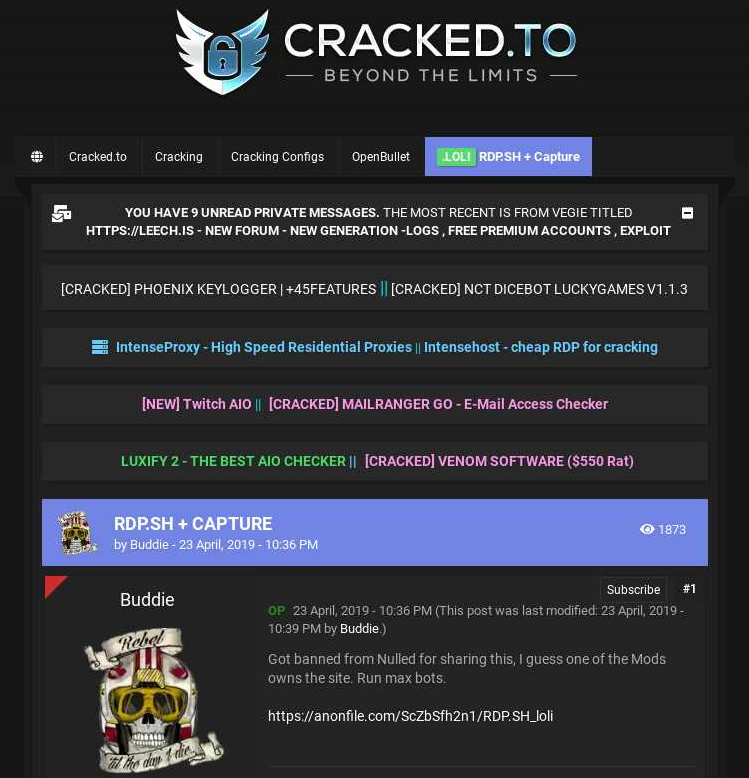
In this 2019 post from Cracked, a forum moderator told the author of the post (Buddie) that the owner of the RDP service was the founder of Nulled, a.k.a. “Finndev.” Image: Ke-la.com.
On Jan. 30, the U.S. Department of Justice said it seized eight domain names that were used to operate Cracked, a cybercrime forum that sprang up in 2018 and attracted more than four million users. The DOJ said the law enforcement action, dubbed Operation Talent, also seized domains tied to Sellix, Cracked’s payment processor.
In addition, the government seized the domain names for two popular anonymity services that were heavily advertised on Cracked and Nulled and allowed customers to rent virtual servers: StarkRDP[.]io, and rdp[.]sh.
Those archived webpages show both RDP services were owned by an entity called 1337 Services Gmbh. According to corporate records compiled by Northdata.com, 1337 Services GmbH is also known as AS210558 and is incorporated in Hamburg, Germany.
The Cracked forum administrator went by the nicknames “FlorainN” and “StarkRDP” on multiple cybercrime forums. Meanwhile, a LinkedIn profile for a Florian M. from Germany refers to this person as the co-founder of Sellix and founder of 1337 Services GmbH.
Northdata’s business profile for 1337 Services GmbH shows the company is controlled by two individuals: 32-year-old Florian Marzahl and Finn Alexander Grimpe, 28.
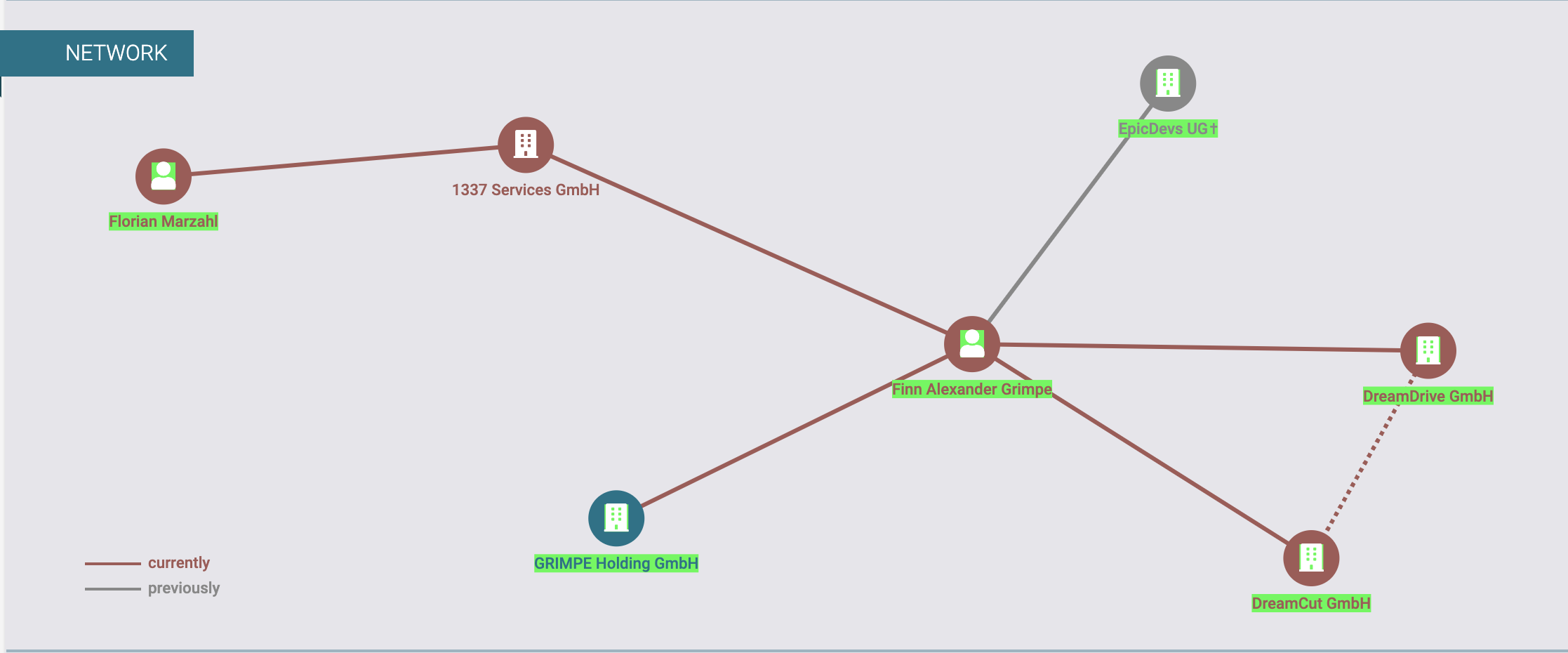
An organization chart showing the owners of 1337 Services GmbH as Florian Marzahl and Finn Grimpe. Image: Northdata.com.
Neither Marzahl nor Grimpe responded to requests for comment. But Grimpe’s first name is interesting because it corresponds to the nickname chosen by the founder of Nulled, who goes by the monikers “Finn” and “Finndev.” NorthData reveals that Grimpe was the founder of a German entity called DreamDrive GmbH, which rented out high-end sports cars and motorcycles.
According to the cyber intelligence firm Intel 471, a user named Finndev registered on multiple cybercrime forums, including Raidforums [seized by the FBI in 2022], Void[.]to, and vDOS, a DDoS-for-hire service that was shut down in 2016 after its founders were arrested.
The email address used for those accounts was f.grimpe@gmail.com. DomainTools.com reports f.grimpe@gmail.com was used to register at least nine domain names, including nulled[.]lol and nulled[.]it. Neither of these domains were among those seized in Operation Talent.
Intel471 finds the user FlorainN registered across multiple cybercrime forums using the email address olivia.messla@outlook.de. The breach tracking service Constella Intelligence says this email address used the same password (and slight variations of it) across many accounts online — including at hacker forums — and that the same password was used in connection with dozens of other email addresses, such as florianmarzahl@hotmail.de, and fmarzahl137@gmail.com.
The Justice Department said the Nulled marketplace had more than five million members, and has been selling stolen login credentials, stolen identification documents and hacking services, as well as tools for carrying out cybercrime and fraud, since 2016.
Perhaps fittingly, both Cracked and Nulled have been hacked over the years, exposing countless private messages between forum users. A review of those messages archived by Intel 471 showed that dozens of early forum members referred privately to Finndev as the owner of shoppy[.]gg, an e-commerce platform that caters to the same clientele as Sellix.
Shoppy was not targeted as part of Operation Talent, and its website remains online. Northdata reports that Shoppy’s business name — Shoppy Ecommerce Ltd. — is registered at an address in Gan-Ner, Israel, but there is no ownership information about this entity. Shoppy did not respond to requests for comment.
Constella found that a user named Shoppy registered on Cracked in 2019 using the email address finn@shoppy[.]gg. Constella says that email address is tied to a Twitter/X account for Shoppy Ecommerce in Israel.
The DOJ said one of the alleged administrators of Nulled, a 29-year-old Argentinian national named Lucas Sohn, was arrested in Spain. The government has not announced any other arrests or charges associated with Operation Talent.
Indeed, both StarkRDP and FloraiN have posted to their accounts on Telegram that there were no charges levied against the proprietors of 1337 Services GmbH. FlorainN told former customers they were in the process of moving to a new name and domain for StarkRDP, where existing accounts and balances would be transferred.
“StarkRDP has always been operating by the law and is not involved in any of these alleged crimes and the legal process will confirm this,” the StarkRDP Telegram account wrote on January 30. “All of your servers are safe and they have not been collected in this operation. The only things that were seized is the website server and our domain. Unfortunately, no one can tell who took it and with whom we can talk about it. Therefore, we will restart operation soon, under a different name, to close the chapter [of] ‘StarkRDP.'”


Introduction The business world is relocating to the cloud and the trend is strong. It has been predicted that by the end of 2020, 83% of all businesses will be in the cloud and by 2021, the percentage of workloads processed in cloud data centers will reach 94%. By 2022, cloud services will be three […]
The post Microsoft Azure job outlook appeared first on Infosec Resources.

 FreshRSS