For families of the missing, systemic obstacles to identifying remains and locating people in Israeli detention has created a kind of social and legal purgatory.
**Submission URL** : https://arxiv.org/abs/2603.16572 **Repository hijacking** — Skills.sh and SkillsDirectory index agent skills by pointing to GitHub repository URLs rather than hosting files directly. When an original repository owner renames their GitHub account, the previous username becomes available. An adversary who claims that username and recreates the repository intercepts all future skill downloads. The authors found 121 skills forwarding to 7 vulnerable repositories. The most-downloaded hijackable skill had 2,032 downloads. **Scanner disagreement** — The paper tested 5 scanners against 238,180 unique skills from 4 marketplaces. Fail rates ranged from 3.79% (Snyk on Skills.sh) to 41.93% (OpenClaw scanner on ClawHub). Cross-scanner consensus was negligible: only 33 of 27,111 skills (0.12%) flagged by all five. When repository-context re-scoring was applied to the 2,887 scanner-flagged skills, only 0.52% remained in malicious-flagged repositories. **Live credentials** — A TruffleHog scan found 12 functioning API credentials (NVIDIA, ElevenLabs, Gemini, MongoDB, and others) embedded across the corpus. **What to do:** - Pin skills to specific commit hashes, not mutable branch heads - Monitor for repository ownership changes on skills already deployed - Require at minimum two independent scanners to flag a skill before treating as confirmed - Prefer direct-hosting marketplaces (ClawHub's model) over link-out distribution The repository hijacking vector is real and responsibly disclosed. The link-out distribution model is an architectural weakness — no patch resolves it. We wrote a practitioner-focused analysis covering this and 6 other papers from this week at
Moxie Marlinspike says the technology powering his encrypted AI chatbot, Confer, will be integrated into Meta AI. The move could help protect the AI conversations of millions of people.
CVE-2026-33068 is a configuration loading order defect in Anthropic's Claude Code CLI tool (versions prior to 2.1.53). A malicious `.claude/settings.json` file in a repository can bypass the workspace trust confirmation dialog by exploiting the order in which settings are resolved. The mechanism: Claude Code supports a `bypassPermissions` field in settings files. This is a legitimate, documented feature intended for trusted workspaces. The vulnerability is that repository-level settings ( `.claude/settings.json` ) are loaded and resolved before the workspace trust dialog is presented to the user. A malicious repository can include a settings file with `bypassPermissions` entries, and those permissions are applied before the user has an opportunity to review and approve the workspace. This is CWE-807: Reliance on Untrusted Inputs in a Security Decision. The trust decision (whether to grant elevated permissions) depends on inputs from the entity being evaluated (the repository). The security boundary between "untrusted repository" and "trusted workspace" is bridged by the settings loading order. The fix in Claude Code 2.1.53 changes the loading order so that the trust dialog is presented before repository-level settings are resolved. Worth noting: `bypassPermissions` is not a hidden feature or a misconfiguration. It is documented and useful for legitimate workflows. The bug is purely in the loading order.
found this during a routine supply chain audit of our own codebase. the part that concerns us most is the false patch problem - anyone who responded to CVE-2025-58367 last year updated the restricted unpickler and considered that attack surface closed. it wasn't. if you're running the likes of SageMaker, DataHub, or acryl-datahub and haven't pinned to 8.6.2 yet, worth checking now.
Customer conversations with chatbots can include contact information and personal details that make it easier for scammers to launch phishing attacks and commit fraud.
In the beginning, it was simple. A website, a database and 150M+ email addresses to search. Time has added serverless functions (which run on servers 🤷♂️), code on the edge, new data storage constructs and a completely different mechanism for even just querying a simple email address. HIBP is a continually evolving beast, and barely a week goes by that we don't implement code of significance. You don't always see it out there in the public realm, but the tweaks - in including the major one I talk about in this week's video - all add up to make the platform faster, more sustainable and if we do it right, even a bit more cost-effective to run 😊
Since starting HIBP a dozen and a bit years ago, I've loaded an average of one breach every 4.7 days. That's 959 of them to date, but last week it was five in only two days. That's a few weeks' worth of breaches in only 48 and a half hours. And that's the way it tends to be in this industry: flurries of activity followed by periods of silence. I obviously don't have any control over the cadence of breaches (nor when they begin circulating), which does make for some interesting scheduling challenges. Somewhere amongst responding to those incidents, we manage to do all the other mechanical things required to keep this service running the way it does. Anyway, this week it's "breachapalooza", with some behind-the-scenes info on the Odido, KomikoAI, Quitbro, Lovora and Provecho.
New analysis shows that attacks on satellite navigation systems have impacted some 1,100 ships in the Middle East since the US and Israel attacked Iran on February 28.
The Odido breach leaks were towards the beginning during this week's update. I recorded it the day after the second dump of data had hit, with a third dump coming a few hours later, and a final dump of everything the day after that. From what I hear, it dominated the news in the Netherlands, and we sure saw that through the traffic stats. Clearly, the leak cadence was designed for maximum news impact, and it seems to have achieved that. It may not have put any cash in the extortionist's pockets, but it's set a very visible precedent and, I suspect, put a massive law enforcement target on them. It's hard to image leaks of this impact continuing for much longer...
As Israeli airstrikes hit Tehran this morning, Iranians received mysterious push notifications saying that “help is on the way,” promising amnesty if they surrender.
Well, the ESP32 Bluetooth bridge experiment was a complete failure. Not the radios themselves, they're actually pretty cool, but there's just no way I could get the Yale locks to be reliably operated by them. At a guess, BLE is a bit too passive to detect state changes, and unless it was awake and communicating, it just had no idea what was happening with the locks. So, I've now silenced all lock-related alerts and am focusing on making the wifi network as reliable as possible in the hope the locks actually become responsive. If that doesn't work, those Aqara U400s look really sweet...
A big "thank you" to everyone who helped me troubleshoot the problem with my "Print Screen" button on the new PC. Try as we all might, none of us could figure out why it refused to bind to SnagIt and instead insisted on dumping the entire collection of screens to a file on the desktop. But an especailly big thanks to the follower who later emailed me with an idea that didn't work, and followed up with an idea that finally did!
So, yeah, thanks Logitech for making this a real pain in the arse 🤦♂️
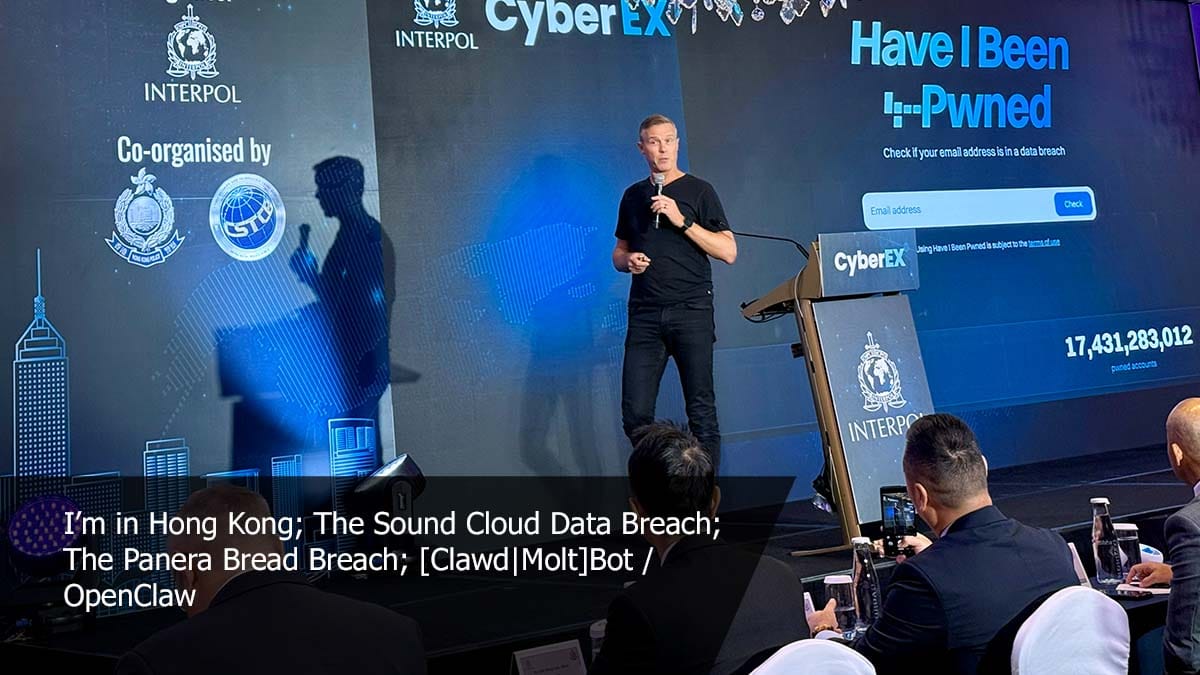
This week I'm in Hong Kong, and the day after recording, I gave the talk shown in the image above at INTERPOL's Cybercrime Expert Group. I posted a little about this on Facebook and LinkedIn, but thought I'd expand on what really stuck with me after watching other speakers: the effort agencies are putting into cybercrime prevention. It's very easy for folks to judge law enforcement solely on what they see from the outside, and that's mostly going after offenders and taking down criminal infrastructure. But the bit I'm increasingly seeing behind the scenes is a push to help kids (the sorts of hackers I usually interact with are teenagers or young adults at most) make better choices when they're faced with a pathway into cybercrime. The transition from minor offences (game cheats and DDoS'ing) to full-on cybercriminals (hacking and extortion) is very well-known, and intervening at the right time can not only make a difference to the impact of data breaches on all of us, but it can also make a massive difference to these kids' lives. These agencies are underfunded and understaffed compared to the scale of the problem, so making the time to come visit and find some ways to help in our little corner of the data breach world is a no-brainer 😊
It's the discussion about the reaction of some people in the UK regarding their impending social media ban for under 16s that bugged me most. Most noteably was the hand-waving around "the gov is just trying to siphon up all our IDs" and "this means everyone will have to show ID, not just under 16s". If only there was another precedent somewhere in the world where precisely this model was rolled... oh - wait! 🐨 The way the ban (sorry - "delay") has been done in Australia isn't perfect, but it also doesn't have to be. There are still plenty of under 16s with access so socials, but I do not know of a single adult who had had to show any form of ID or do any age verification whatsoever. So, relax, wait until we know more about how thye're planning to do it (and the UK gov will be closely looking at the Aussie precedent), and then lose your minds if it's done totally differently at the expense of everyone's privacy.
I thought Scott would cop it first when he posted about what his solar system really cost him last year. "You're so gonna get that stupid AI-slop response from some people", I joked. But no, he got other stupid responses instead! And I got the AI-slop responses! Draw your own conclusions on those comments, but I find it fascinating that the one thing people would take away from a thoughtful blog post I spent many hours writing to explain how much work I put into privacy is that the illustration was computer-generated. That such feedback aligns with the political leanings of folks on Mastodon is also fascinating, and probably something I should have seen coming. But hey, there's nothing new about folks popping their heads up to make inane comments where none were needed, and I have a special blog post for just such occasions: If You Don't Want Guitar Lessons, Stop Following Me.
I’m in Oslo! Flighty is telling me I’ve flown in or out of here 43 times since a visit in 2014 set me on a new path professionally and, many years later, personally. It’s special here, like a second home that just feels… right. This week, the business end of things is about the WhiteDate data breach. Seeking a partner along common racial lines isn’t unusual, but… well… WhiteDate is anything but usual. And, just for fun, see if you can pick the thing that garnered the most negative feedback about that blog post this week, I’ll feature the discussion in the next vid.
 Login
Login