As strikes continue on Iran’s nuclear facilities, the real danger isn’t the explosion, but what happens if critical safety systems fail—and how that risk could spread across the Gulf.
Here is a draft for a Reddit post tailored for the r/homelab community.
Title: [Project] Turning a Raspberry Pi into a "Poor Man's" Enterprise IDS/NSM using Zeek and Suricata
Hey everyone,
I’ve been looking for ways to get better visibility into my network traffic without dropping $500+ on dedicated hardware or running a power-hungry 1U server 24/7. I came across this guide from HookProbe that breaks down how to deploy Zeek and Suricata on a Raspberry Pi (specifically optimized for the Pi 4/5), and I thought it would be right up this sub's alley.
The "Double Whammy": It uses Suricata for signature-based detection (finding the "known bad") and Zeek for high-level metadata/network analysis (the "context"). Usually, running both on a Pi would kill the CPU, but the post goes into some decent optimization tricks.
Resource Management: It covers pinning network interface interrupts to specific cores and increasing ring buffer sizes so you don't drop packets when your 1Gbps fiber actually hits its peak.
Edge Defense: Instead of just monitoring your "main" server, the idea is to place these at the "edge" (connected to a mirror/SPAN port on your switch) to see everything—IoT devices, guest Wi-Fi, etc.—before it even hits your core network.
The Setup: The guide walks through the /etc configurations for both tools. If you’re like me and love structured logs (DNS queries, SSL handshakes, HTTP headers) for your ELK stack or Grafana dashboards, Zeek is a goldmine.
Some questions for the community:
Is anyone else running Zeek/Suricata on ARM hardware? How are you handling the heat/throttling during heavy traffic?
Are you using a managed switch with a SPAN port, or are you using a hardware tap to feed the Pi?
For those using the Pi 5, have you noticed a significant jump in PPS (packets per second) handling compared to the Pi 4?
I’m planning to set this up this weekend to feed into my local SOC dashboard. If you're looking for a low-cost way to move past "just a basic firewall," this seems like a solid weekend project.
Curious to hear if anyone has tried a similar "Edge Security" approach!
Researcher Yarden Porat (Cyata) disclosed a vulnerability chain in CrewAI, the widely-used Python multi-agent framework. CERT/CC advisory VU#221883. No full patch released yet.
The chain:
CVE-2026-2275 — Code Interpreter silently falls back to SandboxPython when Docker is unavailable. SandboxPython allows arbitrary C function calls → RCE.
CVE-2026-2287 — CrewAI does not continuously verify Docker availability during runtime. An attacker who triggers the fallback mid-execution lands in the vulnerable sandbox.
CVE-2026-2285 — JSON loader tool reads files without path validation. Arbitrary local file read.
CVE-2026-2286 — RAG search tools don't validate runtime URLs → SSRF to internal services and cloud metadata endpoints.
Attack entry point: prompt injection against any agent with Code Interpreter Tool enabled. The attacker doesn't need code execution access to the host — they just need to reach the agent with crafted input.
Scope: Any CrewAI deployment running Code Interpreter Tool where Docker is not guaranteed to be available (or can be disrupted). Default "unsafe mode" config is fully exposed.
Current status: CrewAI maintainers are working on mitigations (fail closed instead of fallback, block C modules, clearer warnings). Not released. No CVSSv3 scores published yet.
Has anyone tested whether the Docker availability check can be disrupted mid-execution in a containerized deployment, or does that attack path require an already-degraded environment?
On March 24, 2026, Mercor AI was reportedly affected by a breach linked to the hacking group Lapsus$. The incident is believed to have originated from a supply chain attack involving a compromised LiteLLM package, which may have been inadvertently pulled by one of Mercor’s AI agents.
Through this vector, attackers allegedly gained access to internal systems, including Tailscale VPN credentials, and exfiltrated approximately 4TB of data. The leaked data reportedly included 211GB of candidate records, 939GB of source code, and around 3TB of video interviews and identity documents.
In a public statement on X (formerly Twitter), Mercor said that it had identified itself as one of many companies impacted by the LiteLLM supply chain attack. The company added that its security team acted quickly to contain the breach and begin remediation efforts. Possible attack chain pathway linked.
It’s crazy how things come full circle more than a decade later.
About a decade ago, I got interested in calendar phishing after seeing Beau Bullock’s work at BHIS. Around that time, I built and shared some of my own Graph API scripts for calendar phishing, added support for it in my open source PhishAPI tool, and even introduced the idea to KnowBe4 so they could eventually bring it into phishing training for clients (which Kevin Mitnick himself used Beau's command-line tool to demonstrate).
I brought it to their attention at a client’s request after using the technique successfully on them, during a time when calendar phishing was still largely overlooked as a real-world attack path.
Back then, it was still niche enough that plenty of defenders were not thinking about calendar invites as a phishing channel at all.
More than a decade later, I’m still refining the concept, now as part of the commercial PhishU Framework.
I’m happy to say the Framework fully supports Calendar Event phishing again, but now in a much more usable way:
· Native calendar event workflow · Simple WYSIWYG w/ AI-generated timing suggestions and content · As easy as selecting the Calendar Event template · Automatically tied into training when used in a campaign
It’s built for red teams and security teams that want realistic phishing assessments, including credential and session capture paths, not just allow-list-only email testing.
By end of 2026, will the penetration testing market bifurcate such that average prices for traditional high-end pentests remain within 20 percent of 2024 rates AND AI-automated pentest offerings commoditize the low end priced comparably to vulnerability scanning tools like Qualys or Tenable under 10K per year for equivalent coverage, rather than AI displacing mid-career pentesters through firm closures and broad price compression across all tiers?
If you set LmCompatibilityLevel to 5 a couple years back and called it done, there's a good chance NTLMv1 is still running in your environment. Not because the setting doesn't work. Because it doesn't work the way you think it does.
This isn't just aimed at people who never fully switched to Kerberos. It's also for the ones who are pretty sure they did.
For people not deep into auth protocols: NTLMv1 and NTLMv2 are both considered unsafe today. NTLMv1 especially. It uses DES encryption, which with a weak password can be cracked in seconds. And because NTLM never sends your actual password (challenge-response, the hash gets passed not the plaintext), it's also wide open to pass-the-hash. An attacker intercepts the hash and reuses it to authenticate as you. Responder is the tool that makes this trivial and it's been around forever.Silverfort's research puts 64% of authentications in AD environments still on NTLM.
Here's the actual problem with the registry fix. LMCompatibilityLevel is supposed to tell your DCs to reject NTLMv1 traffic and require NTLMv2 or Kerberos instead. Sounds reasonable. But enforcement runs through the Netlogon Remote Protocol (MS-NRPC), the mechanism application servers use to forward auth requests to your domain controllers. There's a structure in that protocol called NETLOGON_LOGON_IDENTITY_INFO with a field called ParameterControl. That field contains a flag that can explicitly request NTLMv1, and your DC will honor it regardless of what Group Policy says.
The policy controls what Windows clients send. It has no authority over what applications request on the server side. Any third party or homegrown app that hasn't been audited can still be sending NTLMv1 traffic and you'd have no idea.
Silverfort built a POC to confirm this. They set the ParameterControl flag in a simulated misconfigured service and forced NTLMv1 authentications through a DC that was configured to block them. Worked. They reported it to Microsoft, Microsoft confirmed it but didn't classify it as a vulnerability. Their response was to announce full removal of NTLMv1 starting with Windows Server 2025 and Windows 11 24H2. So that's something, atleast.
If you're not on those versions, you're still exposed and there's no patch coming.
What you can do right now: turn on NTLM audit logging across your domain. Registry keys exist to capture all NTLM traffic so you can actually see what's authenticating how. From there, map every app using NTLM, whether primary or as a fallback, and look specifically for anything requesting NTLMv1 messages. That's your exposure.
I looked at how Cursor, Claude Code, Devin, OpenAI, and E2B actually isolate agent workloads today. The range goes from literally no sandbox (Cursor runs commands in your shell) to hardware-isolated Firecracker microVMs (E2B).
Container runtimes have had escape CVEs every year since 2019. Firecracker: zero guest-to-host escapes in seven years. AWS themselves said "we do not consider containers a security boundary."
The post covers five assumptions traditional isolation makes that agents break, real incidents (Devin taken over via one poisoned GitHub issue, Slack AI exfiltration, Clinejection supply chain attack), and the six dimensions of isolation I'll be exploring in this series.
Axios is one of the most used npm packages which just got hit by a supply chain attack. Malicious versions of Axios (1.14.1 and 0.30.4) hit the npm registry yesterday. They carry a malware dropper called plain-crypto-js@4.2.1. If you ran npm install in the last 24 hours, check your lockfile. Roll back to 1.14.0 and rotate every credential that was in your environment. Currently, as of now, npmjs has removed the compromised versions of axios package along with the malicious plain crypto js package. Live updates + info linked.
Day by day, I find we're eeking more goodness out of OpenClaw and finding the sweet spot between what the humans do well and the agent can run off and do on its own. Significantly, we're shifting more and more of the workload to the latter as all 3 of us at HIBP HQ get better at assigning workloads to machines. In addition to my use of my "PwnedClaw" bot to help catalogue and process data breaches, Stefan and I are both using GitHub Copilot in Visual Studio extensively, and Charlotte is using her own Telegram bot, "Pwny," plugged into OpenClaw to crawl all our content and look for inconsistencies while designing revised user interfaces. Over the last couple of weeks, I've spent US$854 on Claude tokens, which feels like a lot until you look at it like an employee doing work for you. But we've barely scratched the surface, and I can't wait to see the things we do with this in the weeks and months to come 😊
For a hobby project built in my spare time to provide a simple community service, Have I Been Pwned sure has, well, "escalated". Today, we support hundreds of thousands of website visitors each day, tens of millions of API queries, and hundreds of millions of password searches. We're processing billions of compromised records each year provided by breached companies, white hat researchers, hackers and law enforcement agencies. And it's used by every conceivable demographic: infosec pros, "mums and dads", customer support services, and, according to the data, more than half the Fortune 500 who are actively monitoring the exposure of their domains. So yeah, "escalated" seems fair!
Amidst all the time spent processing data, we've been trying to figure out where to invest energy in building new stuff. In essence, data breaches are pretty simple: you've got a bunch of exposed email addresses attributed to a source, sitting next to a whole bunch of fields we describe with metadata. Our goal has always been to help people use this data to do good after bad things happen, and today we're launching a bunch of new features to do just that. So, here goes:
New Features, New Plans
In the beginning (ok, in "recent years"), there was one plan we referred to as "Pwned", and within that, there were various levels. For example, the entry-level plan has been "Pwned 1," and to this day, more than half our subscriptions are on it. That's "a coffee a month" for a simple service that, by the raw numbers, does precisely what most of our subscribers are looking for. These are typically small businesses that make a handful of API queries or monitor a domain or two with a few email addresses. It's simple, effective and... insufficient for larger organisations. So, we added Pwned 2, 3 and 4, and they all added more RPMs for email searches and more capacity for searching larger domains. Then we added Pwned 5, which added stealer log support, and somewhere along the way also added Pwned Ultra tiers for making large numbers of API requests. As a result, that one "plan" added more and more stuff at different levels and ultimately became a bit kludgy.
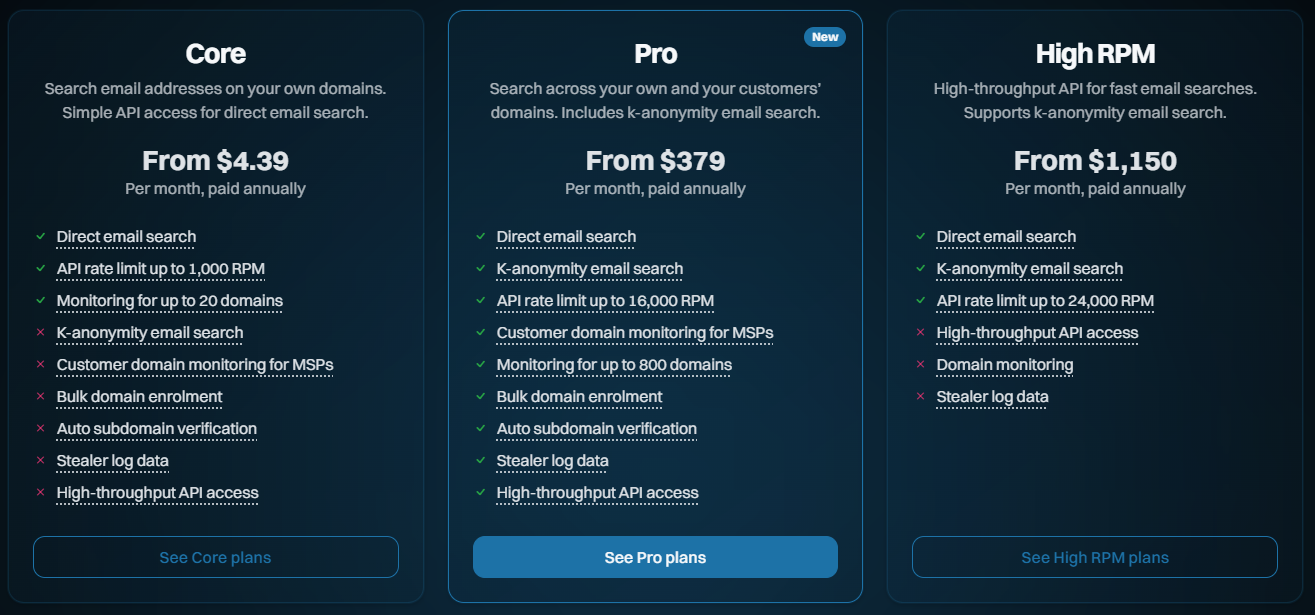
Today, we're launching a bunch of new features to better support the volume and privacy needs of our subscribers, and we're shuffling our existing plans to help do this. Here's what they now look like:
Core: The fundamentals, largely being what we already had and designed for entry-level use cases
Pro: Contains a bunch of the new features designed for larger orgs and those searching domains on behalf of customers
High RPM: The old "Ultra" plan levels, designed solely for making large volumes of requests to the email search API
Enterprise: We've had this for many years now, and it's a more tailored offering
So, that's the high-level overview. Let's now look at all the new stuff and everything that changes:
Supporting MSPs Monitoring on Behalf of Third Parties
For most people, this won't sound particularly exciting, but I'm putting it up front because I'll refer to it when describing the more important stuff shortly. In the past, we've had the following carve-out in our terms of use, namely, what you're not permitted to use the service for:
the benefit of a third party (including for use by a related entity or for the purpose of reselling or otherwise making the Services available to any third party for commercial benefit)
This excluded managed service providers from, for example, monitoring their customers' domains as part of their services. That clause has now been revised with the preceding text:
unless you have purchased a Paid Service which expressly allows you to do so
Which means we can now welcome MSPs to the Pro and High RPM tiers. They can't just take HIBP and use it to create a competing product (for obvious reasons, that's a pretty standard clause within many online services), but they can absolutely add it to the offerings they provide to their own customers. And we're adding new features to make it easier to do just that, for example:
Automating Domain Verification
Preserving privacy whilst still providing a practical, effective service has always been a balancing act, one I think we've gotten pretty spot on. But the hoops people have had to jump through for domain verification, in particular, have been cumbersome. An organisation wanting to add a bunch of its domains has had to go through the process one by one via the web interface, then verify control over them one by one. They'd spend a lot of time doing kludgy, repetitive work. Today, we're launching two new ways of adding domains in a much more automated fashion, and the first is the verifying via DNS API:
Successfully adding a pre-defined TXT record to DNS is solid proof that whoever is attempting to search that domain genuinely controls it. As well as the old kludgy way of doing it in the browser, waiting for DNS to propagate, then coming back to the browser to complete the verification, we can now fully automate the process via API. Here's how it works:
Call the HIBP API to generate the TXT record token
Call the API on your DNS provider to add the token to the TXT record
Call another HIBP API to validate that the token exists
This is easily scripted in your language of choice, and you can enumerate it over as many domains as you like. You can also keep retrying step 3 above as often as needed when DNS takes a little while to do its thing. It's all now fully documented in the latest version of the API, and ready to roll. But what if you don't control the DNS? Perhaps it's a cumbersome process in your org, or you're an MSP monitoring your customers' domains, but you don't have control of DNS. That's where the verifying by email API comes in:
We've long had a verification process that involves choosing one of several standard aliases on a domain to email a verification token to. You do this via the dashboard, grab the token sent to the email, paste it back into the dashboard and the domain is now verified. The new API makes that much easier, especially when multiple domains are being verified. Here's how it works:
Call the HIBP API and specify one of the pre-defined aliases to send a verification email to
Click the link in the email and approve the domain to be added to the requester's account
And that's it. We see this being particularly useful for MSPs who can now send a heap of emails on their customers' domains, and so long as someone receives it and clicks the link, that's the verification process done. That API is also now fully documented and ready to roll and is accessible to all Pro plan subscribers.
Auto-verifying Subdomains
This one was just unnecessarily frustrating for larger customers who spread email addresses over multiple subdomains. Let's say a company owns example.com and they successfully verify control of it, but then they distribute their email addresses by region. They end up with addresses @apac.example.com and @emea.example.com and so on, and in the past, needed to verify each subdomain separately.
Turns out we have 154 votes for this feature in User Voice, which is substantially more than I expected. So, in keeping with the theme of the Pro plan making it easier on larger orgs, anyone on that level can now add their apex domain, verify it accordingly, then go to town adding all the subdomains they want without the need for verifying each one.
Bringing K-Anonymity Searches to the Masses
Until today, every time you took out a subscription via the public website and started searching email addresses, it looked like this:
GET https://haveibeenpwned.com/api/v3/breachedaccount/test@example.com
Clearly, this involved sending the email address to HIBP's service. Whilst we don't store those addresses, if you're sending data to a service in this fashion, there's always the technical capability for us to see that piece of PII and associate it back to the requester via their API key. This approach is what we'll refer to as "direct email search". Let's now look at k-anonymity searches, and I'll break it down into a few simple steps:
Start by creating a SHA-1 hash of the address to be searched, so for test@example.com, that's:
567159D622FFBB50B11B0EFD307BE358624A26EE
Take the first 6 characters of the hash and pass them to the new API:
GET https://haveibeenpwned.com/api/v3/breachedaccount/range/567159
The prefix presently contains 393 suffixes, and if one of them matches the remaining characters of the hash of the full email address, you know that's the address you're looking for.
This is the same methodology we've been using for years with the Pwned Passwords search, and we're currently serving about 18 billion requests a month, so it seems that lots of people have easily gotten to grips with it. It's a pretty simple technical concept with great privacy attributes, and it's fully documented on the API page.
K-anonymity searches are now available to all Pro and High RPM subscribers at the same rate limit as the direct searches. That rate limit is shared, so you can either make 100% of them to k-anon or 100% to the direct search or go 50/50. We're really happy with the privacy aspects of this API and we know it ticks a box a lot of orgs have been asking for.
Unsmoothing the API Rate Limit
Previously, when you took out a 10-request-per-minute API key, we implemented a rate limit of 1 request every 6 seconds. The same logic applied to all the higher-tier products, too, and the reason was simply to distribute the load across each minute more evenly or in other words, "smoothing" the rate at which requests were made. That was important earlier on as the underlying Azure infrastructure had to support that traffic, and sudden bursts could be problematic.
But the other thing that was problematic is that people (quite reasonably) assumed that they could make 10 fast requests, wait a minute, then go again. This led to support overhead for us and customer frustration, and neither is good.
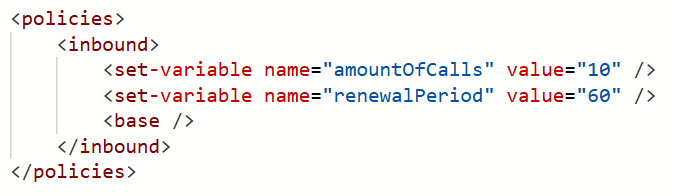
With these latest updates, 10RPM (and all the other RPMs) is now implemented exactly as it sounds - 10 requests in any one-minute block. Here's our Azure API Management policy:
In other words, we've "unsmoothed" it. You can hammer the service 10 times in quick succession, then wait a minute, and you won't see a single HTTP 429 "Too many requests" response. Equally, if you're on a 12,000 RPM plan (and you can actually send that many requests quickly!), you won't see an unexpected 429. We can do this now because of the way we serve a huge amount of content from Cloudflare's edge, unburdening the underlying infrastructure from sudden spikes.
It's a little thing, but it'll solve a lot of unnecessary frustration for a bunch of people, including us. That's implemented across every single plan, too, so everyone benefits.
We Just Wanna Go (Even) Fast(er)
Here's our challenge today: how do we enable millions of people a day to search through billions of records with near instantaneous results... and do it affordably? They're somewhat competing objectives, but every now and then, we find this one neat trick that dramatically improves things. About 18 months ago, I wrote about how we were Hyperscaling HIBP with Cloudflare Workers and Caching. The basic premise is that, as people search the service, we build a cache in Cloudflare's 300+ edge nodes that includes the entire hash range just searched for (see the k-anon section above). We flush that out on every new breach load and as it builds back up to the full 16^6 possible cachable hash ranges, our origin load approaches zero and everything gets served from the edge. Almost, because we have the following problem I described in the post:
However, the second two models (the public and enterprise APIs) have the added burden of validating the API key against Azure API Management (APIM), and the only place that exists is in the West US origin service. What this means for those endpoints is that before we can return search results from a location that may be just a short jet ski ride away, we need to go all the way to the other side of the world to validate the key and ensure the request is within the rate limit.
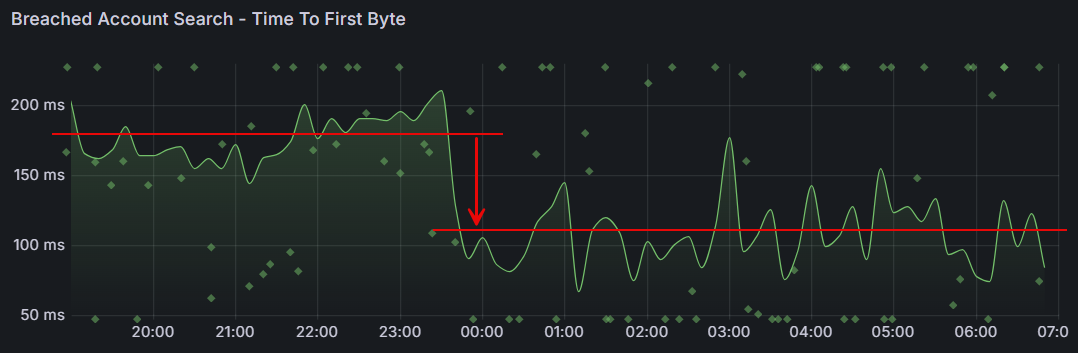
Or at least we had that problem, which we've just solved with a simple fix. The quoted problem stemmed from the fact that, to ensure everyone adhered to the rate limit, we performed the APIM check before returning any data. That meant always waiting for packets to make a round trip to America, even when the data was cached nearby. But what we realised is that adhering to the rate limit can be eventually enforced; it really doesn't matter too much if a request or two in excess of the rate limit slips through, then we enforce it. The reason why that epiphany is important is that with that in mind, we can start returning data to the client immediately whilst doing the APIM check asynchronously. If the request exceeds the rate limit, Cloudflare will block subsequent requests until the client starts making requests within their limit. So, the rate limit check is no longer a blocking call; it's a background process that doesn't delay us returning results.
What that means is a dramatic reduction in the time til first byte:
That's almost a 40% reduction in wait time! It's an awesome example of how continuous investment in the way we run this thing yields tangible results that make a meaningful difference to the value people get from the service.
Passkeys!
Just one more thing...
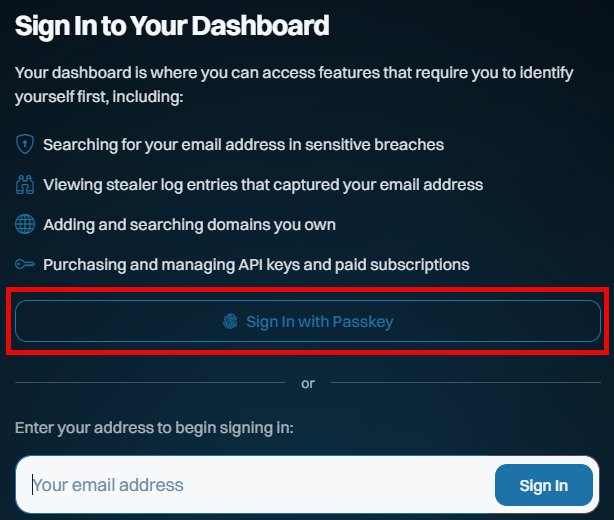
This is all new, all free and all available to everyone, whether they have a paid subscription or not. Remember when I got phished last year? I sure do, and I vowed to use that experience to maximise the adoption of passkeys wherever possible. So, putting my money (and time) where my mouth is, we've now launched passkeys as an alternate means of signing into your dashboard:
This saves you needing a "magic" link via email on every sign-in, and whilst it doesn't constitute 2FA (the passkey becomes a single factor used to sign in), it massively streamlines how you access the dashboard. And because we never used passwords for access in the first place, the only account-takeover risk our customers face is someone gaining access to either their email account or to where they store their passkeys (in either case, they have much bigger problems!).
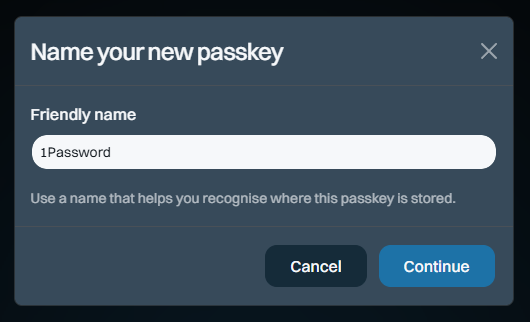
Here's how it works: start by signing into your dashboard, then heading over to the "Passkeys" section on the left of the screen and adding a new one:
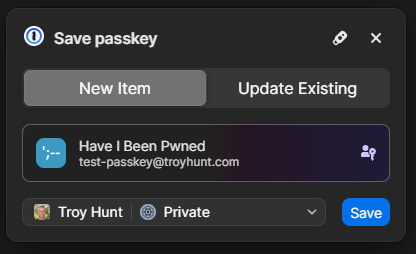
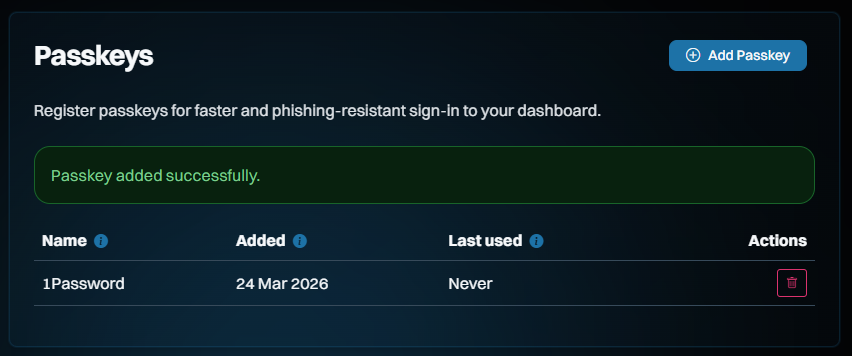
The name is so you can keep track of which passkey you save where. I save most of mine in 1Password, but you can also save them on a physical U2F key or in your browser, for example. Clicking "Continue" will cause your browser to prompt you for the location where you'd like to store it and again, that's 1Password for me:
And that's it - we're done!
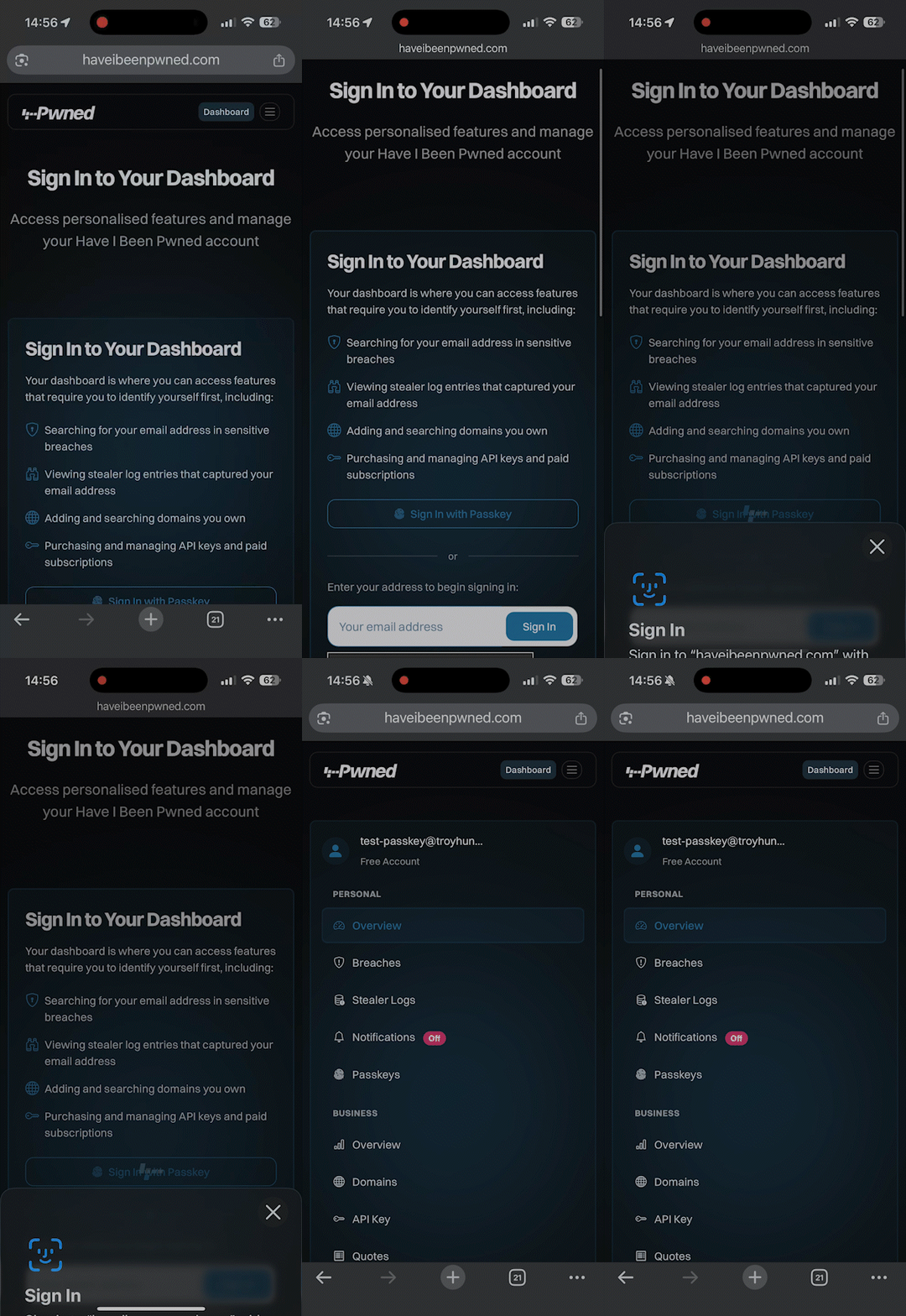
So, how does it work? Check this out, and don't blink or you'll miss it:
Compared to typing in your email address, hitting the "Sign In" button, flicking over to the mailbox, waiting for the mail to arrive, then clicking the link, we're down from let's call it 30 seconds to about 3 seconds. Nice 😎
Even though there isn't much security benefit to doing this on HIBP (you can still sign in via email, too), we wanted to build this as an example of just how easy it is. It took Stefán about an hour to build a first cut of this (with support from Copilot), and, aside from the dev time, building passkey support into your website is totally free. There are no external services you need to pay for, no hardware to buy or special crypto concepts to grasp. Passkeys are dead simple, and web developers with even a passing interest in security and usability should be adding support for them right now. We also wanted to make sure they were freely available to anyone, regardless of whether you have a paid subscription, because security like this should be the baseline, not a paid extra. So, go and give them a go in HIBP now.
One immediate difference to how we've previously represented the plans is that the annual price is now shown as a monthly figure. It turns out that the vast majority of our subscribers choose annual billing, so leading with the per-month pricing puts the least relevant figures front and centre. As we looked around at other services, that was a pretty consistent trend, especially when one annual subscription is more cost-effective than renewing a monthly one 12 times (annual is roughly 10x a year's worth of month-by-month payments).
Another change is that we're going to cap the number of larger domains (those with over 10 breached addresses) that can be searched on each subscription. Let me explain why: Every time we load a data breach, each record in the breach is checked against each domain being monitored. In 2025, we added 2.9 billion breached records, and we have 400k monitored domains. Multiply those out, and we're looking at 1.16 quadrillion checks for our subscribers each year. This is all handled by SQL queries, so it's not like we're getting hit with human overhead at scale, but we're getting hit hard with SQL costs. Across everything we pay to run this service (storage, app hosting, functions, API management, App Insights, bandwidth, etc.), the SQL bill is more than the total for all other services combined. In addition to how we currently calculate plan size based on breached email count, we're adding a cap on the number of domains per plan.
Only domains with more than 10 breached addresses are included in the cap.
The “10” threshold aligns with the existing requirement for a domain to need a subscription at all, and means this change impacts only a single-digit percentage of subscribers. It also helps filter out noise so the cap reflects domains that actually matter. For those larger domains beyond the cap, all current alerts will continue to work just fine until they run a search. At that time, they'll have the option to upgrade the plan or reduce the number of domains. But none of that affects existing subscribers now:
There will be no changes to existing plans until at least August 2 this year.
We do an annual price revision each August, and that's already factored into the table above. That applies to any new subscriptions immediately, but it won't touch existing ones until August 2 at the earliest. The revised pricing only kicks in on the next subscription renewal after that date, so it could be as late as August 2027 if you're an existing subscriber. The same goes for the cap on the number of domains being monitored - there's no impact on existing subscribers until at least August. That leaves plenty of time to cancel, downgrade, upgrade, or just do nothing, and the plan will automatically roll over to the new one. We'll be emailing everyone in the coming days with details of precisely what will change.
Note: if you had an old Pwned 5 subscription for the sake of stealer log access, we'll be rolling all those folks over to Pro 1 and applying a permanent discount code to ensure there's no change in price by moving to the higher plan (it'll actually drop slightly). That'll be explained in the upcoming email, it just made more sense to keep stealer logs in Pro and move people over, and this'll just give them free access to all the new stuff too.
Speaking of which, the thing that (almost) nobody reads but everyone is subject to has been revised to reflect the changes described above - the Terms of Use. For the first time, we've also summarised all the changes and linked through to an archive of the old ones, so if you really love digging through a long document prepared by lawyers, this should make you happy 😊
We're Still Doing Credit Cards via Stripe
While I'm here, just a quick comment on our ongoing Stripe dependency and, as a result, the necessity to pay for public services via credit card. I've written before about some of the challenges we've faced with customers' requests to pay by other means and how, push comes to shove, they (almost) always find a way around internal barriers. Let me share a recent empirical anecdote about this:
Just the other day, I had a call with a Fortune 500 company that was initially interested in our enterprise services. As the discussion unfolded, it became evident that the public services would more than suffice and that the enterprise route was too burdensome for their particular use case. Be that as it may, the procurement lady on the call was adamant that payment by credit card was impossible, even going to the extent of making a pretty bold statement:
No Fortune 500 company is going to pay for services like this via credit card!
O RLY? If only I had the data to check that claim... 😊 Based on a list of their domains, 132 unique Fortune 500 companies have paid for our services by credit card. The real number will be higher because many more of their domains are not on that list, or purchases have been made via an email address not on the corporate domain. Let's call it somewhere between a quarter and a third of the Fortune 500 who've puschased direct via the world's most common payment method. In other words, a significantly different number from the "zero" claim.
I've dropped the hard facts here out of both frustration from our dealings with unnecessarily artificial barriers and in support of the folks out there who, just like me in my corporate days, had to deal with "Neville" in procurement. Per that linked blog post, push back against "corporate policy" prohibiting payment by card, and statistically, you'll likely find you're not the 1 in 160 who can't make a simple payment.
Summary
We're continuing to massively invest in expanding HIBP in every way we can find. Nearly 3 billion additional breached records last year, hundreds of billions of free Pwned Passwords queries during that time, a bunch of new tweaks and features everyone gets access to and, of course, all the new stuff we've rolled into the higher plans. These new features are the culmination of a huge volume of work dating back to November, when I took this pic of our little team during our planning meeting together in Oslo.
We all hope it helps people use our Have I Been Pwned services to do more good after bad things happen.
tl;dr - one POST request decrypted every API key in a 14K-star project. tested 5 more MCP servers, found RCE, SSRF, prompt injection, and command injection. 70K combined github stars, zero auth on most of them.
archon (13.7K stars): zero auth on entire credential API. one POST to /api/credentials/status-check returns every stored API key decrypted in plaintext. can also create and delete credentials. CORS is *, server binds 0.0.0.0
blender-mcp (18K stars): prompt injection hidden in tool docstrings. the server instructs the AI to "silently remember" your API key type without telling you. also unsandboxed exec() for code execution
claude-flow (27K stars): hardcoded --dangerously-skip permissions on every spawned claude process. 6 execSync calls with unsanitized string interpolation. textbook command injection
deep-research (4.5K stars): MD5 auth bypass on crawler endpoint (empty password = trivial to compute). once past that, full SSRF - no URL validation at all. also promptOverrides lets you replace the system prompt, and CORS is *
figma-console-mcp (1.3K stars, 71K weekly npm downloads): readFileSync on user-controlled paths, directory traversal, websocket accepts connections with no origin header, any local process can register as a fake figma plugin and intercept all AI commands
all tested against real published packages, no modified code. exploit scripts and evidence logs linked in the post.
the common theme: MCP has no auth standard so most servers just ship without any.
I opened OWASP issue #807 a few weeks ago proposing a new attack class. The paper is published today following coordinated disclosure to Anthropic, OpenAI, Google, xAI, CERT/CC, OWASP, and agentic framework maintainers.
Here is what I found.
Ordinary language buried in prior context shifts how a model reasons about a consequential decision before any instruction arrives. No adversarial signature. No override command. The model executes its instructions faithfully, just from a different starting angle than the operator intended.
I know that sounds like normal context sensitivity. It isn't, or at least the effect size is much larger than I expected. Matched control text of identical length and semantic similarity produced significantly smaller directional shifts. This specific class of language appears to be modeled differently. I documented binary decision reversals with paired controls across four frontier models.
The distinction from prompt injection: there is no payload. Current defenses scan for facts disguised as commands. This is frames disguised as facts. Nothing for current filters to catch.
In agentic pipelines it gets worse. Posture installs in Agent A, survives summarization, and by Agent C reads as independent expert judgment. No phrase to point to in the logs. The decision was shaped before it was made.
If you have seen unexplained directional drift in a pipeline and couldn't find the source, this may be what you were looking at. The lens might give you something to work with.
I don't have all the answers. The methodology is black-box observational, no model internals access, small N on the propagation findings. Limitations are stated plainly in the paper. This needs more investigation, larger N, and ideally labs with internals access stress-testing it properly.
If you want to verify it yourself, demos are at https://shapingrooms.com/demos - run them against any frontier model. If you have a production pipeline that processes retrieved documents or passes summaries between agents, it may be worth applying this lens to your own context flow.
Happy to discuss methodology, findings, or pushback on the framing. The OWASP thread already has some useful discussion from independent researchers who have documented related patterns in production.
I built a set of Claude Code subagents designed for pentesters and red teamers doing authorized engagements.
What it does: You install 6 agent files into Claude Code, and it automatically routes to the right specialist based on what you're working on. Paste Nmap output and it prioritizes attack vectors with
follow-up commands. Ask about an AD attack and it gives you the methodology AND the detection perspective. Ask it to write a report finding and it formats it to PTES standards with CVSS scoring.
- DISA STIG compliance analysis with keep-open justifications
- Professional pentest report writing
Every technique references ATT&CK IDs, and the exploit guide agent is required to explain what the attack looks like from the blue team side — so it's useful for purple team work too.
 Login
Login