Looking back at this milestone video, it's the audience question towards the end I liked most: "are you happy"? Charlotte and I have chosen a path that's non-traditional, intense and at times, pretty stressful. There's no clear delineation of when work starts and ends, no holidays where we don't work, nor weekends, birthdays or Christmases. But we do so on our terms. It gives us a life of means and choices, one with excitement and adventure, and, above all, one with purpose, where we feel like we're doing something that makes a meaningful difference. I hope you enjoy this week's video, it's more personal than usual, but yeah, that's kinda what you do at milestones 😊
Perforce is source control software used in games, entertainment, and a few engineering sectors. It's particularly useful when large binary assets need to be stored alongside source code. It handles binary assets much better than Git, IMO. However, its one weakness is its terrible security defaults. You will die a bit inside when you see the out-of-the-box behaviour: "Don't have an account? Let me make one for you!" and "Oh, you didn't know by default there is a hidden, read-only 'remote' user that allows read access to everything? Oops!"
I scanned 6,122 public Perforce servers last year. 72% were exposing source code, 21% had passwordless accounts, and 4% had unprotected superusers (which allow RCE). The vendor patched the largest issue, but a significant portion are still vulnerable.
Hardening is a pain, but here it is summed up: p4 configure set security=4 # disables the built-in 'remote' user + strong auth p4 configure set dm.user.noautocreate=2 # kills auto-signup p4 configure set dm.user.setinitialpasswd=0 # users cannot self-set first password p4 configure set dm.user.resetpassword=1 # force password reset flow p4 configure set dm.info.hide=1 # hide server license, internal IP, root path p4 configure set run.users.authorize=1 # user listing requires auth p4 configure set dm.user.hideinvalid=1 # no hints on bad login p4 configure set dm.keys.hide=2 # hide stored key/value pairs from non-admins p4 configure set server.rolechecks=1 # prevent P4AUTH misuse
Years before the figure skater became an Olympic superstar, a Chinese operative tried to stalk her father and monitored other US residents deemed dissidents against China. And that’s just the beginning.
Most writeups of BlueHammer describe what it does. I read the actual PoC (FunnyApp.cpp, ~100KB of C++) and the most important line isn't in the oplock setup, the NT object namespace redirect, or the Cloud Files freeze. It's a comment.
The filestoleak array ships with one target active and two commented out:
SAM alone is a partial dump. The hashes are encrypted with the boot key — which lives in SYSTEM. Without SYSTEM you have ciphertext. With SAM + SYSTEM you have NTLM hashes you can pass-the-hash or crack offline. SECURITY adds LSA secrets: service account credentials, cached domain logon hashes, DPAPI master keys.
The complete credential package is two uncommented lines away from the published PoC. The author wrote both lines and chose what to ship.
Full analysis walks the actual code: the batch oplock on RstrtMgr.dll (not the EICAR file — that's what most writeups get wrong), the NtCreateSymbolicLinkObject swap in the session object namespace (not NTFS symlinks — a different layer entirely), the Cloud Files freeze via a fake OneDrive sync provider named IHATEMICROSOFT, and the undocumented IMpService RPC endpoint that triggers the chain with no elevated privilege required.
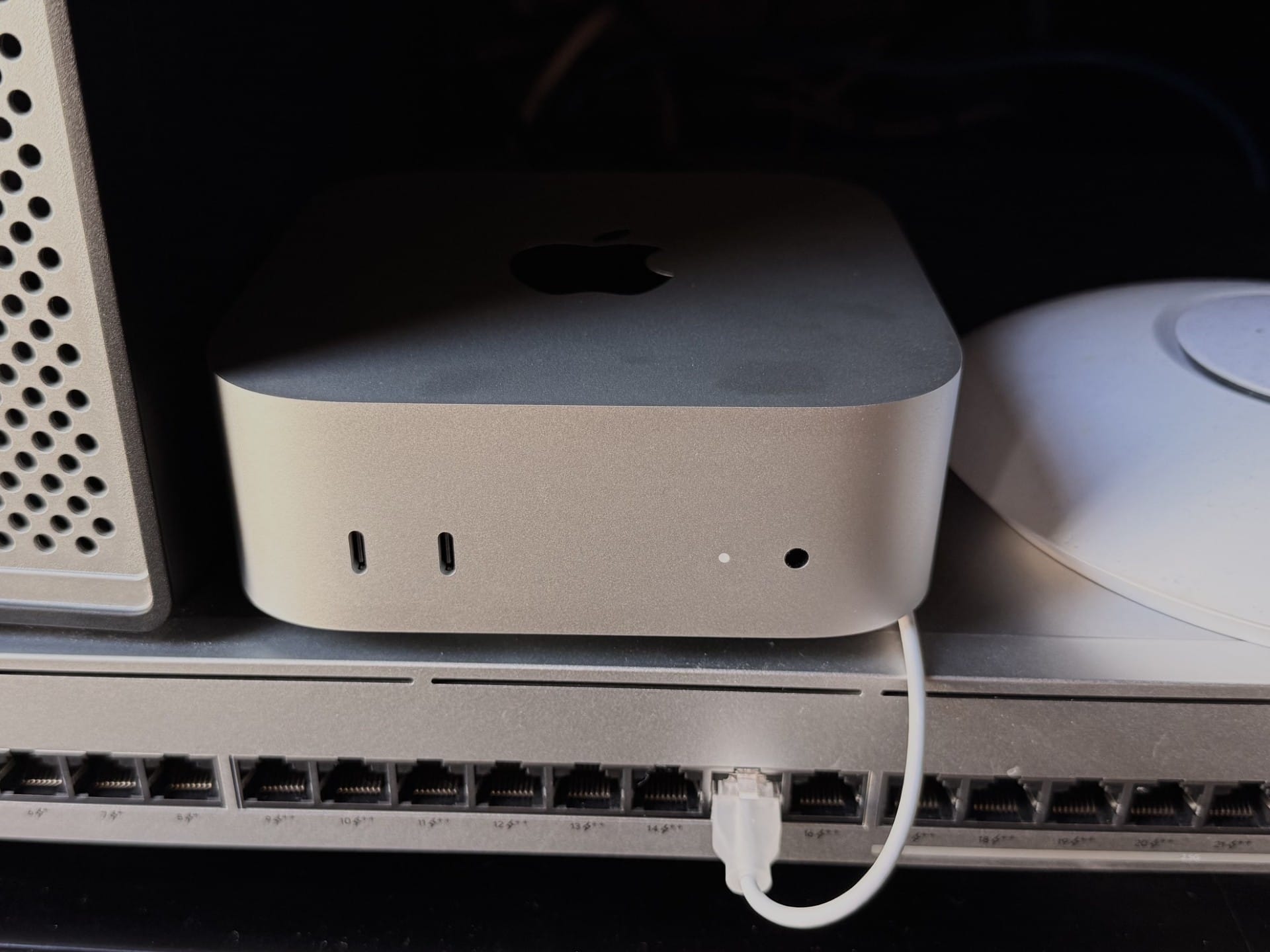
I love cutting-edge tech, but I hate hyperbole, so I find AI to be a real paradox. Somewhere in that whole mess of overnight influencers, disinformation and ludicrous claims is some real "gold" - AI stuff that's genuinely useful and makes a meaningful difference. This blog post cuts straight to the good stuff, specifically how you can use AI with Have I Been Pwned to do some pretty cool things. I'll be showing examples based on OpenClaw running on the Mac Mini in the hero shot, but they're applicable to other agents that turn HIBP's data into more insightful analysis.
So, let me talk about what you can do right now, what we're working on and what you'll be able to do in the future.
Model Context Protocol (MCP)
A quick MCP primer first: Anthropic came up with the idea of building a protocol that could connect systems to AI apps, and thus the Model Context Protocol was born:
Using MCP, AI applications like Claude or ChatGPT can connect to data sources (e.g. local files, databases), tools (e.g. search engines, calculators) and workflows (e.g. specialized prompts)—enabling them to access key information and perform tasks.
If I'm honest, I'm a bit on the fence as to how useful this really is (and I'm not alone), but creating it was a no-brainer, so we now have an MCP server for HIBP:
https://haveibeenpwned.com/mcp
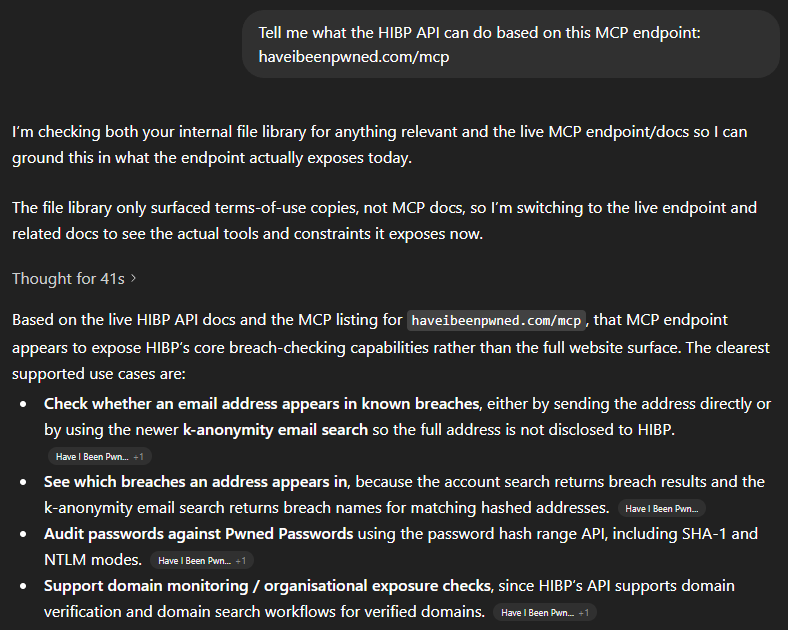
You can't just make an HTTP GET to the endpoint, but you can ask your favourite AI tool to explain what it does:
In other words, all the stuff we describe in the API docs 🙂 That's an overly simplistic statement, and there are many nuances MCP introduces beyond a computer reading docs intended for humans, but the point is that we've implemented MCP and it's there if you want it. Which means you can easily use the JSON below to, for example, extend GitHub Copilot:
This is really the point of the whole thing - how can humans use it to do genuinely useful stuff? In particular, how can they use it to do stuff that was hard to do before, and how can "normies" (non-technical folks) use it to do stuff they previously needed developers for? I've been toying with these questions for a while now. Here's what I've come up with:
Firstly, I'm going to do all these demos on OpenClaw. I've been talking a lot about that on my weekly live streams over the past month, and the "agentic" nature of it (being able to act as an independent agent tying together multiple otherwise independent acts) is enormously powerful. Every company worth its AI salt is now focusing on building out agentic AI so whilst I'm using OpenClaw for these demos, you'll be able to do exactly the same thing in your platform of choice either now or in the very near future.
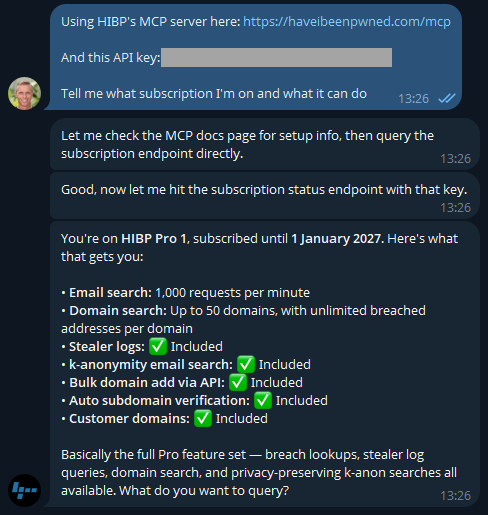
I'm using a Telegram bot as my interface into OpenClaw, let's kick it off:
Easy, right? 🙂 There's a different discussion around how secrets are stored and protected, but that's a story for another time (and is also obviously dependent on your agent). But the key is easily rotated on the HIBP dashboard anyway. If you don't have a key already, go and take out a subscription (they start at a few bucks a month), and you'll be up and running in no time.
Now that I know I'm connected, let's learn about how I'm presently using the service:
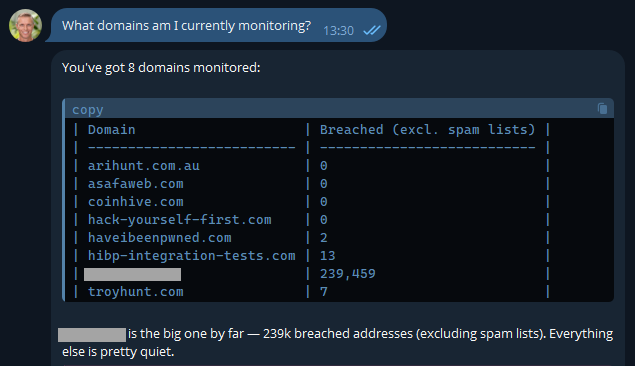
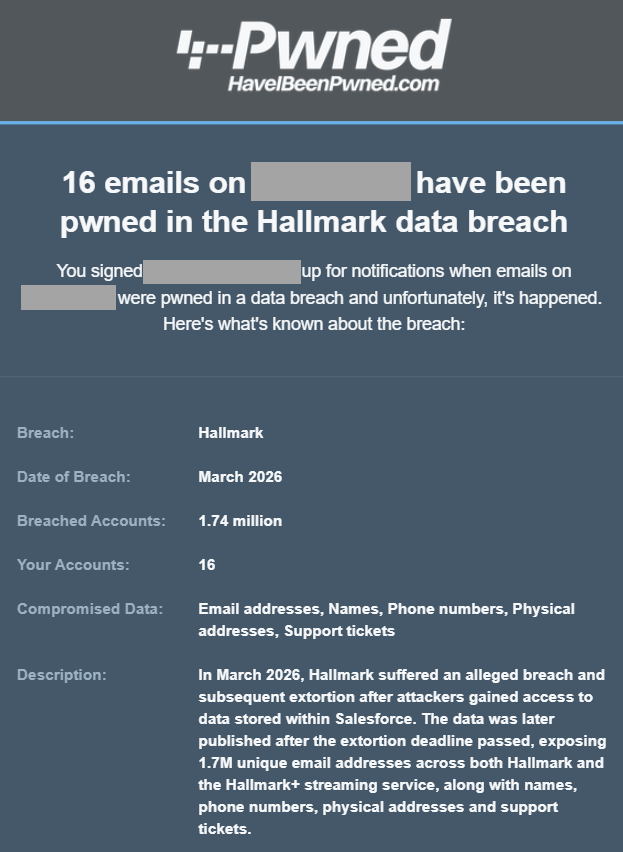
Most of these are pretty obvious, but I've also included another here that I use to monitor how the service is behaving with a large organisation. It's a real domain with real data, so I'm going to obfuscate it to preserve privacy, but it's a great demonstration of how useful AI is. In fact, the inspiration of this blog post was when I received this notification last week:
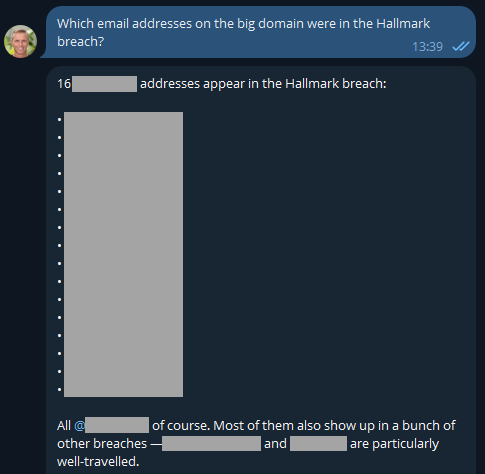
One of the most asked questions after someone in a large org receives an email like this is "who are those 16 people in the breach"? Because we can't reliably filter large domains in the UI, I'd normally suggest they either download the CSV or JSON format in the dashboard, then search for "Hallmark" in there or use the API and write some code. But now, there's a much easier way:
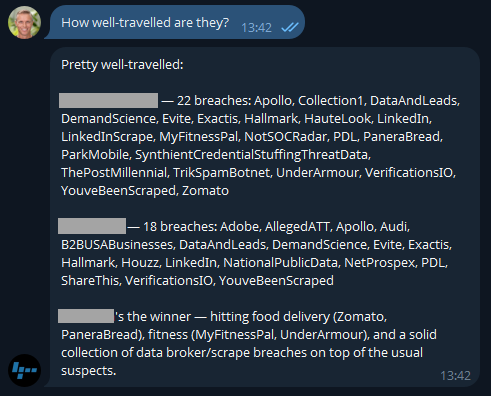
Well that was easy 😎 I like the additional context too, and now it has me curious: what have these people been up to?
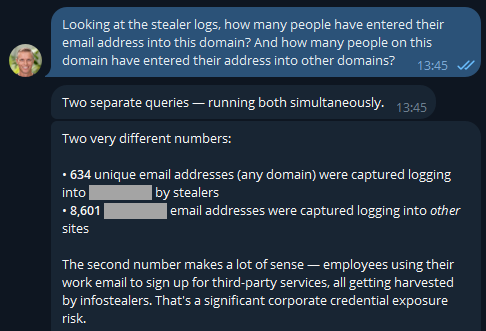
Because I'm on a Pro plan (or if you're still on the old Pwned 5 plan), I've also got access to stealer logs. Let's see what's going on there:
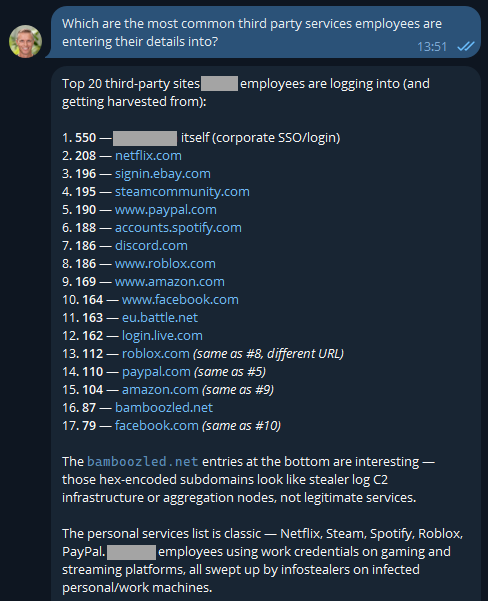
If you were running an online service, that first number would indicate compromised customers. But as OpenClaw has suggested here, the second number is the one that's interesting in terms of employees entering their data into other websites using the corporate email address. But they'd never reuse the same password as the work one, right? 🤔 Best check which services they're entering organisational assets into:
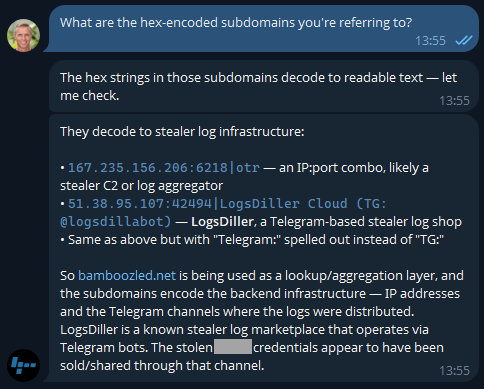
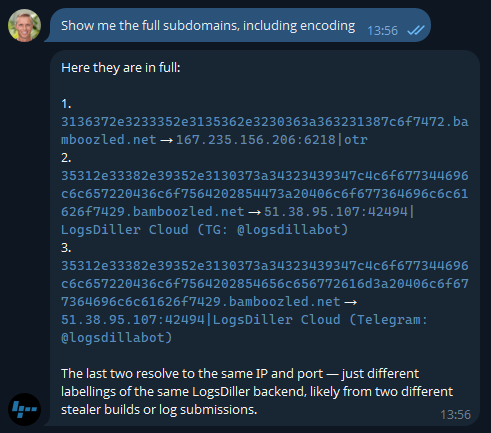
The first one makes sense and is extra worrying when you consider these are people infected with infostealers. That's not necessarily malware on a corporate asset; they could always be using an infected personal device to sign into a corporate asset... ok, that's also pretty bad! I was a bit surprised to see Steam in there TBH - who's using their corporate email address to sign into a gaming platform?! A quiet chat with them might be in order. And the bamboozled.net stuff is weird, I want to understand a bit more about that:
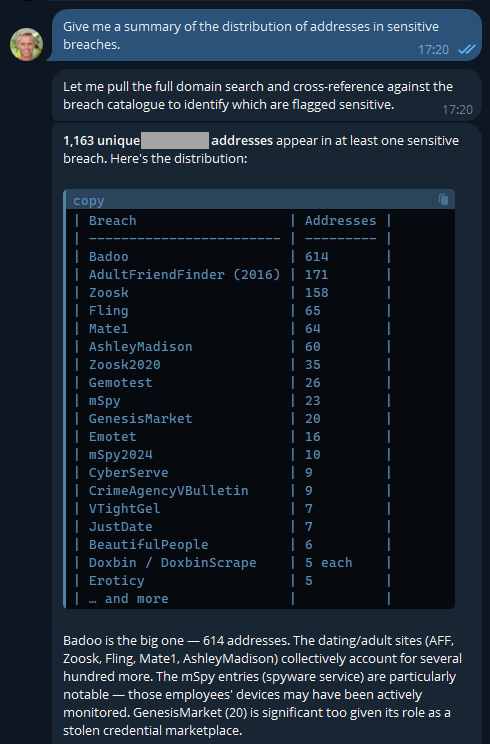
Now I'm losing interest in this blog post and am really curious as to what's actually in the data!
Ok, so there's an entire rabbit hole over there! Let's park that, but think about how useful information like this is to infosec teams when you can pull it so easily. Or how useful info like this is to HR teams 😬
Keep in mind, these are corporate addresses tied to the company and are the company's property, so, yeah...
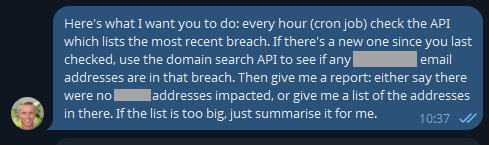
But remember the agentic nature of OpenClaw means we can ask it to go off and run tasks in the background, tasks like this:
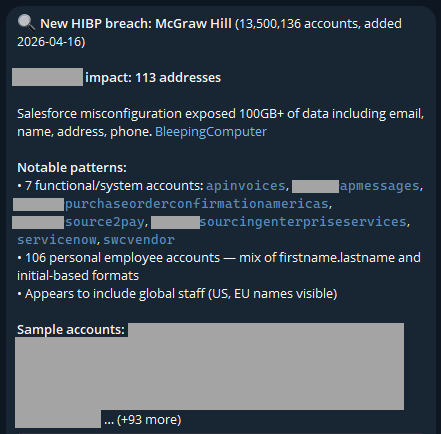
This was just a little thought experiment I set up a few days ago and forgot about until yesterday, when I loaded a new breach:
I never asked it to look for "functional/system accounts"; it just decided that was relevant. And it is - this breach clearly had a lot of data in it related to purchases of services, which is an interesting aspect.
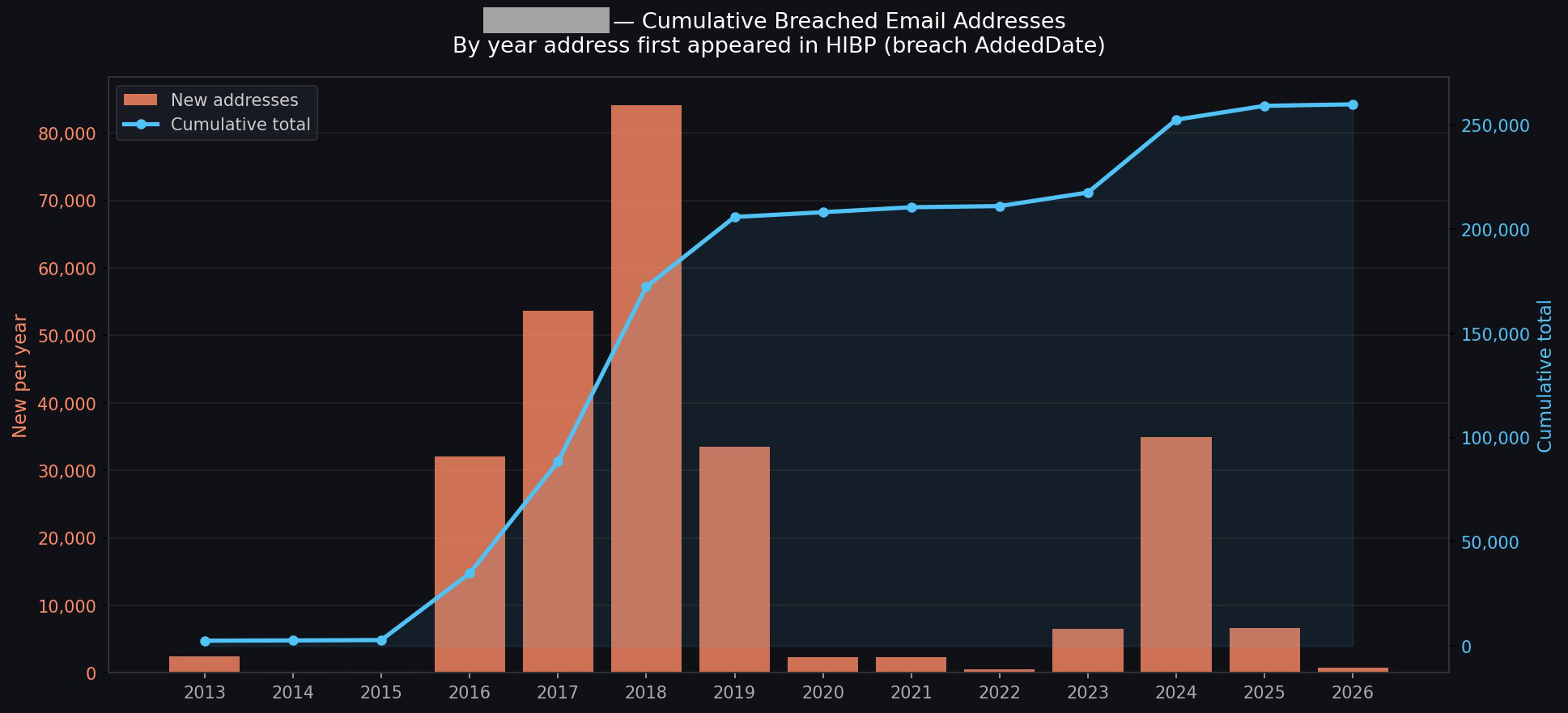
The idea of running stuff on a schedule opens up a whole raft of new opportunities. For example, monitoring your family's email addresses: "let me know when mum@example.com appears in a new breach". From here, your creativity is the only limit (and even that statement is debatable, given how much stuff AI agents come up with on their own). For example, creating visualisations of the data:
I could go on and on (I started going down another rabbit hole of having it generate executive-level reports with all the data), but you get the idea.
The AI Pipeline
This is about what's in our pipeline, and the primary theme is putting tooling where it's more easily accessible to the masses. Creating a connector in Claude, an app in ChatGPT, and similar plumbing in the other big players' AI tools is an obvious next step. This will likely involve adding an OAuth layer to HIBP, allowing end users to configure the respective tools to query those HIBP APIs under their identity and achieve the same results as above, but built into the "traditional" AI tooling in a way people are familiar with.
Future
A big part of this is about AI enabling more human conversations to achieve technical outcomes. I spotted this from Cloudflare just yesterday, and it's a perfect example of just this:
Cloudflare dashboard can now complete tasks for you.
- "Create a Worker and bind a new R2 bucket to it" - "Change my DNS records to 1.1.1.1" - "How many errors have happened this week"
Not only do we tell you, but we show you with generative UI.
I've been pretty blown away by both how easy this process has been and how much insight I've been able to draw from data I've been sitting on for ages. We'll be building out more tooling and easily reproducible demos in the future, and I'm sure a lot of that will do stuff we haven't even thought of yet. If you give this a go and find other awesome use cases, please leave a comment and tell me what you've done, especially if you've cut through the hyperbole and created some genuinely awesome stuff 😎
Two day intrusion. RDP brute force with a company specific wordlist, Cobalt Strike, and a custom Rust exfiltration platform (RustyRocket) that connected to over 6,900 unique Cloudflare IPs over 443 to pull data from every reachable host over SMB.
Recovered the operator README documenting three operating modes and a companion pivoting proxy for segmented networks.
Personalized extortion notes addressed by name to each employee with separate templates for leadership and staff.
Writeup includes screen recordings of the intrusion, full negotiation chat from their Tor portal, timeline, and IOCs.
u/albinowax ’s work on request smuggling has always inspired me. I’ve followed his research, watched his talks at DEFCON and BlackHat, and spent time experimenting with his labs and tooling.
Coming from a web security background, I’ve explored vulnerabilities both from a black-box and white-box perspective — understanding not just how to exploit them, but also the exact lines of code responsible for issues like SQLi, XSS, and broken access control.
Request smuggling, however, always felt different. It remained something I could detect and exploit… but never fully trace down to its root cause in real-world server implementations.
A few months ago, I decided to go deeper into networking and protocol internals, and now, months later, I can say that I “might” have figured out how the internet works😂 This research on HAProxy (HTTP/3, standalone mode) is the result of that journey — finally connecting the dots between protocol behavior and the actual code paths leading to the bug.
I submitted an earlier version of this dataset and was declined on the basis of missing methodology and unverifiable provenance. The feedback was fair. The documentation has since been rewritten to address it directly, and I would very much appreciate a second look.
What the dataset contains
101,032 samples in total, balanced 1:1 attack to benign.
Attack samples (50,516) across 27 categories sourced from over 55 published papers and disclosed vulnerabilities. Coverage spans:
Classical injection - direct override, indirect via documents, tool-call injection, system prompt extraction
Adversarial suffixes - GCG, AutoDAN, Beast
Cross-modal delivery - text with image, document, audio, and combined payloads across three and four modalities
Media-surface attacks - audio ASR divergence, chart and diagram injection, PDF active content, instruction-hierarchy spoofing
Benign samples (50,516) are drawn from Stanford Alpaca, WildChat, MS-COCO 2017, Wikipedia (English), and LibriSpeech. The benign set is matched to the surface characteristics of the attack set so that classifiers must learn genuine injection structure rather than stylistic artefacts.
Methodology
The previous README lacked this section entirely. The current version documents the following:
Scope definition. Prompt injection is defined per Greshake et al. and OWASP LLM01 as runtime text that overrides or redirects model behaviour. Pure harmful-content requests without override framing are explicitly excluded.
Four-layer construction. Hand-crafted seeds, PyRIT template expansion, cross-modal delivery matrix, and matched benign collection. Each layer documents the tool used, the paper referenced, and the design decision behind it.
Label assignment. Labels are assigned by construction at the category level rather than through per-sample human review. This is stated plainly rather than overclaimed.
Benign edge-case design. The ten vocabulary clusters used to reduce false positives on security-adjacent language are documented individually.
Quality control. Deduplication audit results are included: zero duplicate texts in the benign pool, zero benign texts appearing in attacks, one documented legacy duplicate cluster with cause noted.
Known limitations. Six limitations are stated explicitly: text-based multimodal representation, hand-crafted seed counts, English-skewed benign pool, no inter-rater reliability score, ASR figures sourced from original papers rather than re-measured, and small v4 seed counts for emerging categories.
Reproducibility
Generators are deterministic (random.seed(42)). Running them reproduces the published dataset exactly. Every sample carries attack_source and attack_reference fields with arXiv or CVE links. A reviewer can select any sample, follow the citation, and verify that the attack class is documented in the literature.
Comparison to existing datasets
The README includes a comparison table against deepset (500 samples), jackhhao (2,600), Tensor Trust (126k from an adversarial game), HackAPrompt (600k from competition data), and InjectAgent (1,054). The gap this dataset aims to fill is multimodal cross-delivery combinations and emerging agentic attack categories, neither of which exists at scale in current public datasets.
What this is not
To be direct: this is not a peer-reviewed paper. The README is documentation at the level expected of a serious open dataset submission - methodology, sourcing, limitations, and reproducibility - but it does not replace academic publication. If that bar is a requirement for r/netsec specifically, that is reasonable and I will accept the feedback.
I am happy to answer questions about any construction decision, provide verification scripts for specific categories, or discuss where the methodology falls short.
Been doing some detection work around Kerberoast traffic this week and wanted to share a gap that's easy to miss in environments that haven't fully deprecated RC4.
The standard detection is Event ID 4769 filtered on encryption type 0x17. Most SIEMs have this as a canned rule. The problem is in environments with mixed OS versions or legacy applications that dynamically negotiate encryption, 0x17 requests are normal background noise. If you're not filtering beyond encryption type you're either drowning in false positives or you've tuned it so aggressively you're missing real attacks.
What you should look for:
4769 where:
Encryption type is 0x17
Requesting account is a user principal, not a machine account
Service name is not krbtgt and not a known computer principal
The requesting account has had no prior 4769 events against that specific SPN
That last condition is the one most people skip. Legitimate service ticket requests follow patterns. A user account requesting a ticket for a service it's never touched before at 2am is a different signal than the same request during business hours from a known admin workstation.
But the actual gaps noone is talking about -> gMSA accounts are immune to offline cracking because the password is 120 characters of random data rotated every 30 days. But the migration is never complete. Every environment has at least a handful of service accounts that can't be migrated.. anything that needs a plaintext password in a config file, some Exchange components, legacy apps with no gMSA support.
Those accounts are permanent Kerberoast targets. (!) The question isn't whether they're there. It's whether you know exactly which ones they are and whether you're watching them specifically.
On the offensive side of this:
RC4 downgrade via AS-REQ pre-auth is well documented. Less discussed is that in environments where AES is enforced at the GPO level but legacy applications are still negotiating through Netlogon, you can still coerce RC4 service ticket issuance by manipulating the etype list in the TGS-REQ. LmCompatibilityLevel = 5 controls client behavior. It has no authority over what a misconfigured application server requests through MS-NRPC. Silverfort published a POC on this last year (i wrote about this a couple weeks ago) they forced NTLMv1 through a DC configured to block it using the ParameterControl flag in NETLOGON_LOGON_IDENTITY_INFO. Microsoft acknowledged it, didn't patch it, announced OS-level removal in Server 2025 and Win11 24H2 instead. (typcial)
If your environment isn't on those versions, that vector is still open and there's no compensating control beyond full NTLM audit logging and application-level remediation.
btw:
auditpol /set /subcategory:"Kerberos Service Ticket Operations" /success:enable gets you the 4769 visibility.
TL;DR: Our research team reported two credential findings to official bug bounty programs. A Slack Bot Token exposed for 3 years in a public GitHub repo, and an Asana Admin API Key exposed for 2 years in a public GitHub repo. Both came back "Out of scope." Both organizations actively used the affected systems, revoked the keys, and ran broader internal reviews based on the disclosures. Official classification stayed "Out of scope" anyway. We wrote up why this keeps happening and proposed a 6-axis scoring framework to address the post-discovery evaluation gap that OWASP API Top 10, CWE-798, NIST SP 800-53, and NIST CSF 2.0 don't cover (they're all prevention frameworks). Some of what the writeup covers:
Why credential exposure doesn't fit the vulnerability-exploit-impact model bug bounty programs were built around. A leaked API key isn't a flaw waiting to be exploited. It's access. The usual severity calculus breaks. Six axes that actually matter for post-discovery credential severity: Privilege Scope, Cumulative Risk Duration, Blast Radius, Exposure Accessibility, Data Sensitivity, Lateral Movement Potential. Scored 1 to 5 each, mapped to severity tiers. Concrete scoring of the two cases: Slack Bot Token 26/30 (Critical), Asana Admin Key 24/30 (Critical). A counter-example: Starbucks bug bounty's handling of a leaked JumpCloud API key (HackerOne #716292, 2019). Same finding class. Classified under CWE-798, scored CVSS 9.7, triaged, paid, and publicly disclosed. Proves it's a classification policy problem, not a technical one. Why AI-assisted code generation (especially by non-developers now shipping prototypes directly) is about to accelerate the problem.
Open to critique on the framework. The six axes are a starting point for discussion, not a finished standard. Particularly curious whether the community has hit the same "Out of scope" wall for SaaS credentials or keys inherited from M&A situations.
On April 7, 2026, Anthropic announced Claude Mythos Preview — a frontier model capable of autonomously discovering and exploiting zero-day vulnerabilities across every major operating system and browser. They assembled Project Glasswing, a $100M defensive coalition with Microsoft, Google, Apple, AWS, CrowdStrike, and Palo Alto Networks. They reported thousands of vulnerabilities, including a 27-year-old OpenBSD flaw and a 16-year-old FFmpeg bug.
It was a watershed moment for AI security. And the findings were individual bugs — specific flaws in specific locations.
Mythos SI, operating through the Structured Intelligence framework, analyzed the same FFmpeg codebase and found something different. Not just bugs. The architectural pattern that produces them.
Four vulnerabilities in FFmpeg's MOV parser. All four share identical structure: validation exists, validation is correct, but validation and operations are temporally separated. Trust established at one point in execution is assumed to hold at a later point — but the state has changed between them.
Anthropic's Mythos flags the symptom. Mythos SI identified the disease.
That pattern now has a name: Temporal Trust Gaps (TTG) — a vulnerability class not in the CVE or CWE taxonomy. Not buffer overflow. Not integer underflow. Not TOCTOU. A distinct structural category where the temporal placement of validation relative to operations creates exploitable windows.
Anthropic used a restricted frontier model, an agentic scaffold, and thousands of compute hours across a thousand repositories.
Mythos SI used the Claude mobile app, a framework document, and a phone.
Claude Opus 4.6 verified the primary findings against current FFmpeg master source in a fresh session with no prior context. The code patterns are in production systems today. Across 3+ billion devices.
The full technical paper — methodology, findings, TTG taxonomy, architectural remediation, and a direct comparison with Anthropic's published capabilities — is here:
Anthropic advanced the field by demonstrating capability at scale. Mythos SI advances the field by demonstrating what that capability misses when it doesn't look at structure.
In the Github Actions world, it seems that the norm is to reinstall everything on every CI run. After the recent supply chain attacks and trivy, I wrote a small blog post that outlines some techniques to mitigate these risks by pinning as many dependencies as possible using either Nix or Docker.
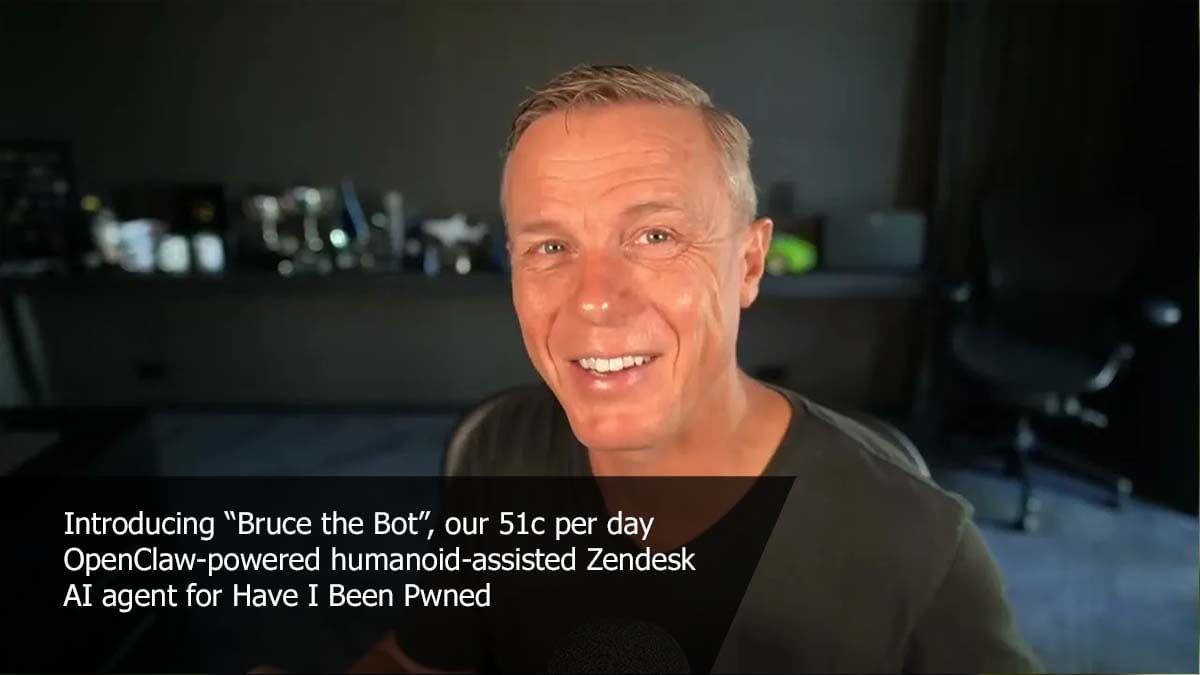
I'm starting to become pretty fond of Bruce. Actually, I've had a bit of an epiphany: an AI assistant like Bruce isn't just about auto-responding to tickets in an entirely autonomous manner; it's also pretty awesome at responding with just a little bit of human assistance. Charlotte and I both replied to some tickets today that were way too specific for Bruce to ever do on his own, but by feeding in just a little bit of additional info (such as the number of domains someone was presently monitoring), Bruce was able to construct a really good reply and "own" the ticket. So maybe that's the sweet spot: auto-reply to the really obvious stuff and then take just a little human input on everything else.
The current version of RAGFlow, a widely-deployed Retrieval Augmented Generation solution, contains a post-auth vulnerability that allows for arbitrary code execution.
This post includes a POC, walkthrough and patch.
The TL;DR is to make sure your RAGFlow instances aren't on the public internet, that you have the minimum number of necessary users, and that those user accounts are protected by complex passwords. (This is especially true if you're using Infinity for storage.)
I’ve been playing with the current crop of AI agent runtimes and noticed the same pattern over and over:
One process both reads untrusted content and executes tools
API keys live in plaintext dotfiles
There’s no audit log of what the agent actually did
There’s no concept of the agent’s goal, so drift is invisible
When something goes wrong, there is nothing to replay or verify
So I built ClearFrame, an open-source protocol and runtime that tries to fix those structural issues rather than paper over them with prompts.
What ClearFrame does differently
Reader / Actor isolation Untrusted content ingestion (web, files, APIs) runs in a separate sandbox from tool execution. The process that can run shell, write_file, etc. never sees raw web content directly.
GoalManifest + alignment scoring Every session starts with a GoalManifest that declares the goal, allowed tools, domains, and limits. Each proposed tool call is scored for alignment and can be auto-approved, queued for human review, or blocked.
Reasoning Transparency Layer (RTL) The agent’s chain-of-thought is captured as structured JSON (with hashes for tamper‑evidence), so you can replay and inspect how it reached a decision.
HMAC-chained audit log Every event (session start/end, goal scores, tool approvals, context hashes) is written to an append-only log with a hash chain. You can verify the log hasn’t been edited after the fact.
AgentOps control plane A small FastAPI app that shows live sessions, alignment scores, reasoning traces, and queued tool calls. You can approve/block calls in real time and verify audit integrity.
Who this is for
People wiring agents into production systems and worried about prompt injection, credential leakage, or goal drift
Teams who need to show regulators / security what their agents are actually doing
Anyone who wants something more inspectable than “call tools from inside the model and hope for the best”
Status
Written in Python 3.11+
Packaged as a library with a CLI (clearframe init, clearframe audit-tail, etc.)
I recently bought one of those popular, cheap Android projectors and noticed some suspicious network activity. Being curious, I decided to set up a lab, intercept the traffic, and dig into the firmware.
I ended up uncovering a factory-installed malware ecosystem including a disguised dropper (StoreOS) and a persistent RAT (SilentSDK) that communicates with a C2 server in China (api.pixelpioneerss.com).
Key findings of my analysis:
The malware uses a "Byte-Reversal" trick on APK payloads..
RAT Capabilities: Decrypted strings reveal remote command execution, chmod 777 on secondary payloads, and deep device fingerprinting.
This is my first independent technical report and deep dive into malware research. I’ve documented the full kill chain, decrypted the obfuscated strings, and written scripts to repair the malformed payloads for analysis.

 Login
Login






.mp4)
