 Login
Login
The Emerging Workload Security Threat, a Retrospective on VoidLink
Explore how VoidLink, a malware framework, targets Kubernetes and AI workloads. Discover why kernel-level runtime security is the new frontline.

In early January 2026, KrebsOnSecurity revealed how a security researcher disclosed a vulnerability that was used to build Kimwolf, the world’s largest and most disruptive botnet. Since then, the person in control of Kimwolf — who goes by the handle “Dort” — has coordinated a barrage of distributed denial-of-service (DDoS), doxing and email flooding attacks against the researcher and this author, and more recently caused a SWAT team to be sent to the researcher’s home. This post examines what is knowable about Dort based on public information.
A public “dox” created in 2020 asserted Dort was a teenager from Canada (DOB August 2003) who used the aliases “CPacket” and “M1ce.” A search on the username CPacket at the open source intelligence platform OSINT Industries finds a GitHub account under the names Dort and CPacket that was created in 2017 using the email address jay.miner232@gmail.com.
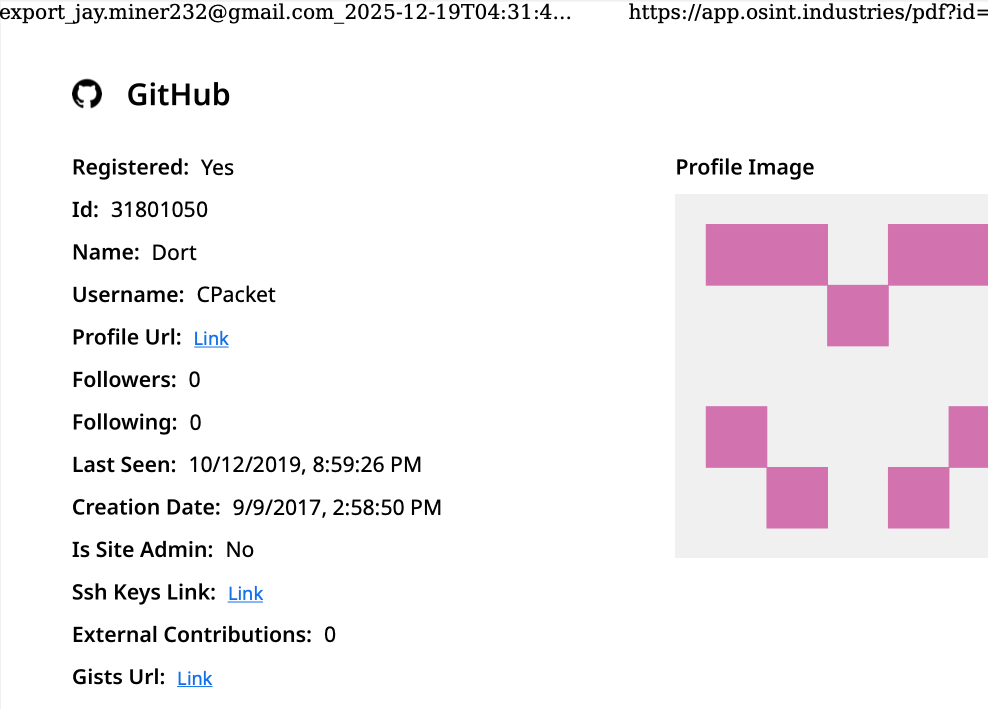
Image: osint.industries.
The cyber intelligence firm Intel 471 says jay.miner232@gmail.com was used between 2015 and 2019 to create accounts at multiple cybercrime forums, including Nulled (username “Uubuntuu”) and Cracked (user “Dorted”); Intel 471 reports that both of these accounts were created from the same Internet address at Rogers Canada (99.241.112.24).
Dort was an extremely active player in the Microsoft game Minecraft who gained notoriety for their “Dortware” software that helped players cheat. But somewhere along the way, Dort graduated from hacking Minecraft games to enabling far more serious crimes.
Dort also used the nickname DortDev, an identity that was active in March 2022 on the chat server for the prolific cybercrime group known as LAPSUS$. Dort peddled a service for registering temporary email addresses, as well as “Dortsolver,” code that could bypass various CAPTCHA services designed to prevent automated account abuse. Both of these offerings were advertised in 2022 on SIM Land, a Telegram channel dedicated to SIM-swapping and account takeover activity.
The cyber intelligence firm Flashpoint indexed 2022 posts on SIM Land by Dort that show this person developed the disposable email and CAPTCHA bypass services with the help of another hacker who went by the handle “Qoft.”
“I legit just work with Jacob,” Qoft said in 2022 in reply to another user, referring to their exclusive business partner Dort. In the same conversation, Qoft bragged that the two had stolen more than $250,000 worth of Microsoft Xbox Game Pass accounts by developing a program that mass-created Game Pass identities using stolen payment card data.
Who is the Jacob that Qoft referred to as their business partner? The breach tracking service Constella Intelligence finds the password used by jay.miner232@gmail.com was reused by just one other email address: jacobbutler803@gmail.com. Recall that the 2020 dox of Dort said their date of birth was August 2003 (8/03).
Searching this email address at DomainTools.com reveals it was used in 2015 to register several Minecraft-themed domains, all assigned to a Jacob Butler in Ottawa, Canada and to the Ottawa phone number 613-909-9727.
Constella Intelligence finds jacobbutler803@gmail.com was used to register an account on the hacker forum Nulled in 2016, as well as the account name “M1CE” on Minecraft. Pivoting off the password used by their Nulled account shows it was shared by the email addresses j.a.y.m.iner232@gmail.com and jbutl3@ocdsb.ca, the latter being an address at a domain for the Ottawa-Carelton District School Board.
Data indexed by the breach tracking service Spycloud suggests that at one point Jacob Butler shared a computer with his mother and a sibling, which might explain why their email accounts were connected to the password “jacobsplugs.” Neither Jacob nor any of the other Butler household members responded to requests for comment.
The open source intelligence service Epieos finds jacobbutler803@gmail.com created the GitHub account “MemeClient.” Meanwhile, Flashpoint indexed a deleted anonymous Pastebin.com post from 2017 declaring that MemeClient was the creation of a user named CPacket — one of Dort’s early monikers.
Why is Dort so mad? On January 2, KrebsOnSecurity published The Kimwolf Botnet is Stalking Your Local Network, which explored research into the botnet by Benjamin Brundage, founder of the proxy tracking service Synthient. Brundage figured out that the Kimwolf botmasters were exploiting a little-known weakness in residential proxy services to infect poorly-defended devices — like TV boxes and digital photo frames — plugged into the internal, private networks of proxy endpoints.
By the time that story went live, most of the vulnerable proxy providers had been notified by Brundage and had fixed the weaknesses in their systems. That vulnerability remediation process massively slowed Kimwolf’s ability to spread, and within hours of the story’s publication Dort created a Discord server in my name that began publishing personal information about and violent threats against Brundage, Yours Truly, and others.

Dort and friends incriminating themselves by planning swatting attacks in a public Discord server.
Last week, Dort and friends used that same Discord server (then named “Krebs’s Koinbase Kallers”) to threaten a swatting attack against Brundage, again posting his home address and personal information. Brundage told KrebsOnSecurity that local police officers subsequently visited his home in response to a swatting hoax which occurred around the same time that another member of the server posted a door emoji and taunted Brundage further.

Dort, using the alias “Meow,” taunts Synthient founder Ben Brundage with a picture of a door.
Someone on the server then linked to a cringeworthy (and NSFW) new Soundcloud diss track recorded by the user DortDev that included a stickied message from Dort saying, “Ur dead nigga. u better watch ur fucking back. sleep with one eye open. bitch.”
“It’s a pretty hefty penny for a new front door,” the diss track intoned. “If his head doesn’t get blown off by SWAT officers. What’s it like not having a front door?”
With any luck, Dort will soon be able to tell us all exactly what it’s like.
Update, 10:29 a.m.: Jacob Butler responded to requests for comment, speaking with KrebsOnSecurity briefly via telephone. Butler said he didn’t notice earlier requests for comment because he hasn’t really been online since 2021, after his home was swatted multiple times. He acknowledged making and distributing a Minecraft cheat long ago, but said he hasn’t played the game in years and was not involved in Dortsolver or any other activity attributed to the Dort nickname after 2021.
“It was a really old cheat and I don’t remember the name of it,” Butler said of his Minecraft modification. “I’m very stressed, man. I don’t know if people are going to swat me again or what. After that, I pretty much walked away from everything, logged off and said fuck that. I don’t go online anymore. I don’t know why people would still be going after me, to be completely honest.”
When asked what he does for a living, Butler said he mostly stays home and helps his mom around the house because he struggles with autism and social interaction. He maintains that someone must have compromised one or more of his old accounts and is impersonating him online as Dort.
“Someone is actually probably impersonating me, and now I’m really worried,” Butler said. “This is making me relive everything.”
But there are issues with Butler’s timeline. For example, Jacob’s voice in our phone conversation was remarkably similar to the Jacob/Dort whose voice can be heard in this Sept. 2022 Clash of Code competition between Dort and another coder (Dort lost). At around 6 minutes and 10 seconds into the recording, Dort launches into a cursing tirade that mirrors the stream of profanity in the diss rap that Dortdev posted threatening Brundage. Dort can be heard again at around 16 minutes; at around 26:00, Dort threatens to swat his opponent.
Butler said the voice of Dort is not his, exactly, but rather that of an impersonator who had likely cloned his voice.
“I would like to clarify that was absolutely not me,” Butler said. “There must be someone using a voice changer. Or something of the sorts. Because people were cloning my voice before and sending audio clips of ‘me’ saying outrageous stuff.”
For the past week, the massive “Internet of Things” (IoT) botnet known as Kimwolf has been disrupting The Invisible Internet Project (I2P), a decentralized, encrypted communications network designed to anonymize and secure online communications. I2P users started reporting disruptions in the network around the same time the Kimwolf botmasters began relying on it to evade takedown attempts against the botnet’s control servers.
Kimwolf is a botnet that surfaced in late 2025 and quickly infected millions of systems, turning poorly secured IoT devices like TV streaming boxes, digital picture frames and routers into relays for malicious traffic and abnormally large distributed denial-of-service (DDoS) attacks.
I2P is a decentralized, privacy-focused network that allows people to communicate and share information anonymously.
“It works by routing data through multiple encrypted layers across volunteer-operated nodes, hiding both the sender’s and receiver’s locations,” the I2P website explains. “The result is a secure, censorship-resistant network designed for private websites, messaging, and data sharing.”
On February 3, I2P users began complaining on the organization’s GitHub page about tens of thousands of routers suddenly overwhelming the network, preventing existing users from communicating with legitimate nodes. Users reported a rapidly increasing number of new routers joining the network that were unable to transmit data, and that the mass influx of new systems had overwhelmed the network to the point where users could no longer connect.
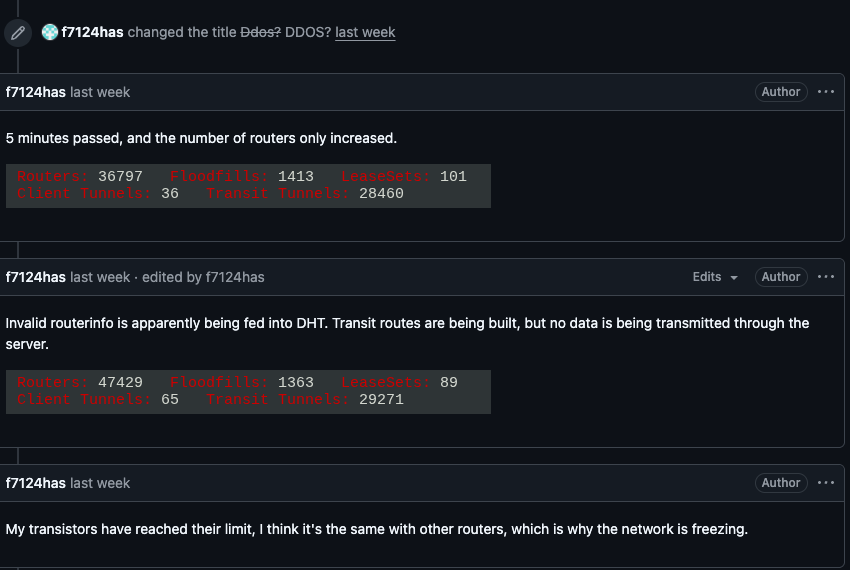
I2P users complaining about service disruptions from a rapidly increasing number of routers suddenly swamping the network.
When one I2P user asked whether the network was under attack, another user replied, “Looks like it. My physical router freezes when the number of connections exceeds 60,000.”
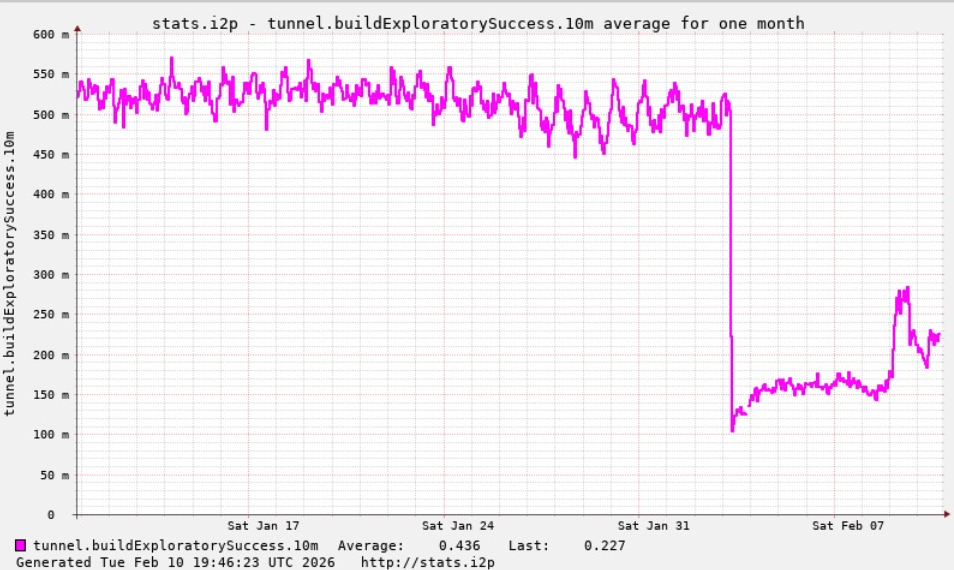
A graph shared by I2P developers showing a marked drop in successful connections on the I2P network around the time the Kimwolf botnet started trying to use the network for fallback communications.
The same day that I2P users began noticing the outages, the individuals in control of Kimwolf posted to their Discord channel that they had accidentally disrupted I2P after attempting to join 700,000 Kimwolf-infected bots as nodes on the network.
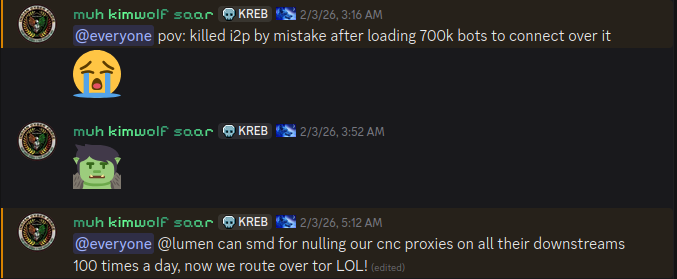
The Kimwolf botmaster openly discusses what they are doing with the botnet in a Discord channel with my name on it.
Although Kimwolf is known as a potent weapon for launching DDoS attacks, the outages caused this week by some portion of the botnet attempting to join I2P are what’s known as a “Sybil attack,” a threat in peer-to-peer networks where a single entity can disrupt the system by creating, controlling, and operating a large number of fake, pseudonymous identities.
Indeed, the number of Kimwolf-infected routers that tried to join I2P this past week was many times the network’s normal size. I2P’s Wikipedia page says the network consists of roughly 55,000 computers distributed throughout the world, with each participant acting as both a router (to relay traffic) and a client.
However, Lance James, founder of the New York City based cybersecurity consultancy Unit 221B and the original founder of I2P, told KrebsOnSecurity the entire I2P network now consists of between 15,000 and 20,000 devices on any given day.
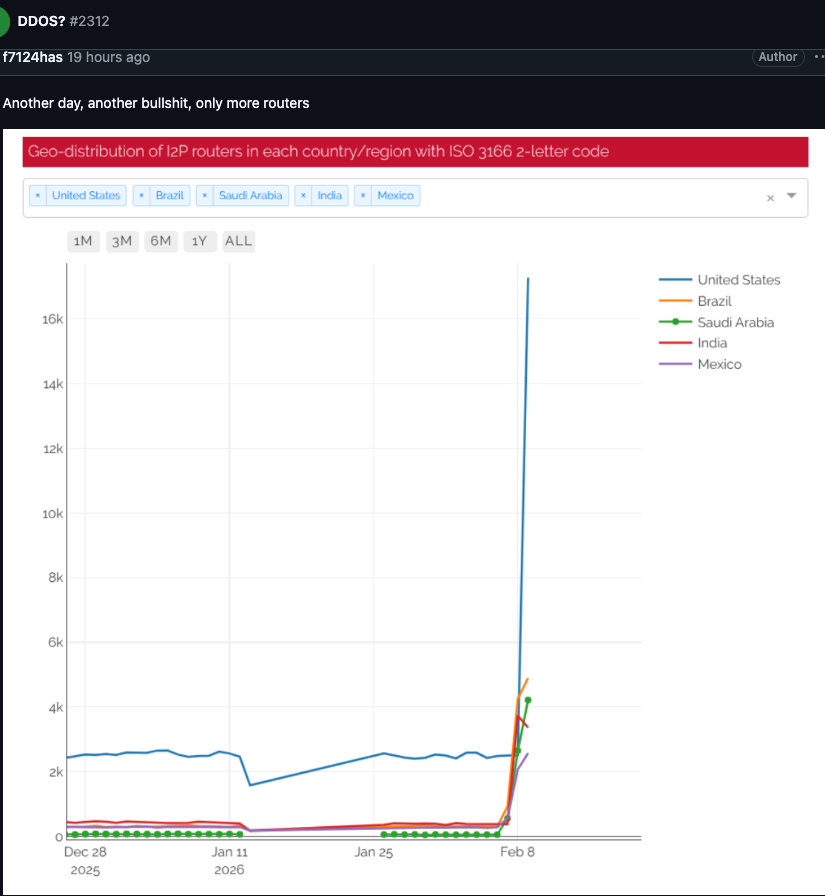
An I2P user posted this graph on Feb. 10, showing tens of thousands of routers — mostly from the United States — suddenly attempting to join the network.
Benjamin Brundage is founder of Synthient, a startup that tracks proxy services and was the first to document Kimwolf’s unique spreading techniques. Brundage said the Kimwolf operator(s) have been trying to build a command and control network that can’t easily be taken down by security companies and network operators that are working together to combat the spread of the botnet.
Brundage said the people in control of Kimwolf have been experimenting with using I2P and a similar anonymity network — Tor — as a backup command and control network, although there have been no reports of widespread disruptions in the Tor network recently.
“I don’t think their goal is to take I2P down,” he said. “It’s more they’re looking for an alternative to keep the botnet stable in the face of takedown attempts.”
The Kimwolf botnet created challenges for Cloudflare late last year when it began instructing millions of infected devices to use Cloudflare’s domain name system (DNS) settings, causing control domains associated with Kimwolf to repeatedly usurp Amazon, Apple, Google and Microsoft in Cloudflare’s public ranking of the most frequently requested websites.
James said the I2P network is still operating at about half of its normal capacity, and that a new release is rolling out which should bring some stability improvements over the next week for users.
Meanwhile, Brundage said the good news is Kimwolf’s overlords appear to have quite recently alienated some of their more competent developers and operators, leading to a rookie mistake this past week that caused the botnet’s overall numbers to drop by more than 600,000 infected systems.
“It seems like they’re just testing stuff, like running experiments in production,” he said. “But the botnet’s numbers are dropping significantly now, and they don’t seem to know what they’re doing.”
