Reading view

Verisign Celebrates Hispanic Heritage Month

Photographs of three Hispanic Verisign employees on a dark purple background.

Celebrating National Hispanic Heritage Month reminds us how the wide range of perspectives and experiences among our employees makes us stronger both as a company and as a steward of the internet. In honor of this month, we are proud to recognize the stories of three of our Hispanic employees, and the positive impact they make at Verisign.

Carlos Ruesta

As Verisign’s director of information security, Carlos Ruesta draws inspiration from his father’s community commitment as an agricultural engineer in Peru, working to bring safe food and water to isolated communities. His father’s experiences inform Carlos’ belief in Verisign’s mission of enabling the world to connect online with reliability and confidence, anytime, anywhere and motivates his work as part of a team that ensures trust.

As a leader in our security compliance division, Carlos ensures that his team maintains a robust governance, risk, and compliance framework, translating applicable laws and regulations into security control requirements. “Being part of a team that emphasizes trust, motivates me,” he said. “Management trusts me to make decisions affecting large-scale projects that protect our company. This allows me to use my problem-solving skills and leadership abilities.”

Carlos commends Verisign’s respectful and encouraging environment, which he considers vital in cultivating successful career paths for newcomers navigating the cybersecurity field. He says by recognizing individual contributions and supporting each other’s professional growth, Hispanic employees at Verisign feel a sense of belonging in the workplace and are able to excel in their career journeys.

Alejandro Gonzalez Roman

Alejandro Gonzalez Roman, a senior UX designer at Verisign, combines his artistic talent with technical expertise in his role, collaborating among various departments across Verisign. “My dad is an artist, and still one of my biggest role models,” he said. “He taught me that to be good at anything means to dedicate a lot of time to perfecting your craft. I see art as a way to inspire people to make the world a better place. In my job as a UX designer, I use art to make life a little easier for people.”

As a UX designer, Alejandro strives to make technology accessible to everyone, regardless of background or abilities. He believes that life experiences and cultural knowledge provide individuals with a unique perspective, which he considers an invaluable source of inspiration when designing. And with the Hispanic population being one of the largest minorities in the United States, cultural knowledge is crucial. Understanding how different people interact with technology and integrating cultural insights into the work is essential to good UX design.

Overall, Alejandro is motivated by the strong sense of teamwork at Verisign. “Day-to-day work with our strong team has helped me improve my work” he said. “With collaboration and encouragement, we push each other to be better UX designers. I couldn’t succeed as I have without this amazing team around me.”

Rebecca Bustamante

Rebecca Bustamante, senior manager of operations analysis, says Verisign’s “people-first” culture is part of her motivation, and she is grateful for the opportunities that allowed her to take on different roles within the company to learn and broaden her skills. “I’ve had opportunities because people believed in my potential and saw my work ethic,” she said. “These experiences have given me the understanding and skills to succeed at the job I have today.”

One of these experiences was joining the WIT@Verisign (Women in Technology) leadership team, which proved instrumental to her personal growth and led to valuable work friendships. In fact, one of her most cherished memories at Verisign includes leading a Verisign Cares team project in Virginia’s Great Falls Park, where she and her coworkers worked together to clear invasive plants and renovate walking paths.

Rebecca sees this type of camaraderie among employees as a crucial part of the people-first culture at Verisign. She particularly commends Verisign’s team leaders who value consistent communication and take the time to listen to people’s stories, which fosters an authentic understanding. This approach makes collaboration more natural and allows teamwork to develop organically. Rebecca emphasizes the significance of celebrating her culture, as it directly influences her job performance and effective communication. But she pointed out that the term “Hispanic” encompasses a wide diversity of peoples and nations. She advocates respect, practices active listening, and promotes a culture celebrating each other’s successes.

Joining the Verisign Team

These three individuals – as well as their many team members – contribute to Verisign’s efforts to enable and enhance the security, stability, and resiliency of key internet infrastructure every single day.

At Verisign, we recognize the importance of talent and culture in driving an environment that fosters high performance, inclusion, and integrity in all aspects of our work. It’s why recruiting and retaining the very best talent is our continual focus. If you would like to be part of the Verisign Team, please visit Verisign Careers.

The post Verisign Celebrates Hispanic Heritage Month appeared first on Verisign Blog.

  •  

Building a More Secure Routing System: Verisign’s Path to RPKI

abstract-technology-background

This blog was co-authored by Verisign Distinguished Engineer Mike Hollyman and Verisign Director – Engineering Hasan Siddique. It is based on a lightning talk they gave at NANOG 87 in February 2023, the slides from which are available on the NANOG website.

At Verisign, we believe that continuous improvements to the safety and security of the global routing system are critical for the reliability of the internet. As such, we’ve recently embarked on a path to implement Resource Public Key Infrastructure (RPKI) within our technology ecosystem as a step toward building a more secure routing system. In this blog, we share our ongoing journey toward RPKI adoption and the lessons we’ve learned as an operator of critical internet infrastructure.

While RPKI is not a silver bullet for securing internet routing, practical adoption of RPKI can deliver significant benefits. This will be a journey of deliberate, measured, and incremental steps towards a larger goal, but we believe the end result will be more than worth it.

Why RPKI and why now?

Under the Border Gateway Protocol (BGP) – the internet’s de-facto inter-domain routing protocol for the last three decades – local routing policies decide where and how internet traffic flows, but each network independently applies its own policies on what actions it takes, if any, with data that connects through its network. For years, “routing by rumor” served the internet well; however, our growing dependence upon the global internet for sensitive and critical communications means that internet infrastructure merits a more robust approach for protecting routing information. Preventing route leaks, mis-originations, and hijacks is a first step.

Verisign was one of the first organizations to join the Mutually Agreed Norms for Routing Security (MANRS) Network Operator Program in 2017. Ever since the establishment of the program, facilitating routing information – via an Internet Routing Registry (IRR) or RPKI – has been one of the key “actions” of the MANRS program. Verisign has always been fully supportive of MANRS and its efforts to promote a culture of collective responsibility, collaboration, and coordination among network peers in the global internet routing system.

Just as RPKI creates new protections, it also brings new challenges. Mindful of those challenges, but committed to our mission of upholding the security, stability, and resiliency of the internet, Verisign is heading toward RPKI adoption.

Adopting RPKI ROV and External Dependencies

In his March 2022 blog titled “Routing Without Rumor: Securing the Internet’s Routing System,” Verisign EVP & CSO, Danny McPherson, discussed how “RPKI creates new external and third-party dependencies that, as adoption continues, ultimately replace the traditionally autonomous operation of the routing system with a more centralized model. If too tightly coupled to the routing system, these dependencies may impact the robustness and resilience of the internet itself.” McPherson’s blog also reviewed the importance of securing the global internet BGP routing system, including utilizing RPKI to help overcome the hurdles that BGP’s implicit trust model presents.

RPKI Route Origin Validation (ROV) is one critical step forward in securing the global BGP system to prevent mis-originations and errors from propagating invalid routing information worldwide. RPKI ROV helps move the needle towards a safer internet. However, just as McPherson pointed out, this comes at the expense of creating a new external dependency within the operational path of Verisign’s critical Domain Name System (DNS) services.

RPKI Speed Bumps

At NANOG 87, we shared our concerns on how systemic and circular dependencies must be acknowledged and mitigated, to the extent possible. The following are some concerns and potential risks related to RPKI:

  • RPKI has yet to reach the operational maturity of related, established routing protocols, such as BGP. BGP has been around for over 30 years, but comparatively, RPKI has been growing in the Internet Engineering Task Force (IETF) Secure Inter-Domain Routing Operations (SIDROPS) working group for only 12 years. Currently, RPKI Unique Prefix-Origin Pairs are seen for just over 40% of the global routing prefixes, and much of that growth has occurred only in the last four years. Additionally, as the RPKI system gains support, we see how it occasionally fails due to a lack of maturity. The good news is that the IETF is actively engaged in making improvements to the system, and it’s rewarding to see the progress being made.
  • Every organization deploying RPKI needs to understand the circular dependencies that may arise. For example, publishing a Route Origin Authorization (ROA) in the RPKI system requires the DNS. Additionally, there are over 20 publishing points in the RPKI system today with fully qualified domain names (FQDNs) in the .com and .net top-level domains (TLDs). All five of the Regional Internet Registries (RIRs) use the .net TLD for their RPKI infrastructure.
  • Adopting RPKI means taking on additional, complex responsibilities. Organizations that participate in RPKI inherit additional operational tasks for testing, publishing, and alerting of the RPKI system and ultimately operating net-new infrastructure; however, these 24/7 services are critical when it comes to supporting a system that relates to routing stability.
  • In order to adequately monitor RPKI deployment, ample resources are required. Real-time monitoring should be considered a basic requirement for both internal and external RPKI infrastructure. As such, organizations must allocate technical engineering resources and support services to meet this need.

Additional considerations include:

  • the shared fate dependency (i.e., when all prefixes are signed with ROAs)
  • long-term engineering support
  • operational integration of RPKI systems
  • operational experience of RIRs as they now run critical infrastructure to support RPKI
  • overclaiming with the RIR certification authorities
  • lack of transparency for operator ROV policies
  • inconsistency between open source RPKI validator development efforts
  • the future scale of RPKI

These items require careful consideration before implementing RPKI, not afterwards.

Managing Risks

To better manage potential risks in our journey towards RPKI adoption, we established “day zero” requirements. These included firm conditions that must be met before any further testing could occur, including monitoring data across multiple protocols, coupled with automated ROA/IRR provisioning.

The deliberate decision to take a measured approach has proved rewarding, leaving us better positioned to manage and maintain our data and critical RPKI systems.

Investing engineering cycles in building robust monitoring and automation has increased our awareness of trends and outages based on global and local observability. As a result, operations and support teams benefit from live training on how to respond to RPKI-related events. This has helped us improve operational readiness in response to incidents. Additionally, automation reduces the risk of human error and, when coupled with monitoring, introduces stronger guardrails throughout the provisioning process.

Balancing Our Mission with Adopting New Technology

Verisign’s core mission is to enable the world to connect online with reliability and confidence, anytime, anywhere. This means that as we adopt RPKI, we must adhere to strict design principles that don’t risk sacrificing the integrity and availability of DNS data.

Our path to RPKI adoption is just one example of how we continuously strive for improvement and implement new technology, all while ensuring we protect Verisign’s critical DNS services.

While there are obstacles ahead of us, at Verisign we strongly advocate for consistent, focused discipline and continuous improvement. This means our course is set – we are firmly moving toward RPKI adoption.

Conclusion

Our goal is to improve internet routing security programs through efforts such as technology implementation, industry engagement, standards development, open-source contributions, funding, and the identification of shared risks which need to be understood and managed appropriately.

Implementing RPKI at your own organization will require broad investment in your people, processes, and technology stack. At Verisign specifically, we have assigned resources to perform research, increased budgets, completed various risk management tasks, and allocated significant time to development and engineering cycles. While RPKI itself does not address all security issues, there are incremental steps we can collectively take toward building a more resilient internet routing security paradigm.

As stewards of the internet, we are implementing RPKI as the next step in strengthening the security of internet routing information. We look forward to sharing updates on our progress.

The post Building a More Secure Routing System: Verisign’s Path to RPKI appeared first on Verisign Blog.

  •  

Verisign Honors Vets in Technology For Military Appreciation Month

Verisign veterans american flag

For Murray Green, working for a company that is a steward of critical internet infrastructure is a mission that he can get behind. Green, a senior engineering manager at Verisign, is a U.S. Army veteran who served during Operation Desert Storm and sees stewardship as a lifelong mission. In both roles, he has stayed focused on the success of the mission and cultivating great teamwork.

Teamwork is something that Laura Street, a software engineer and U.S. Air Force veteran, came to appreciate through her military service. It was then that she learned to appreciate how people from different backgrounds can work together on missions by finding their commonalities.

While military and civilian roles are very different, Verisign appeals to many veterans because of the mission-driven nature of the work we do.

Green and Street are two of the many veterans who have chosen to apply their military experience in a civilian career at Verisign. Both say that the work is not only rewarding to them, but to anyone who depends on Verisign’s commitment in helping to maintain the security, stability, and resiliency of the Domain Name System (DNS) and the internet.

At Verisign, we celebrate Military Appreciation Month by paying tribute to those who have served and recognizing how fortunate we are to work alongside amazing veterans whose contributions to our work provide enormous value.

Introducing Data-Powered Technology

Before joining the military, Murray Green studied electrical engineering but soon realized that his true passion was computer science. Looking for a way to pay for school and explore and excel as a Programmer Analyst, he turned to the U.S. Army.

He served more than four years at the Walter Reed Army Medical Center in Washington as the sole programmer for military personnel, using a proprietary language to maintain a reporting system that supplied data analysis. It was a role that helped him recognize the importance of data to any mission – whether for the U.S. Army or a company like Verisign.

At Walter Reed, he helped usher in the age of client-server computing, which dramatically reduced data processing time. “Around this time, personal computers connected to mini servers were just coming online so, using this new technology, I was able to unload data from the mainframe and bring it down to minicomputers running programs locally, which resulted in tasks being completed without the wait times associated with conventional mainframe computing,” he said. “I was there at the right time.”

His work led him to receive the Meritorious Service Medal, recognizing his expertise in the proprietary programming language that was used to assist in preparation for Operation Desert Storm, the first mobilization of U.S. Army personnel since Vietnam.

In the military, he also came to understand the importance of leadership – “providing purpose, direction, and motivation to accomplish the mission and improve the organization.”

Green has been at Verisign for over 20 years, starting off in the registry side of the business. In that role, he helped maintain the .com/.net top level-domain (TLD) name database, which at the time, held 5 million domain names. Today, he still oversees this database, managing a highly skilled team that has helped provide uninterrupted resolution service for .com and .net for over a quarter of a century.

Sense of Teamwork Leaves a Lasting Impression

Street had been in medical school, looking for a way to pay for her continued education, when she heard about the military’s Health Professional Scholarship Program and turned to the U.S. Air Force.

“I met some terrific people in the military,” she said. “My favorite experiences involved working with people who cared about others and were able to motivate them with positivity.” But it was the sense of teamwork she encountered in the military that left a lasting impression.

“There’s a sense of accountability and concern for others,” she said. “You help one another.”

While working in the Education and Training department, she had been working with a support team to troubleshoot a video that wasn’t loading properly and was impressed with how the developers worked to fix the problem. She immediately took an interest in programming and enrolled in night classes at a local community college. After completing her service in the U.S. Air Force, she went back to school to pursue a bachelor’s degree in computer science.

She’s been at Verisign for two years and, while the job itself is rewarding because it taps into so many of her interests – from Java programming to network protection and packet analysis – it was the chemistry with the team that was most enticing about the role.

“I felt as at-ease as one can possibly feel during a technical interview,” she said. “I got the sense that these were people who I would want to work with.

Street credits the military for teaching her valuable communication and teamwork skills that she continues to apply in her role, which focuses on keeping the .com and .net top-level-domains available around the clock, around the world.

A Unique and Global Mission

Both Green and Street encourage service members to stay focused on the success of their personal missions and the teamwork they learned in the military, and to leverage those skills in the civilian world. Use your service as a selling point and understand that companies value that background more than you think, they said.

“Being proud of the service we provide to others and paying attention to details allows us at Verisign to make a global difference,” Green said. “The veterans on our team bring an incredible skillset that is highly valued here. I know that I’m a part of an incredible team at Verisign.”

Verisign is proud to create career opportunities where veterans can apply their military training. To learn more about our current openings, visit Verisign Careers.

The post Verisign Honors Vets in Technology For Military Appreciation Month appeared first on Verisign Blog.

  •  

Celebrating Women Engineers Today and Every Day at Verisign

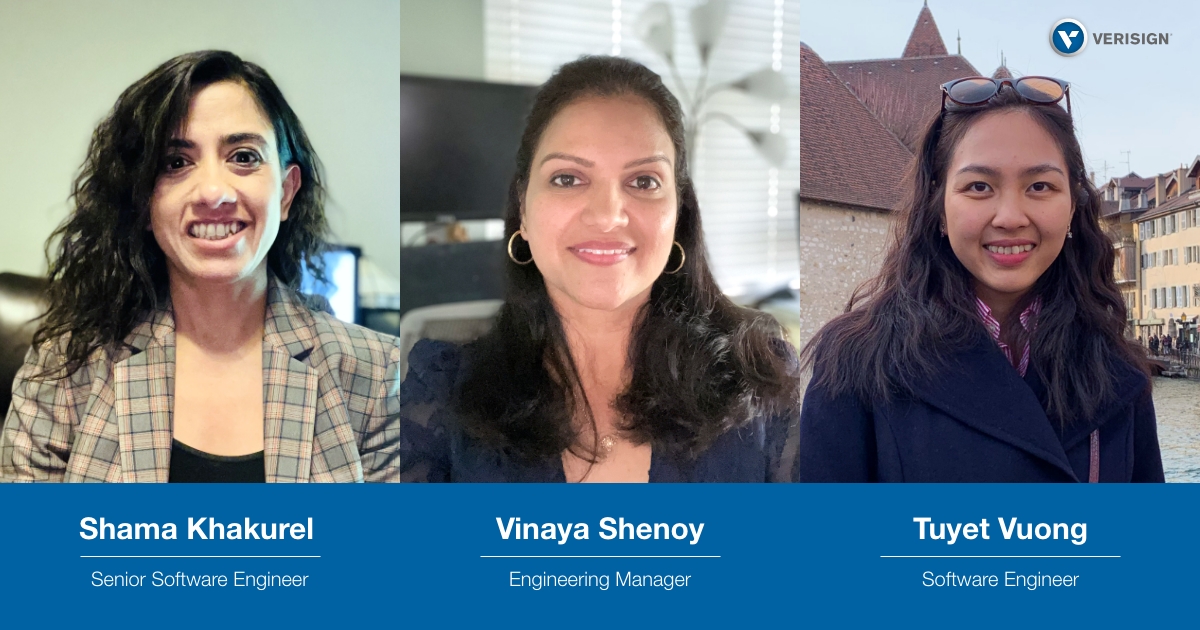
Celebrating Verisign's women engineers for INWED 2022

Today, as the world celebrates International Women in Engineering Day, we recognize and honor women engineers at Verisign, whose own stories have helped shape dreams and encouraged young women and girls to take up engineering careers.

Here are three of their stories:

Shama Khakurel, Senior Software Engineer

When Shama Khakurel was in high school, she aspired to join the medical field. But she quickly realized that classes involving math or engineering came easiest to her, much more so than her work in biology or other subjects. It wasn’t until she took a summer computer programming course called “Lotus and dBase Programming” that she realized her career aspirations had officially changed; from that point on, she wanted to be an engineer.

In the nearly 20 years she’s been at Verisign, she’s expanded her skills, challenged herself, pursued opportunities – and always had the support of managers who mentored her along the way.

“Verisign has given me every opportunity to grow,” Shama says. And even though she continues to “learn something new every day,” she also provides mentorship to younger engineering employees.

Women tend to shy away from engineering roles, she says, because they think that math and science are harder subjects. “They seem to follow and believe that myth, but there is a lot of opportunity for a woman in this field.”

Vinaya Shenoy, Engineering Manager

For Vinaya Shenoy, an engineering manager who has worked for Verisign for 17 years, a passion for math and science at a young age steered her toward a career in computer science engineering.

She draws inspiration from other women who are industry leaders and immigrants from India and who made it to top rank with their determination and leadership skills. She credits their stories with helping her see what all women are capable of, especially in unconventional or unexpected areas.

“Engineering is not just coding. There are a lot of areas within engineering that you can explore and pursue,” she says. “If problem-solving and creating are your passions, you can harness the power of technology to solve problems and give back to the community.”

Tuyet Vuong, Software Engineer

Tuyet Vuong is one of those people who enjoys problem-solving. As a young girl and the child of two physics teachers, she would often build small gadgets – perhaps her own clock or a small fan – from things she would find around the house.

Today, the challenges are bigger and have a greater impact, and she still finds herself enjoying them.

“Engineering is a fun, exciting and rewarding discipline where you can explore and build new things that are helpful to society,” says Tuyet. And sharing the insights and experiences of so many talented people – both men and women – is what makes the role that much more rewarding.

That sense of fulfillment also comes from breaking down stereotypes, such as the attitudes about women only being suitable for a limited number of careers when she was growing up in Vietnam. That’s why she’s a firm believer that mentoring and encouraging young women engineers isn’t just the responsibility of other women.

“The effort should come from both genders,” she says. “The effort shouldn’t come from women alone.”

Looking to the Future

At Verisign, we see the real impact of all our women engineers’ contributions when it comes to ensuring that the internet is secure, stable and resilient. Today and every day, we celebrate Verisign’s women engineers. We thank you for all you’ve done and everything you’re yet to accomplish.


If you’re interested in pursuing your passion for engineering, view our open career opportunities here.

The post Celebrating Women Engineers Today and Every Day at Verisign appeared first on Verisign Blog.

  •  
❌