Some internet connectivity is returning in Iran after nearly 90 days offline, web monitoring groups say. But it isn’t clear if the reconnection is permanent.
National security and digital forensics experts have called foul on Nigel Farage's "disturbing" and unsubstantiated claim that Russia was behind the leak of a story about the UK politician receiving a £5 million gift from a crypto billionaire. Sources inside Farage's right-wing Reform UK told the Mail on Sunday that the party leader believes Russian spies hacked his phone and relayed details about Christopher Harborne's gift, a matter of which only four people were aware. Farage was said to have engaged outside "counter-espionage experts" to perform a technical analysis of his device – analysis that was said to point to Russia. According to Peter Sommer, professor of digital forensics at Birmingham City University, whichever outfit was entrusted to carry out this work would have been looking for two different types of markers to prove Russia was involved. These would be either the phishing message Farage clicked on that allowed Russia to access his private communications or the malware code an attacker used to exfiltrate them. "It's obviously trivial to disguise the source of an email, so that doesn't help," Sommer told The Register. "And the second thing is if you're talking about looking for hacking codes, hackers, whether they are juveniles or people in major SIGINT systems, are likely to be stealing from each other, so there's nothing unique about a code that would say where it comes from." Sommer also highlighted that advanced intelligence powers have tools at their disposal to obfuscate the source of malicious code. The CIA's leaked Marble Framework supposedly had the ability to translate malicious code into any language, including those used by its chief adversaries. "Now, absent from that, how on Earth do you determine that this is a Russian hack?" Sommer asked. Neither Farage nor Reform UK has spoken officially on the alleged Russian phone hack. They have not specified which experts on whose conclusions they used to make the claims, they have not stated what evidence pointed to Russia's involvement, and they have not committed to making this forensic assessment available for public scrutiny. Opening up the data for verification was one of the core issues raised by Ciaran Martin, founding chief executive of the UK's National Cyber Security Centre (NCSC), who labeled Farage's claims "disturbing" and "without any merit." Speaking to The Guardian, Martin said that not only is the lack of clear evidence concerning, but also if Russia was behind the hack-and-leak operation, a deliberate attempt at destabilizing a foreign democracy, then it would have significant consequences for the UK's Russia policy. "An aspiring prime minister has essentially claimed that Russia has launched an unprecedentedly aggressive intervention – a malicious intervention – in British politics, and he's not produced a shred of evidence to support that claim," Martin said. "It is a very, very serious thing to allege. It would be a national security issue," he added. "If it is true, the government should be in emergency session in COBR right now, considering their response to the most serious Russian intervention in internal British affairs for years." He said the claims published by the Mail on Sunday, at present, are unsubstantiated, and if true, in normal circumstances, this would prompt a formal government response. The Reg understands that the NCSC has not been engaged by Farage or Reform UK over the matter. The National Crime Agency did not respond to questions regarding its involvement and the Metropolitan Police Service declined to comment. Reform UK did not respond to our requests for more information, nor did Nigel Farage's office. What exactly did Reform UK claim? According to sources who spoke to the Mail on Sunday, Russian spies hacked Farage's phone, ascertained details about Harborne's £5 million donation to the party leader, and leaked it to The Guardian, which first reported the story. The Guardian said at the weekend that Farage is now under "mounting pressure" to prove his claim about the Russian phone hack. There is no indication the Graun 's reporting was connected to any illegal activity or Russian spies, but Farage is implying so, telling the Mail on Sunday: "This shocking revelation brings into question The Guardian’s judgment and whether Reform can cooperate with them in future." According to the analysis of Farage's phone, carried out by the unidentified counter-espionage experts, the findings were "almost certainly linked to Moscow," the Reform UK source said. They also claimed that spear-phishing tactics were used to compromise his phone, email, and bank accounts. "It bore all the sophisticated hallmarks of a nation-state actor using destabilization techniques in the run-up to this month's local elections," the source added. Farage said: "These actions by Russia are deeply concerning and highlight the threat they pose to British security." Regarding the motive for such an attack, Reform UK believes its leader angered Russian president Vladimir Putin by previously expressing support for NATO. He has said in the past that UK forces should shoot down Russian aircraft if they enter NATO airspace, and joined controversial calls for Ukraine to be admitted to the military alliance. The party also said that Harborne may be a target for the Russian regime because he joined former prime minister Boris Johnson on a trip to Ukraine in 2022, designed to showcase the impact of Russia's invasion earlier that year. ®
Cisco's 2026 Segmentation Report analyzes 400 failed segmentation projects and identifies four distinct patterns of failure — and what teams can do about them
As Americans stew over the looming risk of job-stealing AI and data centers in their back yards, the feds are raising the alarm about a new category of threat, documents obtained by WIRED show.
Anthropic has revealed its intention to one day release models that match the performance of its Mythos bug-finding AI to the public, once it can make them safe. In case you came in late, in early April Anthropic announced it had developed a model called Mythos that is so good at finding security vulnerabilities in programming code that the company decided to offer it only to select entities because allowing unfettered access would mean cybercriminals could quickly discover and exploit software flaws. That access program is called “Project Glasswing” and participants report it quickly finds many bugs but few that humans couldn’t find given enough time and resources. Those with access to Mythos have also sometimes said the quantity of bugs it finds somewhat overwhelms their ability to patch them all. The mere existence of Mythos has sparked a little panic – Japan’s government ordered a sweeping security review and Indian authorities demanded a patching spree at financial institutions – plus a general realization that even lesser AI models are also decent bug-finders, meaning cyber-defenders must now expect attackers will weaponize more flaws, more often. No company—including Anthropic—has developed safeguards strong enough to prevent such models from being misused Anthropic last week published an “initial update” on Project Glasswing that in its second-to-last paragraph reveals the company’s next step will see it “… work with critical partners – including US and allied governments – to expand Project Glasswing to additional partners. And in the near future, once we’ve developed the far stronger safeguards we need, we look forward to making Mythos-class models available through a general release.” The company didn’t explain what it means by “near future” and admits that “At present, no company—including Anthropic—has developed safeguards strong enough to prevent such models from being misused and potentially causing severe harm.” Further illustration of that assertion can be found earlier in the company’s post, which reveals that Anthropic has used Mythos to scan more than 1,000 open-source projects that it says “collectively underpin much of the internet – and much of our own infrastructure.” To date, Mythos has found an estimated 6,202 high-or-critical-severity vulnerabilities in these projects – and 23,019 flaws in all. The post reveals that when Mythos finds a flaw, Anthropic and its pals in the security community reproduce the issue that Mythos has found and “re-assess its severity.” “Once we’ve confirmed that a vulnerability is real, we check for whether there are already fixes in place, and write a detailed report to the software’s maintainers,” Anthropic explains. “We take considerable care here: on top of the regular challenges of maintaining open-source software, maintainers have been facing a deluge of low-quality, AI-generated bug reports. Indeed, several maintainers have told us they’re currently severely capacity constrained, and some have even asked us to slow down our rate of disclosures because they need more time to design patches.” 1,752 of the high-or-critical-rated vulnerabilities Mythos found in FOSS have gone through that process and 90.6 percent (1,587) proved to be valid flaws. Of those, 62.4 percent (1,094) “were confirmed as either high-or-critical-severity,” the post states. One of the critical flaws impacted the wolfSSL cryptography library used by billions of devices worldwide. “Mythos Preview constructed an exploit that would let an attacker forge certificates that would (for instance) allow them to host a fake website for a bank or email provider,” Anthropic wrote. “The website would look perfectly legitimate to an end user, despite being controlled by the attacker.” Thankfully, developers have already patched wolfSSL, and Anthropic said it will deliver a full technical analysis “in the coming weeks.” Keep an eye out for CVE-2026-5194 to learn more about this one. Mythos is adding to an already overloaded security ecosystem “75 of the 530 high-or-critical-severity bugs we’ve reported have now been patched, and 65 of those have been given public advisories,” the post states, then explains that low fix rate by revealing Anthropic is “still early in the 90-day window that’s set out in our Coordinated Vulnerability Disclosure policy: we expect many more patches to land soon.” The company thinks it is also “likely to be undercounting patches because some vulnerabilities are patched without a public advisory.” Lastly, the flood of bugs Mythos found “is adding to an already overloaded security ecosystem.” Anthropic’s suggestion for security teams struggling to develop fixes for bugs AI discovered is, unsurprisingly, more AI such as skills that improve its Claude model’s ability to help developers. ®
OPINION Dirty Frag, Copy Fail, and Fragnesia are less a random cluster of Linux bugs and more the public unveiling of how AI tools can pry open security holes with just a prompt or two. What they also have in common is their shared abuse of a core kernel abstraction: The page cache. What does this mean for you and me? Is this the rainstorm before a downpour of killer Linux security problems, or is this just a shower? It depends on who you ask. Whatever else may be true, these problems must be addressed. As Igor Seletskiy, CEO of CloudLinux, said: "The real story here is that we typically see one or two kernel-level LPE (Linux privilege escalations) vulnerabilities that affect multiple distros/versions per year. And now we see two such vulnerabilities one week apart. We should expect this trend to continue for quite a few months, meaning companies might have to reboot servers weekly." Ouch! But is this the start of a trend? Linus Torvalds, who knows a thing or two about Linux, said at Open Source Summit North America in Minneapolis that until recently, the kernel community would quietly notify distributions about a bug and ask them to upgrade without detailing the vulnerability, and "most of the time, nobody would figure out what happened." That was then. This is now. With AI‑accelerated analysis, he recalled that "last week, we fixed the bug; within three hours, there was a blog post about the implications of that bug fix, because security people love getting attention." As a result of this kind of thing, Torvalds has changed how the Linux security community will deal with AI-discovered security holes. "AI-detected bugs are pretty much by definition not secret, and treating them on some private list is a waste of time for everybody involved – and only makes that duplication worse because the reporters can't even see each other's reports." In addition, Torvalds added, in the case of AI-discovered bugs, you need to keep in mind that just "because you found it with AI, 100 other people also found it with AI." That means we're going to hear a lot more about Linux security problems. But are they getting worse? I asked Greg Kroah-Hartman, the Linux stable kernel maintainer, and he told me: "Maybe? It's hard to tell; the 'recent' ones really are very minor, as the number of systems that have 'untrusted users' is not common anymore. I don't see any real uptick in our actual bug fixes that I can tell." He continued: "We fix bugs like that on a daily basis, it's just the rise of people wanting to 'name a bug' and release a public exploit seems to be all the rage at the moment." An important point that Chris Wright, Red Hat's CTO, made at Red Hat Summit, the week before, is that in "security, all things aren't created equal. There will always be a spectrum of vulnerabilities that will surface. Some of those will be really critical and we will need to respond very quickly, so that becomes a clear priority. Others will have a longer tail of lower severity." Torvalds also added at Open Source Summit that just because you read stories about Linux and AI-discovered bugs, you shouldn't think the same thing isn't happening to proprietary software, such as Windows. "If you think that AI can't reverse engineer closed source, you're in for a surprise." In fact, he warned, "closed source is even worse in this respect, because the AI can't help you fix those problems, but the AI sure can help find those problems in the first place." He also discouraged security researchers from publishing working exploits: "When it comes to things that really are security issues, you may not want to make the exploit public… Don't be that guy who then crows about it publicly and says, 'Look, I could bring down this big company.'" Following on this theme, Christopher "CRob" Robinson, chief security architect for the Open Source Software Foundation (OpenSSF), told The Register that thanks to AI, "roughly 30 percent of reported Linux security bugs were duplicates. That's going to be another problem in this AI age, where everybody's a researcher, right, with a $20 cloud code account." That, in turn, will burden already overworked maintainers with yet more patches to deal with. Linux, Torvalds added, is something that its maintainers can handle. Smaller open source projects, however, are all too likely to be overwhelmed. The real problem, according to what the Google Threat Intelligence Group has discovered, is that the mean time to exploit (TTE) for vulnerabilities has continually decreased "from 63 days in 2018 to -1 day in 2024 and further downward to an estimated -7 days in 2025. A negative number indicates that exploitation of a vulnerability, on average, occurred before a patch was released." So what does this mean? Yes, we're going to see a lot more security vulnerabilities showing up in Linux and other open source projects. Yes, some of them will be serious, and all too many will have exploits out before the patches arrive. It's not, however, that Linux has suddenly become less secure. It's that AI eyes are much better at detecting bugs than human eyes have ever been. We will catch up, and AI can help with that, too. In the meantime, system administrators and developers will have to be more security-conscious than ever before. As Wright told The Reg, it's high time we switched from using SELinux in permissive to restrictive mode. Enforcing strict security is a pain, but what's even more of a pain is having to rebuild your containers and servers after a serious attack gets through. ®
Plus: Google publishes a live exploit for an unpatched flaw, the feds arrest two men accused of creating thousands of nonconsensual deepfake nudes, and more.
A malware-spreading scumbag swimming through GitHub pushed malicious commits to more than 5,500 repositories on Monday as part of an automated campaign called Megalodon. Similar to the earlier TeamPCP attacks that poisoned about 3,800 GitHub repositories, this new campaign has so far infected 5,561 repos with CI/CD credential-stealing malware, according to SafeDep researchers, who uncovered the predatory commits and published a full list of the compromised repositories. If a repository owner merges the commit, the malware executes inside their CI/CD pipeline and propagates further, Ox Security lead researcher Moshe Siman Tov Bustan said in a Thursday blog post. Megalodon steals AWS secret keys and Google Cloud access tokens. It also queries AWS, Google Cloud Platform, and Azure metadata for instance role credentials, reads SSH private keys, Docker and Kubernetes configurations, Vault tokens, Terraform credentials, and scans source code for more than 30 secret regex patterns. Then it exfiltrates GitHub tokens, including secrets used to authenticate with cloud providers, thus allowing attackers to impersonate developers’ cloud identities, along with Bitbucket tokens. In other words: consider ALL of your CI/CD variables pwned. "We’ve entered a new supply chain attack era, and TeamPCP compromising GitHub was only the beginning,” Bustan told The Register. “What’s coming next is an endless wave, a tsunami of cyber attacks on developers worldwide.” Plus, he added, hacking GitHub “compromises the security of every company with a private repository hosted on the platform.” This new wave of supply chain attacks hitting developers’ environments won’t stop until “companies like npm and GitHub take serious action against the spread of malicious code on their servers,” Bustan said. He noted npm’s statement on X saying it “invalidated npm granular access tokens with write access that bypass 2FA” to prevent additional supply-chain attacks like Mini Shai Hulud. “That could help a little with account hijacking, but it doesn’t solve the actual problem,” Bustan said. “Malicious code is still reaching their servers, and nothing is stopping it before it does.” npm … but not TeamPCP SafeDep spotted Megalodon hidden inside a legitimate package: Tiledesk, an open source live chat and chatbot platform. The attacker backdoored versions 2.18.6 (May 19) through 2.18.12 (May 21), and the same npm maintainer published the last clean version, 2.18.5, before unknowingly publishing these newer compromised versions. “The attacker never touched the npm account,” the open source supply-chain security startup researchers said. “They compromised the GitHub repository, and the maintainer published from the poisoned source without realizing it.” While publishing malicious packages on npm is a TeamPCP signature move, Bustan said there’s no threat-intel or code-analysis evidence that connects Megalodon to the crew behind the Trivy, Checkmarx, and other recent supply-chain attacks. “Our best guess now is that it's a different threat actor copying their behavior and style, but not much of the code itself,” he told us. And despite TeamPCP open sourcing its Shai-Hulud worm and announcing a supply-chain attack competition on BreachForums, Ox doesn’t believe Megalodon is a contest entry. “We have indications that they are not participating in the TeamPCP contest due to the contest having a specific rule to add a public encryption key that the actor behind the malware could match with his private key to prove his involvement,” Bustan said. Who is built-bot? SafeDep’s threat hunters traced the malicious commit (acac5a9) to an author “build-bot,” connected to the email address build-system[@]noreply.dev with the message “ci: add build optimization step.” The author name and noreply email mimic automated CI commits, and there’s no GitHub account linked to the author and committer user fields. “Someone pushed the commit to master with no PR and no merge commit, using a compromised PAT or deploy key,” according to the researchers. They searched GitHub for other commits authored by the same email address and found 2,878 results, plus a second email, ci-bot@automated.dev, with an additional 2,841 commits. All landed May 18 during a six-hour window (11:36 to 17:48 UTC) and targeted 5,561 repositories. This includes nine compromised Tiledesk repositories: tiledesk-server, tiledesk-dashboard, tiledesk-telegram-connector, tiledesk-llm, tiledesk-docker-proxy, tiledesk-community-app, tiledesk-campaign-dashboard, tiledesk-helpcenter-template, and tiledesk-ai. Others include Black-Iron-Project with eight compromised repos, WISE-Community, and hundreds of smaller repositories. ®
Discover how Cisco is evolving its vulnerability disclosure practices. We are leveraging AI to prioritize high-risk security issues, helping customers focus on critical patching and remediation efforts.
Memorial Day weekend officially kicks off summer, and for millions of Americans, that means road trips, flights, cookouts, and a little online shopping for the deals.
Unfortunately, scammers know this. They count on the fact that you’re distracted, you’re moving fast, and you’re probably connected to a network you don’t own.
Here are five scams surging this holiday weekend, what they look like, and how to stay ahead of them.
1. Fake Travel Alerts from “Your Bank” or Hotel
You’re packing your bag when a text arrives: “Unusual activity detected on your account. Verify now to avoid suspension.”
It looks like it’s from your bank, or maybe your hotel loyalty program. There’s a link. There’s urgency. And that’s exactly the point.
These are brand impersonation scams, and they’re a dominant tactic year-round, but they spike around travel holidays when people are actively monitoring reservations and accounts.
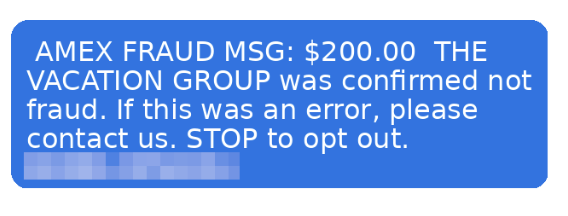
Example of a fraudulent AMEX message.
According to McAfee research, trusted brands like banks, airlines, and hotels are among the most commonly impersonated, and email scams impersonating retail and financial brands have surged up to 85% as major holidays approach.
The message will typically ask you to click a link and “confirm your details” to secure your account or honor a reservation. That link leads to a convincing-looking fake site designed to capture your login credentials, payment info, or both.
How to Avoid Travel Alert Scams:
Don’t click links in unsolicited texts or emails.
Go directly to the company’s app or website by typing the URL yourself.
Remember: pressure is a tactic, not customer service.
McAfee’s Scam Detector can flag suspicious messages before you interact with them, whether they come via text, email, or social media.
2. Fake Memorial Day Weekend “Deals”
Memorial Day is one of the biggest shopping weekends of the year. Scammers treat it like an open invitation.
Fraudulent retailers flood social feeds with too-good-to-be-true deals on everything from patio furniture to electronics, often impersonating legitimate brands with copycat websites and paid ads.
According to McAfee’s holiday shopping research, 91% of shoppers see ads from unfamiliar retailers, 37% say they might buy from a brand they don’t recognize, and a full 40% of consumers have abandoned a purchase out of fear that the deal wasn’t real.
The most impersonated brands in McAfee’s research span luxury labels (Coach, Dior, Gucci) to mainstream favorites (Apple, Samsung, Nintendo, Disney), exactly the kind of items that show up in “blowout sale” ads. Fake storefronts have grown significantly, with technology URL scams rising nearly 50%.
Once shoppers enter their payment details on a fraudulent site, that information goes directly to criminals. The average scam loss during the holiday shopping period runs around $840 per victim.
How to Avoid Shopping Scams:
Type retailer URLs directly into your browser instead of clicking through ads or social posts.
Look for HTTPS and double-check the domain carefully before entering any payment info.
If a deal looks unbelievably good, verify it on the retailer’s official app before buying.
McAfee’s Web Protection blocks malicious and suspicious sites before they load, including fake checkout pages.
3. QR Code Scams at Gas Stations and Travel Stops
If you’re road-tripping this weekend, you may scan a QR code somewhere. It could be at the gas pump, a rest stop, a parking meter, or a roadside attraction. Scammers know this too.
Criminals increasingly place fake QR codes over legitimate ones on gas station pumps, parking kiosks, and public signs. When you scan, you’re redirected to a convincing-looking payment or login page that captures your financial information. This is known as “quishing” or phishing via QR code.
McAfee research shows just how widespread this risk has become: 68% of people scanned a QR code in the past three months, and 18% ended up on a suspicious or unsafe page after scanning. Among those who did, more than half took a risky action like entering personal information, installing an app, or connecting a digital wallet.
How to Avoid Sketchy QR Codes:
Before scanning any QR code in public, look closely at the sticker or sign.
If it looks like it’s been placed over something else, skip it.
If you do scan, check the URL before proceeding.
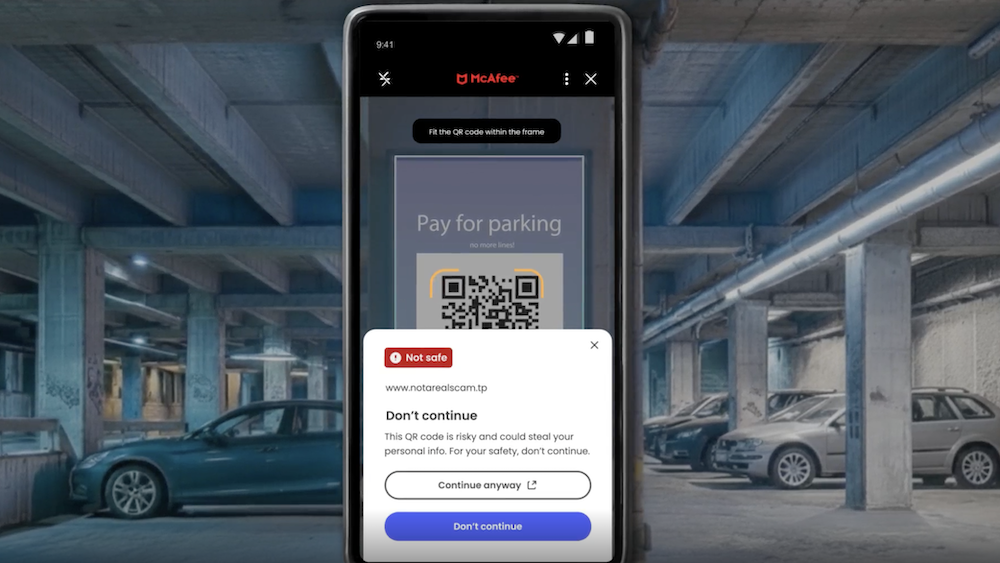
McAfee’s Scam Detector now includes instant QR code safety checks that assess risk before you tap, so you’re not flying blind at the gas pump.
This shows how McAfee blocks unsafe QR codes.
4. Public Wi-Fi Traps at Airports, Hotels, and Coffee Shops
Whether you’re waiting at the airport or grabbing coffee before hitting the highway, free Wi-Fi can feel like a gift. But not every “free Wi-Fi” network is what it appears to be.
Hackers set up what are called “evil twin” networks, hotspots with names designed to look exactly like the legitimate network at the airport, hotel, or café you’re in.
The moment you connect, they can use tools called packet sniffers to capture the data you send and receive: passwords, banking credentials, credit card numbers, email logins.
According to McAfee’s travel research, 63% of travelers connect to public Wi-Fi, and 49% use airport Wi-Fi, making these among the riskiest behaviors travelers engage in without realizing it.
Some of these fake networks go further, presenting a phony login screen that captures your username and password for popular services like Google or Apple before you even realize you’ve been compromised.
How to Avoid Malicious Wi-Fi :
Always confirm the exact Wi-Fi network name with staff before connecting.
Turn off auto-join for Wi-Fi on your devices.
And most importantly: use a VPN.
A VPN creates an encrypted tunnel for your internet traffic, so even if a hacker intercepts it, they’ll only see scrambled data. McAfee’s VPN is included in McAfee+ plans and automatically connects when you join public Wi-Fi, exactly the protection you want when you’re traveling and connecting everywhere.
5. Toll Road and Parking Text Scams (Expect a Surge After the Weekend)
You may have seen these already: a text that says you owe an unpaid toll or parking fee, with a link to pay before penalties kick in. These scams have been circulating for a while, and there’s a good chance Memorial Day weekend is about to make them worse.
Scammers track news cycles and know that millions of Americans will be driving this weekend, many of them through toll roads and unfamiliar areas.
That means they can blast out fake “unpaid toll” texts after the holiday and a significant percentage of recipients will think: “Actually, I did drive somewhere new this weekend.” That uncertainty is exactly what they’re counting on.
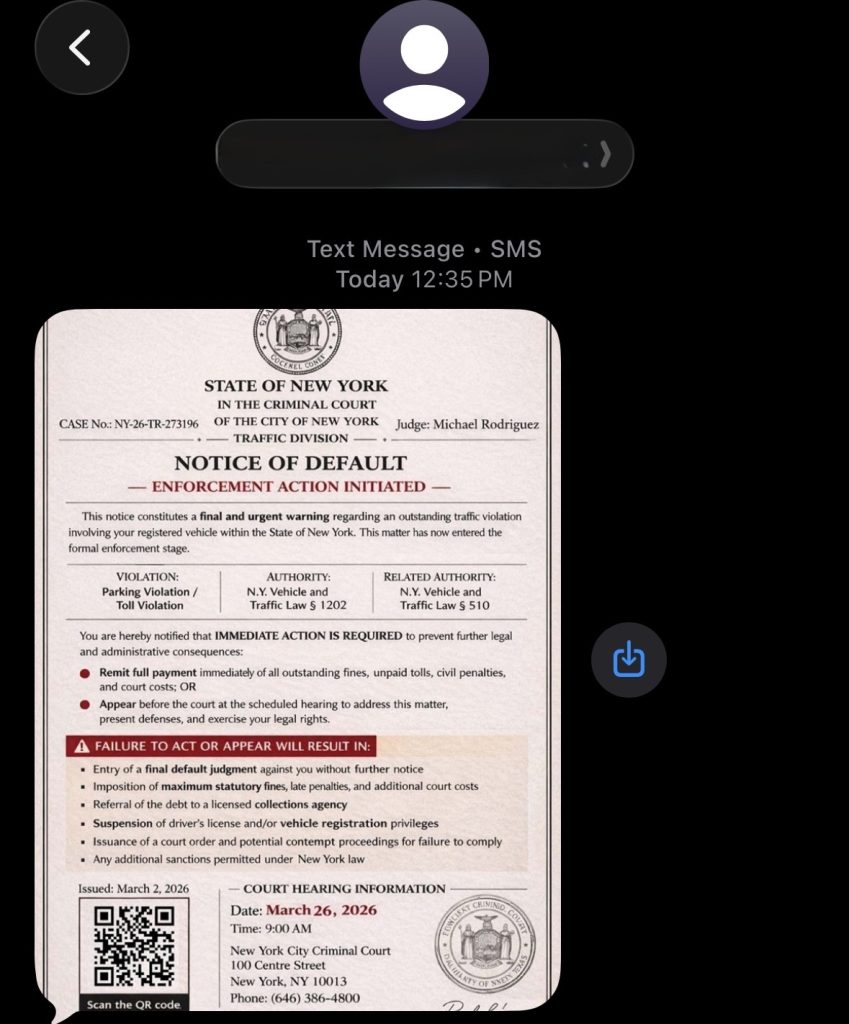
Fake court notices threatening parking and toll violations have been making the rounds this spring.
These texts typically impersonate EZPass, SunPass, or state transportation departments and create urgency around a small fee to avoid larger fines. The link leads to a fake payment page designed to steal your credit card details.
How to Avoid Toll Scams:
Don’t click links in unsolicited toll or parking texts.
If you think the charge might be legitimate, go directly to your state’s official toll authority website and look up your account there.
Real toll agencies will not threaten immediate penalties over text with a payment link.
If you receive one of these texts after this weekend, treat it as suspicious by default.
Have a Safe Memorial Day Weekend
Scammers don’t take holidays. If anything, long weekends are peak season. The good news: a little awareness goes a long way. Slow down before you click, verify before you scan, and protect your connection before you log on.
McAfee+ Advanced comes with layered protection across all the moments where scams are most likely to strike, from the gas station to the hotel lobby to your inbox.
The US President’s oft-maligned Trump Mobile venture may be facing another setback after a security buff claims he discovered a now-plugged website vulnerability that he says was leaking what could be tens of thousands of suckers' customers' details. The individual behind the discovery, who goes by "Louis," says he's a self-taught tech tinkerer and described himself as "just a nerd between jobs with too much time on my hands." He reckons the website’s data could be scooped up with a simple POST request. “It wasn't SQL. That wouldn't be as bad,” he told The Register. “It was a really simple HTTP request. POST, and then just asking for the info I wanted, basically.” More than 27,000 people who ordered from Trump Mobile, the President’s all-American smartphone and cell service brand, had their data flimsily secured online, Louis claimed. Louis, a long-serving IT professional who refuses to be called a security researcher, said the types of data he was able to gather included: first and last names, primary addresses, secondary addresses, email addresses, phone numbers, customer/account numbers, "enrollment ID" (pre-order number), and whether the order was placed by phone or online. “I discovered it first by looking into the site to see if I could find how many orders there actually were, and noticing some API endpoints,” he added. “I tried a couple of basic commands, and then it started showing whatever data I wanted. “It was as easy as going to the website and writing a very simple HTTP POST request into the console.” The website flaw only allowed him to return ten customer records at a time, he said, but these records all contained a customer number, which Louis used to loop through them all. In the space of an hour, the method allowed him to access the records of around 5,000 Trump Mobile customers, he claimed. After confirming the issue was valid and that all the data his script scooped up was deleted, Louis tried to disclose his findings to Trump Mobile, and anyone else who could take action, but received no response, although someone appears to have fixed the issue. The Register also tried contacting Trump Mobile but similarly received nothing in return. Out of options for disclosure, Louis decided to go public, informing two prominent YouTube creators and known orderers of the Trump T1 phone, Stephen “Coffeezilla” Findeisen and Charles “penguinz0” White Jr., whose respective videos covering his findings have jointly gathered millions of views. Trump T1 begins shipping Trump Mobile’s flagship device, the T1 Android smartphone with the gold-colored casing, began showing up at pre-order customers’ doors this week, after originally being slated for an August 2025 release. The brand’s entire schtick since first being announced in June 2025, around the time of a significant escalation in US-China trade war conflict, was that everything was going to be “Made in America.” Early renders of the proposed T1 showed what appeared to be an iPhone-like device – gold-colored, of course – but those who received their orders this week confirm it is just a reskinned HTC U-24 Pro, a mid-range Android from the Taiwanese tech biz which first hit the market in June 2024. The American flag embossed on the back of the device also only has 11 stripes instead of 13, although all the stars are present and accounted for, at least. When the President’s sons launched the Trump Mobile Brand last year, they promised the devices would be manufactured in America, although the company soon dropped this from its marketing. The T1 comes loaded with 512GB of storage, a 120Hz display, a Snapdragon 7 chip, and, of course, Truth Social pre-installed. Customers can order now to lock in what the company calls promotional pricing, picking up the T1 for $499. It is not clear what this may rise to in the future. You can pick up a standard HTC U-24 Pro 512GB model for roughly the same price, depending on the retailer. ®
Cisco tested AI’s ability to write an accurate report on a tabletop security incident response exercise, and found that while the tech can save time, many risks remain. The networking giant revealed its results in a Thursday blog post by Nate Pors, a senior incident commander in the Cisco Talos Incident Response team. Pors opened by observing that when to used generate long-form technical content, large language models can deliver “significant inaccuracies, unusual conclusions, and inconsistent writing styles.” LLMs make those mistakes because they’re essentially a fancy autocomplete system that makes educated guesses. Pors wrote that the nature of LLMs therefore sees them mess up in four ways: Using different data for each query, which means it’s “difficult to rely on an LLM for repeatable, standardized research outcomes.”Reaching different conclusions from the same data. “In a data breach scenario, a model might suggest a full organization-wide password reset in one instance and a targeted reset in another,” Pors wrote and AI then “often defaults to whichever recommendation it generates first” – and may therefore give bad advice.Because LLMs generate content token-by-token, they can create documents with different structure and formatting on each new run. “This unpredictability is problematic for professional environments where standardized layouts, such as consistent executive summaries or recommendation sections, are essential for quality control,” the Talos man observed.AI can discard data, so its output might ignore critical information.Talos developed several techniques to stop this sort of thing happening. One involves giving an LLM “granular, single-task instructions” that focus on “a specific, small portion of the report.” Doing so means “risk of hallucination or cross-contamination between sections is significantly reduced.” Telling an LLM which sources to use also helps. So does setting rules about the style and format of output. Using those techniques, Cisco says the time required to draft an incident report based on a tabletop exercise fell by 50 percent. "A blind test of the sample report in our quality assurance process showed no noticeable drop in overall writing quality," Pors wrote. "The peer reviewer, professional editor, and management reviewer all made complimentary comments about the report while unaware that it was AI-generated. The peer reviewer commented that the incidence of typos and grammatical errors was far lower than in the average report." But the Talos team also found “editing multiple sample reports within a single session resulted in cross-contamination of content from one report’s source material to another, even if the notes used to generate the first report were deleted from the project’s reference documents.” The researchers therefore recommend starting a new session, and re-entering prompts, for each new incident report. They also developed a spelling-and-grammar-checking prompt that “hallucinated numerous grammar issues … failed to identify actual issues,” had a success rate below 50 percent and “would behave inconsistently, sometimes catching issues and sometimes overlooking them. “It is currently unsuitable for production use,” Pors concluded. Pors said Cisco concluded that its approach “could be adapted to any cybersecurity reporting use case with standardized inputs and predictable outputs," but also warned authors must "take ownership of every word of the final report." "While testing, we found that the LLMs generated recommendations that were duplicative, irrelevant, or not actionable. If this were used in a production environment without manual checks, it could result in poor-quality recommendations in a final report." Those problems arose when considering a tabletop exercise, a far simpler affair than analysis of an incident that involves analyzing log files from multiple systems. ®
Democratic lawmakers on Thursday blasted President Trump’s spending priorities – specifically a proposed $1 billion White House security and ballroom project and a nearly $1.8 billion “slush fund” for Trump allies tied to the January 6 Capitol riot – as his administration pushes deep cuts to cybersecurity funding. US Representative Delia Ramirez (D-IL) decried the president's priorities as Congress weighs reauthorization of the State and Local Cybersecurity Grant Program (SLCGP), a funding effort that began in 2022 and earmarked $1 billion to state and local governments over the next four years to help mitigate cyber risks. "Budgets are moral documents, and spending a billion dollars on a ballroom, which is what the president wants, or $1.7 billion to incentivize insurrectionists while we still are waiting for the reauthorization of this critical grant program, says a lot about where priorities are right now with this administration," she said during a House Homeland Security subcommittee hearing on state and local cybersecurity. Another Democrat on the committee, Rep. James Walkinshaw (D-VA), noted the US Cybersecurity and Infrastructure Security Agency (CISA) also eliminated federal support for the Multi-State Information Sharing and Analysis Center (MS-ISAC), which used to provide free and low-cost threat detection and response services to state and local governments. The MS-ISAC has since shifted to a fee-based model to support the state threat sharing program. This means, as expert witness Samir Jain, VP of policy for the Center for Democracy and Technology, testified, “jurisdictions that most need the help are least likely to be able to afford it. Smaller jurisdictions, because if they don't have the resources and the money to join the ISAC, they probably also don't have the resources and the money to buy equipment, to buy network monitoring tools, to have cybersecurity staff. It's the ones who need it the most are the least likely to be able to get it as a result.” Walkinshaw also pointed out that CISA’s 2025 budget was about $3 billion. President Trump proposed slashing the cyber-defense agency’s spending by $707 million in 2027, to just over $2 billion. This is on top of the $135 million in cuts to CISA, along with about a third of its workforce (close to 1,000 people) since Trump returned to office. “So we are looking at a one-third cut in federal funding for cybersecurity,” Walkinshaw said. “If President Trump gets his way, we'd be spending a billion dollars for the ballroom and $1.8 billion for the January 6 slush fund – $2.8 billion just on those two items, $800 million more than his total commitment to cybersecurity.” Meanwhile, other expert witnesses who testified before the committee, all IT and security chiefs from Tennessee, New York, and Florida, implored the lawmakers to spend more – not less – on state and local infosec. “State and local governments operate critical systems that citizens rely on every day, including emergency services, schools, utilities, courts, and public infrastructure,” Tennessee CIO Kristin Darby told lawmakers. “Those systems are increasingly targeted by criminal organizations and nation-state actors,” she said, adding that “demand for cybersecurity support far exceeds the current funding levels.” As AI-enabled attacks, ransomware infections, and cloud-based system intrusions accelerate across Tennessee, “many local governments across our state have little or no dedicated cybersecurity staff,” Darby continued. “This creates a dangerous imbalance between highly sophisticated attackers and severely resource-constrained defenders.” New York state director of security and intelligence Colin Ahern urged lawmakers to “reauthorize and fully fund the state and local cybersecurity grant program, which is the single most consequential investment in the cyber protection of state and local governments in this country.” He also advocated for frontier-model AI access for state and local governments, which are tasked with protecting the power grid, drinking water supply, public health systems, and other critical operations. “We cannot do that while frontier defensive AI capabilities are restricted to federal partners and a handful of large enterprises,” Ahern said. “Cybersecurity is the silent partner of democracy,” he continued. “When the utilities, school districts, and state and local governments that constitute the operational fabric of American life are hollowed out by cyber attacks, the institutions that support our democratic life are hollowed out with them.” ®
Three firms will pay nearly $1 million for selling “Active Listening” technology that they claimed tapped people’s phones for advertising. The FTC alleges the “tech” was just pricey email lists.
Finding vulns just doesn't pay like it used to. At least one bug hunter who found an open source security flaw and reported it months ago via HackerOne’s backlogged Internet Bug Bounty (IBB) program finally got paid for his work - but at a drastically reduced reward rate. The security researcher found a medium-severity vulnerability that previously paid $1,843. As of Monday, HackerOne’s IBB pays $297 for the same severity level. Similarly, the new IBB cash prize for a critical vulnerability is $2,257, compared to the previous $9,250 reward. High-severity bugs now fetch $1,009, while they used to earn a $4,429 payout. And low-severity bugs earn researchers $68, compared to the previous $597 reward. HackerOne’s IBB remains on a break, and is not accepting new submissions. “The IBB program is currently paused while we evaluate adjustments to the program that will maximize value to researchers, sponsors, and the open-source ecosystem,” a spokesperson told us. “We remain committed to strengthening open source security through ethical security research.” When asked if AI-generated reports played a role in the pause and reduced reward amounts, a spokesperson didn’t give us a direct answer. “The Internet Bug Bounty is a unique, dynamic program where bounty levels automatically adjust based on the contributions from active participating sponsors,” the HackerOne spokesperson said. “Payouts under this program are regularly adjusted accordingly, as provided in the IBB program description.” Tale of two hackers Back in January, The Register talked with hacker Jakub Ciolek, who told us he reported two denial-of-service bugs in Argo CD, a popular Kubernetes controller, via HackerOne’s IBB program last fall. Both were assigned CVEs and fixed. Ciolek expected to receive about $8,500 for the two flaws - but instead HackerOne ghosted him for months, finally sending him an email after The Register reached out to the bug bounty platform. HackerOne thanked him for his patience and said his bug reports remain "pending reward processing due to a temporary operational backlog." Shortly after, we heard from another researcher in a similar situation. “I still hope to get some bounty some day for it,” the bug hunter told The Reg, noting that HackerOne set an end-of-March deadline to sort the backlog. On Wednesday, this hacker told us he finally received a bounty announcement and payout from HackerOne, although at $297, it was less than expected, as the payout amounts changed after they submitted their report. “I am glad I finally got something,” they said. Ciolek said he’s still waiting for any word from HackerOne, and told us repeatedly that this isn’t about the money. “The reduced payout is a symptom,” he said. “The economics of vulnerability reporting are changing very quickly.” Until just a few months ago, project maintainers - and bug hunters themselves, Ciolek included - dismissed this as an AI-slop problem. Recently, however, as models have gotten exponentially better at writing code and exploits, open source projects can’t keep up with the pace of bug reports, which still require humans to evaluate them. "Over the last few months, we have stopped getting AI slop security reports in the curl project,” Daniel Stenberg, founder and lead developer of curl, famously said in a social media post. "They're gone. Instead, we get an ever-increasing amount of really good security reports, almost all done with the help of AI." Linux kernel maintainer Greg Kroah-Hartman also noted in an interview with The Register how AI-assisted bug reports contained less slop and more valid concerns. On Sunday, Linux kernel boss Linus Torvalds declared that the project’s security mailing list has become “almost entirely unmanageable” due to multiple researchers using AI to find bugs and then filling the list with duplicate reports. “The recent Linux security mailing list situation is a clear signal: AI-assisted reports are increasingly real enough to matter, but numerous enough to overwhelm the people who have to validate and fix them,” Ciolek told us. “Bug bounties were supposed to reward what was scarce,” he continued. “That used to be discovery. Today, finding plausible bugs is becoming much cheaper, and generating reports is easy to scale. The expensive part is still very human: someone has to verify impact, deduplicate reports, decide whether something really crosses a security boundary, coordinate disclosure, and get a safe fix shipped.” While Ciolek says he’s sympathetic to changing economics, and overworked, underpaid open source project maintainers' capacity to investigate every serious-looking security report, the trust issue between researchers and bug bounty programs remains. “The trust issue here is that the change was effectively applied long after the work was already done, fixed, and publicly credited under a different expectation,” Ciolek said. “Responsible disclosure depends on researchers believing the process is predictable. The rules should not change after the work is complete. Serious researchers will price that in as risk, or they will stop participating.” Ciolek says he’s no longer actively doing bug bounty research - but will report serious issues as he finds them. “With the current flood of findings, I don't want to add more volume unless I'm confident the issue is serious enough,” Ciolek said. “In this AI-assisted era, the valuable work is no longer just ‘I found another bug.’ It is ‘I verified this matters and helped get it fixed.’ I think the original discovery-first bug bounty model is becoming obsolete. The next model has to reward more of the remediation cycle, not only the finding.” ®
Users of the Myspace93 parody web art site be warned: the dataset spilled after a reported breach in 2021 included the plaintext usernames and passwords of more than 46,000 registered users. The site's co-creator has blamed "trusted members" of a Windows93 Discord channel for the leakage. The figure of 46,000+ users is a recent estimate from HaveIBeenPwned (HIBP) - the web's go-to breach aggregator - which ingested the related data this week, more than five years after the January 2021 attack. In addition to the clear-as-day passwords and usernames, HIBP said email addresses and IP addresses were also among the exposed data. Myspace93 is an offshoot of the Windows93 project. They’re both websites that spoof the old social media network and operating system respectively, allowing users to experience them now that they’re long gone. Its co-creator, who only goes by the alias jankenpopp, or Janken, penned a note to the website’s users following the attack. Dated July 4, 2021, Janken explained that the breach came about after they shared a beta app with trusted members of the Windows93 Discord channel. According to Janken, those members betrayed the co-creator and used their access to the beta application to steal server files and gain access to an unencrypted credential store. “None of them alerted me immediately to what was going on,” Janken wrote. “On the contrary, they created a program to download our entire server, and it was only a week later that another honest user alerted me to the fact that these people were bragging about having the Myspace passwords. “They didn't want to tell me the truth, and it took me two days to get a confession from them: not only had they downloaded all the source files of Windows93 behind my back, but also the unencrypted file containing the passwords of more than 45k Myspace users. The group had also shared a download tool - along with instructions for using it - in their chat, and had posted numerous stolen files (unrelated to Myspace) across multiple platforms, said Janken. “I removed the .smash app from the server and called them to order. They whimpered and promised me on their honor to delete all the stuff and that things would not go any further. I believed them because at the time we were very close, we talked every day, and they regularly helped me to manage the community, to fix bugs, sometimes to code new features for Windows93 or to make the services more secure. I really trusted them back in the day and considered them part of my team. I blame myself for being so naive.” The MySpace93 website is still up and running for anyone who wants to revel in a little noughties internet nostalgia, but the ability to register an account and use the site as a social network is closed. Affected users should make sure they watch out for any reused passwords on other sites and switch on 2FA where they can. Janken said they had closed all the social network-related services across all the Windows93 offshoots as a result of the findings. ®
 Login
Login