 Login
Login


KrebsOnSecurity.com celebrates its 16th anniversary today! A huge “thank you” to all of our readers — newcomers, long-timers and drive-by critics alike. Your engagement this past year here has been tremendous and truly a salve on a handful of dark days. Happily, comeuppance was a strong theme running through our coverage in 2025, with a primary focus on entities that enabled complex and globally-dispersed cybercrime services.

Image: Shutterstock, Younes Stiller Kraske.
In May 2024, we scrutinized the history and ownership of Stark Industries Solutions Ltd., a “bulletproof hosting” provider that came online just two weeks before Russia invaded Ukraine and served as a primary staging ground for repeated Kremlin cyberattacks and disinformation efforts. A year later, Stark and its two co-owners were sanctioned by the European Union, but our analysis showed those penalties have done little to stop the Stark proprietors from rebranding and transferring considerable network assets to other entities they control.
In December 2024, KrebsOnSecurity profiled Cryptomus, a financial firm registered in Canada that emerged as the payment processor of choice for dozens of Russian cryptocurrency exchanges and websites hawking cybercrime services aimed at Russian-speaking customers. In October 2025, Canadian financial regulators ruled that Cryptomus had grossly violated its anti-money laundering laws, and levied a record $176 million fine against the platform.

In September 2023, KrebsOnSecurity published findings from researchers who concluded that a series of six-figure cyberheists across dozens of victims resulted from thieves cracking master passwords stolen from the password manager service LastPass in 2022. In a court filing in March 2025, U.S. federal agents investigating a spectacular $150 million cryptocurrency heist said they had reached the same conclusion.
Phishing was a major theme of this year’s coverage, which peered inside the day-to-day operations of several voice phishing gangs that routinely carried out elaborate, convincing, and financially devastating cryptocurrency thefts. A Day in the Life of a Prolific Voice Phishing Crew examined how one cybercrime gang abused legitimate services at Apple and Google to force a variety of outbound communications to their users, including emails, automated phone calls and system-level messages sent to all signed-in devices.
Nearly a half-dozen stories in 2025 dissected the incessant SMS phishing or “smishing” coming from China-based phishing kit vendors, who make it easy for customers to convert phished payment card data into mobile wallets from Apple and Google. In an effort to wrest control over this phishing syndicate’s online resources, Google has since filed at least two John Doe lawsuits targeting these groups and dozens of unnamed defendants.
In January, we highlighted research into a dodgy and sprawling content delivery network called Funnull that specialized in helping China-based gambling and money laundering websites distribute their operations across multiple U.S.-based cloud providers. Five months later, the U.S. government sanctioned Funnull, identifying it as a top source of investment/romance scams known as “pig butchering.”

Image: Shutterstock, ArtHead.
In May, Pakistan arrested 21 people alleged to be working for Heartsender, a phishing and malware dissemination service that KrebsOnSecurity first profiled back in 2015. The arrests came shortly after the FBI and the Dutch police seized dozens of servers and domains for the group. Many of those arrested were first publicly identified in a 2021 story here about how they’d inadvertently infected their computers with malware that gave away their real-life identities.
In April, the U.S. Department of Justice indicted the proprietors of a Pakistan-based e-commerce company for conspiring to distribute synthetic opioids in the United States. The following month, KrebsOnSecurity detailed how the proprietors of the sanctioned entity are perhaps better known for operating an elaborate and lengthy scheme to scam westerners seeking help with trademarks, book writing, mobile app development and logo designs.
Earlier this month, we examined an academic cheating empire turbocharged by Google Ads that earned tens of millions of dollars in revenue and has curious ties to a Kremlin-connected oligarch whose Russian university builds drones for Russia’s war against Ukraine.

An attack drone advertised on a website hosted in the same network as Russia’s largest private education company — Synergy University.
As ever, KrebsOnSecurity endeavored to keep close tabs on the world’s biggest and most disruptive botnets, which pummeled the Internet this year with distributed denial-of-service (DDoS) assaults that were two to three times the size and impact of previous record DDoS attacks.
In June, KrebsOnSecurity.com was hit by the largest DDoS attack that Google had ever mitigated at the time (we are a grateful guest of Google’s excellent Project Shield offering). Experts blamed that attack on an Internet-of-Things botnet called Aisuru that had rapidly grown in size and firepower since its debut in late 2024. Another Aisuru attack on Cloudflare just days later practically doubled the size of the June attack against this website. Not long after that, Aisuru was blamed for a DDoS that again doubled the previous record.
In October, it appeared the cybercriminals in control of Aisuru had shifted the botnet’s focus from DDoS to a more sustainable and profitable use: Renting hundreds of thousands of infected Internet of Things (IoT) devices to proxy services that help cybercriminals anonymize their traffic.
However, it has recently become clear that at least some of the disruptive botnet and residential proxy activity attributed to Aisuru last year likely was the work of people responsible for building and testing a powerful botnet known as Kimwolf. Chinese security firm XLab, which was the first to chronicle Aisuru’s rise in 2024, recently profiled Kimwolf as easily the world’s biggest and most dangerous collection of compromised machines — with approximately 1.83 million devices under its thumb as of December 17.
XLab noted that the Kimwolf author “shows an almost ‘obsessive’ fixation on the well-known cybersecurity investigative journalist Brian Krebs, leaving easter eggs related to him in multiple places.”

Image: XLab, Kimwolf Botnet Exposed: The Massive Android Botnet with 1.8 million infected devices.
I am happy to report that the first KrebsOnSecurity stories of 2026 will go deep into the origins of Kimwolf, and examine the botnet’s unique and highly invasive means of spreading digital disease far and wide. The first in that series will include a somewhat sobering and global security notification concerning the devices and residential proxy services that are inadvertently helping to power Kimwolf’s rapid growth.
Thank you once again for your continued readership, encouragement and support. If you like the content we publish at KrebsOnSecurity.com, please consider making an exception for our domain in your ad blocker. The ads we run are limited to a handful of static images that are all served in-house and vetted by me (there is no third-party content on this site, period). Doing so would help further support the work you see here almost every week.
And if you haven’t done so yet, sign up for our email newsletter! (62,000 other subscribers can’t be wrong, right?). The newsletter is just a plain text email that goes out the moment a new story is published. We send between one and two emails a week, we never share our email list, and we don’t run surveys or promotions.
Thanks again, and Happy New Year everyone! Be safe out there.
A 20-year-old Florida man at the center of a prolific cybercrime group known as “Scattered Spider” was sentenced to 10 years in federal prison today, and ordered to pay roughly $13 million in restitution to victims.
Noah Michael Urban of Palm Coast, Fla. pleaded guilty in April 2025 to charges of wire fraud and conspiracy. Florida prosecutors alleged Urban conspired with others to steal at least $800,000 from five victims via SIM-swapping attacks that diverted their mobile phone calls and text messages to devices controlled by Urban and his co-conspirators.
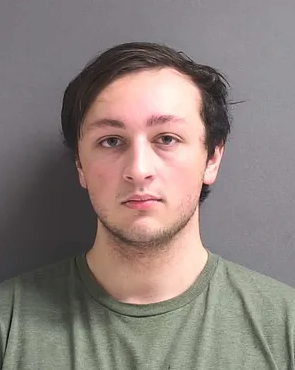
A booking photo of Noah Michael Urban released by the Volusia County Sheriff.
Although prosecutors had asked for Urban to serve eight years, Jacksonville news outlet News4Jax.com reports the federal judge in the case today opted to sentence Urban to 120 months in federal prison, ordering him to pay $13 million in restitution and undergo three years of supervised release after his sentence is completed.
In November 2024 Urban was charged by federal prosecutors in Los Angeles as one of five members of Scattered Spider (a.k.a. “Oktapus,” “Scatter Swine” and “UNC3944”), which specialized in SMS and voice phishing attacks that tricked employees at victim companies into entering their credentials and one-time passcodes at phishing websites. Urban pleaded guilty to one count of conspiracy to commit wire fraud in the California case, and the $13 million in restitution is intended to cover victims from both cases.
The targeted SMS scams spanned several months during the summer of 2022, asking employees to click a link and log in at a website that mimicked their employer’s Okta authentication page. Some SMS phishing messages told employees their VPN credentials were expiring and needed to be changed; other missives advised employees about changes to their upcoming work schedule.
That phishing spree netted Urban and others access to more than 130 companies, including Twilio, LastPass, DoorDash, MailChimp, and Plex. The government says the group used that access to steal proprietary company data and customer information, and that members also phished people to steal millions of dollars worth of cryptocurrency.
For many years, Urban’s online hacker aliases “King Bob” and “Sosa” were fixtures of the Com, a mostly Telegram and Discord-based community of English-speaking cybercriminals wherein hackers boast loudly about high-profile exploits and hacks that almost invariably begin with social engineering. King Bob constantly bragged on the Com about stealing unreleased rap music recordings from popular artists, presumably through SIM-swapping attacks. Many of those purloined tracks or “grails” he later sold or gave away on forums.
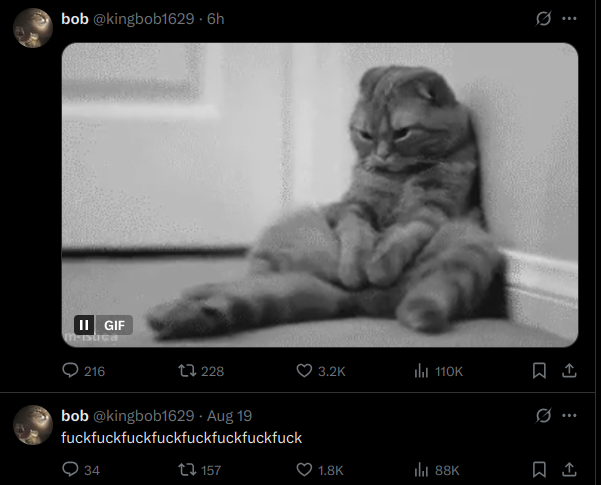
Noah “King Bob” Urban, posting to Twitter/X around the time of his sentencing today.
Sosa also was active in a particularly destructive group of accomplished criminal SIM-swappers known as “Star Fraud.” Cyberscoop’s AJ Vicens reported in 2023 that individuals within Star Fraud were likely involved in the high-profile Caesars Entertainment and MGM Resorts extortion attacks that same year.
The Star Fraud SIM-swapping group gained the ability to temporarily move targeted mobile numbers to devices they controlled by constantly phishing employees of the major mobile providers. In February 2023, KrebsOnSecurity published data taken from the Telegram channels for Star Fraud and two other SIM-swapping groups showing these crooks focused on SIM-swapping T-Mobile customers, and that they collectively claimed internal access to T-Mobile on 100 separate occasions over a 7-month period in 2022.
Reached via one of his King Bob accounts on Twitter/X, Urban called the sentence unjust, and said the judge in his case discounted his age as a factor.
“The judge purposefully ignored my age as a factor because of the fact another Scattered Spider member hacked him personally during the course of my case,” Urban said in reply to questions, noting that he was sending the messages from a Florida county jail. “He should have been removed as a judge much earlier on. But staying in county jail is torture.”
A court transcript (PDF) from a status hearing in February 2025 shows Urban was telling the truth about the hacking incident that happened while he was in federal custody. It involved an intrusion into a magistrate judge’s email account, where a copy of Urban’s sealed indictment was stolen. The judge told attorneys for both sides that a co-defendant in the California case was trying to find out about Mr. Urban’s activity in the Florida case.
“What it ultimately turned into a was a big faux pas,” Judge Harvey E. Schlesinger said. “The Court’s password…business is handled by an outside contractor. And somebody called the outside contractor representing Judge Toomey saying, ‘I need a password change.’ And they gave out the password change. That’s how whoever was making the phone call got into the court.”
A 23-year-old Scottish man thought to be a member of the prolific Scattered Spider cybercrime group was extradited last week from Spain to the United States, where he is facing charges of wire fraud, conspiracy and identity theft. U.S. prosecutors allege Tyler Robert Buchanan and co-conspirators hacked into dozens of companies in the United States and abroad, and that he personally controlled more than $26 million stolen from victims.
Scattered Spider is a loosely affiliated criminal hacking group whose members have broken into and stolen data from some of the world’s largest technology companies. Buchanan was arrested in Spain last year on a warrant from the FBI, which wanted him in connection with a series of SMS-based phishing attacks in the summer of 2022 that led to intrusions at Twilio, LastPass, DoorDash, Mailchimp, and many other tech firms.

Tyler Buchanan, being escorted by Spanish police at the airport in Palma de Mallorca in June 2024.
As first reported by KrebsOnSecurity, Buchanan (a.k.a. “tylerb”) fled the United Kingdom in February 2023, after a rival cybercrime gang hired thugs to invade his home, assault his mother, and threaten to burn him with a blowtorch unless he gave up the keys to his cryptocurrency wallet. Buchanan was arrested in June 2024 at the airport in Palma de Mallorca while trying to board a flight to Italy. His extradition to the United States was first reported last week by Bloomberg.
Members of Scattered Spider have been tied to the 2023 ransomware attacks against MGM and Caesars casinos in Las Vegas, but it remains unclear whether Buchanan was implicated in that incident. The Justice Department’s complaint against Buchanan makes no mention of the 2023 ransomware attack.
Rather, the investigation into Buchanan appears to center on the SMS phishing campaigns from 2022, and on SIM-swapping attacks that siphoned funds from individual cryptocurrency investors. In a SIM-swapping attack, crooks transfer the target’s phone number to a device they control and intercept any text messages or phone calls to the victim’s device — including one-time passcodes for authentication and password reset links sent via SMS.
In August 2022, KrebsOnSecurity reviewed data harvested in a months-long cybercrime campaign by Scattered Spider involving countless SMS-based phishing attacks against employees at major corporations. The security firm Group-IB called them by a different name — 0ktapus, because the group typically spoofed the identity provider Okta in their phishing messages to employees at targeted firms.
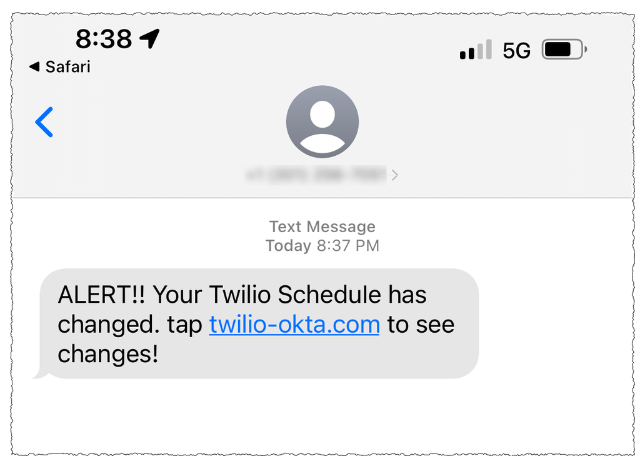
A Scattered Spider/0Ktapus SMS phishing lure sent to Twilio employees in 2022.
The complaint against Buchanan (PDF) says the FBI tied him to the 2022 SMS phishing attacks after discovering the same username and email address was used to register numerous Okta-themed phishing domains seen in the campaign. The domain registrar NameCheap found that less than a month before the phishing spree, the account that registered those domains logged in from an Internet address in the U.K. FBI investigators said the Scottish police told them the address was leased to Buchanan from January 26, 2022 to November 7, 2022.
Authorities seized at least 20 digital devices when they raided Buchanan’s residence, and on one of those devices they found usernames and passwords for employees of three different companies targeted in the phishing campaign.
“The FBI’s investigation to date has gathered evidence showing that Buchanan and his co-conspirators targeted at least 45 companies in the United States and abroad, including Canada, India, and the United Kingdom,” the FBI complaint reads. “One of Buchanan’s devices contained a screenshot of Telegram messages between an account known to be used by Buchanan and other unidentified co-conspirators discussing dividing up the proceeds of SIM swapping.”
U.S. prosecutors allege that records obtained from Discord showed the same U.K. Internet address was used to operate a Discord account that specified a cryptocurrency wallet when asking another user to send funds. The complaint says the publicly available transaction history for that payment address shows approximately 391 bitcoin was transferred in and out of this address between October 2022 and
February 2023; 391 bitcoin is presently worth more than $26 million.
In November 2024, federal prosecutors in Los Angeles unsealed criminal charges against Buchanan and four other alleged Scattered Spider members, including Ahmed Elbadawy, 23, of College Station, Texas; Joel Evans, 25, of Jacksonville, North Carolina; Evans Osiebo, 20, of Dallas; and Noah Urban, 20, of Palm Coast, Florida. KrebsOnSecurity reported last year that another suspected Scattered Spider member — a 17-year-old from the United Kingdom — was arrested as part of a joint investigation with the FBI into the MGM hack.
Mr. Buchanan’s court-appointed attorney did not respond to a request for comment. The accused faces charges of wire fraud conspiracy, conspiracy to obtain information by computer for private financial gain, and aggravated identity theft. Convictions on the latter charge carry a minimum sentence of two years in prison.
Documents from the U.S. District Court for the Central District of California indicate Buchanan is being held without bail pending trial. A preliminary hearing in the case is slated for May 6.
In September 2023, KrebsOnSecurity published findings from security researchers who concluded that a series of six-figure cyberheists across dozens of victims resulted from thieves cracking master passwords stolen from the password manager service LastPass in 2022. In a court filing this week, U.S. federal agents investigating a spectacular $150 million cryptocurrency heist said they had reached the same conclusion.

On March 6, federal prosecutors in northern California said they seized approximately $24 million worth of cryptocurrencies that were clawed back following a $150 million cyberheist on Jan. 30, 2024. The complaint refers to the person robbed only as “Victim-1,” but according to blockchain security researcher ZachXBT the theft was perpetrated against Chris Larsen, the co-founder of the cryptocurrency platform Ripple. ZachXBT was the first to report on the heist.
This week’s action by the government merely allows investigators to officially seize the frozen funds. But there is an important conclusion in this seizure document: It basically says the U.S. Secret Service and the FBI agree with the findings of the LastPass breach story published here in September 2023.
That piece quoted security researchers who said they were witnessing six-figure crypto heists several times each month that all appeared to be the result of crooks cracking master passwords for the password vaults stolen from LastPass in 2022.
“The Federal Bureau of Investigation has been investigating these data breaches, and law enforcement agents investigating the instant case have spoken with FBI agents about their investigation,” reads the seizure complaint, which was written by a U.S. Secret Service agent. “From those conversations, law enforcement agents in this case learned that the stolen data and passwords that were stored in several victims’ online password manager accounts were used to illegally, and without authorization, access the victims’ electronic accounts and steal information, cryptocurrency, and other data.”
The document continues:
“Based on this investigation, law enforcement had probable cause to believe the same attackers behind the above-described commercial online password manager attack used a stolen password held in Victim 1’s online password manager account and, without authorization, accessed his cryptocurrency wallet/account.”
Working with dozens of victims, security researchers Nick Bax and Taylor Monahan found that none of the six-figure cyberheist victims appeared to have suffered the sorts of attacks that typically preface a high-dollar crypto theft, such as the compromise of one’s email and/or mobile phone accounts, or SIM-swapping attacks.
They discovered the victims all had something else in common: Each had at one point stored their cryptocurrency seed phrase — the secret code that lets anyone gain access to your cryptocurrency holdings — in the “Secure Notes” area of their LastPass account prior to the 2022 breaches at the company.
Bax and Monahan found another common theme with these robberies: They all followed a similar pattern of cashing out, rapidly moving stolen funds to a dizzying number of drop accounts scattered across various cryptocurrency exchanges.
According to the government, a similar level of complexity was present in the $150 million heist against the Ripple co-founder last year.
“The scale of a theft and rapid dissipation of funds would have required the efforts of multiple malicious actors, and was consistent with the online password manager breaches and attack on other victims whose cryptocurrency was stolen,” the government wrote. “For these reasons, law enforcement agents believe the cryptocurrency stolen from Victim 1 was committed by the same attackers who conducted the attack on the online password manager, and cryptocurrency thefts from other similarly situated victims.”
Reached for comment, LastPass said it has seen no definitive proof — from federal investigators or others — that the cyberheists in question were linked to the LastPass breaches.
“Since we initially disclosed this incident back in 2022, LastPass has worked in close cooperation with multiple representatives from law enforcement,” LastPass said in a written statement. “To date, our law enforcement partners have not made us aware of any conclusive evidence that connects any crypto thefts to our incident. In the meantime, we have been investing heavily in enhancing our security measures and will continue to do so.”
On August 25, 2022, LastPass CEO Karim Toubba told users the company had detected unusual activity in its software development environment, and that the intruders stole some source code and proprietary LastPass technical information. On Sept. 15, 2022, LastPass said an investigation into the August breach determined the attacker did not access any customer data or password vaults.
But on Nov. 30, 2022, LastPass notified customers about another, far more serious security incident that the company said leveraged data stolen in the August breach. LastPass disclosed that criminal hackers had compromised encrypted copies of some password vaults, as well as other personal information.
Experts say the breach would have given thieves “offline” access to encrypted password vaults, theoretically allowing them all the time in the world to try to crack some of the weaker master passwords using powerful systems that can attempt millions of password guesses per second.
Researchers found that many of the cyberheist victims had chosen master passwords with relatively low complexity, and were among LastPass’s oldest customers. That’s because legacy LastPass users were more likely to have master passwords that were protected with far fewer “iterations,” which refers to the number of times your password is run through the company’s encryption routines. In general, the more iterations, the longer it takes an offline attacker to crack your master password.
Over the years, LastPass forced new users to pick longer and more complex master passwords, and they increased the number of iterations on multiple occasions by several orders of magnitude. But researchers found strong indications that LastPass never succeeded in upgrading many of its older customers to the newer password requirements and protections.
Asked about LastPass’s continuing denials, Bax said that after the initial warning in our 2023 story, he naively hoped people would migrate their funds to new cryptocurrency wallets.
“While some did, the continued thefts underscore how much more needs to be done,” Bax told KrebsOnSecurity. “It’s validating to see the Secret Service and FBI corroborate our findings, but I’d much rather see fewer of these hacks in the first place. ZachXBT and SEAL 911 reported yet another wave of thefts as recently as December, showing the threat is still very real.”
Monahan said LastPass still hasn’t alerted their customers that their secrets—especially those stored in “Secure Notes”—may be at risk.
“Its been two and a half years since LastPass was first breached [and] hundreds of millions of dollars has been stolen from individuals and companies around the globe,” Monahan said. “They could have encouraged users to rotate their credentials. They could’ve prevented millions and millions of dollars from being stolen by these threat actors. But instead they chose to deny that their customers were are risk and blame the victims instead.”
Federal prosecutors in Los Angeles this week unsealed criminal charges against five men alleged to be members of a hacking group responsible for dozens of cyber intrusions at major U.S. technology companies between 2021 and 2023, including LastPass, MailChimp, Okta, T-Mobile and Twilio.
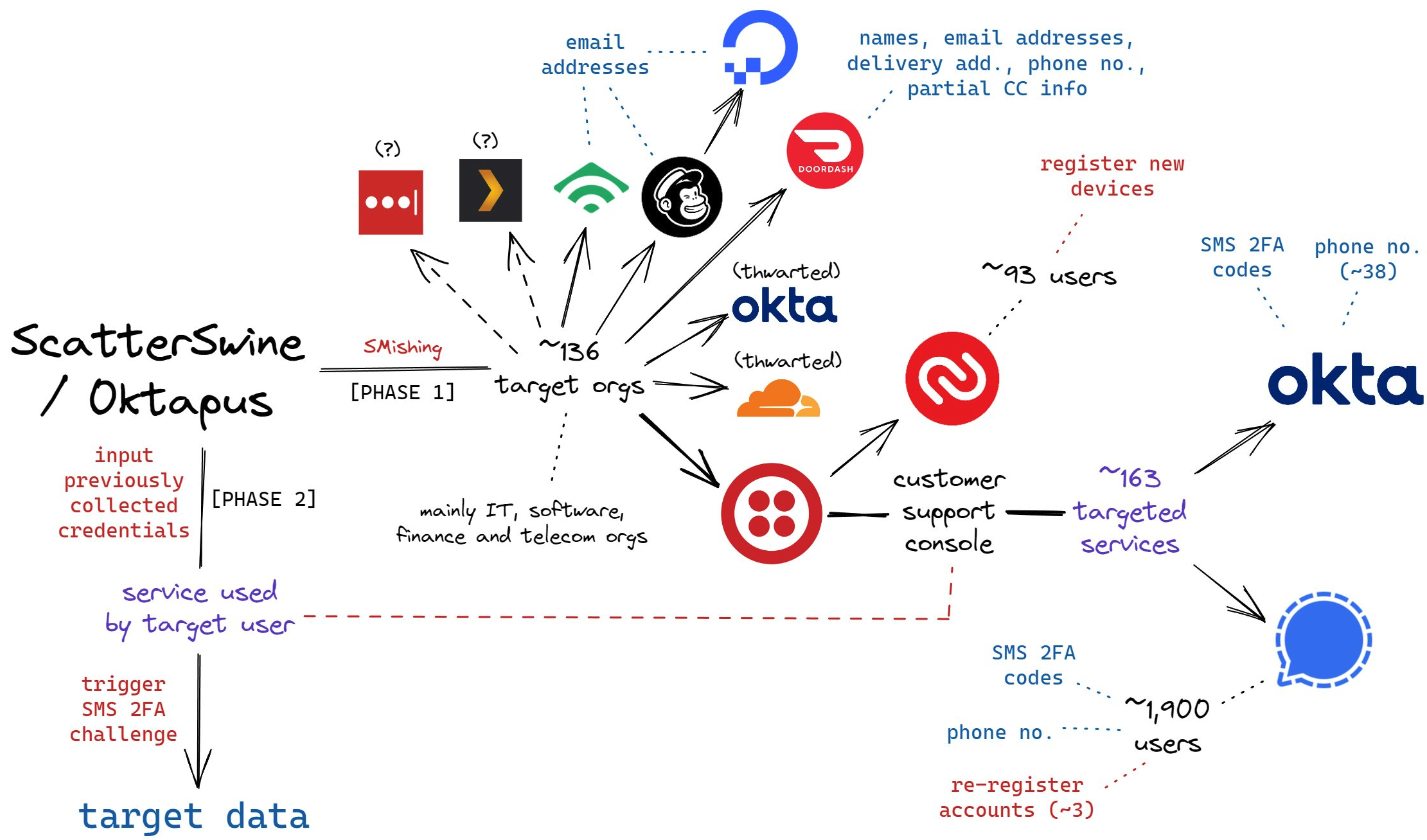
A visual depiction of the attacks by the SMS phishing group known as Scattered Spider, and Oktapus. Image: Amitai Cohen twitter.com/amitaico.
The five men, aged 20 to 25, are allegedly members of a hacking conspiracy dubbed “Scattered Spider” and “Oktapus,” which specialized in SMS-based phishing attacks that tricked employees at tech firms into entering their credentials and one-time passcodes at phishing websites.
The targeted SMS scams asked employees to click a link and log in at a website that mimicked their employer’s Okta authentication page. Some SMS phishing messages told employees their VPN credentials were expiring and needed to be changed; other phishing messages advised employees about changes to their upcoming work schedule.
These attacks leveraged newly-registered domains that often included the name of the targeted company, such as twilio-help[.]com and ouryahoo-okta[.]com. The phishing websites were normally kept online for just one or two hours at a time, meaning they were often yanked offline before they could be flagged by anti-phishing and security services.
The phishing kits used for these campaigns featured a hidden Telegram instant message bot that forwarded any submitted credentials in real-time. The bot allowed the attackers to use the phished username, password and one-time code to log in as that employee at the real employer website.
In August 2022, multiple security firms gained access to the server that was receiving data from that Telegram bot, which on several occasions leaked the Telegram ID and handle of its developer, who used the nickname “Joeleoli.”
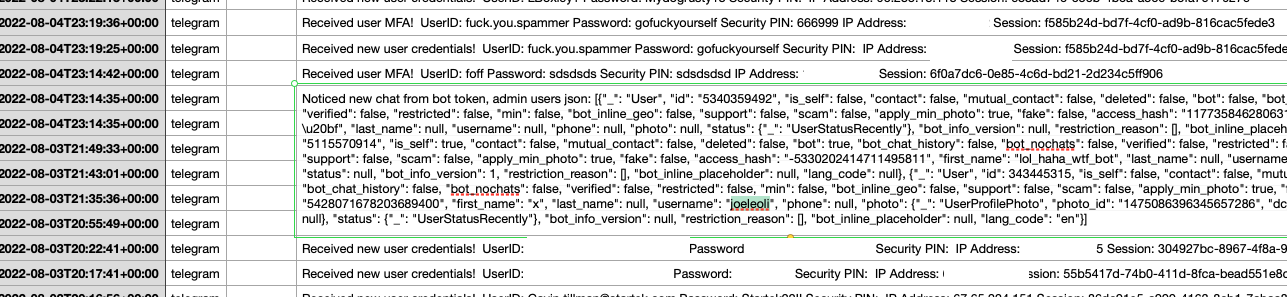
The Telegram username “Joeleoli” can be seen sandwiched between data submitted by people who knew it was a phish, and data phished from actual victims. Click to enlarge.
That Joeleoli moniker registered on the cybercrime forum OGusers in 2018 with the email address joelebruh@gmail.com, which also was used to register accounts at several websites for a Joel Evans from North Carolina. Indeed, prosecutors say Joeleoli’s real name is Joel Martin Evans, and he is a 25-year-old from Jacksonville, North Carolina.
One of Scattered Spider’s first big victims in its 2022 SMS phishing spree was Twilio, a company that provides services for making and receiving text messages and phone calls. The group then used their access to Twilio to attack at least 163 of its customers. According to prosecutors, the group mainly sought to steal cryptocurrency from victim companies and their employees.
“The defendants allegedly preyed on unsuspecting victims in this phishing scheme and used their personal information as a gateway to steal millions in their cryptocurrency accounts,” said Akil Davis, the assistant director in charge of the FBI’s Los Angeles field office.
Many of the hacking group’s phishing domains were registered through the registrar NameCheap, and FBI investigators said records obtained from NameCheap showed the person who managed those phishing websites did so from an Internet address in Scotland. The feds then obtained records from Virgin Media, which showed the address was leased for several months to Tyler Buchanan, a 22-year-old from Dundee, Scotland.
A Scattered Spider phishing lure sent to Twilio employees.
As first reported here in June, Buchanan was arrested in Spain as he tried to board a flight bound for Italy. The Spanish police told local media that Buchanan, who allegedly went by the alias “Tylerb,” at one time possessed Bitcoins worth $27 million.
The government says much of Tylerb’s cryptocurrency wealth was the result of successful SIM-swapping attacks, wherein crooks transfer the target’s phone number to a device they control and intercept any text messages or phone calls sent to the victim — including one-time passcodes for authentication, or password reset links sent via SMS.
According to several SIM-swapping channels on Telegram where Tylerb was known to frequent, rival SIM-swappers hired thugs to invade his home in February 2023. Those accounts state that the intruders assaulted Tylerb’s mother in the home invasion, and that they threatened to burn him with a blowtorch if he didn’t give up the keys to his cryptocurrency wallets. Tylerb was reputed to have fled the United Kingdom after that assault.
A still frame from a video released by the Spanish national police, showing Tyler Buchanan being taken into custody at the airport.
Prosecutors allege Tylerb worked closely on SIM-swapping attacks with Noah Michael Urban, another alleged Scattered Spider member from Palm Coast, Fla. who went by the handles “Sosa,” “Elijah,” and “Kingbob.”
Sosa was known to be a top member of the broader cybercriminal community online known as “The Com,” wherein hackers boast loudly about high-profile exploits and hacks that almost invariably begin with social engineering — tricking people over the phone, email or SMS into giving away credentials that allow remote access to corporate networks.
In January 2024, KrebsOnSecurity broke the news that Urban had been arrested in Florida in connection with multiple SIM-swapping attacks. That story noted that Sosa’s alter ego Kingbob routinely targeted people in the recording industry to steal and share “grails,” a slang term used to describe unreleased music recordings from popular artists.
FBI investigators identified a fourth alleged member of the conspiracy – Ahmed Hossam Eldin Elbadawy, 23, of College Station, Texas — after he used a portion of cryptocurrency funds stolen from a victim company to pay for an account used to register phishing domains.
The indictment unsealed Wednesday alleges Elbadawy controlled a number of cryptocurrency accounts used to receive stolen funds, along with another Texas man — Evans Onyeaka Osiebo, 20, of Dallas.
Members of Scattered Spider are reputed to have been involved in a September 2023 ransomware attack against the MGM Resorts hotel chain that quickly brought multiple MGM casinos to a standstill. In September 2024, KrebsOnSecurity reported that a 17-year-old from the United Kingdom was arrested last year by U.K. police as part of an FBI investigation into the MGM hack.
Evans, Elbadawy, Osiebo and Urban were all charged with one count of conspiracy to commit wire fraud, one count of conspiracy, and one count of aggravated identity theft. Buchanan, who is named as an indicted co-conspirator, was charged with conspiracy to commit wire fraud, conspiracy, wire fraud, and aggravated identity theft.
A Justice Department press release states that if convicted, each defendant would face a statutory maximum sentence of 20 years in federal prison for conspiracy to commit wire fraud, up to five years in federal prison for the conspiracy count, and a mandatory two-year consecutive prison sentence for aggravated identity theft. Buchanan would face up to 20 years in prison for the wire fraud count as well.
Further reading:
A 22-year-old man from the United Kingdom arrested this week in Spain is allegedly the ringleader of Scattered Spider, a cybercrime group suspected of hacking into Twilio, LastPass, DoorDash, Mailchimp, and nearly 130 other organizations over the past two years.
The Spanish daily Murcia Today reports the suspect was wanted by the FBI and arrested in Palma de Mallorca as he tried to board a flight to Italy.
A still frame from a video released by the Spanish national police shows Tylerb in custody at the airport.
“He stands accused of hacking into corporate accounts and stealing critical information, which allegedly enabled the group to access multi-million-dollar funds,” Murcia Today wrote. “According to Palma police, at one point he controlled Bitcoins worth $27 million.”
The cybercrime-focused Twitter/X account vx-underground said the U.K. man arrested was a SIM-swapper who went by the alias “Tyler.” In a SIM-swapping attack, crooks transfer the target’s phone number to a device they control and intercept any text messages or phone calls sent to the victim — including one-time passcodes for authentication, or password reset links sent via SMS.
“He is a known SIM-swapper and is allegedly involved with the infamous Scattered Spider group,” vx-underground wrote on June 15, referring to a prolific gang implicated in costly data ransom attacks at MGM and Caesars casinos in Las Vegas last year.
Sources familiar with the investigation told KrebsOnSecurity the accused is a 22-year-old from Dundee, Scotland named Tyler Buchanan, also allegedly known as “tylerb” on Telegram chat channels centered around SIM-swapping.
In January 2024, U.S. authorities arrested another alleged Scattered Spider member — 19-year-old Noah Michael Urban of Palm Coast, Fla. — and charged him with stealing at least $800,000 from five victims between August 2022 and March 2023. Urban allegedly went by the nicknames “Sosa” and “King Bob,” and is believed to be part of the same crew that hacked Twilio and a slew of other companies in 2022.
Investigators say Scattered Spider members are part of a more diffuse cybercriminal community online known as “The Com,” wherein hackers from different cliques boast loudly about high-profile cyber thefts that almost invariably begin with social engineering — tricking people over the phone, email or SMS into giving away credentials that allow remote access to corporate internal networks.
One of the more popular SIM-swapping channels on Telegram maintains a frequently updated leaderboard of the most accomplished SIM-swappers, indexed by their supposed conquests in stealing cryptocurrency. That leaderboard currently lists Sosa as #24 (out of 100), and Tylerb at #65.
In August 2022, KrebsOnSecurity wrote about peering inside the data harvested in a months-long cybercrime campaign by Scattered Spider involving countless SMS-based phishing attacks against employees at major corporations. The security firm Group-IB called the gang by a different name — 0ktapus, a nod to how the criminal group phished employees for credentials.
The missives asked users to click a link and log in at a phishing page that mimicked their employer’s Okta authentication page. Those who submitted credentials were then prompted to provide the one-time password needed for multi-factor authentication.
These phishing attacks used newly-registered domains that often included the name of the targeted company, and sent text messages urging employees to click on links to these domains to view information about a pending change in their work schedule. The phishing sites also featured a hidden Telegram instant message bot to forward any submitted credentials in real-time, allowing the attackers to use the phished username, password and one-time code to log in as that employee at the real employer website.
One of Scattered Spider’s first big victims in its 2022 SMS phishing spree was Twilio, a company that provides services for making and receiving text messages and phone calls. The group then pivoted, using their access to Twilio to attack at least 163 of its customers.
A Scattered Spider phishing lure sent to Twilio employees.
Among those was the encrypted messaging app Signal, which said the breach could have let attackers re-register the phone number on another device for about 1,900 users.
Also in August 2022, several employees at email delivery firm Mailchimp provided their remote access credentials to this phishing group. According to Mailchimp, the attackers used their access to Mailchimp employee accounts to steal data from 214 customers involved in cryptocurrency and finance.
On August 25, 2022, the password manager service LastPass disclosed a breach in which attackers stole some source code and proprietary LastPass technical information, and weeks later LastPass said an investigation revealed no customer data or password vaults were accessed.
However, on November 30, 2022 LastPass disclosed a far more serious breach that the company said leveraged data stolen in the August breach. LastPass said criminal hackers had stolen encrypted copies of some password vaults, as well as other personal information.
In February 2023, LastPass disclosed that the intrusion involved a highly complex, targeted attack against an engineer who was one of only four LastPass employees with access to the corporate vault. In that incident, the attackers exploited a security vulnerability in a Plex media server that the employee was running on his home network, and succeeded in installing malicious software that stole passwords and other authentication credentials. The vulnerability exploited by the intruders was patched back in 2020, but the employee never updated his Plex software.
Plex announced its own data breach one day before LastPass disclosed its initial August intrusion. On August 24, 2022, Plex’s security team urged users to reset their passwords, saying an intruder had accessed customer emails, usernames and encrypted passwords.
Sosa and Tylerb were both subjected to physical attacks from rival SIM-swapping gangs. These communities have been known to settle scores by turning to so-called “violence-as-a-service” offerings on cybercrime channels, wherein people can be hired to perform a variety geographically-specific “in real life” jobs, such as bricking windows, slashing car tires, or even home invasions.
In 2022, a video surfaced on a popular cybercrime channel purporting to show attackers hurling a brick through a window at an address that matches the spacious and upscale home of Urban’s parents in Sanford, Fl.
January’s story on Sosa noted that a junior member of his crew named “Foreshadow” was kidnapped, beaten and held for ransom in September 2022. Foreshadow’s captors held guns to his bloodied head while forcing him to record a video message pleading with his crew to fork over a $200,000 ransom in exchange for his life (Foreshadow escaped further harm in that incident).
According to several SIM-swapping channels on Telegram where Tylerb was known to frequent, rival SIM-swappers hired thugs to invade his home in February 2023. Those accounts state that the intruders assaulted Tylerb’s mother in the home invasion, and that they threatened to burn him with a blowtorch if he didn’t give up the keys to his cryptocurrency wallets. Tylerb was reputed to have fled the United Kingdom after that assault.
KrebsOnSecurity sought comment from Mr. Buchanan, and will update this story in the event he responds.


s3-ep124-auth--1200


 FreshRSS