Login
Login
Netherlands Seizes 800 Servers, Arrests 2 for Aiding Cyberattacks
Authorities in the Netherlands have arrested the co-owners of two related Internet hosting companies for operating IT infrastructure used by Russia to carry out cyberattacks, influence operations and disinformation campaigns inside the European Union. The two men were the focus of a 2025 KrebsOnSecurity story about how their hosting companies had assumed control over the technical infrastructure of Stark Industries Solutions, an Internet service provider sanctioned last year by the EU as a frequent staging ground for cyber mischief from Russia’s intelligence agencies.

An investigator with the Tax Intelligence and Investigation Service (FIOD), the Dutch financial crimes agency, during the raid. Image: FIOD.
The Dutch daily news outlet de Volkskrant reports that the Dutch financial crime agency FIOD on May 18 arrested a 57-year-old from Amsterdam and a 39-year-old from The Hague, charging them with violating sanctions law by directly or indirectly making economic resources available to EU-sanctioned entities.
The Dutch investigation focuses on Stark Industries, a sprawling hosting provider that materialized just two weeks before Russia invaded Ukraine. As detailed in this May 2024 deep-dive, Stark quickly became the source of massive distributed denial-of-service (DDoS) attacks against European targets, and emerged as a top supplier of proxy and anonymity services that showed up time and again in cyberattacks linked to Russia-backed hacking groups.
That report identified two Moldovan brothers — Ivan and Yuri Neculiti and their company PQHosting — who were providing one of Stark’s two main conduits to the larger Internet. In May 2025, the EU sanctioned PQHosting and the Neculiti brothers for aiding Russia’s hybrid warfare efforts. But as KrebsOnSecurity observed in September 2025, those sanctions failed to target Stark’s remaining connection to the Internet — an Internet service provider based in the Netherlands called MIRhosting.
MIRhosting is operated by Andrey Nesterenko, a 39-year-old Russian native who runs the business out of the Netherlands. News that PQHosting and the Neculiti brothers were about to be sanctioned by the EU leaked in the media nearly two weeks before the sanctions were announced last year. During that time, the Stark network assets were transferred from PQHosting to a new entity called the[.]hosting, under the control of the Dutch entity WorkTitans BV.
And as our September 2025 report showed, WorkTitans was controlled by Nesterenko and a 57-year-old from Amsterdam named Youssef Zinad. On top of that, WorkTitans was getting connectivity to the larger Internet solely through MIRhosting, where Zinad had worked previously.
On May 18, Dutch financial crime investigators arrested Nesterenko and Zinad, and searched three businesses in Enschede and Almere and two data centers in Dronten and Schiphol-Rijk. A statement from the Dutch authorities said they also seized laptops, telephones and more than 800 servers.
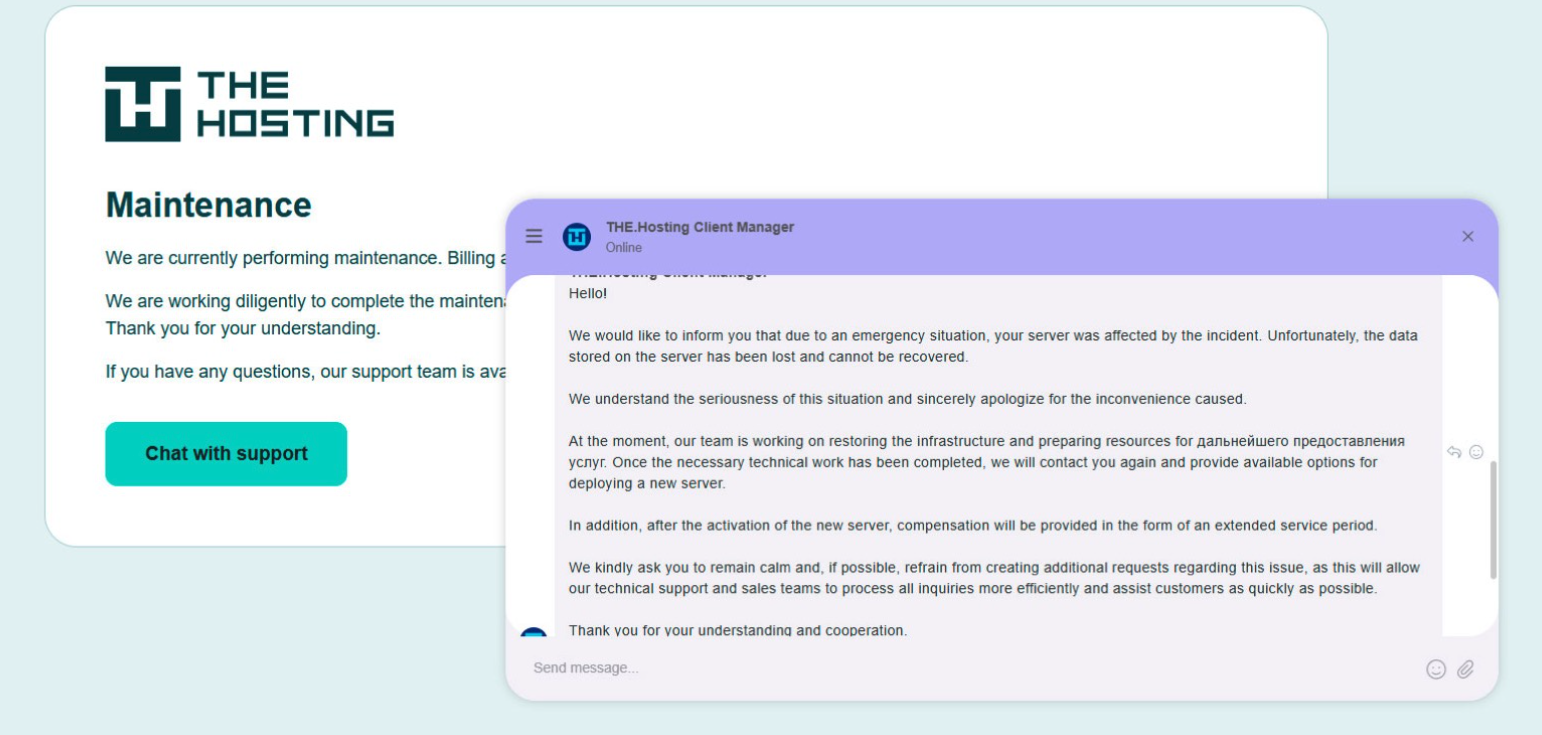
A message to the-hosting customers immediately after 800 of its servers were seized by Dutch authorities. The message says that unfortunately data stored on the server has been lost and cannot be recovered.
De Volkskrant said it reviewed data showing WorkTitans and MIRhosting were the most-used networks in pro-Russian attacks on Danish government bodies between November 13 and 19, 2025, the week of Denmark’s municipal elections.
The publication wrote that prior to Nesterenko’s arrest, the MIRhosting founder denied that he knew his servers had been misused by pro-Russian cybercriminals. “He said he had ended all services with the Neculiti brothers when the EU sanctions came into force in May 2025,” and the he “reserved all rights to take action against ‘harmful and incorrect publications,” de Volkskrant wrote.
MIRhosting released a statement saying it has initiated an internal investigation into the alleged facts concerning the elections in Denmark, and that it has temporarily paused services to WorkTitans as a precautionary measure while the matter is being reviewed further.
“Based on our preliminary findings, there are no indications that the services over which we exercise control were actually used to influence the Danish elections,” the statement reads. “No anomalies or spikes were observed in our network traffic during the period mentioned in the publication; had large-scale DDoS attacks occurred, such activity would have been evident. Furthermore, prior to the media publication, we had not received any complaints, abuse reports, or official requests regarding suspicious activities or misuse of our network. Meanwhile, our regular operational activities continue, and our service to our other clients remains fully intact.”
Born in Nizhny Novgorod, Russia, Mr. Nesterenko grew up as a piano prodigy who performed publicly at a young age. In 2004, Nesterenko founded MIRhosting’s parent Innovation IT Solutions Corp., which has the notable distinction of being the company responsible for hosting stopgeorgia[.]ru, a hacktivist website for organizing cyberattacks against Georgia that appeared at the same time Russian forces invaded the former Soviet nation in 2008. That conflict was thought to be the first war ever fought in which a notable cyberattack and an actual military engagement happened simultaneously.
Responding to questions shared via email, Nesterenko said MIRhosting does not support cybercrime, sanctions evasion, or illegal activity, and that the allegations and arrest by Dutch authorities have been extremely harmful to him and his company.
“The transition to the.hosting was not intended to evade sanctions,” Nesterenko wrote. “The hardware and customer portfolio had already been transferred to WorkTitans before the sanctions appeared. Closing or damaging a legitimate Dutch infrastructure company will not stop cybercrime, but it will harm many people who have done nothing wrong.”
Far less is public about the 57-year-old Zinad, who reportedly has been keeping a low profile since our story last year. De Volkskrant reported that Zinad blocked access to his LinkedIn account, had gone months without responding to emails, WhatsApp messages and phone calls, and told a colleague that illness was forcing him to lead a somewhat more reclusive life.
Mr. Zinad’s now-defunct LinkedIn profile. It was full of posts for MIRhosting’s services.
Mr. Nesterenko claims Zinad was never an employee of MIRhosting.
“He helped me and MIRhosting with certain business tasks under a normal business-to-business arrangement between companies,” Nesterenko explained.
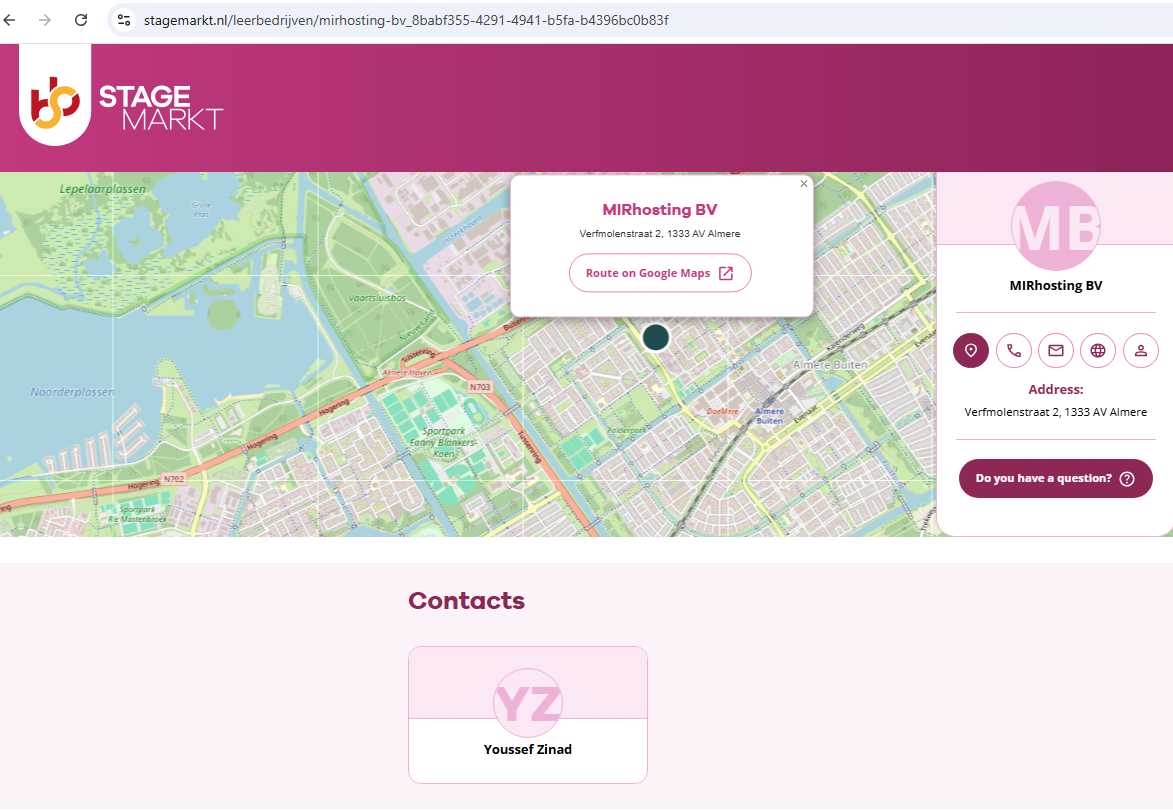
However, in previous emails to KrebsOnSecurity, Nesterenko carbon copied Mr. Zinad (who had a @mirhosting.com email), explaining that he was part of the company’s legal team. Also, the Dutch website stagemarkt[.]nl lists Youssef Zinad as an official contact for MIRhosting’s offices in Almere.
Mr. Zinad has never responded to requests for comment. Nor did de Volkskrant have any luck tracking him down. The publication said it repeatedly asked Mr. Zinad (referred to here as simply “Z”), but he reportedly avoided every form of contact.
“‘I am unavailable but will respond to your message as soon as possible,’ reads an automated reply on WhatsApp on 2 October 2025,” de Volkskrant reported. “It is the only response de Volkskrant would receive in months. He did not pick up his phone and did not call back. When an acquaintance asked him via LinkedIn to contact the reporter, he blocked access to his LinkedIn page. At an address in Almere where Z.’s personal limited company is registered, no one was present in April. The corner house’s blinds were drawn, and a pile of rubbish bags lay outside next to a container, as if someone had recently left. A neighbour said he knew the man but did not know where he was staying. Z. was later arrested at a residence in Amsterdam.”