Normal view

Who is the Kimwolf Botmaster “Dort”?

28 February 2026 at 12:01

In early January 2026, KrebsOnSecurity revealed how a security researcher disclosed a vulnerability that was used to build Kimwolf, the world’s largest and most disruptive botnet. Since then, the person in control of Kimwolf — who goes by the handle “Dort” — has coordinated a barrage of distributed denial-of-service (DDoS), doxing and email flooding attacks against the researcher and this author, and more recently caused a SWAT team to be sent to the researcher’s home. This post examines what is knowable about Dort based on public information.

A public “dox” created in 2020 asserted Dort was a teenager from Canada (DOB August 2003) who used the aliases “CPacket” and “M1ce.” A search on the username CPacket at the open source intelligence platform OSINT Industries finds a GitHub account under the names Dort and CPacket that was created in 2017 using the email address jay.miner232@gmail.com.

Image: osint.industries.

The cyber intelligence firm Intel 471 says jay.miner232@gmail.com was used between 2015 and 2019 to create accounts at multiple cybercrime forums, including Nulled (username “Uubuntuu”) and Cracked (user “Dorted”); Intel 471 reports that both of these accounts were created from the same Internet address at Rogers Canada (99.241.112.24).

Dort was an extremely active player in the Microsoft game Minecraft who gained notoriety for their “Dortware” software that helped players cheat. But somewhere along the way, Dort graduated from hacking Minecraft games to enabling far more serious crimes.

Dort also used the nickname DortDev, an identity that was active in March 2022 on the chat server for the prolific cybercrime group known as LAPSUS$. Dort peddled a service for registering temporary email addresses, as well as “Dortsolver,” code that could bypass various CAPTCHA services designed to prevent automated account abuse. Both of these offerings were advertised in 2022 on SIM Land, a Telegram channel dedicated to SIM-swapping and account takeover activity.

The cyber intelligence firm Flashpoint indexed 2022 posts on SIM Land by Dort that show this person developed the disposable email and CAPTCHA bypass services with the help of another hacker who went by the handle “Qoft.”

“I legit just work with Jacob,” Qoft said in 2022 in reply to another user, referring to their exclusive business partner Dort. In the same conversation, Qoft bragged that the two had stolen more than $250,000 worth of Microsoft Xbox Game Pass accounts by developing a program that mass-created Game Pass identities using stolen payment card data.

Who is the Jacob that Qoft referred to as their business partner? The breach tracking service Constella Intelligence finds the password used by jay.miner232@gmail.com was reused by just one other email address: jacobbutler803@gmail.com. Recall that the 2020 dox of Dort said their date of birth was August 2003 (8/03).

Searching this email address at DomainTools.com reveals it was used in 2015 to register several Minecraft-themed domains, all assigned to a Jacob Butler in Ottawa, Canada and to the Ottawa phone number 613-909-9727.

Constella Intelligence finds jacobbutler803@gmail.com was used to register an account on the hacker forum Nulled in 2016, as well as the account name “M1CE” on Minecraft. Pivoting off the password used by their Nulled account shows it was shared by the email addresses j.a.y.m.iner232@gmail.com and jbutl3@ocdsb.ca, the latter being an address at a domain for the Ottawa-Carelton District School Board.

Data indexed by the breach tracking service Spycloud suggests that at one point Jacob Butler shared a computer with his mother and a sibling, which might explain why their email accounts were connected to the password “jacobsplugs.” Neither Jacob nor any of the other Butler household members responded to requests for comment.

The open source intelligence service Epieos finds jacobbutler803@gmail.com created the GitHub account “MemeClient.” Meanwhile, Flashpoint indexed a deleted anonymous Pastebin.com post from 2017 declaring that MemeClient was the creation of a user named CPacket — one of Dort’s early monikers.

Why is Dort so mad? On January 2, KrebsOnSecurity published The Kimwolf Botnet is Stalking Your Local Network, which explored research into the botnet by Benjamin Brundage, founder of the proxy tracking service Synthient. Brundage figured out that the Kimwolf botmasters were exploiting a little-known weakness in residential proxy services to infect poorly-defended devices — like TV boxes and digital photo frames — plugged into the internal, private networks of proxy endpoints.

By the time that story went live, most of the vulnerable proxy providers had been notified by Brundage and had fixed the weaknesses in their systems. That vulnerability remediation process massively slowed Kimwolf’s ability to spread, and within hours of the story’s publication Dort created a Discord server in my name that began publishing personal information about and violent threats against Brundage, Yours Truly, and others.

Dort and friends incriminating themselves by planning swatting attacks in a public Discord server.

Last week, Dort and friends used that same Discord server (then named “Krebs’s Koinbase Kallers”) to threaten a swatting attack against Brundage, again posting his home address and personal information. Brundage told KrebsOnSecurity that local police officers subsequently visited his home in response to a swatting hoax which occurred around the same time that another member of the server posted a door emoji and taunted Brundage further.

Dort, using the alias “Meow,” taunts Synthient founder Ben Brundage with a picture of a door.

Someone on the server then linked to a cringeworthy (and NSFW) new Soundcloud diss track recorded by the user DortDev that included a stickied message from Dort saying, “Ur dead nigga. u better watch ur fucking back. sleep with one eye open. bitch.”

“It’s a pretty hefty penny for a new front door,” the diss track intoned. “If his head doesn’t get blown off by SWAT officers. What’s it like not having a front door?”

With any luck, Dort will soon be able to tell us all exactly what it’s like.

Update, 10:29 a.m.: Jacob Butler responded to requests for comment, speaking with KrebsOnSecurity briefly via telephone. Butler said he didn’t notice earlier requests for comment because he hasn’t really been online since 2021, after his home was swatted multiple times. He acknowledged making and distributing a Minecraft cheat long ago, but said he hasn’t played the game in years and was not involved in Dortsolver or any other activity attributed to the Dort nickname after 2021.

“It was a really old cheat and I don’t remember the name of it,” Butler said of his Minecraft modification. “I’m very stressed, man. I don’t know if people are going to swat me again or what. After that, I pretty much walked away from everything, logged off and said fuck that. I don’t go online anymore. I don’t know why people would still be going after me, to be completely honest.”

When asked what he does for a living, Butler said he mostly stays home and helps his mom around the house because he struggles with autism and social interaction. He maintains that someone must have compromised one or more of his old accounts and is impersonating him online as Dort.

“Someone is actually probably impersonating me, and now I’m really worried,” Butler said. “This is making me relive everything.”

But there are issues with Butler’s timeline. For example, Jacob’s voice in our phone conversation was remarkably similar to the Jacob/Dort whose voice can be heard in this Sept. 2022 Clash of Code competition between Dort and another coder (Dort lost). At around 6 minutes and 10 seconds into the recording, Dort launches into a cursing tirade that mirrors the stream of profanity in the diss rap that Dortdev posted threatening Brundage. Dort can be heard again at around 16 minutes; at around 26:00, Dort threatens to swat his opponent.

Butler said the voice of Dort is not his, exactly, but rather that of an impersonator who had likely cloned his voice.

“I would like to clarify that was absolutely not me,” Butler said. “There must be someone using a voice changer. Or something of the sorts. Because people were cloning my voice before and sending audio clips of ‘me’ saying outrageous stuff.”
Who Operates the Badbox 2.0 Botnet?

26 January 2026 at 16:11

The cybercriminals in control of Kimwolf — a disruptive botnet that has infected more than 2 million devices — recently shared a screenshot indicating they’d compromised the control panel for Badbox 2.0, a vast China-based botnet powered by malicious software that comes pre-installed on many Android TV streaming boxes. Both the FBI and Google say they are hunting for the people behind Badbox 2.0, and thanks to bragging by the Kimwolf botmasters we may now have a much clearer idea about that.

Our first story of 2026, The Kimwolf Botnet is Stalking Your Local Network, detailed the unique and highly invasive methods Kimwolf uses to spread. The story warned that the vast majority of Kimwolf infected systems were unofficial Android TV boxes that are typically marketed as a way to watch unlimited (pirated) movie and TV streaming services for a one-time fee.

Our January 8 story, Who Benefitted from the Aisuru and Kimwolf Botnets?, cited multiple sources saying the current administrators of Kimwolf went by the nicknames “Dort” and “Snow.” Earlier this month, a close former associate of Dort and Snow shared what they said was a screenshot the Kimwolf botmasters had taken while logged in to the Badbox 2.0 botnet control panel.

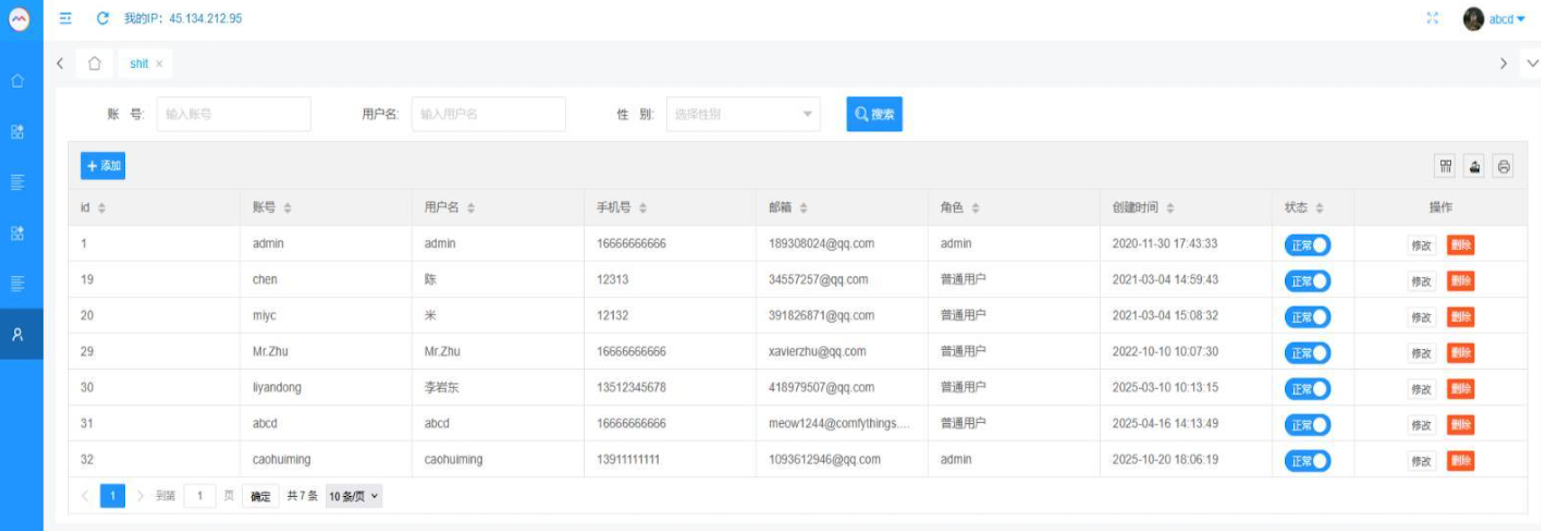
That screenshot, a portion of which is shown below, shows seven authorized users of the control panel, including one that doesn’t quite match the others: According to my source, the account “ABCD” (the one that is logged in and listed in the top right of the screenshot) belongs to Dort, who somehow figured out how to add their email address as a valid user of the Badbox 2.0 botnet.

The control panel for the Badbox 2.0 botnet lists seven authorized users and their email addresses. Click to enlarge.

Badbox has a storied history that well predates Kimwolf’s rise in October 2025. In July 2025, Google filed a “John Doe” lawsuit (PDF) against 25 unidentified defendants accused of operating Badbox 2.0, which Google described as a botnet of over ten million unsanctioned Android streaming devices engaged in advertising fraud. Google said Badbox 2.0, in addition to compromising multiple types of devices prior to purchase, also can infect devices by requiring the download of malicious apps from unofficial marketplaces.

Google’s lawsuit came on the heels of a June 2025 advisory from the Federal Bureau of Investigation (FBI), which warned that cyber criminals were gaining unauthorized access to home networks by either configuring the products with malware prior to the user’s purchase, or infecting the device as it downloads required applications that contain backdoors — usually during the set-up process.

The FBI said Badbox 2.0 was discovered after the original Badbox campaign was disrupted in 2024. The original Badbox was identified in 2023, and primarily consisted of Android operating system devices (TV boxes) that were compromised with backdoor malware prior to purchase.

KrebsOnSecurity was initially skeptical of the claim that the Kimwolf botmasters had hacked the Badbox 2.0 botnet. That is, until we began digging into the history of the qq.com email addresses in the screenshot above.

CATHEAD

An online search for the address 34557257@qq.com (pictured in the screenshot above as the user “Chen“) shows it is listed as a point of contact for a number of China-based technology companies, including:

Beijing Hong Dake Wang Science & Technology Co Ltd.
Beijing Hengchuang Vision Mobile Media Technology Co. Ltd.
Moxin Beijing Science and Technology Co. Ltd.

The website for Beijing Hong Dake Wang Science is asmeisvip[.]net, a domain that was flagged in a March 2025 report by HUMAN Security as one of several dozen sites tied to the distribution and management of the Badbox 2.0 botnet. Ditto for moyix[.]com, a domain associated with Beijing Hengchuang Vision Mobile.

A search at the breach tracking service Constella Intelligence finds 34557257@qq.com at one point used the password “cdh76111.” Pivoting on that password in Constella shows it is known to have been used by just two other email accounts: daihaic@gmail.com and cathead@gmail.com.

Constella found cathead@gmail.com registered an account at jd.com (China’s largest online retailer) in 2021 under the name “陈代海,” which translates to “Chen Daihai.” According to DomainTools.com, the name Chen Daihai is present in the original registration records (2008) for moyix[.]com, along with the email address cathead@astrolink[.]cn.

Incidentally, astrolink[.]cn also is among the Badbox 2.0 domains identified in HUMAN Security’s 2025 report. DomainTools finds cathead@astrolink[.]cn was used to register more than a dozen domains, including vmud[.]net, yet another Badbox 2.0 domain tagged by HUMAN Security.

XAVIER

A cached copy of astrolink[.]cn preserved at archive.org shows the website belongs to a mobile app development company whose full name is Beijing Astrolink Wireless Digital Technology Co. Ltd. The archived website reveals a “Contact Us” page that lists a Chen Daihai as part of the company’s technology department. The other person featured on that contact page is Zhu Zhiyu, and their email address is listed as xavier@astrolink[.]cn.

A Google-translated version of Astrolink’s website, circa 2009. Image: archive.org.

Astute readers will notice that the user Mr.Zhu in the Badbox 2.0 panel used the email address xavierzhu@qq.com. Searching this address in Constella reveals a jd.com account registered in the name of Zhu Zhiyu. A rather unique password used by this account matches the password used by the address xavierzhu@gmail.com, which DomainTools finds was the original registrant of astrolink[.]cn.

ADMIN

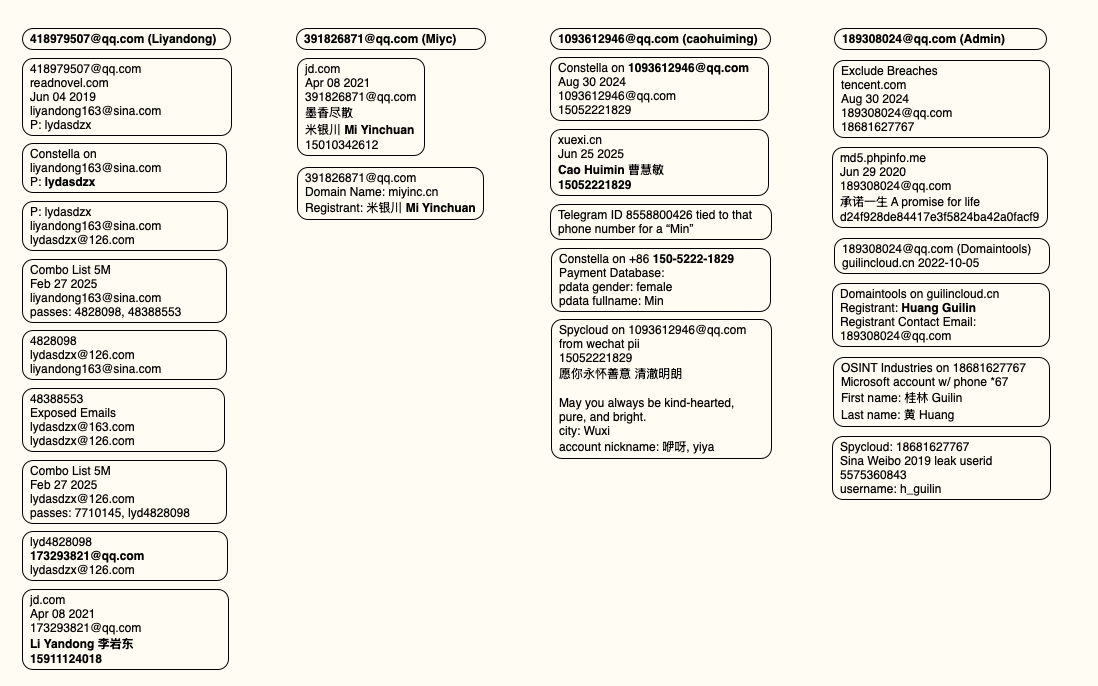
The very first account listed in the Badbox 2.0 panel — “admin,” registered in November 2020 — used the email address 189308024@qq.com. DomainTools shows this email is found in the 2022 registration records for the domain guilincloud[.]cn, which includes the registrant name “Huang Guilin.”

Constella finds 189308024@qq.com is associated with the China phone number 18681627767. The open-source intelligence platform osint.industries reveals this phone number is connected to a Microsoft profile created in 2014 under the name Guilin Huang (桂林 黄). The cyber intelligence platform Spycloud says that phone number was used in 2017 to create an account at the Chinese social media platform Weibo under the username “h_guilin.”

The public information attached to Guilin Huang’s Microsoft account, according to the breach tracking service osintindustries.com.

The remaining three users and corresponding qq.com email addresses were all connected to individuals in China. However, none of them (nor Mr. Huang) had any apparent connection to the entities created and operated by Chen Daihai and Zhu Zhiyu — or to any corporate entities for that matter. Also, none of these individuals responded to requests for comment.

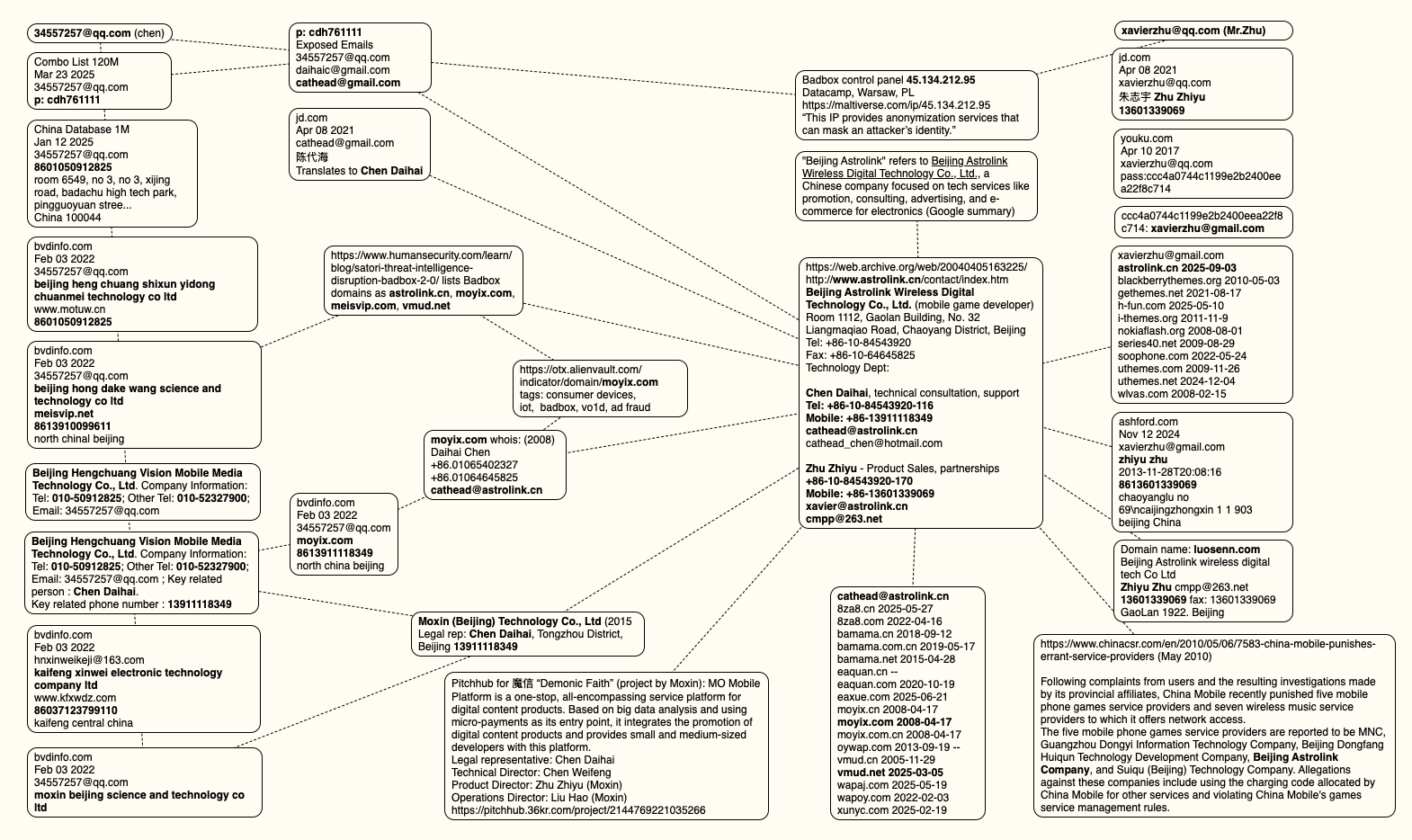
The mind map below includes search pivots on the email addresses, company names and phone numbers that suggest a connection between Chen Daihai, Zhu Zhiyu, and Badbox 2.0.

This mind map includes search pivots on the email addresses, company names and phone numbers that appear to connect Chen Daihai and Zhu Zhiyu to Badbox 2.0. Click to enlarge.

UNAUTHORIZED ACCESS

The idea that the Kimwolf botmasters could have direct access to the Badbox 2.0 botnet is a big deal, but explaining exactly why that is requires some background on how Kimwolf spreads to new devices. The botmasters figured out they could trick residential proxy services into relaying malicious commands to vulnerable devices behind the firewall on the unsuspecting user’s local network.

The vulnerable systems sought out by Kimwolf are primarily Internet of Things (IoT) devices like unsanctioned Android TV boxes and digital photo frames that have no discernible security or authentication built-in. Put simply, if you can communicate with these devices, you can compromise them with a single command.

Our January 2 story featured research from the proxy-tracking firm Synthient, which alerted 11 different residential proxy providers that their proxy endpoints were vulnerable to being abused for this kind of local network probing and exploitation.

Most of those vulnerable proxy providers have since taken steps to prevent customers from going upstream into the local networks of residential proxy endpoints, and it appeared that Kimwolf would no longer be able to quickly spread to millions of devices simply by exploiting some residential proxy provider.

However, the source of that Badbox 2.0 screenshot said the Kimwolf botmasters had an ace up their sleeve the whole time: Secret access to the Badbox 2.0 botnet control panel.

“Dort has gotten unauthorized access,” the source said. “So, what happened is normal proxy providers patched this. But Badbox doesn’t sell proxies by itself, so it’s not patched. And as long as Dort has access to Badbox, they would be able to load” the Kimwolf malware directly onto TV boxes associated with Badbox 2.0.

The source said it isn’t clear how Dort gained access to the Badbox botnet panel. But it’s unlikely that Dort’s existing account will persist for much longer: All of our notifications to the qq.com email addresses listed in the control panel screenshot received a copy of that image, as well as questions about the apparently rogue ABCD account.

Setting the Record Straight – Myths vs. Facts about .com

13 August 2024 at 17:30
Verisign Logo

Over the past several weeks, there has been significant discussion about Verisign and its management of the .com top-level domain (TLD) registry. Much of this discussion has been distorted by factual inaccuracies, a misunderstanding of core technical concepts, and misinterpretations regarding pricing, competition, and market dynamics in the domain name industry.

Billions of internet users and trillions of dollars in global commerce rely on the continuing security, stability, and resiliency of the .com TLD and the technical infrastructure that powers it, so it is vital that discussions about this topic be rooted in fact.

To set the record straight, we have collected and addressed the most common myths currently circulating about the .com TLD.

Myths vs. Facts about .com

Myth: The technology that powers the .com TLD is not sophisticated.

Fact: Verisign has invested continuously for decades to build and evolve the infrastructure that powers the .com TLD, which is the most technically sophisticated of its kind. This infrastructure includes an advanced registration system, which reliably updates and maintains an accurate record of all registered .com domain names on a continuous basis, ensuring that millions of registry transactions are processed correctly, and millions of daily changes – including cryptographic updates to support Domain Name System Security Extensions (DNSSEC) – are distributed to a highly resilient global resolution constellation within seconds. This system ensures that users around the world maintain continuous, round-the-clock access to .com domain names and all the resources and services they support. Verisign has also played a vital role in the development and deployment of DNSSEC technology which uses cryptographic protections to ensure those connections are delivered with reliability and trust.

Verisign’s infrastructure processes an average of 329 billion Domain Name System (DNS) transactions each day, operating at a peak of more than six million transactions per second so far this year. Verisign’s resolution infrastructure is engineered to handle peak query loads significantly greater than the highest ever observed, to ensure continuous operation regardless of demand. This infrastructure has delivered 100 percent DNS availability for .com for more than 27 years without interruption. Verisign accomplishes this by operating a large, globally distributed registry operation, made up of hundreds of technical sites spread across 60+ nations on six continents. These sites run purpose-built technology invented by Verisign technologists for the unique demands of the .com TLD. Verisign engineers have developed specialized technologies and protocols that are designed to achieve higher availability and resiliency to prevent disruption. Examples of this design include employing network, system, and application-level diversification approaches such as using hardware from multiple vendors for network and data center operations and using multiple operating system providers to better withstand localized failures or single-threaded supplier issues. Using in-house purpose-built systems, as opposed to leveraging public cloud operations, lowers the risks of circular dependencies as most public cloud providers also rely on .com and the root infrastructure operated by Verisign. These approaches ensure diversity and redundancy for every component of .com operations.

Verisign is also tasked with defending against highly sophisticated and massive volumetric cyberattacks while managing ever-increasing global demand. Trillions of dollars in global commerce and billions of internet users depend on the availability of Verisign infrastructure 24/7. To defend .com against cyberattacks, including by highly sophisticated nation-state actors, Verisign employs a comprehensive enterprise risk management program and threat-driven defensive practices that drive continuous improvements to Verisign’s systems and programs. Verisign has operationalized the National Institute of Standards and Technology’s (NIST) Cybersecurity Framework and the Center for Internet Security’s (CIS) Critical Security Controls in the ongoing design and evolution of its infrastructure, with a security-first mindset. In addition, Verisign employs advanced information security measures such as continuous monitoring, real-time threat detection, ongoing vulnerability assessments, bug bounty programs, and rigorous security audits to safeguard its infrastructure.

Verisign’s infrastructure powers more than just .com. In addition to operating other TLDs, Verisign plays a unique role as Root Zone Maintainer and operator of two of the world’s 13 root servers, a critical function necessary for internet navigation. Hundreds of Verisign employees have developed highly specialized skills, honed over decades, to develop, maintain, and operate this unique global infrastructure. Verisign holds more than 500 patents for DNS and related technologies, and its innovations are deployed globally by other critical internet infrastructure operators. Verisign has made many of its critical DNS patents available on a royalty-free basis to the global DNS community and those technologies have been deployed around the world.

Myth: The annual wholesale price for .com domain names – $10.26 as of Sept. 1 – is much higher than market value and is harming consumers.

Fact: While other generic TLDs (gTLDs) do not share .com’s pricing transparency, the annual wholesale renewal price of a .com domain name is lower than 87 percent of the 448 gTLDs for which such data is available from registrars. Based on that data, some of the largest original gTLDs, which have been in the market for over 20 years, have renewal pricing of $9.93 (.org), $15.00 (.biz), and $17.50 (.info). Some of the largest new gTLDs, which have been in the market for over 10 years, have renewal pricing of $10 (.xyz – increasing to $11 by the end of September), $25.00 (.online), and $40.00 (.store). The available market data makes it clear that .com domain names are priced at or below market value. It is notable that competing TLDs have continued to grow market share while pricing their domain names over twice as high as .com domain names.

Customers of .com domain names are more likely to be affected by two factors outside of Verisign’s control: 1) the rising cost of retail registrations that are outpacing wholesale prices, with some registrars now charging more than double the wholesale price to renew a .com domain name; and 2) the unregulated secondary market, which accumulates large inventories of domain names and charges markups that are – in some cases – thousands of times higher than the regulated wholesale price.

Myth: Verisign spends an unusual amount on share repurchases and dividends at the expense of infrastructure investment.

Fact: Verisign’s technological infrastructure is unmatched in the DNS industry for its scale, technical diversity, security, and resiliency. Verisign has invested for years to evolve and harden that technology, a fact illustrated by the company’s 27-year DNS uptime record. During the 2000s, Verisign offered a number of DNS-related services, including distributed denial-of-service (DDoS) attack mitigation and managed DNS. Significant capacity was added during that period. In 2018, when Verisign divested the last of its non-core businesses to focus on .com and other DNS operations, the company not only maintained, but increased capacity in order to meet growing DNS demand as well as to address growing DDoS volumetric attacks.

Verisign is certainly a profitable company and is proud of its operational success and history of sound financial management, which are important factors in maintaining the security, stability, and resiliency of the DNS. Some critics have singled out Verisign’s methods of increasing shareholder value, a duty of all public companies. Verisign has fulfilled this duty in part through share repurchases and dividends, which benefit a large and diverse group of shareholders including individuals, public employee retirement systems, index funds, and mutual funds (benefiting their millions of investors). Less than one percent of Verisign’s shares are held by company officers and directors.

Verisign’s return of capital practices are well in line with those of other successful public companies. In 2023, more than 90 percent of S&P 500 companies returned capital to shareholders and Verisign ranked 216th out of the S&P 500 in terms of cash returned to shareholders as a percentage of market capitalization. In terms of profitability, market expectation of Verisign’s earnings per share (a reliable measure of profitability) is $8.36 for the next 12 months, which places it 198th in the S&P 500.

Verisign’s sound and transparent financial management underpins its successful management of the .com TLD and other key internet infrastructure. Verisign has been a public company for 26 years and an S&P 500 company for 18 years. As a publicly listed company operating critical internet infrastructure, the public and the DNS ecosystem benefit from Verisign’s transparency in its operating and financial results, which must comply with the SEC’s disclosure rules and regulations for public companies. Verisign’s financial statements must also undergo an independent audit each year. By contrast, many other registries, registrars, and resellers, including some who focus on the secondary market, serve only the narrow interests of their private owners and do so with no obligations surrounding public disclosure or transparency of their ownership, profitability, operations, or otherwise. Adding obligations for these entities to report ownership, profitability, and other metrics to The Internet Corporation for Assigned Names and Numbers (ICANN) and the public would benefit the entire DNS ecosystem.

Myth: Contracts to operate gTLD registries should be routinely rebid, and a presumptive right of renewal for such contracts is bad for consumers and the internet.

Fact: The National Telecommunications and Information Administration (NTIA) recently opined that “The security, stability, and resilience of the Internet’s unique identifier systems is of paramount importance…” This position is shared by Verisign and the majority of participants in the global multistakeholder system of internet governance. ICANN has supported and clarified this priority and the role it plays in registry contracts. The contracts for .com and all other gTLDs reflect this priority (i.e., that stability and predictability in registry operations leads to long-term investments by operators). Verisign’s right to renew its .com Registry Agreement is conditioned on meeting rigorous technical and operational requirements to ensure .com’s continued security, stability, and continuous availability to billions of internet users. This contractual approach encourages gTLD operators to invest in infrastructure to support rising demand and defend against cyberattacks. Due to its investments, Verisign has operated .com with 100 percent DNS uptime for over 27 years.

Myth: Verisign’s operation of .com constitutes a “monopoly.”

Fact: There are nearly 1,200 gTLDs, and more than 250 country-code TLDs (ccTLDs), operating today. Each of these TLDs offer the same core functionality, allowing users to establish and maintain an online presence, establish websites, and create email addresses. Globally, there are over 362 million registered domain names – the majority of which are registered in TLDs not operated by Verisign. The number of domain names registered in non-Verisign operated gTLDs and ccTLDs has grown consistently as those TLDs have grown their share of the marketplace. In addition to this competition at the wholesale level, there are more than 2,800 ICANN-accredited registrars, and thousands more resellers, offering domain names at a range of prices and in a range of packages to consumers.

Further, from a practical perspective, the technical nature of TLD registries requires that they each be run by a single operator, but with so many operators in the marketplace, consumers have a broad and diverse array of choices at a range of prices. Other TLDs like .org, .shop, .ai, and .uk are not “monopolies” and neither is .com.

Myth: Verisign sets .com domain name prices for consumers.

Fact: Domain name registrars set unregulated retail prices for .com domain names, and those prices vary widely among the 2,800 ICANN-accredited registrars and associated resellers. Some registrars charge more than double the annual wholesale price for .com domain name renewals, and, in many cases, those price increases have outpaced Verisign’s tightly regulated .com wholesale price increases. In analyzing registrar pricing, it is important to distinguish introductory offers – which are often set lower to attract new customers – from renewal prices, which is what registrars charge existing customers to maintain their domain name registrations.

In addition to the retail registrar market, there is also a multibillion-dollar secondary market for domain names, in which domain investors, or “domainers,” accumulate millions of desirable domain names in order to resell them at markups that can be thousands of times higher than Verisign’s regulated wholesale prices. The gap between wholesale prices and secondary market prices makes it possible for domainers to hold names for years – making them prohibitively expensive to the general public. The profitability of the secondary market has also attracted successful retail registrars to expand into it, acquiring large portfolios of .com domain names and creating auction sites where they are sold well above retail prices. A blog that reports on high-profile domain name sales reported that just one reselling site handled $90 million in secondary sales in the second quarter of 2024 alone. Although the secondary marketplace may serve a function within the DNS ecosystem, it is completely unregulated.

Myth: The U.S. Government lifted price caps on .com domain names in 2018.

Fact: Amendment 35 to the Cooperative Agreement retained wholesale price restrictions in the .com TLD, while also retaining legacy regulations prohibiting Verisign from operating as a registrar in the .com TLD. Of the nearly 1,200 gTLDs overseen by ICANN and the global multistakeholder community, .com, .net, and .name (also operated by Verisign) remain the only three that are governed by maximum price restrictions. Those restrictions remain in place today and will remain in place after the .com Registry Agreement is renewed later this year.

The post Setting the Record Straight – Myths vs. Facts about .com appeared first on Verisign Blog.

Domain Name Industry Brief Quarterly Report: DNIB.com Announces 362.4 Million Domain Name Registrations in the Second Quarter of 2024

25 July 2024 at 21:09

Today, the latest issue of The Domain Name Industry Brief Quarterly Report was released by DNIB.com, showing the second quarter of 2024 closed with 362.4 million domain name registrations across all top-level domains (TLDs), unchanged compared to the first quarter of 2024. Domain name registrations increased by 5.8 million, or 1.6%, year over year.

Check out the latest issue of The Domain Name Industry Brief Quarterly Report to see domain name stats from the second quarter of 2024, including:

  • Top 10 largest TLDs by number of reported domain names, with quarterly renewal percentages when available
  • Top 10 largest ccTLDs by number of reported domain names, with quarterly renewal percentages when available
  • Top 10 largest gTLDs by number of reported domain names, with quarterly renewal percentages and other key statistics

DNIB.com and The Domain Name Industry Brief Quarterly Report are sponsored by Verisign. To see past issues of the quarterly report, interactive dashboards and learn about DNIB.com’s statistical methodology, please visit DNIB.com.

The post Domain Name Industry Brief Quarterly Report: DNIB.com Announces 362.4 Million Domain Name Registrations in the Second Quarter of 2024 appeared first on Verisign Blog.

Domain Name Industry Brief Quarterly Report: DNIB.com Announces 362.4 Million Domain Name Registrations in the First Quarter of 2024

11 July 2024 at 13:07

Today, the latest issue of The Domain Name Industry Brief Quarterly Report was released by DNIB.com, showing the first quarter of 2024 closed with 362.4 million domain name registrations across all top-level domains (TLDs), an increase of 2.5 million domain name registrations, or 0.7%, compared to the fourth quarter of 2023. Domain name registrations also increased by 7.5 million, or 2.1%, year over year.

Starting with the Q1 2024 report, the DNIB Quarterly Report now includes new information on quarterly renewal percentages for all TLDs, as available, summary information on other legacy gTLDs as a group and an expanded overall analysis of gTLDs.

Check out the latest issue of The Domain Name Industry Brief Quarterly Report to see domain name stats from the first quarter of 2024, including:

  • Top 10 largest TLDs by number of reported domain names, with quarterly renewal percentages when available
  • Top 10 largest ccTLDs by number of reported domain names, with quarterly renewal percentages when available
  • Top 10 largest gTLDs by number of reported domain names, with quarterly renewal percentages and other key statistics

DNIB.com and The Domain Name Industry Brief Quarterly Report are sponsored by Verisign. To see past issues of the quarterly report, interactive dashboards and learn about DNIB.com’s statistical methodology, please visit DNIB.com.

The post Domain Name Industry Brief Quarterly Report: DNIB.com Announces 362.4 Million Domain Name Registrations in the First Quarter of 2024 appeared first on Verisign Blog.

Domain Name Industry Brief Quarterly Report: DNIB.com Announces 359.8 Million Domain Name Registrations in the Fourth Quarter of 2023

15 February 2024 at 13:28

Today, the latest issue of The Domain Name Industry Brief Quarterly Report was released by DNIB.com, showing the fourth quarter of 2023 closed with 359.8 million domain name registrations across all top-level domains (TLDs), an increase of 0.6 million domain name registrations, or 0.2%, compared to the third quarter of 2023. Domain name registrations also increased by 8.9 million, or 2.5%, year over year.

Check out the latest issue of The Domain Name Industry Brief Quarterly Report to see domain name stats from the fourth quarter of 2023, including:

  • Top 10 largest TLDs by number of reported domain names
  • Top 10 largest ccTLDs by number of reported domain names
  • ngTLDs as percentage of total TLDs
  • Geographical ngTLDs as percentage of total corresponding geographical TLDs

DNIB.com and The Domain Name Industry Brief Quarterly Report are sponsored by Verisign. To see past issues of the quarterly report, interactive dashboards and learn about DNIB.com’s statistical methodology, please visit DNIB.com.

The post Domain Name Industry Brief Quarterly Report: DNIB.com Announces 359.8 Million Domain Name Registrations in the Fourth Quarter of 2023 appeared first on Verisign Blog.

Domain Name Industry Brief Quarterly Report: DNIB.com Announces 359.3 Million Domain Name Registrations in the Third Quarter of 2023

15 November 2023 at 21:30

Today, the latest issue of The Domain Name Industry Brief Quarterly Report was released by DNIB.com, showing the third quarter of 2023 closed with 359.3 million domain name registrations across all top-level domains (TLDs), an increase of 2.7 million domain name registrations, or 0.8%, compared to the second quarter of 2023. Domain name registrations also increased by 8.5 million, or 2.4%, year over year.

Check out the latest issue of The Domain Name Industry Brief Quarterly Report to see domain name stats from the third quarter of 2023, including:

  • Top 10 largest TLDs by number of reported domain names
  • Top 10 largest ccTLDs by number of reported domain names
  • ngTLDs as percentage of total TLDs
  • Geographical ngTLDs as percentage of total corresponding geographical TLDs

DNIB.com and The Domain Name Industry Brief Quarterly Report are sponsored by Verisign. To see past issues of the quarterly report, interactive dashboards, and learn about DNIB.com’s statistical methodology, please visit DNIB.com.

The post Domain Name Industry Brief Quarterly Report: DNIB.com Announces 359.3 Million Domain Name Registrations in the Third Quarter of 2023 appeared first on Verisign Blog.

Domain Name Industry Brief Quarterly Report: DNIB.com announces 356.6 Million Domain Name Registrations in the Second Quarter of 2023

7 September 2023 at 20:36

Today, the latest issue of The Domain Name Industry Brief Quarterly Report was released by DNIB.com, showing the second quarter of 2023 closed with 356.6 million domain name registrations across all top-level domains (TLDs), an increase of 1.7 million domain name registrations, or 0.5%, compared to the first quarter of 2023. Domain name registrations also increased by 4.3 million, or 1.2%, year over year.


Check out the latest issue of The Domain Name Industry Brief Quarterly Report to see domain name stats from the second quarter of 2023, including:

  • Top 10 largest TLDs by number of reported domain names
  • Top 10 largest ccTLDs by number of reported domain names
  • ngTLDs as percentage of total TLDs
  • Geographical ngTLDs as percentage of total corresponding geographical TLDs

With the launch of the DNIB.com dashboards, 16 additional TLDs have been included in applicable calculations. The applicable current and historical data presented in this edition of the quarterly report have been adjusted accordingly, and applicable quarterly and year-over-year trends have been calculated using those adjusted figures. More information is available at DNIB.com.

DNIB.com and the Domain Name Industry Brief Quarterly Report are sponsored by Verisign. To see past issues of the quarterly report, interactive dashboards, and learn about DNIB.com’s statistical methodology, please visit DNIB.com.

The post Domain Name Industry Brief Quarterly Report: DNIB.com announces 356.6 Million Domain Name Registrations in the Second Quarter of 2023 appeared first on Verisign Blog.

Announcing the Launch of DNIB.com, a New Source for DNS News, Information, Research, and Analysis

22 June 2023 at 20:30

Verisign today announced the launch of DNIB.com, the new Domain Name Industry Brief (DNIB) website.

Sponsored by Verisign, DNIB.com is a source for insights and analysis from subject-matter experts on key topics relevant to the global Domain Name System (DNS). DNIB.com will offer insight on policy, governance, technology, security, and business trends relevant to analysts, entrepreneurs, policymakers, and anyone with an interest in the DNS. The website features a collection of new, searchable, and interactive dashboards tracking relevant DNS data and trends, that is designed to be a valuable day-to-day resource for industry stakeholders, and anyone interested in learning more about global domain name operations.

DNIB.com is also the new home of the DNIB quarterly report, which Verisign has published for more than a decade, providing a trusted and valued resource for stakeholders across the globe seeking to understand the dynamism and trends of the domain name industry.

The report will be published each quarter at DNIB.com, summarizing the state of the domain name industry through a variety of statistical and analytical research. The new and expanded DNIB.com dashboards take that statistical data to the next level, enabling exploration of trend data across the industry, providing additional history and depth, and offering expert insights and commentary.

The post Announcing the Launch of DNIB.com, a New Source for DNS News, Information, Research, and Analysis appeared first on Verisign Blog.

Verisign Domain Name Industry Brief: 354.0 Million Domain Name Registrations in the First Quarter of 2023

8 June 2023 at 21:04
DNIB-Q1-23

Today, we released the latest issue of The Domain Name Industry Brief, which shows that the first quarter of 2023 closed with 354.0 million domain name registrations across all top-level domains (TLDs), an increase of 3.5 million domain name registrations, or 1.0%, compared to the fourth quarter of 2022.1,2 Domain name registrations also increased by 3.5 million, or 1.0%, year over year.1,2

Check out the latest issue of The Domain Name Industry Brief to see domain name stats from the first quarter of 2023, including:

This issue of the Domain Name Industry Brief includes a correction to the March 2023 issue, which incorrectly reported the number of domain name registrations in the .eu ccTLD.2 This was the result of a one-time error in the .eu domain name registration data, provided by ZookNIC, which has since been resolved.

To see past issues of The Domain Name Industry Brief, please visit https://verisign.com/dnibarchives.

  1. All figure(s) exclude domain names in the .tk, .cf, .ga, .gq, and .ml ccTLDs. Quarterly and year-over-year trends have been calculated relative to historical figures that have also been adjusted to exclude these five ccTLDs. For further information, please see the Editor’s Note contained in Vol. 19, Issue 1 of The Domain Name Industry Brief.
  2. The generic TLD, ngTLD and ccTLD data cited in the brief: (i) includes ccTLD internationalized domain names, (ii) is an estimate as of the time this brief was developed and (iii) is subject to change as more complete data is received. Some numbers in the brief may reflect standard rounding.

The post Verisign Domain Name Industry Brief: 354.0 Million Domain Name Registrations in the First Quarter of 2023 appeared first on Verisign Blog.

Verisign Domain Name Industry Brief: 350.4 Million Domain Name Registrations in the Fourth Quarter of 2022

9 March 2023 at 20:57

Today, we released the latest issue of The Domain Name Industry Brief, which shows that the fourth quarter of 2022 closed with 350.4 million domain name registrations across all top-level domains (TLDs), an increase of 0.5 million domain name registrations, or 0.1%, compared to the third quarter of 2022.1,2 Domain name registrations have increased by 8.7 million, or 2.6%, year over year.1,2

Check out the latest issue of The Domain Name Industry Brief to see domain name stats from the fourth quarter of 2022, including:
Top 10 Largest TLDs by Number of Reported Domain Names
Top 10 Largest ccTLDs by Number of Reported Domain Names
ngTLDs as Percentage of Total TLDs
Geographical ngTLDs as Percentage of Total Corresponding Geographical TLDs

To see past issues of The Domain Name Industry Brief, please visit https://verisign.com/dnibarchives.

  1. All figure(s) exclude domain names in the .tk, .cf, .ga, .gq, and .ml ccTLDs. Quarterly and year-over-year trends have been calculated relative to historical figures that have also been adjusted to exclude these five ccTLDs. For further information, please see the Editor’s Note contained in Vol. 19, Issue 1 of The Domain Name Industry Brief.
  2. The generic TLD, ngTLD and ccTLD data cited in the brief: (i) includes ccTLD internationalized domain names, (ii) is an estimate as of the time this brief was developed, and (iii) is subject to change as more complete data is received. Some numbers in the brief may reflect standard rounding.

The post Verisign Domain Name Industry Brief: 350.4 Million Domain Name Registrations in the Fourth Quarter of 2022 appeared first on Verisign Blog.

Verisign Domain Name Industry Brief: 349.9 Million Domain Name Registrations in the Third Quarter of 2022

8 December 2022 at 20:42
Verisign Q3 2022 Domain Name Industry Brief Volume 19 Issue 4 Cover

Today, we released the latest issue of The Domain Name Industry Brief, which shows that the third quarter of 2022 closed with 349.9 million domain name registrations across all top-level domains, a decrease of 1.6 million domain name registrations, or 0.4%, compared to the second quarter of 2022.1,2 Domain name registrations have increased by 11.5 million, or 3.4%, year over year.1,2

Check out the latest issue of The Domain Name Industry Brief to see domain name stats from the third quarter of 2022, including:
Top 10 Largest TLDs by Number of Reported Domain Names
Top 10 Largest ccTLDs by Number of Reported Domain Names
ngTLDs as Percentage of Total TLDs
Geographical ngTLDs as Percentage of Total Corresponding Geographical TLDs

To see past issues of The Domain Name Industry Brief, please visit verisign.com/dnibarchives.

  1. All figure(s) exclude domain names in the .tk, .cf, .ga, .gq and .ml ccTLDs. Quarterly and year-over-year trends have been calculated relative to historical figures that have also been adjusted to exclude these five ccTLDs. For further information, please see the Editor’s Note contained in Vol. 19, Issue 1 of The Domain Name Industry Brief.
  2. The generic TLD, ngTLD and ccTLD data cited in the brief: (i) includes ccTLD internationalized domain names, (ii) is an estimate as of the time this brief was developed and (iii) is subject to change as more complete data is received. Some numbers in the brief may reflect standard rounding.

The post Verisign Domain Name Industry Brief: 349.9 Million Domain Name Registrations in the Third Quarter of 2022 appeared first on Verisign Blog.

Verisign Q2 2022 Domain Name Industry Brief: 351.5 Million Domain Name Registrations in the Second Quarter of 2022

20 September 2022 at 20:17

Today, we released the latest issue of The Domain Name Industry Brief, which shows that the second quarter of 2022 closed with 351.5 million domain name registrations across all top-level domains, an increase of 1.0 million domain name registrations, or 0.3%, compared to the first quarter of 2022.1,2 Domain name registrations have increased by 10.4 million, or 3.0%, year over year.1,2

the second quarter of 2022 closed with 351.5 million domain name registrations across all top-level domains, an increase of 1.0 million domain name registrations, or 0.3%, compared to the first quarter of 2022.

Check out the latest issue of The Domain Name Industry Brief to see domain name stats from the second quarter of 2022, including:
Top 10 Largest TLDs by Number of Reported Domain Names
Top 10 Largest ccTLDs by Number of Reported Domain Names
ngTLDs as Percentage of Total TLDs
Geographical ngTLDs as Percentage of Total Corresponding Geographical TLDs

To see past issues of The Domain Name Industry Brief, please visit verisign.com/dnibarchives.

  1. All figure(s) exclude domain names in the .tk, .cf, .ga, .gq and .ml ccTLDs. Quarterly and year-over-year trends have been calculated relative to historical figures that have also been adjusted to exclude these five ccTLDs. For further information, please see the Editor’s Note contained in Vol. 19, Issue 1 of The Domain Name Industry Brief.
  2. The generic TLD, ngTLD and ccTLD data cited in the brief: (i) includes ccTLD internationalized domain names, (ii) is an estimate as of the time this brief was developed and (iii) is subject to change as more complete data is received. Some numbers in the brief may reflect standard rounding.

The post Verisign Q2 2022 Domain Name Industry Brief: 351.5 Million Domain Name Registrations in the Second Quarter of 2022 appeared first on Verisign Blog.

Verisign Q1 2022 Domain Name Industry Brief: 350.5 Million Domain Name Registrations in the First Quarter of 2022

30 June 2022 at 20:13
Verisign Q1 2022 Domain Name Industry Brief Volume 19 Issue 2 Cover

Today, we released the latest issue of The Domain Name Industry Brief, which shows that the first quarter of 2022 closed with 350.5 million domain name registrations across all top-level domains, an increase of 8.8 million domain name registrations, or 2.6%, compared to the fourth quarter of 2021.1,2 Domain name registrations have increased by 13.2 million, or 3.9%, year over year.1,2

Check out the latest issue of The Domain Name Industry Brief to see domain name stats from the first quarter of 2022, including:
Top 10 Largest TLDs by Number of Reported Domain Names
Top 10 Largest ccTLDs by Number of Reported Domain Names
ngTLDs as Percentage of Total TLDs
Geographical ngTLDs as Percentage of Total Corresponding Geographical TLDs

To see past issues of The Domain Name Industry Brief, please visit verisign.com/dnibarchives.

  1. All figure(s) exclude domain names in the .tk, .cf, .ga, .gq and .ml ccTLDs. Quarterly and year-over-year trends have been calculated relative to historical figures that have also been adjusted to exclude these five ccTLDs. For further information, please see the Editor’s Note contained in Vol 19, Issue 1 of The Domain Name Industry Brief.
  2. The generic TLD, ngTLD and ccTLD data cited in the brief: (i) includes ccTLD internationalized domain names, (ii) is an estimate as of the time this brief was developed and (iii) is subject to change as more complete data is received. Some numbers in the brief may reflect standard rounding.

The post Verisign Q1 2022 Domain Name Industry Brief: 350.5 Million Domain Name Registrations in the First Quarter of 2022 appeared first on Verisign Blog.

Verisign Q4 2021 The Domain Name Industry Brief: 341.7 Million Domain Name Registrations in the Fourth Quarter of 2021

15 April 2022 at 16:07

Today, we released the latest issue of The Domain Name Industry Brief, which shows that the fourth quarter of 2021 closed with 341.7 million domain name registrations across all top-level domains, an increase of 3.3 million domain name registrations, or 1.0%, compared to the third quarter of 2021.1,2 Domain name registrations have increased by 1.6 million, or 0.5%, year over year.1,2

Q4 2021 Domain Name Industry Brief. Graph of domain name registrations across all tlds

Check out the latest issue of The Domain Name Industry Brief to see domain name stats from the fourth quarter of 2021, including:
Top 10 Largest TLDs by Number of Reported Domain Names
Top 10 Largest ccTLDs by Number of Reported Domain Names
ngTLDs as Percentage of Total TLDs
Geographical ngTLDs as Percentage of Total Corresponding Geographical TLDs

To see past issues of The Domain Name Industry Brief, please visit verisign.com/dnibarchives.


  1. All figure(s) exclude domain names in the .tk, .cf, .ga, .gq and .ml ccTLDs. Quarterly and year-over-year trends have been calculated relative to historical figures that have also been adjusted to exclude these five ccTLDs. For further information, please see the Editor’s Note contained in the full Domain Name Industry Brief.
  2. The generic TLD, ngTLD and ccTLD data cited in the brief: (i) includes ccTLD internationalized domain names, (ii) is an estimate as of the time this brief was developed and (iii) is subject to change as more complete data is received. Some numbers in the brief may reflect standard rounding.

The post Verisign Q4 2021 The Domain Name Industry Brief: 341.7 Million Domain Name Registrations in the Fourth Quarter of 2021 appeared first on Verisign Blog.

Verisign Q2 2021 The Domain Name Industry Brief: 367.3 Million Domain Name Registrations in the Second Quarter of 2021

2 September 2021 at 19:29
Q2 2021 Domain Name Industry Brief Report Cover

Today, we released the latest issue of The Domain Name Industry Brief, which shows that the second quarter of 2021 closed with 367.3 million domain name registrations across all top-level domains (TLDs), an increase of 3.8 million domain name registrations, or 1.0%, compared to the first quarter of 2021.1,2 Domain name registrations have decreased by 2.8 million, or 0.7%, year over year.1,2

Q2 2021 closed with 367.3 million domain name registrations across all TLDs.

Check out the latest issue of The Domain Name Industry Brief to see domain name stats from the second quarter of 2021, including:

This quarter’s The Domain Name Industry Brief also includes an overview of how Registration Data Access Protocol (RDAP) improves upon the legacy WHOIS protocol.

To see past issues of The Domain Name Industry Brief, please visit verisign.com/dnibarchives.


1. The figure(s) includes domain names in the .tk ccTLD. .tk is a ccTLD that provides free domain names to individuals and businesses. Revenue is generated by monetizing expired domain names. Domain names no longer in use by the registrant or expired are taken back by the registry and the residual traffic is sold to advertising networks. As such, there are no deleted .tk domain names. https://www.businesswire.com/news/home/20131216006048/en/Freenom-Closes-3M-Series-Funding#.UxeUGNJDv9s.

2. The generic top-level domain (gTLD), new gTLD (ngTLD) and ccTLD data cited in the brief: (i) includes ccTLD Internationalized Domain Names (IDNs), (ii) is an estimate as of the time this brief was developed and (iii) is subject to change as more complete data is received. Some numbers in the brief may reflect standard rounding.

The post Verisign Q2 2021 The Domain Name Industry Brief: 367.3 Million Domain Name Registrations in the Second Quarter of 2021 appeared first on Verisign Blog.

Verisign Q1 2021 Domain Name Industry Brief: 363.5 Million Domain Name Registrations in the First Quarter of 2021

3 June 2021 at 19:22
Q1 2021 Domain Name Industry Brief Report Cover

Today, we released the latest issue of the Domain Name Industry Brief, which shows that the first quarter of 2021 closed with 363.5 million domain name registrations across all top-level domains (TLDs), a decrease of 2.8 million domain name registrations, or 0.8%, compared to the fourth quarter of 2020.1,2 Domain name registrations have decreased by 3.3 million, or 0.9%, year over year.1,2

Q1 2021 domain name registrations across all top-level domains

Check out the latest issue of the Domain Name Industry Brief to see domain name stats from the first quarter of 2021, including:

This quarter’s Domain Name Industry Brief also includes a look at a recent collaboration between Verisign, ICANN and industry partners to combat botnets.

To see past issues of the Domain Name Industry Brief, please visit verisign.com/dnibarchives.


1. The figure(s) includes domain names in the .tk ccTLD. .tk is a ccTLD that provides free domain names to individuals and businesses. Revenue is generated by monetizing expired domain names. Domain names no longer in use by the registrant or expired are taken back by the registry and the residual traffic is sold to advertising networks. As such, there are no deleted .tk domain names. https://www.businesswire.com/news/home/20131216006048/en/Freenom-Closes-3M-Series-Funding#.UxeUGNJDv9s.

2. The generic top-level domain (gTLD), new gTLD (ngTLD) and ccTLD data cited in the brief: (i) includes ccTLD Internationalized Domain Names (IDNs), (ii) is an estimate as of the time this brief was developed and (iii) is subject to change as more complete data is received. Some numbers in the brief may reflect standard rounding.

The internet had 363.5 million domain name registrations at the end of Q1 2021.

The post Verisign Q1 2021 Domain Name Industry Brief: 363.5 Million Domain Name Registrations in the First Quarter of 2021 appeared first on Verisign Blog.

Verisign Q4 2020 Domain Name Industry Brief: 366.3 Million Domain Name Registrations in the Fourth Quarter of 2020

4 March 2021 at 21:21

Today, we released the latest issue of the Domain Name Industry Brief, which shows that the fourth quarter of 2020 closed with 366.3 million domain name registrations across all top-level domains (TLDs), a decrease of 4.4 million domain name registrations, or 1.2 percent, compared to the third quarter of 2020.1,2 Domain name registrations have grown by 4.0 million, or 1.1 percent, year over year.1,2

366.3 MILLION DOMAIN NAME REGISTRATIONS IN THE FOURTH QUARTER OF 2020

Check out the latest issue of the Domain Name Industry Brief to see domain name stats from the fourth quarter of 2020, including:

This quarter’s Domain Name Industry Brief also includes a closer look at encryption and what new DNS capabilities may be possible with a “minimize at the root and top-level domain, encrypt when needed elsewhere” approach to DNS encryption.

To see past issues of the Domain Name Industry Brief, please visit Verisign.com/DNIBArchives.


1. The figure(s) includes domain names in the .tk ccTLD. .tk is a ccTLD that provides free domain names to individuals and businesses. Revenue is generated by monetizing expired domain names. Domain names no longer in use by the registrant or expired are taken back by the registry and the residual traffic is sold to advertising networks. As such, there are no deleted .tk domain names. https://www.businesswire.com/news/home/20131216006048/en/Freenom-Closes-3M-Series-Funding#.UxeUGNJDv9s.

2. The generic top-level domain (gTLD), new gTLD (ngTLD) and ccTLD data cited in the brief: (i) includes ccTLD Internationalized Domain Names (IDNs), (ii) is an estimate as of the time this brief was developed and (iii) is subject to change as more complete data is received. Some numbers in the brief may reflect standard rounding.

The post Verisign Q4 2020 Domain Name Industry Brief: 366.3 Million Domain Name Registrations in the Fourth Quarter of 2020 appeared first on Verisign Blog.

❌